
Basic organization design Learning objectives 1 Understand six
Basic organization design Learning objectives: 1. Understand six elements of organizational structure 2. Identify different ways of departmentalization, their strengths and weaknesses 3. Understand factors affecting organizational structure
Elements of structure • • • Work specialization Chain of command Span of control Authority and responsibility Centralization versus decentralization Departmentalization
Work specialization • Benefits – Make efficient use of the diversity skills – Increase productivity • Limitations – Can not infinitely increase productivity – High level of specialization may decrease productivity
Chain of command Definition: no person should report to more than one boss • Benefits – – Provide control and communication Clear relationship Clear responsibility Focus senior managers’ attention on major issues • Limitations – Inflexible – Time consuming – Not be able to deal with complains well
Span of control • Definition: the number of subordinates a manager can direct efficiently and effectively • Rule of thumb: The nearer we approach the supreme head of the whole organization, the more we ought work towards groups of three; the closer we get to the foot of the whole organization, the more we work together towards groups of six • Factors affecting the span of control: similarity of tasks, complexity of tasks, physical proximity of employees, interactions among employees, etc.
Authority and responsibility • • Authority: the rights inherent in a managerial position to give orders and expect them to be obeyed Responsibility: an obligation to perform assigned activities
Line authority and staff authority • Line authority: – the authority that entitles a manager to direct the work of an employee – Position that contributes directly to the achievements of organizational objectives • Staff authority: positions that have some authority but that are created to support, assist, and advise the holders of line authority
Centralization and decentralization • Centralization: a function of how much decision making authority is pushed down to lower levels in an organization. • Decentralization: The pushing down of decision-making authority to the lowest levels of an organization
Departmentalization • Definition: group activities and people into departments • Seven types of departmentalization
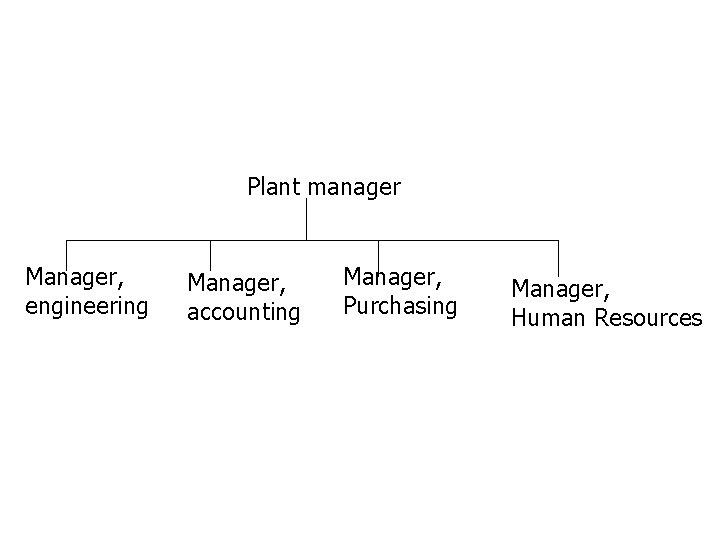
Plant manager Manager, engineering Manager, accounting Manager, Purchasing Manager, Human Resources
Functional departmentalization • Definition: Employees with closely related skills and responsibilities are assigned to the same department • Three basic enterprise functions: – Production (creating utility and adding utility to a good or service) – Selling (finding customers etc who agree to accept the good or services at a price) – Financing (raising and collecting, safeguarding, and expending the funds of the enterprise)
Advantages: – Is logical reflection of functions – Maintains power and prestige of major functions – Follows principle of occupational specializing – Simplifies training – Furnishes means of tight control at top
Disadvantages – Deemphasizes overall company objectives – Overemphasizes narrow perspective – Reduces coordination among functions – Profit responsibility at the top – Slow adaptation to the environment – Limits development of general managers
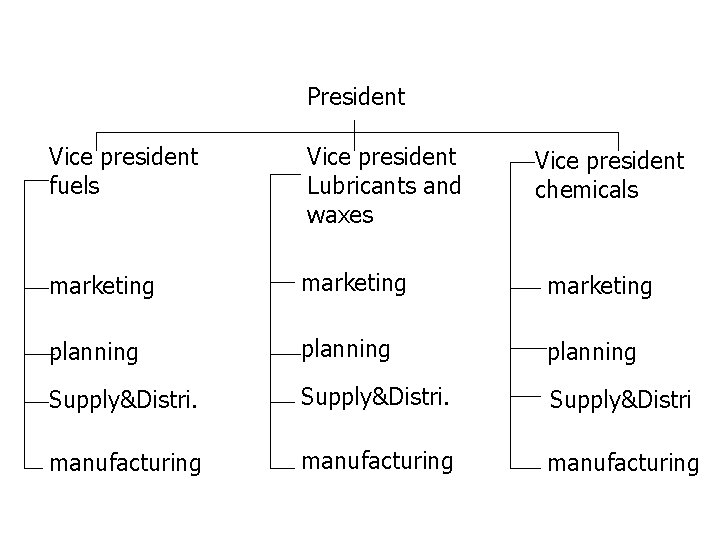
President Vice president fuels Vice president Lubricants and waxes marketing planning Supply&Distri manufacturing Vice president chemicals
Product departmentalization • Definition: group activities and people on the basis of product or product lines
Advantages • Focus on product line • Facilitate use of specialized capital, facilities, skills, and knowledge • Permits growth and diversity of products and services • Improve coordination of functional activities • Places responsibility for profits at the division level • Furnishes measurable training ground for general managers
Disadvantages: • Requires more persons with general manager abilities • Tends to make maintenance of economic central services difficult • Presents increased problem of top management control
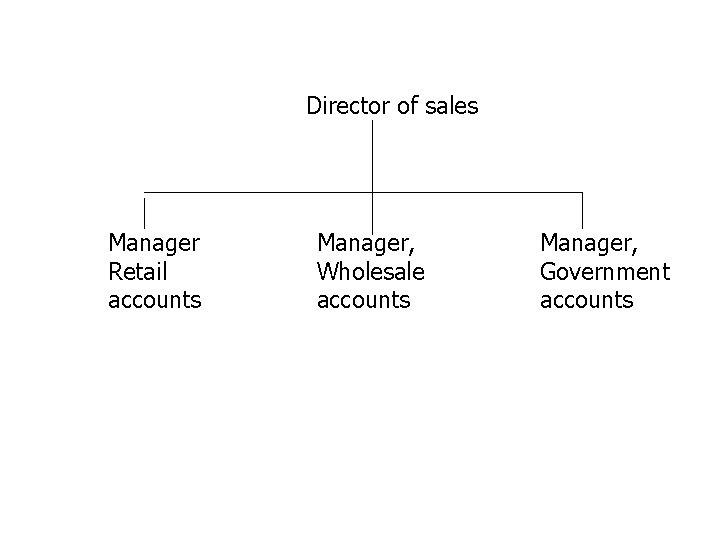
Director of sales Manager Retail accounts Manager, Wholesale accounts Manager, Government accounts
Customer departmentalization • Definition: group activities and people according to types of customers
Advantages: • Encourage concentration on customer needs • Gives customers feeling that they have an understanding supplier • Develops expertness in customer areas
Disadvantages: • May be difficult to coordinate operations between competing customer demands • Requires managers and staff expert in customers’ problems • Customer groups may not always be clearly defined
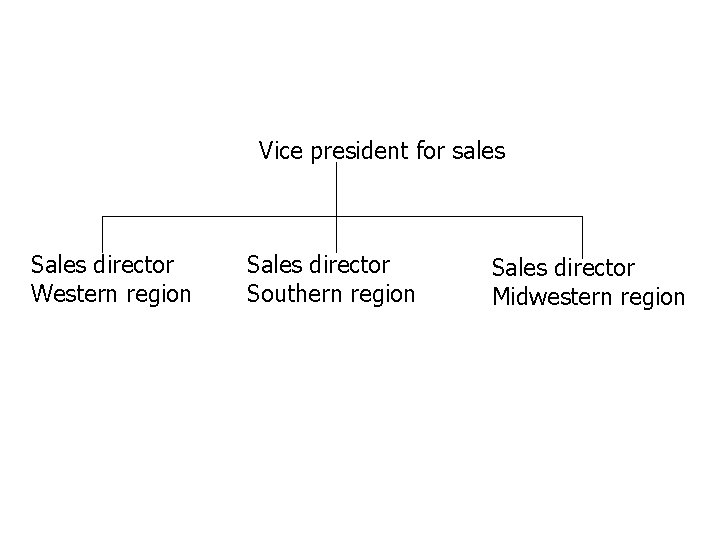
Vice president for sales Sales director Western region Sales director Southern region Sales director Midwestern region
Geographic departmentalization • Definition: activities and people in a given area or territory are grouped together
Advantages: • Places responsibility at a lower level • Places emphasis on local markets and problems • Improves coordination in a region • Takes advantages of economies of local operations • Better face-to-face communication with local interests • Furnishes measurable training ground for general managers
Disadvantages: • Requires more persons with general manager abilities • Tends to make maintenance of economical central services difficult • Increase problem of top management control
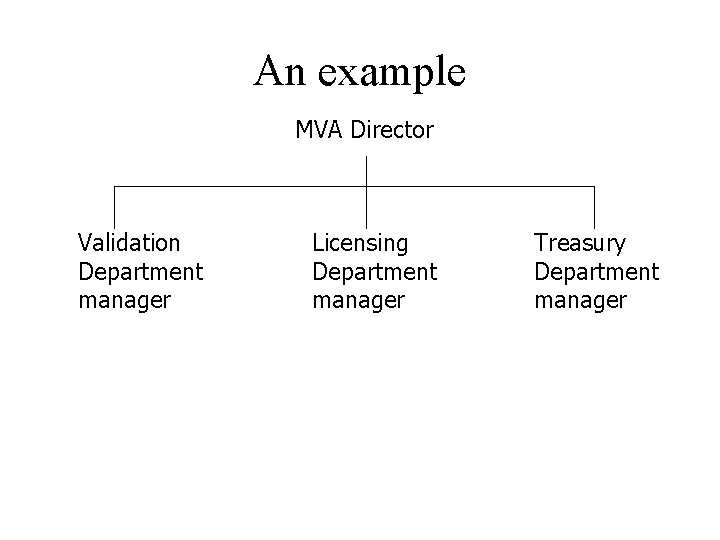
An example MVA Director Validation Department manager Licensing Department manager Treasury Department manager
Process/Equipment departmentalization • Definition: activities and people are grouped around a process or a type of equipment
Advantages: • Achieves economic advantage • Uses specialized technology • Utilizes special skills
Disadvantages: • Coordination of departments is difficult • Responsibility for profit is at the top • Is unsuitable for developing general managers
- Slides: 29