
Basic Orbital Mechanics Classroom Lesson Lab Rat Scientific
Basic Orbital Mechanics Classroom Lesson Lab. Rat Scientific 2018 © 1
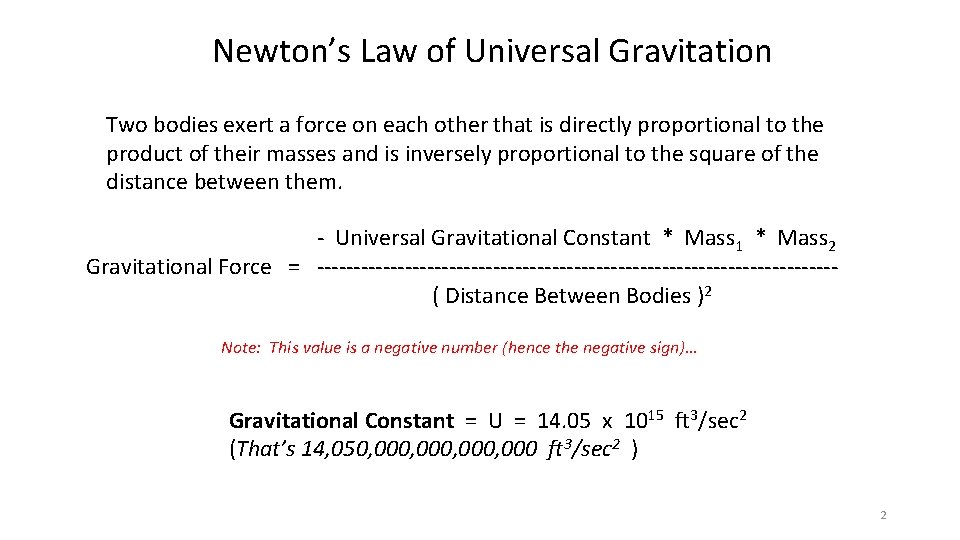
Newton’s Law of Universal Gravitation Two bodies exert a force on each other that is directly proportional to the product of their masses and is inversely proportional to the square of the distance between them. - Universal Gravitational Constant * Mass 1 * Mass 2 Gravitational Force = -----------------------------------( Distance Between Bodies )2 Note: This value is a negative number (hence the negative sign)… Gravitational Constant = U = 14. 05 x 1015 ft 3/sec 2 (That’s 14, 050, 000, 000 ft 3/sec 2 ) 2
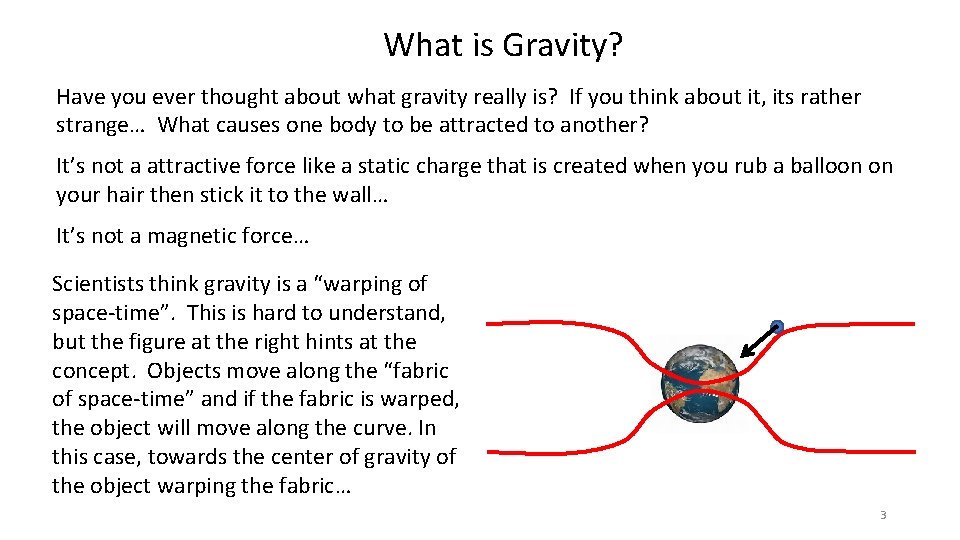
What is Gravity? Have you ever thought about what gravity really is? If you think about it, its rather strange… What causes one body to be attracted to another? It’s not a attractive force like a static charge that is created when you rub a balloon on your hair then stick it to the wall… It’s not a magnetic force… Scientists think gravity is a “warping of space-time”. This is hard to understand, but the figure at the right hints at the concept. Objects move along the “fabric of space-time” and if the fabric is warped, the object will move along the curve. In this case, towards the center of gravity of the object warping the fabric… 3
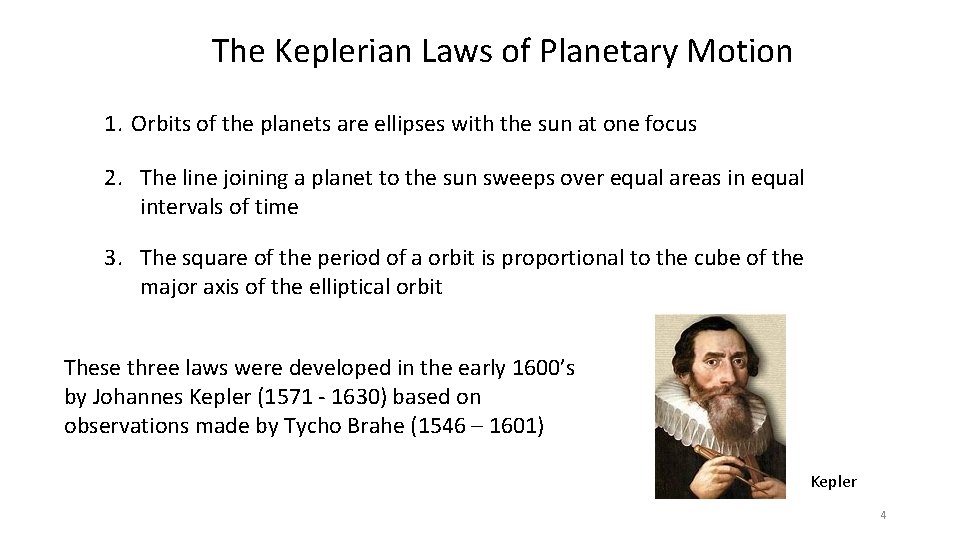
The Keplerian Laws of Planetary Motion 1. Orbits of the planets are ellipses with the sun at one focus 2. The line joining a planet to the sun sweeps over equal areas in equal intervals of time 3. The square of the period of a orbit is proportional to the cube of the major axis of the elliptical orbit These three laws were developed in the early 1600’s by Johannes Kepler (1571 - 1630) based on observations made by Tycho Brahe (1546 – 1601) Kepler 4
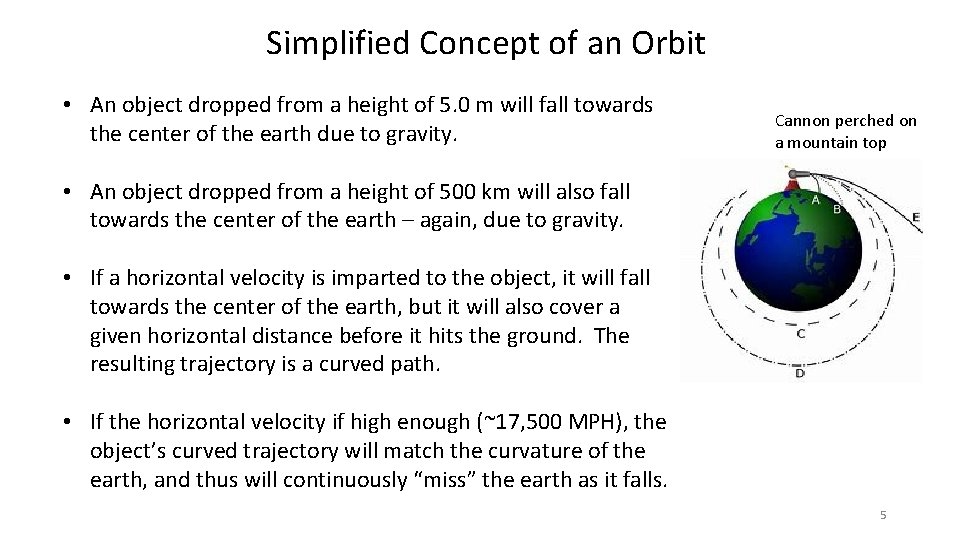
Simplified Concept of an Orbit • An object dropped from a height of 5. 0 m will fall towards the center of the earth due to gravity. Cannon perched on a mountain top • An object dropped from a height of 500 km will also fall towards the center of the earth – again, due to gravity. • If a horizontal velocity is imparted to the object, it will fall towards the center of the earth, but it will also cover a given horizontal distance before it hits the ground. The resulting trajectory is a curved path. • If the horizontal velocity if high enough (~17, 500 MPH), the object’s curved trajectory will match the curvature of the earth, and thus will continuously “miss” the earth as it falls. 5
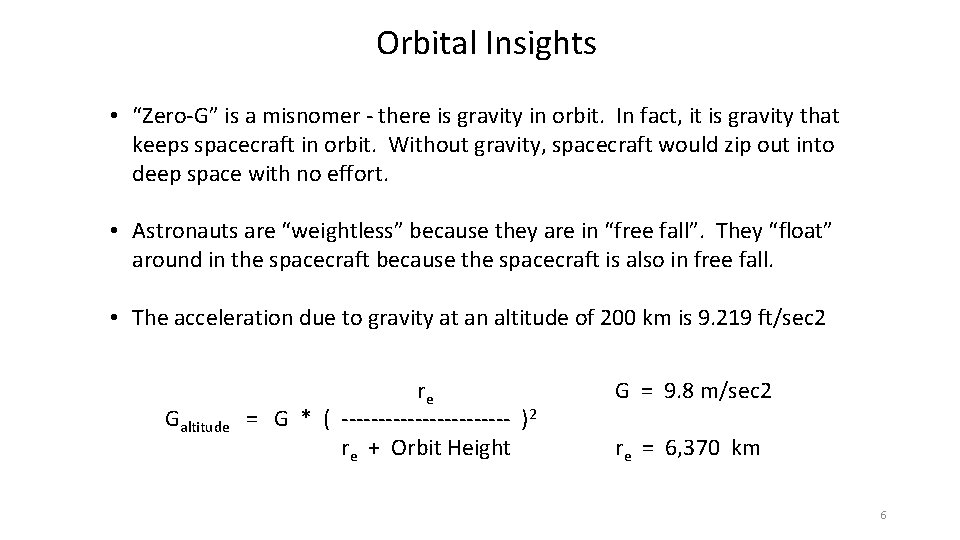
Orbital Insights • “Zero-G” is a misnomer - there is gravity in orbit. In fact, it is gravity that keeps spacecraft in orbit. Without gravity, spacecraft would zip out into deep space with no effort. • Astronauts are “weightless” because they are in “free fall”. They “float” around in the spacecraft because the spacecraft is also in free fall. • The acceleration due to gravity at an altitude of 200 km is 9. 219 ft/sec 2 Galtitude re = G * ( ------------ )2 re + Orbit Height G = 9. 8 m/sec 2 re = 6, 370 km 6
Orbital Insights • Sub-orbital rockets (a. k. a. sounding rockets) can fly three times higher than the space station, but their horizontal velocity is much less than 17, 500 MPH. As a result, their trajectories end up hitting the ground. This is known as an earth intersecting orbit… 7
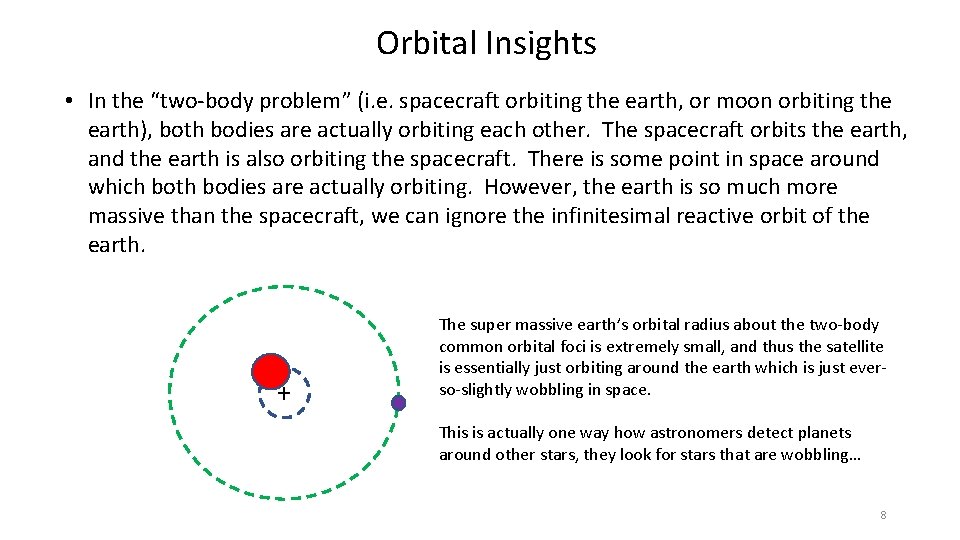
Orbital Insights • In the “two-body problem” (i. e. spacecraft orbiting the earth, or moon orbiting the earth), both bodies are actually orbiting each other. The spacecraft orbits the earth, and the earth is also orbiting the spacecraft. There is some point in space around which both bodies are actually orbiting. However, the earth is so much more massive than the spacecraft, we can ignore the infinitesimal reactive orbit of the earth. + The super massive earth’s orbital radius about the two-body common orbital foci is extremely small, and thus the satellite is essentially just orbiting around the earth which is just everso-slightly wobbling in space. This is actually one way how astronomers detect planets around other stars, they look for stars that are wobbling… 8
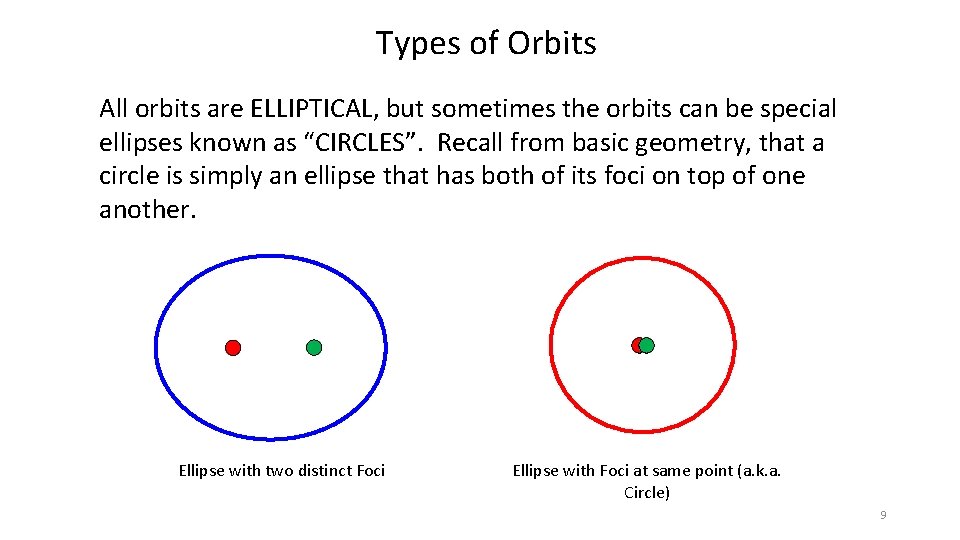
Types of Orbits All orbits are ELLIPTICAL, but sometimes the orbits can be special ellipses known as “CIRCLES”. Recall from basic geometry, that a circle is simply an ellipse that has both of its foci on top of one another. Ellipse with two distinct Foci Ellipse with Foci at same point (a. k. a. Circle) 9
Terminology Apogee: The highest point in an elliptical orbit Perigee: The lowest point in an elliptical orbit Orbital Energy: The sum of the mutual potential energy and kinetic energy of two orbiting bodies divided by the reduced mass 10
Useful Numerical Constants Gravitational Constant = U = 14. 05 x 1015 ft 3/sec 2 (That’s 14, 050, 000, 000 ft 3/sec 2 ) Radius of the Earth = 20. 9 x 106 ft (That’s 20, 900, 000 ft or 3, 958 miles) In this lesson: • Distances are in FEET • Orbital Radii are referenced to the Center of the Earth 11
Orbital Basics • The velocity of the spacecraft determines the height of the orbit • The spacecraft velocity for a high orbit is actually lower, than that for a lower orbit. This doesn’t really make sense since the spacecraft must fire its rocket motor to climb to a higher orbit… However, if we look at the total energy (Kinetic + Potential) the energy increase as the orbital altitude increases. • If the spacecraft is in an elliptical orbit, its velocity will be constantly changing. It is slowest at apogee, and highest at perigee. 12
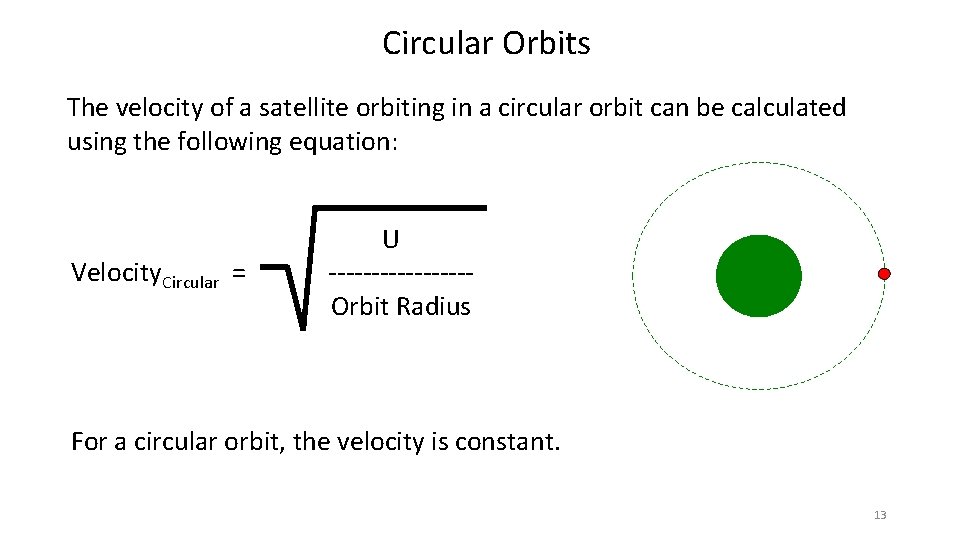
Circular Orbits The velocity of a satellite orbiting in a circular orbit can be calculated using the following equation: Velocity. Circular = U --------Orbit Radius For a circular orbit, the velocity is constant. 13
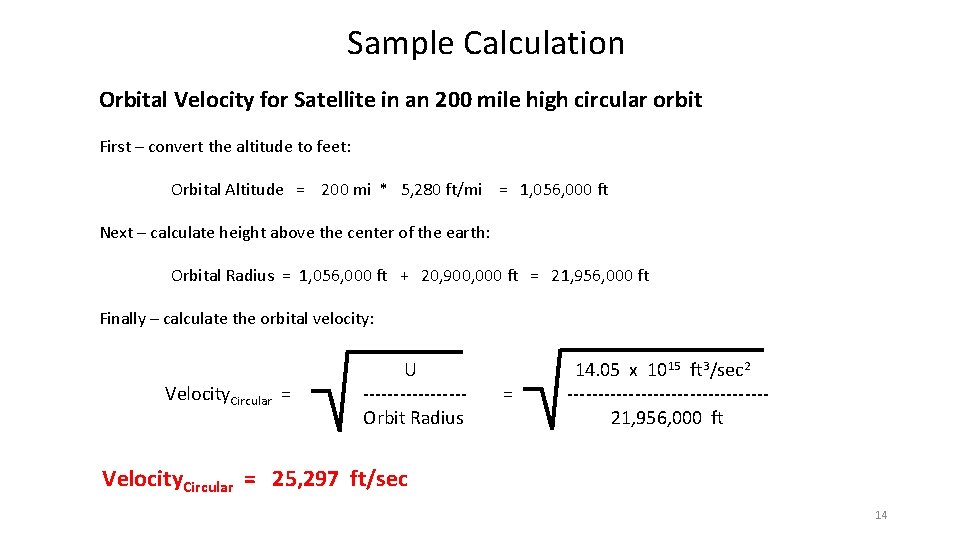
Sample Calculation Orbital Velocity for Satellite in an 200 mile high circular orbit First – convert the altitude to feet: Orbital Altitude = 200 mi * 5, 280 ft/mi = 1, 056, 000 ft Next – calculate height above the center of the earth: Orbital Radius = 1, 056, 000 ft + 20, 900, 000 ft = 21, 956, 000 ft Finally – calculate the orbital velocity: Velocity. Circular = U --------Orbit Radius = 14. 05 x 1015 ft 3/sec 2 ----------------21, 956, 000 ft Velocity. Circular = 25, 297 ft/sec 14
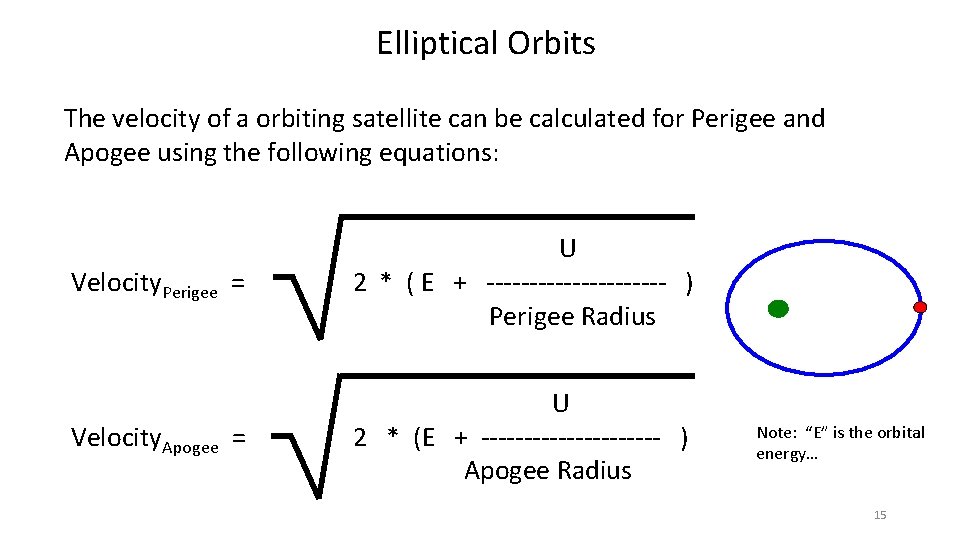
Elliptical Orbits The velocity of a orbiting satellite can be calculated for Perigee and Apogee using the following equations: Velocity. Perigee = U 2 * ( E + ----------- ) Perigee Radius Velocity. Apogee = U 2 * (E + ----------- ) Apogee Radius Note: “E” is the orbital energy… 15
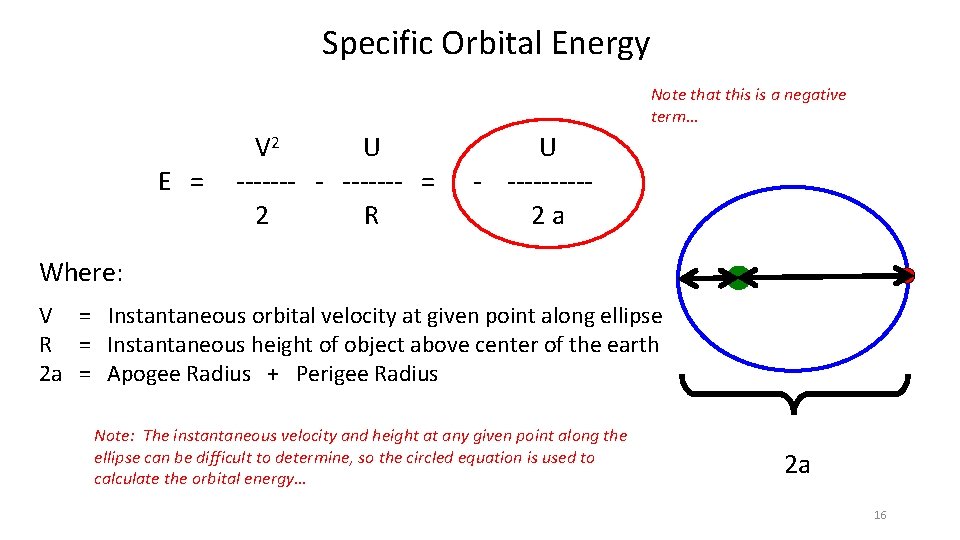
Specific Orbital Energy Note that this is a negative term… E = V 2 U ------- - ------- = 2 R U - -----2 a Where: V = Instantaneous orbital velocity at given point along ellipse R = Instantaneous height of object above center of the earth 2 a = Apogee Radius + Perigee Radius Note: The instantaneous velocity and height at any given point along the ellipse can be difficult to determine, so the circled equation is used to calculate the orbital energy… 2 a 16

Sample Calculation Calculate the spacecraft velocity and perigee and apogee for an elliptical orbit that has an perigee of 150 miles and an apogee of 400 miles. First, calculate the apogee and perigee in feet – Perigee (ft) = 150 mi * 5, 280 ft/mi = 792, 000 ft Apogee (ft) = 400 mi * 5, 280 ft/mi = 2, 112, 000 ft Next, calculate the apogee and perigee above the center of the earth – Perigee (ft) = 20, 900, 000 ft + 792, 000 ft = 21, 692, 000 ft Apogee (ft) = 20, 900, 000 ft + 2, 112, 000 ft = 23, 012, 000 ft 17
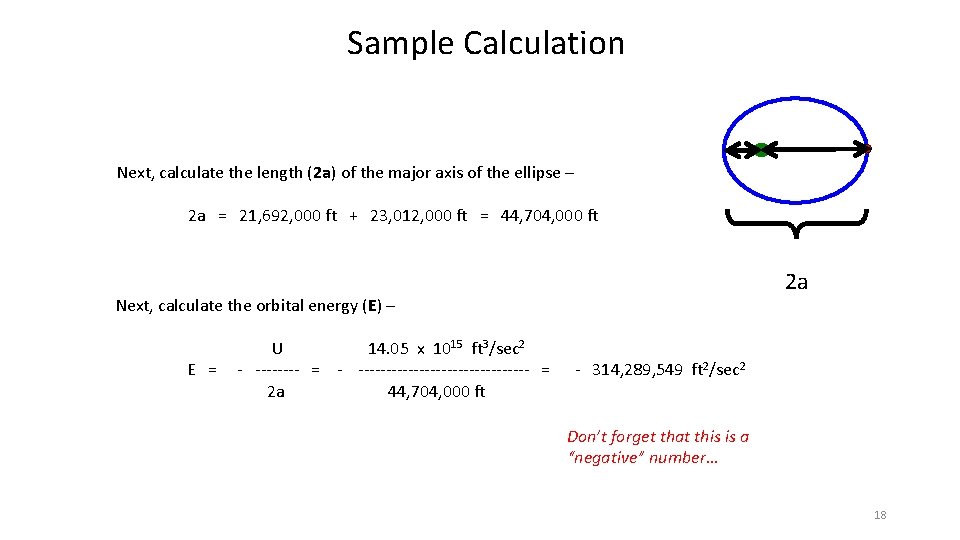
Sample Calculation Next, calculate the length (2 a) of the major axis of the ellipse – 2 a = 21, 692, 000 ft + 23, 012, 000 ft = 44, 704, 000 ft 2 a Next, calculate the orbital energy (E) – E = U 14. 05 x 1015 ft 3/sec 2 - ---- = - ---------------- = 2 a 44, 704, 000 ft - 314, 289, 549 ft 2/sec 2 Don’t forget that this is a “negative” number… 18
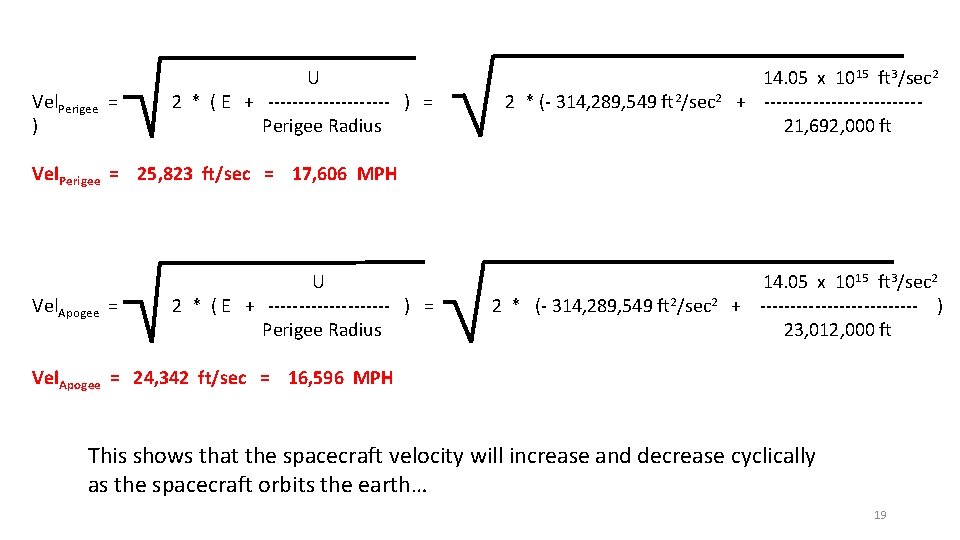
Vel. Perigee = ) U 2 * ( E + ---------- ) = Perigee Radius 2 * (- 314, 289, 549 ft 2/sec 2 14. 05 x 1015 ft 3/sec 2 + -------------21, 692, 000 ft 2 * (- 314, 289, 549 ft 2/sec 2 14. 05 x 1015 ft 3/sec 2 + ------------- ) 23, 012, 000 ft Vel. Perigee = 25, 823 ft/sec = 17, 606 MPH Vel. Apogee = U 2 * ( E + ---------- ) = Perigee Radius Vel. Apogee = 24, 342 ft/sec = 16, 596 MPH This shows that the spacecraft velocity will increase and decrease cyclically as the spacecraft orbits the earth… 19
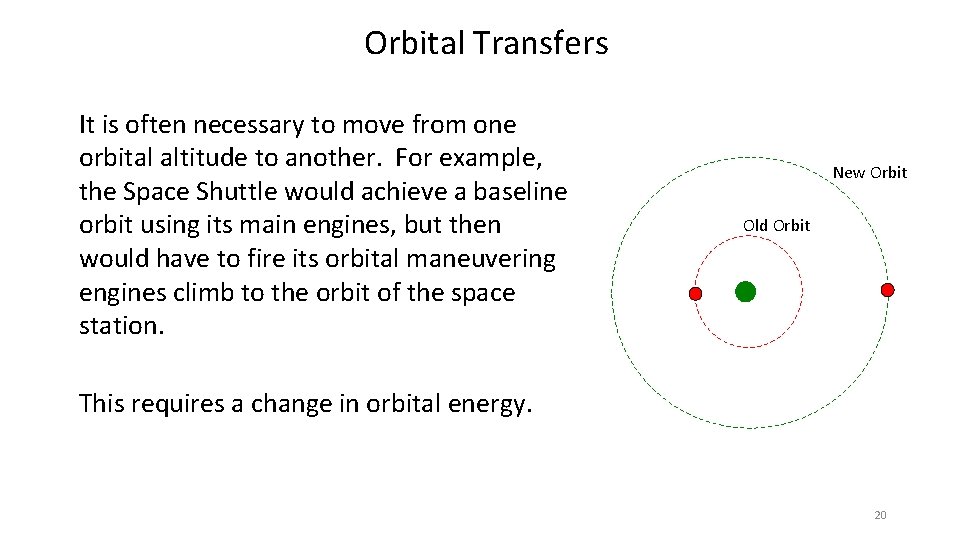
Orbital Transfers It is often necessary to move from one orbital altitude to another. For example, the Space Shuttle would achieve a baseline orbit using its main engines, but then would have to fire its orbital maneuvering engines climb to the orbit of the space station. New Orbit Old Orbit This requires a change in orbital energy. 20
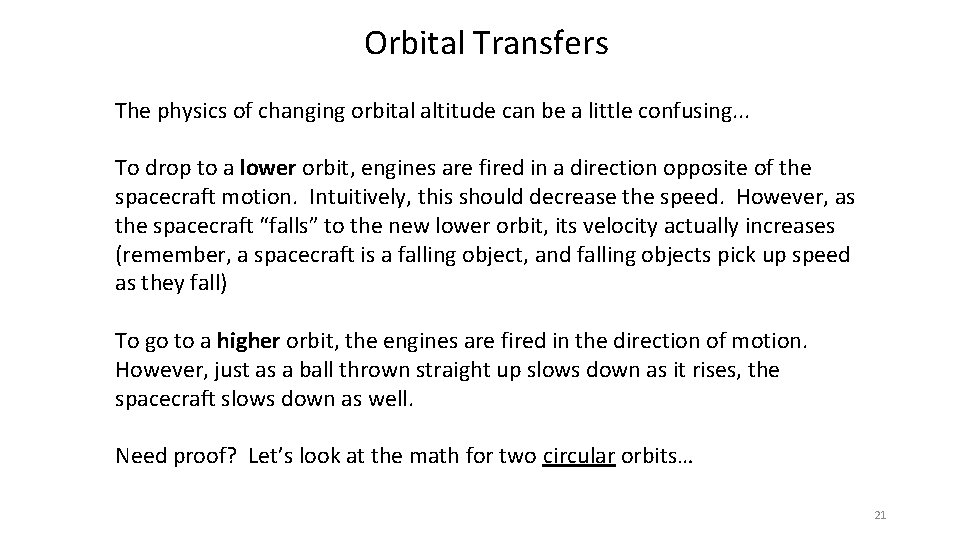
Orbital Transfers The physics of changing orbital altitude can be a little confusing. . . To drop to a lower orbit, engines are fired in a direction opposite of the spacecraft motion. Intuitively, this should decrease the speed. However, as the spacecraft “falls” to the new lower orbit, its velocity actually increases (remember, a spacecraft is a falling object, and falling objects pick up speed as they fall) To go to a higher orbit, the engines are fired in the direction of motion. However, just as a ball thrown straight up slows down as it rises, the spacecraft slows down as well. Need proof? Let’s look at the math for two circular orbits… 21
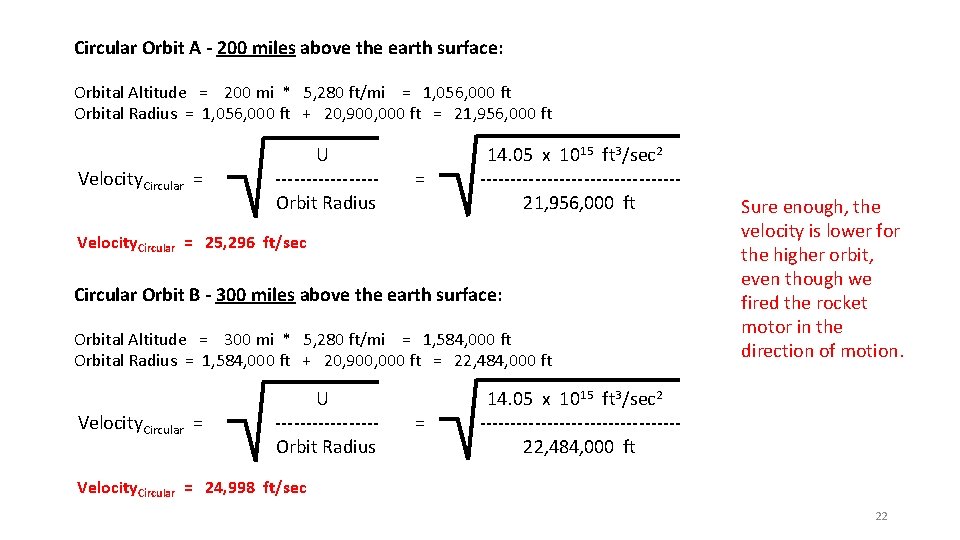
Circular Orbit A - 200 miles above the earth surface: Orbital Altitude = 200 mi * 5, 280 ft/mi = 1, 056, 000 ft Orbital Radius = 1, 056, 000 ft + 20, 900, 000 ft = 21, 956, 000 ft Velocity. Circular = U --------Orbit Radius = 14. 05 x 1015 ft 3/sec 2 ----------------21, 956, 000 ft Velocity. Circular = 25, 296 ft/sec Circular Orbit B - 300 miles above the earth surface: Orbital Altitude = 300 mi * 5, 280 ft/mi = 1, 584, 000 ft Orbital Radius = 1, 584, 000 ft + 20, 900, 000 ft = 22, 484, 000 ft Velocity. Circular = U --------Orbit Radius = Sure enough, the velocity is lower for the higher orbit, even though we fired the rocket motor in the direction of motion. 14. 05 x 1015 ft 3/sec 2 ----------------22, 484, 000 ft Velocity. Circular = 24, 998 ft/sec 22
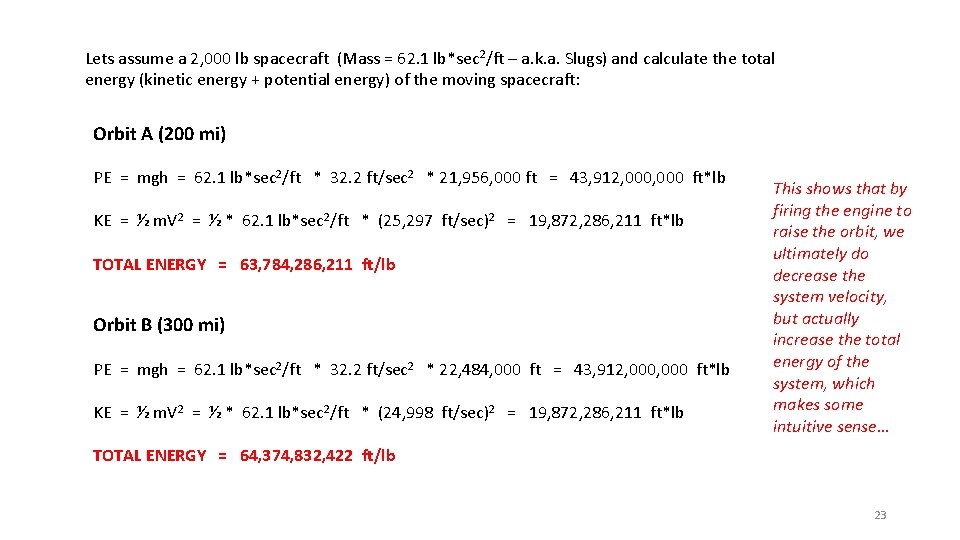
Lets assume a 2, 000 lb spacecraft (Mass = 62. 1 lb*sec 2/ft – a. k. a. Slugs) and calculate the total energy (kinetic energy + potential energy) of the moving spacecraft: Orbit A (200 mi) PE = mgh = 62. 1 lb*sec 2/ft * 32. 2 ft/sec 2 * 21, 956, 000 ft = 43, 912, 000 ft*lb KE = ½ m. V 2 = ½ * 62. 1 lb*sec 2/ft * (25, 297 ft/sec)2 = 19, 872, 286, 211 ft*lb TOTAL ENERGY = 63, 784, 286, 211 ft/lb Orbit B (300 mi) PE = mgh = 62. 1 lb*sec 2/ft * 32. 2 ft/sec 2 * 22, 484, 000 ft = 43, 912, 000 ft*lb KE = ½ m. V 2 = ½ * 62. 1 lb*sec 2/ft * (24, 998 ft/sec)2 = 19, 872, 286, 211 ft*lb This shows that by firing the engine to raise the orbit, we ultimately do decrease the system velocity, but actually increase the total energy of the system, which makes some intuitive sense… TOTAL ENERGY = 64, 374, 832, 422 ft/lb 23
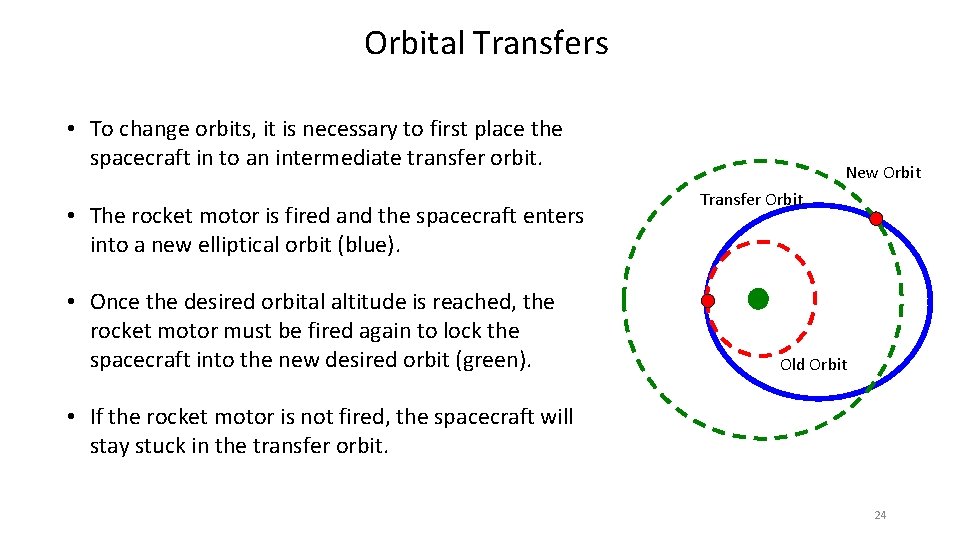
Orbital Transfers • To change orbits, it is necessary to first place the spacecraft in to an intermediate transfer orbit. • The rocket motor is fired and the spacecraft enters into a new elliptical orbit (blue). • Once the desired orbital altitude is reached, the rocket motor must be fired again to lock the spacecraft into the new desired orbit (green). New Orbit Transfer Orbit Old Orbit • If the rocket motor is not fired, the spacecraft will stay stuck in the transfer orbit. 24
Orbital Transfers • All of this rocket motor firing consumes fuel, and spacecraft can only carry a finite amount… • Fuel limitations means orbital maneuvering must be minimized. • It also means that any maneuvering that is done, needs to be as efficient as possible. 25
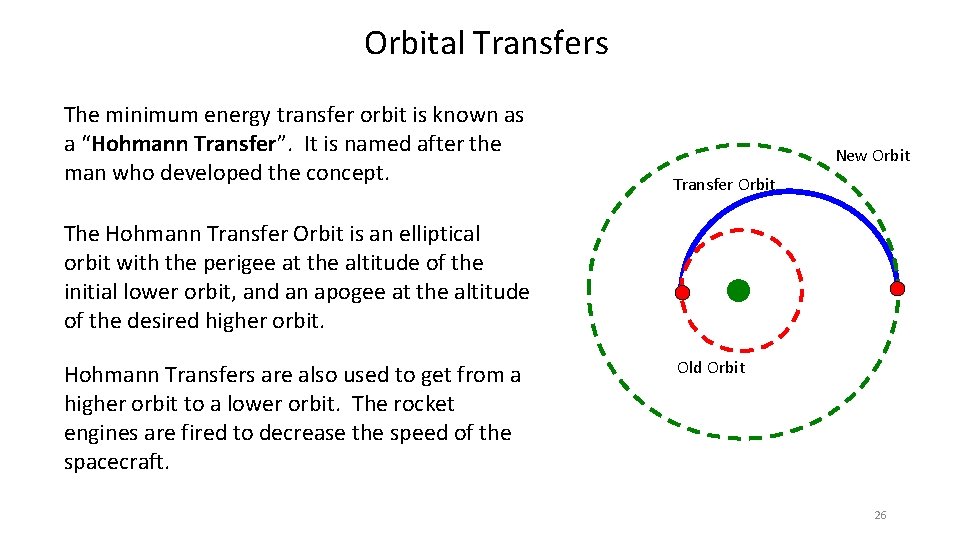
Orbital Transfers The minimum energy transfer orbit is known as a “Hohmann Transfer”. It is named after the man who developed the concept. New Orbit Transfer Orbit The Hohmann Transfer Orbit is an elliptical orbit with the perigee at the altitude of the initial lower orbit, and an apogee at the altitude of the desired higher orbit. Hohmann Transfers are also used to get from a higher orbit to a lower orbit. The rocket engines are fired to decrease the speed of the spacecraft. Old Orbit 26
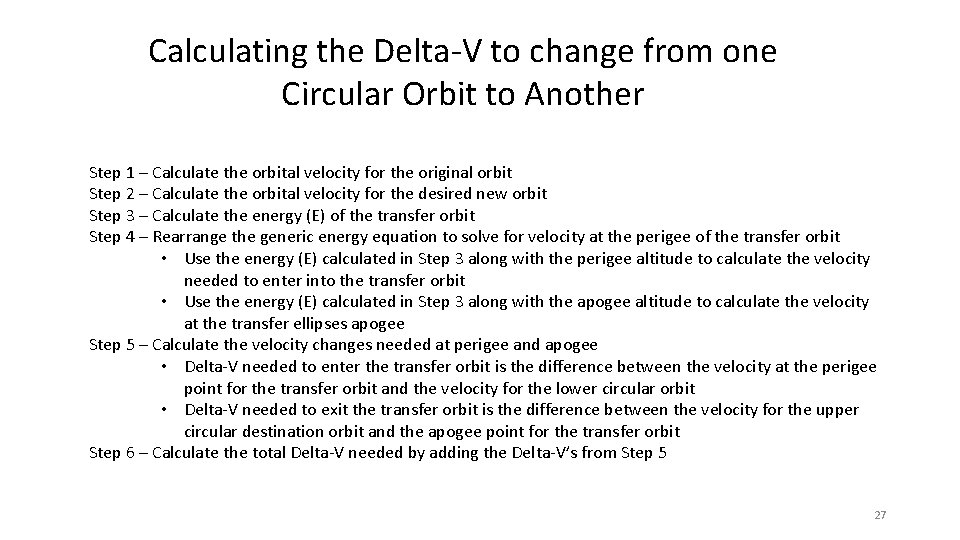
Calculating the Delta-V to change from one Circular Orbit to Another Step 1 – Calculate the orbital velocity for the original orbit Step 2 – Calculate the orbital velocity for the desired new orbit Step 3 – Calculate the energy (E) of the transfer orbit Step 4 – Rearrange the generic energy equation to solve for velocity at the perigee of the transfer orbit • Use the energy (E) calculated in Step 3 along with the perigee altitude to calculate the velocity needed to enter into the transfer orbit • Use the energy (E) calculated in Step 3 along with the apogee altitude to calculate the velocity at the transfer ellipses apogee Step 5 – Calculate the velocity changes needed at perigee and apogee • Delta-V needed to enter the transfer orbit is the difference between the velocity at the perigee point for the transfer orbit and the velocity for the lower circular orbit • Delta-V needed to exit the transfer orbit is the difference between the velocity for the upper circular destination orbit and the apogee point for the transfer orbit Step 6 – Calculate the total Delta-V needed by adding the Delta-V’s from Step 5 27
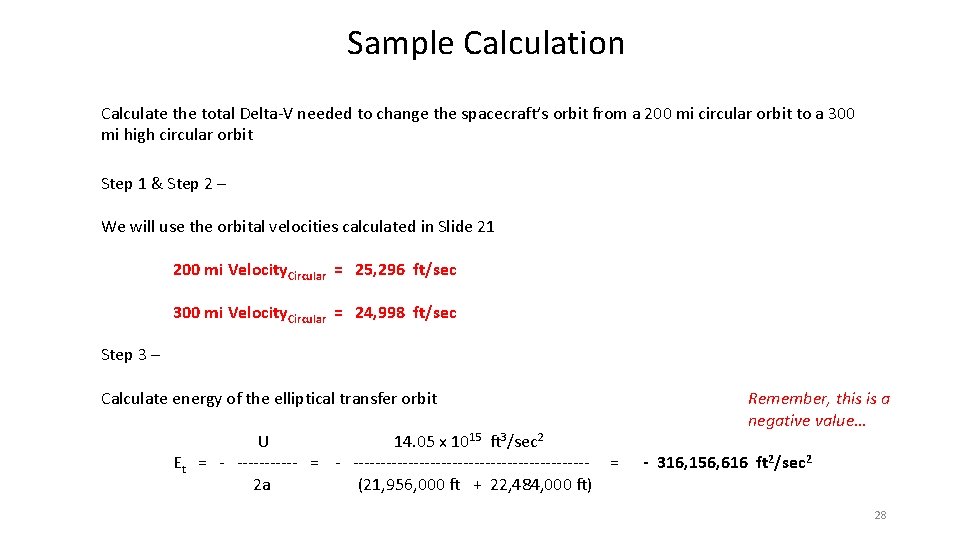
Sample Calculation Calculate the total Delta-V needed to change the spacecraft’s orbit from a 200 mi circular orbit to a 300 mi high circular orbit Step 1 & Step 2 – We will use the orbital velocities calculated in Slide 21 200 mi Velocity. Circular = 25, 296 ft/sec 300 mi Velocity. Circular = 24, 998 ft/sec Step 3 – Calculate energy of the elliptical transfer orbit U 14. 05 x 1015 ft 3/sec 2 Et = - --------------------------- = 2 a (21, 956, 000 ft + 22, 484, 000 ft) Remember, this is a negative value… - 316, 156, 616 ft 2/sec 2 28
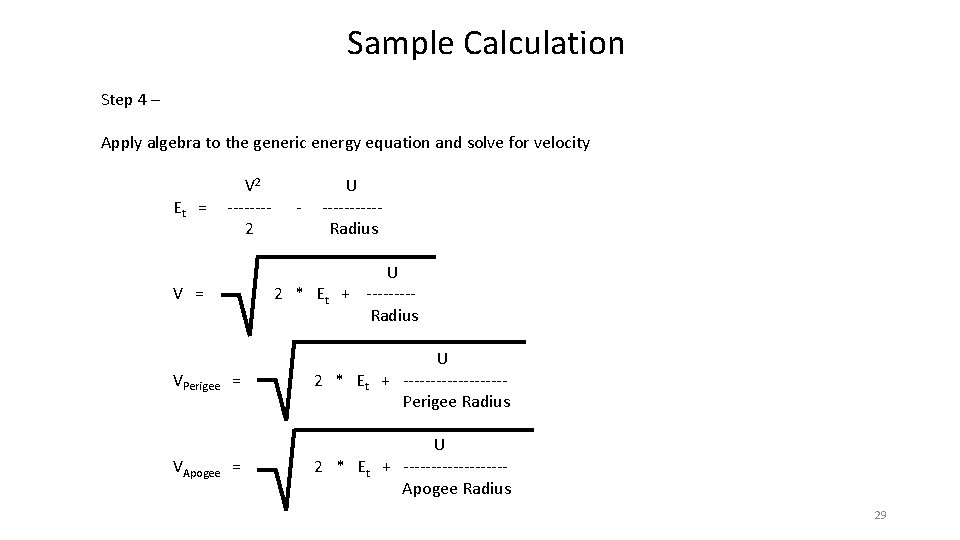
Sample Calculation Step 4 – Apply algebra to the generic energy equation and solve for velocity Et = V 2 -------2 V = - U -----Radius U 2 * Et + ----Radius VPerigee = U 2 * Et + ---------Perigee Radius VApogee = U 2 * Et + ---------Apogee Radius 29
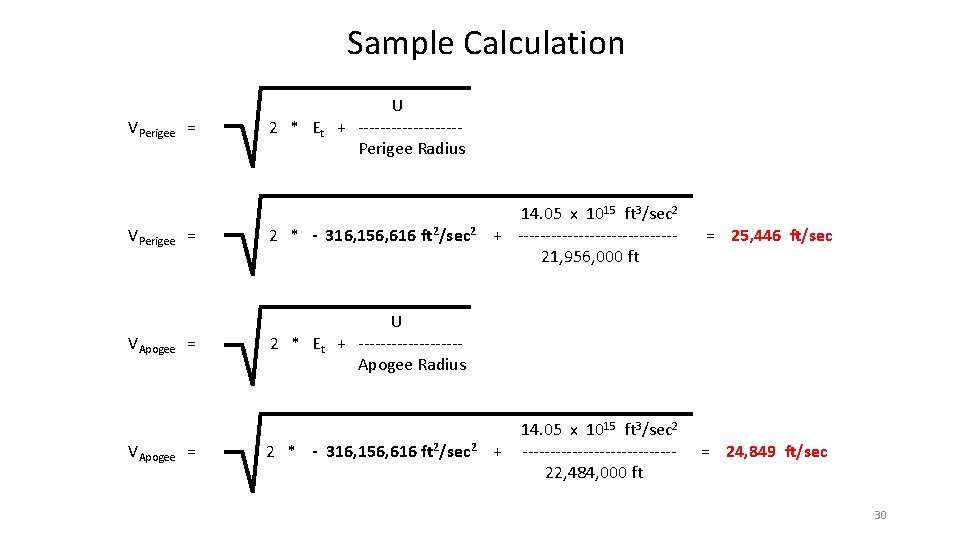
Sample Calculation VPerigee = U 2 * Et + ---------Perigee Radius VPerigee = 2 * - 316, 156, 616 ft 2/sec 2 VApogee = U 2 * Et + ---------Apogee Radius VApogee = 14. 05 x 1015 ft 3/sec 2 + --------------21, 956, 000 ft = 25, 446 ft/sec 14. 05 x 1015 ft 3/sec 2 --------------22, 484, 000 ft = 24, 849 ft/sec 2 * - 316, 156, 616 ft 2/sec 2 + 30
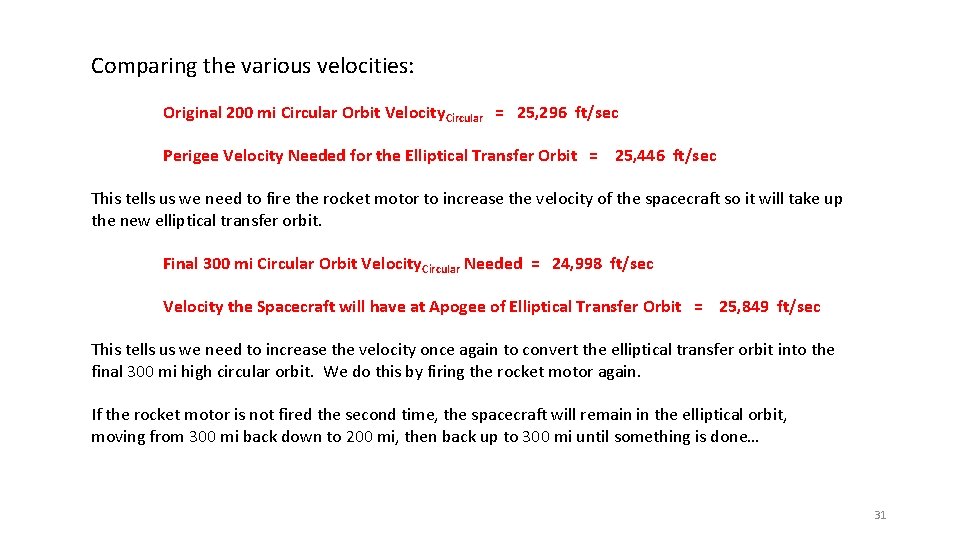
Comparing the various velocities: Original 200 mi Circular Orbit Velocity. Circular = 25, 296 ft/sec Perigee Velocity Needed for the Elliptical Transfer Orbit = 25, 446 ft/sec This tells us we need to fire the rocket motor to increase the velocity of the spacecraft so it will take up the new elliptical transfer orbit. Final 300 mi Circular Orbit Velocity. Circular Needed = 24, 998 ft/sec Velocity the Spacecraft will have at Apogee of Elliptical Transfer Orbit = 25, 849 ft/sec This tells us we need to increase the velocity once again to convert the elliptical transfer orbit into the final 300 mi high circular orbit. We do this by firing the rocket motor again. If the rocket motor is not fired the second time, the spacecraft will remain in the elliptical orbit, moving from 300 mi back down to 200 mi, then back up to 300 mi until something is done… 31
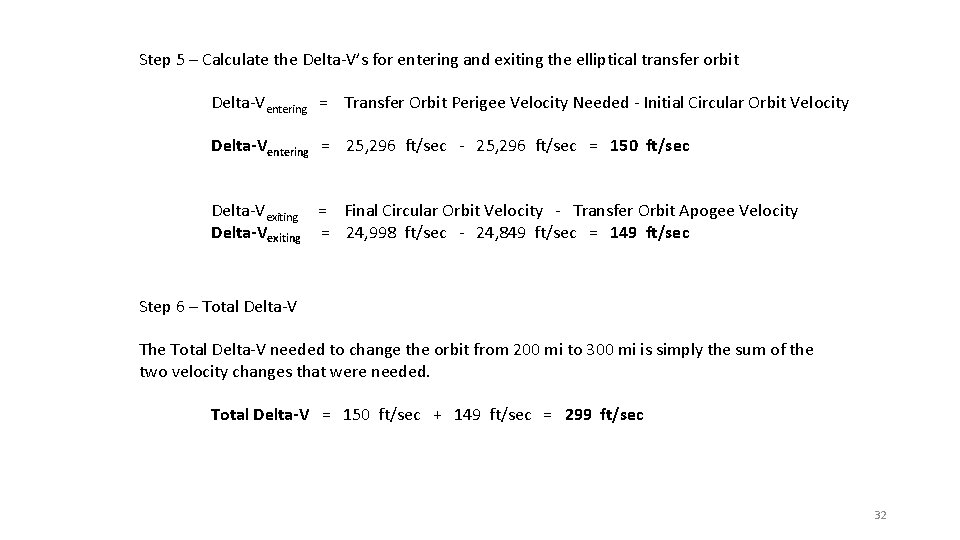
Step 5 – Calculate the Delta-V’s for entering and exiting the elliptical transfer orbit Delta-Ventering = Transfer Orbit Perigee Velocity Needed - Initial Circular Orbit Velocity Delta-Ventering = 25, 296 ft/sec - 25, 296 ft/sec = 150 ft/sec Delta-Vexiting = Final Circular Orbit Velocity - Transfer Orbit Apogee Velocity Delta-Vexiting = 24, 998 ft/sec - 24, 849 ft/sec = 149 ft/sec Step 6 – Total Delta-V The Total Delta-V needed to change the orbit from 200 mi to 300 mi is simply the sum of the two velocity changes that were needed. Total Delta-V = 150 ft/sec + 149 ft/sec = 299 ft/sec 32
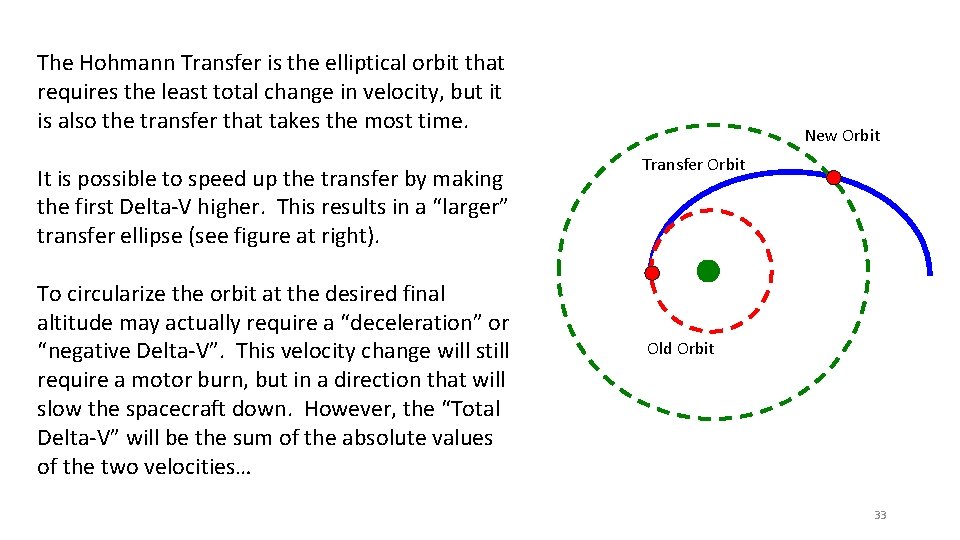
The Hohmann Transfer is the elliptical orbit that requires the least total change in velocity, but it is also the transfer that takes the most time. It is possible to speed up the transfer by making the first Delta-V higher. This results in a “larger” transfer ellipse (see figure at right). To circularize the orbit at the desired final altitude may actually require a “deceleration” or “negative Delta-V”. This velocity change will still require a motor burn, but in a direction that will slow the spacecraft down. However, the “Total Delta-V” will be the sum of the absolute values of the two velocities… New Orbit Transfer Orbit Old Orbit 33
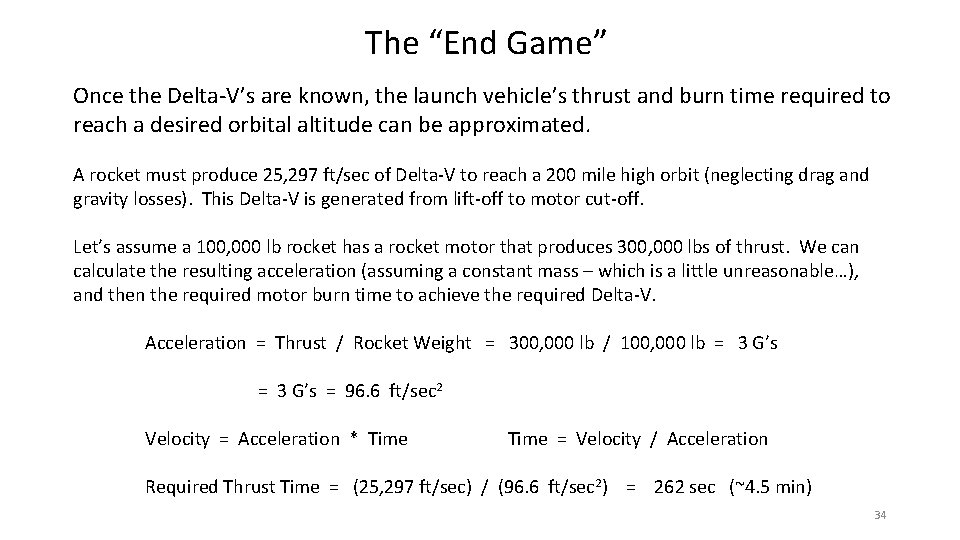
The “End Game” Once the Delta-V’s are known, the launch vehicle’s thrust and burn time required to reach a desired orbital altitude can be approximated. A rocket must produce 25, 297 ft/sec of Delta-V to reach a 200 mile high orbit (neglecting drag and gravity losses). This Delta-V is generated from lift-off to motor cut-off. Let’s assume a 100, 000 lb rocket has a rocket motor that produces 300, 000 lbs of thrust. We can calculate the resulting acceleration (assuming a constant mass – which is a little unreasonable…), and then the required motor burn time to achieve the required Delta-V. Acceleration = Thrust / Rocket Weight = 300, 000 lb / 100, 000 lb = 3 G’s = 96. 6 ft/sec 2 Velocity = Acceleration * Time = Velocity / Acceleration Required Thrust Time = (25, 297 ft/sec) / (96. 6 ft/sec 2) = 262 sec (~4. 5 min) 34
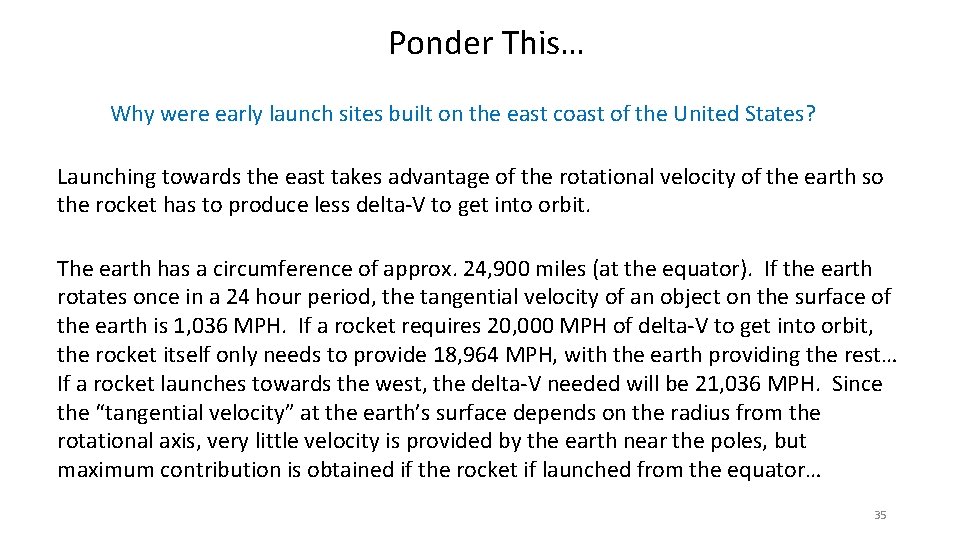
Ponder This… Why were early launch sites built on the east coast of the United States? Launching towards the east takes advantage of the rotational velocity of the earth so the rocket has to produce less delta-V to get into orbit. The earth has a circumference of approx. 24, 900 miles (at the equator). If the earth rotates once in a 24 hour period, the tangential velocity of an object on the surface of the earth is 1, 036 MPH. If a rocket requires 20, 000 MPH of delta-V to get into orbit, the rocket itself only needs to provide 18, 964 MPH, with the earth providing the rest… If a rocket launches towards the west, the delta-V needed will be 21, 036 MPH. Since the “tangential velocity” at the earth’s surface depends on the radius from the rotational axis, very little velocity is provided by the earth near the poles, but maximum contribution is obtained if the rocket if launched from the equator… 35
Questions ? 36
- Slides: 36