
Basic Operating Practices 1 Basic Operating Practices TRAINING
Basic Operating Practices 1
Basic Operating Practices TRAINING OBJECTIVES • Driving Practices • Basic Operations • Ground Guiding • Safe Driving • General Rules of the Road • Night Driving 2
Basic Operating Practices Driving Practices • Always sit up straight in the seat • Adjust seat to easily reach and operate vehicle controls, and have a clear view of the front • Adjust mirrors • Always wear your seatbelt or vehicle restraint • Be in full control of vehicle • Only remove your hands from wheel when performing acts essential to driving 3
Basic Operating Practices Driving Practices • Before moving any vehicle carefully check around the vehicle to ensure no one or no objects are in the path of the vehicle • Try to anticipate future situations • Before starting the vehicle make sure the parking brake is engaged. 4
Basic Operating Practices Driving Practices 5
Basic Operating Practices Basic Operations • Starting • Driving on the Right • Steering and Turning • Handling Curves • Breaking and Stopping • Using Selective Vision • Backing • Abstaining from Alcohol and • Turning Around Other Drugs • Parking • Resting • Speed Control • Safe Distances • Avoid Collisions • Intersections 6
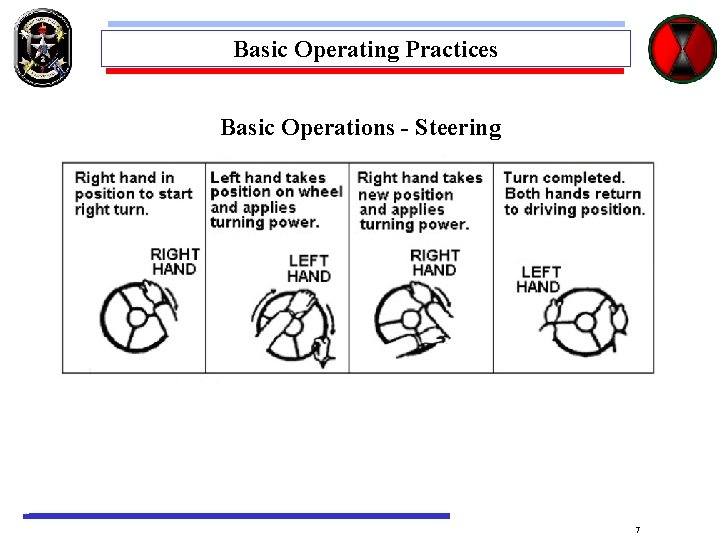
Basic Operating Practices Basic Operations - Steering 7
Basic Operating Practices Basic Operations – Braking The proper use of brakes is one of the most important elements of good driving as well as one of the best indicators of driving capability. Your brakes are used in all stopping procedures, but they are seldom used alone. Emergency stops may be the exception for the professional operator, but being prepared for them should be routine. The heavier a vehicle, the more work the brakes must do to stop it and the more heat they absorb. The brakes, tires, springs, and shock absorbers on heavy vehicles are designed to work best when the vehicle is fully loaded. Empty trucks require greater stopping distances because they have less traction and they can bounce and lock up the wheels. 8
Basic Operating Practices Basic Operations – Backing To turn while backing, turn the steering wheel in the same direction as if you were moving forward. To back to the right, turn the wheel to the right. To back to the left, turn the wheel to the left, and back slowly. In a vehicle with standard gears, speed cannot be safely controlled unless the clutch is used with the accelerator. Always come to a full stop before shifting into forward gear. You will always have ground guides when backing a military vehicle. 9
Basic Operating Practices Basic Operations – Turning Around The safest and often quickest way to turn around is to drive around the block, making three right turns and a final left turn. This eliminates the problems of most left turns. However, in some cases (such as a deadend street or other tight space) the vehicle may have to be turned completely around. Carefully follow these suggestions: • Select a place where there is at least 500 feet of clear visibility in each direction. • Do not attempt any turnaround near hills or curves or where visibility is limited. • Be sure there are no signs prohibiting the turn. • Be sure there is enough space to safely complete the turn. • Check for vehicular and pedestrian traffic before and during the turn. The responsibility for avoiding an accident rests with the operator. 10
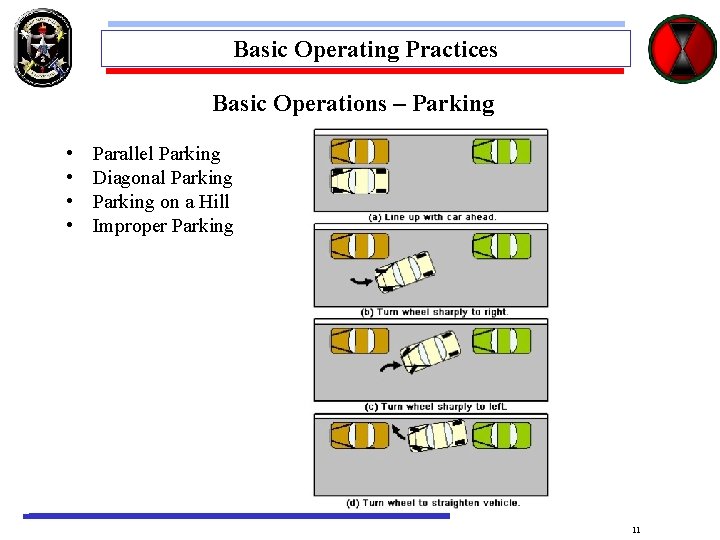
Basic Operating Practices Basic Operations – Parking • • Parallel Parking Diagonal Parking on a Hill Improper Parking 11
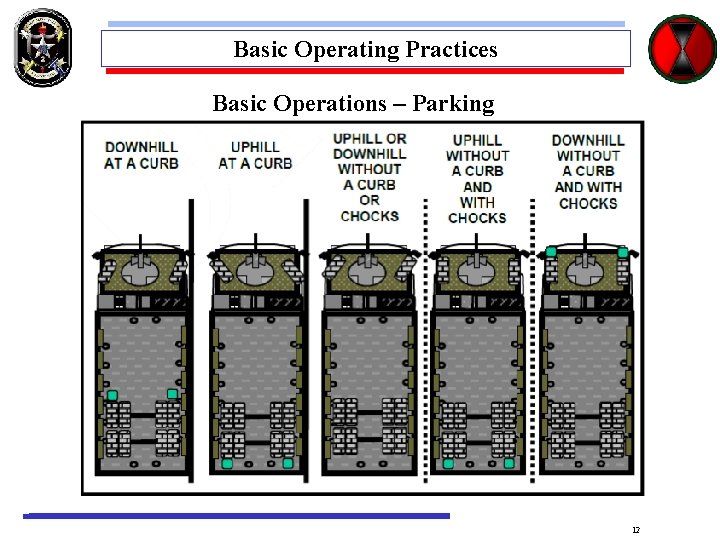
Basic Operating Practices Basic Operations – Parking 12

Basic Operating Practices Basic Operations – Speed Control Driving at a high rate of speed is more likely to cause an accident than any other driving infraction. A high speed driving accident is also more likely to cause a fatality. Military regulations and civilian laws govern speed. The most important and common sense rule is “NO PERSON SHALL DRIVE A VEHICLE AT A SPEED GREATER THAN IS REASONABLE AND PRUDENT UNDER THE EXISTING CONDITIONS”. However, conditions are constantly changing and it may be necessary to drive slower than the posted speed limit. Although many improvements have been made in safety equipment on vehicles, the most important safety factor in any vehicle is the control the operator has over the vehicle. The faster the vehicle goes, the less control the operator has over the vehicle. This loss of control increases the chances of being in an accident with fatalities. Accident statistics show that speed is a factor in one-fifth of all accidents and in almost half of the fatal accidents. Speed affects all of the mechanics of your driving. It affects your ability to turn, pass, slow down, and stop. 13
Basic Operating Practices Basic Operations – Avoid Collisions Many collisions can be avoided by simply slowing down. Even if it is too late to stop or slow down, an operator may often avoid collisions by swerving to one side. It is normally safer to swerve to the right than to the left. It is also better to run off the road to the right than to collide head on with an oncoming vehicle. When swerving a speeding vehicle, there is the risk of flipping the vehicle over. The faster a vehicle is going the more distance it takes to turn safely from a straight path. 14
Basic Operating Practices Basic Operations – Driving on the Right On two-lane roads, the law requires you to drive on the right-hand side of the road. Driving on the left-hand side of the road is permitted only in certain situations (such as passing). The danger of ignoring this law is obvious. However, more than one-seventh of fatal accidents are the result of head-on and sideswipe collisions. When driving on multi lane roads in a military vehicle use the right lane to travel. We are usually the slower traffic on the road and slow traffic should be in the farthest right lane unless it is an exit only or turning lane. 15
Basic Operating Practices Basic Operations – Handling Curves Even though thousands of people are killed each year in vehicle collisions, more are killed in one-vehicle accidents. Many of these accidents occur on a curve when an operator (who is usually driving too fast) loses control of his/her vehicle, skids off the road, and careens into a telephone pole or his/her vehicle turns over and rolls down an embankment. To make a vehicle follow a curved path, force must be used to overcome its natural tendency to go straight. The natural tendency to continue in a straight path increases much more rapidly than the speed. At 60 MPH, it takes nine times as much force to keep a vehicle turning as it does at 20 MPH. 16
Basic Operating Practices Basic Operations – Using Selective Vision Safe operators are completely aware of their surroundings. They know what is going on in the immediate vicinity of their vehicle and have scanned the areas far enough ahead of them that, if needed, they can react quickly to any possible dangers. Good practice is looking 12 -15 seconds ahead of you. By not looking ahead, an operator may cause an accident because of having to stop quickly or change lanes quickly. Good operators shift their attention back and forth, near and far. Here are some hazards to be aware of when looking ahead: • Turning vehicles or those entering the highway. • Brake lights from slow moving vehicles. • Hills, curves, or anything that might require slowing down or changing lanes. • Paying attention to traffic signals and signs. • Traffic signs which warn of road conditions where a change in speed is necessary. 17
Basic Operating Practices Basic Operations – Abstaining from Alcohol and other Drugs Driving under the influence of alcohol is a factor in at least half of the fatal motor vehicle accidents in the United States. The smallest amount of alcohol is enough to impair an operator’s judgment and reactionary time. Alcohol is not the only drug that impairs driving ability. Medicines (such as barbiturates and antihistamines) may cause drowsiness. There are many over-the-counter drugs that may cause drowsiness. When uncertain about the effects of a particular medicine; before taking, check with your doctor or pharmacist. If he/she says that it may cause drowsiness, do not take it before driving. Staying alert is the key to staying alive. Narcotics may dull the senses; induce profound sleep; or cause stupor, coma, or convulsions. Effects on the central nervous system include hilarity, carelessness, talkativeness, euphoria, distortion of sensation and perception, impairment of judgment and memory, distortion of emotional responsiveness, irritability, and confusion. 18
Basic Operating Practices Basic Operations – Abstaining from Alcohol and other Drugs 19
Basic Operating Practices Basic Operations – Your Actions Effect Others 20
Basic Operating Practices Basic Operations – Resting It is the operator’s responsibility to inform his/her supervisor if they have experienced loss of sleep or feel unusually sleepy to the point that they feel their driving may be unsafe. The supervisor should then adjust the operator’s duties accordingly. This does not excuse one from keeping physically capable of performing their duty. Repeated incidents will require a physical checkup and/or disciplinary action. Operators will be provided with at least 8 consecutive hours of rest during any 24 -hour period. An operator will not drive more than 10 hours in a duty period (including rest and meal breaks). If more than 10 hours are needed to complete operations, commanders will assign to each vehicle an assistant operator who is qualified to operate the vehicle (see AR 385 -10). 21
Basic Operating Practices Basic Operations – Safe Distances An operator who tailgates, does not allow enough time or distance to handle emergency situations. Rear end collisions often occur because an operator has not allowed for a safe stopping distance between their vehicle and the one in front of them. Safe passing requires that operators know not only how to pass, but also when and when not to pass. One good rule to keep when determining how much space should be kept in front of the vehicle is that at least one second for each 10 feet of vehicle length at speeds below 40 MPH. At greater speeds, you must add one second for safety. For example, the operator of a 40 -foot vehicle traveling at a speed below 40 MPH should leave 4 seconds between himself/herself and the vehicle ahead; in a 60 -foot vehicle, 6 seconds. If the 40 -foot vehicle is moving faster than 40 MPH, 5 seconds would be needed; for the 60 -foot vehicle, 7 seconds. Specific following distances are determined for certain vehicles: • When driving outside of cities and towns, a bus or truck should not travel closer than 200 feet behind another bus or truck. • When a fire engine is answering an alarm, the minimum safe following distance is 500 feet. 22
Basic Operating Practices Basic Operations – Intersections The most dangerous place on a street or highway is an intersection. Many drivers and pedestrians have lost their lives at intersections. An intersection is any place where two or more roads join or cross each other. Whether a driver has the right-of-way or not, they are required to slow down when approaching all intersections. The following rules of the road are standard; however, state and local laws take precedence. • Intersections without traffic controls • Intersections with traffic controls • Turns at intersections • Special interscetions 23
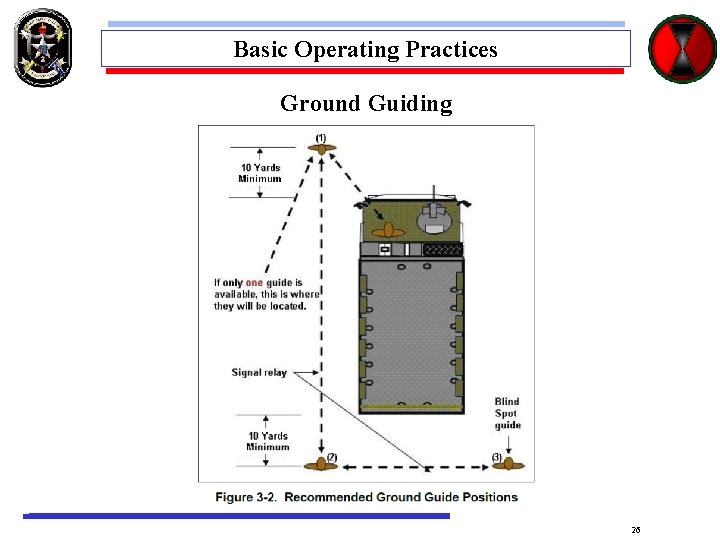
Basic Operating Practices Ground Guiding Ground guides must be trained in standard hand arm signals and flashlight signals before guiding a wheeled vehicle. Hand arm signals are the basic method used for ground guiding. Operators and ground guides will coordinate signals before vehicle movement. Examples of hand arm signals are in Appendix B and Appendix C. Voice signals between a ground guide and operator can be misunderstood. Therefore, they should not be used except in an emergency. Before a wheeled vehicle is started for movement, a member of the crew or the operator must walk completely around the vehicle to ensure no one or nothing is in danger from the vehicle's movement. At no time will ground guides walk backwards while guiding a vehicle. 24
Basic Operating Practices Ground Guiding 25
Basic Operating Practices Ground Guiding 26
Basic Operating Practices Ground Guiding 27
Basic Operating Practices Safe Driving The ability to mechanically operate a motor vehicle is not the only qualification of a safe operator. This skill must be augmented by a definite sense of personal responsibility and by knowledge of driving skills and unceasing respect for the laws of physics, physiology, and psychology as they affect the operator and their vehicle. Since safety is a command responsibility, it is the duty of commanders at all levels to ensure compliance with these non-statutory laws. Instruction for military operators should include an explanation of these elements and examples of the results of common violations. • Physiological Considerations • Psychological Considerations • Effects of Physical Laws 28
Basic Operating Practices Rules of the Road Rules of the road are standardized throughout the United States (US) to promote highway safety. However, they may be modified by local laws and ordinances or by appropriate civil or military authority. Such modifications are normally indicated by traffic control personnel or by signs or markings. Operators are informed of applicable rules and variations when operating a vehicle outside the continental United States (OCONUS). The following are the general rules of the road for all operators: • • Operate vehicles on the right of the highway, giving approaching traffic at least half of the road, unless conditions or directions indicate otherwise. When overtaking and passing other vehicles, pass to the left and remain on the left until safely clear of the overtaken vehicle. However, DO NOT overtake and pass another vehicle unless the left side of the road is clearly visible and free of oncoming traffic and pavement markings indicate that you are in a passing zone. Ensure that there is sufficient distance to pass and safely return to the right lane without coming within 100 feet of an approaching vehicle. Passing on the right is permitted when the front vehicle has signaled, slowed down, and is making a left turn. Be cautious because the turning vehicle may block views for the passing vehicle and the driver of an oncoming vehicle. 29
Basic Operating Practices Rules of the Road • • • Passing on the right is also permitted while driving on a street or highway designed for two or more lanes of traffic in both directions or on a one-way street with at least two lanes. Under such conditions, keep movement from one lane to another to the minimum. When changing lanes on multi-lane streets or highways, always use the proper turning signal and ensure that such movement can be made safely and does not interfere with the movement of traffic in other lanes. Passing on the right is not permitted when a vehicle must drive off the pavement or the main portion of the roadway to get around another vehicle. DO NOT start, stop, or turn a vehicle from its course on the highway without ensuring that making such a change is reasonably safe and by giving adequate warning to other drivers. Make a visual survey of the traffic that may be affected by this action. Give clear warning signals that are standard, appropriate for the operator’s intentions, and timed to give reasonable warning. A proper signal of intent to turn right or left will be given continuously during not less than the last 100 feet traveled by the vehicle before turning. To turn right at an intersection, approach the turn at the extreme right of the right-hand lane and make the turn as close to the right as practicable. To turn left, approach the turn to the right of, and close to, the center line, leaving the intersection to the right of the centerline of the entered road. An exception is a one-way road, which will be entered to the left of the centerline. A turn to reverse the direction of a vehicle will not be made unless a vehicle approaching from either direction can be seen from a distance of 500 feet. 30
Basic Operating Practices Rules of the Road • • • Observe the rules of right-of-way with judgment and courtesy. The safe operator gives the rightof-way rather than taking it. In general, when two vehicles enter an intersection at or about the same time, the vehicle on the left yields the right-of-way to the vehicle on the right. Always yield right-of-way to the first vehicle arriving at an intersection. When entering a through highway from a secondary road, give the right-of-way to traffic on the main thoroughfare. Fire, police, and emergency vehicles have the right-of-way over all other vehicles. However, all emergency vehicles are required to be operated with due regard for life, property, and traffic laws. Obey directions given by traffic control personnel or signs regardless of conflict with the general rules quoted. Slower moving vehicles should stay in the right-hand lane. Observed highway speeds, under normal conditions, vary somewhat from state to state. These speeds are generally posted on regulatory signs with warnings where reduction in speed is directed. Safe highway speeds are determined by analysis of traffic, highway design, and population densities. Posted speed indicates the results of such analysis under conditions of average traffic, dry pavement, and good visibility. At no time should vehicles be operated in excess of posted speed limits. Operator judgment should be consciously developed to determine speeds suitable to driving conditions. Safe driving requires constant adjustment to changing driving conditions. An operator will be trained to judge and maintain safe following distances to ensure adequate reaction time and stopping distances at any speed and under varying conditions. 31
Basic Operating Practices Night Driving Headlights are a poor substitute for daylight. An operator should never drive so fast that they cannot stop within the distance able to be seen ahead with the headlights. When driving at night, take the follow precautions: • At twilight, turn on the headlights, not just parking lights. Most states require that a driver use their headlights from sunset to sunrise in order to be more visible to others. • Be aware that some other drivers may not have turned on their lights. • Use low beams when driving in cities and towns, except on streets where there is no other lighting. • Use low beams when following a vehicle. • Use low beams when approaching traffic in oncoming lanes. • Use high-beam headlights on highways only when it is safe and legal to do so (such as when no other vehicle is approaching). • If the high beams of an oncoming car are not dimmed, avoid looking directly at the bright lights. Glance toward the side of the road; then quickly look ahead to determine the other vehicle's position. 32
Basic Operating Practices Review The objective of training a military operator is to teach him/her how to perform the job efficiently with maximum safety, comfort, and economy. Good driving habits are attained through constant practice. During daily driving, review the techniques discussed. Test occasionally to keep information fresh. Avoid slipping into bad, perhaps dangerous habits. Remember that as a military vehicle operator, you have a responsibility to safely operate your equipment and preserve the life of those around you and that you may be transporting. As the operator you are the final decision maker when it comes to the operation and movement of your vehicle. If you are being asked to do something unsafe or not within the guidelines of the regulations it is your responsibility to object and not move your vehicle. You will need to use regulations and policies to back up your actions. Always make sure you do this with respect and professionalism. 33
Basic Operating Practices CONCLUSION • As a vehicle operator, your responsibility and liability are far more extensive than you may have originally thought. Understand that operating any type of equipment (large combat equipment or small wheeled vehicles) carries with it the responsibility associated with liabilities and potentially life-changing situations. • REMEMBER: Operate your equipment in a safe and prudent manner at all times! 34
- Slides: 34