
Basic of Separation minima STRUCTURE 1 Division of
Basic of Separation minima
STRUCTURE 1) Division of Basic Separation 2) Horizontal separation and procedures 3) Vertical separation and procedures 4) Separation based on ATS surveillance systems 5) Test
![OBJECTIVES Name the separation standards [1] State the vertical separation standards. [1] Explain the](http://slidetodoc.com/presentation_image_h2/7843a761a9a9acc8e1a0dac62f3b68b9/image-3.jpg "OBJECTIVES Name the separation standards [1] State the vertical separation standards. [1] Explain the")
OBJECTIVES Name the separation standards [1] State the vertical separation standards. [1] Explain the vertical separation procedures. [2] State the horizontal separation standards. [1] Explain the horizontal separation procedures. [2] Explain the ATS surveillance systems separation standards and procedures. [2]
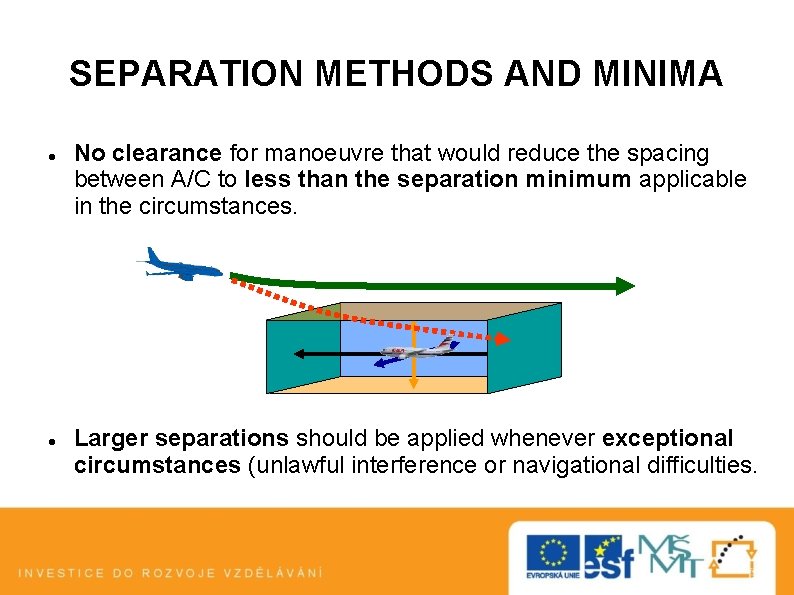
SEPARATION METHODS AND MINIMA No clearance for manoeuvre that would reduce the spacing between A/C to less than the separation minimum applicable in the circumstances. Larger separations should be applied whenever exceptional circumstances (unlawful interference or navigational difficulties.
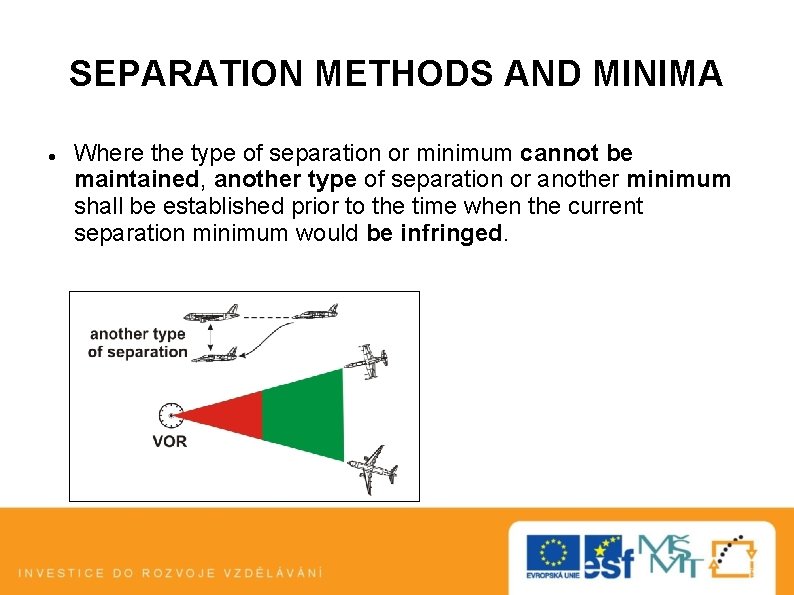
SEPARATION METHODS AND MINIMA Where the type of separation or minimum cannot be maintained, another type of separation or another minimum shall be established prior to the time when the current separation minimum would be infringed.
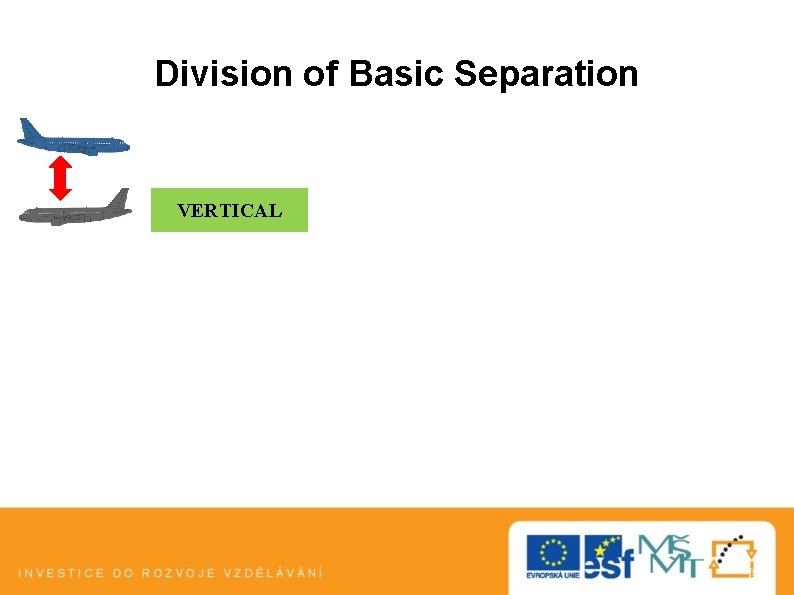
Division of Basic Separation VERTICAL
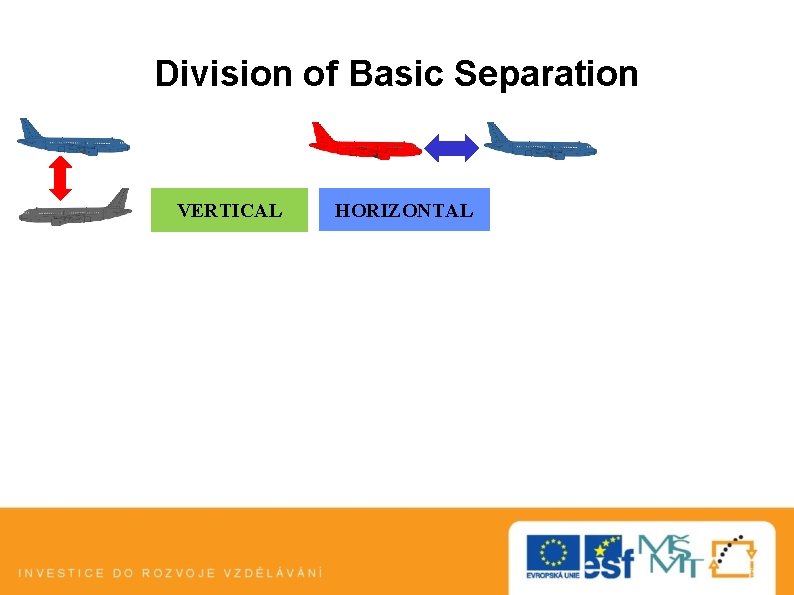
Division of Basic Separation VERTICAL HORIZONTAL
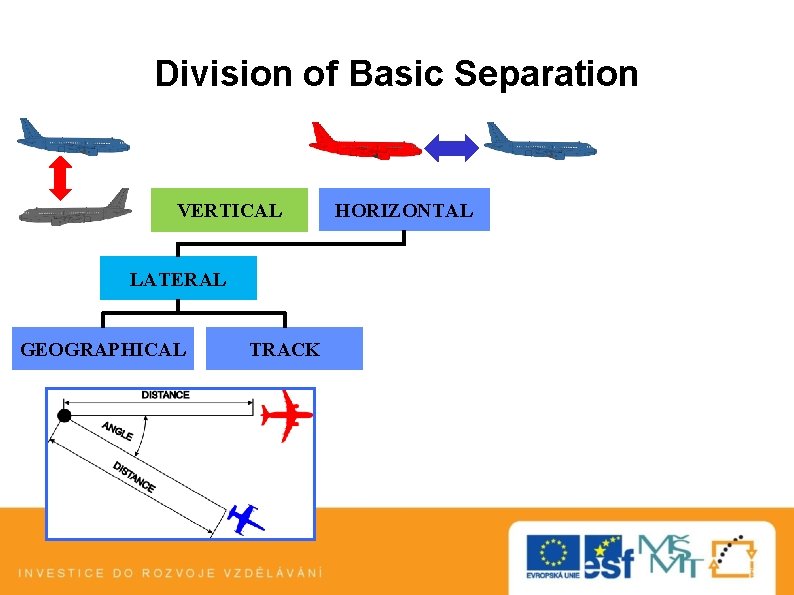
Division of Basic Separation VERTICAL LATERAL GEOGRAPHICAL TRACK HORIZONTAL
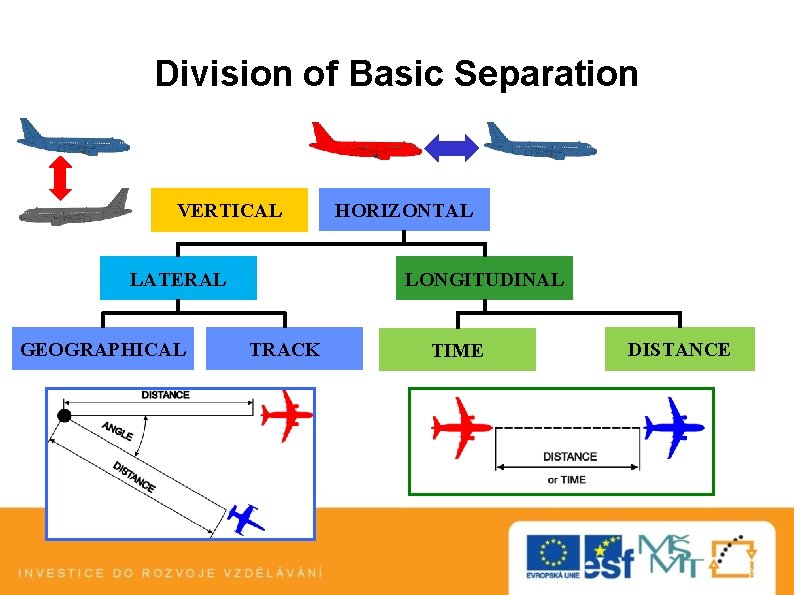
Division of Basic Separation VERTICAL LATERAL GEOGRAPHICAL HORIZONTAL LONGITUDINAL TRACK TIME DISTANCE
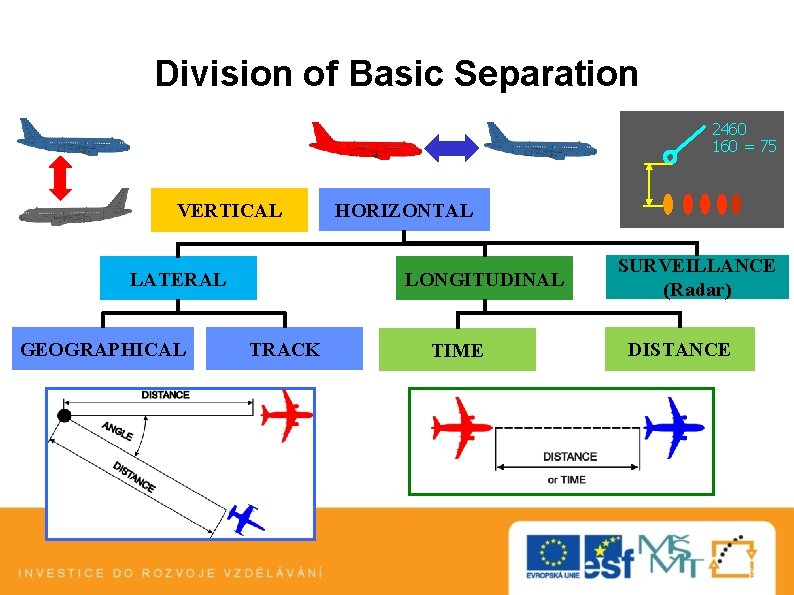
Division of Basic Separation 2460 160 = 75 VERTICAL LATERAL GEOGRAPHICAL HORIZONTAL LONGITUDINAL TRACK TIME SURVEILLANCE (Radar) DISTANCE
Minima is specified in distance values expressed in: 1. Vertical - Feet (m) between aircraft levels 2. Horizontal – at the same level Lateral: separation between routes or geographical points Longitudinal: separation between aircraft, using: time (min) between aircraft passing over the same point; or distance (nm/km) between aircraft passing over the same point Surveillance distance (nm/km) between aircraft symbols on the radar screen 3. Composite: by using a combination of vertical and horizontal separation,
Name types of separations. What is necessary to do if type of separation or minima cannot be maintained?

1. Vertical separation is obtained by requiring a/c using prescribed altimeter setting procedures to operate at different levels (flight levels or altitudes). 1013 – Flight level QNH - Altitude

Reduced Vertical Separation Minima airspace is between FL 290 and FL 410 inclusive,
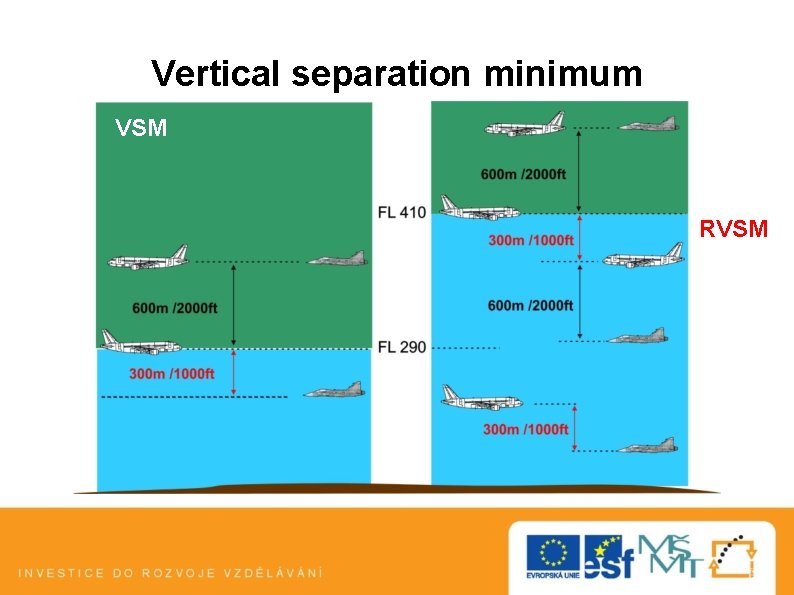
Vertical separation minimum VSM RVSM
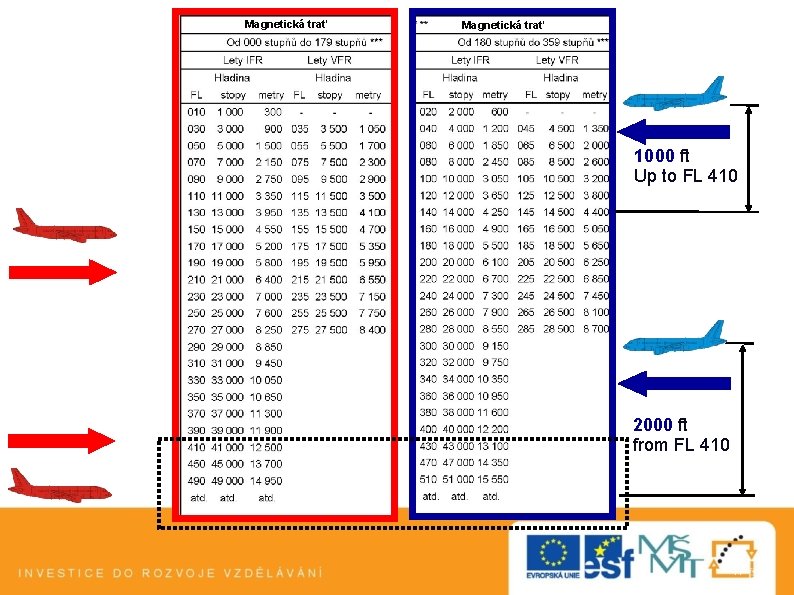
Magnetická trať 1000 ft Up to FL 410 2000 ft from FL 410 17

Longitudinal separation, the SAME TRACK a) same direction tracks and intersecting tracks or portions thereof, the angular difference of which is less than 45° or more than 315°, and whose protected airspaces overlap.
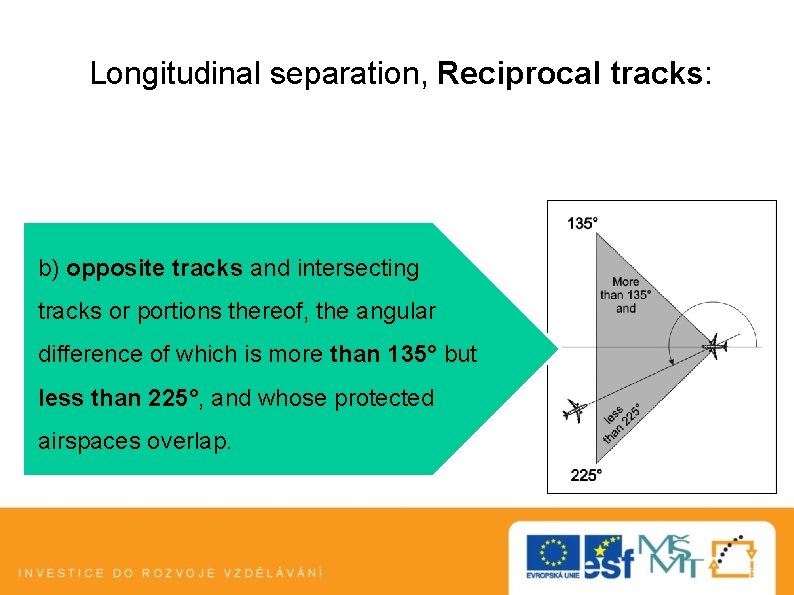
Longitudinal separation, Reciprocal tracks: b) opposite tracks and intersecting tracks or portions thereof, the angular difference of which is more than 135° but less than 225°, and whose protected airspaces overlap.
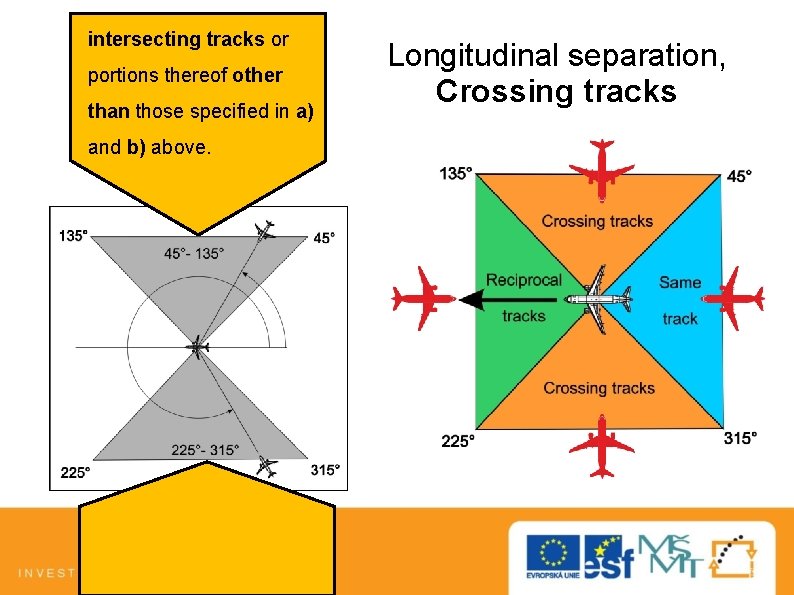
intersecting tracks or portions thereof other than those specified in a) and b) above. Longitudinal separation, Crossing tracks
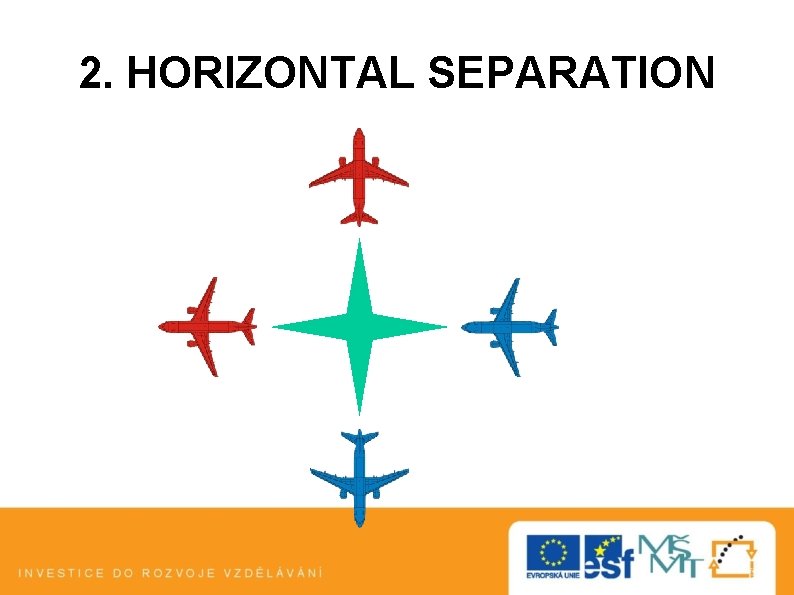
2. HORIZONTAL SEPARATION
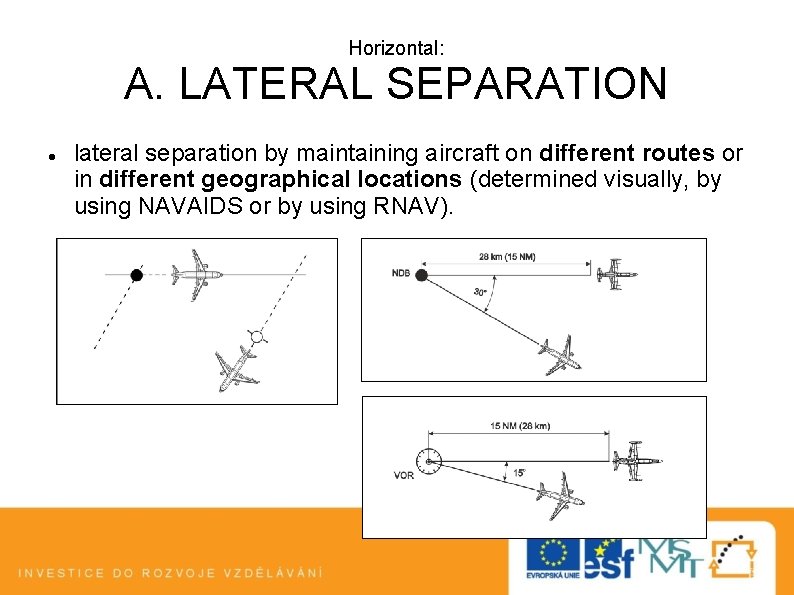
Horizontal: A. LATERAL SEPARATION lateral separation by maintaining aircraft on different routes or in different geographical locations (determined visually, by using NAVAIDS or by using RNAV).
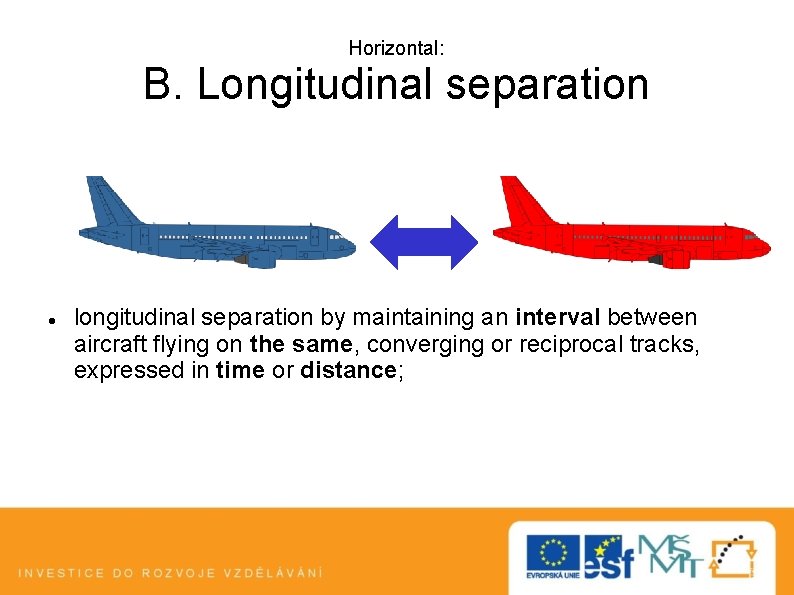
Horizontal: B. Longitudinal separation longitudinal separation by maintaining an interval between aircraft flying on the same, converging or reciprocal tracks, expressed in time or distance;
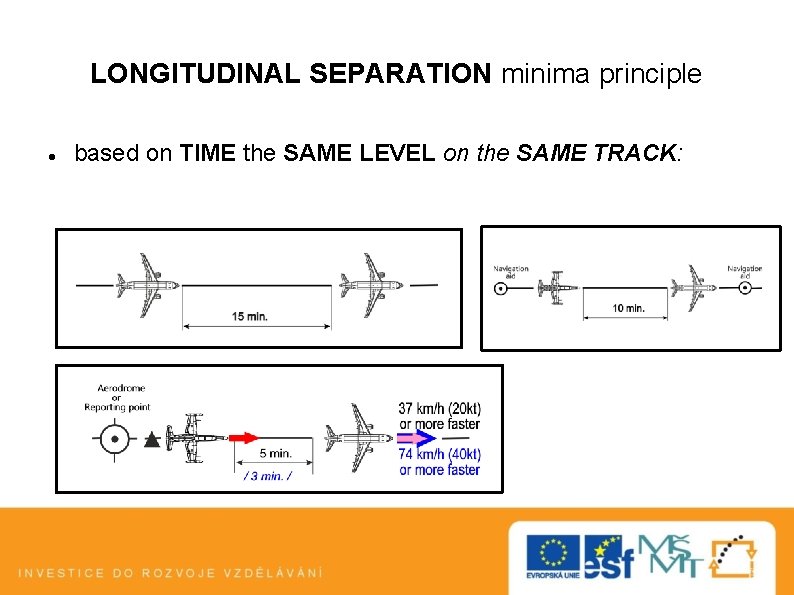
LONGITUDINAL SEPARATION minima principle based on TIME the SAME LEVEL on the SAME TRACK:
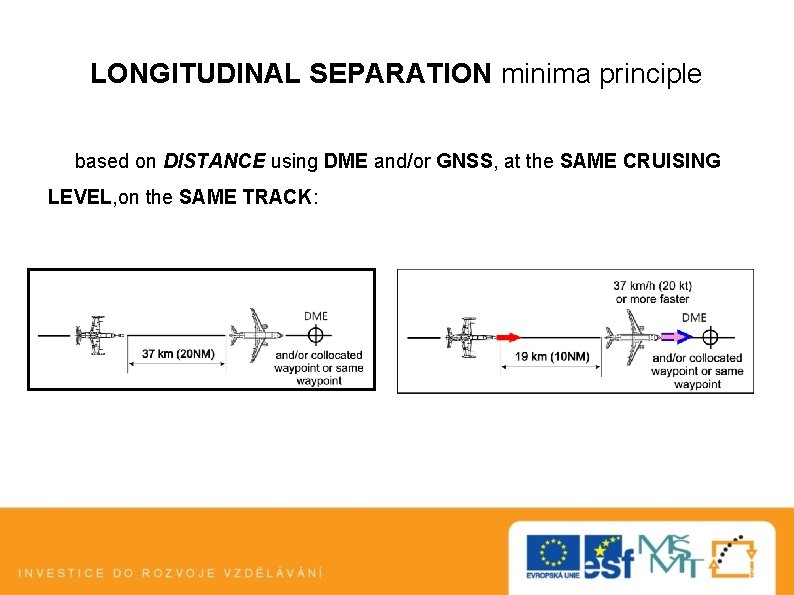
LONGITUDINAL SEPARATION minima principle based on DISTANCE using DME and/or GNSS, at the SAME CRUISING LEVEL, on the SAME TRACK:
Explain principle of Longitudinal separation. Explain principle of Lateral separation.
ATS Surveillance Services Separation minima based on ATS surveillance systems 2460 160 75 2461 160 75
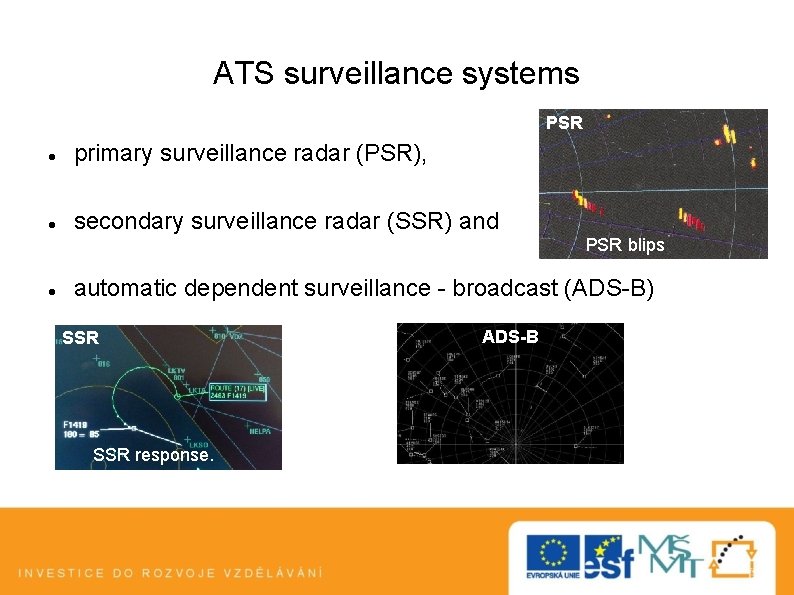
ATS surveillance systems PSR primary surveillance radar (PSR), secondary surveillance radar (SSR) and PSR blips automatic dependent surveillance - broadcast (ADS-B) SSR response. ADS-B
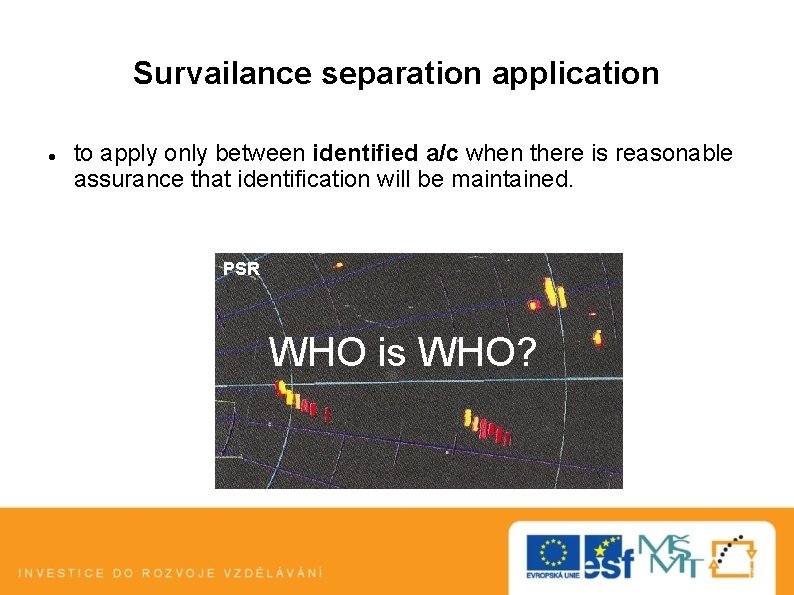
Survailance separation application to apply only between identified a/c when there is reasonable assurance that identification will be maintained. PSR WHO is WHO?
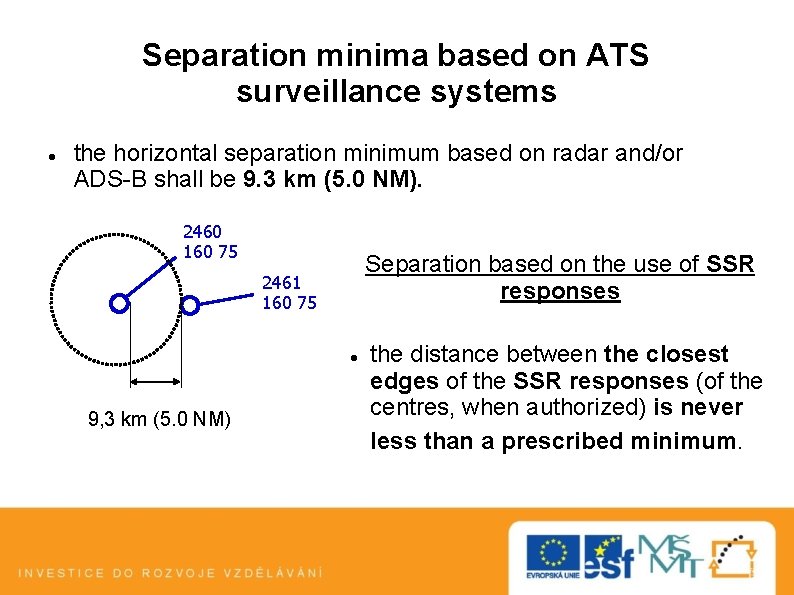
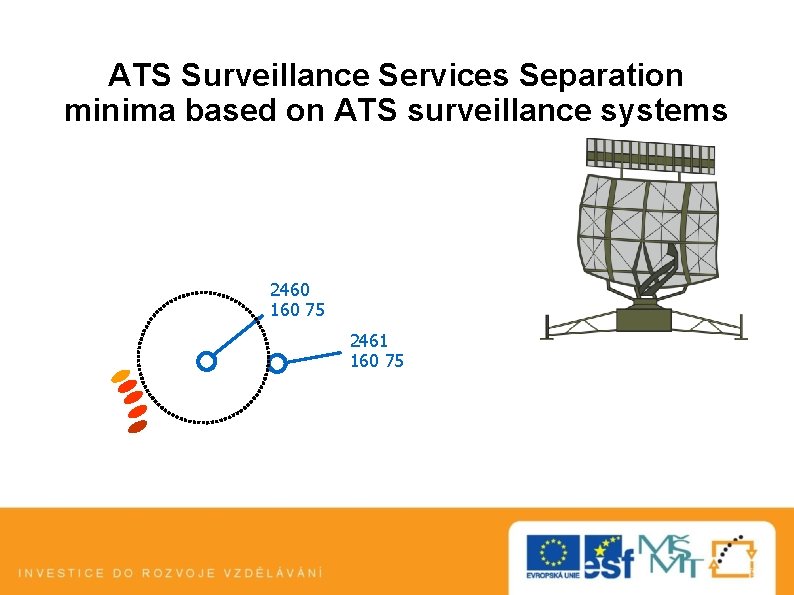
Separation minima based on ATS surveillance systems the horizontal separation minimum based on radar and/or ADS-B shall be 9. 3 km (5. 0 NM). 2460 160 75 Separation based on the use of SSR responses 2461 160 75 9, 3 km (5. 0 NM) the distance between the closest edges of the SSR responses (of the centres, when authorized) is never less than a prescribed minimum.
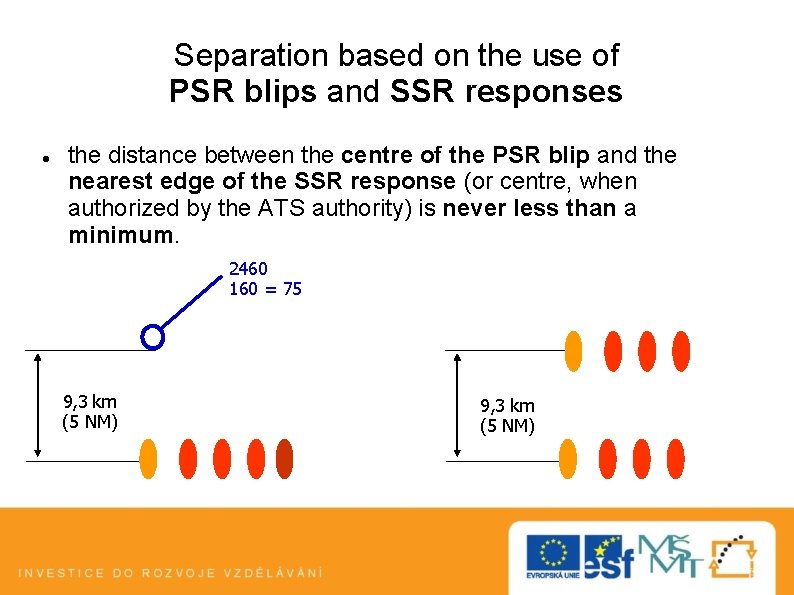
Separation based on the use of PSR blips and SSR responses the distance between the centre of the PSR blip and the nearest edge of the SSR response (or centre, when authorized by the ATS authority) is never less than a minimum. 2460 160 = 75 9, 3 km (5 NM)
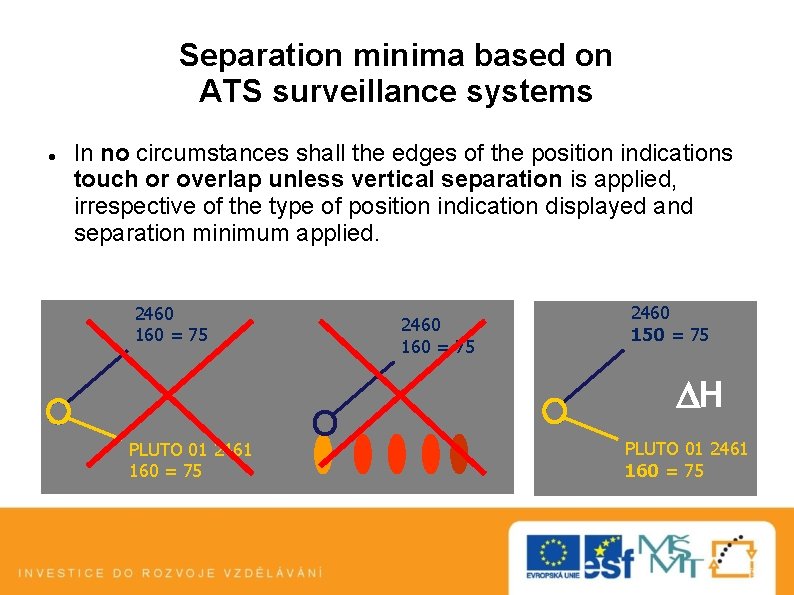
Separation minima based on ATS surveillance systems In no circumstances shall the edges of the position indications touch or overlap unless vertical separation is applied, irrespective of the type of position indication displayed and separation minimum applied. 2460 160 = 75 2460 150 = 75 H PLUTO 01 2461 160 = 75
The reduced radar separation minima The radar separation minimum may, if so prescribed by the ATS authority, be reduced, but not below: a) 5. 6 km (3. 0 NM) when radar capabilities at a given location so permit; and
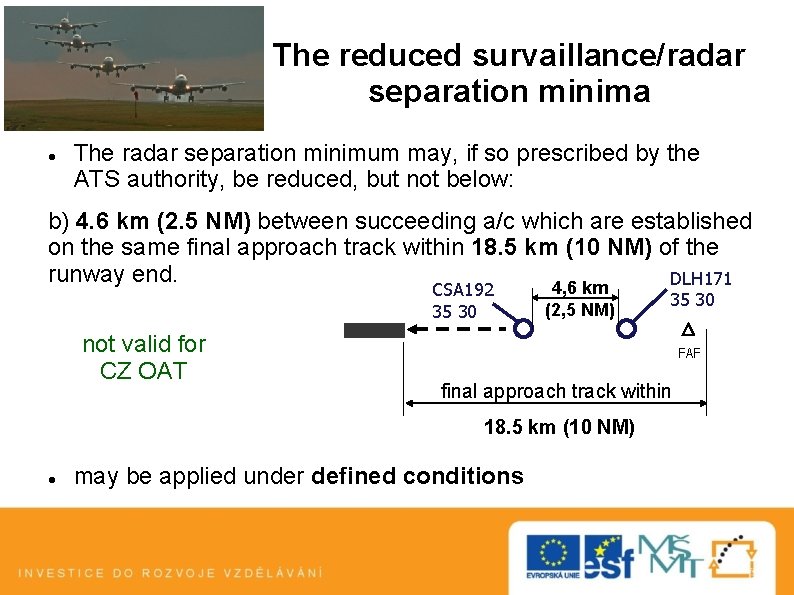
The reduced survaillance/radar separation minima The radar separation minimum may, if so prescribed by the ATS authority, be reduced, but not below: b) 4. 6 km (2. 5 NM) between succeeding a/c which are established on the same final approach track within 18. 5 km (10 NM) of the runway end. DLH 171 CSA 192 35 30 not valid for CZ OAT 4, 6 km (2, 5 NM) FAF final approach track within 18. 5 km (10 NM) 35 30 may be applied under defined conditions
Explain principle of Separation minima based on ATS surveillance systems. Only to which aircraft could be surveillance minima applied?
SUMMARY No clearance to reduce the spacing between A/C to less than the separation minimum. To provide safe ATC these types of minima are applied: 1. Vertical 2. Horizontal (Lateral, Longitudinal, Surveillance) 3. Composite
TEST MAX. 22 point MIN. 70% 10 min. 15 point
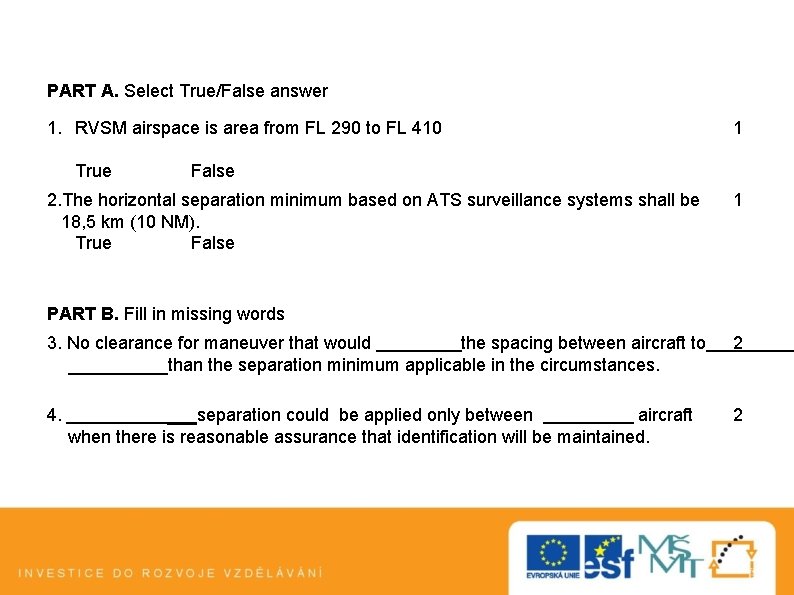
PART A. Select True/False answer 1. RVSM airspace is area from FL 290 to FL 410 True 1 False 2. The horizontal separation minimum based on ATS surveillance systems shall be 18, 5 km (10 NM). True False 1 PART B. Fill in missing words 3. No clearance for maneuver that would the spacing between aircraft to _____than the separation minimum applicable in the circumstances. 2 4. 2 ___separation could be applied only between aircraft when there is reasonable assurance that identification will be maintained.
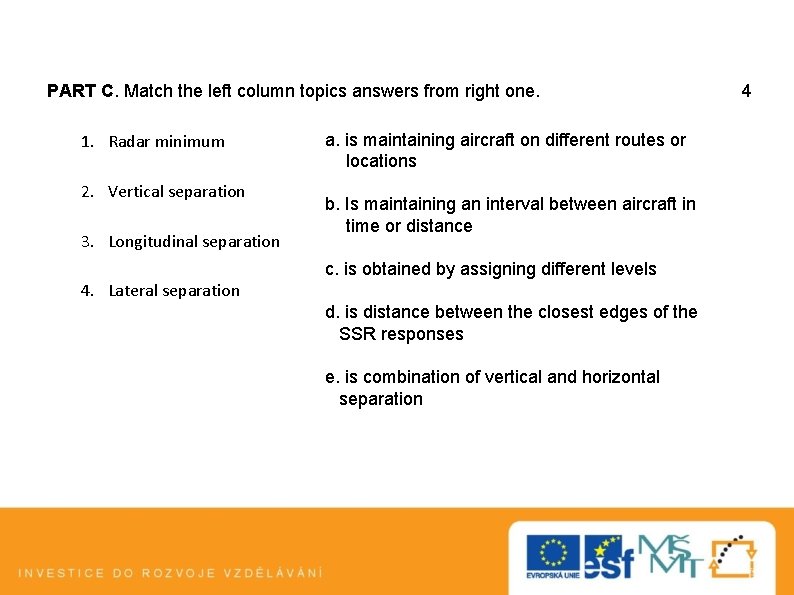
PART C. Match the left column topics answers from right one. 1. Radar minimum 2. Vertical separation 3. Longitudinal separation 4. Lateral separation a. is maintaining aircraft on different routes or locations b. Is maintaining an interval between aircraft in time or distance c. is obtained by assigning different levels d. is distance between the closest edges of the SSR responses e. is combination of vertical and horizontal separation 4
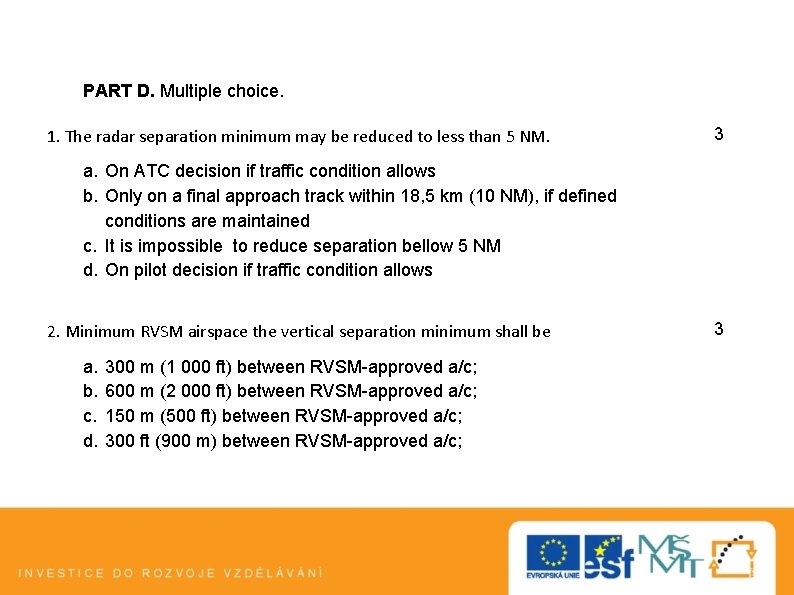
PART D. Multiple choice. 1. The radar separation minimum may be reduced to less than 5 NM. 3 a. On ATC decision if traffic condition allows b. Only on a final approach track within 18, 5 km (10 NM), if defined conditions are maintained c. It is impossible to reduce separation bellow 5 NM d. On pilot decision if traffic condition allows 2. Minimum RVSM airspace the vertical separation minimum shall be a. b. c. d. 300 m (1 000 ft) between RVSM-approved a/c; 600 m (2 000 ft) between RVSM-approved a/c; 150 m (500 ft) between RVSM-approved a/c; 300 ft (900 m) between RVSM-approved a/c; 3
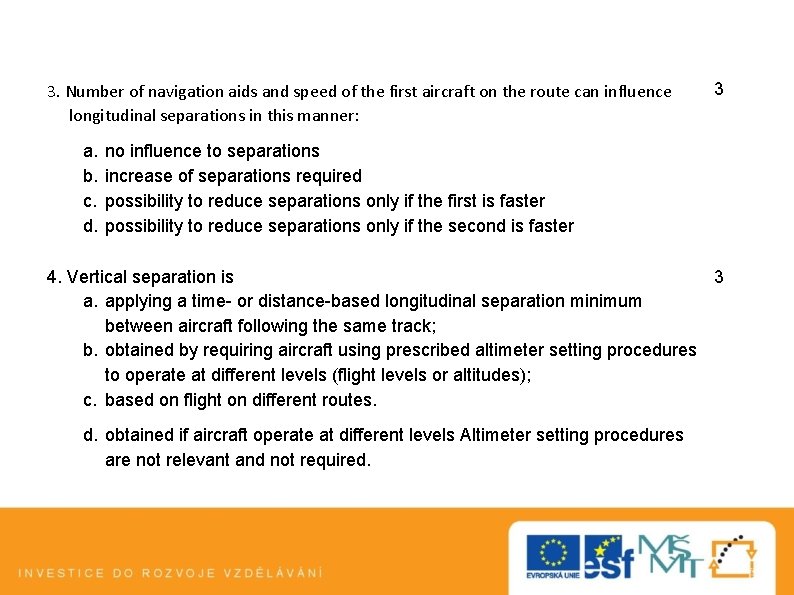
3. Number of navigation aids and speed of the first aircraft on the route can influence longitudinal separations in this manner: a. b. c. d. 3 no influence to separations increase of separations required possibility to reduce separations only if the first is faster possibility to reduce separations only if the second is faster 4. Vertical separation is 3 a. applying a time- or distance-based longitudinal separation minimum between aircraft following the same track; b. obtained by requiring aircraft using prescribed altimeter setting procedures to operate at different levels (flight levels or altitudes); c. based on flight on different routes. d. obtained if aircraft operate at different levels Altimeter setting procedures are not relevant and not required.
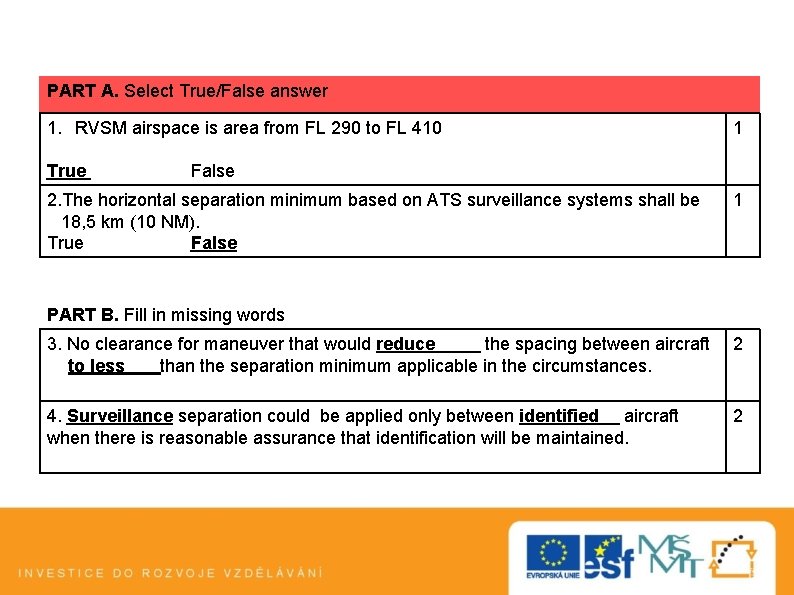
PART A. Select True/False answer 1. RVSM airspace is area from FL 290 to FL 410 True 1 False 2. The horizontal separation minimum based on ATS surveillance systems shall be 18, 5 km (10 NM). True False 1 PART B. Fill in missing words 3. No clearance for maneuver that would reduce the spacing between aircraft to less than the separation minimum applicable in the circumstances. 2 4. Surveillance separation could be applied only between identified aircraft when there is reasonable assurance that identification will be maintained. 2
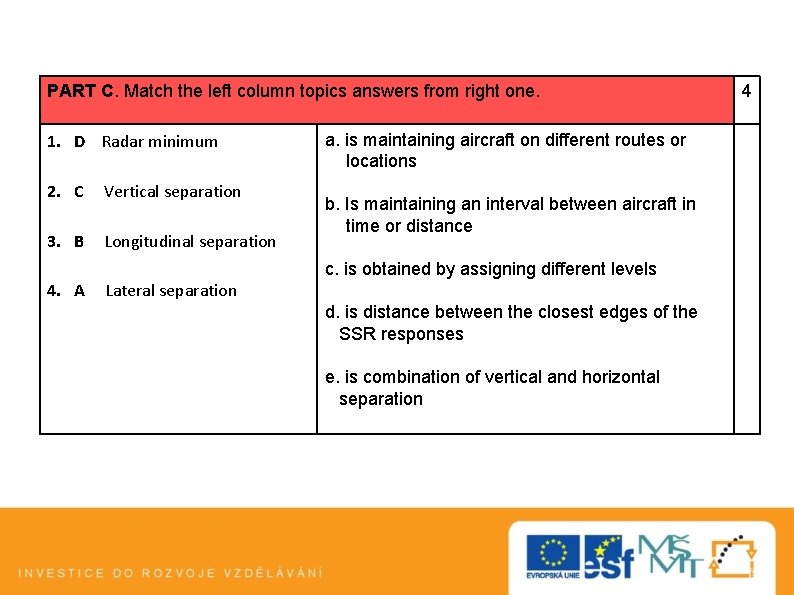
PART C. Match the left column topics answers from right one. 1. D Radar minimum 2. C Vertical separation 3. B Longitudinal separation 4. A a. is maintaining aircraft on different routes or locations b. Is maintaining an interval between aircraft in time or distance c. is obtained by assigning different levels Lateral separation d. is distance between the closest edges of the SSR responses e. is combination of vertical and horizontal separation 4
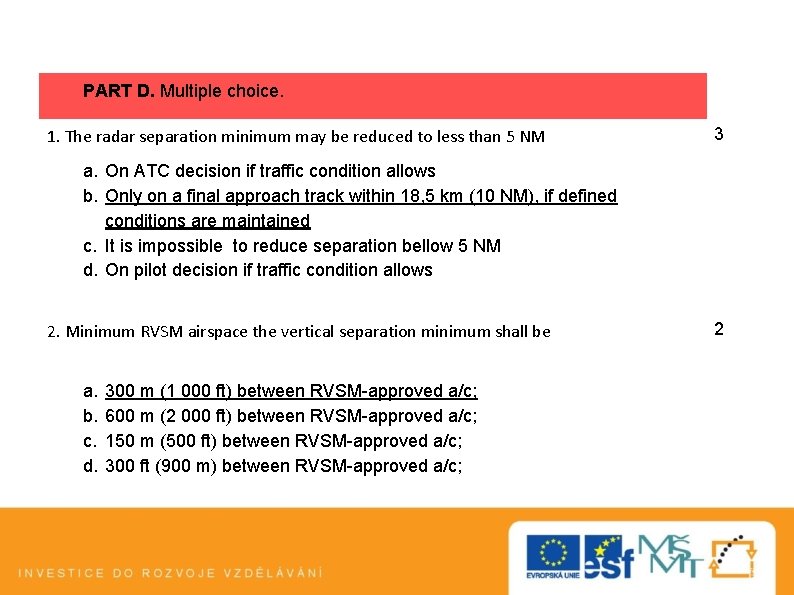
PART D. Multiple choice. 1. The radar separation minimum may be reduced to less than 5 NM 3 a. On ATC decision if traffic condition allows b. Only on a final approach track within 18, 5 km (10 NM), if defined conditions are maintained c. It is impossible to reduce separation bellow 5 NM d. On pilot decision if traffic condition allows 2. Minimum RVSM airspace the vertical separation minimum shall be a. b. c. d. 300 m (1 000 ft) between RVSM-approved a/c; 600 m (2 000 ft) between RVSM-approved a/c; 150 m (500 ft) between RVSM-approved a/c; 300 ft (900 m) between RVSM-approved a/c; 2
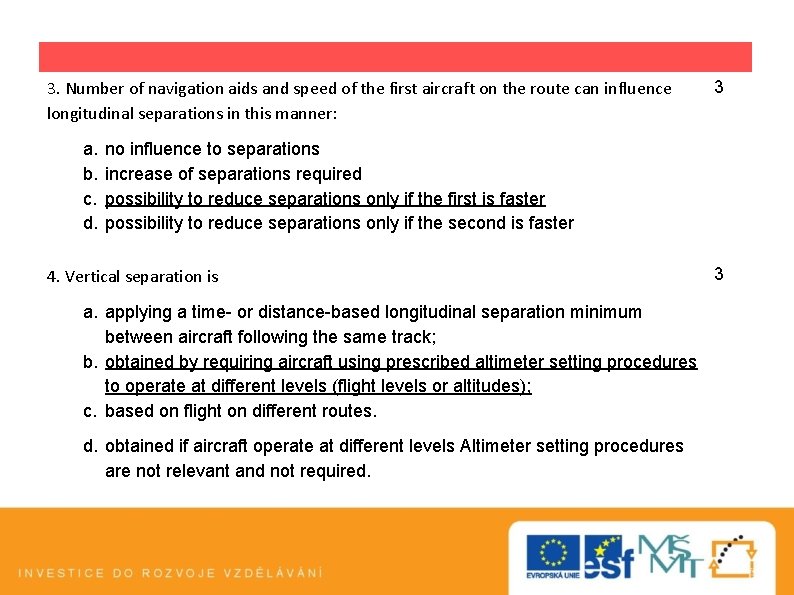
3. Number of navigation aids and speed of the first aircraft on the route can influence longitudinal separations in this manner: a. b. c. d. 3 no influence to separations increase of separations required possibility to reduce separations only if the first is faster possibility to reduce separations only if the second is faster 4. Vertical separation is a. applying a time- or distance-based longitudinal separation minimum between aircraft following the same track; b. obtained by requiring aircraft using prescribed altimeter setting procedures to operate at different levels (flight levels or altitudes); c. based on flight on different routes. d. obtained if aircraft operate at different levels Altimeter setting procedures are not relevant and not required. 3
- Slides: 44