
Basic of Magnetic Resonance Imaging SeongGi Kim Paul
Basic of Magnetic Resonance Imaging Seong-Gi Kim Paul C. Lauterbur Chair in Imaging Research Professor of Radiology, Neurobiology and Bioengineering University of Pittsburgh www. kimlab. pitt. edu
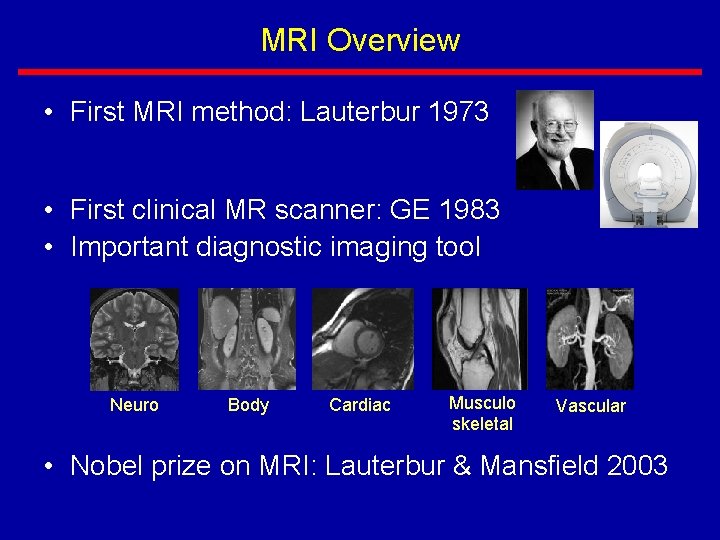
MRI Overview • First MRI method: Lauterbur 1973 • First clinical MR scanner: GE 1983 • Important diagnostic imaging tool Neuro Body Cardiac Musculo skeletal Vascular • Nobel prize on MRI: Lauterbur & Mansfield 2003
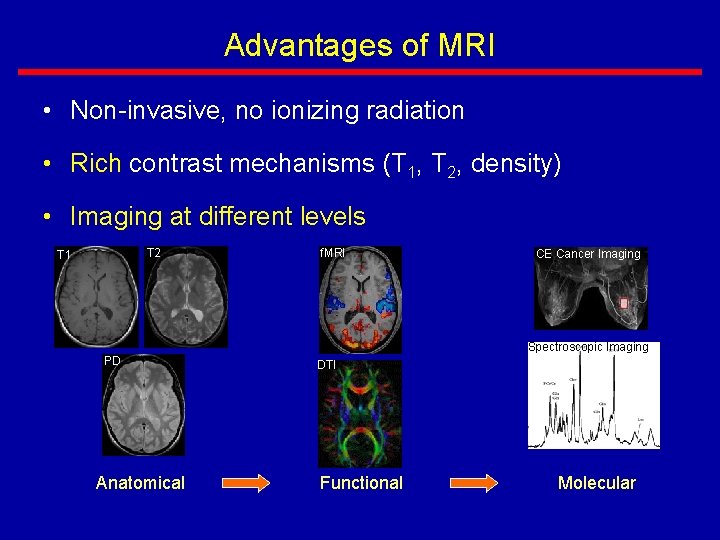
Advantages of MRI • Non-invasive, no ionizing radiation • Rich contrast mechanisms (T 1, T 2, density) • Imaging at different levels T 2 T 1 f. MRI CE Cancer Imaging Spectroscopic Imaging PD Anatomical DTI Functional Molecular
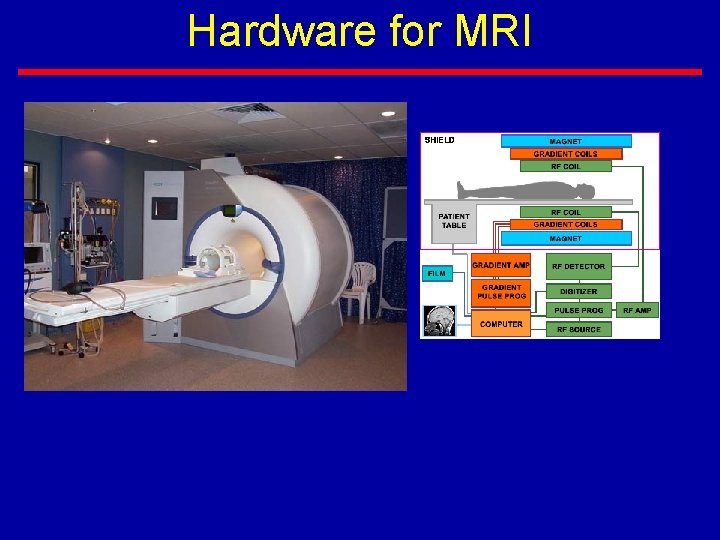
Hardware for MRI
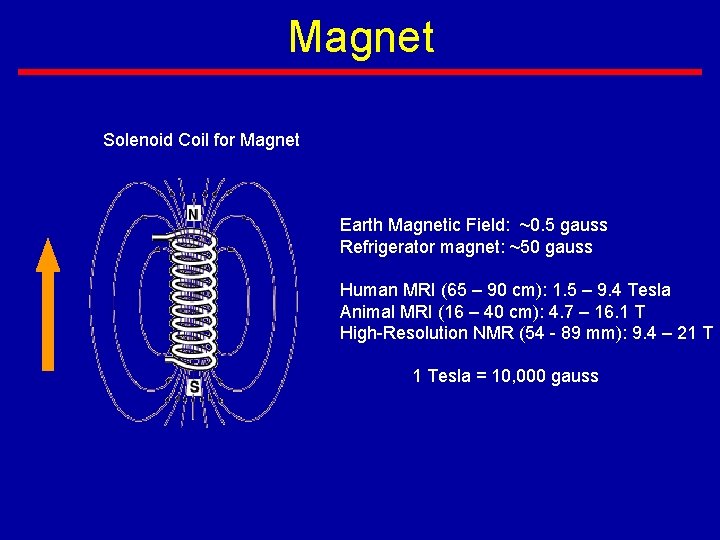
Magnet Solenoid Coil for Magnet Earth Magnetic Field: ~0. 5 gauss Refrigerator magnet: ~50 gauss Human MRI (65 – 90 cm): 1. 5 – 9. 4 Tesla Animal MRI (16 – 40 cm): 4. 7 – 16. 1 T High-Resolution NMR (54 - 89 mm): 9. 4 – 21 T 1 Tesla = 10, 000 gauss
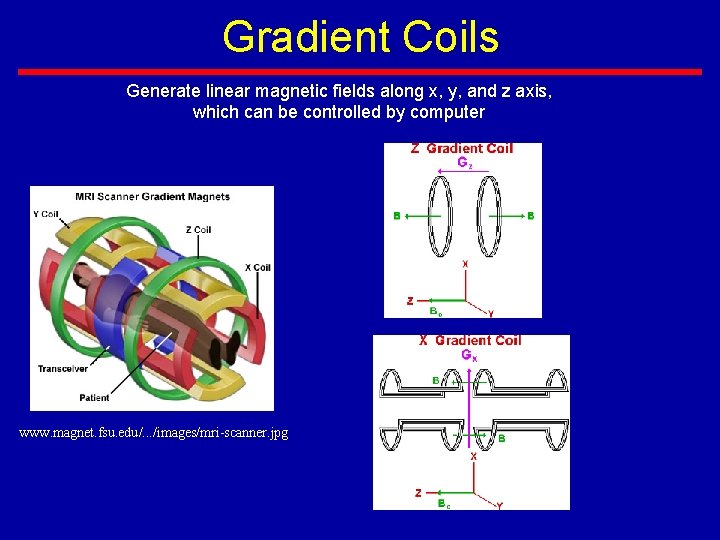
Gradient Coils Generate linear magnetic fields along x, y, and z axis, which can be controlled by computer www. magnet. fsu. edu/. . . /images/mri-scanner. jpg
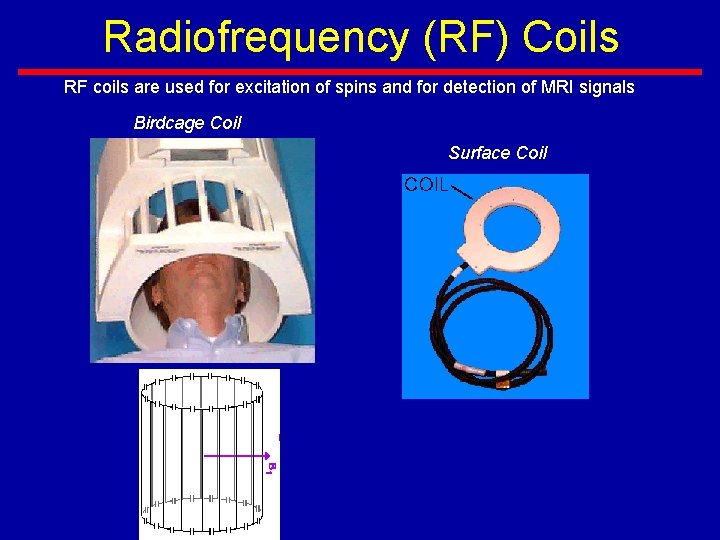
Radiofrequency (RF) Coils RF coils are used for excitation of spins and for detection of MRI signals Birdcage Coil Surface Coil
Basic NMR
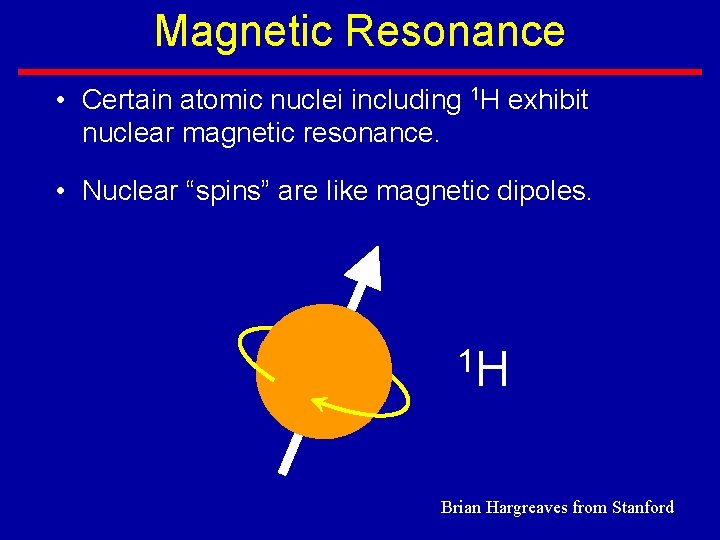
Magnetic Resonance • Certain atomic nuclei including 1 H exhibit nuclear magnetic resonance. • Nuclear “spins” are like magnetic dipoles. 1 H Brian Hargreaves from Stanford
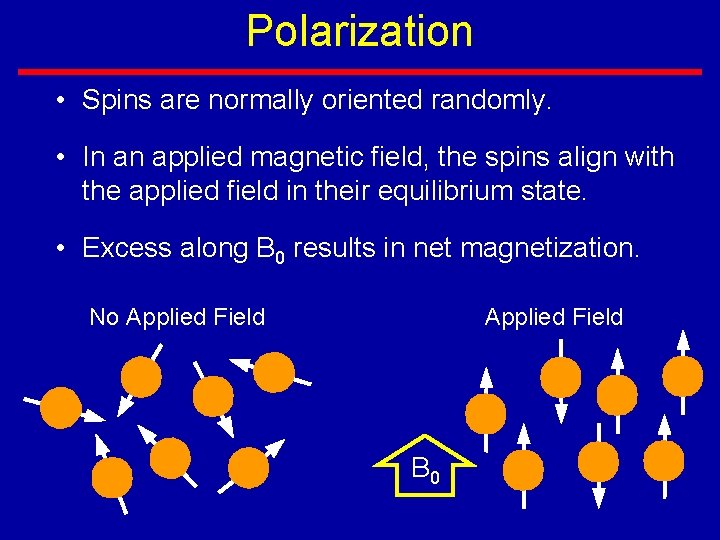
Polarization • Spins are normally oriented randomly. • In an applied magnetic field, the spins align with the applied field in their equilibrium state. • Excess along B 0 results in net magnetization. No Applied Field B 0
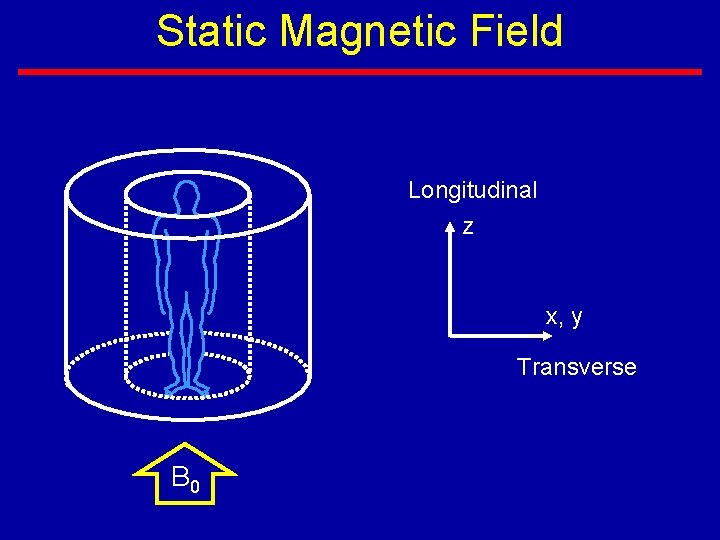
Static Magnetic Field Longitudinal z x, y Transverse B 0
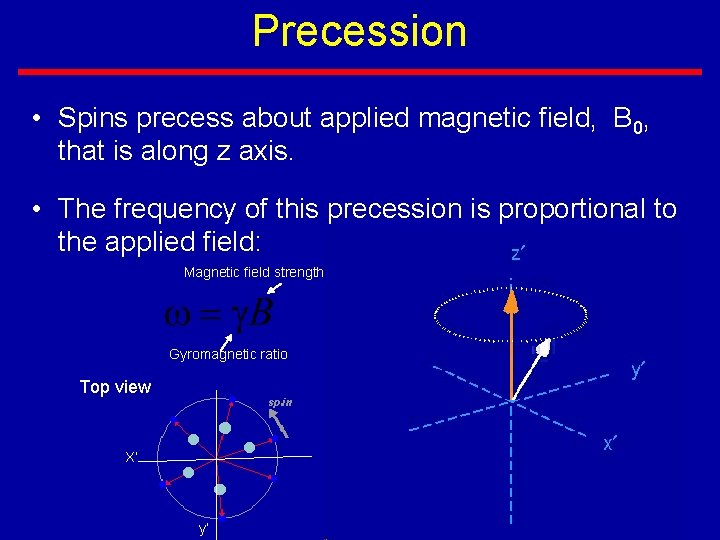
Precession • Spins precess about applied magnetic field, B 0, that is along z axis. • The frequency of this precession is proportional to the applied field: Magnetic field strength Gyromagnetic ratio Top view X’ y’
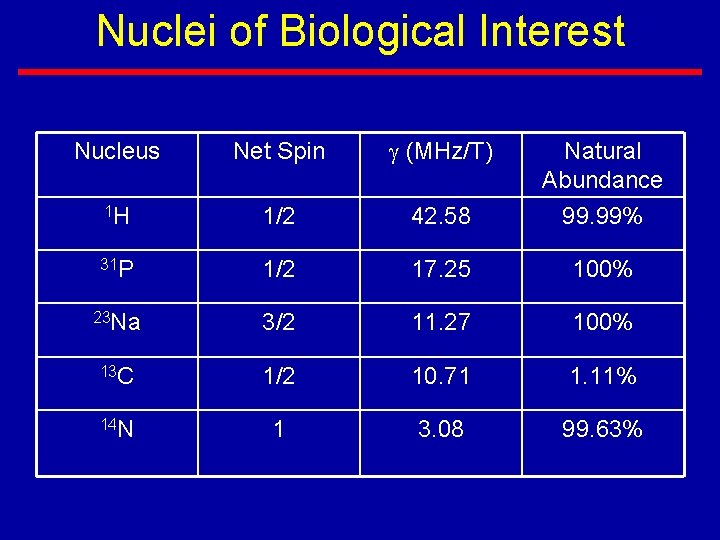
Nuclei of Biological Interest Nucleus Net Spin (MHz/T) Natural Abundance 1 H 1/2 42. 58 99. 99% 31 P 1/2 17. 25 100% 23 Na 3/2 11. 27 100% 13 C 1/2 10. 71 1. 11% 14 N 1 3. 08 99. 63%
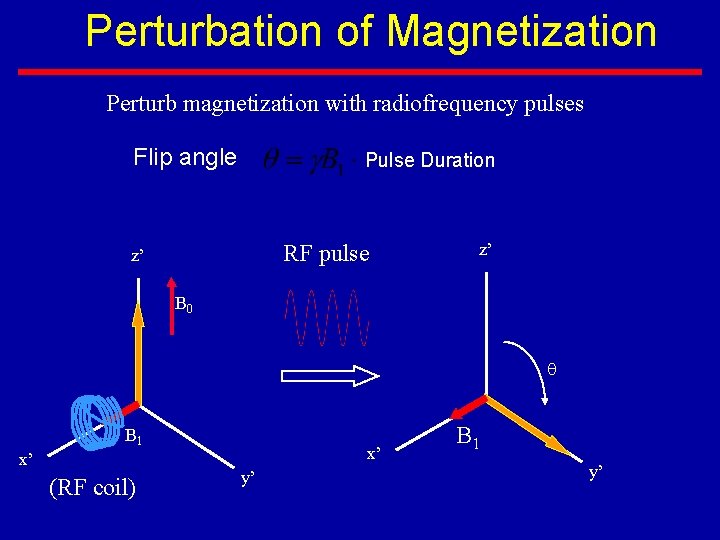
Perturbation of Magnetization Perturb magnetization with radiofrequency pulses Flip angle Pulse Duration RF pulse z’ z’ B 0 B 1 x’ (RF coil) x’ y’ B 1 y’
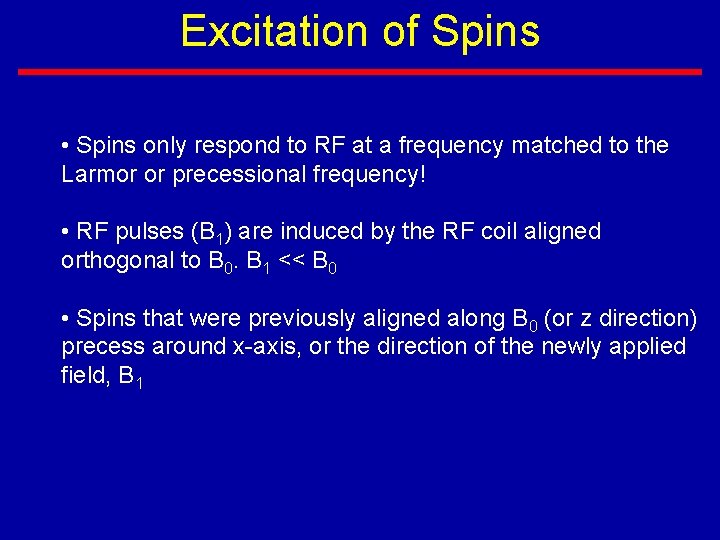
Excitation of Spins • Spins only respond to RF at a frequency matched to the Larmor or precessional frequency! • RF pulses (B 1) are induced by the RF coil aligned orthogonal to B 0. B 1 << B 0 • Spins that were previously aligned along B 0 (or z direction) precess around x-axis, or the direction of the newly applied field, B 1
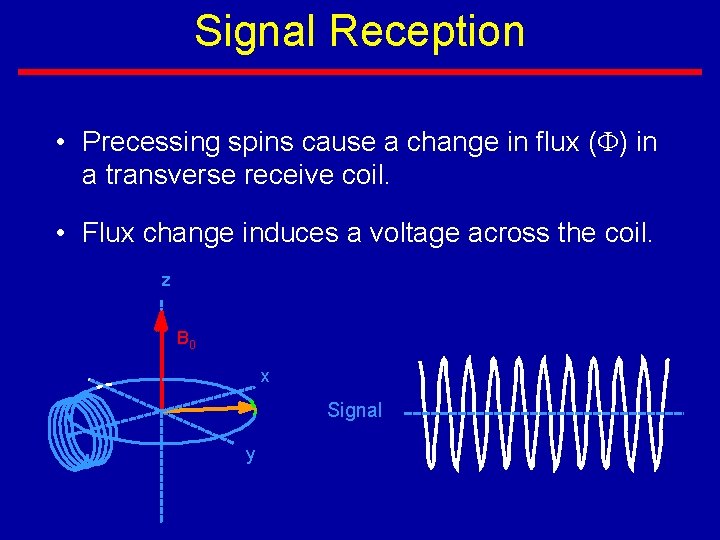
Signal Reception • Precessing spins cause a change in flux (F) in a transverse receive coil. • Flux change induces a voltage across the coil. z B 0 x Signal y

Signal Reception • The detected signal is at the Larmor frequency • One can only receive the signal when axis of detection coil is perpendicular to B 0 • The signal loses by dephasing of spins
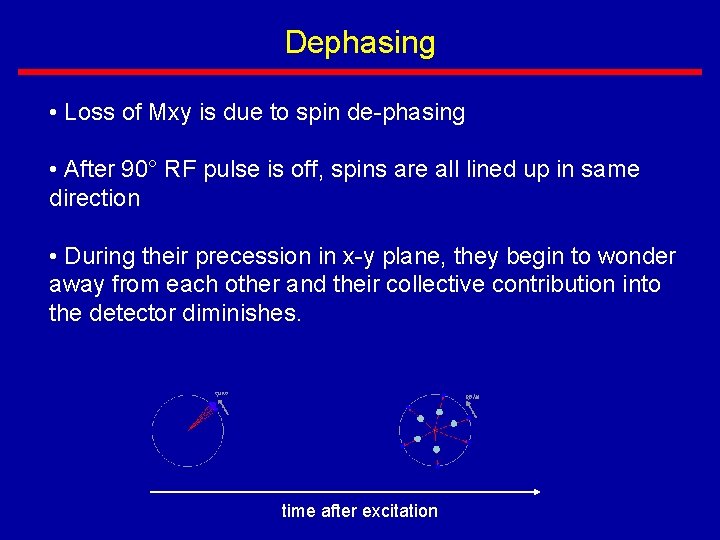
Dephasing • Loss of Mxy is due to spin de-phasing • After 90° RF pulse is off, spins are all lined up in same direction • During their precession in x-y plane, they begin to wonder away from each other and their collective contribution into the detector diminishes. time after excitation
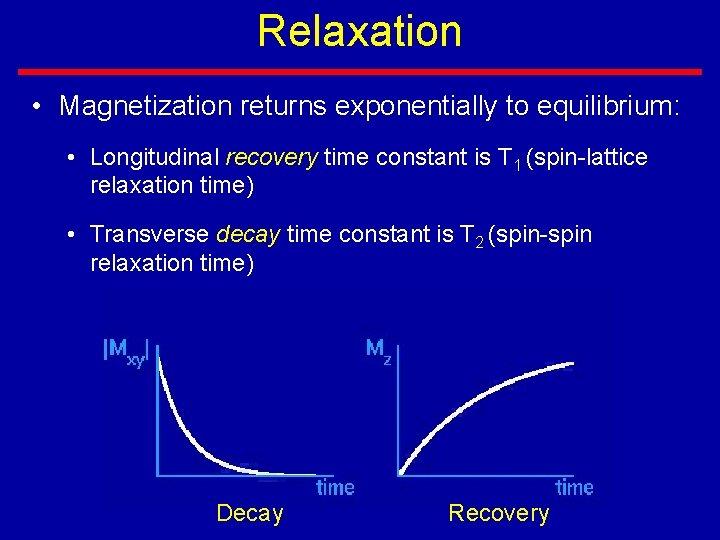
Relaxation • Magnetization returns exponentially to equilibrium: • Longitudinal recovery time constant is T 1 (spin-lattice relaxation time) • Transverse decay time constant is T 2 (spin-spin relaxation time) Decay Recovery
Relaxation • T 1 and T 2 are due to independent processes • Generally T 2 < T 1 • Dependent on tissue type and magnetic field
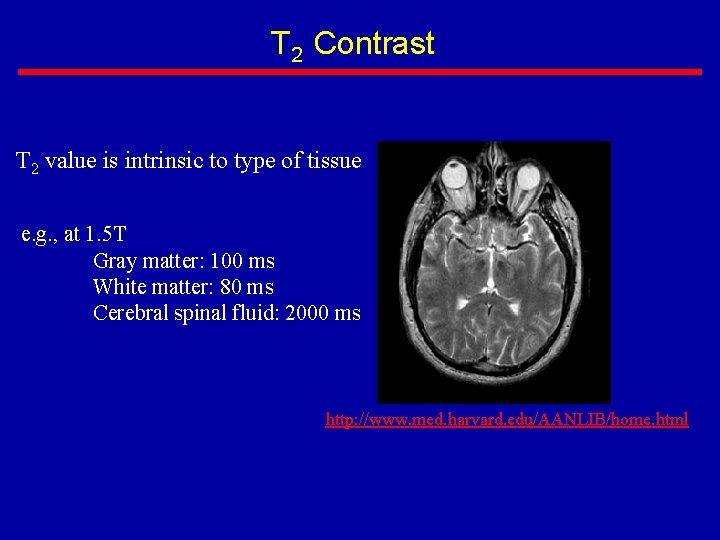
T 2 Contrast T 2 value is intrinsic to type of tissue e. g. , at 1. 5 T Gray matter: 100 ms White matter: 80 ms Cerebral spinal fluid: 2000 ms http: //www. med. harvard. edu/AANLIB/home. html
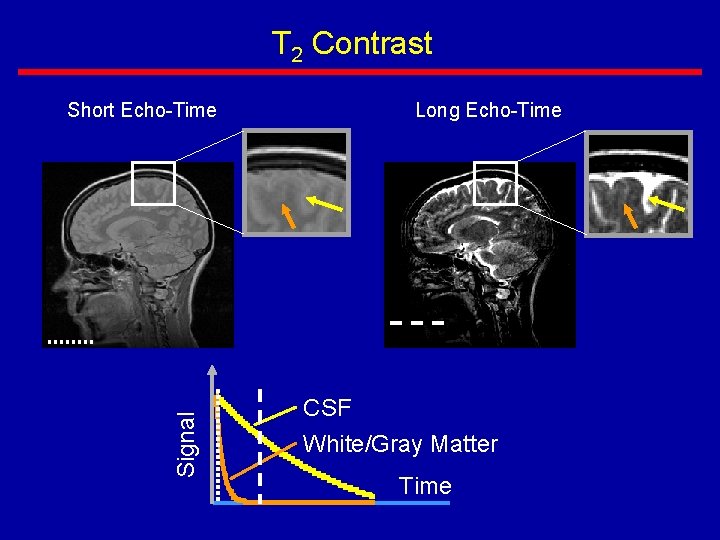
T 2 Contrast Signal Short Echo-Time Long Echo-Time CSF White/Gray Matter Time
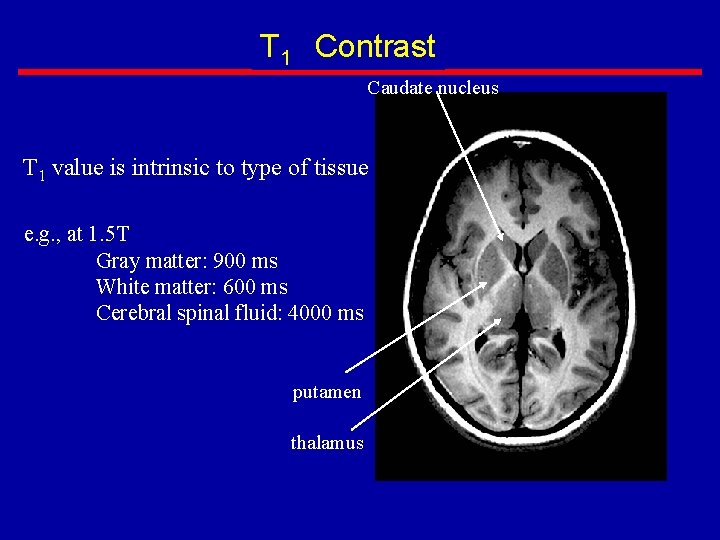
T 1 Contrast Caudate nucleus T 1 value is intrinsic to type of tissue e. g. , at 1. 5 T Gray matter: 900 ms White matter: 600 ms Cerebral spinal fluid: 4000 ms putamen thalamus
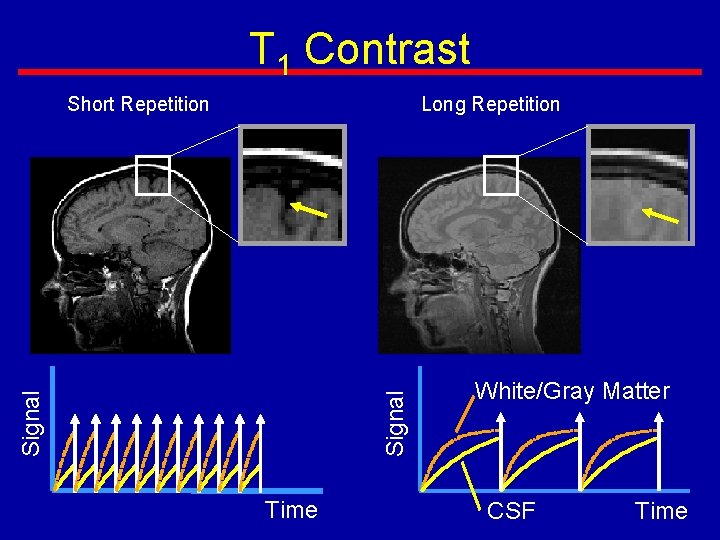
T 1 Contrast Signal Long Repetition Signal Short Repetition Time White/Gray Matter CSF Time
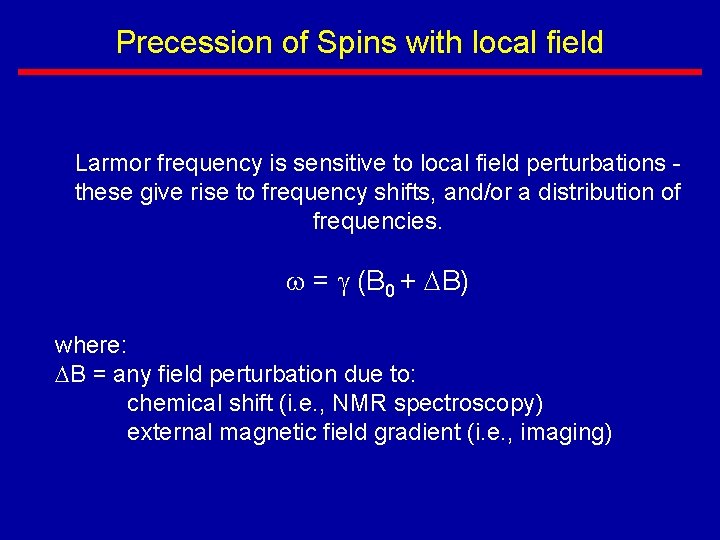
Precession of Spins with local field Larmor frequency is sensitive to local field perturbations these give rise to frequency shifts, and/or a distribution of frequencies. w = (B 0 + B) where: B = any field perturbation due to: chemical shift (i. e. , NMR spectroscopy) external magnetic field gradient (i. e. , imaging)
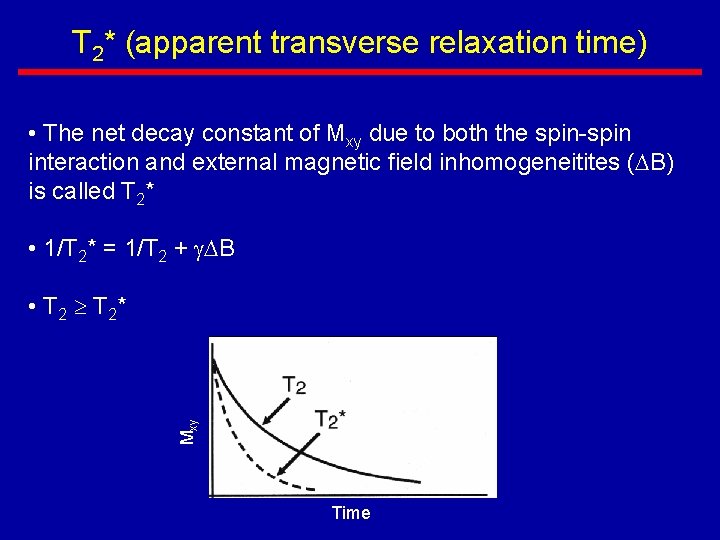
T 2* (apparent transverse relaxation time) • The net decay constant of Mxy due to both the spin-spin interaction and external magnetic field inhomogeneitites ( B) is called T 2* • 1/T 2* = 1/T 2 + B Mxy • T 2* Time
How to measure T 2 • How to acquire the MRI signal without the dephasing contribution from static external magnetic field inhomogeneities ( B), or T 2* effects • Solution: use a spin-echo! • Spin-echo signal detection is one of the most common methods used in MRI
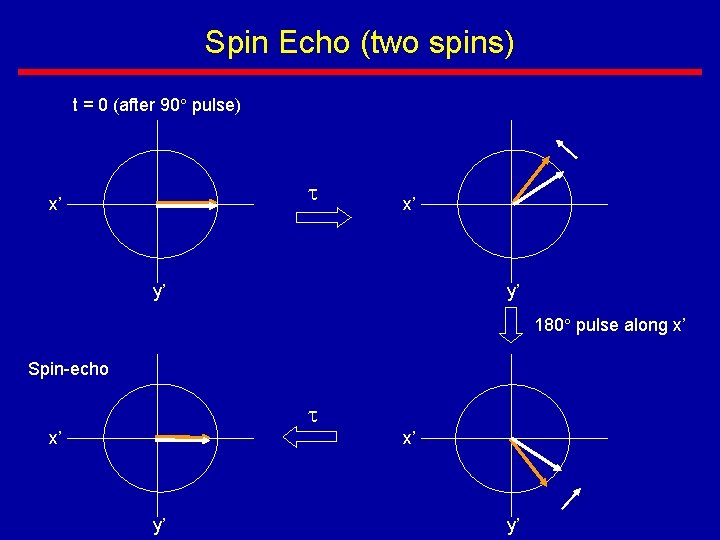
Spin Echo (two spins) t = 0 (after 90 pulse) x’ x’ y’ y’ 180 pulse along x’ Spin-echo x’ x’ y’ y’
Spin Echo • The amazing property of the spin-echo is that the dephasing contribution from static magnetic field inhomogeneity is refocused and thus eliminated. • The amplitude of the spin-echo is independent of T 2*, but depends on T 2 • One cannot refocus dephasing due to the microscopic spin-spin interaction (T 2)
Magnetic Field Gradients • Spatial information is obtained by the application of magnetic field gradients (i. e. a magnetic field that changes from point-topoint). • Gradients are denoted as Gx, Gy, Gz, corresponding to the x, y, or z directions. Any combination of Gx, Gy, Gz can be applied to get a gradient along an arbitrary direction (gradients are vector quantities). • Depending on the gradient’s function, these gradients are called – Slice-select gradient – The read or frequency-encoding gradient – The phase-encoding gradient
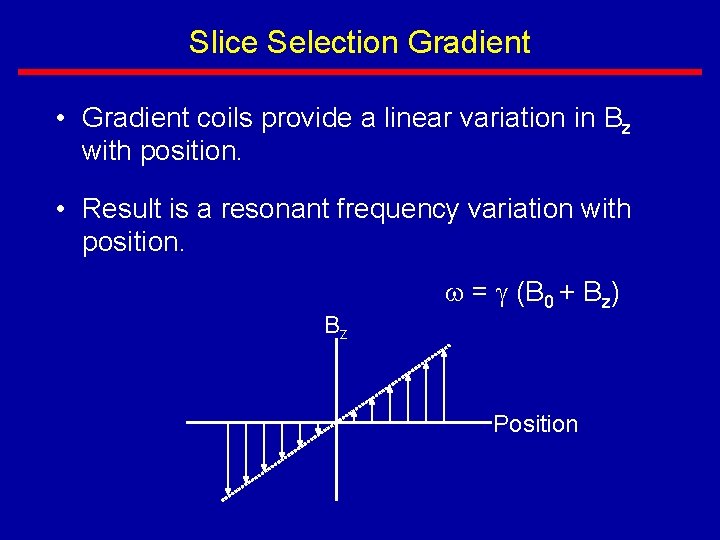
Slice Selection Gradient • Gradient coils provide a linear variation in Bz with position. • Result is a resonant frequency variation with position. Bz w = (B 0 + Bz) Position
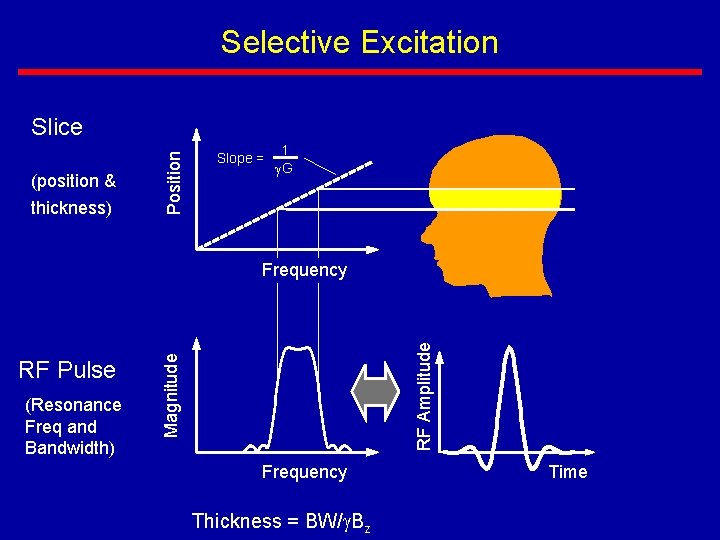
Selective Excitation (position & thickness) Position Slice Slope = 1 G (Resonance Freq and Bandwidth) Magnitude RF Pulse RF Amplitude Frequency Thickness = BW/ Bz Time
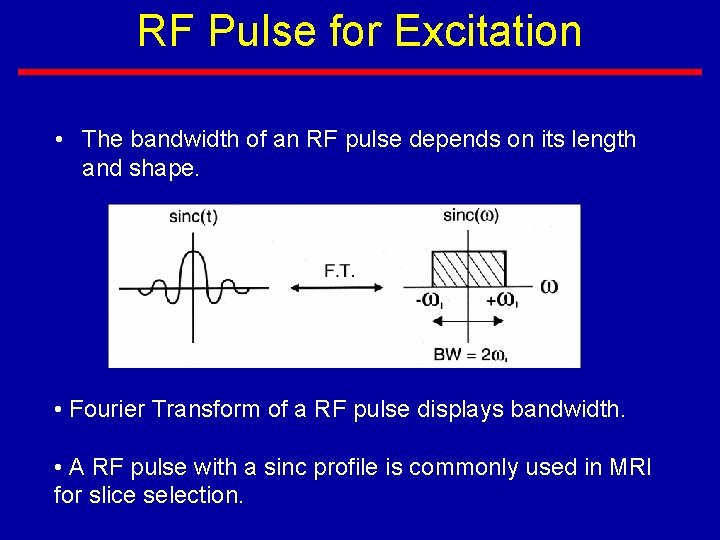
RF Pulse for Excitation • The bandwidth of an RF pulse depends on its length and shape. • Fourier Transform of a RF pulse displays bandwidth. • A RF pulse with a sinc profile is commonly used in MRI for slice selection.
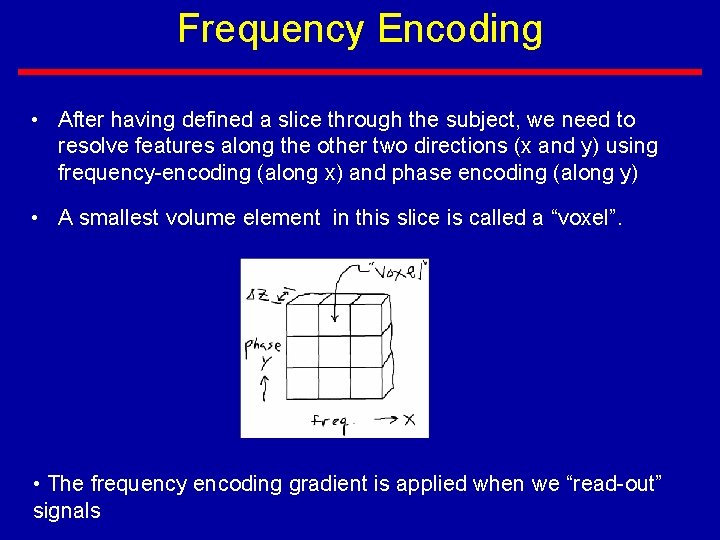
Frequency Encoding • After having defined a slice through the subject, we need to resolve features along the other two directions (x and y) using frequency-encoding (along x) and phase encoding (along y) • A smallest volume element in this slice is called a “voxel”. • The frequency encoding gradient is applied when we “read-out” signals
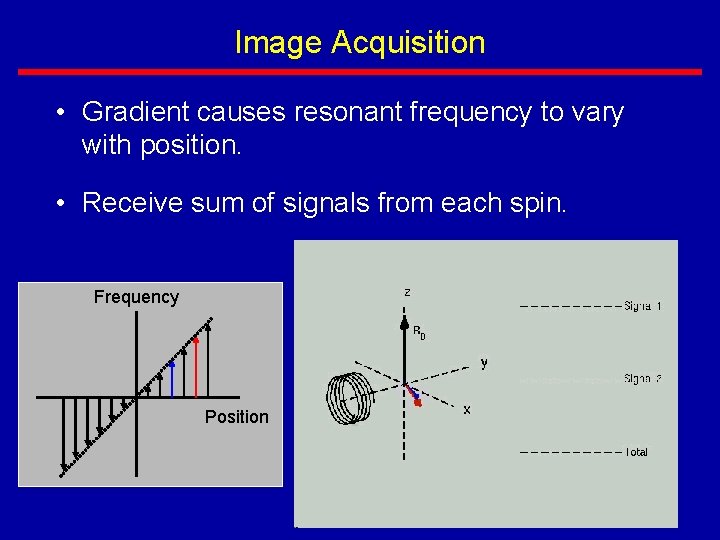
Image Acquisition • Gradient causes resonant frequency to vary with position. • Receive sum of signals from each spin. Frequency Position
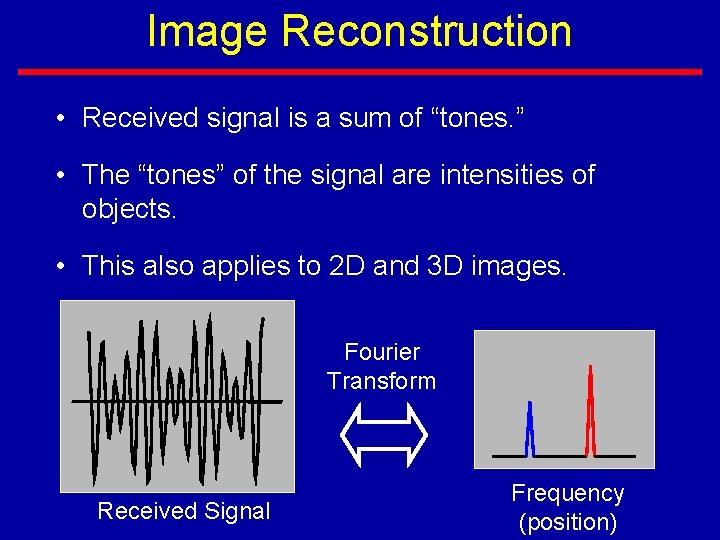
Image Reconstruction • Received signal is a sum of “tones. ” • The “tones” of the signal are intensities of objects. • This also applies to 2 D and 3 D images. Fourier Transform Received Signal Frequency (position)
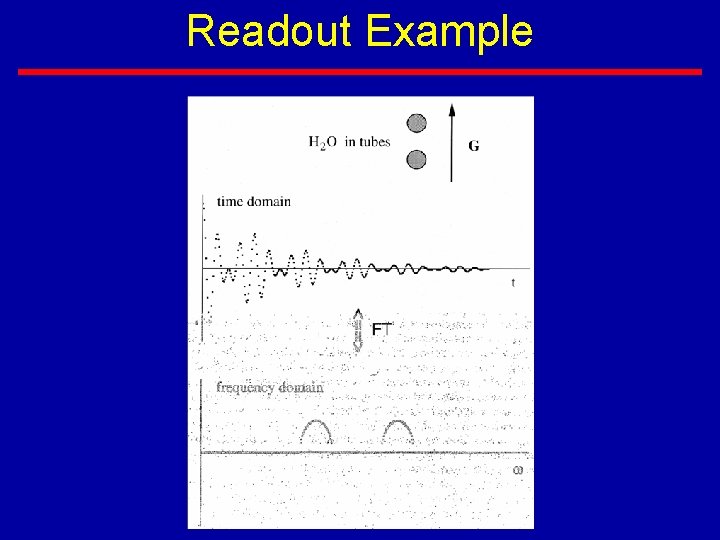
Readout Example
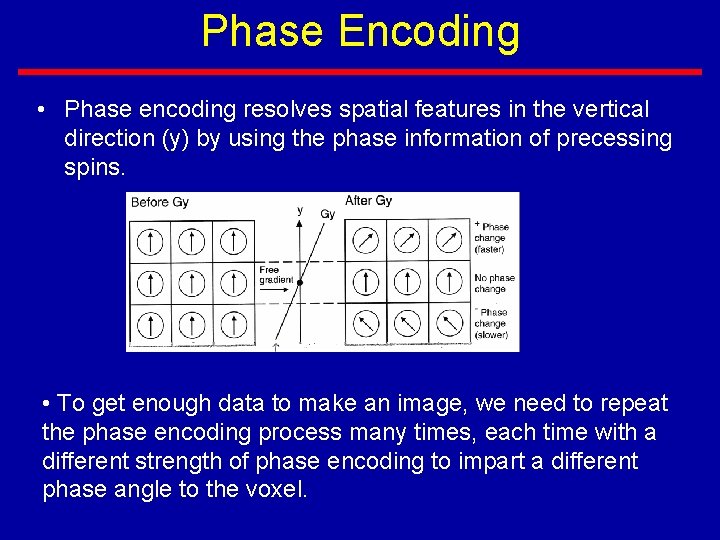
Phase Encoding • Phase encoding resolves spatial features in the vertical direction (y) by using the phase information of precessing spins. • To get enough data to make an image, we need to repeat the phase encoding process many times, each time with a different strength of phase encoding to impart a different phase angle to the voxel.
Number of Phase Encoding Step • The # of phase encoding steps = # of rows in image (i. e. the resolution in the y -direction). • The phase shift between adjacent rows is = 360° / # rows
Pulse Sequences • Excitation and imaging are separate. • Pulse sequence controls: • RF excitation • Gradient waveforms • Acquisition • Reconstruction information as well.
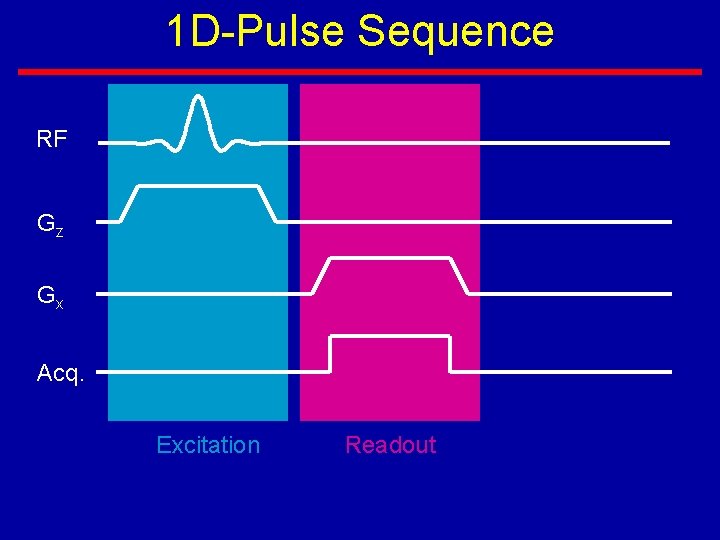
1 D-Pulse Sequence RF Gz Gx Acq. Excitation Readout
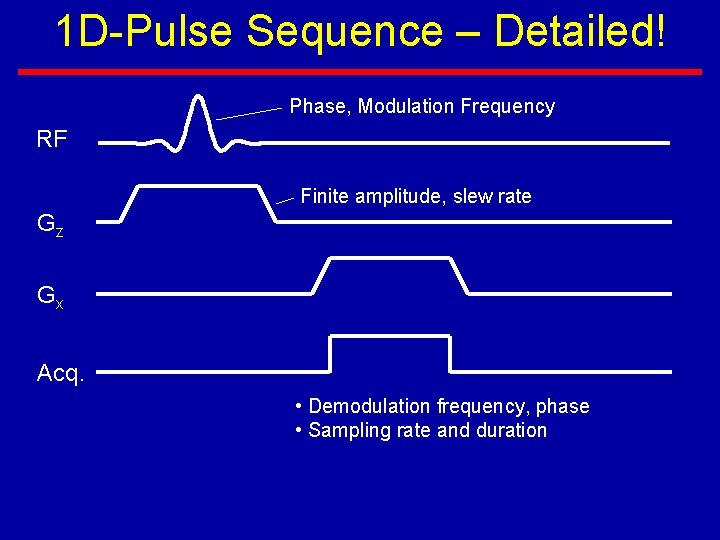
1 D-Pulse Sequence – Detailed! Phase, Modulation Frequency RF Finite amplitude, slew rate Gz Gx Acq. • Demodulation frequency, phase • Sampling rate and duration
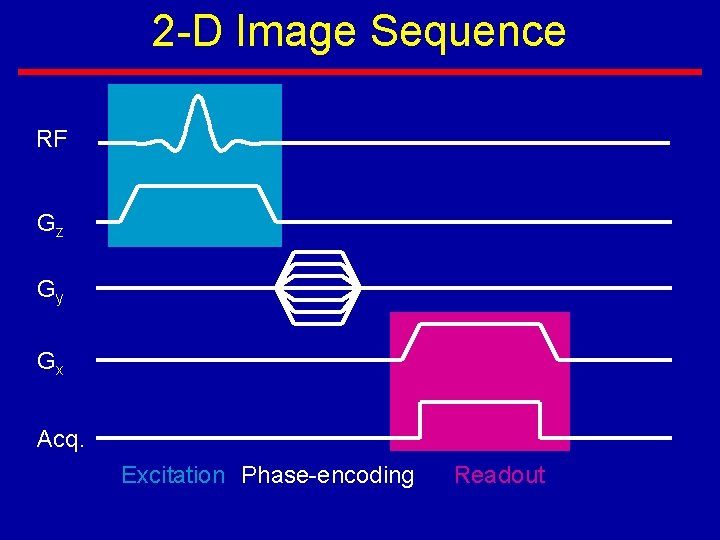
2 -D Image Sequence RF Gz Gy Gx Acq. Excitation Phase-encoding Readout
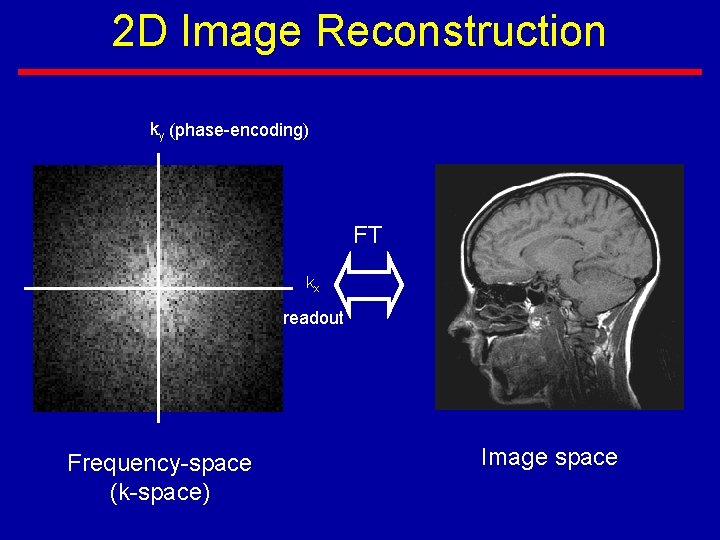
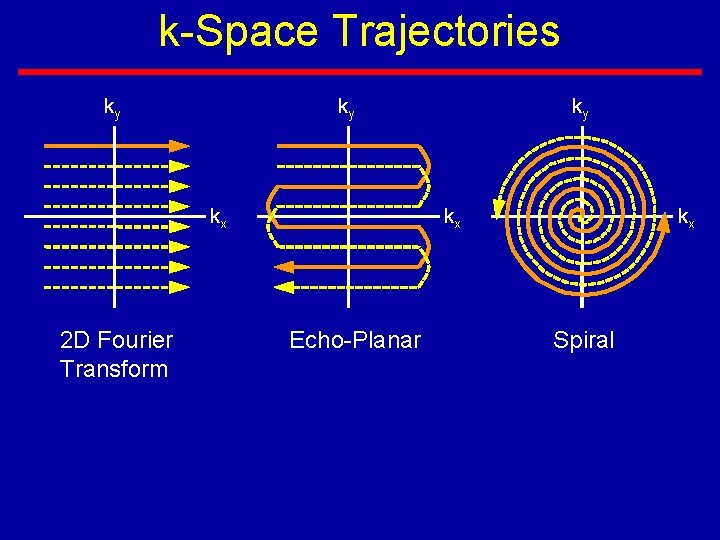
2 D Image Reconstruction ky (phase-encoding) FT kx readout Frequency-space (k-space) Image space
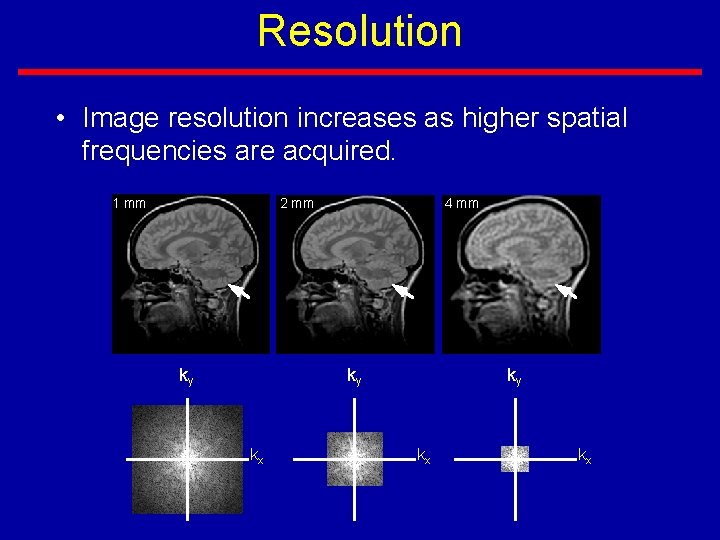
Resolution • Image resolution increases as higher spatial frequencies are acquired. 1 mm 2 mm ky 4 mm ky kx kx
k-Space Trajectories ky ky kx 2 D Fourier Transform ky kx Echo-Planar kx Spiral
- Slides: 46