
Basic Nursing Foundations of Skills Concepts Chapter 8
Basic Nursing: Foundations of Skills & Concepts Chapter 8 COMMUNICATION
Communication n The sending and receiving of a message.
Aspects of Communication (i) Sender - the one who conveys the message to another person. n Message - the thought, idea, or emotion conveyed. n Channel - how the message is sent. n
Aspects of Communication (ii) Receiver - physiological/ psychological components. n Feedback - the receiver’s response to the sender. n Influences - Culture, education, emotions and other factors involved. n
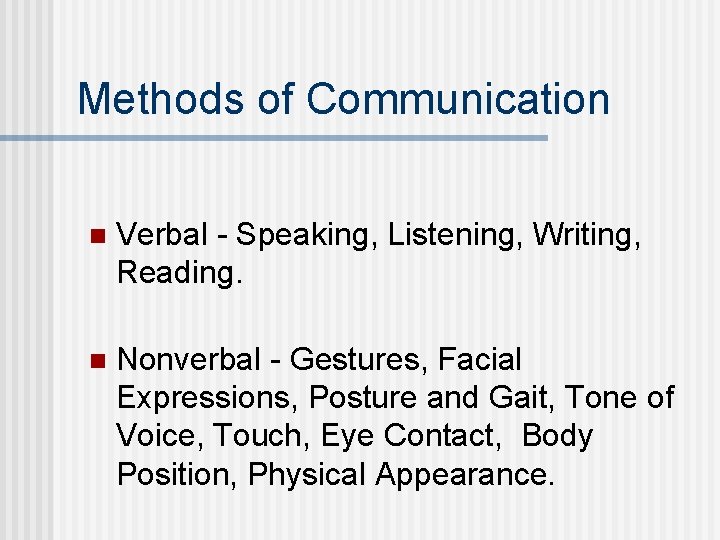
Methods of Communication n Verbal - Speaking, Listening, Writing, Reading. n Nonverbal - Gestures, Facial Expressions, Posture and Gait, Tone of Voice, Touch, Eye Contact, Body Position, Physical Appearance.
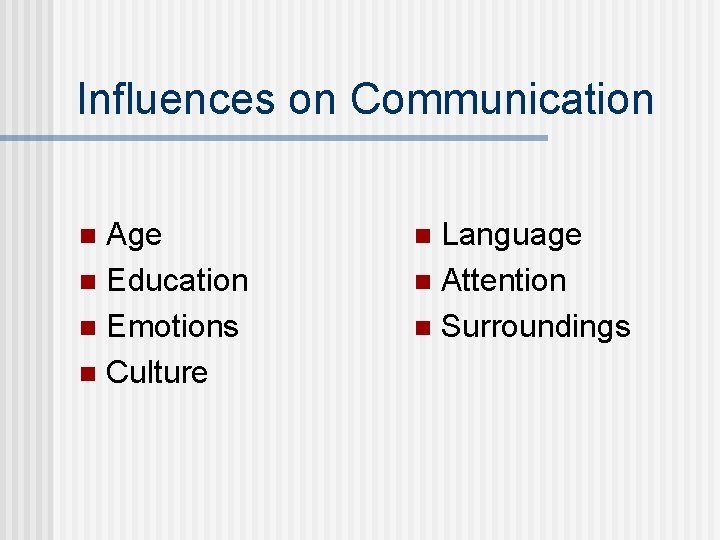
Influences on Communication Age n Education n Emotions n Culture n Language n Attention n Surroundings n
Congruency of Messages § Verbal and nonverbal communication must be congruent, or in agreement.
Listening and Observing § Listening and observing are two of the most valuable skills a nurse can have. § These two skills are used to gather the subjective and objective data for the nursing assessment.
Active Listening § The process of hearing spoken words and noting nonverbal behavior. § Active listening takes energy and concentration.
Therapeutic Communication § Sometimes called effective communication, it is purposeful and goal-oriented, creating a beneficial outcome for the client.
Goals of Therapeutic Communication To obtain or provide information n To develop trust n To show caring n To explore feelings n
Enhancing Communication n n n Self-Disclosure. Caring. Genuineness. Warmth. Active Listening. Empathy (the capacity to understand another’s feelings). Acceptance and respect.
Communication Techniques n n n n Clarifying/validating. Asking open questions. Using indirect statements. Reflecting. Paraphrasing. Summarizing. Focusing. Silence.
Barriers Communication Some barriers include: n n n n Closed questions. False reassurance. Judgmental responses. Defensive reflex. Agreeing/Disagreeing or Approving/ Disapproving. Giving advice. Requesting an explanation. Changing the subject.
Psychosocial Aspects of Communication Style. n Gestures. n Meaning of time. n Meaning of space. n Cultural values. n Political correctness. n
Style Three types of style: § Passive - apologetic, weak, makes little eye contact, often fidgety. § Aggressive - haughty, angry, demanding, shows no concern for anyone else’s feelings § Assertive - honest, direct, firm, makes eye contact, confident, respectful of others.
Gestures § Movements of the hands and arms. § Nurses must be sensitive to cultural variances with regard to gestures.
Meaning of Time § In the U. S. , great emphasis is placed on time and schedules. Being on time is very important. § In other cultures, such emphasis is not placed on time.
Meaning of Space § Human beings all observe rules around comfort zones—the distance observed between two people. Such comfort zones include: n n Intimate: touch to 18 inches Personal: 18 inches to 4 feet Social: 4 feet to 12 feet Public: 12 feet or more
Cultural Values n A nurse should be familiar with the cultural values of the people in the nurse’s region of employment. n A nurse needs to be aware of those times when her values differ from the values of the dominant culture.
Political Correctness n To be politically correct in communication means to use language sensitive to those who are different from oneself.
Nurse-Client Communication n Almost every nurse-client interaction should involve therapeutic communication. n Nurse-client communication is influenced by both the nurse and the client.
Three Phases of Nurse-Client Communication n Introduction: Fairly short; expectations clarified; mutual goals set n Working: Major portion of the interaction; used to accomplish goals outlined in introduction; feedback from client essential. n Termination: Nurse asks if client has questions; summarizing the topic is another way to indicate closure.
Determinant Factors in Communication A nurse’s communication is affected by: n n n Past Experience State of Health Home Situation Workload Staff Relations Self-Awareness
Determinant Factors in Communication A client’s communication is affected by: n n n n Social Factors Religion Family Situation Level of Consciousness Stage of Illness Visual, Hearing and Speech Ability Language Proficiency
Communication within the Health Care Team § Providing care is a team effort. § To ensure efficiency and effectiveness, effective communication is necessary. § This communication may be oral or written.
The Nurse’s Ways of Communication n Oral n Written n Self-Reflection
Oral Communication Nurses communicate within many different relationships, each with their own rules. n n n Nurse-Nurse-Nursing Assistant Nurse-Student Nurse-Physician Nurse-Other Health Professionals Group Communication (I. e. client-care conferences)
Written Communication Nurses’ communications are often written: n n On charts Requisitions for x-rays and other tests and services Electronic communications, via computer Telemedicine: the use of communications technology to transmit health information from one location to another.
Self-Reflection Nurses often engage in internal dialogue: n Positive self-talk: Saying positive thoughts aloud; thinking, saying and hearing positive statements about yourself n Negative self-talk: Self-destructive. Your self-image is lowered by your own criticism.
Communicating With Yourself n Positive self-talk: Saying positive thoughts aloud; thinking, saying and hearing positive statements about yourself n Negative self-talk: Self-destructive. Your self-image is lowered by your own criticism.
- Slides: 31