
Basic Navigation Leading Cadet Training Practical Navigation Lecture
Basic Navigation Leading Cadet Training Practical Navigation Lecture 4
Aids to Navigation Good navigators will not rely solely on accurate compass work & good distance measurement to find their way around. They will use a number of techniques to improve their navigation:
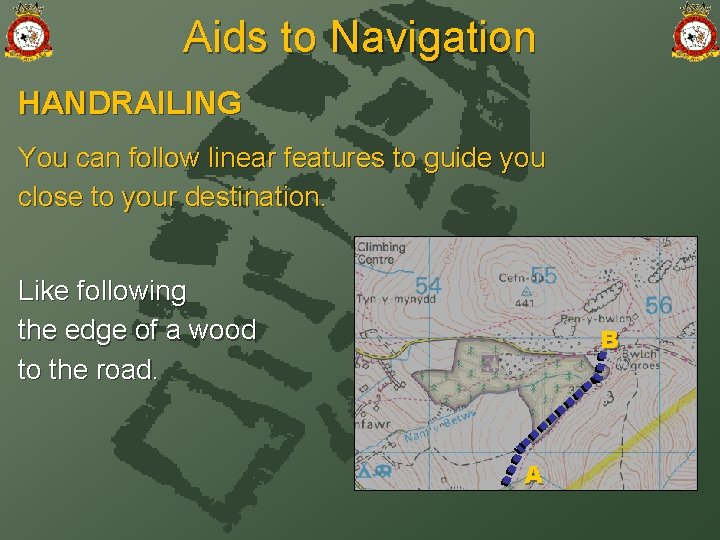
Aids to Navigation HANDRAILING You can follow linear features to guide you close to your destination. Like following the edge of a wood to the road. B A
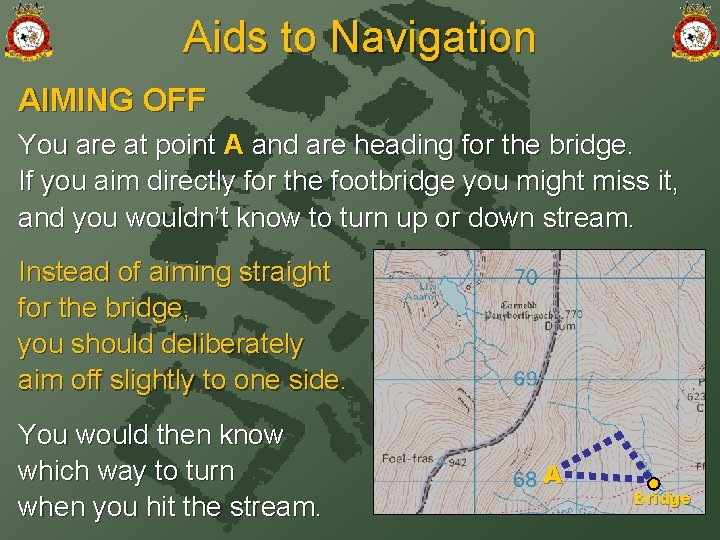
Aids to Navigation AIMING OFF You are at point A and are heading for the bridge. If you aim directly for the footbridge you might miss it, and you wouldn’t know to turn up or down stream. Instead of aiming straight for the bridge, you should deliberately aim off slightly to one side. You would then know which way to turn when you hit the stream. A Bridge
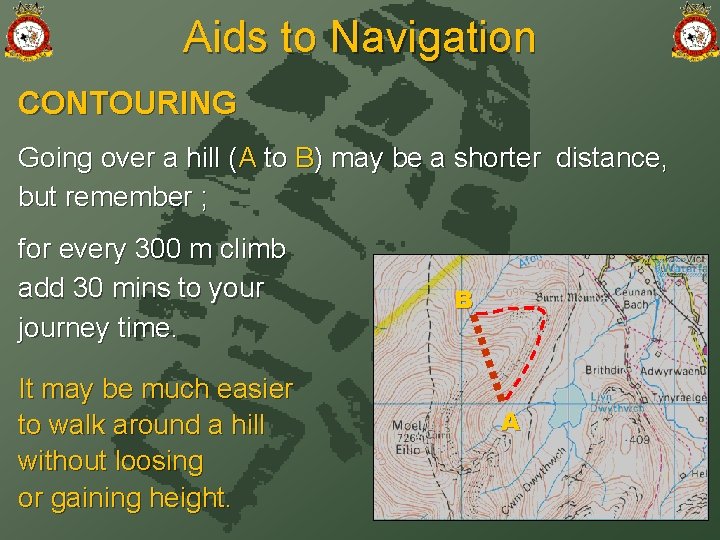
Aids to Navigation CONTOURING Going over a hill (A to B) may be a shorter distance, but remember ; for every 300 m climb add 30 mins to your journey time. It may be much easier to walk around a hill without loosing or gaining height. B A
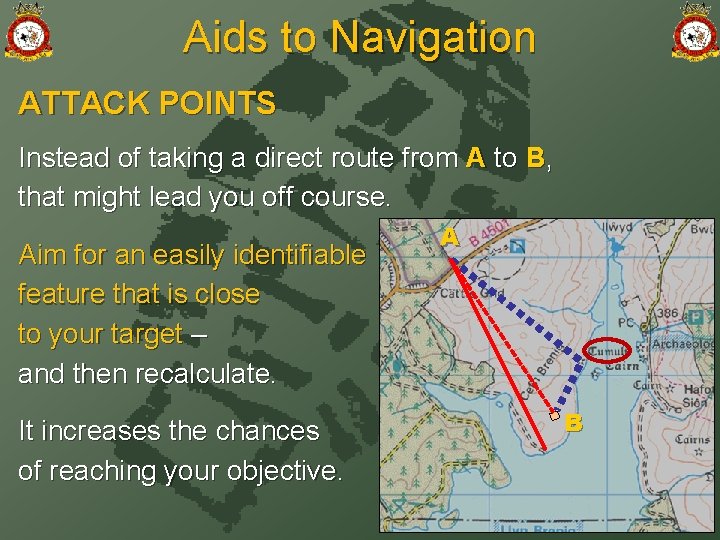
Aids to Navigation ATTACK POINTS Instead of taking a direct route from A to B, that might lead you off course. Aim for an easily identifiable feature that is close to your target – and then recalculate. It increases the chances of reaching your objective. A B
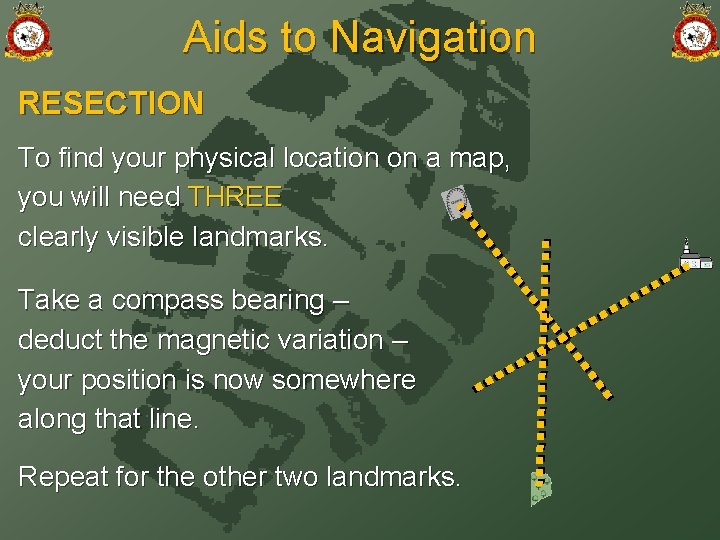
Aids to Navigation RESECTION To find your physical location on a map, you will need THREE clearly visible landmarks. Take a compass bearing – deduct the magnetic variation – your position is now somewhere along that line. Repeat for the other two landmarks.
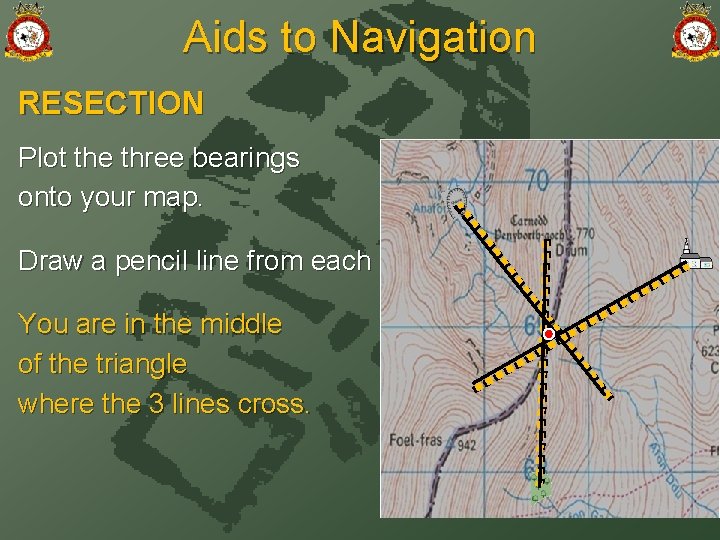
Aids to Navigation RESECTION Plot the three bearings onto your map. Draw a pencil line from each You are in the middle of the triangle where the 3 lines cross.
Aids to Navigation Other useful techniques to improve navigation
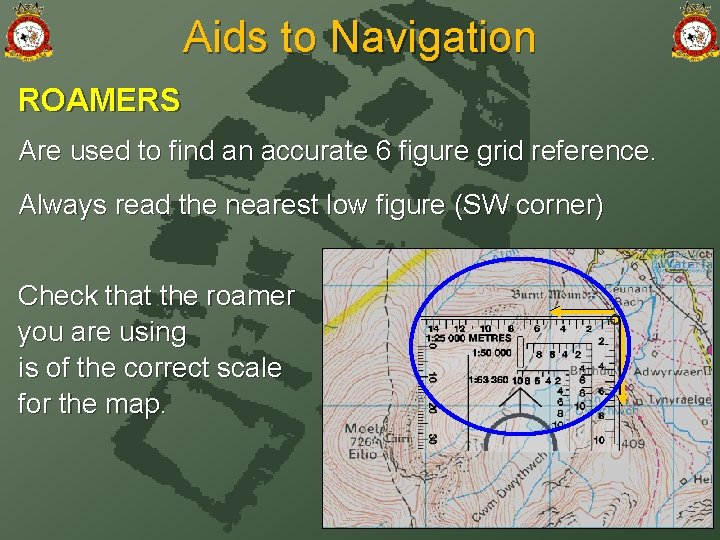
Aids to Navigation ROAMERS Are used to find an accurate 6 figure grid reference. Always read the nearest low figure (SW corner) Check that the roamer you are using is of the correct scale for the map.
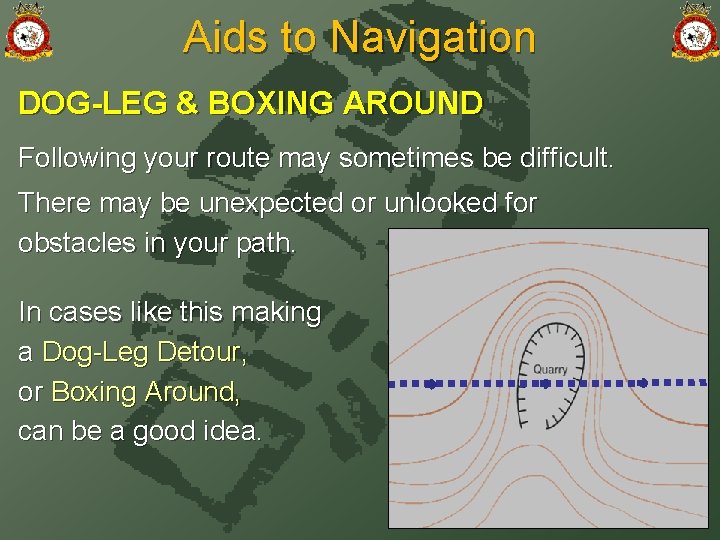
Aids to Navigation DOG-LEG & BOXING AROUND Following your route may sometimes be difficult. There may be unexpected or unlooked for obstacles in your path. In cases like this making a Dog-Leg Detour, or Boxing Around, can be a good idea.
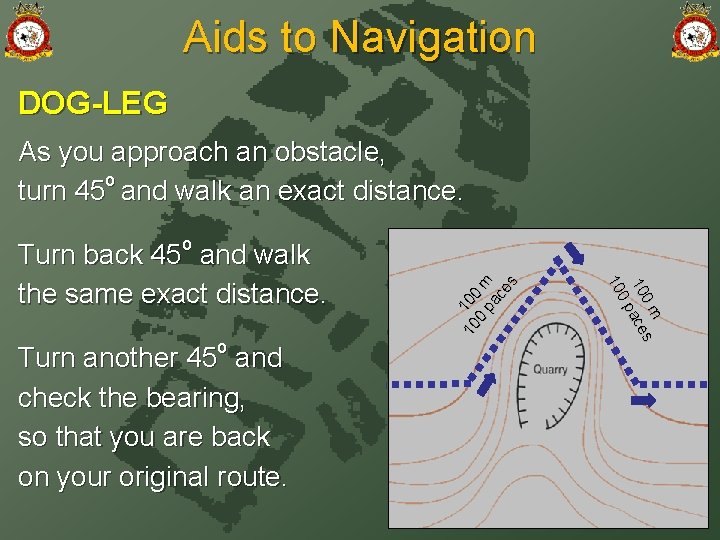
Aids to Navigation DOG-LEG Turn another 45 o and check the bearing, so that you are back on your original route. 0 m s 10 ace 0 p 10 Turn back 45 o and walk the same exact distance. 10 100 0 pa m ce s As you approach an obstacle, o turn 45 and walk an exact distance.
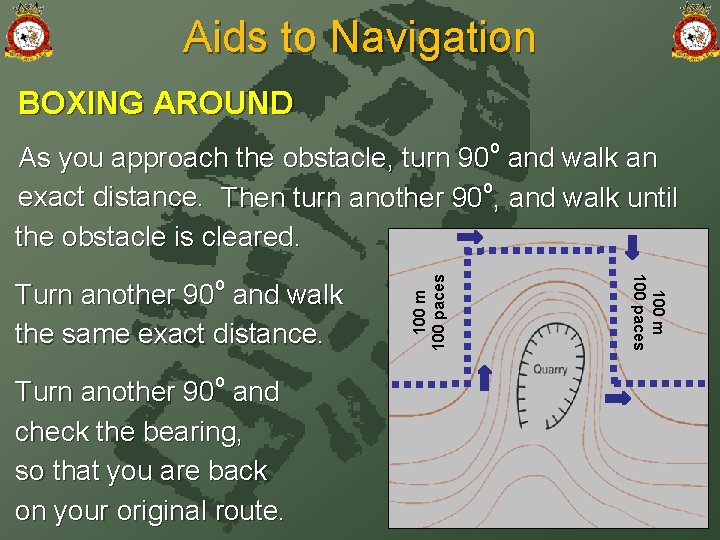
Aids to Navigation BOXING AROUND o Turn another 90 and check the bearing, so that you are back on your original route. 100 m 100 paces Turn another 90 o and walk the same exact distance. 100 m 100 paces As you approach the obstacle, turn 90 o and walk an exact distance. Then turn another 90 o, and walk until the obstacle is cleared.
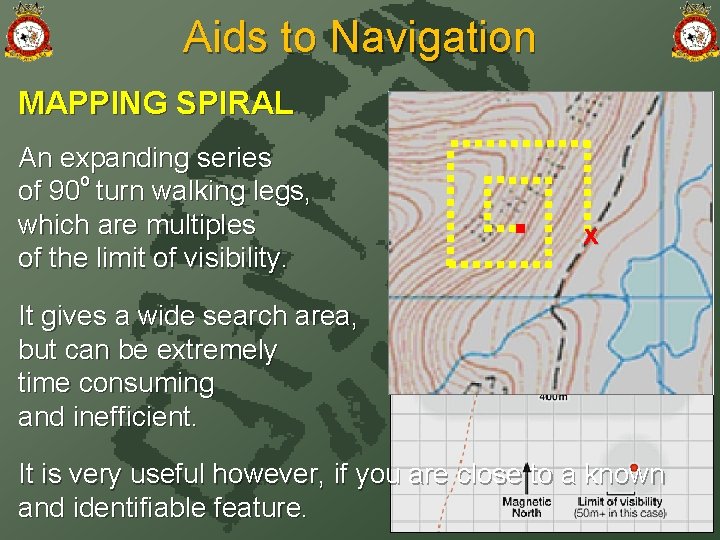
Aids to Navigation MAPPING SPIRAL An expanding series o of 90 turn walking legs, which are multiples of the limit of visibility. x It gives a wide search area, but can be extremely time consuming and inefficient. It is very useful however, if you are close to a known and identifiable feature.
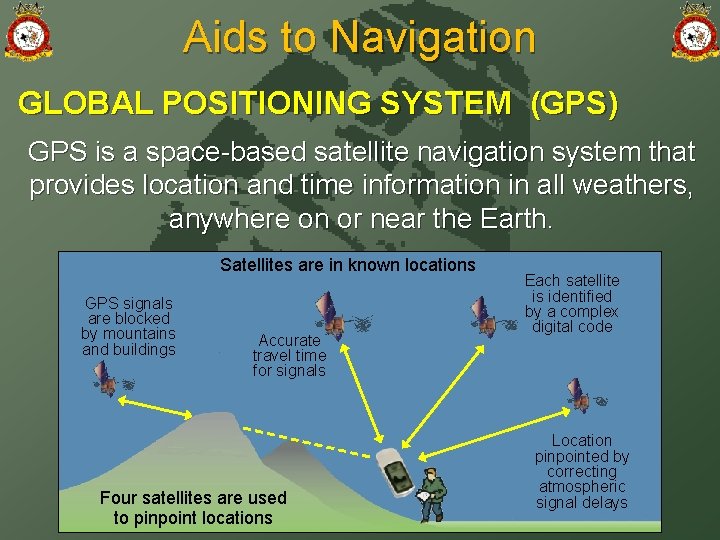
Aids to Navigation GLOBAL POSITIONING SYSTEM (GPS) GPS is a space-based satellite navigation system that provides location and time information in all weathers, anywhere on or near the Earth. Satellites are in known locations GPS signals are blocked by mountains and buildings Accurate travel time for signals Four satellites are used to pinpoint locations Each satellite is identified by a complex digital code Location pinpointed by correcting atmospheric signal delays
Check of Understanding Following linear features to guide you close to your destination is known as: Aiming Off Contouring An Attack Point Handrailing
Check of Understanding Instead of taking a direct bearing you identify a feature that is close to your objective, what is this known as? Contouring An Attack Point Resection Aiming Off
Check of Understanding A cadet decides to follow a stream down from the hill-side because he knows that the stream runs close to his campsite. What is this navigational techniques known as: Aiming Off Contouring Handrailing Using Attack Points
Check of Understanding What is meant by contouring? Walking around a hill Gaining as much height as possible Walking over a hill Losing as much height as possible
Check of Understanding Instead of taking a direct bearing you deliberately veer to the left or right to hit an obvious feature, what is this known as? Contouring Aiming Off Resection Handrailing
Check of Understanding An attack point would be: Any prominent feature close to your object Any prominent feature on a hill Any prominent feature far away to your object The summit of any hill
Check of Understanding What is Resection? Three bearings that cross to give a large triangular fix. Two bearings that cross to give a position fix. One exact bearing to give a line fix. Three bearings that cross to give a small triangular fix.
Questions?
Basic Navigation Leading Cadet Training End of Presentation
- Slides: 24