
Basic Navigation Leading Cadet Training Bearings and Distances
Basic Navigation Leading Cadet Training Bearings and Distances Lecture 3
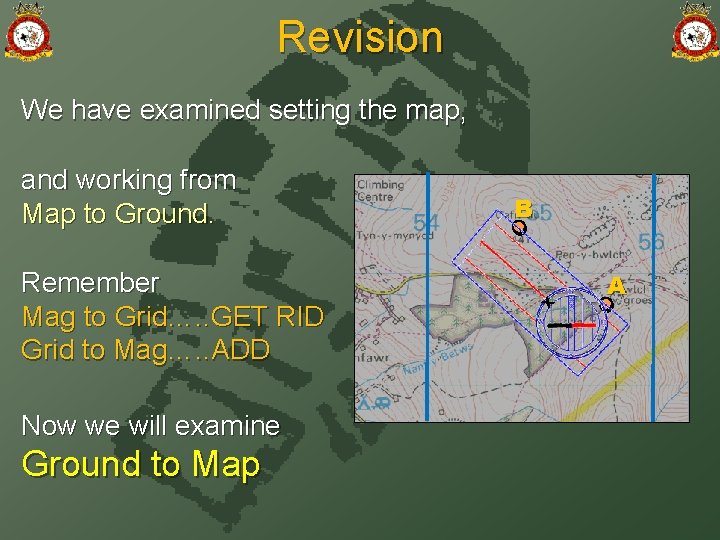
Revision We have examined setting the map, Remember Mag to Grid…. . GET RID Grid to Mag…. . ADD Now we will examine Ground to Map B x and working from Map to Ground. A
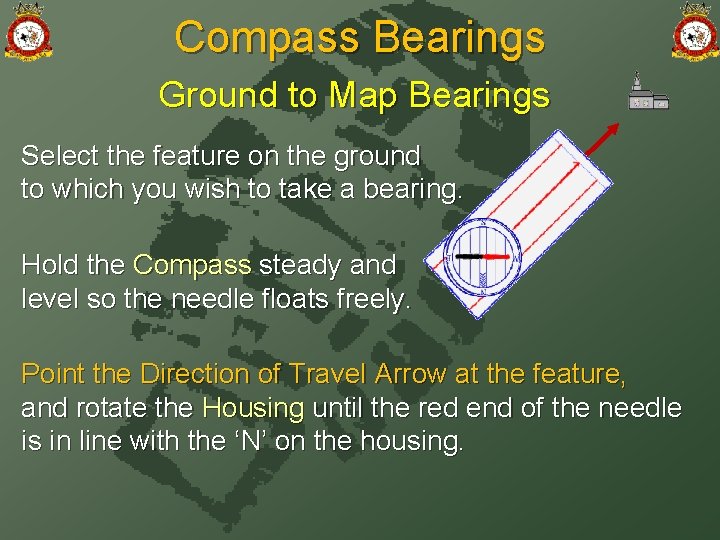
Compass Bearings Ground to Map Bearings Select the feature on the ground to which you wish to take a bearing. Hold the Compass steady and level so the needle floats freely. Point the Direction of Travel Arrow at the feature, and rotate the Housing until the red end of the needle is in line with the ‘N’ on the housing.
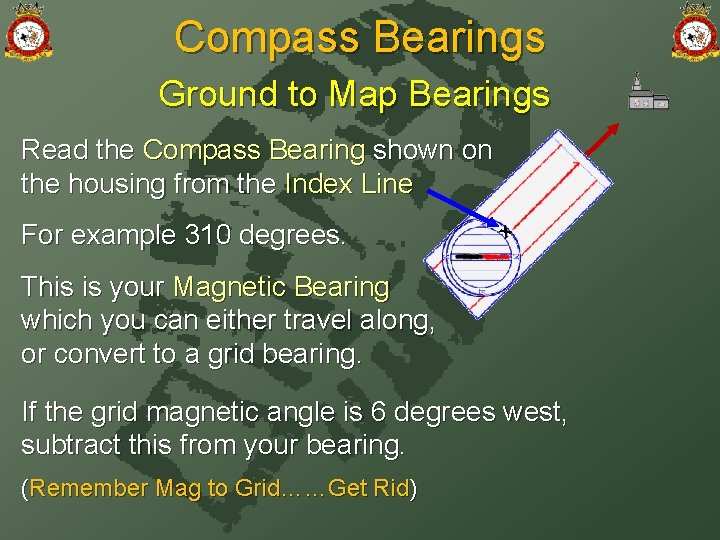
Compass Bearings Ground to Map Bearings Read the Compass Bearing shown on the housing from the Index Line For example 310 degrees. x This is your Magnetic Bearing which you can either travel along, or convert to a grid bearing. If the grid magnetic angle is 6 degrees west, subtract this from your bearing. (Remember Mag to Grid……Get Rid)

Compass Bearings Ground to Map Bearings Convert to a Grid Bearing. Place the Compass A x on the map and keeping the bearing set on the Housing, rotate the whole Compass until the Orienting Lines are parallel to the Eastings. The edge of the Compass should run through your position and show the bearing on the map.
Compass Bearings Following a Bearing Hold your compass level and steady. Ensure the red end of the needle is in line with the ‘N’ on the Housing. Follow the direction of travel arrow. Line up the direction arrow with a physical feature (e. g. tree, pylon, tower). Use this as a reference point which is easier than following the compass every inch of the way.
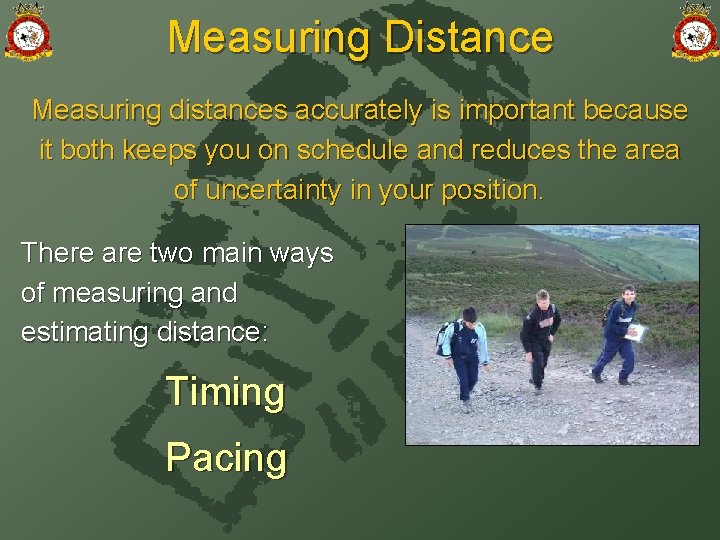
Measuring Distance Measuring distances accurately is important because it both keeps you on schedule and reduces the area of uncertainty in your position. There are two main ways of measuring and estimating distance: Timing Pacing
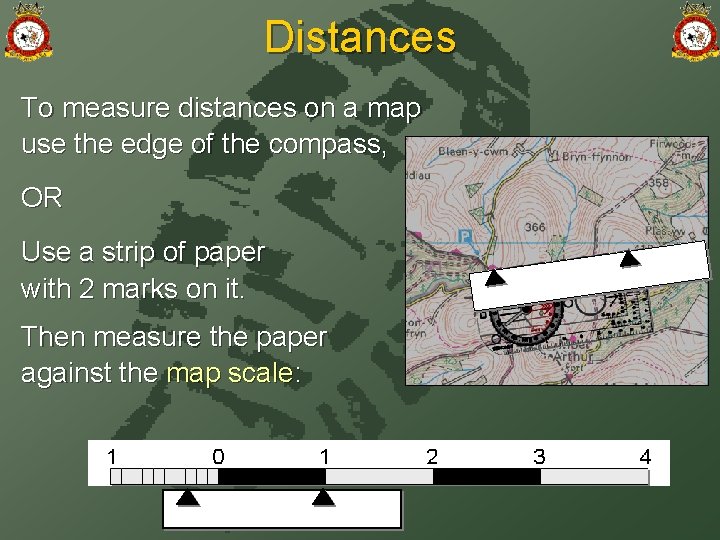
Distances To measure distances on a map use the edge of the compass, OR Use a strip of paper with 2 marks on it. Then measure the paper against the map scale:
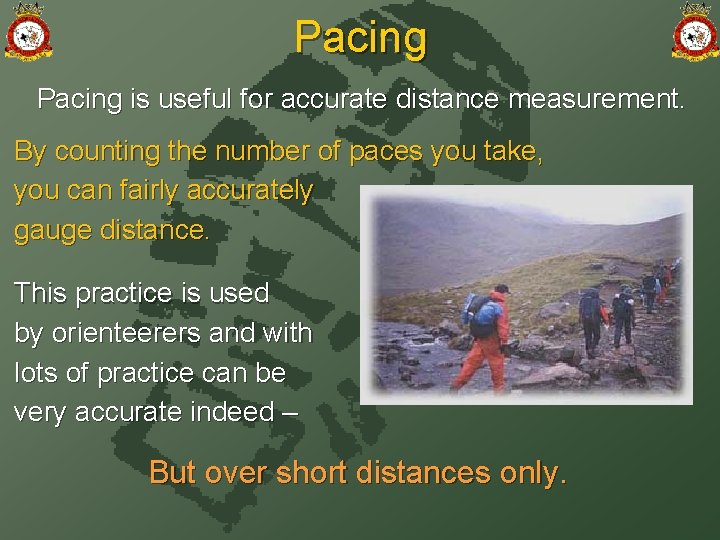
Pacing is useful for accurate distance measurement. By counting the number of paces you take, you can fairly accurately gauge distance. This practice is used by orienteerers and with lots of practice can be very accurate indeed – But over short distances only.
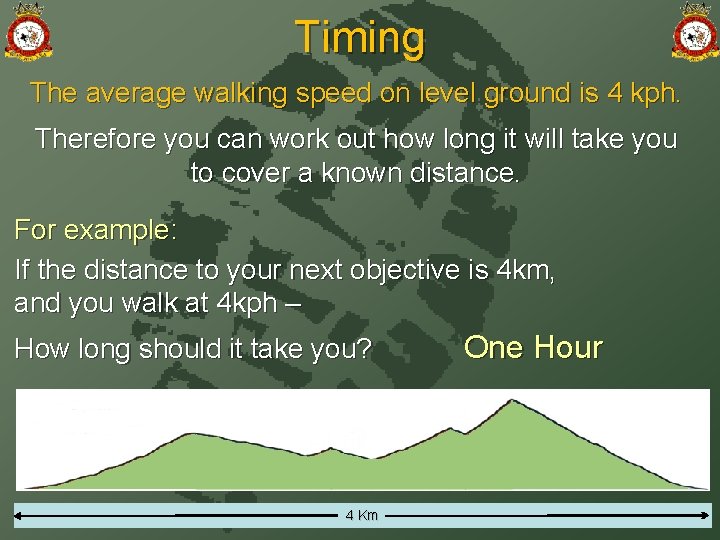
Timing The average walking speed on level ground is 4 kph. Therefore you can work out how long it will take you to cover a known distance. For example: If the distance to your next objective is 4 km, and you walk at 4 kph – How long should it take you? 4 Km One Hour
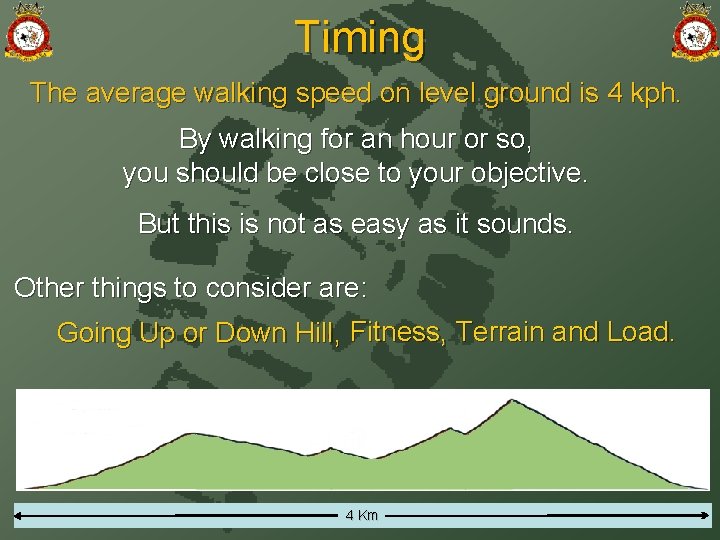
Timing The average walking speed on level ground is 4 kph. By walking for an hour or so, you should be close to your objective. But this is not as easy as it sounds. Other things to consider are: Going Up or Down Hill, Fitness, Terrain and Load. 4 Km
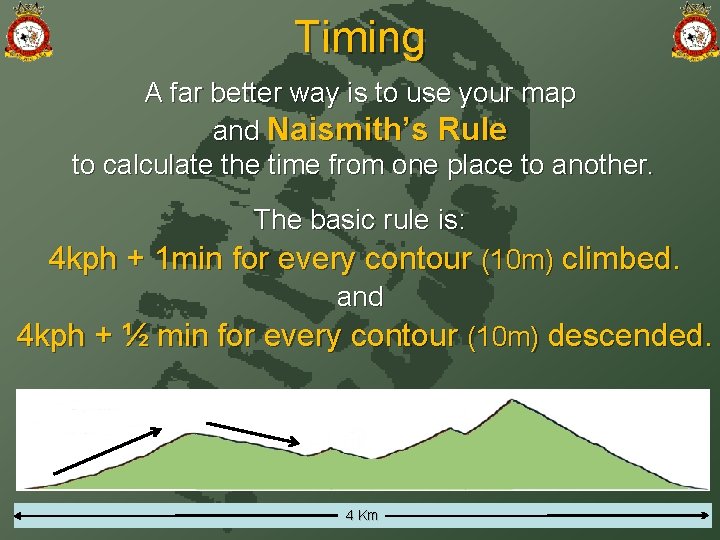
Timing A far better way is to use your map and Naismith’s Rule to calculate the time from one place to another. The basic rule is: 4 kph + 1 min for every contour (10 m) climbed. and 4 kph + ½ min for every contour (10 m) descended. 4 Km
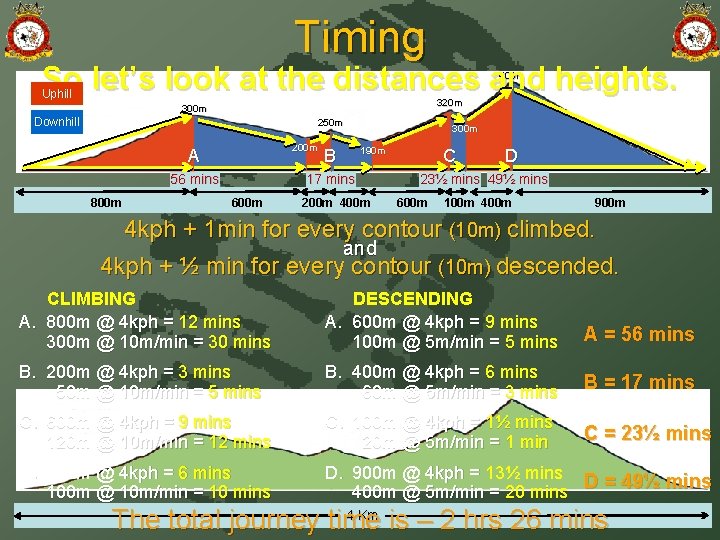
Timing So let’s look at the distances and heights. 400 m Uphill Uphil 320 m 300 m Downhill Downhil 250 m 200 m A 56 mins 800 m B 300 m 190 m 17 mins 600 m 200 m 400 m C D 23½ mins 49½ mins 600 m 100 m 400 m 900 m 4 kph + 1 min for every contour (10 m) climbed. and 4 kph + ½ min for every contour (10 m) descended. CLIMBING A. 800 m @ 4 kph = 12 mins 300 m @ 10 m/min = 30 mins DESCENDING A. 600 m @ 4 kph = 9 mins 100 m @ 5 m/min = 5 mins A = 56 mins B. 200 m @ 4 kph = 3 mins 50 m @ 10 m/min = 5 mins B. 400 m @ 4 kph = 6 mins 60 m @ 5 m/min = 3 mins B = 17 mins C. 600 m @ 4 kph = 9 mins 120 m @ 10 m/min = 12 mins C. 100 m @ 4 kph = 1½ mins 20 m @ 5 m/min = 1 min C = 23½ mins D. 400 m @ 4 kph = 6 mins 100 m @ 10 m/min = 10 mins D. 900 m @ 4 kph = 13½ mins D = 49½ mins 400 m @ 5 m/min = 20 mins 4 Km The total journey time is – 2 hrs 26 mins
Errors No matter which method of estimating distance you choose, there will be an error attached to it. This is particularly true when you are inexperienced. If you add to this the possible error in measuring direction, you will begin to see the difficulties that can lie ahead.
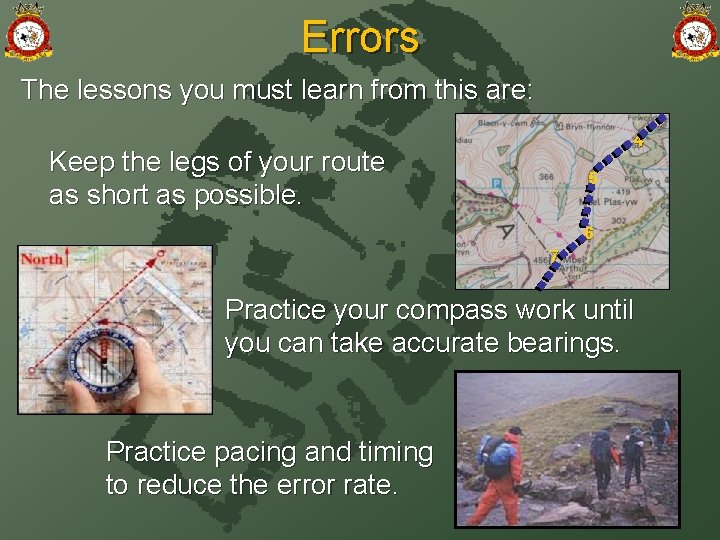
Errors The lessons you must learn from this are: 4 Keep the legs of your route as short as possible. 5 7 6 Practice your compass work until you can take accurate bearings. Practice pacing and timing to reduce the error rate.
Check of Understanding When changing magnetic bearing to grid bearings Which of the following is correct? Mag to grid - Multiply Mag to grid - Add Mag to grid – Get Rid Always an addition
Check of Understanding Using a compass to take a bearing on a distant object what would you do first? Align the red compass needle with the object Turn the capsule housing to subtract the GMA Point the direction of travel arrow at the object Turn the capsule housing to align the orienting lines with the object
Check of Understanding When navigating, in order to reduce errors to a minimum, you should. . . Always follow the established paths and tracks Walk as quickly as possible to your destination Measure distance and bearing as accurately as possible Never follow the established paths and tracks
Check of Understanding Measuring distances accurately whilst hillwalking is important because it: Calculates your speed of travel Keeps you on schedule Pinpoints your position accurately Chooses the shortest route
Check of Understanding What do you estimate as the average walking speed of a group on level ground? 3 kph 4 kph 5 kph 6 kph
Check of Understanding Measuring distances accurately whilst out walking helps you particularly to? Calculate magnetic variation Select the shortest route Calculate the gradient Reduce the area of uncertainty in your position
Check of Understanding What is the Naismith's Rule? 5 kph overall 5 kph as measured on the map, plus 30 mins for every 300 m climbed 4 kph overall
Check of Understanding Pacing can be an accurate method of measuring distance if carried out over: A maximum count of 5000 paces Medium Distances A maximum count of 1000 paces Short Distances
Check of Understanding What is pacing useful for? By counting paces, you can fairly accurately gauge distance To see how long it takes to cover a set distance Measuring the length of each step taken To accurately plot your course
Basic Navigation Leading Cadet Training End of Presentation
- Slides: 25