
Basic MRI I Chapter 3 Notes Terms to
Basic MRI I Chapter 3 Notes
Terms to know • Resonant Characteristic-- able to have resonance • Magnetized—makes a net magnetization vector in a magnetic field • Magnetization—process of forming a net magnetization vector • Resonance—capacity to absorb and reradiate radiofrequency energy
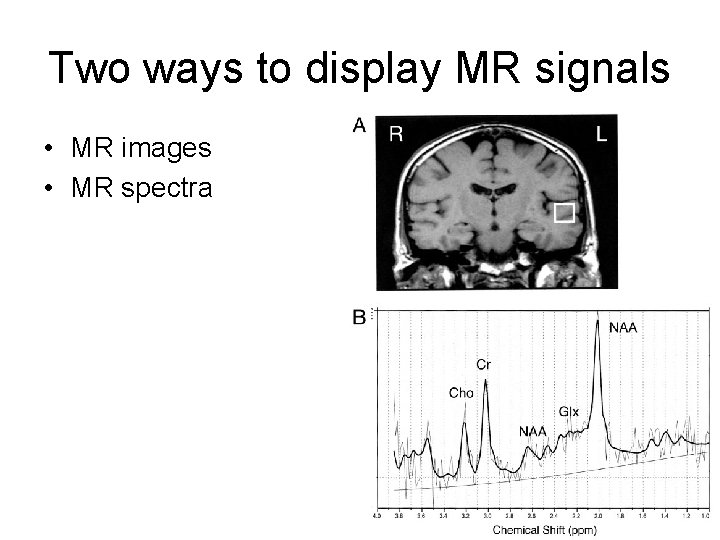
Two ways to display MR signals • MR images • MR spectra
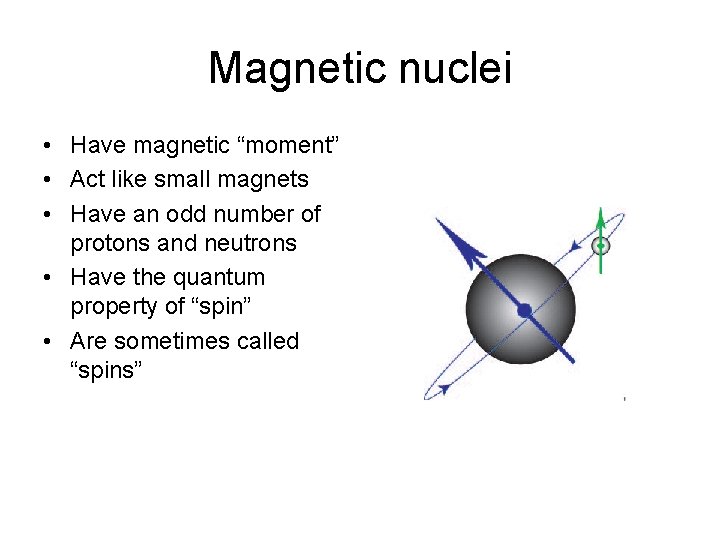
Magnetic nuclei • Have magnetic “moment” • Act like small magnets • Have an odd number of protons and neutrons • Have the quantum property of “spin” • Are sometimes called “spins”
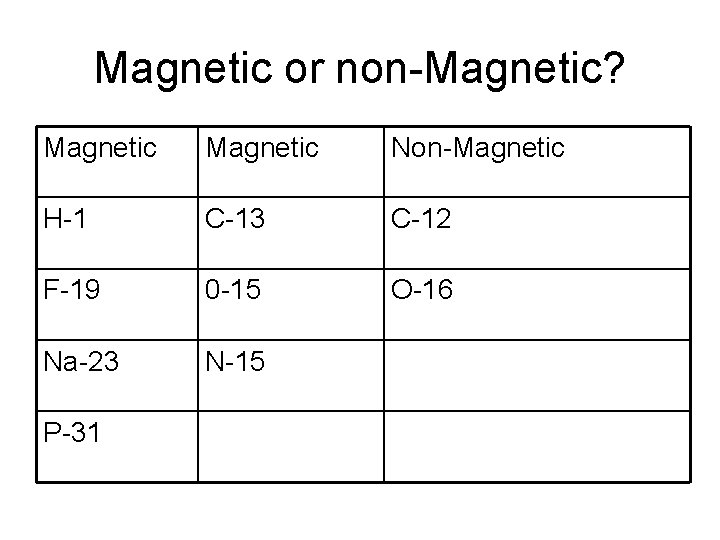
Magnetic or non-Magnetic? Magnetic Non-Magnetic H-1 C-13 C-12 F-19 0 -15 O-16 Na-23 N-15 P-31

RF signal strength • Most significant factor in determining image quality and the time it takes to acquire an image
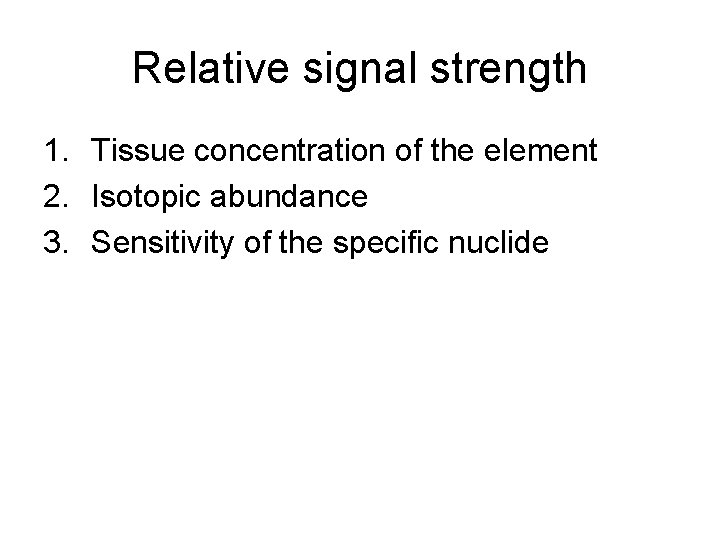
Relative signal strength 1. Tissue concentration of the element 2. Isotopic abundance 3. Sensitivity of the specific nuclide
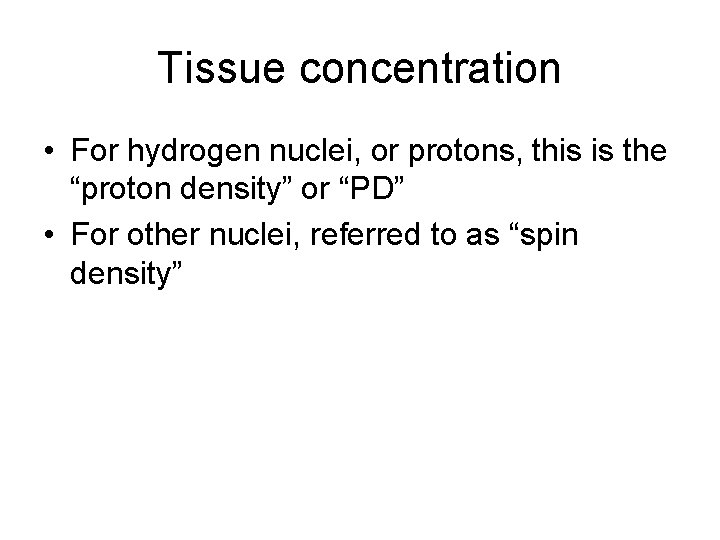
Tissue concentration • For hydrogen nuclei, or protons, this is the “proton density” or “PD” • For other nuclei, referred to as “spin density”
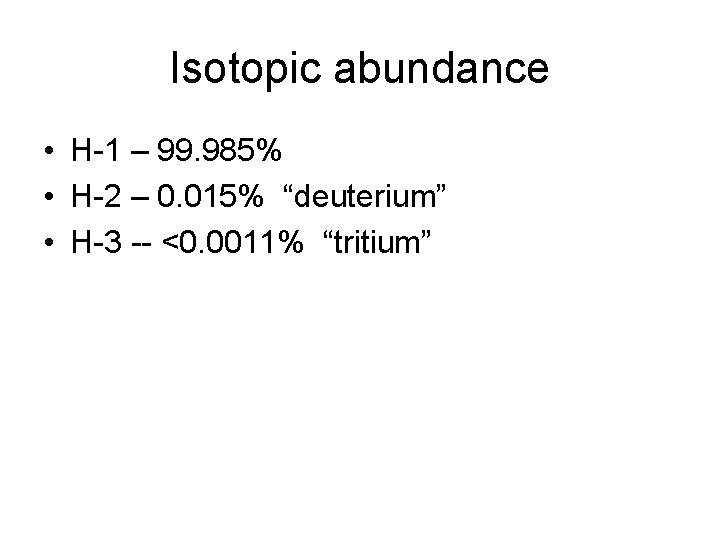
Isotopic abundance • H-1 – 99. 985% • H-2 – 0. 015% “deuterium” • H-3 -- <0. 0011% “tritium”
Sensitivity • Signal strength produced by an equal number of nuclei • H-1 is the strongest, considered 1. 0 or 100% • See table 3 in your book.
Why proton imaging is so good • High tissue concentration • Most abundant magnetic isotope of hydrogen (H-1) is magnetic!
RF energy • RF pulses (transmitted)– usually 90 degrees or 180 degrees, but can be of any angle • RF signal (received)– received by coils that act as antennae • Stored in k-space • Fourier transform (FT) to make images • Received as echoes
Nuclear magnetic interactions • Nuclear alignment—only a few of every million nuclei align with the magnet, but this is enough to form a net magnetization vector • The rest are tumbling randomly, due to “thermal activity. ”
Precession and resonance • The rate of precession is the same as the resonant frequency, called the Larmor Frequency
Excitation • Tip the net magnetization vector away from the z direction…any component in the x-y plane generates a signal that can be detected.
Relaxation • The net magnetization vector re-forms, lines up with the z direction, and the individual spins dephase.
Frequency is proportional to field strength • • • Freq = gyromagnetic ratio x field strength Freq = “gamma” x B-naught Freq = γHB 0 Gyromagnetic ratio = γH = 43. 58 MHz/T Field strength = B 0
- Slides: 17