
Basic MRI I Chapter 2 The Magnet The
Basic MRI I Chapter 2
The Magnet • The heart of the system • Induces tissue magnetization • Induces resonance with a specific frequency • Frequency is proportional to field strength
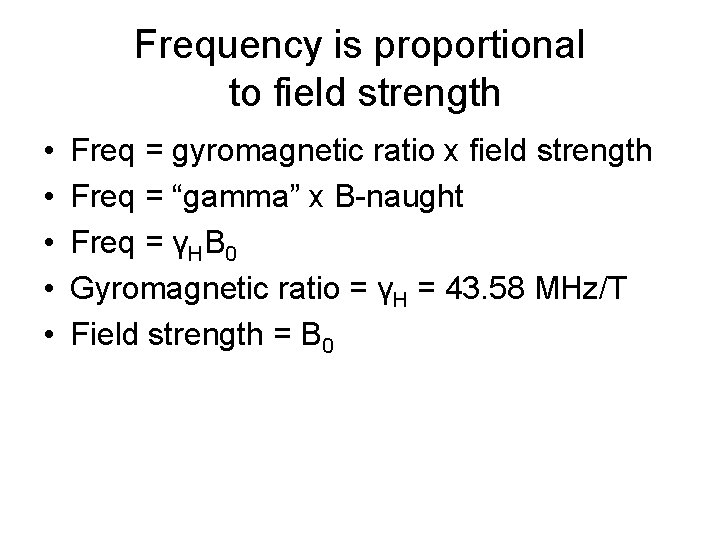
Frequency is proportional to field strength • • • Freq = gyromagnetic ratio x field strength Freq = “gamma” x B-naught Freq = γHB 0 Gyromagnetic ratio = γH = 43. 58 MHz/T Field strength = B 0
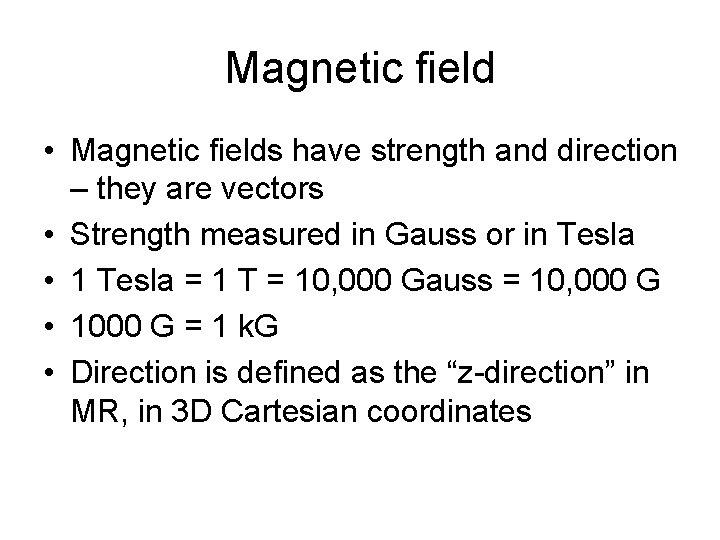
Magnetic field • Magnetic fields have strength and direction – they are vectors • Strength measured in Gauss or in Tesla • 1 Tesla = 1 T = 10, 000 Gauss = 10, 000 G • 1000 G = 1 k. G • Direction is defined as the “z-direction” in MR, in 3 D Cartesian coordinates

Type of Magnets Magnet type Advantages Disadvantages Superconducting Strong, homogeneous Needs cryogens, expensive Resistive No cryogens, Open Lower field strength Permanent Open, No cryogens No power to maintain field Lowest field strength
Gradients • Intro to gradient concept • Linear gradients • Non-linear gradients
Gradients • Orientation – Definition of orthogonal = “ at right angles” • Functions – To get images—all types – To get specialized images (gradient echo) – To reduce artifacts • Strength – Units of m. T/m – High value = ~ 20 m. T/m

Gradients • Rise time = time for gradient to reach its maximum, like 0. 20 msec • Slew rate = rate of gradient change, like 100 m. T/m/msec
Eddy currents • Electrical currents induced or generated in conducting materials, in metal in the machine, minimized by gradients
Shimming • To achieve homogeneous field strength

Shielding • Passive—large pieces of ferromagnetic metal like iron • Active—electromagnets to decrease the extent of the field
RF system • Coils – Body coils – Surface coils – Special coils • TMJ • Head • Wrist – Linear, quadrature, CP, phased array
RF shielding • Farraday cage – To decrease stray RF energy from lights and motors outside the magnet from getting into the receive coil (antenna) – Copper screen – Sheet metal
Computer • • • To store and acquire signals in k-space To reconstruct images To perform Fourier Transform Storage, retrieval, transmission of images Post Processing, zoom, magnification, contrast/windowing, 3 D reconstructions
- Slides: 14