
Basic Mathematics for Accelerators Rende Steerenberg CERN Beams
Basic Mathematics for Accelerators Rende Steerenberg - CERN - Beams Department CERN Accelerator School Introduction to Accelerator Physics 31 August – 12 September 2014 Prague – Czech Republic
Marathon This However, overview before or review you start of the a marathon, basic mathematics you needused a in accelerator proper physicswarming-up is a part of the warming up Rende Steerenberg, CERN CAS - 1 September 2014 Prague - Czech republic 2
Basic Mathematics for Accelerators – CAS 2014 Contents • What Maths are needed and Why ? • Differential Equations • Vector Basics • Matrices Rende Steerenberg, CERN CAS - 1 September 2014 Prague - Czech republic 3
Basic Mathematics for Accelerators – CAS 2014 • What Maths are needed and Why ? • Differential Equations • Vector Basics • Matrices Rende Steerenberg, CERN CAS - 1 September 2014 Prague - Czech republic 4

Basic Mathematics for Accelerators – CAS 2014 Forces in Accelerators Particles in our accelerator will oscillate around the circumference of the machine under the influence of external forces Mainly Magnetic forces in the transverse plane Rende Steerenberg, CERN Electric forces in the longitudinal plane CAS - 1 September 2014 Prague - Czech republic 5
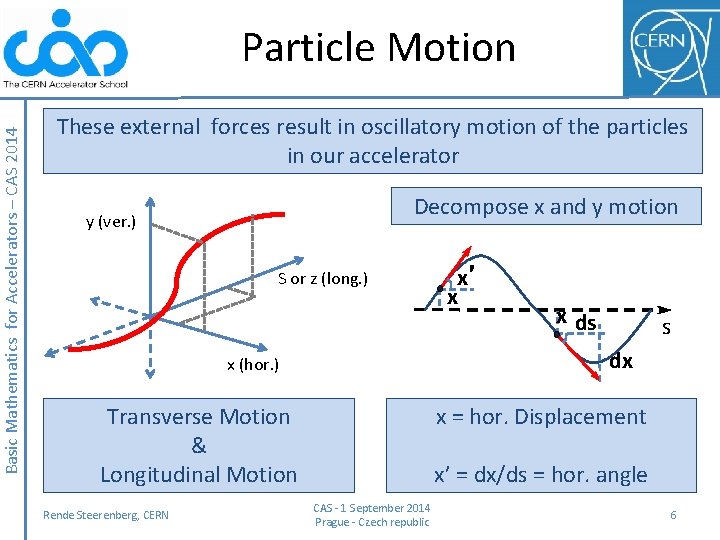
Basic Mathematics for Accelerators – CAS 2014 Particle Motion These external forces result in oscillatory motion of the particles in our accelerator Decompose x and y motion y (ver. ) S or z (long. ) x ds s dx x (hor. ) Transverse Motion & Longitudinal Motion Rende Steerenberg, CERN x’ x x = hor. Displacement x’ = dx/ds = hor. angle CAS - 1 September 2014 Prague - Czech republic 6
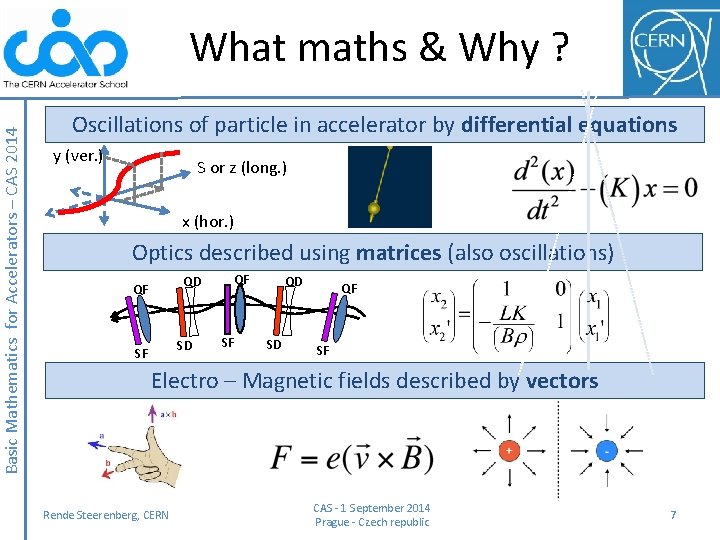
Basic Mathematics for Accelerators – CAS 2014 What maths & Why ? Oscillations of particle in accelerator by differential equations y (ver. ) S or z (long. ) x (hor. ) Optics described using matrices (also oscillations) QD QF SD SF QF SF QD SD QF SF Electro – Magnetic fields described by vectors Rende Steerenberg, CERN CAS - 1 September 2014 Prague - Czech republic 7
Basic Mathematics for Accelerators – CAS 2014 • What Maths are needed and Why ? • Differential Equations • Vector Basics • Matrices Rende Steerenberg, CERN CAS - 1 September 2014 Prague - Czech republic 8
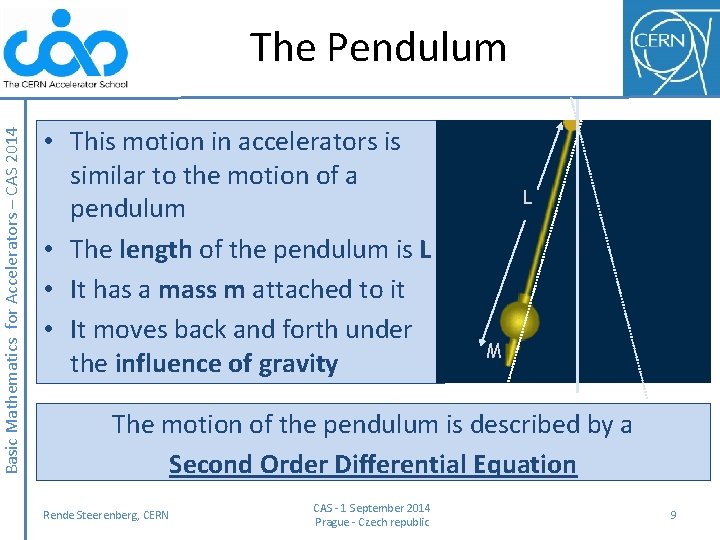
Basic Mathematics for Accelerators – CAS 2014 The Pendulum • This motion in accelerators is similar to the motion of a pendulum • The length of the pendulum is L • It has a mass m attached to it • It moves back and forth under the influence of gravity L M The motion of the pendulum is described by a Second Order Differential Equation Rende Steerenberg, CERN CAS - 1 September 2014 Prague - Czech republic 9

Basic Mathematics for Accelerators – CAS 2014 Simple Harmonic Motion • Position: θ L (provided θ is small) • Velocity: M • Acceleration: Fr Mg Rende Steerenberg, CERN • Restoring force: CAS - 1 September 2014 Prague - Czech republic 10

Basic Mathematics for Accelerators – CAS 2014 Hill’s equation Second order differential equation describing a the Simple Harmonic Motion of the pendulum The motion of the particles in our accelerators can also be described by a 2 nd order differential equation Hill’s equation Where: • restoring forces are magnetic fields • K(s) is related to the magnetic gradients Rende Steerenberg, CERN CAS - 1 September 2014 Prague - Czech republic 11
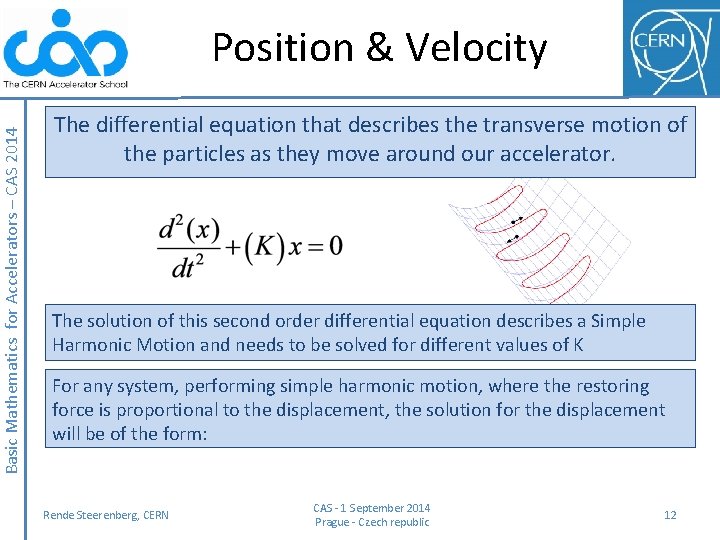
Basic Mathematics for Accelerators – CAS 2014 Position & Velocity The differential equation that describes the transverse motion of the particles as they move around our accelerator. The solution of this second order differential equation describes a Simple Harmonic Motion and needs to be solved for different values of K For any system, performing simple harmonic motion, where the restoring force is proportional to the displacement, the solution for the displacement will be of the form: Rende Steerenberg, CERN CAS - 1 September 2014 Prague - Czech republic 12

Basic Mathematics for Accelerators – CAS 2014 Phase Space Plot the velocity as a function of displacement: x 0 x x 0 • It is an ellipse. • As ωt advances by 2 π it repeats itself. • This continues for (ω t + k 2π), with k=0, ± 1, ± 2, . . etc Rende Steerenberg, CERN CAS - 1 September 2014 Prague - Czech republic 13
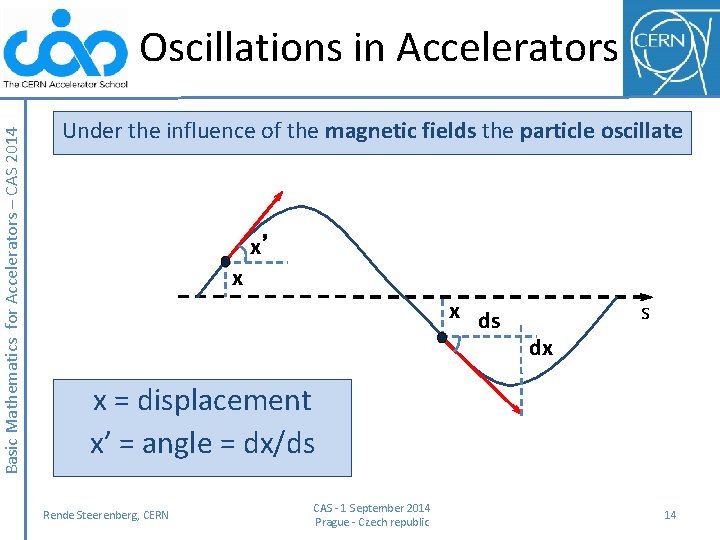
Basic Mathematics for Accelerators – CAS 2014 Oscillations in Accelerators Under the influence of the magnetic fields the particle oscillate x’ x x ds s dx x = displacement x’ = angle = dx/ds Rende Steerenberg, CERN CAS - 1 September 2014 Prague - Czech republic 14

Basic Mathematics for Accelerators – CAS 2014 Transverse Phase Space Plot This changes slightly the Phase Space plot X’ Position: φ Angle: x • φ = ωt is called the phase angle • X-axis is the horizontal or vertical position (or time in longitudinal case). • Y-axis is the horizontal or vertical phase angle (or energy in longitudinal case) Rende Steerenberg, CERN CAS - 1 September 2014 Prague - Czech republic 15
Basic Mathematics for Accelerators – CAS 2014 • What Maths are needed and Why ? • Differential Equations • Vector Basics • Matrices Rende Steerenberg, CERN CAS - 1 September 2014 Prague - Czech republic 16
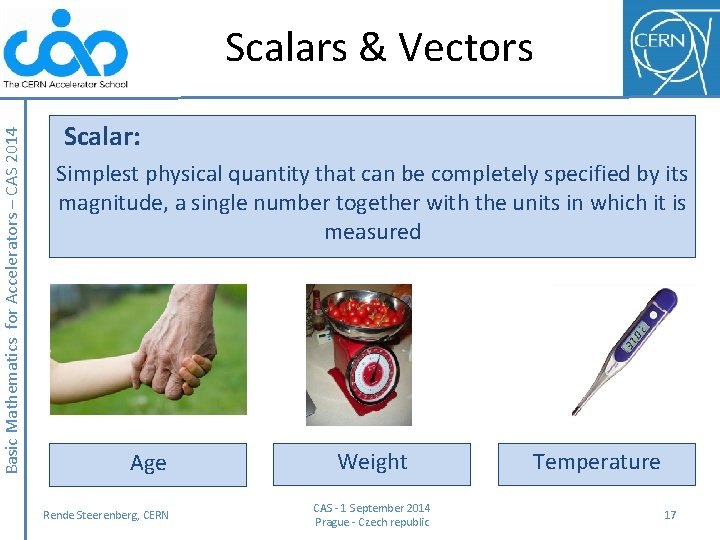
Basic Mathematics for Accelerators – CAS 2014 Scalars & Vectors Scalar: Simplest physical quantity that can be completely specified by its magnitude, a single number together with the units in which it is measured Age Rende Steerenberg, CERN Weight CAS - 1 September 2014 Prague - Czech republic Temperature 17
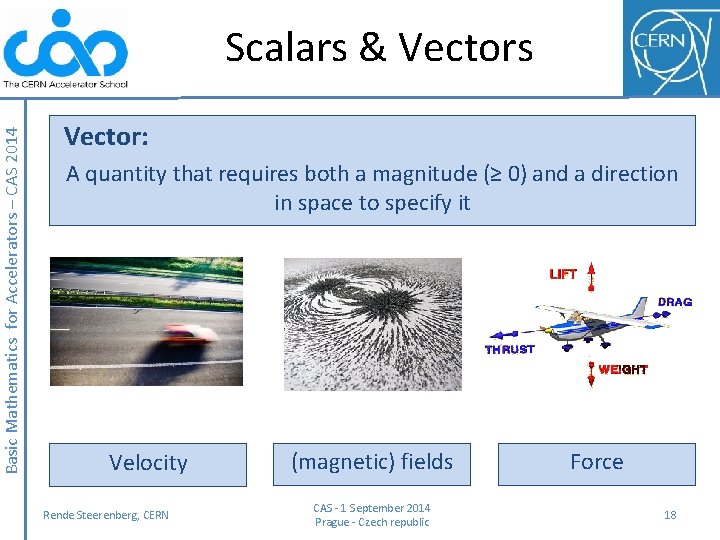
Basic Mathematics for Accelerators – CAS 2014 Scalars & Vectors Vector: A quantity that requires both a magnitude (≥ 0) and a direction in space to specify it Velocity Rende Steerenberg, CERN (magnetic) fields CAS - 1 September 2014 Prague - Czech republic Force 18
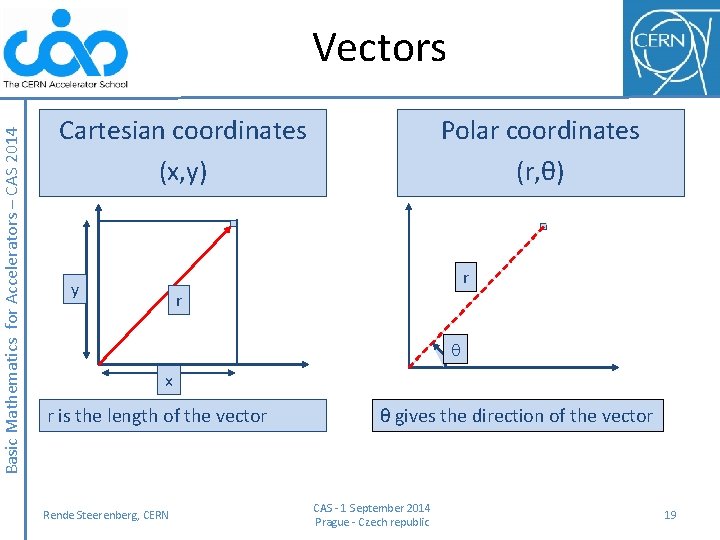
Basic Mathematics for Accelerators – CAS 2014 Vectors Cartesian coordinates (x, y) Polar coordinates (r, θ) r y r x r is the length of the vector Rende Steerenberg, CERN θ gives the direction of the vector CAS - 1 September 2014 Prague - Czech republic 19
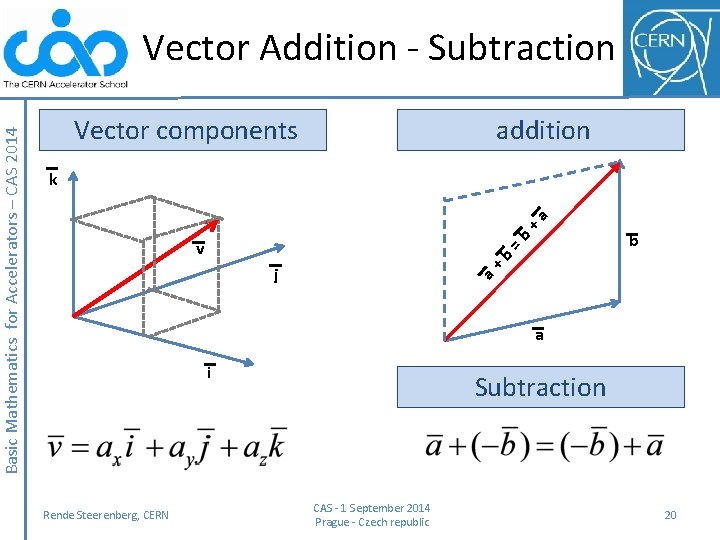
Vector components addition =b +a k b b v j a+ Basic Mathematics for Accelerators – CAS 2014 Vector Addition - Subtraction a i Rende Steerenberg, CERN Subtraction CAS - 1 September 2014 Prague - Czech republic 20
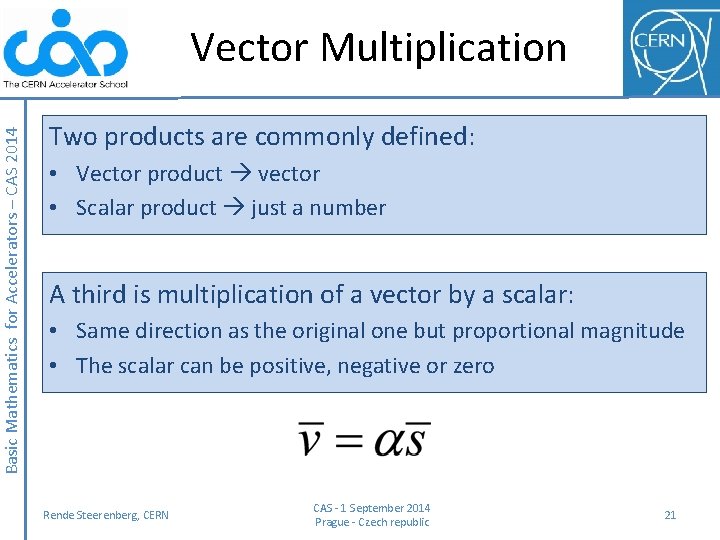
Basic Mathematics for Accelerators – CAS 2014 Vector Multiplication Two products are commonly defined: • Vector product vector • Scalar product just a number A third is multiplication of a vector by a scalar: • Same direction as the original one but proportional magnitude • The scalar can be positive, negative or zero Rende Steerenberg, CERN CAS - 1 September 2014 Prague - Czech republic 21
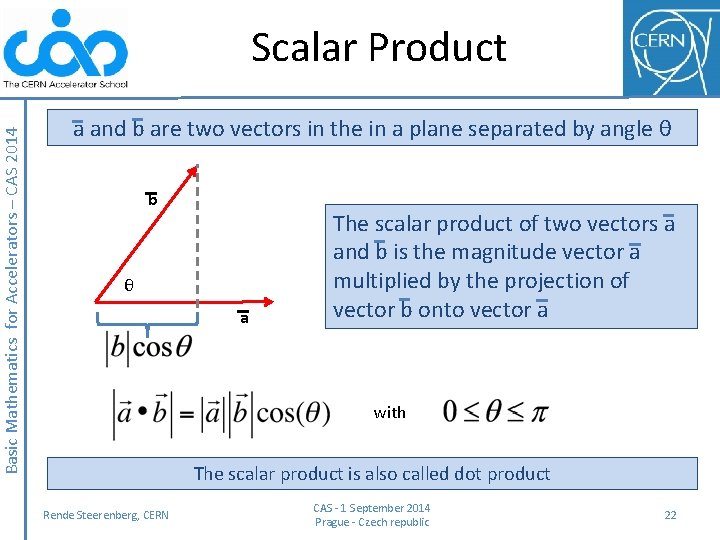
Basic Mathematics for Accelerators – CAS 2014 Scalar Product a and b are two vectors in the in a plane separated by angle θ b θ a The scalar product of two vectors a and b is the magnitude vector a multiplied by the projection of vector b onto vector a with The scalar product is also called dot product Rende Steerenberg, CERN CAS - 1 September 2014 Prague - Czech republic 22
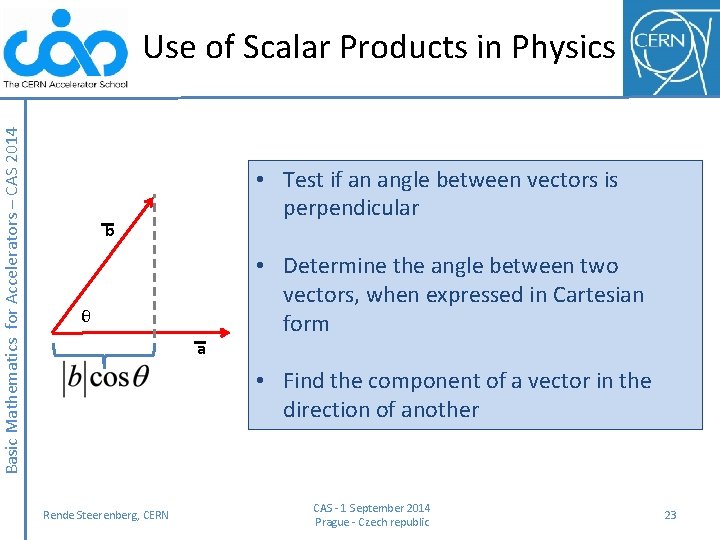
Basic Mathematics for Accelerators – CAS 2014 Use of Scalar Products in Physics • Test if an angle between vectors is perpendicular b θ a • Determine the angle between two vectors, when expressed in Cartesian form • Find the component of a vector in the direction of another Rende Steerenberg, CERN CAS - 1 September 2014 Prague - Czech republic 23
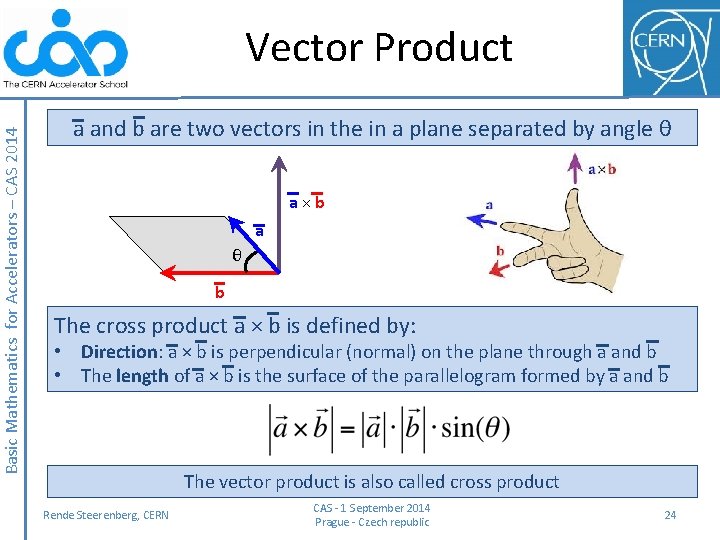
Basic Mathematics for Accelerators – CAS 2014 Vector Product a and b are two vectors in the in a plane separated by angle θ a×b a θ b The cross product a × b is defined by: • Direction: a × b is perpendicular (normal) on the plane through a and b • The length of a × b is the surface of the parallelogram formed by a and b The vector product is also called cross product Rende Steerenberg, CERN CAS - 1 September 2014 Prague - Czech republic 24
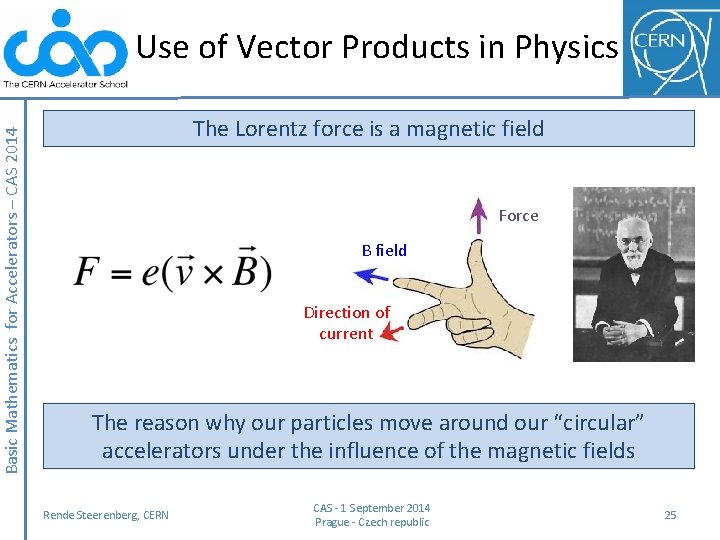
Basic Mathematics for Accelerators – CAS 2014 Use of Vector Products in Physics The Lorentz force is a magnetic field Force B field Direction of current The reason why our particles move around our “circular” accelerators under the influence of the magnetic fields Rende Steerenberg, CERN CAS - 1 September 2014 Prague - Czech republic 25
Basic Mathematics for Accelerators – CAS 2014 • What Maths are needed and Why ? • Differential Equations • Vector Basics • Matrices Rende Steerenberg, CERN CAS - 1 September 2014 Prague - Czech republic 26
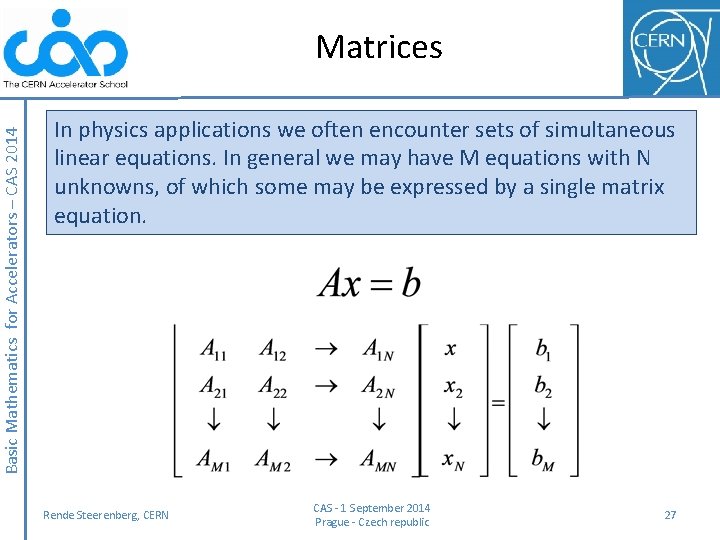
Basic Mathematics for Accelerators – CAS 2014 Matrices In physics applications we often encounter sets of simultaneous linear equations. In general we may have M equations with N unknowns, of which some may be expressed by a single matrix equation. Rende Steerenberg, CERN CAS - 1 September 2014 Prague - Czech republic 27
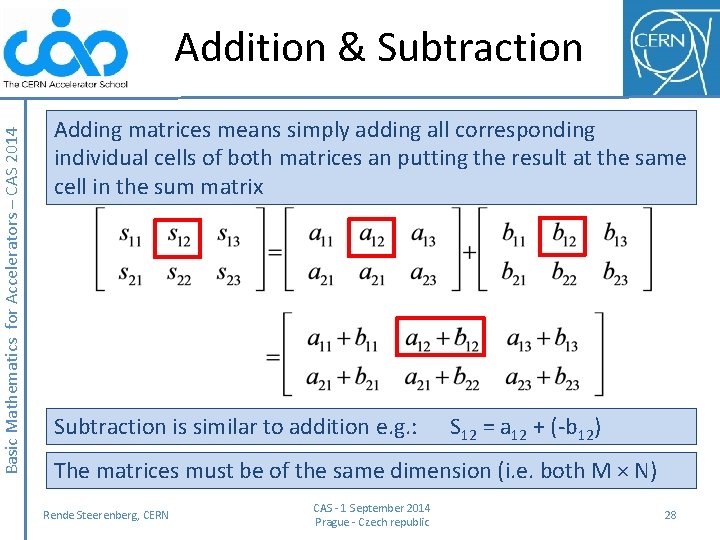
Basic Mathematics for Accelerators – CAS 2014 Addition & Subtraction Adding matrices means simply adding all corresponding individual cells of both matrices an putting the result at the same cell in the sum matrix Subtraction is similar to addition e. g. : S 12 = a 12 + (-b 12) The matrices must be of the same dimension (i. e. both M × N) Rende Steerenberg, CERN CAS - 1 September 2014 Prague - Czech republic 28
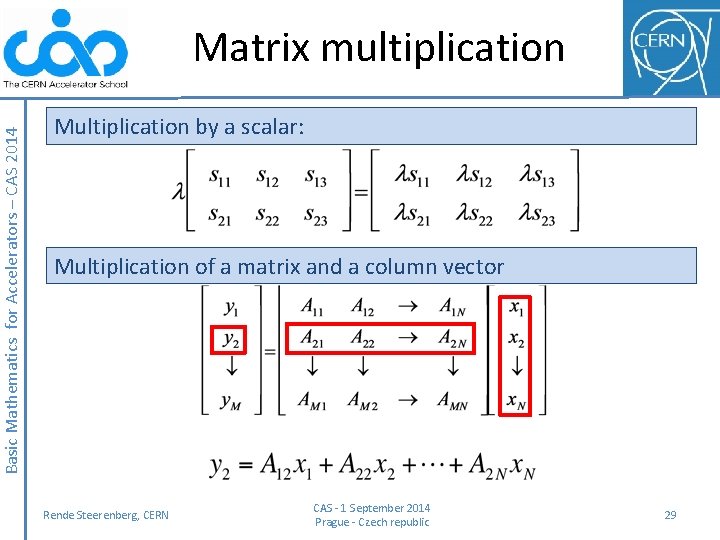
Basic Mathematics for Accelerators – CAS 2014 Matrix multiplication Multiplication by a scalar: Multiplication of a matrix and a column vector Rende Steerenberg, CERN CAS - 1 September 2014 Prague - Czech republic 29

Basic Mathematics for Accelerators – CAS 2014 Matrix multiplication Multiplication of two matrices Matrix multiplication is associative: Multiplication is not commutative: Multiplication is distributive over addition: and Rende Steerenberg, CERN CAS - 1 September 2014 Prague - Czech republic 30
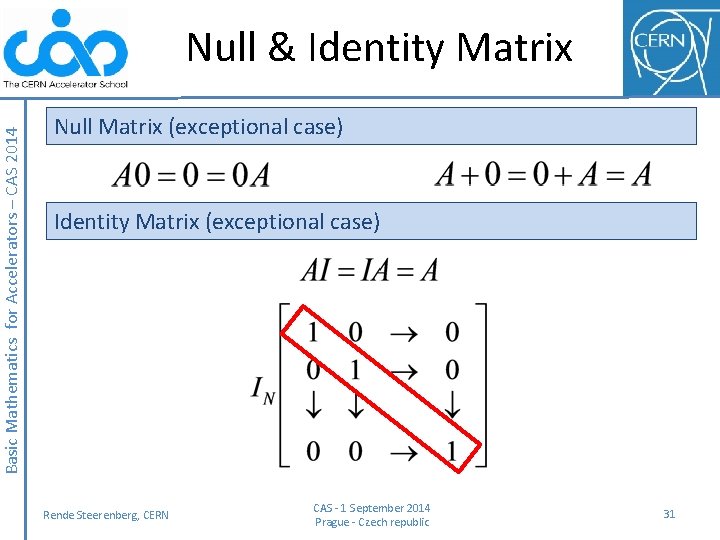
Basic Mathematics for Accelerators – CAS 2014 Null & Identity Matrix Null Matrix (exceptional case) Identity Matrix (exceptional case) Rende Steerenberg, CERN CAS - 1 September 2014 Prague - Czech republic 31

Basic Mathematics for Accelerators – CAS 2014 Transpose The transpose of a matrix A, often written as AT is simply the matrix whose columns are the rows of matrix A If A is an M×N matrix then AT is an N × M matrix Rende Steerenberg, CERN CAS - 1 September 2014 Prague - Czech republic 32
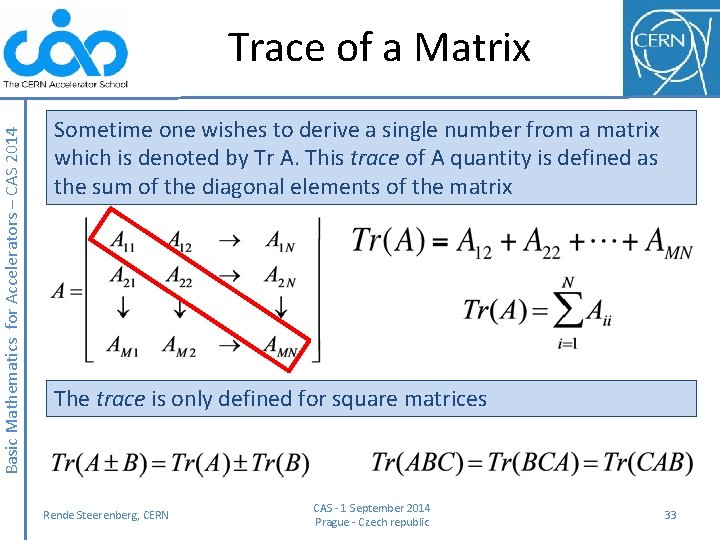
Basic Mathematics for Accelerators – CAS 2014 Trace of a Matrix Sometime one wishes to derive a single number from a matrix which is denoted by Tr A. This trace of A quantity is defined as the sum of the diagonal elements of the matrix The trace is only defined for square matrices Rende Steerenberg, CERN CAS - 1 September 2014 Prague - Czech republic 33
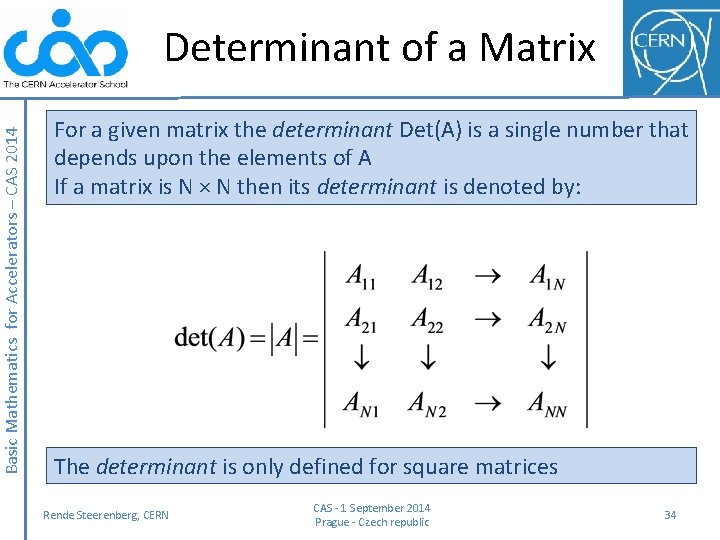
Basic Mathematics for Accelerators – CAS 2014 Determinant of a Matrix For a given matrix the determinant Det(A) is a single number that depends upon the elements of A If a matrix is N × N then its determinant is denoted by: The determinant is only defined for square matrices Rende Steerenberg, CERN CAS - 1 September 2014 Prague - Czech republic 34
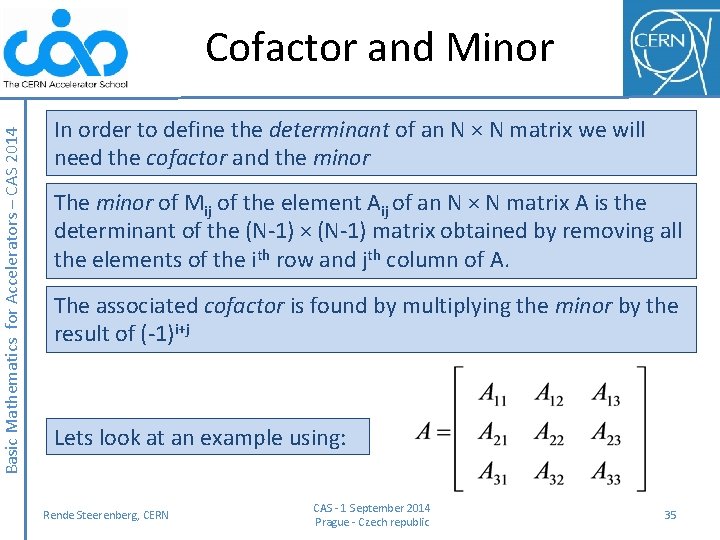
Basic Mathematics for Accelerators – CAS 2014 Cofactor and Minor In order to define the determinant of an N × N matrix we will need the cofactor and the minor The minor of Mij of the element Aij of an N × N matrix A is the determinant of the (N-1) × (N-1) matrix obtained by removing all the elements of the ith row and jth column of A. The associated cofactor is found by multiplying the minor by the result of (-1)i+j Lets look at an example using: Rende Steerenberg, CERN CAS - 1 September 2014 Prague - Czech republic 35
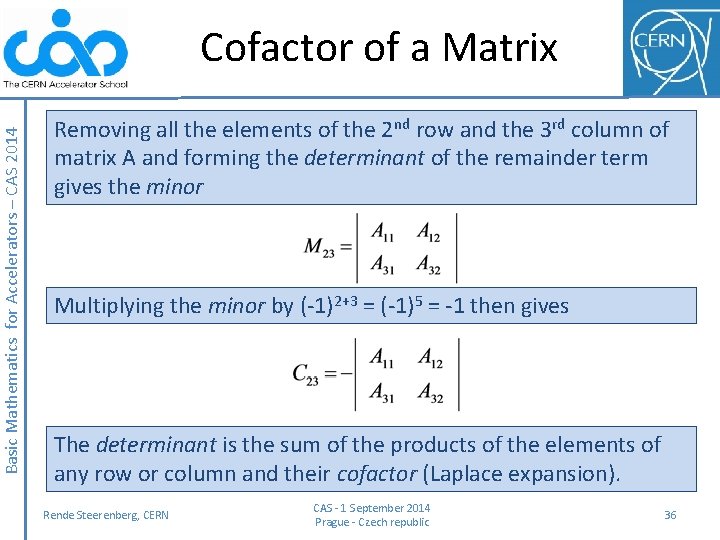
Basic Mathematics for Accelerators – CAS 2014 Cofactor of a Matrix Removing all the elements of the 2 nd row and the 3 rd column of matrix A and forming the determinant of the remainder term gives the minor Multiplying the minor by (-1)2+3 = (-1)5 = -1 then gives The determinant is the sum of the products of the elements of any row or column and their cofactor (Laplace expansion). Rende Steerenberg, CERN CAS - 1 September 2014 Prague - Czech republic 36
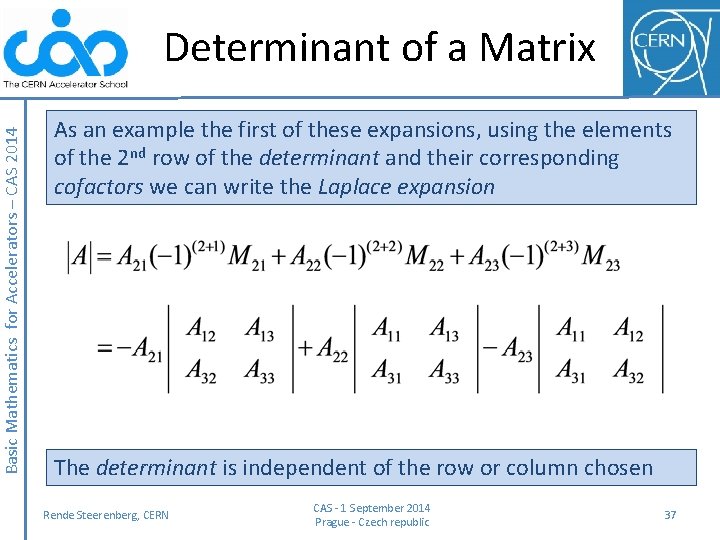
Basic Mathematics for Accelerators – CAS 2014 Determinant of a Matrix As an example the first of these expansions, using the elements of the 2 nd row of the determinant and their corresponding cofactors we can write the Laplace expansion The determinant is independent of the row or column chosen Rende Steerenberg, CERN CAS - 1 September 2014 Prague - Czech republic 37
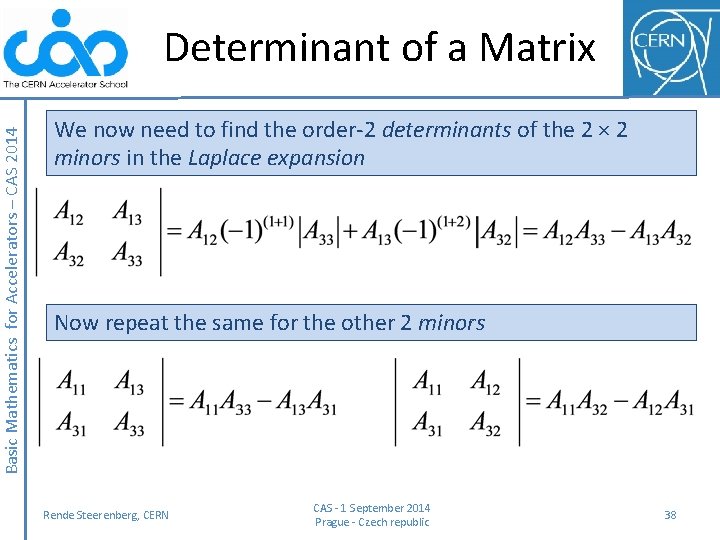
Basic Mathematics for Accelerators – CAS 2014 Determinant of a Matrix We now need to find the order-2 determinants of the 2 × 2 minors in the Laplace expansion Now repeat the same for the other 2 minors Rende Steerenberg, CERN CAS - 1 September 2014 Prague - Czech republic 38
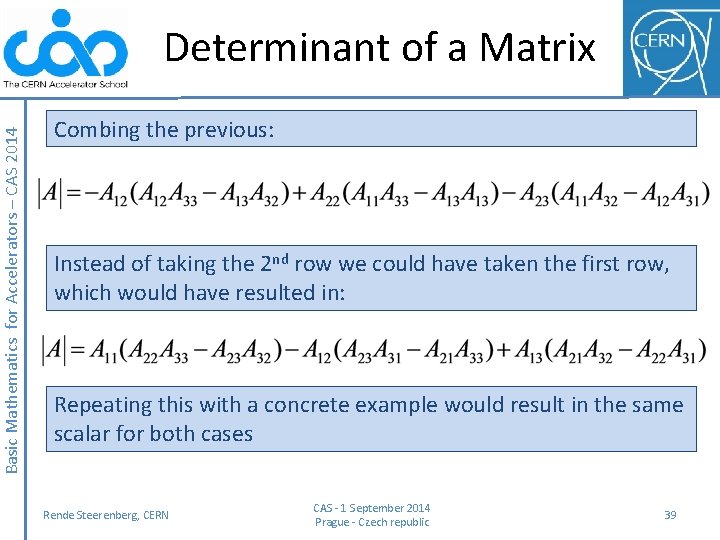
Basic Mathematics for Accelerators – CAS 2014 Determinant of a Matrix Combing the previous: Instead of taking the 2 nd row we could have taken the first row, which would have resulted in: Repeating this with a concrete example would result in the same scalar for both cases Rende Steerenberg, CERN CAS - 1 September 2014 Prague - Czech republic 39
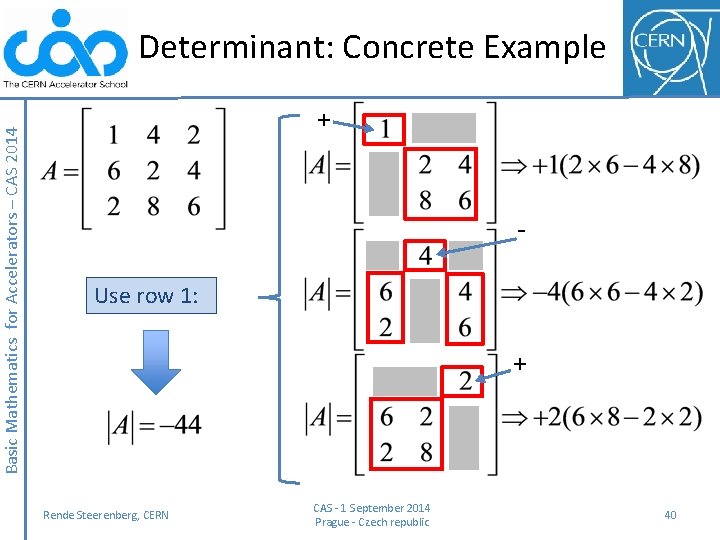
Basic Mathematics for Accelerators – CAS 2014 Determinant: Concrete Example + Use row 1: + Rende Steerenberg, CERN CAS - 1 September 2014 Prague - Czech republic 40
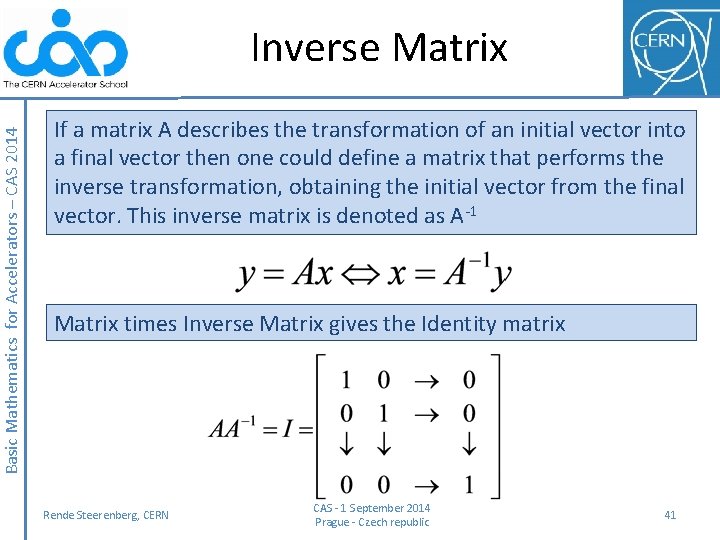
Basic Mathematics for Accelerators – CAS 2014 Inverse Matrix If a matrix A describes the transformation of an initial vector into a final vector then one could define a matrix that performs the inverse transformation, obtaining the initial vector from the final vector. This inverse matrix is denoted as A-1 Matrix times Inverse Matrix gives the Identity matrix Rende Steerenberg, CERN CAS - 1 September 2014 Prague - Czech republic 41
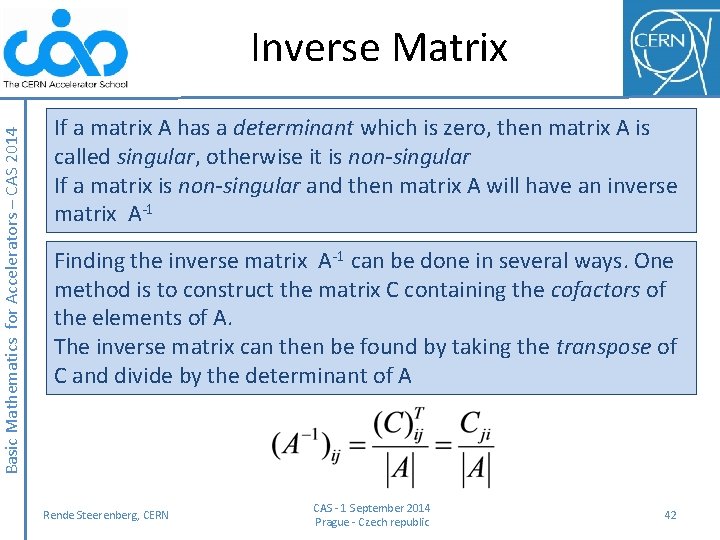
Basic Mathematics for Accelerators – CAS 2014 Inverse Matrix If a matrix A has a determinant which is zero, then matrix A is called singular, otherwise it is non-singular If a matrix is non-singular and then matrix A will have an inverse matrix A-1 Finding the inverse matrix A-1 can be done in several ways. One method is to construct the matrix C containing the cofactors of the elements of A. The inverse matrix can then be found by taking the transpose of C and divide by the determinant of A Rende Steerenberg, CERN CAS - 1 September 2014 Prague - Czech republic 42
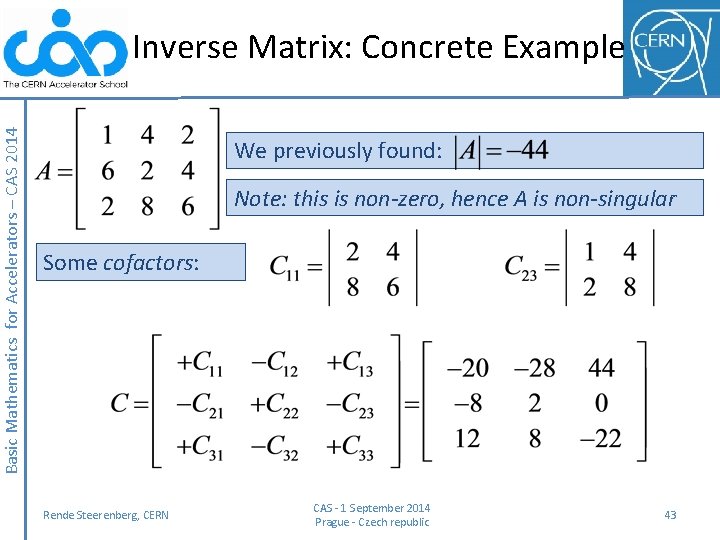
Basic Mathematics for Accelerators – CAS 2014 Inverse Matrix: Concrete Example We previously found: Note: this is non-zero, hence A is non-singular Some cofactors: Rende Steerenberg, CERN CAS - 1 September 2014 Prague - Czech republic 43
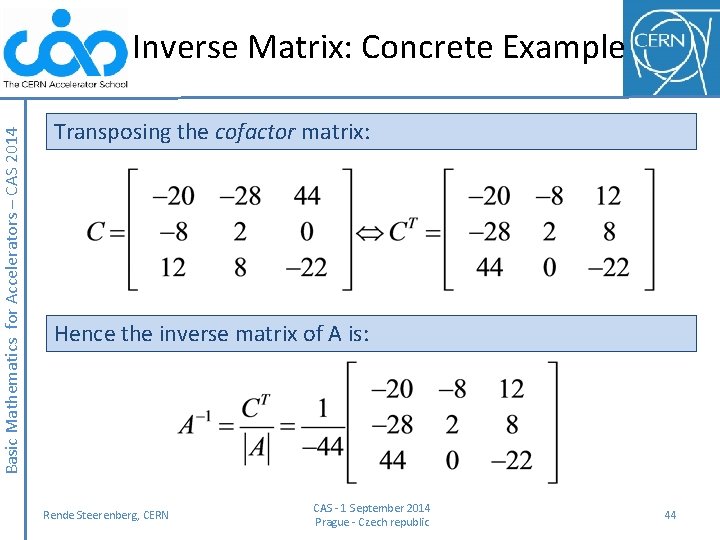
Basic Mathematics for Accelerators – CAS 2014 Inverse Matrix: Concrete Example Transposing the cofactor matrix: Hence the inverse matrix of A is: Rende Steerenberg, CERN CAS - 1 September 2014 Prague - Czech republic 44
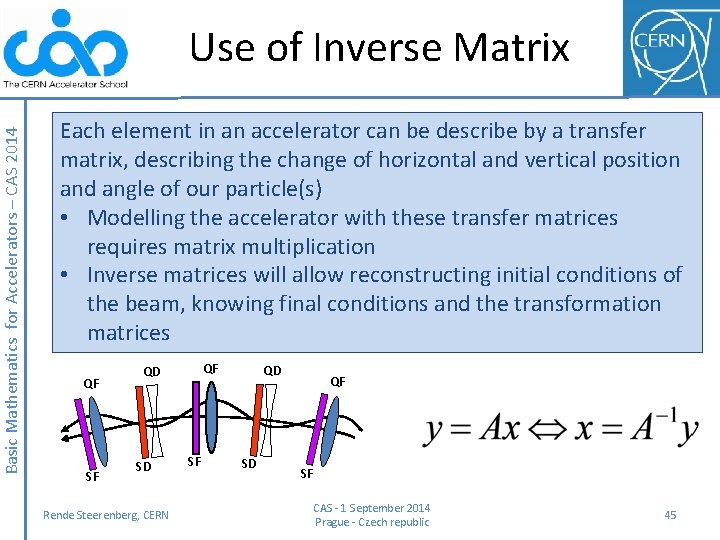
Basic Mathematics for Accelerators – CAS 2014 Use of Inverse Matrix Each element in an accelerator can be describe by a transfer matrix, describing the change of horizontal and vertical position and angle of our particle(s) • Modelling the accelerator with these transfer matrices requires matrix multiplication • Inverse matrices will allow reconstructing initial conditions of the beam, knowing final conditions and the transformation matrices QF SF QF QD SD Rende Steerenberg, CERN SF QD SD QF SF CAS - 1 September 2014 Prague - Czech republic 45
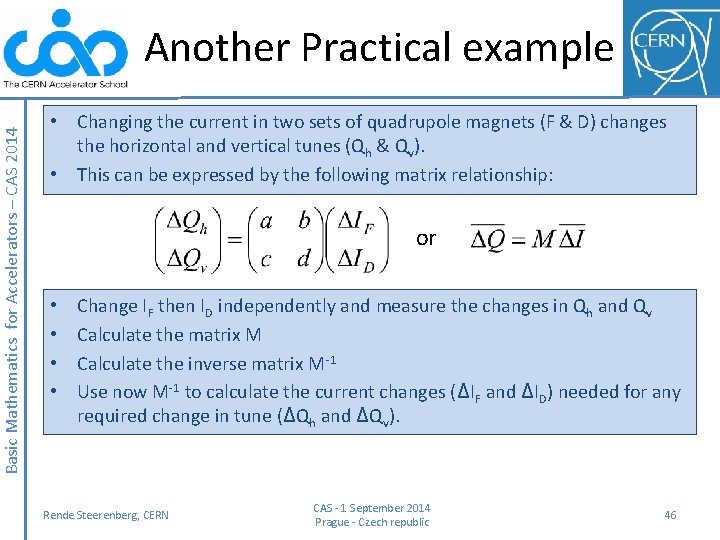
Basic Mathematics for Accelerators – CAS 2014 Another Practical example • Changing the current in two sets of quadrupole magnets (F & D) changes the horizontal and vertical tunes (Qh & Qv). • This can be expressed by the following matrix relationship: or • • Change IF then ID independently and measure the changes in Qh and Qv Calculate the matrix M Calculate the inverse matrix M-1 Use now M-1 to calculate the current changes (ΔIF and ΔID) needed for any required change in tune (ΔQh and ΔQv). Rende Steerenberg, CERN CAS - 1 September 2014 Prague - Czech republic 46
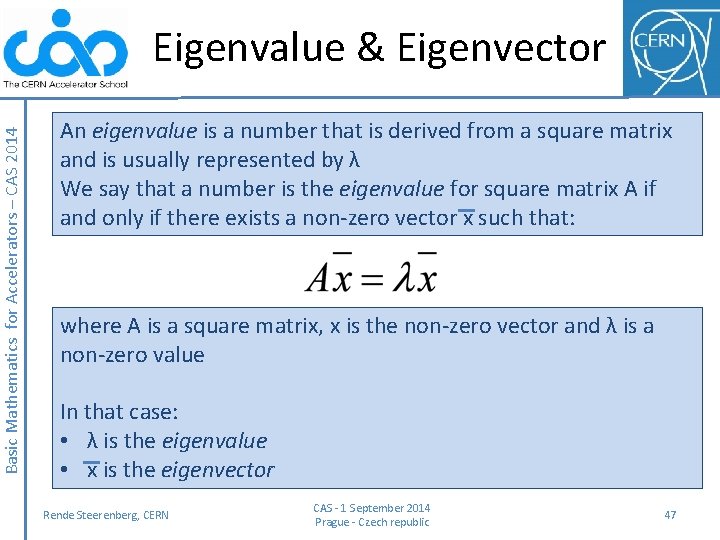
Basic Mathematics for Accelerators – CAS 2014 Eigenvalue & Eigenvector An eigenvalue is a number that is derived from a square matrix and is usually represented by λ We say that a number is the eigenvalue for square matrix A if and only if there exists a non-zero vector x such that: where A is a square matrix, x is the non-zero vector and λ is a non-zero value In that case: • λ is the eigenvalue • x is the eigenvector Rende Steerenberg, CERN CAS - 1 September 2014 Prague - Czech republic 47
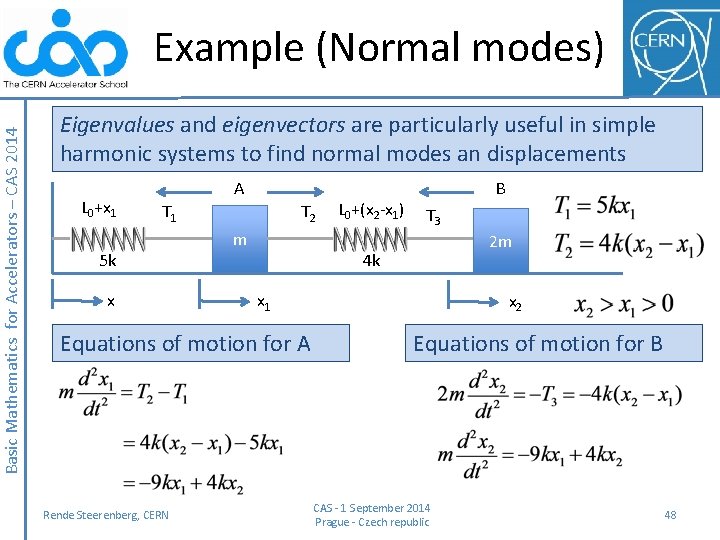
Basic Mathematics for Accelerators – CAS 2014 Example (Normal modes) Eigenvalues and eigenvectors are particularly useful in simple harmonic systems to find normal modes an displacements L 0+x 1 A T 1 5 k x T 2 m T 3 2 m 4 k x 1 Equations of motion for A Rende Steerenberg, CERN L 0+(x 2 -x 1) B x 2 Equations of motion for B CAS - 1 September 2014 Prague - Czech republic 48

Basic Mathematics for Accelerators – CAS 2014 Eigenvalue & Eigenvector A normal mode of a mechanical system is a motion of the system in which all the masses execute simple harmonic motion with the same angular frequency called normal mode angular frequency Let: and The equations of motion become then Rende Steerenberg, CERN In matrix form CAS - 1 September 2014 Prague - Czech republic 49
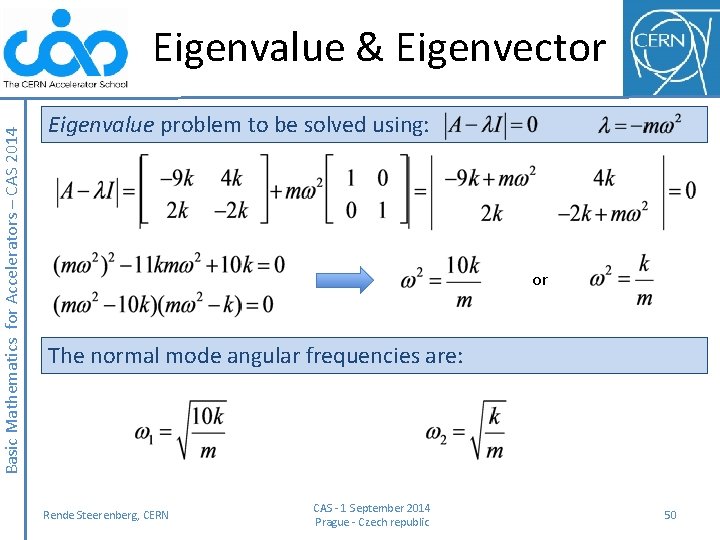
Basic Mathematics for Accelerators – CAS 2014 Eigenvalue & Eigenvector Eigenvalue problem to be solved using: or The normal mode angular frequencies are: Rende Steerenberg, CERN CAS - 1 September 2014 Prague - Czech republic 50
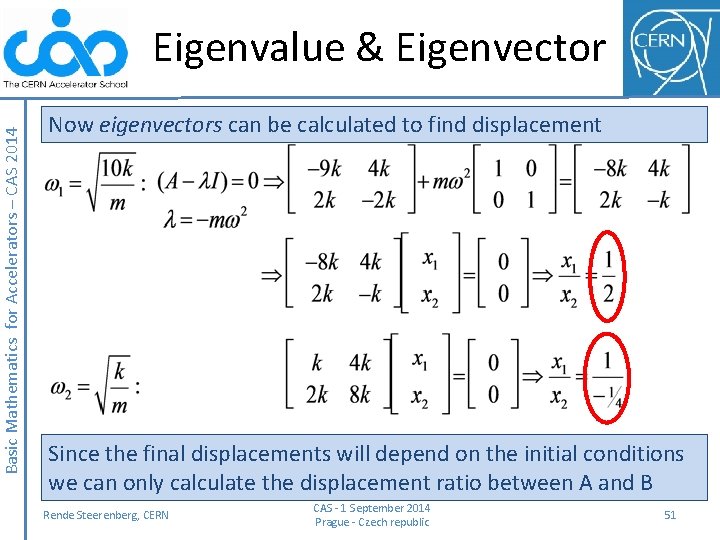
Basic Mathematics for Accelerators – CAS 2014 Eigenvalue & Eigenvector Now eigenvectors can be calculated to find displacement Since the final displacements will depend on the initial conditions we can only calculate the displacement ratio between A and B Rende Steerenberg, CERN CAS - 1 September 2014 Prague - Czech republic 51
Basic Mathematics for Accelerators – CAS 2014 Eigenvalue & Eigenvector The example treated a simple harmonic oscillator that was coupled through springs. Using eigenvalues and eigenvectors we could conclude something about: • Oscillation frequencies • Displacements The particles in our accelerators make simple harmonic oscillation under the influence of magnetic fields in the horizontal and vertical plane. Through magnets, but also collective effect, the particle oscillations in the horizontal plane and vertical plane can become coupled. Eigenvalues and Eigenvector can be used to characterise this coupling Rende Steerenberg, CERN CAS - 1 September 2014 Prague - Czech republic 52
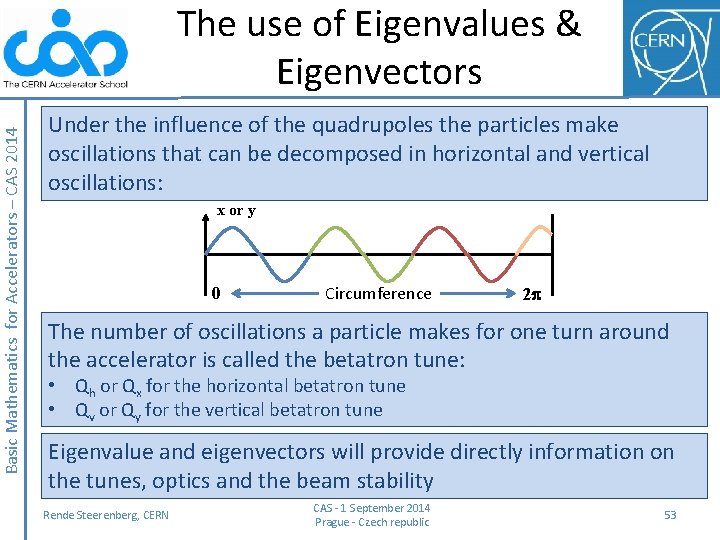
Basic Mathematics for Accelerators – CAS 2014 The use of Eigenvalues & Eigenvectors Under the influence of the quadrupoles the particles make oscillations that can be decomposed in horizontal and vertical oscillations: x or y 0 Circumference 2 p The number of oscillations a particle makes for one turn around the accelerator is called the betatron tune: • Qh or Qx for the horizontal betatron tune • Qv or Qy for the vertical betatron tune Eigenvalue and eigenvectors will provide directly information on the tunes, optics and the beam stability Rende Steerenberg, CERN CAS - 1 September 2014 Prague - Czech republic 53
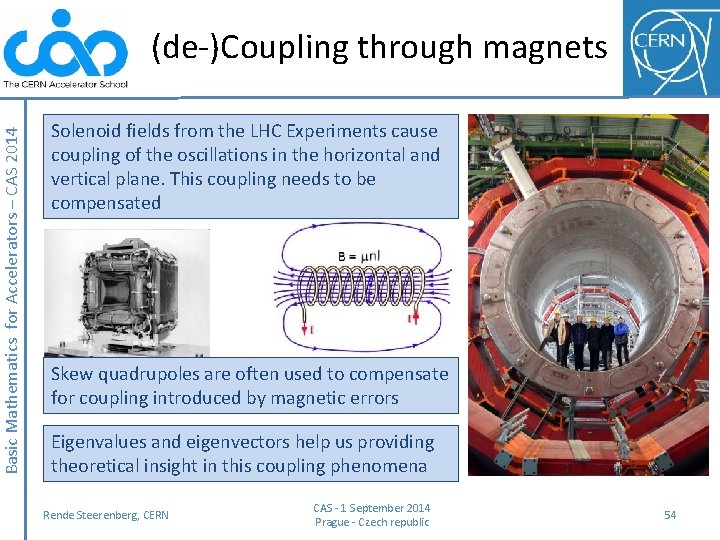
Basic Mathematics for Accelerators – CAS 2014 (de-)Coupling through magnets Solenoid fields from the LHC Experiments cause coupling of the oscillations in the horizontal and vertical plane. This coupling needs to be compensated Skew quadrupoles are often used to compensate for coupling introduced by magnetic errors Eigenvalues and eigenvectors help us providing theoretical insight in this coupling phenomena Rende Steerenberg, CERN CAS - 1 September 2014 Prague - Czech republic 54
Basic Mathematics for Accelerators – CAS 2014 Everything must be made as simple as possible. But not simpler…. Albert Einstein Rende Steerenberg, CERN CAS - 1 September 2014 Prague - Czech republic 55
Basic Mathematics for Accelerators – CAS 2014 -- Spare Slides -- Rende Steerenberg, CERN CAS - 1 September 2014 Prague - Czech republic 56
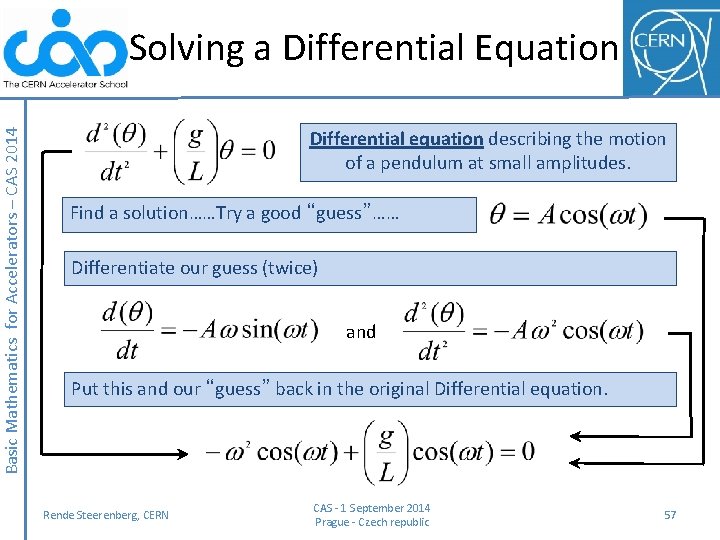
Basic Mathematics for Accelerators – CAS 2014 Solving a Differential Equation Differential equation describing the motion of a pendulum at small amplitudes. Find a solution……Try a good “guess”…… Differentiate our guess (twice) and Put this and our “guess” back in the original Differential equation. Rende Steerenberg, CERN CAS - 1 September 2014 Prague - Czech republic 57
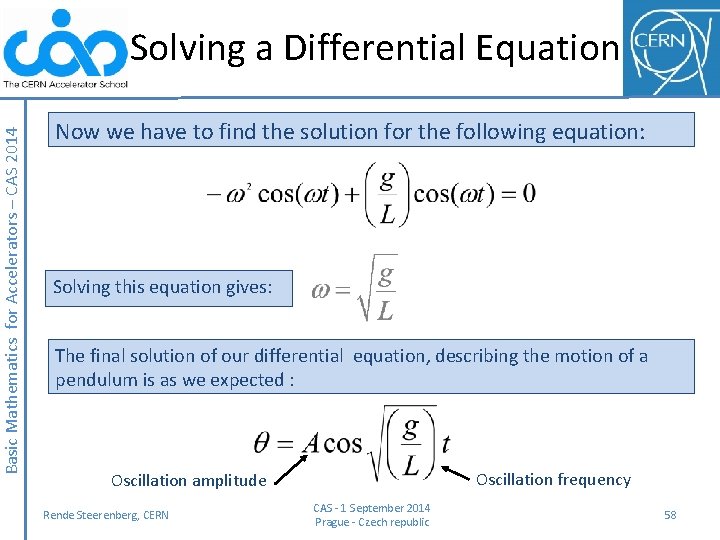
Basic Mathematics for Accelerators – CAS 2014 Solving a Differential Equation Now we have to find the solution for the following equation: Solving this equation gives: The final solution of our differential equation, describing the motion of a pendulum is as we expected : Oscillation frequency Oscillation amplitude Rende Steerenberg, CERN CAS - 1 September 2014 Prague - Czech republic 58
- Slides: 58