
Basic Math Vectors and Scalars AdditionSubtraction of Vectors
Basic Math Vectors and Scalars Addition/Subtraction of Vectors Unit Vectors Dot Product
Scalars and Vectors (1) n n n Scalar – physical quantity that is specified in terms of a single real number, or magnitude q Ex. Length, temperature, mass, speed Vector – physical quantity that is specified by both magnitude and direction q Ex. Force, velocity, displacement, acceleration We represent vectors graphically or quantitatively: q Graphically: through arrows with the orientation representing the direction and length representing the magnitude q Quantitatively: A vector r in the Cartesian plane is an ordered pair of real numbers that has the form <a, b>. We write r=<a, b> where a and b are the components of vector v. Note: Both and r represent vectors, and will be used interchangeably.
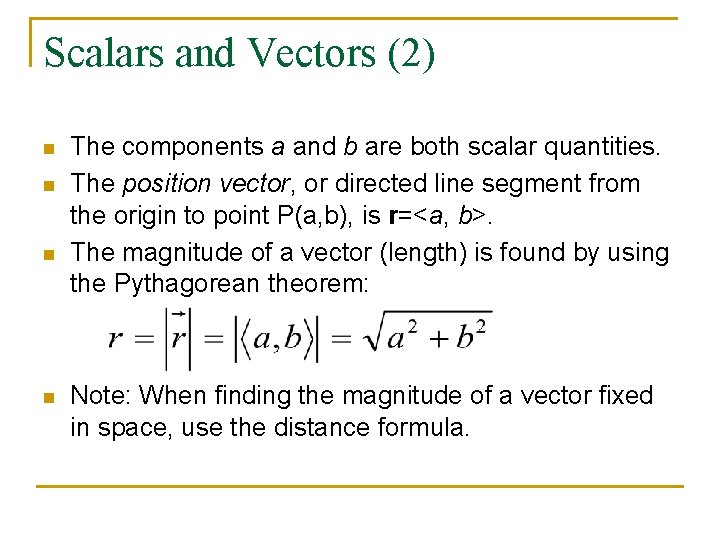
Scalars and Vectors (2) n n The components a and b are both scalar quantities. The position vector, or directed line segment from the origin to point P(a, b), is r=<a, b>. The magnitude of a vector (length) is found by using the Pythagorean theorem: Note: When finding the magnitude of a vector fixed in space, use the distance formula.
Operations with Vectors (1) n Vector Addition/Subtraction The sum of two vectors, u=<u 1, u 2> and v=<v 1, v 2> is the vector u+v =<(u 1+v 1), (u 2+v 2)>. q q Ex. If u=<4, 3> and v=<-5, 2>, then u+v=<-1, 5> Similarly, u-v=<4 -(-5), 3 -2>=<9, 1>
Operations with Vectors (2) n Multiplication of a Vector by Scalar If u=<u 1, u 2> and c is a real number, the scalar multiple cu is the vector cu=<cu 1, cu 2>. q Ex. If u=<4, 3> and c=2, then cu=<(2· 4), (2· 3)> cu=<8, 6>
Unit Vectors (1) n n n A unit vector is a vector of length 1. They are used to specify a direction. By convention, we usually use i, j and k to represent the unit vectors in the x, y and z directions, respectively (in 3 dimensions). q q q n i=<1, 0, 0> j=<0, 1, 0> k=<0, 0, 1> points along the positive x-axis points along the positive y-axis points along the positive z-axis Unit vectors for various coordinate systems: q q Cartesian: i, j, and k Cartesian: we may choose a different set of unit vectors, e. g. we can rotate i, j, and k
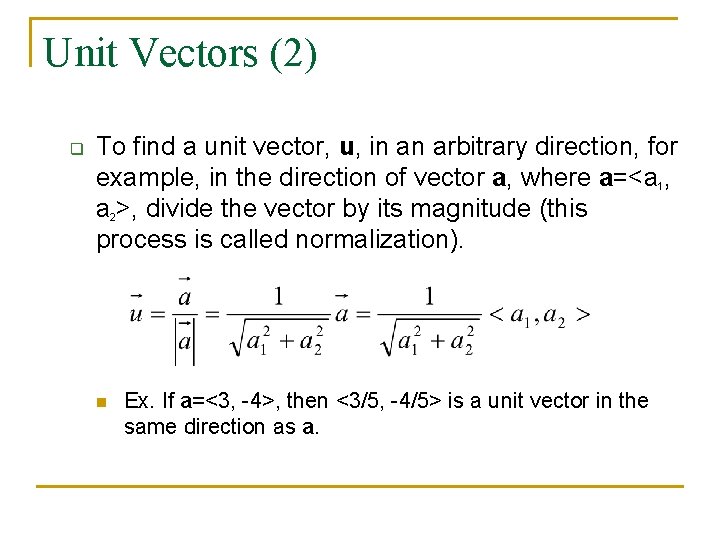
Unit Vectors (2) q To find a unit vector, u, in an arbitrary direction, for example, in the direction of vector a, where a=<a 1, a 2>, divide the vector by its magnitude (this process is called normalization). n Ex. If a=<3, -4>, then <3/5, -4/5> is a unit vector in the same direction as a.
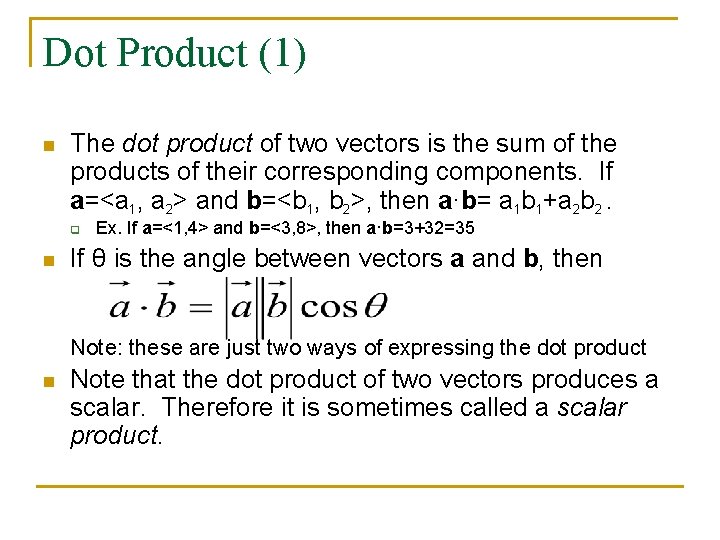
Dot Product (1) n The dot product of two vectors is the sum of the products of their corresponding components. If a=<a 1, a 2> and b=<b 1, b 2>, then a·b= a 1 b 1+a 2 b 2. q n Ex. If a=<1, 4> and b=<3, 8>, then a·b=3+32=35 If θ is the angle between vectors a and b, then Note: these are just two ways of expressing the dot product n Note that the dot product of two vectors produces a scalar. Therefore it is sometimes called a scalar product.
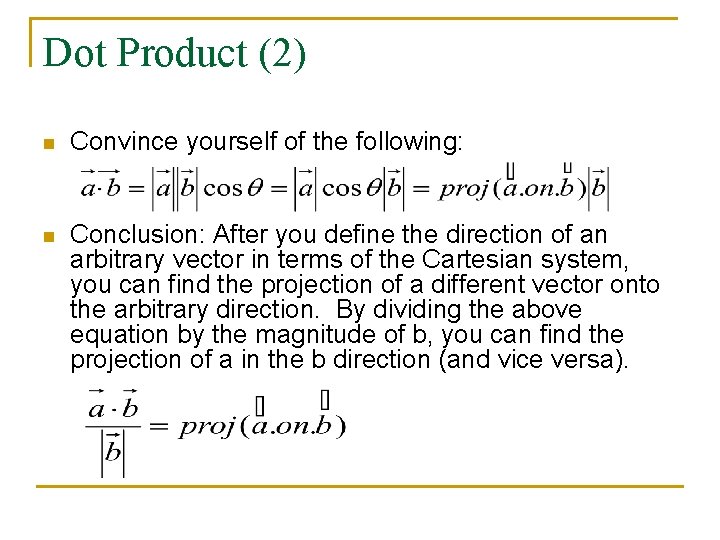
Dot Product (2) n Convince yourself of the following: n Conclusion: After you define the direction of an arbitrary vector in terms of the Cartesian system, you can find the projection of a different vector onto the arbitrary direction. By dividing the above equation by the magnitude of b, you can find the projection of a in the b direction (and vice versa).
- Slides: 9