
Basic life support KS 4 Basic life support
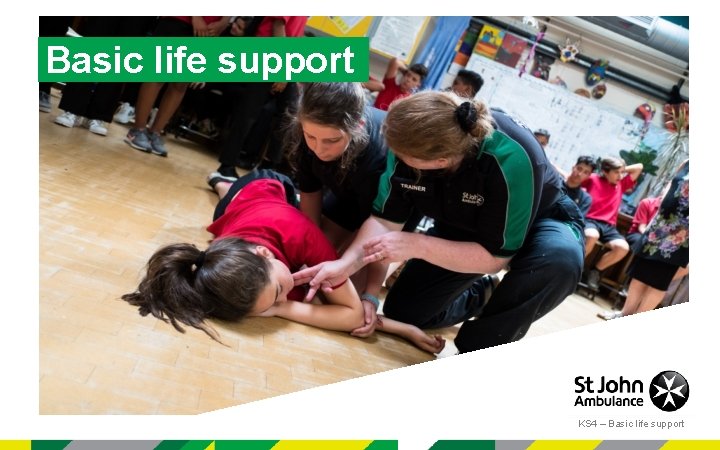
Basic life support KS 4 – Basic life support
Basic life support A short course for young people to learn how to deal with first aid emergencies. KS 4 - Basic life support
Learning outcomes ➤ I am able to carry out a primary survey ➤ I can place an unresponsive casualty, who is breathing normally, in to the recovery position ➤ I know when and how to deliver CPR to an unresponsive casualty who is not breathing normally KS 4 - Basic life support
When things go wrong A 12 Think of something that could happen to make someone unresponsive. KS 4 – Basic life support

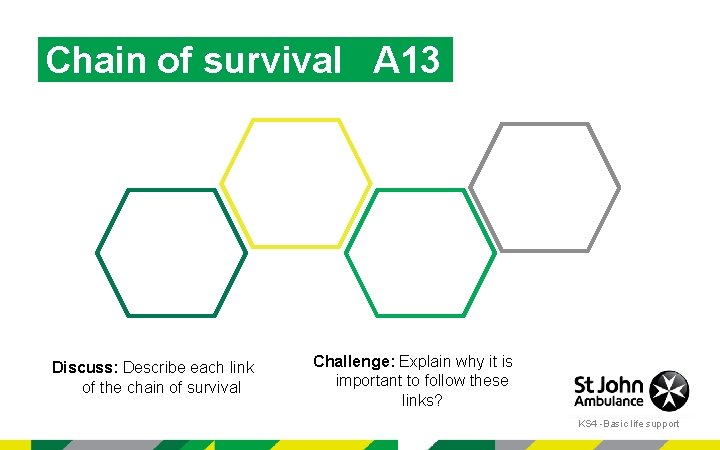
Chain of survival A 13 Early CPR Call for help Post resuscitation Early defibrillation care Discuss: Describe each link of the chain of survival Challenge: Explain why it is important to follow these links to increase the casualty’s chances of survival KS 4 – Basic life support
Primary survey You do a primary survey to assess a casualty. KS 4 – Basic life support
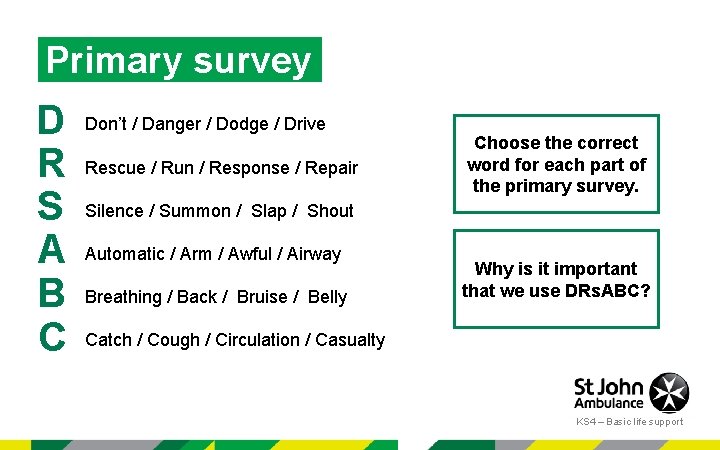
Primary survey D R S A B C Don’t / Danger / Dodge / Drive Rescue / Run / Response / Repair Choose the correct word for each part of the primary survey. Silence / Summon / Slap / Shout Automatic / Arm / Awful / Airway Breathing / Back / Bruise / Belly Why is it important that we use DRs. ABC? Catch / Cough / Circulation / Casualty KS 4 – Basic life support
Watch this video https: //youtu. be/l. CMhu. RM 0 c. IU KS 4 – Basic life support
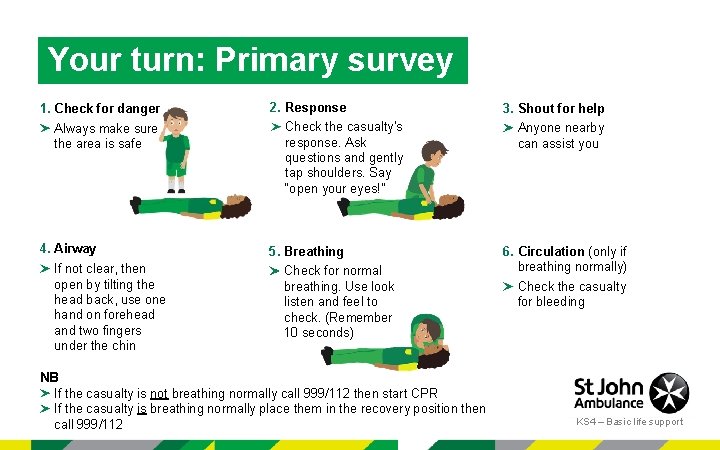
Your turn: Primary survey 1. Check for danger Always make sure the area is safe 4. Airway If not clear, then open by tilting the head back, use one hand on forehead and two fingers under the chin 2. Response Check the casualty’s response. Ask questions and gently tap shoulders. Say “open your eyes!” 5. Breathing Check for normal breathing. Use look listen and feel to check. (Remember 10 seconds) 3. Shout for help Anyone nearby can assist you 6. Circulation (only if breathing normally) Check the casualty for bleeding NB If the casualty is not breathing normally call 999/112 then start CPR If the casualty is breathing normally place them in the recovery position then call 999/112 KS 4 – Basic life support
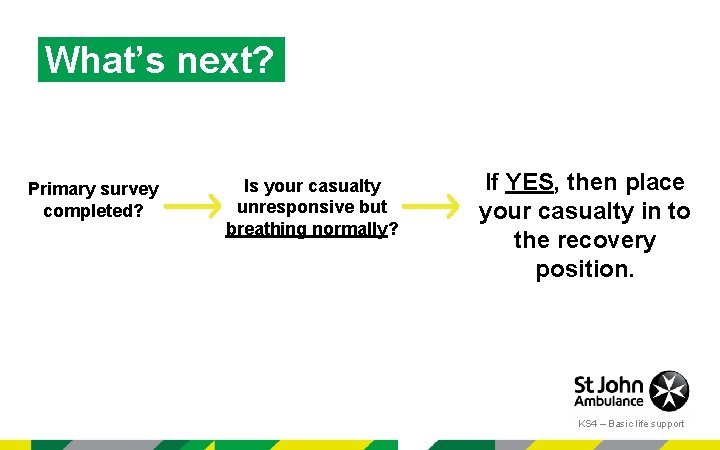
What’s next? Primary survey completed? Is your casualty unresponsive but breathing normally? If YES, then place your casualty in to the recovery position. KS 4 – Basic life support
Watch this video https: //youtu. be/ubb. ZU 15 -ETM KS 4 – Basic life support
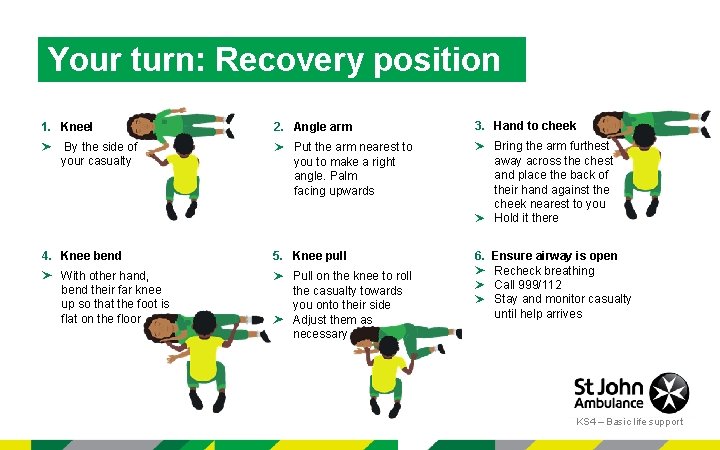
Your turn: Recovery position 1. Kneel By the side of your casualty 4. Knee bend With other hand, bend their far knee up so that the foot is flat on the floor 2. Angle arm Put the arm nearest to you to make a right angle. Palm facing upwards 5. Knee pull Pull on the knee to roll the casualty towards you onto their side Adjust them as necessary 3. Hand to cheek Bring the arm furthest away across the chest and place the back of their hand against the cheek nearest to you Hold it there 6. Ensure airway is open Recheck breathing Call 999/112 Stay and monitor casualty until help arrives KS 4 – Basic life support
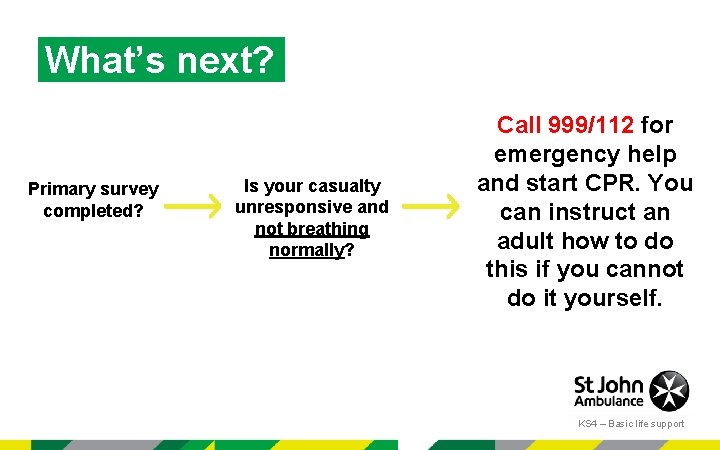
What’s next? Primary survey completed? Is your casualty unresponsive and not breathing normally? Call 999/112 for emergency help and start CPR. You can instruct an adult how to do this if you cannot do it yourself. KS 4 – Basic life support
Watch this video https: //youtu. be/z. ZAIA 7 Iqhyo KS 4 – Basic life support
CPR remember… ➤ You may not be strong/confident enough to do CPR on a casualty. That’s OK, you can tell someone else what they need to do ➤ It is important to understand that sometimes even CPR cannot save somebody ➤ Anything you can do to help, even just calling someone else to help, could be lifesaving ➤ Never do CPR on someone if they are awake and breathing normally KS 4 – Basic life support
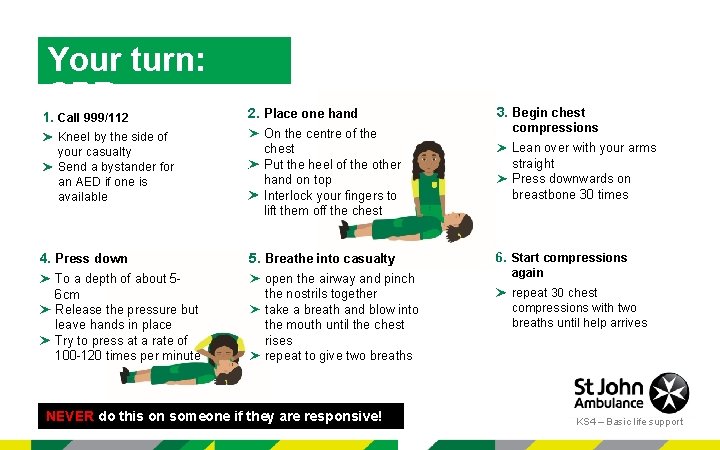
Your turn: CPR 1. Call 999/112 Kneel by the side of your casualty Send a bystander for an AED if one is available 4. Press down To a depth of about 56 cm Release the pressure but leave hands in place Try to press at a rate of 100 -120 times per minute 2. Place one hand On the centre of the chest Put the heel of the other hand on top Interlock your fingers to lift them off the chest 5. Breathe into casualty open the airway and pinch the nostrils together take a breath and blow into the mouth until the chest rises repeat to give two breaths NEVER do this on someone if they are responsive! 3. Begin chest compressions Lean over with your arms straight Press downwards on breastbone 30 times 6. Start compressions again repeat 30 chest compressions with two breaths until help arrives KS 4 – Basic life support
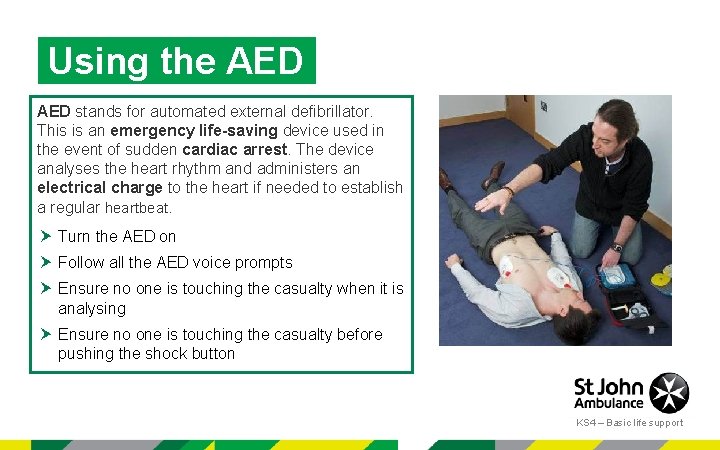
Using the AED stands for automated external defibrillator. This is an emergency life-saving device used in the event of sudden cardiac arrest. The device analyses the heart rhythm and administers an electrical charge to the heart if needed to establish a regular heartbeat. Turn the AED on Follow all the AED voice prompts Ensure no one is touching the casualty when it is analysing Ensure no one is touching the casualty before pushing the shock button KS 4 – Basic life support
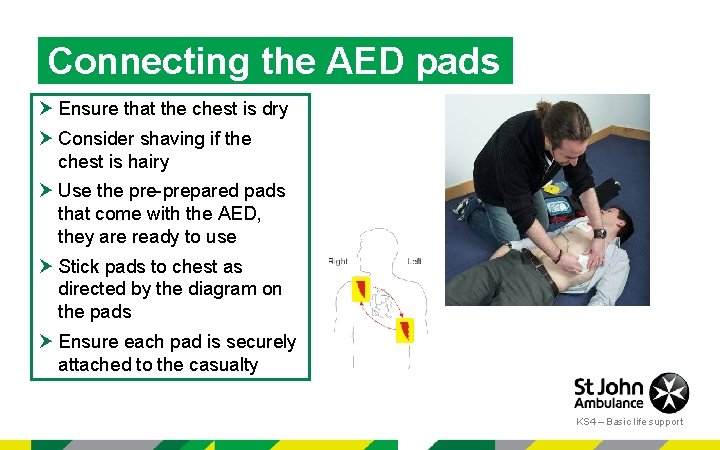
Connecting the AED pads Ensure that the chest is dry Consider shaving if the chest is hairy Use the pre-prepared pads that come with the AED, they are ready to use Stick pads to chest as directed by the diagram on the pads Ensure each pad is securely attached to the casualty KS 4 – Basic life support
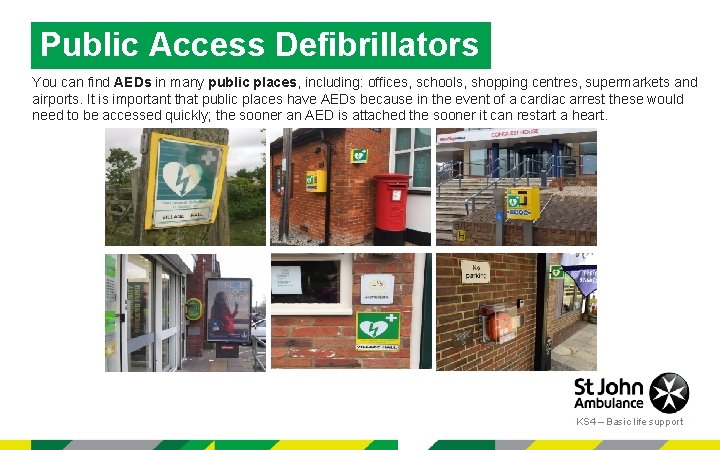
Public Access Defibrillators You can find AEDs in many public places, including: offices, schools, shopping centres, supermarkets and airports. It is important that public places have AEDs because in the event of a cardiac arrest these would need to be accessed quickly; the sooner an AED is attached the sooner it can restart a heart. KS 4 – Basic life support
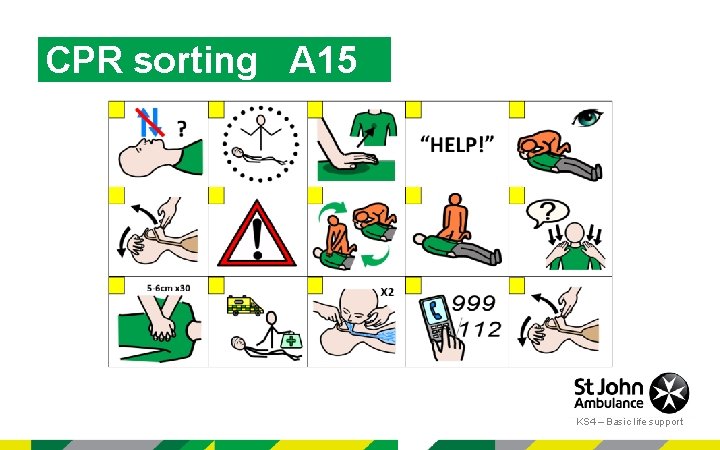
CPR sorting A 15 KS 4 – Basic life support
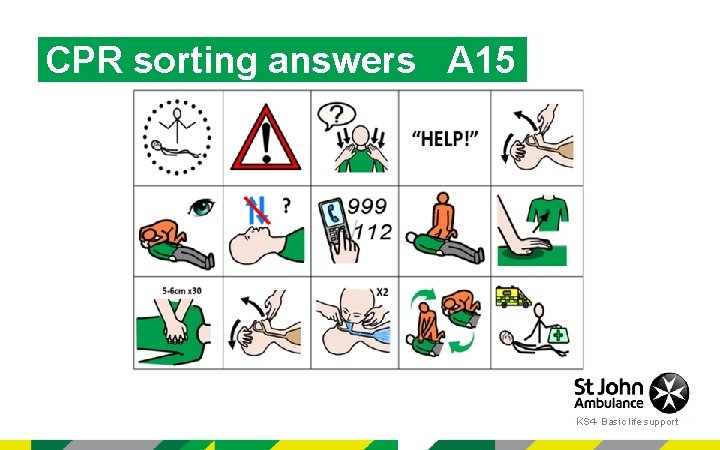
CPR sorting answers A 15 KS 4 - Basic life support
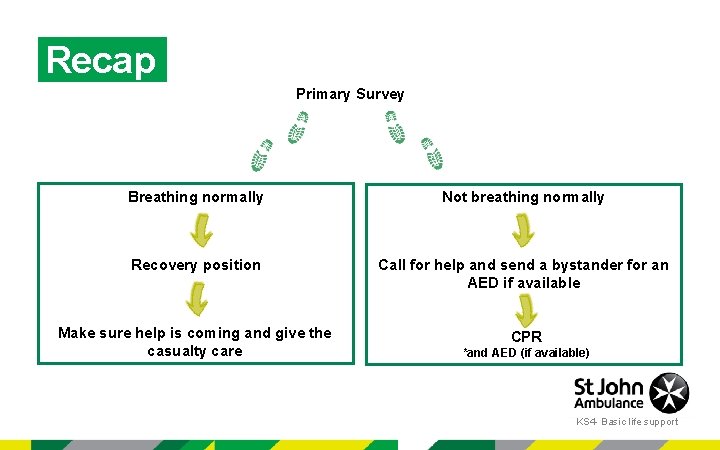
Recap Primary Survey Breathing normally Not breathing normally Recovery position Call for help and send a bystander for an AED if available Make sure help is coming and give the casualty care CPR *and AED (if available) KS 4 - Basic life support
Roll the dice 1. Identify something you have learnt from this session 2. State why the primary survey is important and describe each part of it 3. Explain the chain of survival 4. What is the first thing you would do if you found an unresponsive casualty and why? 5. What would you do with a casualty who was unresponsive and breathing normally? 6. How would you know if a casualty required CPR? KS 4 - Basic life support
Check your learning I am able to: YES UNSURE NO ➤ do a primary survey ➤ place a casualty who is unresponsive but breathing normally in the recovery position ➤ deliver CPR to an unresponsive casualty who is not breathing normally. (or get help and tell someone else how to do it) KS 4 - Basic life support
Thank you!
When things go wrong A 12 Think of something that could happen to make someone unresponsive. KS 4 - Basic life support
Chain of survival A 13 Discuss: Describe each link of the chain of survival Challenge: Explain why it is important to follow these links? KS 4 -Basic life support
Activity A 16 The human body Now you have the opportunity to learn some human anatomy. You could organise human structures and organs onto an outline of a human body. See if you can identify their positions and function. Use our downloadable worksheet which can be found on the St John Ambulance website. KS 4 - Basic life support
Activity A 40 Task choice Can you achieve 50 points by completing a variety of set tasks? Each task is worth a different number of points. Use our downloadable worksheet which can be found on the St John Ambulance website. KS 4 - Basic life support
- Slides: 29