
BASIC IRRS TRAINING Lecture 2 IAEA Safety Standards
BASIC IRRS TRAINING Lecture 2 IAEA Safety Standards as the Basis for the IRRS Process IAEA International Atomic Energy Agency
Outline • • Learning Objectives Development and Structure Safety Fundamentals General Safety Requirements Part 1 Other General Safety Requirements Specific Safety Requirements Link to IRRS modules IAEA Basic IRRS Training - IAEA Safety Standards 2
Learning objectives After finishing this lecture the trainee will: be aware that GSR Part 1 is the basic reference for an IRRS • have an insight into the structure of GSR Part 1 • have an insight into the IAEA Safety Requirements used in IRRS missions and their link with the IRRS modules • IAEA Basic IRRS Training - IAEA Safety Standards 3
DEVELOPMENT & STRUCTURE - History - Hierarchy and Structure IAEA Basic IRRS Training - IAEA Safety Standards 4
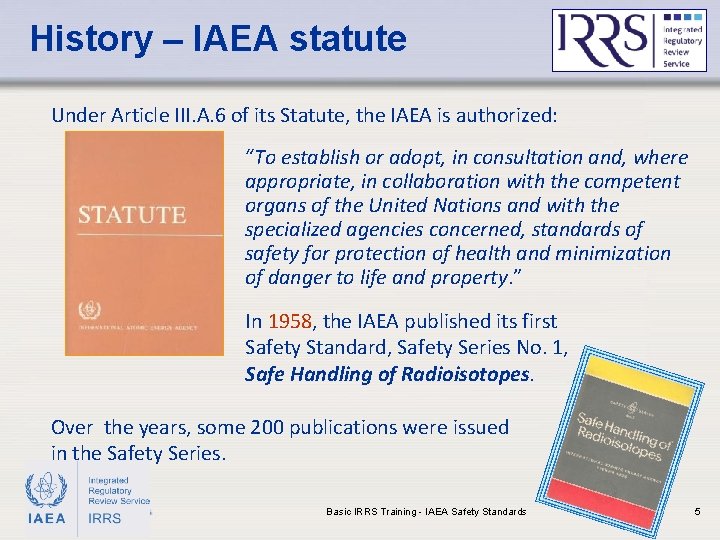
History – IAEA statute Under Article III. A. 6 of its Statute, the IAEA is authorized: “To establish or adopt, in consultation and, where appropriate, in collaboration with the competent organs of the United Nations and with the specialized agencies concerned, standards of safety for protection of health and minimization of danger to life and property. ” In 1958, the IAEA published its first Safety Standard, Safety Series No. 1, Safe Handling of Radioisotopes. Over the years, some 200 publications were issued in the Safety Series. IAEA Basic IRRS Training - IAEA Safety Standards 5
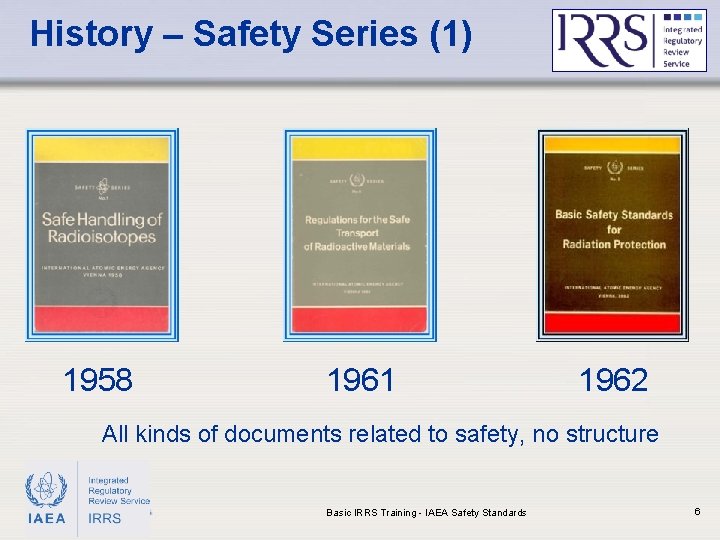
History – Safety Series (1) 1958 1961 1962 All kinds of documents related to safety, no structure IAEA Basic IRRS Training - IAEA Safety Standards 6
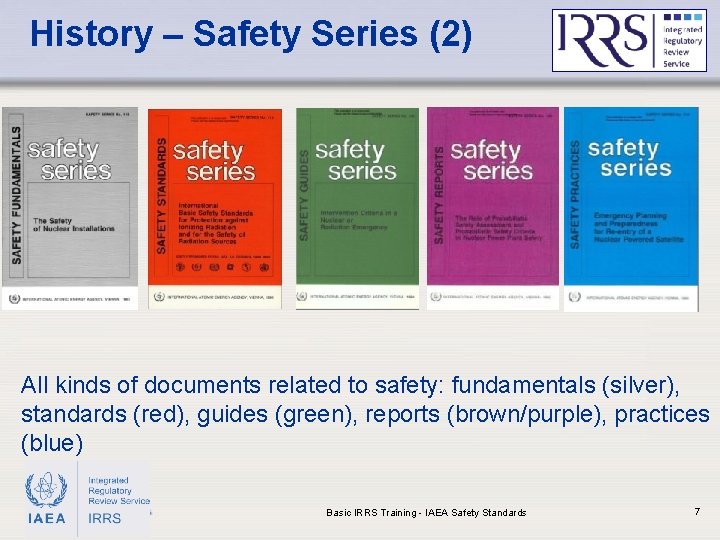
History – Safety Series (2) All kinds of documents related to safety: fundamentals (silver), standards (red), guides (green), reports (brown/purple), practices (blue) IAEA Basic IRRS Training - IAEA Safety Standards 7
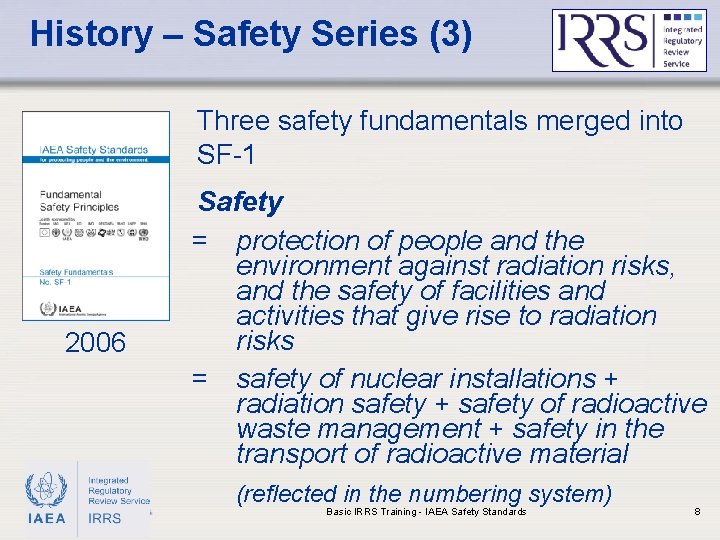
History – Safety Series (3) Three safety fundamentals merged into SF-1 2006 IAEA Safety = protection of people and the environment against radiation risks, and the safety of facilities and activities that give rise to radiation risks = safety of nuclear installations + radiation safety + safety of radioactive waste management + safety in the transport of radioactive material (reflected in the numbering system) Basic IRRS Training - IAEA Safety Standards 8
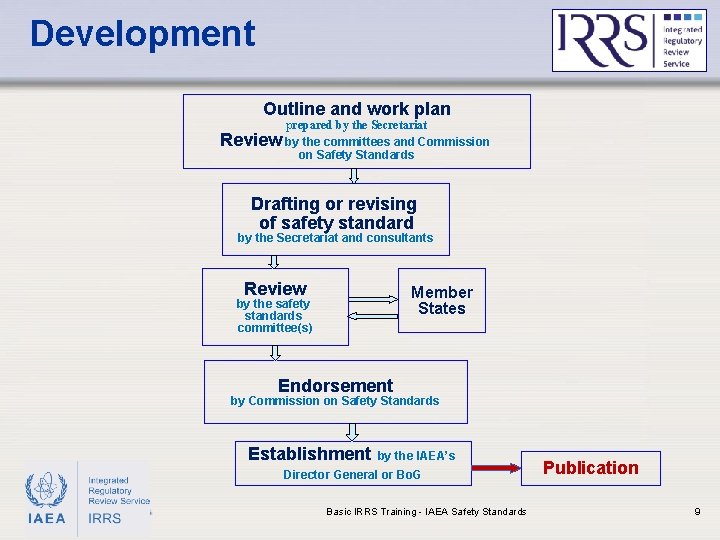
Development Outline and work plan prepared by the Secretariat Review by the committees and Commission on Safety Standards Drafting or revising of safety standard by the Secretariat and consultants Review Member States by the safety standards committee(s) Endorsement by Commission on Safety Standards Establishment by the IAEA’s Director General or Bo. G IAEA Basic IRRS Training - IAEA Safety Standards Publication 9
Development step-by-step IAEA Basic IRRS Training - IAEA Safety Standards 10
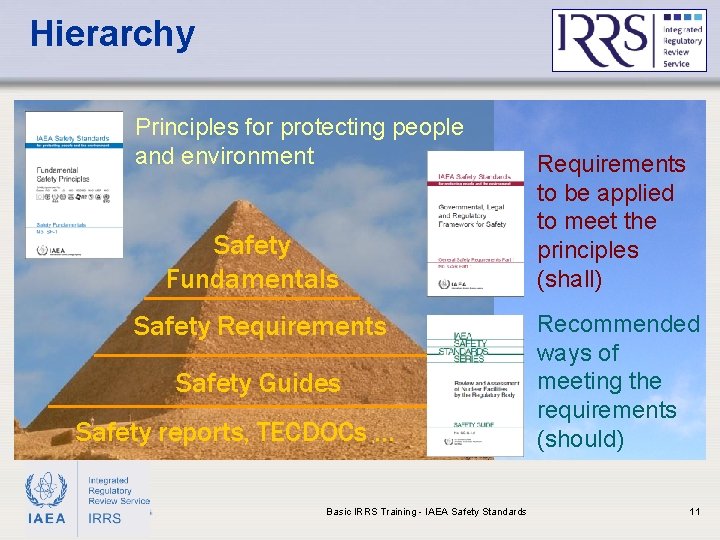
Hierarchy Principles for protecting people and environment Safety Fundamentals Safety Requirements Safety Guides Safety reports, TECDOCs … IAEA Basic IRRS Training - IAEA Safety Standards Requirements to be applied to meet the principles (shall) Recommended ways of meeting the requirements (should) 11
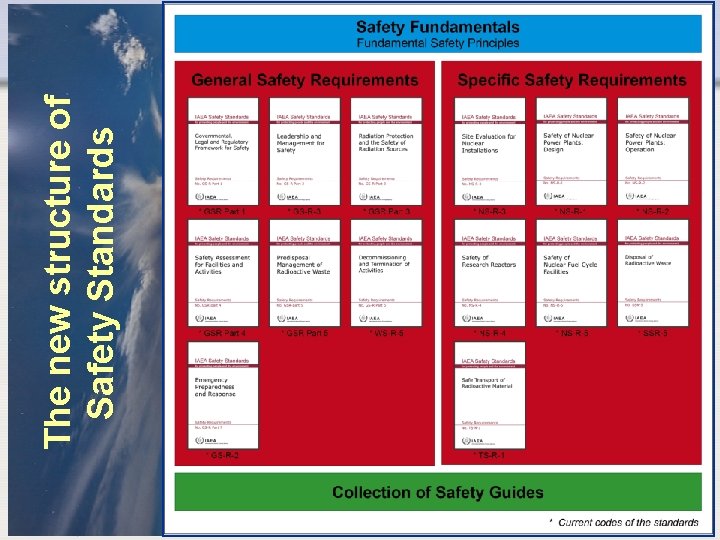
The new structure of Safety Standards Under development IAEA Basic IRRS Training - IAEA Safety Standards 12
SAFETY FUNDAMENTALS IAEA Basic IRRS Training - IAEA Safety Standards 13
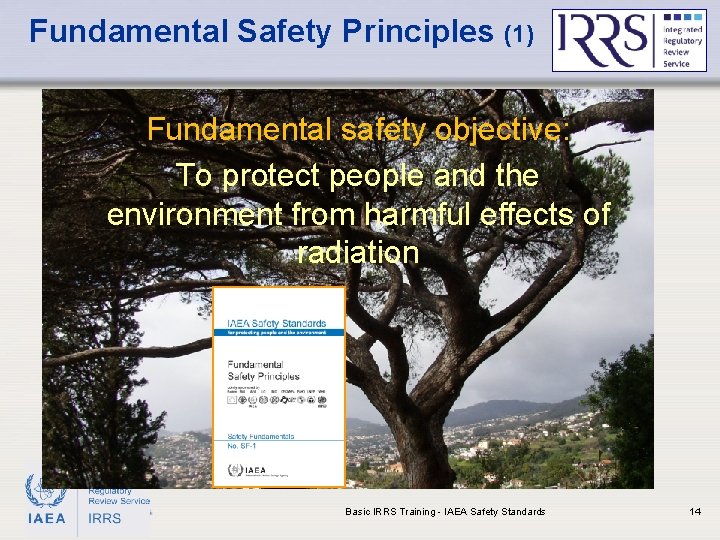
Fundamental Safety Principles (1) Fundamental safety objective: To protect people and the environment from harmful effects of radiation IAEA Basic IRRS Training - IAEA Safety Standards 14
Fundamental Safety Principles (2) Principle 1: Responsibility for safety The prime responsibility for safety must rest with the person or organization responsible for facilities and activities that give rise to radiation risks. Principle 2: Role of government An effective legal and governmental framework for safety, including an independent regulatory body, must be established and sustained. IAEA Basic IRRS Training - IAEA Safety Standards 15
Fundamental Safety Principles (3) Principle 3: Leadership and management for safety Effective leadership and management for safety must be established and sustained in organizations concerned with, and facilities and activities that give rise to, radiation risks. Principle 4: Justification of facilities and activities Facilities and activities that give rise to radiation risks must yield an overall benefit. IAEA Basic IRRS Training - IAEA Safety Standards 16
Fundamental Safety Principles (4) Principle 5: Optimization of protection Protection must be optimized to provide the highest level of safety that can reasonably be achieved Principle 6: Limitation of risks to individuals Measures for controlling radiation risks must ensure that no individual bears an unacceptable risk of harm IAEA Basic IRRS Training - IAEA Safety Standards 17
Fundamental Safety Principles (5) Principle 7: Protection of present and future generations People and the environment, present and future, must be protected against radiation risks Principle 8: Prevention of accidents All practical efforts must be made to prevent and mitigate nuclear or radiation accidents IAEA Basic IRRS Training - IAEA Safety Standards 18
Fundamental Safety Principles (6) Principle 9: Emergency preparedness and response Arrangements must be made for emergency preparedness and response for nuclear or radiation incidents Principle 10: Protective actions to reduce existing or unregulated radiation risks must be justified and optimized IAEA Basic IRRS Training - IAEA Safety Standards 19
General Safety Requirements Part 1 GOVERNMENTAL LEGAL AND REGULATORY FRAMEWORK FOR SAFETY IAEA Basic IRRS Training - IAEA Safety Standards 20
General Safety Requirements Part 1 1. Responsibilities and functions of the government 2. Global Nuclear Safety Regime 3. Responsibilities and functions of the regulatory body Basic reference for the IRRS IAEA Basic IRRS Training - IAEA Safety Standards 21
GSR Part 1 - Objective and Structure Objective: to establish requirements in respect of the governmental, legal and regulatory framework for safety. The framework for safety is to be established for the entire range of facilities and activities, from the use of a limited number of radiation sources to a nuclear power programme. Structure: Requirement : Subject Text of the general requirement 2. x. Detailed and specific requirements related to the general issue IAEA Basic IRRS Training - IAEA Safety Standards 22
GSR Part 1 – Role of Government (1) Requirement 1: National policy and strategy for safety The government shall establish a national policy and strategy for safety, the implementation of which shall be subject to a graded approach in accordance with national circumstances and with the radiation risks associated with facilities and activities, to achieve the fundamental safety objective and to apply the fundamental safety principles established in the Safety Fundamentals. Requirement 2: Establishment of a framework for safety The government shall establish and maintain an appropriate governmental, legal and regulatory framework for safety within which responsibilities are clearly allocated. IAEA Basic IRRS Training - IAEA Safety Standards 23
GSR Part 1 – Role of Government (2) Requirement 3: Establishment of a regulatory body The government, through the legal system, shall establish and maintain a regulatory body, and shall confer on it the legal authority and provide it with the competence and the resources necessary to fulfil its statutory obligation for the regulatory control of facilities and activities. Requirement 4: Independence of the regulatory body The government shall ensure that the regulatory body is effectively independent in its safety related decision making and that it has functional separation from entities having responsibilities or interests that could unduly influence its decision making. IAEA Basic IRRS Training - IAEA Safety Standards 24
GSR Part 1 – Role of Government (3) Requirement 5: Prime responsibility for safety The government shall expressly assign the prime responsibility for safety to the person or organization responsible for a facility or an activity, and shall confer on the regulatory body the authority to require such persons or organizations to comply with stipulated regulatory requirements, as well as to demonstrate such compliance. Requirement 6: Compliance with regulations and responsibility for safety The government shall stipulate that compliance with regulations and requirements established or adopted by the regulatory body does not relieve the person or organization responsible for a facility or an activity of its prime responsibility for safety. IAEA Basic IRRS Training - IAEA Safety Standards 25
GSR Part 1 – Role of Government (4) Requirement 7: Coordination of different authorities with responsibilities for safety within the regulatory framework for safety Where several authorities have responsibilities for safety within the regulatory framework for safety, the government shall make provision for the effective coordination of their regulatory functions, to avoid any omissions or undue duplication and to avoid conflicting requirements being placed on authorized parties. IAEA Basic IRRS Training - IAEA Safety Standards 26
GSR Part 1 – Role of Government (5) Requirement 8: Emergency preparedness and response The government shall make provision for emergency preparedness to enable a timely and effective response in a nuclear or radiological emergency. (More in GS-R-2 and GSR Part 3) Requirement 9: System for protective actions to reduce existing or unregulated radiation risks The government shall establish an effective system for protective actions to reduce undue radiation risks associated with unregulated sources (of natural or artificial origin) and contamination from past activities or events, consistent with the principles of justification and optimization. IAEA Basic IRRS Training - IAEA Safety Standards 27
GSR Part 1 – Role of Government (6) Requirement 10: Provision for the decommissioning of facilities and the management of radioactive waste and of spent fuel The government shall make provision for the safe decommissioning of facilities, the safe management and disposal of radioactive waste arising from facilities and activities, and the safe management of spent fuel. Requirement 11: Competence for safety The government shall make provision for building and maintaining the competence of all parties having responsibilities in relation to the safety of facilities and activities. IAEA Basic IRRS Training - IAEA Safety Standards 28
GSR Part 1 – Role of Government (7) Requirement 12: Interfaces of safety with nuclear security and with the State system of accounting for, and control of, nuclear material The government shall ensure that, within the governmental and legal framework, adequate infrastructural arrangements are established for interfaces of safety with arrangements for nuclear security and with the State system of accounting for, and control of, nuclear material. Requirement 13: Provision of technical services The government shall make provision, where necessary, for technical services in relation to safety, such as services for personal dosimetry, environmental monitoring and the calibration of equipment. IAEA Basic IRRS Training - IAEA Safety Standards 29
GSR Part 1 – Global Safety Regime Requirement 14: International obligations and arrangements for international cooperation The government shall fulfil its respective international obligations, participate in the relevant international arrangements, including international peer reviews, and promote international cooperation to enhance safety globally. Requirement 15: Sharing of operating experience and regulatory experience The regulatory body shall make arrangements for analysis to be carried out to identify lessons to be learned from operating experience and regulatory experience, including experience in other States, and for the dissemination of the lessons learned and for their use by authorized parties, the regulatory body and other relevant authorities. IAEA 30 Basic IRRS Training - IAEA Safety Standards
GRS Part 1 – Role of Regulatory Body (1) Requirement 16: Organizational structure of the regulatory body and allocation of resources The regulatory body shall structure its organization and manage its resources so as to discharge its responsibilities and perform its functions effectively; this shall be accomplished in a manner commensurate with the radiation risks associated with facilities and activities. Requirement 17: Effective independence in the performance of regulatory functions The regulatory body shall perform its functions in a manner that does not compromise its effective independence. IAEA Basic IRRS Training - IAEA Safety Standards 31
GRS Part 1 – Role of Regulatory Body (2) Requirement 18: Staffing and competence of the regulatory body The regulatory body shall employ a sufficient number of qualified and competent staff, commensurate with the nature and the number of facilities and activities to be regulated, to perform its functions and to discharge its responsibilities. Requirement 19: The management system of the regulatory body The regulatory body shall establish, implement, and assess and improve a management system that is aligned with its safety goals and contributes to their achievement. (More in GSR-3) IAEA Basic IRRS Training - IAEA Safety Standards 32
GRS Part 1 – Role of Regulatory Body (3) - Contacts Requirement 20: Liaison with advisory bodies and support organizations The regulatory body shall obtain technical or other expert professional advice or services as necessary in support of its regulatory functions, but this shall not relieve the regulatory body of its assigned responsibilities. Requirement 21: Liaison between the regulatory body and authorized parties The regulatory body shall establish formal and informal mechanisms of communication with authorized parties on all safety related issues, conducting a professional and constructive liaison. IAEA Basic IRRS Training - IAEA Safety Standards 33
GRS Part 1 – Role of Regulatory Body (4) Requirement 22: Stability and consistency of regulatory control The regulatory body shall ensure that regulatory control is stable and consistent. IAEA Basic IRRS Training - IAEA Safety Standards 34
GRS Part 1 – Role of Regulatory Body (5) Core regulatory functions • Authorization • Review and Assessment • Inspection • Enforcement • Development, maintenance and promotion of Regulations and Guides IAEA Basic IRRS Training - IAEA Safety Standards 35
GRS Part 1 – Role of Regulatory Body (6) - Authorization Requirement 23: Authorization of facilities and activities by the regulatory body Authorization by the regulatory body, including specification of the conditions necessary for safety, shall be a prerequisite for all those facilities and activities that are not either explicitly exempted or approved by means of a notification process. Requirement 24: Demonstration of safety for the authorization of facilities and activities The applicant shall be required to submit an adequate demonstration of safety in support of an application for the authorization of a facility or an activity. IAEA Basic IRRS Training - IAEA Safety Standards 36
GRS Part 1 – Role of Regulatory Body (7) – Review and Assessment Requirement 25: Review and assessment of information relevant to safety The regulatory body shall review and assess relevant information — whether submitted by the authorized party or the vendor, compiled by the regulatory body, or obtained from elsewhere — to determine whether facilities and activities comply with regulatory requirements and the conditions specified in the authorization. This review and assessment of information shall be performed prior to authorization and again over the lifetime of the facility or the duration of the activity, as specified in regulations promulgated by the regulatory body or in the authorization. IAEA Basic IRRS Training - IAEA Safety Standards 37
GRS Part 1 – Role of Regulatory Body (8) – Review and Assessment (cont. ) Requirement 26: Graded approach to review and assessment of a facility or an activity Review and assessment of a facility or an activity shall be commensurate with the radiation risks associated with the facility or activity, in accordance with a graded approach. IAEA Basic IRRS Training - IAEA Safety Standards 38
GRS Part 1 – Role of Regulatory Body (9) - Inspection Requirement 27: Inspection of facilities and activities The regulatory body shall carry out inspections of facilities and activities to verify that the authorized party is in compliance with the regulatory requirements and with the conditions specified in the authorization. IAEA Basic IRRS Training - IAEA Safety Standards 39
GRS Part 1 – Role of Regulatory Body (10) – Inspection (cont. ) Requirement 28: Types of inspection of facilities and activities Inspections of facilities and activities shall include programmed inspections and reactive inspections; both announced and unannounced. Requirement 29: Graded approach to inspections of facilities and activities Inspections of facilities and activities shall be commensurate with the radiation risks associated with the facility or activity, in accordance with a graded approach. IAEA Basic IRRS Training - IAEA Safety Standards 40
GRS Part 1 – Role of Regulatory Body (11) - Enforcement Requirement 30: Establishment of an enforcement policy The regulatory body shall establish and implement an enforcement policy within the legal framework for responding to non-compliance by authorized parties with regulatory requirements or with any conditions specified in the authorization. Requirement 31: Requiring of corrective action by authorized parties In the event that risks are identified, including risks unforeseen in the authorization process, the regulatory body shall require corrective actions to be taken by authorized parties. IAEA Basic IRRS Training - IAEA Safety Standards 41
GRS Part 1 – Role of Regulatory Body (12) – Regulations and Guides Requirement 32: Regulations and guides The regulatory body shall establish or adopt regulations and guides to specify the principles, requirements and associated criteria for safety upon which its regulatory judgements, decisions and actions are based. Requirement 33: Review of regulations and guides Regulations and guides shall be reviewed and revised as necessary to keep them up to date, with due consideration taken of relevant international safety standards and technical standards and of relevant experience gained. IAEA Basic IRRS Training - IAEA Safety Standards 42
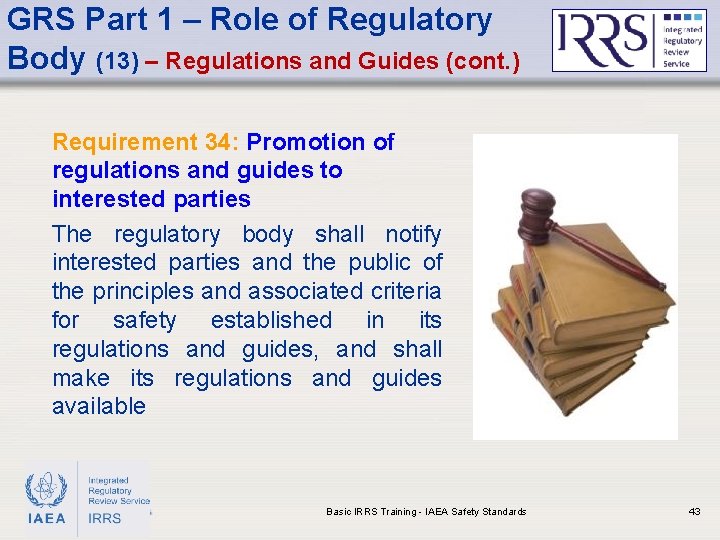
GRS Part 1 – Role of Regulatory Body (13) – Regulations and Guides (cont. ) Requirement 34: Promotion of regulations and guides to interested parties The regulatory body shall notify interested parties and the public of the principles and associated criteria for safety established in its regulations and guides, and shall make its regulations and guides available IAEA Basic IRRS Training - IAEA Safety Standards 43
GRS Part 1 – Role of Regulatory Body (14) Requirement 35: Safety related records The regulatory body shall make provision for establishing, maintaining and retrieving adequate records relating to the safety of facilities and activities. Requirement 36: Communication and consultation with interested parties The regulatory body shall promote the establishment of appropriate means of informing and consulting interested parties and the public about the possible radiation risks associated with facilities and activities, and about the processes and decisions of the regulatory body. IAEA Basic IRRS Training - IAEA Safety Standards 44
OTHER GENERAL SAFETY REQUIREMENTS INVOLVED - GS-R-3 – Management System - GSR Part 3 – Basic Safety Standards - GSR Part 4 – Safety Assessment - GSR Part 5 – Predisposal Management of Waste - GSR Part 6 – Decommissioning of facilities - GS-R-2 – Emergency Preparedness and Response IAEA Basic IRRS Training - IAEA Safety Standards 45
GS-R-3 – Objectives 1) To define requirements for establishing, implementing, assessing and continually improving a management system that integrates safety, health, environmental, security, quality and economic elements to ensure that safety is properly taken into account in all the activities of an organization 2) To ensure, by considering the implications of all actions not within separate management systems but with regard to safety as a whole, that safety is not compromised. IAEA Basic IRRS Training - IAEA Safety Standards 46
GSR Part 3 - Objectives 1) To establish requirements for the protection of people and the environment from harmful effects of ionizing radiation and for the safety of radiation sources 2) These Standards are intended primarily for use by governments and regulatory bodies. Requirements also apply to principal parties and other parties, health authorities, professional bodies and service providers such as technical support organizations IAEA Basic IRRS Training - IAEA Safety Standards 47
GSR Part 3 - Subjects ü General requirements for protection and safety ü Planned exposure situations ü Emergency exposure situations ü Existing exposure situations ü Exemption and clearance criteria ü Sealed source categories ü Dose limits ü EPR criteria Photo: V. Friedrich IAEA Basic IRRS Training - IAEA Safety Standards 48
GSR Part 3 – General requirements • • Application of the principles of radiation protection Responsibilities of the government Responsibilities of the regulatory body Responsibilities for protection and safety (prime responsibility of the operator) • Management requirements: protection and safety in the MS; safety culture; human factors Further parts are used by specific Modules of the IRRS process IAEA Basic IRRS Training - IAEA Safety Standards 49
GSR Part 4 - Objectives 1) To establish the generally applicable requirements to be fulfilled in safety assessment for facilities and activities, with special attention paid to defence in depth, quantitative analyses and the application of a graded approach to the ranges of facilities and of activities that are addressed. 2) The publication also addresses the independent verification of the safety assessment that needs to be carried out by the originators and users of the safety assessment. IAEA Basic IRRS Training - IAEA Safety Standards 50
GSR Part 5 - Objectives To establish, on the basis of the principles established in the Fundamental Safety Principles, the requirements that must be satisfied in the predisposal management of radioactive waste. This publication sets out the objectives, criteria and requirements for the protection of human health and the environment that apply to the siting, design, construction, commissioning, operation and shutdown of facilities for the predisposal management of radioactive waste, and the requirements that must be met to ensure the safety of such facilities and activities IAEA Basic IRRS Training - IAEA Safety Standards 51
GSR Part 5 - Subjects ü Protection of human health and the environment ü Responsibilities associated with the predisposal management of radioactive waste ü Steps in the predisposal management of radioactive waste ü Development and operation of facilities for the predisposal management of radioactive waste Photo: V. Friedrich IAEA Basic IRRS Training - IAEA Safety Standards 52
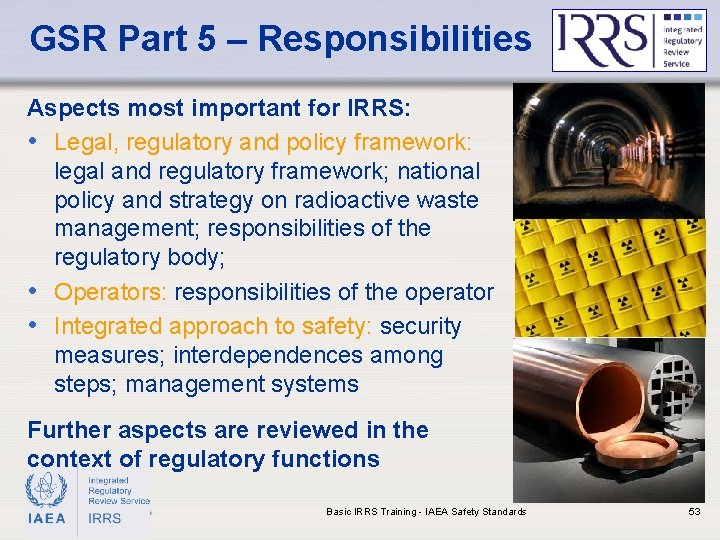
GSR Part 5 – Responsibilities Aspects most important for IRRS: • Legal, regulatory and policy framework: legal and regulatory framework; national policy and strategy on radioactive waste management; responsibilities of the regulatory body; • Operators: responsibilities of the operator • Integrated approach to safety: security measures; interdependences among steps; management systems Further aspects are reviewed in the context of regulatory functions IAEA Basic IRRS Training - IAEA Safety Standards 53
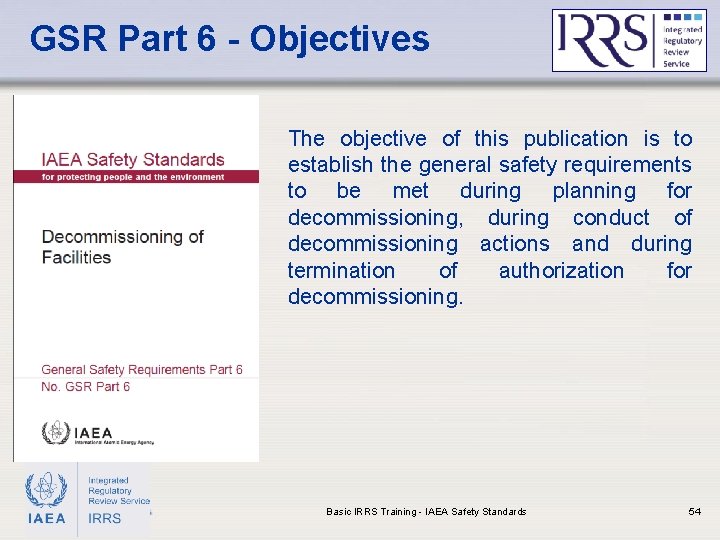
GSR Part 6 - Objectives The objective of this publication is to establish the general safety requirements to be met during planning for decommissioning, during conduct of decommissioning actions and during termination of authorization for decommissioning. IAEA Basic IRRS Training - IAEA Safety Standards 54
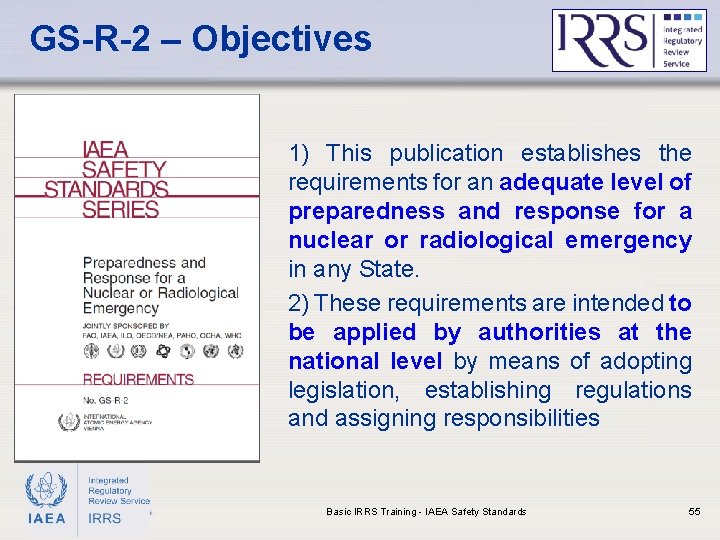
GS-R-2 – Objectives 1) This publication establishes the requirements for an adequate level of preparedness and response for a nuclear or radiological emergency in any State. 2) These requirements are intended to be applied by authorities at the national level by means of adopting legislation, establishing regulations and assigning responsibilities IAEA Basic IRRS Training - IAEA Safety Standards 55
SPECIFIC SAFETY REQUIREMENTS - NS-R-3 – Site evaluation for nuclear installations - SSR-2/1, 2/2 – Nuclear power plants - NS-R-4 – Research reactors - NS-R-5 – Fuel cycle facilities - SSR 5 – Disposal of radioactive waste - SSR 6 – Transport of radioactive material IAEA Basic IRRS Training - IAEA Safety Standards 56
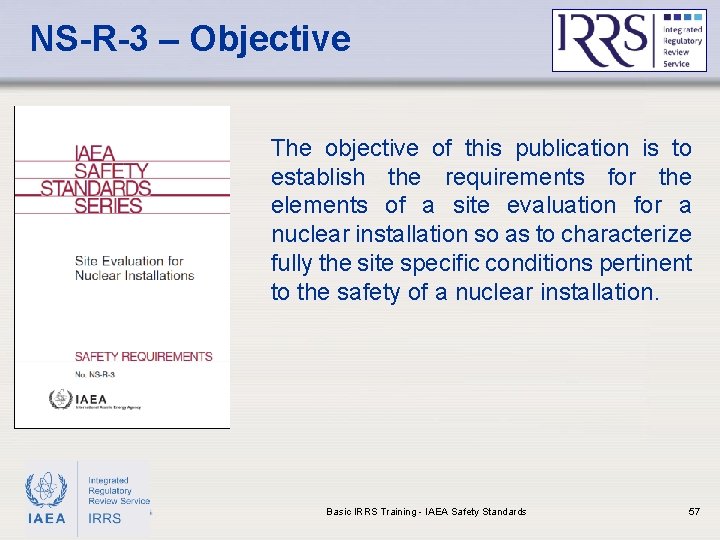
NS-R-3 – Objective The objective of this publication is to establish the requirements for the elements of a site evaluation for a nuclear installation so as to characterize fully the site specific conditions pertinent to the safety of a nuclear installation. IAEA Basic IRRS Training - IAEA Safety Standards 57
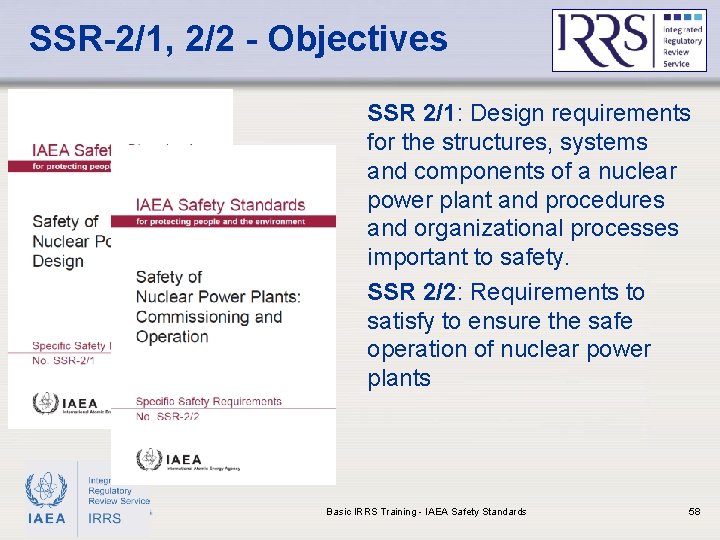
SSR-2/1, 2/2 - Objectives SSR 2/1: Design requirements for the structures, systems and components of a nuclear power plant and procedures and organizational processes important to safety. SSR 2/2: Requirements to satisfy to ensure the safe operation of nuclear power plants IAEA Basic IRRS Training - IAEA Safety Standards 58
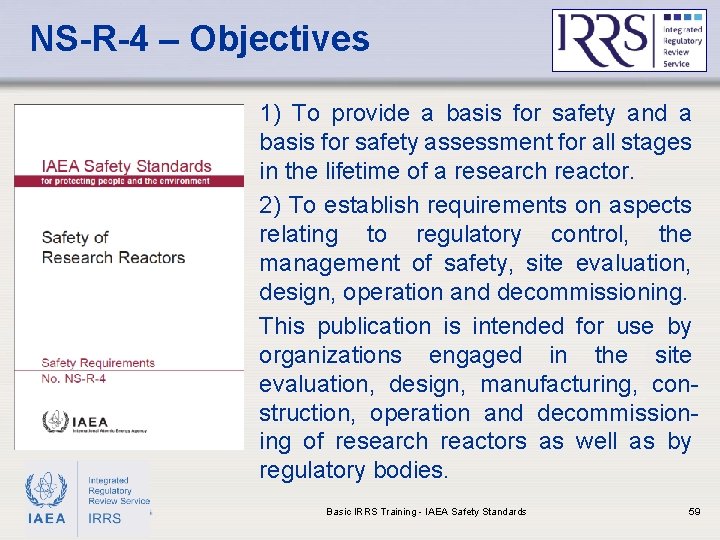
NS-R-4 – Objectives 1) To provide a basis for safety and a basis for safety assessment for all stages in the lifetime of a research reactor. 2) To establish requirements on aspects relating to regulatory control, the management of safety, site evaluation, design, operation and decommissioning. This publication is intended for use by organizations engaged in the site evaluation, design, manufacturing, construction, operation and decommissioning of research reactors as well as by regulatory bodies. IAEA Basic IRRS Training - IAEA Safety Standards 59
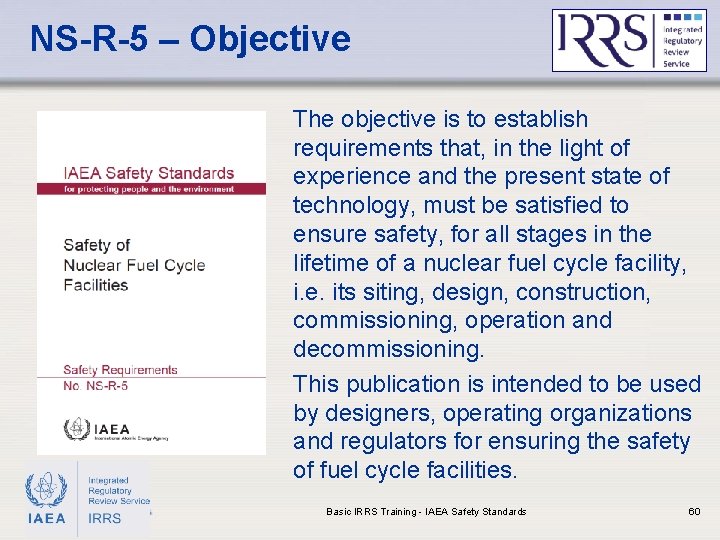
NS-R-5 – Objective The objective is to establish requirements that, in the light of experience and the present state of technology, must be satisfied to ensure safety, for all stages in the lifetime of a nuclear fuel cycle facility, i. e. its siting, design, construction, commissioning, operation and decommissioning. This publication is intended to be used by designers, operating organizations and regulators for ensuring the safety of fuel cycle facilities. IAEA Basic IRRS Training - IAEA Safety Standards 60
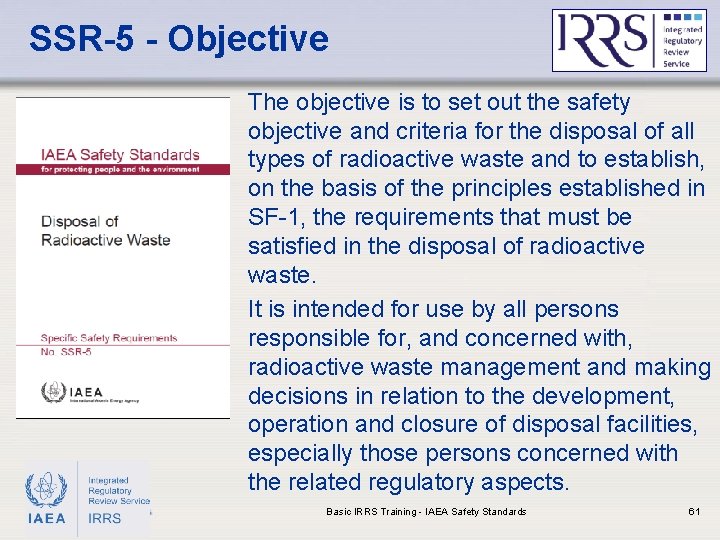
SSR-5 - Objective IAEA The objective is to set out the safety objective and criteria for the disposal of all types of radioactive waste and to establish, on the basis of the principles established in SF-1, the requirements that must be satisfied in the disposal of radioactive waste. It is intended for use by all persons responsible for, and concerned with, radioactive waste management and making decisions in relation to the development, operation and closure of disposal facilities, especially those persons concerned with the related regulatory aspects. Basic IRRS Training - IAEA Safety Standards 61
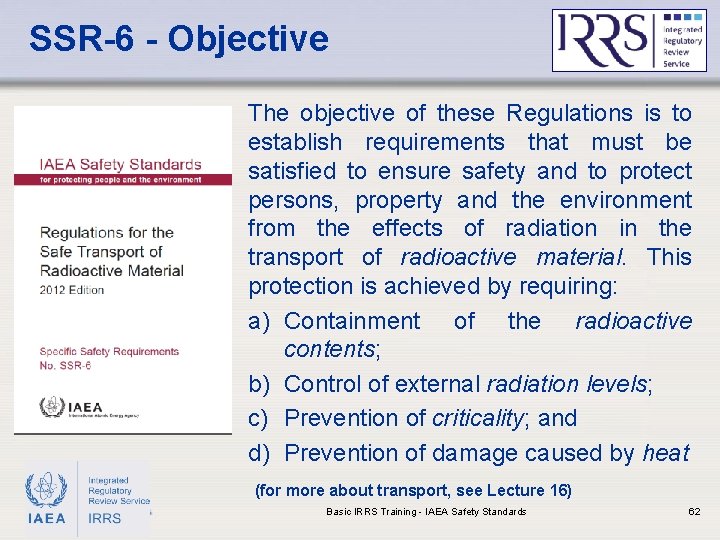
SSR-6 - Objective The objective of these Regulations is to establish requirements that must be satisfied to ensure safety and to protect persons, property and the environment from the effects of radiation in the transport of radioactive material. This protection is achieved by requiring: a) Containment of the radioactive contents; b) Control of external radiation levels; c) Prevention of criticality; and d) Prevention of damage caused by heat IAEA (for more about transport, see Lecture 16) Basic IRRS Training - IAEA Safety Standards 62
Use of Specific Safety Requirements In IRRS missions it is reviewed whether the regulatory body requires that the licensees comply with the safety requirements in these standards IAEA Basic IRRS Training - IAEA Safety Standards 63
LINK TO THE IRRS MODULES IAEA Basic IRRS Training - IAEA Safety Standards 64
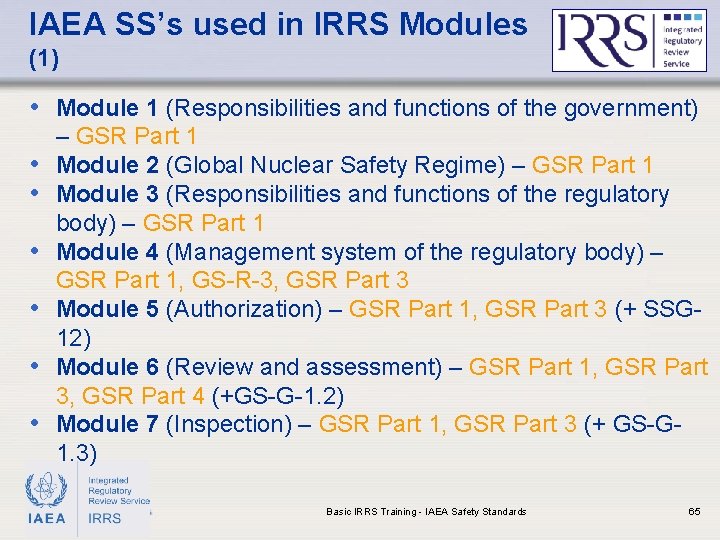
IAEA SS’s used in IRRS Modules (1) • Module 1 (Responsibilities and functions of the government) • • • – GSR Part 1 Module 2 (Global Nuclear Safety Regime) – GSR Part 1 Module 3 (Responsibilities and functions of the regulatory body) – GSR Part 1 Module 4 (Management system of the regulatory body) – GSR Part 1, GS-R-3, GSR Part 3 Module 5 (Authorization) – GSR Part 1, GSR Part 3 (+ SSG 12) Module 6 (Review and assessment) – GSR Part 1, GSR Part 3, GSR Part 4 (+GS-G-1. 2) Module 7 (Inspection) – GSR Part 1, GSR Part 3 (+ GS-G 1. 3) IAEA Basic IRRS Training - IAEA Safety Standards 65
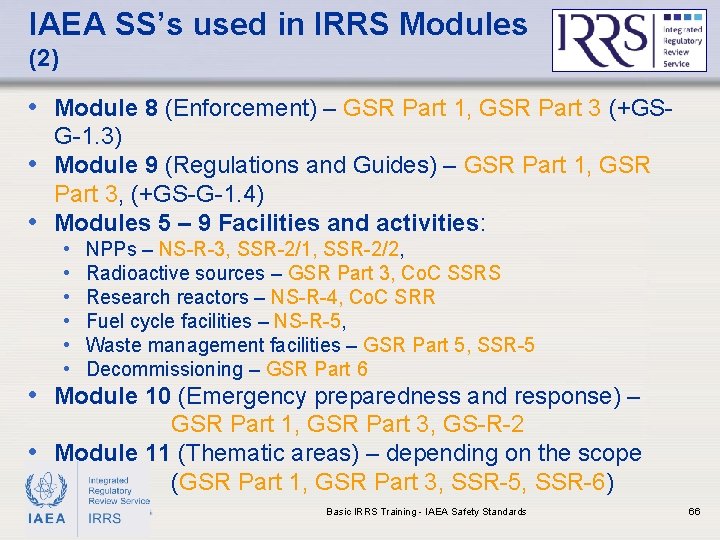
IAEA SS’s used in IRRS Modules (2) • Module 8 (Enforcement) – GSR Part 1, GSR Part 3 (+GSG-1. 3) • Module 9 (Regulations and Guides) – GSR Part 1, GSR Part 3, (+GS-G-1. 4) • Modules 5 – 9 Facilities and activities: • • • NPPs – NS-R-3, SSR-2/1, SSR-2/2, Radioactive sources – GSR Part 3, Co. C SSRS Research reactors – NS-R-4, Co. C SRR Fuel cycle facilities – NS-R-5, Waste management facilities – GSR Part 5, SSR-5 Decommissioning – GSR Part 6 • Module 10 (Emergency preparedness and response) – GSR Part 1, GSR Part 3, GS-R-2 • Module 11 (Thematic areas) – depending on the scope (GSR Part 1, GSR Part 3, SSR-5, SSR-6) IAEA Basic IRRS Training - IAEA Safety Standards 66
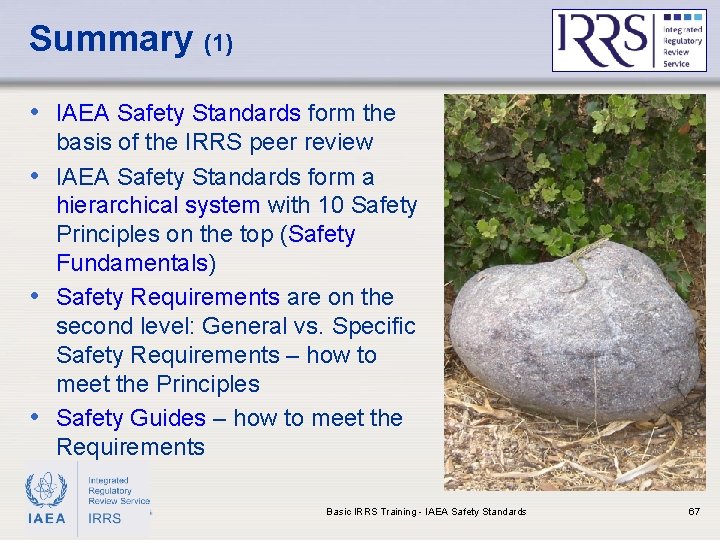
Summary (1) • IAEA Safety Standards form the basis of the IRRS peer review • IAEA Safety Standards form a hierarchical system with 10 Safety Principles on the top (Safety Fundamentals) • Safety Requirements are on the second level: General vs. Specific Safety Requirements – how to meet the Principles • Safety Guides – how to meet the Requirements IAEA Basic IRRS Training - IAEA Safety Standards 67
Summary (2) • Fundamental safety objective: To protect people and the environment from harmful effect of radiation • Fundamental reference for IRRS: General Safety Requirements Part 1 • Responsibilities and functions of the Government (13 Requirements) • Global Nuclear Safety Regime (2 Requirements) • Responsibilities and functions of the Regulatory Body (21 Requirements) Core regulatory functions: authorization; review and assessment; inspection; enforcement; development, maintenance and promotion of regulations and guides IAEA Basic IRRS Training - IAEA Safety Standards 68
Summary (3) • GS-R-3 is meant to define requirements relevant for IRRS on the management system of the regulatory body • GS-R-2 defines emergency preparedness and response requirements. IRRS deals with the regulatory aspects of EPR • GSR Part 3 summarizes the requirements on radiation protection and safety of radiation sources. The IRRS process addresses the general requirements in the IRRS core modules and specific requirements in additional modules IAEA Basic IRRS Training - IAEA Safety Standards 69
Summary (4) • GSR Part 4 defines requirements on safety assessment for facilities and activities • GSR Part 5 establishes requirements on predisposal management of radioactive waste. Requirements on responsibilities are directly reviewed in IRRS, other requirements appear in the context of regulatory activity • GSR Part 6 establishes requirements on decommissioning of facilities IAEA Basic IRRS Training - IAEA Safety Standards 70
Summary (5) • Specific Safety Requirements provide a basis for safety of nuclear power plants (SSR-2/1 and SSR 2/2), research reactors (NS-R-4), fuel cycle facilities (NS-R-5), waste disposal facilities (SSR-5) and transport activities (SSR-6). In IRRS missions it is reviewed whether the regulatory body requires that the licensees comply with the safety requirements in these standards. IAEA Basic IRRS Training - IAEA Safety Standards 71
THANK YOU FOR YOUR ATTENTION This activity is conducted by the IAEA, with funding by the European Union. The views expressed in this presentation do not necessarily reflect the views of the European Commission IAEA Basic IRRS Training - IAEA Safety Standards Photo: V. Friedrich 72
Discussion • Identification of the regulatory body • If more than one institution/organisation, how are interfaces managed? • Independence of the regulatory body IAEA Basic IRRS Training - IAEA Safety Standards 73
- Slides: 73