
Basic Instrument Scan T 6 BDriver com Created
Basic Instrument Scan T 6 BDriver. com Created: 4 Feb 2016 Updated: 28 Aug 2016
Overview • Information Sources • Attitude Instrument Flying • Control-Performance Method • Scanning (Cross-check) • Scanning Errors • Scan Pattern • Power & Attitude Combinations • Transition Points • Descents

Instrument Flying • Source Information • NATOPS Instrument Flight Manual • Chapter 17 covers Attitude Instrument Flying • Information a mix of FAA instrument methods • Electronically issued publication
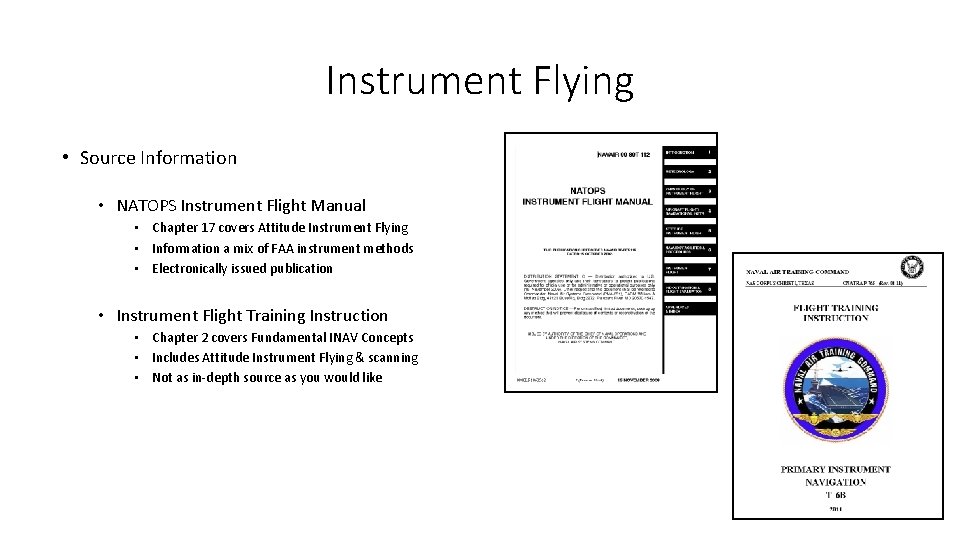
Instrument Flying • Source Information • NATOPS Instrument Flight Manual • Chapter 17 covers Attitude Instrument Flying • Information a mix of FAA instrument methods • Electronically issued publication • Instrument Flight Training Instruction • Chapter 2 covers Fundamental INAV Concepts • Includes Attitude Instrument Flying & scanning • Not as in-depth source as you would like
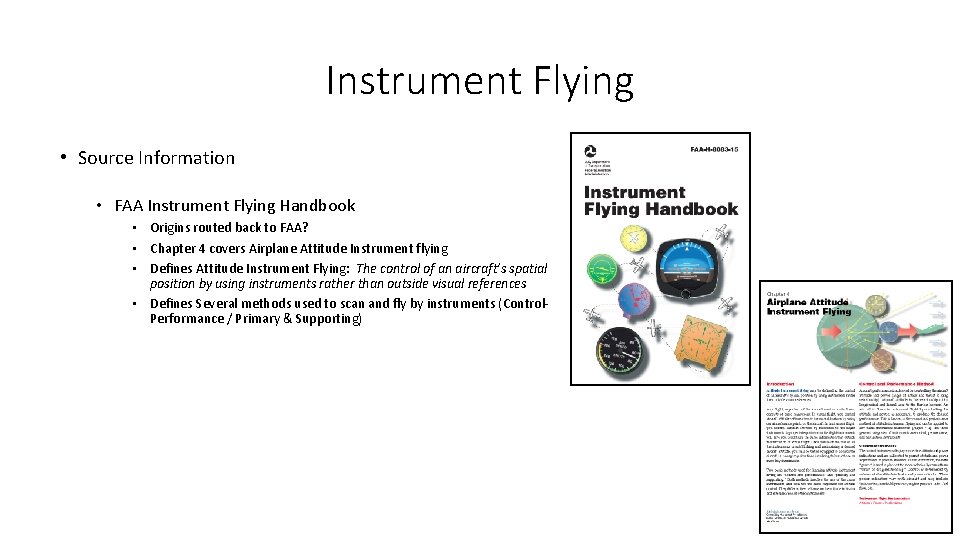
Instrument Flying • Source Information • FAA Instrument Flying Handbook • Origins routed back to FAA? • Chapter 4 covers Airplane Attitude Instrument flying • Defines Attitude Instrument Flying: The control of an aircraft’s spatial position by using instruments rather than outside visual references • Defines Several methods used to scan and fly by instruments (Control. Performance / Primary & Supporting)
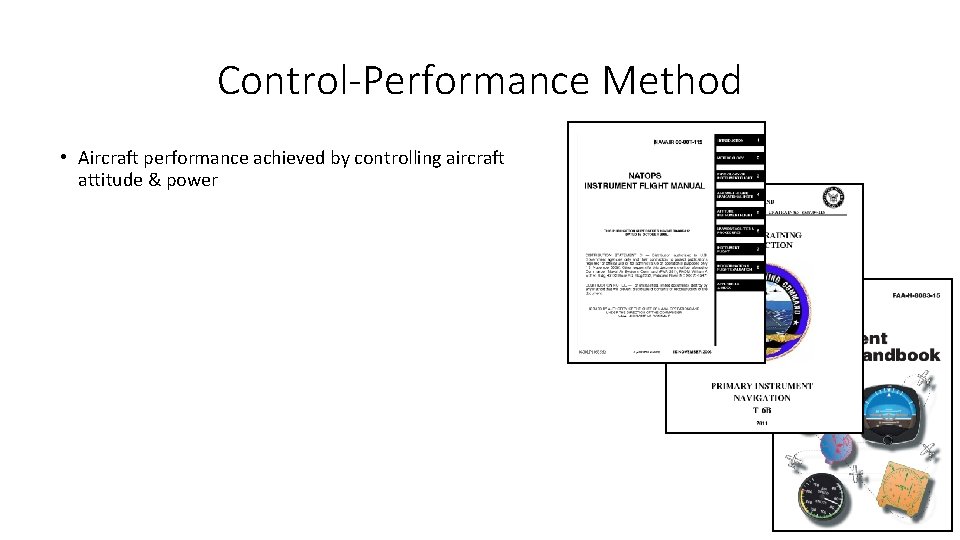
Control-Performance Method • Aircraft performance achieved by controlling aircraft attitude & power
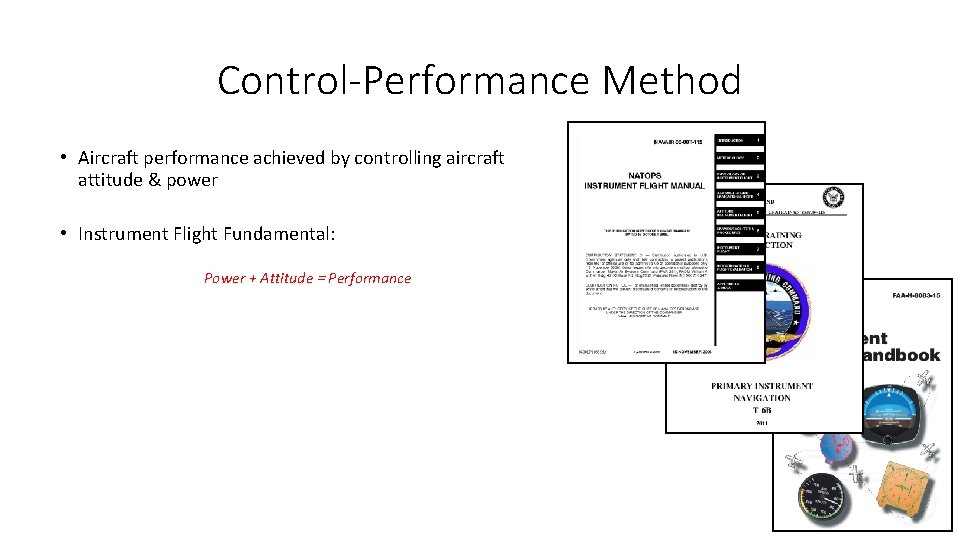
Control-Performance Method • Aircraft performance achieved by controlling aircraft attitude & power • Instrument Flight Fundamental: Power + Attitude = Performance
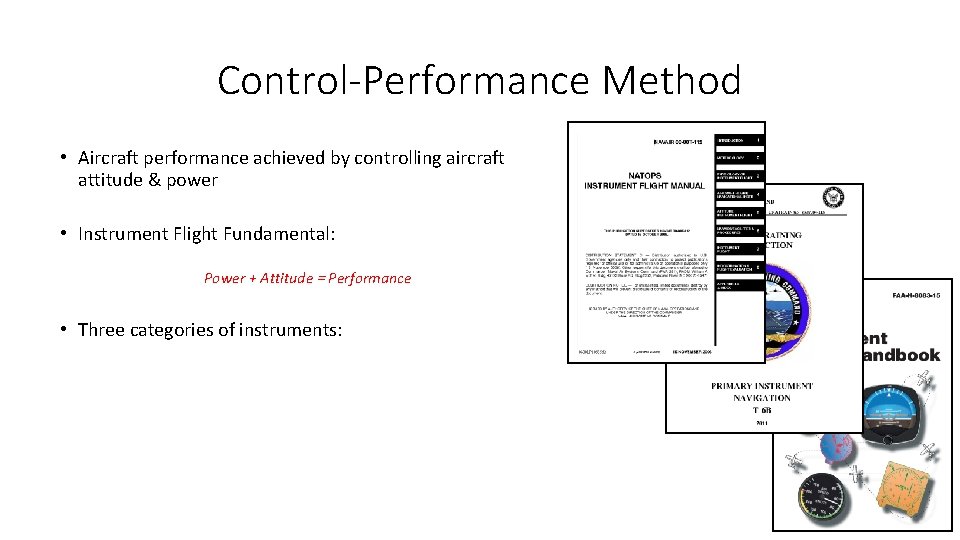
Control-Performance Method • Aircraft performance achieved by controlling aircraft attitude & power • Instrument Flight Fundamental: Power + Attitude = Performance • Three categories of instruments:
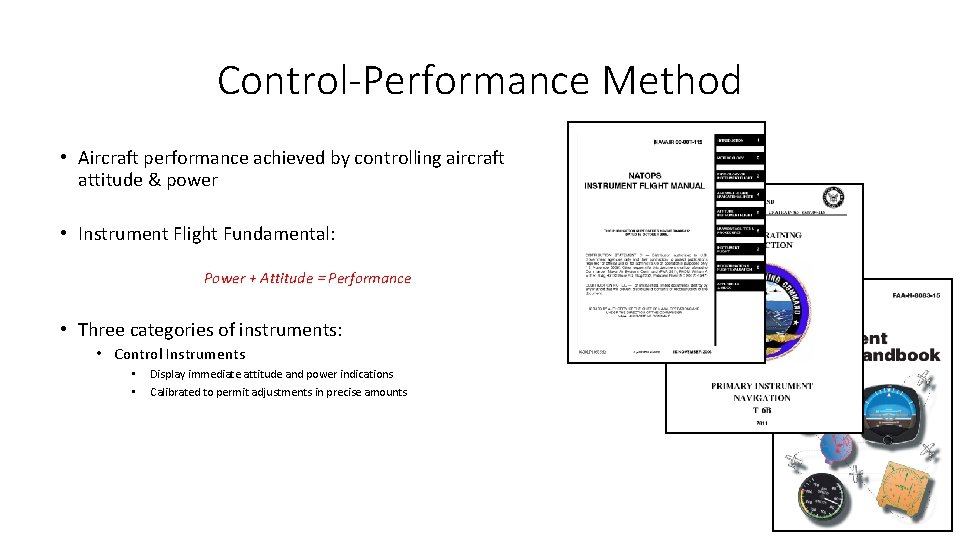
Control-Performance Method • Aircraft performance achieved by controlling aircraft attitude & power • Instrument Flight Fundamental: Power + Attitude = Performance • Three categories of instruments: • Control Instruments • • Display immediate attitude and power indications Calibrated to permit adjustments in precise amounts
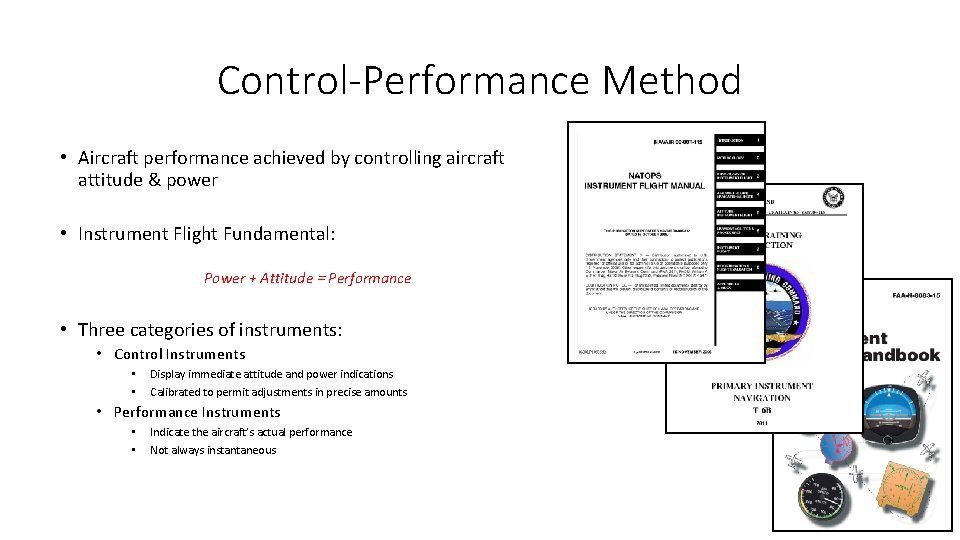
Control-Performance Method • Aircraft performance achieved by controlling aircraft attitude & power • Instrument Flight Fundamental: Power + Attitude = Performance • Three categories of instruments: • Control Instruments • • Display immediate attitude and power indications Calibrated to permit adjustments in precise amounts • Performance Instruments • • Indicate the aircraft’s actual performance Not always instantaneous
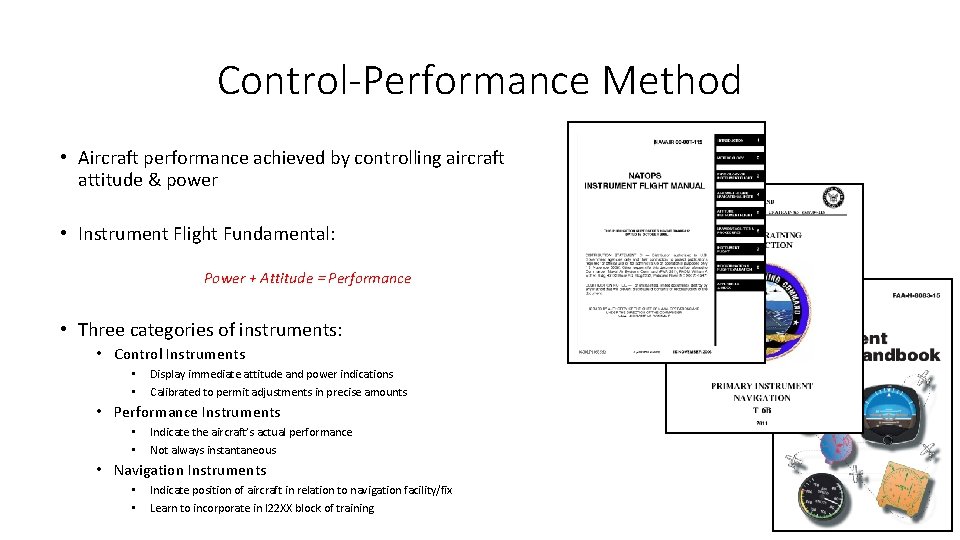
Control-Performance Method • Aircraft performance achieved by controlling aircraft attitude & power • Instrument Flight Fundamental: Power + Attitude = Performance • Three categories of instruments: • Control Instruments • • Display immediate attitude and power indications Calibrated to permit adjustments in precise amounts • Performance Instruments • • Indicate the aircraft’s actual performance Not always instantaneous • Navigation Instruments • • Indicate position of aircraft in relation to navigation facility/fix Learn to incorporate in I 22 XX block of training
Control-Performance Method Setting Controls
Control-Performance Method Gives Setting Controls Known Performance
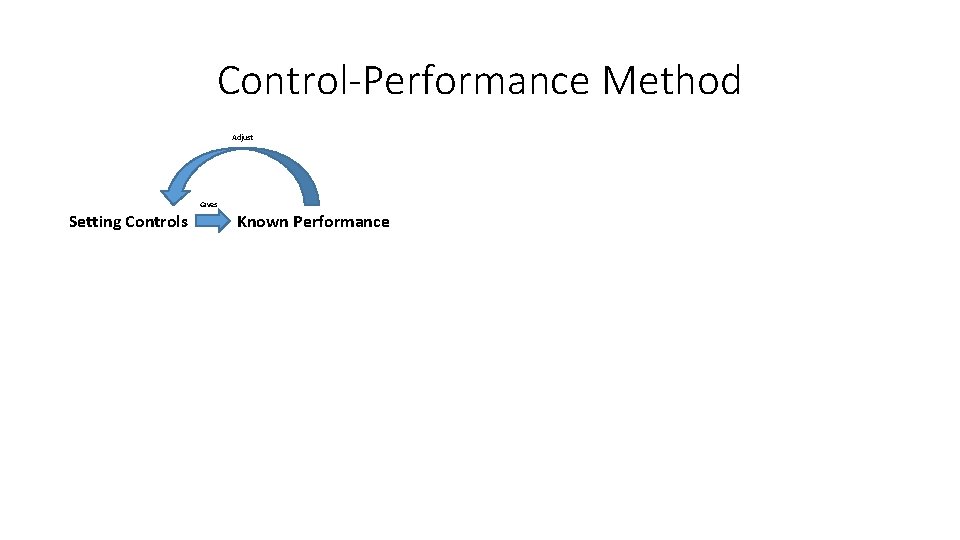
Control-Performance Method Adjust Gives Setting Controls Known Performance
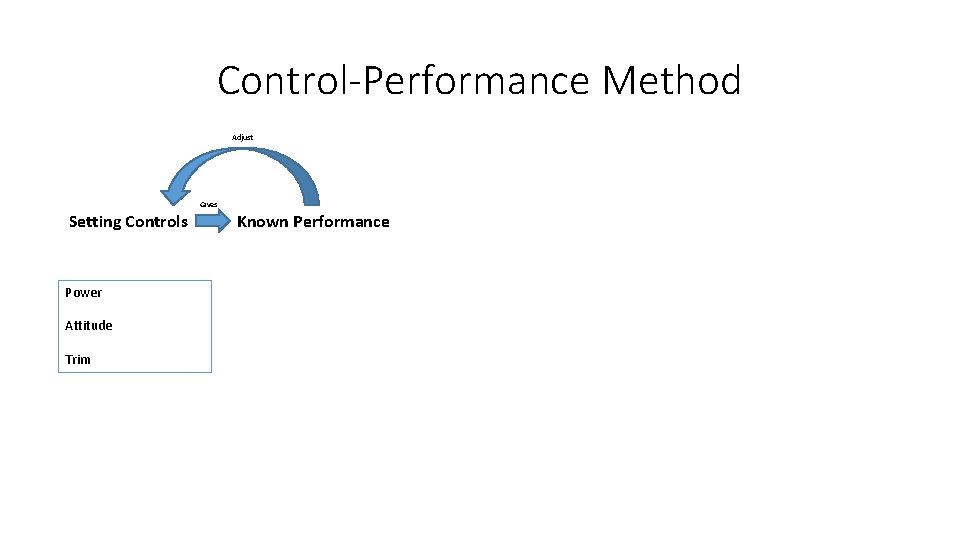
Control-Performance Method Adjust Gives Setting Controls Power Attitude Trim Known Performance
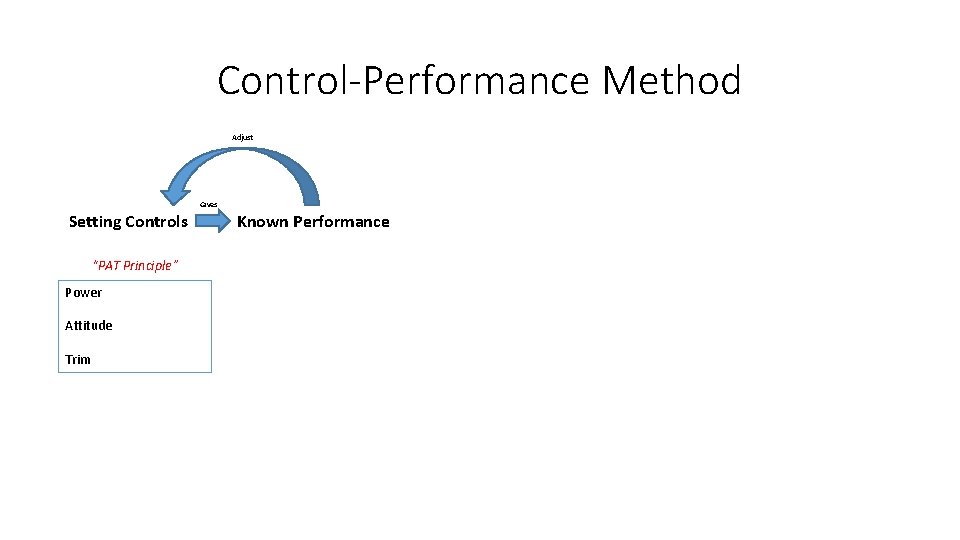
Control-Performance Method Adjust Gives Setting Controls “PAT Principle” Power Attitude Trim Known Performance
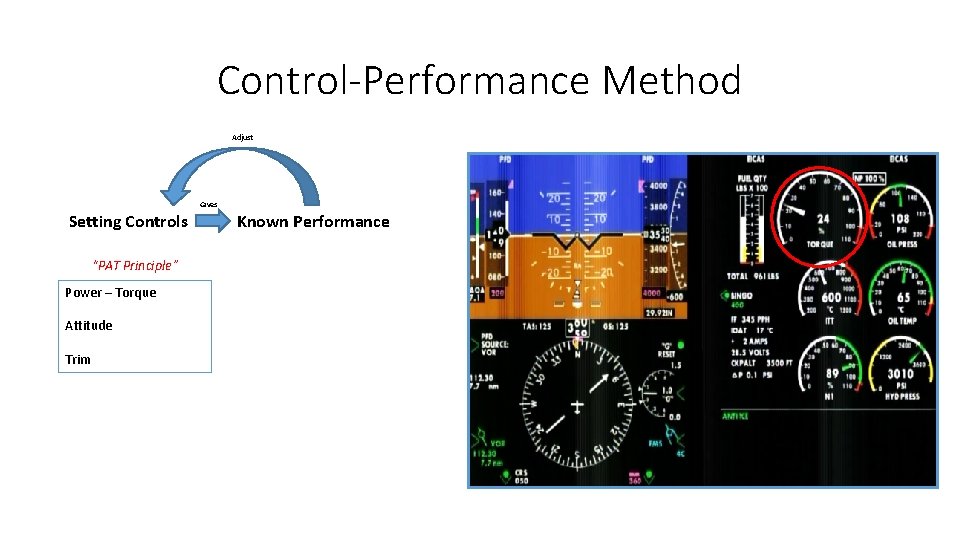
Control-Performance Method Adjust Gives Setting Controls “PAT Principle” Power – Torque Attitude Trim Known Performance
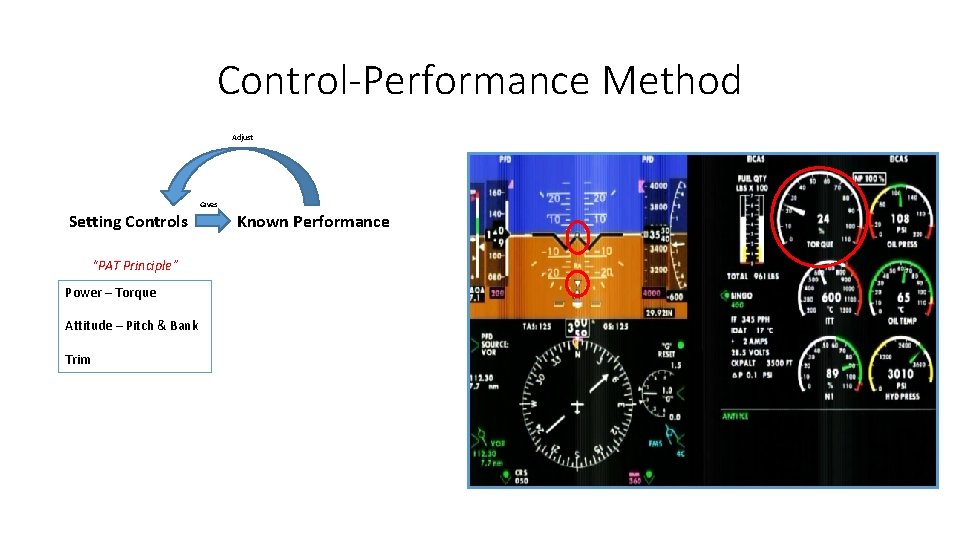
Control-Performance Method Adjust Gives Setting Controls “PAT Principle” Power – Torque Attitude – Pitch & Bank Trim Known Performance
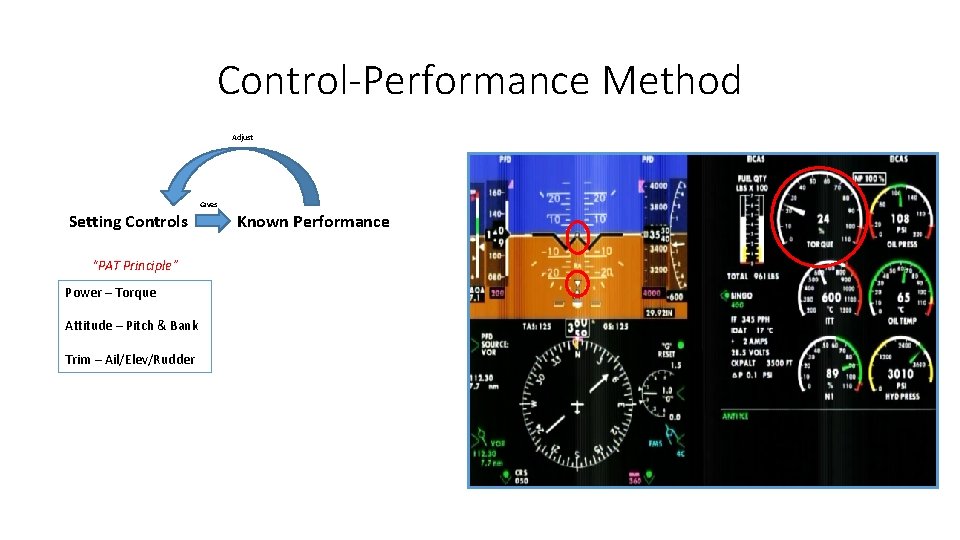
Control-Performance Method Adjust Gives Setting Controls “PAT Principle” Power – Torque Attitude – Pitch & Bank Trim – Ail/Elev/Rudder Known Performance
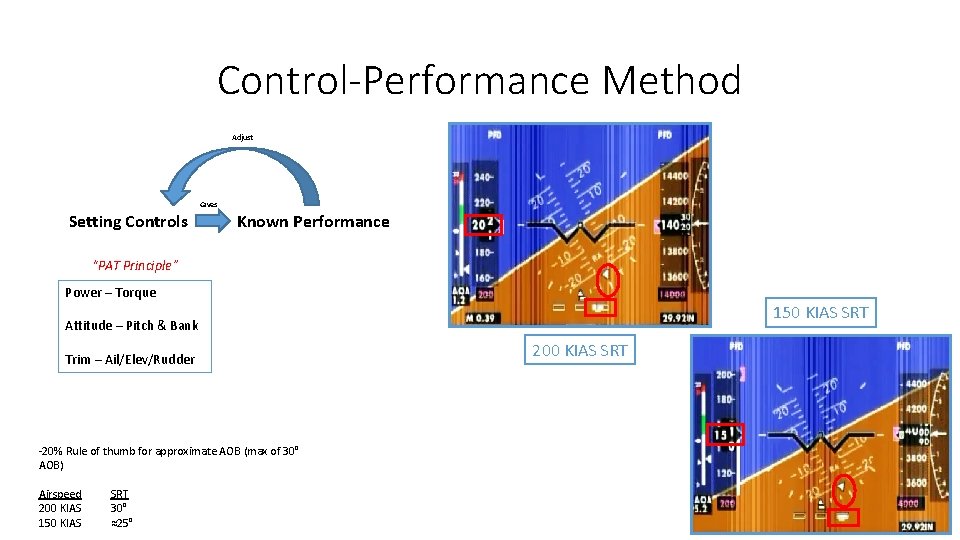
Control-Performance Method Adjust Gives Setting Controls Known Performance “PAT Principle” Power – Torque 150 KIAS SRT Attitude – Pitch & Bank Trim – Ail/Elev/Rudder -20% Rule of thumb for approximate AOB (max of 30° AOB) Airspeed 200 KIAS 150 KIAS SRT 30° ≈25° 200 KIAS SRT
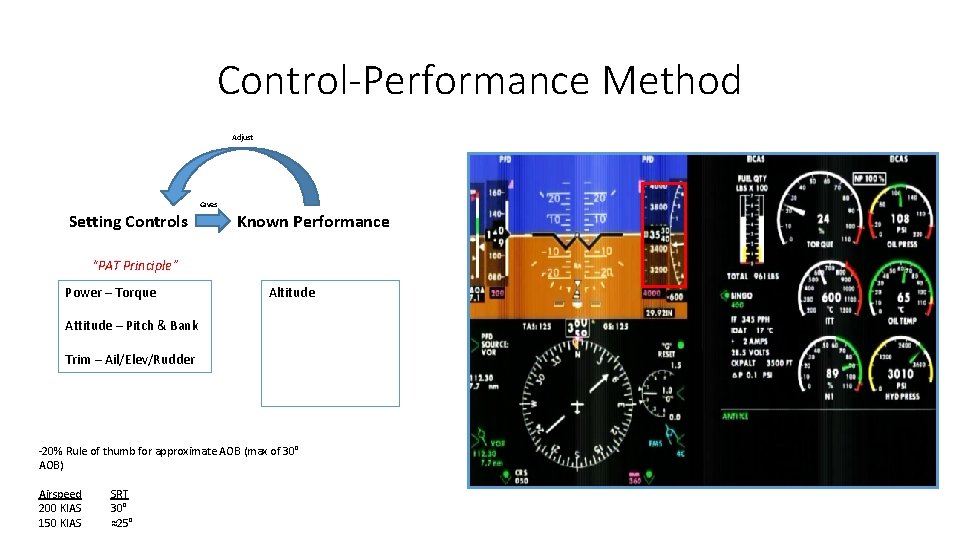
Control-Performance Method Adjust Gives Setting Controls Known Performance “PAT Principle” Power – Torque Altitude Attitude – Pitch & Bank Trim – Ail/Elev/Rudder -20% Rule of thumb for approximate AOB (max of 30° AOB) Airspeed 200 KIAS 150 KIAS SRT 30° ≈25°
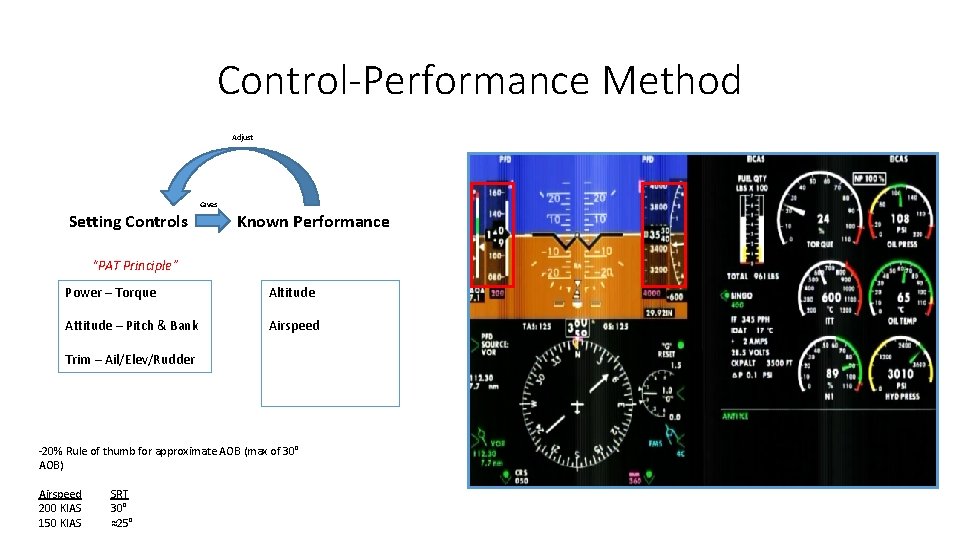
Control-Performance Method Adjust Gives Setting Controls Known Performance “PAT Principle” Power – Torque Altitude Attitude – Pitch & Bank Airspeed Trim – Ail/Elev/Rudder -20% Rule of thumb for approximate AOB (max of 30° AOB) Airspeed 200 KIAS 150 KIAS SRT 30° ≈25°
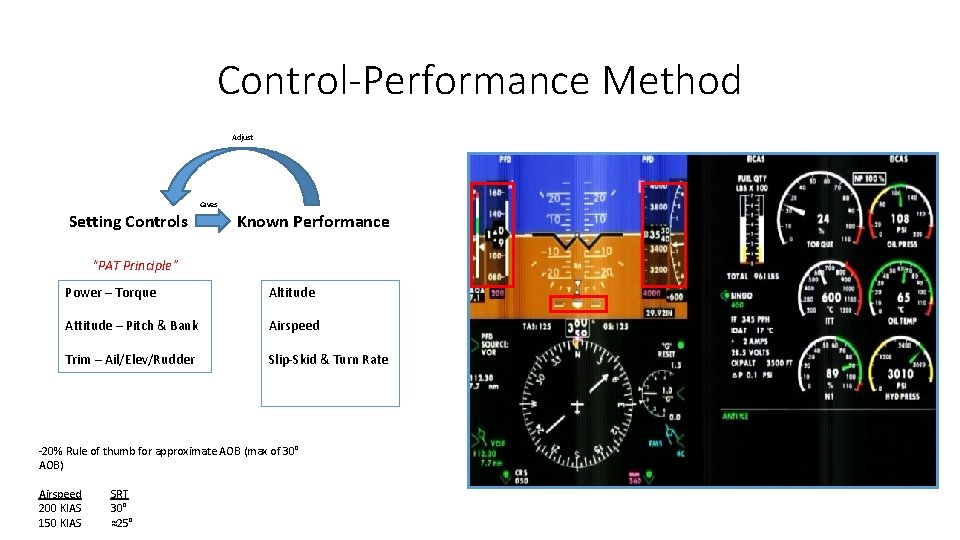
Control-Performance Method Adjust Gives Setting Controls Known Performance “PAT Principle” Power – Torque Altitude Attitude – Pitch & Bank Airspeed Trim – Ail/Elev/Rudder Slip-Skid & Turn Rate -20% Rule of thumb for approximate AOB (max of 30° AOB) Airspeed 200 KIAS 150 KIAS SRT 30° ≈25°
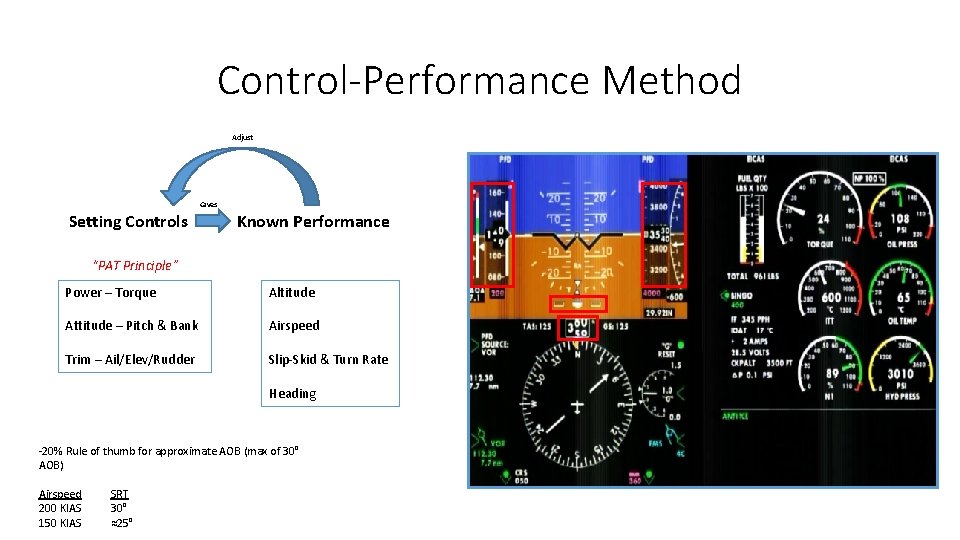
Control-Performance Method Adjust Gives Setting Controls Known Performance “PAT Principle” Power – Torque Altitude Attitude – Pitch & Bank Airspeed Trim – Ail/Elev/Rudder Slip-Skid & Turn Rate Heading -20% Rule of thumb for approximate AOB (max of 30° AOB) Airspeed 200 KIAS 150 KIAS SRT 30° ≈25°
Scanning • Most basic skill in attitude instrument flying
Scanning • Most basic skill in attitude instrument flying • Also referred to as “Cross-check”
Scanning • Most basic skill in attitude instrument flying • Also referred to as “Cross-check” • Scanning is not just looking
Scanning • Most basic skill in attitude instrument flying • Also referred to as “Cross-check” • Scanning is not just looking • Scanning incorporates: • • • Knowing where to look & when to look Interpreting (reading) the instrument Calculating deviation from desired performance Going back to set correction on control instruments Re-checking performance instruments to ensure correction working
Scanning • Most basic skill in attitude instrument flying • Also referred to as “Cross-check” • Scanning is not just looking • Scanning incorporates: • • • Knowing where to look & when to look Interpreting (reading) the instrument Calculating deviation from desired performance Going back to set correction on control instruments Re-checking performance instruments to ensure correction working • Various BI maneuvers help improve scan • • All maneuvers work basic scan rhythm (where & when) & deviations (corrections) Timed Turns & S 1 – Works deviation recognition & corrections to precise levels Steep Turns – Works speed of scan GCA & App Pattern – Work basic transitions & setting known Pwr/Attitude combo
Scanning Errors • Improper Scan • Looking at/emphasizing the wrong instrument during a maneuver (omission) • Beginning to scan from control instruments before the controls are set • Moving eyes between instruments but not reading or making corrections to deviations
Scanning Errors • Improper Scan • Looking at/emphasizing the wrong instrument during a maneuver (omission) • Beginning to scan from control instruments before the controls are set • Moving eyes between instruments but not reading or making corrections to deviations • Slow Scan • Eye movement from scanned area to area is slow due to reading instrument or unfamiliarity of pattern • Delays returning to controls causing deviations to grow before corrections
Scanning Errors • Improper Scan • Looking at/emphasizing the wrong instrument during a maneuver (omission) • Beginning to scan from control instruments before the controls are set • Moving eyes between instruments but not reading or making corrections to deviations • Slow Scan • Eye movement from scanned area to area is slow due to reading instrument or unfamiliarity of pattern • Delays returning to controls causing deviations to grow before corrections • Stagnating Scan/Fixation • Tendency to stare at one instrument for too long causing a breakdown in scan pattern & efficiency • Occurs reading instruments, trying to calculate deviations, trying to be too precise on performance instruments
Scanning Errors • Improper Scan • Looking at/emphasizing the wrong instrument during a maneuver (omission) • Beginning to scan from control instruments before the controls are set • Moving eyes between instruments but not reading or making corrections to deviations • Slow Scan • Eye movement from scanned area to area is slow due to reading instrument or unfamiliarity of pattern • Delays returning to controls causing deviations to grow before corrections • Stagnating Scan/Fixation • Tendency to stare at one instrument for too long causing a breakdown in scan pattern & efficiency • Occurs reading instruments, trying to calculate deviations, trying to be too precise on performance instruments • Chasing Performance Instruments • Making movements with the controls while looking at a performance instrument vice setting new controls • Common error because grades are given of errors from the performance instruments
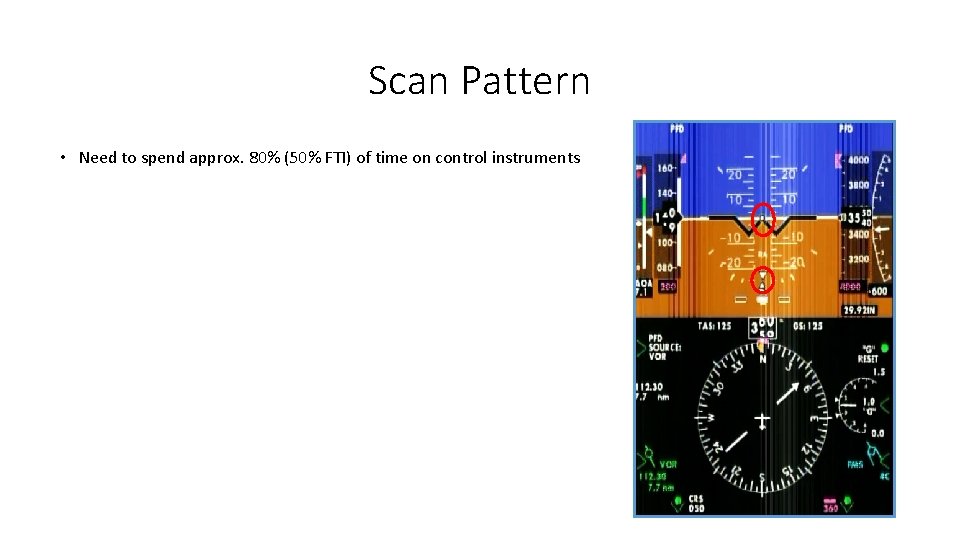
Scan Pattern • Need to spend approx. 80% (50% FTI) of time on control instruments
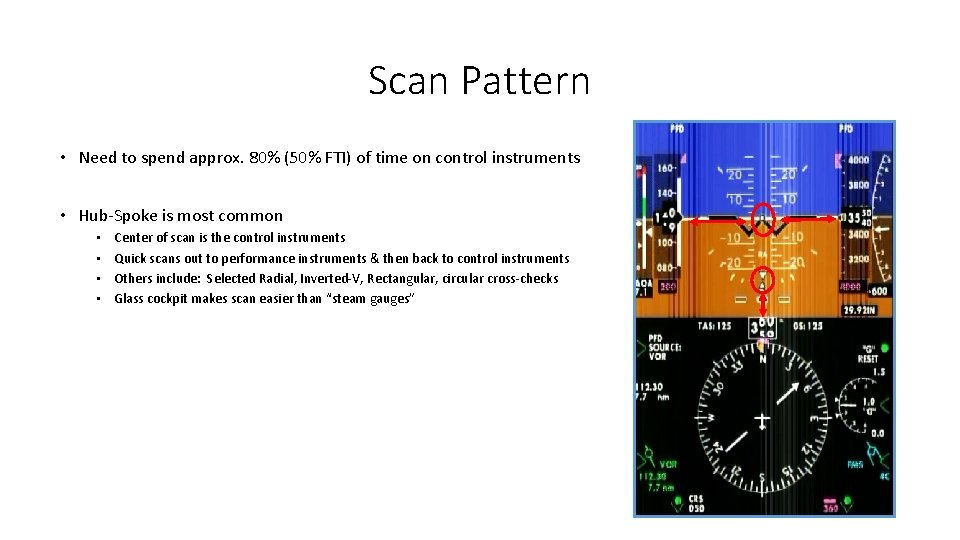
Scan Pattern • Need to spend approx. 80% (50% FTI) of time on control instruments • Hub-Spoke is most common • • Center of scan is the control instruments Quick scans out to performance instruments & then back to control instruments Others include: Selected Radial, Inverted-V, Rectangular, circular cross-checks Glass cockpit makes scan easier than “steam gauges”
Power & Attitude Combinations • Need to know what controls to set for desired performance
Power & Attitude Combinations • Need to know what controls to set for desired performance • Identify performance areas that are common and then figure control combination (reverse engineering)
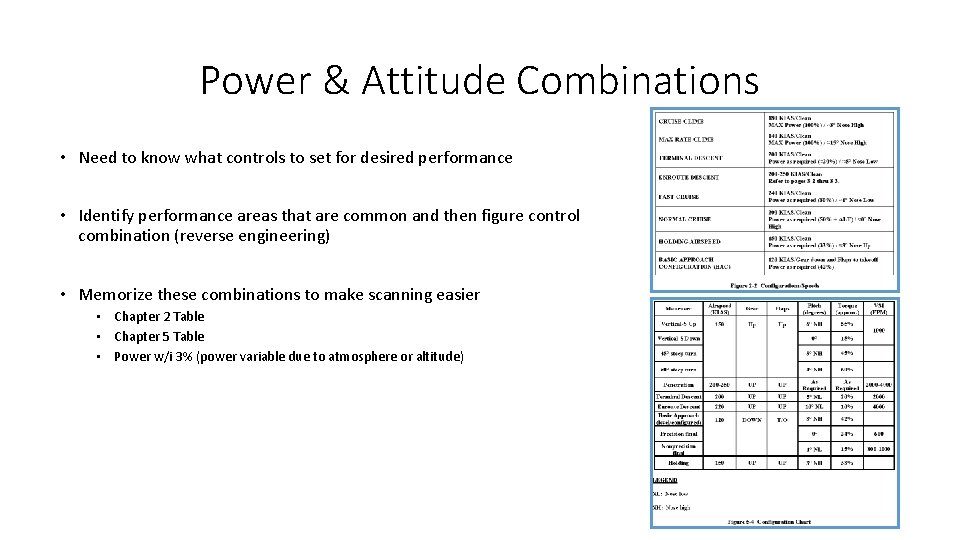
Power & Attitude Combinations • Need to know what controls to set for desired performance • Identify performance areas that are common and then figure control combination (reverse engineering) • Memorize these combinations to make scanning easier • Chapter 2 Table • Chapter 5 Table • Power w/i 3% (power variable due to atmosphere or altitude)
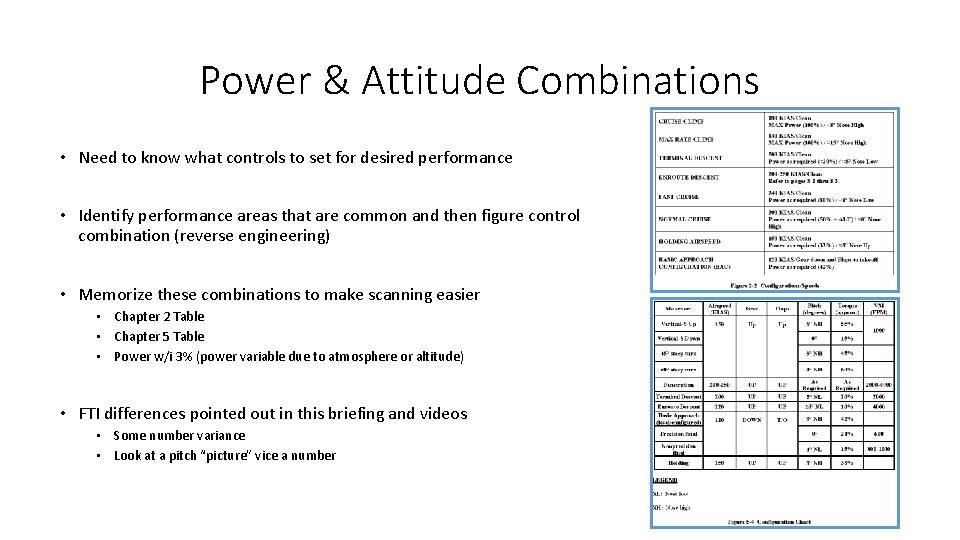
Power & Attitude Combinations • Need to know what controls to set for desired performance • Identify performance areas that are common and then figure control combination (reverse engineering) • Memorize these combinations to make scanning easier • Chapter 2 Table • Chapter 5 Table • Power w/i 3% (power variable due to atmosphere or altitude) • FTI differences pointed out in this briefing and videos • Some number variance • Look at a pitch “picture” vice a number
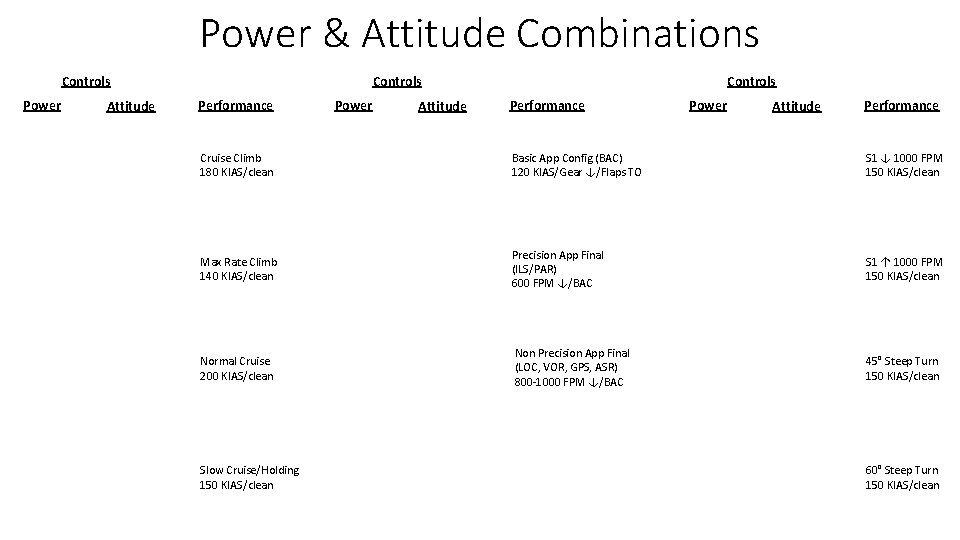
Power & Attitude Combinations Controls Power Attitude Performance Power Attitude Controls Performance Power Attitude Performance Cruise Climb 180 KIAS/clean Basic App Config (BAC) 120 KIAS/Gear ↓/Flaps TO S 1 ↓ 1000 FPM 150 KIAS/clean Max Rate Climb 140 KIAS/clean Precision App Final (ILS/PAR) 600 FPM ↓/BAC S 1 ↑ 1000 FPM 150 KIAS/clean Normal Cruise 200 KIAS/clean Non Precision App Final (LOC, VOR, GPS, ASR) 800 -1000 FPM ↓/BAC 45° Steep Turn 150 KIAS/clean Slow Cruise/Holding 150 KIAS/clean 60° Steep Turn 150 KIAS/clean
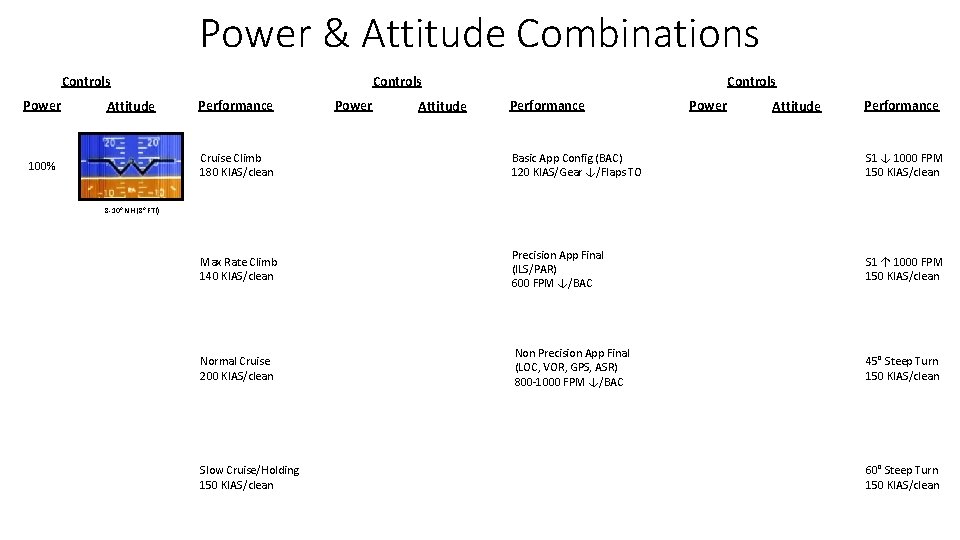
Power & Attitude Combinations Controls Power Attitude 100% Performance Power Attitude Controls Performance Power Attitude Performance Cruise Climb 180 KIAS/clean Basic App Config (BAC) 120 KIAS/Gear ↓/Flaps TO S 1 ↓ 1000 FPM 150 KIAS/clean Max Rate Climb 140 KIAS/clean Precision App Final (ILS/PAR) 600 FPM ↓/BAC S 1 ↑ 1000 FPM 150 KIAS/clean Normal Cruise 200 KIAS/clean Non Precision App Final (LOC, VOR, GPS, ASR) 800 -1000 FPM ↓/BAC 45° Steep Turn 150 KIAS/clean 8 -10° NH (8° FTI) Slow Cruise/Holding 150 KIAS/clean 60° Steep Turn 150 KIAS/clean
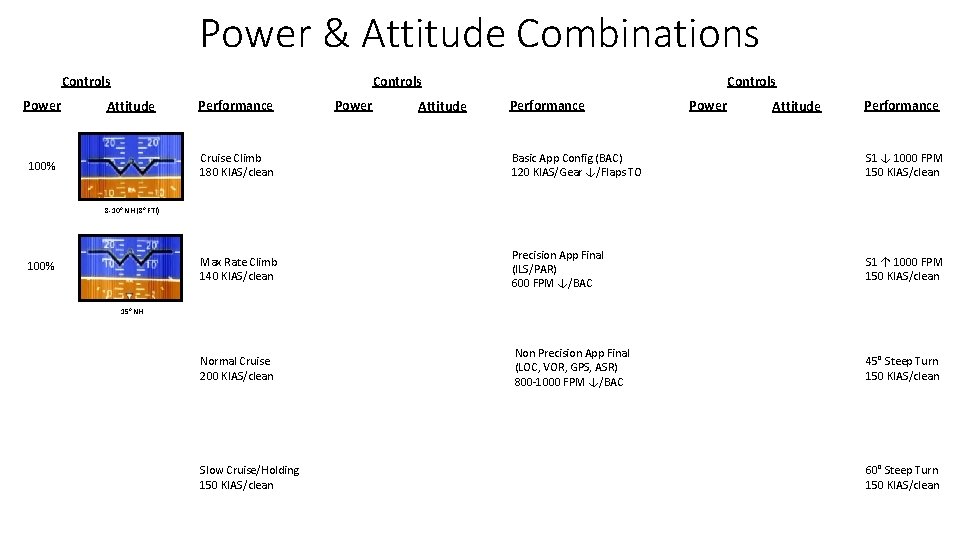
Power & Attitude Combinations Controls Power Attitude 100% Performance Power Attitude Controls Performance Power Attitude Performance Cruise Climb 180 KIAS/clean Basic App Config (BAC) 120 KIAS/Gear ↓/Flaps TO S 1 ↓ 1000 FPM 150 KIAS/clean Max Rate Climb 140 KIAS/clean Precision App Final (ILS/PAR) 600 FPM ↓/BAC S 1 ↑ 1000 FPM 150 KIAS/clean Normal Cruise 200 KIAS/clean Non Precision App Final (LOC, VOR, GPS, ASR) 800 -1000 FPM ↓/BAC 45° Steep Turn 150 KIAS/clean 8 -10° NH (8° FTI) 100% 15° NH Slow Cruise/Holding 150 KIAS/clean 60° Steep Turn 150 KIAS/clean
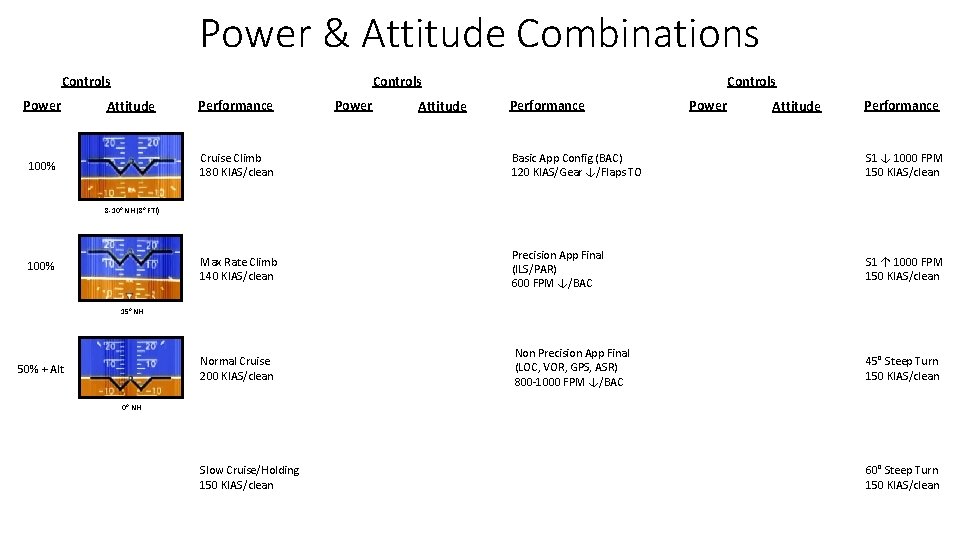
Power & Attitude Combinations Controls Power Attitude 100% Performance Power Attitude Controls Performance Power Attitude Performance Cruise Climb 180 KIAS/clean Basic App Config (BAC) 120 KIAS/Gear ↓/Flaps TO S 1 ↓ 1000 FPM 150 KIAS/clean Max Rate Climb 140 KIAS/clean Precision App Final (ILS/PAR) 600 FPM ↓/BAC S 1 ↑ 1000 FPM 150 KIAS/clean Normal Cruise 200 KIAS/clean Non Precision App Final (LOC, VOR, GPS, ASR) 800 -1000 FPM ↓/BAC 45° Steep Turn 150 KIAS/clean 8 -10° NH (8° FTI) 100% 15° NH 50% + Alt 0° NH Slow Cruise/Holding 150 KIAS/clean 60° Steep Turn 150 KIAS/clean
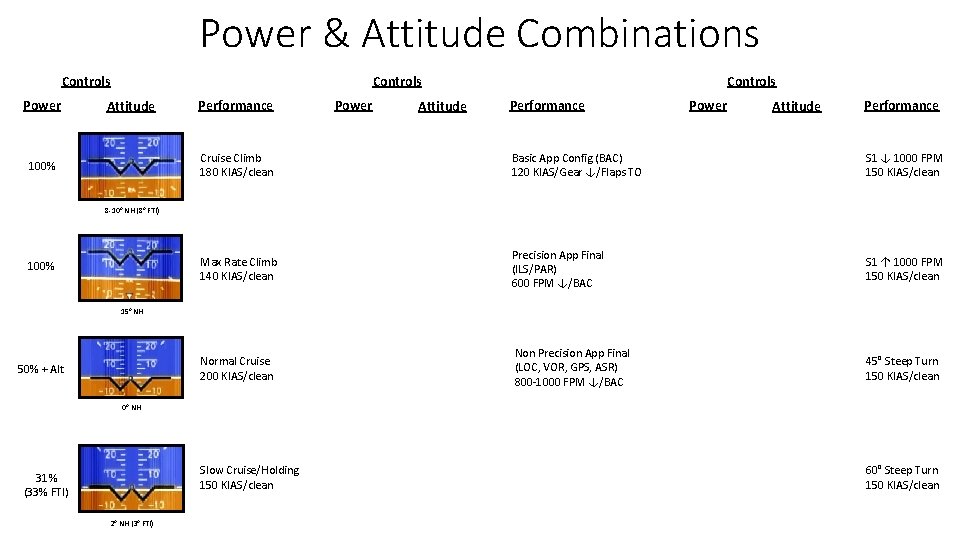
Power & Attitude Combinations Controls Power Attitude 100% Performance Power Attitude Controls Performance Power Attitude Performance Cruise Climb 180 KIAS/clean Basic App Config (BAC) 120 KIAS/Gear ↓/Flaps TO S 1 ↓ 1000 FPM 150 KIAS/clean Max Rate Climb 140 KIAS/clean Precision App Final (ILS/PAR) 600 FPM ↓/BAC S 1 ↑ 1000 FPM 150 KIAS/clean Normal Cruise 200 KIAS/clean Non Precision App Final (LOC, VOR, GPS, ASR) 800 -1000 FPM ↓/BAC 45° Steep Turn 150 KIAS/clean 8 -10° NH (8° FTI) 100% 15° NH 50% + Alt 0° NH Slow Cruise/Holding 150 KIAS/clean 31% (33% FTI) 2° NH (3° FTI) 60° Steep Turn 150 KIAS/clean
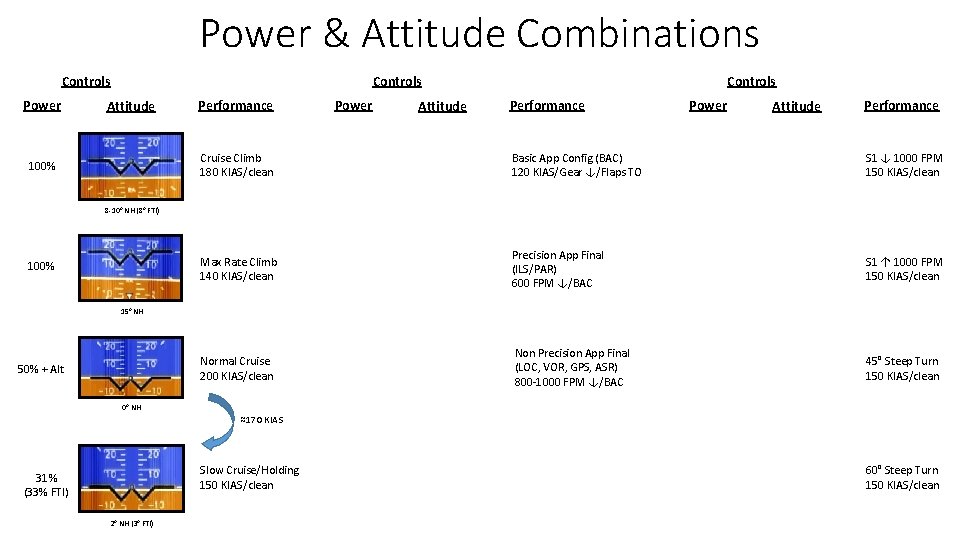
Power & Attitude Combinations Controls Power Attitude 100% Performance Power Attitude Controls Performance Power Attitude Performance Cruise Climb 180 KIAS/clean Basic App Config (BAC) 120 KIAS/Gear ↓/Flaps TO S 1 ↓ 1000 FPM 150 KIAS/clean Max Rate Climb 140 KIAS/clean Precision App Final (ILS/PAR) 600 FPM ↓/BAC S 1 ↑ 1000 FPM 150 KIAS/clean Normal Cruise 200 KIAS/clean Non Precision App Final (LOC, VOR, GPS, ASR) 800 -1000 FPM ↓/BAC 45° Steep Turn 150 KIAS/clean 8 -10° NH (8° FTI) 100% 15° NH 50% + Alt 0° NH ≈170 KIAS Slow Cruise/Holding 150 KIAS/clean 31% (33% FTI) 2° NH (3° FTI) 60° Steep Turn 150 KIAS/clean
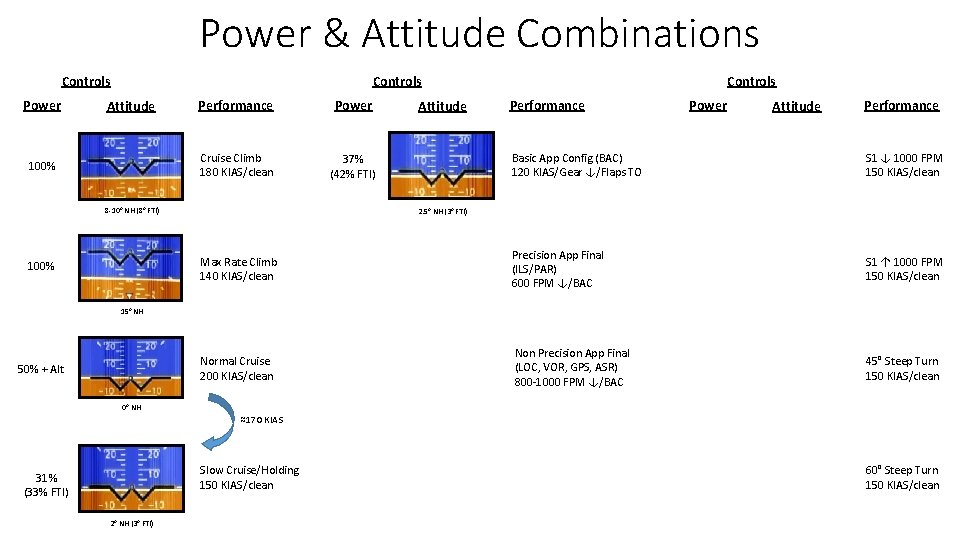
Power & Attitude Combinations Controls Power Attitude 100% Performance Power Cruise Climb 180 KIAS/clean 37% (42% FTI) Performance Power Attitude Performance Basic App Config (BAC) 120 KIAS/Gear ↓/Flaps TO S 1 ↓ 1000 FPM 150 KIAS/clean Max Rate Climb 140 KIAS/clean Precision App Final (ILS/PAR) 600 FPM ↓/BAC S 1 ↑ 1000 FPM 150 KIAS/clean Normal Cruise 200 KIAS/clean Non Precision App Final (LOC, VOR, GPS, ASR) 800 -1000 FPM ↓/BAC 45° Steep Turn 150 KIAS/clean 8 -10° NH (8° FTI) 100% Attitude Controls 2. 5° NH (3° FTI) 15° NH 50% + Alt 0° NH ≈170 KIAS Slow Cruise/Holding 150 KIAS/clean 31% (33% FTI) 2° NH (3° FTI) 60° Steep Turn 150 KIAS/clean
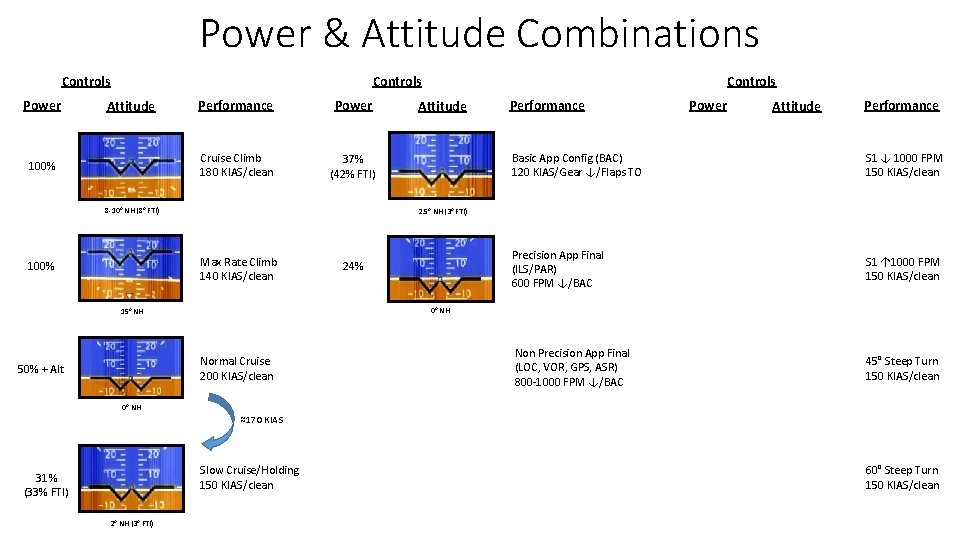
Power & Attitude Combinations Controls Power Attitude 100% Performance Power Cruise Climb 180 KIAS/clean 37% (42% FTI) 8 -10° NH (8° FTI) Performance Power Attitude Performance Basic App Config (BAC) 120 KIAS/Gear ↓/Flaps TO S 1 ↓ 1000 FPM 150 KIAS/clean 24% Precision App Final (ILS/PAR) 600 FPM ↓/BAC S 1 ↑ 1000 FPM 150 KIAS/clean Non Precision App Final (LOC, VOR, GPS, ASR) 800 -1000 FPM ↓/BAC 45° Steep Turn 150 KIAS/clean 0° NH 15° NH Normal Cruise 200 KIAS/clean 50% + Alt Attitude 2. 5° NH (3° FTI) Max Rate Climb 140 KIAS/clean 100% Controls 0° NH ≈170 KIAS Slow Cruise/Holding 150 KIAS/clean 31% (33% FTI) 2° NH (3° FTI) 60° Steep Turn 150 KIAS/clean
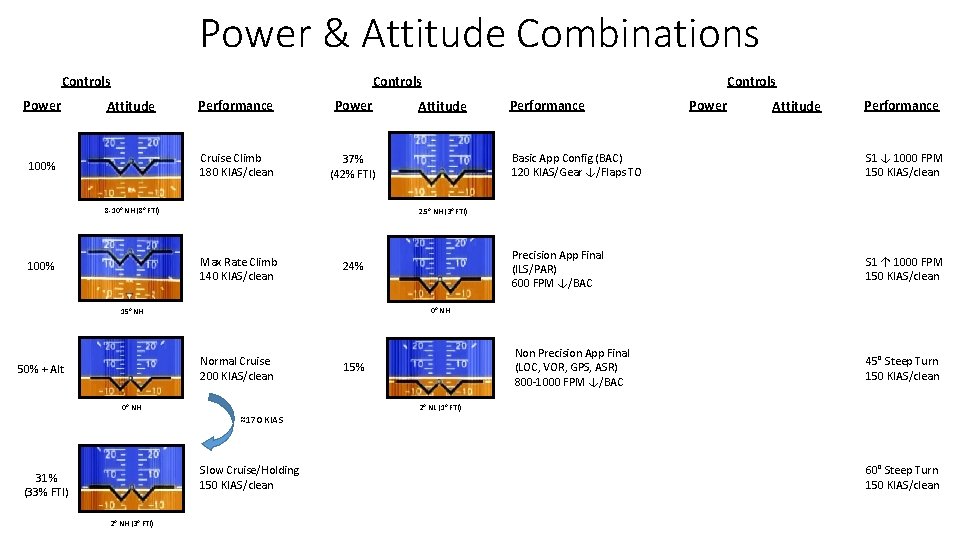
Power & Attitude Combinations Controls Power Attitude 100% Performance Power Cruise Climb 180 KIAS/clean 37% (42% FTI) 8 -10° NH (8° FTI) 24% Performance Power Attitude Performance Basic App Config (BAC) 120 KIAS/Gear ↓/Flaps TO S 1 ↓ 1000 FPM 150 KIAS/clean Precision App Final (ILS/PAR) 600 FPM ↓/BAC S 1 ↑ 1000 FPM 150 KIAS/clean Non Precision App Final (LOC, VOR, GPS, ASR) 800 -1000 FPM ↓/BAC 45° Steep Turn 150 KIAS/clean 0° NH 15° NH Normal Cruise 200 KIAS/clean 50% + Alt Attitude 2. 5° NH (3° FTI) Max Rate Climb 140 KIAS/clean 100% Controls 15% 2° NL (1° FTI) 0° NH ≈170 KIAS Slow Cruise/Holding 150 KIAS/clean 31% (33% FTI) 2° NH (3° FTI) 60° Steep Turn 150 KIAS/clean
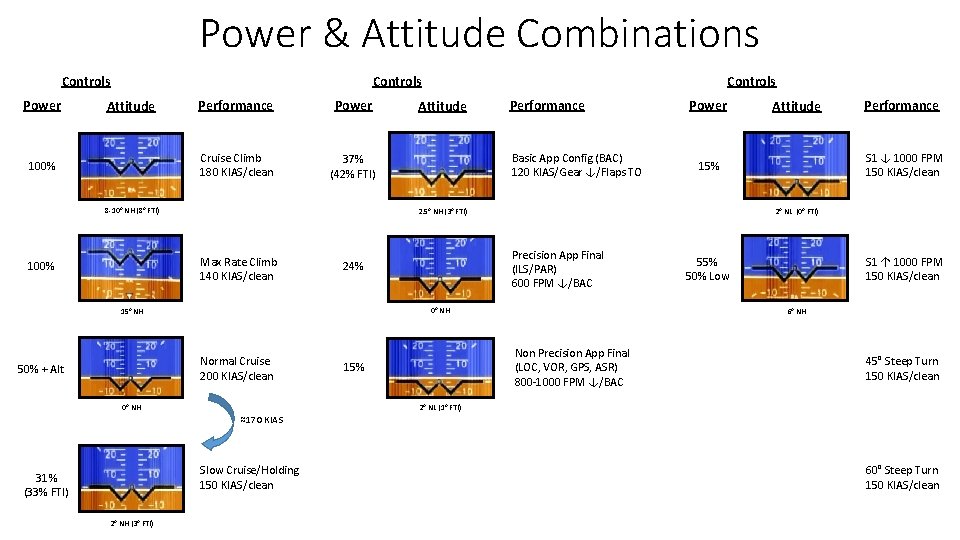
Power & Attitude Combinations Controls Power Attitude 100% Performance Power Cruise Climb 180 KIAS/clean 37% (42% FTI) 8 -10° NH (8° FTI) Performance Basic App Config (BAC) 120 KIAS/Gear ↓/Flaps TO Power 0° NH Normal Cruise 200 KIAS/clean Performance S 1 ↓ 1000 FPM 150 KIAS/clean 15% 50% Low S 1 ↑ 1000 FPM 150 KIAS/clean 6° NH Non Precision App Final (LOC, VOR, GPS, ASR) 800 -1000 FPM ↓/BAC 15% Attitude 2° NL (0° FTI) Precision App Final (ILS/PAR) 600 FPM ↓/BAC 24% 15° NH 50% + Alt Attitude 2. 5° NH (3° FTI) Max Rate Climb 140 KIAS/clean 100% Controls 45° Steep Turn 150 KIAS/clean 2° NL (1° FTI) 0° NH ≈170 KIAS Slow Cruise/Holding 150 KIAS/clean 31% (33% FTI) 2° NH (3° FTI) 60° Steep Turn 150 KIAS/clean
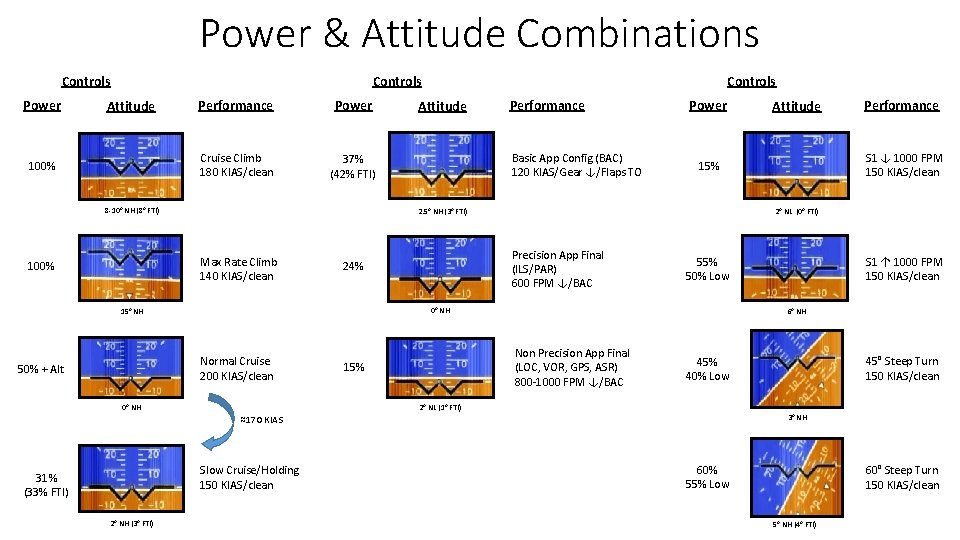
Power & Attitude Combinations Controls Power Attitude 100% Performance Power Cruise Climb 180 KIAS/clean 37% (42% FTI) 8 -10° NH (8° FTI) Performance Basic App Config (BAC) 120 KIAS/Gear ↓/Flaps TO Power 55% 50% Low 3° NH ≈170 KIAS Slow Cruise/Holding 150 KIAS/clean 2° NH (3° FTI) 45° Steep Turn 150 KIAS/clean 45% 40% Low 2° NL (1° FTI) 0° NH 31% (33% FTI) S 1 ↑ 1000 FPM 150 KIAS/clean 6° NH Non Precision App Final (LOC, VOR, GPS, ASR) 800 -1000 FPM ↓/BAC 15% Performance S 1 ↓ 1000 FPM 150 KIAS/clean 15% 0° NH Normal Cruise 200 KIAS/clean Attitude 2° NL (0° FTI) Precision App Final (ILS/PAR) 600 FPM ↓/BAC 24% 15° NH 50% + Alt Attitude 2. 5° NH (3° FTI) Max Rate Climb 140 KIAS/clean 100% Controls 60% 55% Low 60° Steep Turn 150 KIAS/clean 5° NH (4° FTI)
Transition Points • Used during scan to mark point at which you return to the controls to reset the power & attitude for the next performance requirement • Defined for Airspeed, Altitude, & Heading:
Transition Points • Used during scan to mark point at which you return to the controls to reset the power & attitude for the next performance requirement • Defined for Airspeed, Altitude, & Heading: Airspeed: 5 KIAS prior to desired Airspeed
Transition Points • Used during scan to mark point at which you return to the controls to reset the power & attitude for the next performance requirement • Defined for Airspeed, Altitude, & Heading: Airspeed: 5 KIAS prior to desired Airspeed Altitude: 50’ prior (≤ 1, 000’ FPM) / 100’ prior (descent) 200’ prior (climb) / 10% VVI (max rate climb)
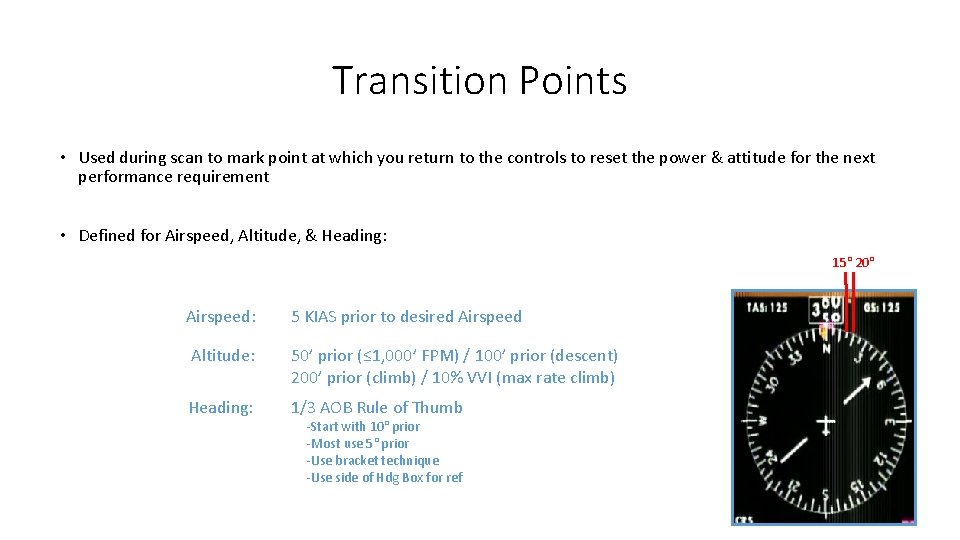
Transition Points • Used during scan to mark point at which you return to the controls to reset the power & attitude for the next performance requirement • Defined for Airspeed, Altitude, & Heading: 15° 20° Airspeed: 5 KIAS prior to desired Airspeed Altitude: 50’ prior (≤ 1, 000’ FPM) / 100’ prior (descent) 200’ prior (climb) / 10% VVI (max rate climb) Heading: 1/3 AOB Rule of Thumb -Start with 10° prior -Most use 5° prior -Use bracket technique -Use side of Hdg Box for ref
Descents • Enroute Descent • Used when descending from higher enroute structure where speed & alt loss is not a big factor (note: 250 KIAS below 10, 000 MSL) • See NATOPS appendix A for max range descents and other descent profiles • FTI procedure calls for 200 -250 KIAS & 4, 000 FPM descent rate
Descents • Enroute Descent • Used when descending from higher enroute structure where speed & alt loss is not a big factor (note: 250 KIAS below 10, 000 MSL) • See NATOPS appendix A for max range descents and other descent profiles • FTI procedure calls for 200 -250 KIAS & 4, 000 FPM descent rate • Terminal Descent • Used in Terminal Area where speed is constant to maintain predictability during vectoring • FTI procedure calls for maintaining current airspeed (200 KIAS) & descent rate as required
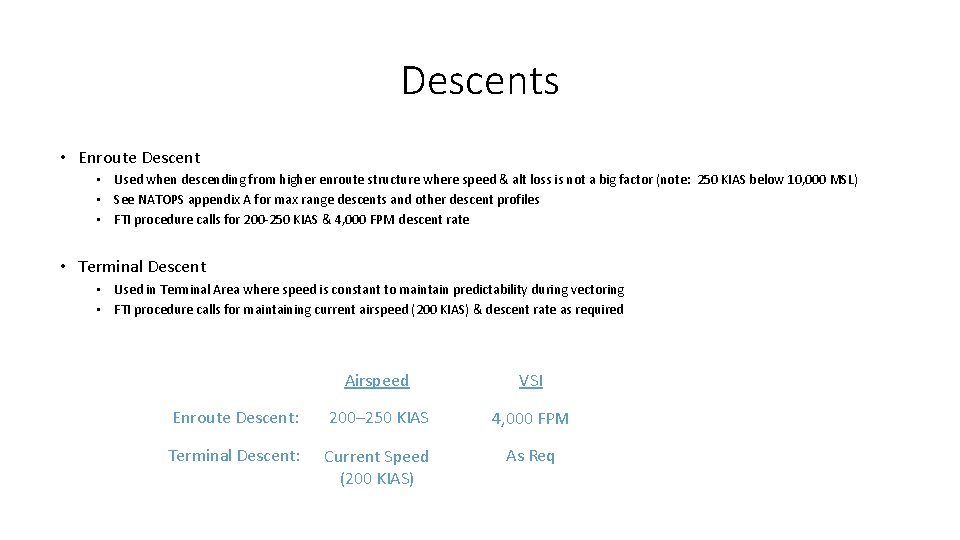
Descents • Enroute Descent • Used when descending from higher enroute structure where speed & alt loss is not a big factor (note: 250 KIAS below 10, 000 MSL) • See NATOPS appendix A for max range descents and other descent profiles • FTI procedure calls for 200 -250 KIAS & 4, 000 FPM descent rate • Terminal Descent • Used in Terminal Area where speed is constant to maintain predictability during vectoring • FTI procedure calls for maintaining current airspeed (200 KIAS) & descent rate as required Airspeed VSI Enroute Descent: 200– 250 KIAS 4, 000 FPM Terminal Descent: Current Speed (200 KIAS) As Req
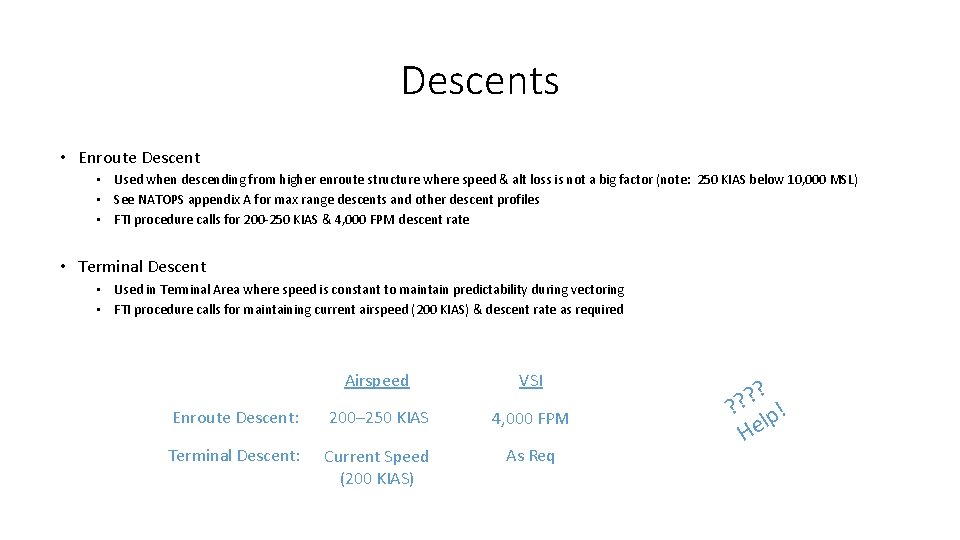
Descents • Enroute Descent • Used when descending from higher enroute structure where speed & alt loss is not a big factor (note: 250 KIAS below 10, 000 MSL) • See NATOPS appendix A for max range descents and other descent profiles • FTI procedure calls for 200 -250 KIAS & 4, 000 FPM descent rate • Terminal Descent • Used in Terminal Area where speed is constant to maintain predictability during vectoring • FTI procedure calls for maintaining current airspeed (200 KIAS) & descent rate as required Airspeed VSI Enroute Descent: 200– 250 KIAS 4, 000 FPM Terminal Descent: Current Speed (200 KIAS) As Req ? ? p! l e H
Descents Power Enroute Descent: Attitude Airspeed VSI
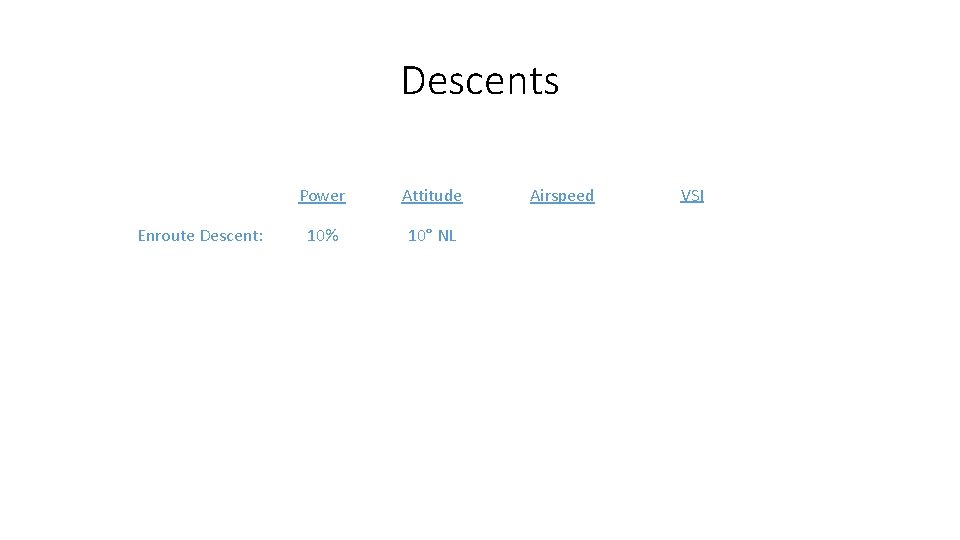
Descents Enroute Descent: Power Attitude 10% 10° NL Airspeed VSI
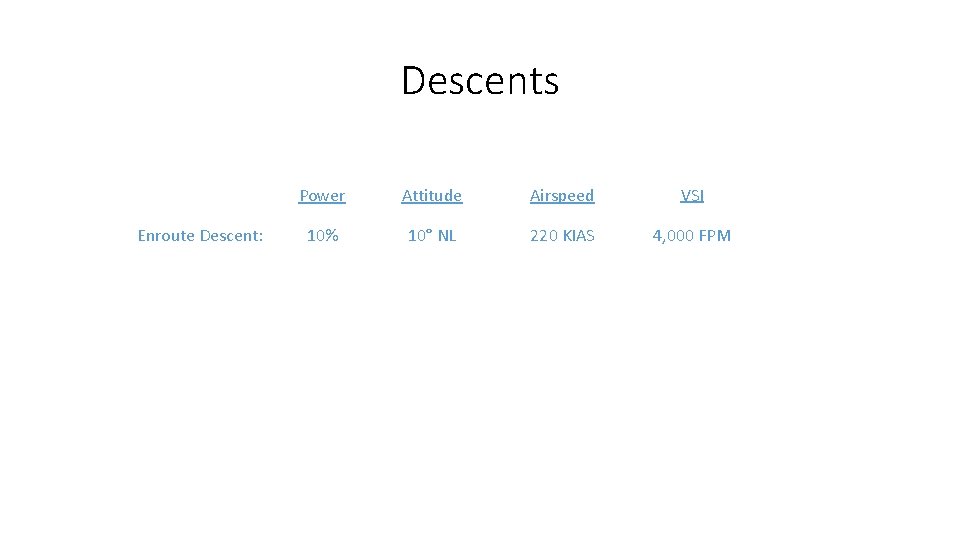
Descents Enroute Descent: Power Attitude Airspeed VSI 10% 10° NL 220 KIAS 4, 000 FPM
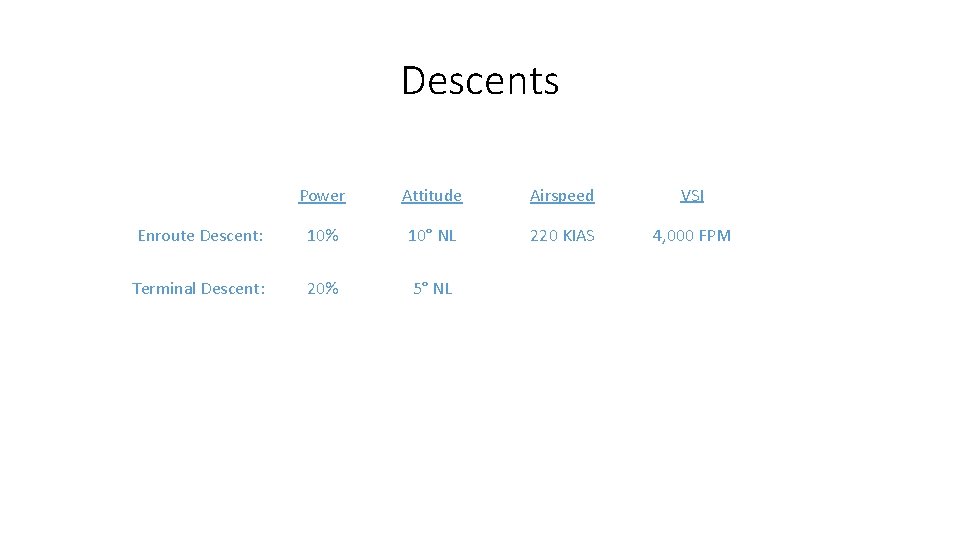
Descents Power Attitude Airspeed VSI Enroute Descent: 10% 10° NL 220 KIAS 4, 000 FPM Terminal Descent: 20% 5° NL
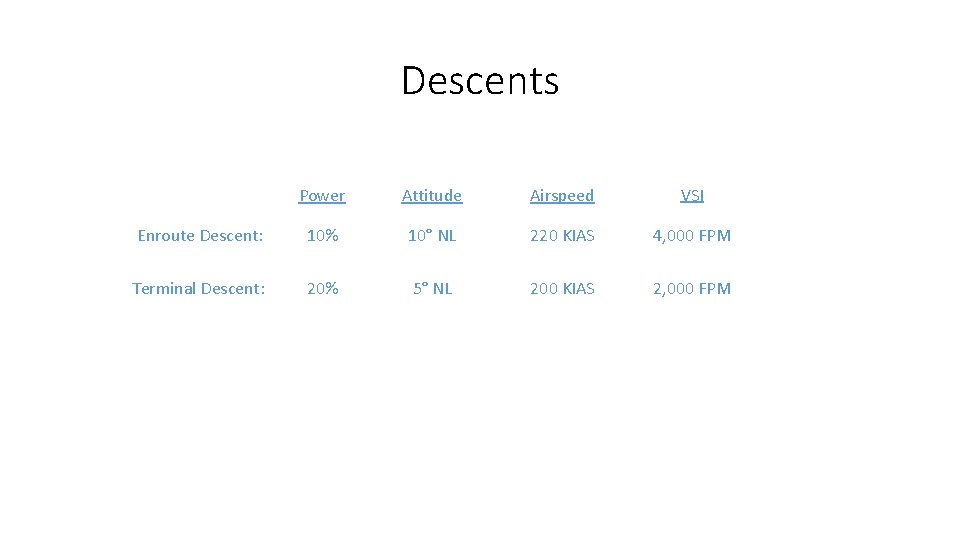
Descents Power Attitude Airspeed VSI Enroute Descent: 10% 10° NL 220 KIAS 4, 000 FPM Terminal Descent: 20% 5° NL 200 KIAS 2, 000 FPM
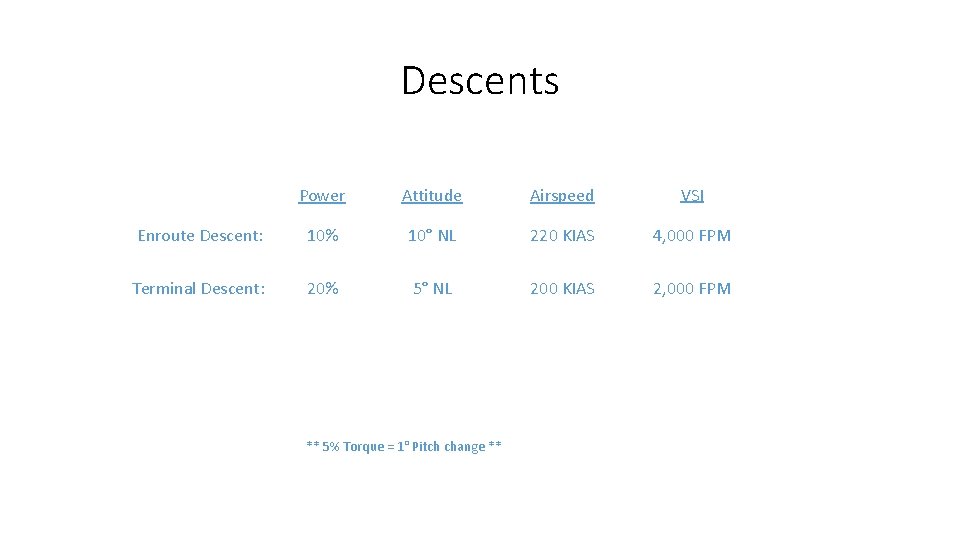
Descents Power Attitude Airspeed VSI Enroute Descent: 10% 10° NL 220 KIAS 4, 000 FPM Terminal Descent: 20% 5° NL 200 KIAS 2, 000 FPM ** 5% Torque = 1° Pitch change **
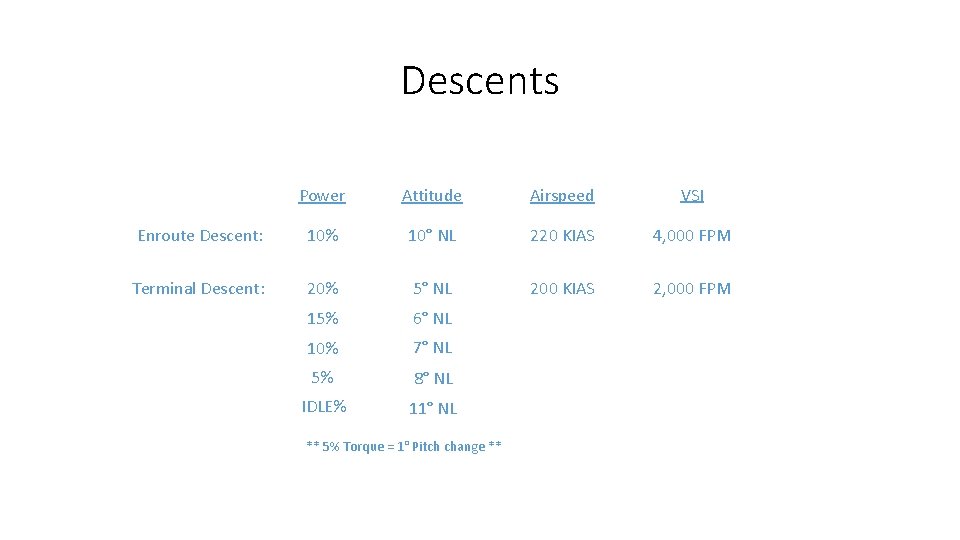
Descents Power Attitude Airspeed VSI Enroute Descent: 10% 10° NL 220 KIAS 4, 000 FPM Terminal Descent: 20% 5° NL 200 KIAS 2, 000 FPM 15% 6° NL 10% 7° NL 5% 8° NL IDLE% 11° NL ** 5% Torque = 1° Pitch change **
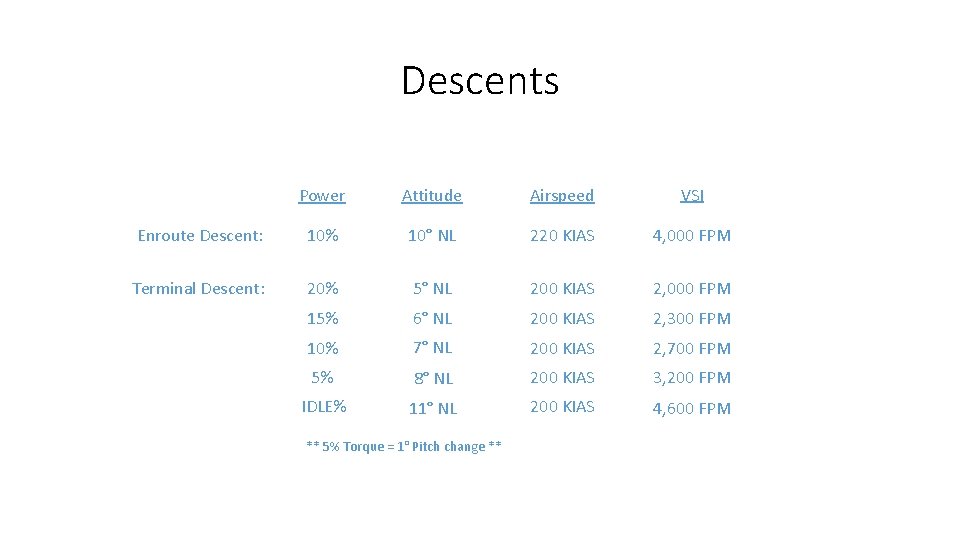
Descents Power Attitude Airspeed VSI Enroute Descent: 10% 10° NL 220 KIAS 4, 000 FPM Terminal Descent: 20% 5° NL 200 KIAS 2, 000 FPM 15% 6° NL 200 KIAS 2, 300 FPM 10% 7° NL 200 KIAS 2, 700 FPM 5% 8° NL 200 KIAS 3, 200 FPM IDLE% 11° NL 200 KIAS 4, 600 FPM ** 5% Torque = 1° Pitch change **
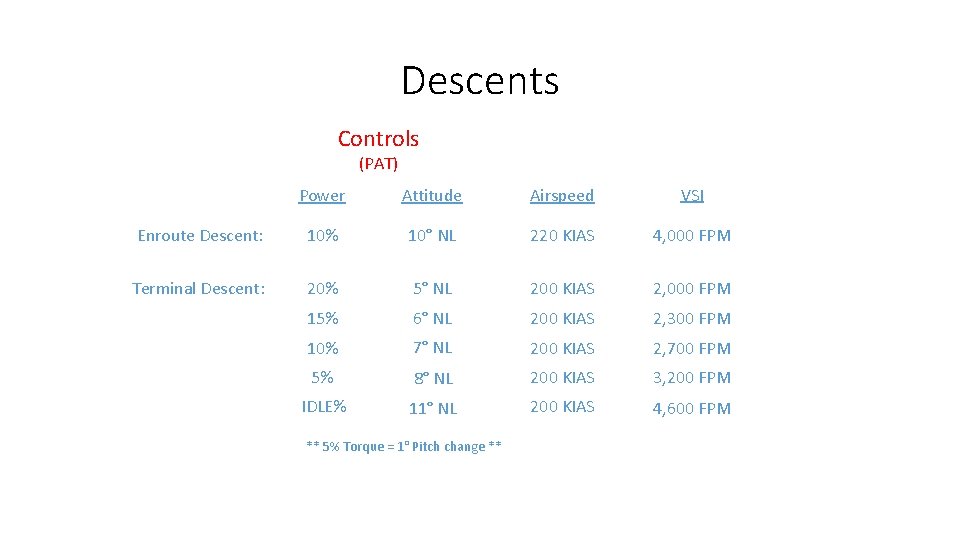
Descents Controls (PAT) Power Attitude Airspeed VSI Enroute Descent: 10% 10° NL 220 KIAS 4, 000 FPM Terminal Descent: 20% 5° NL 200 KIAS 2, 000 FPM 15% 6° NL 200 KIAS 2, 300 FPM 10% 7° NL 200 KIAS 2, 700 FPM 5% 8° NL 200 KIAS 3, 200 FPM IDLE% 11° NL 200 KIAS 4, 600 FPM ** 5% Torque = 1° Pitch change **
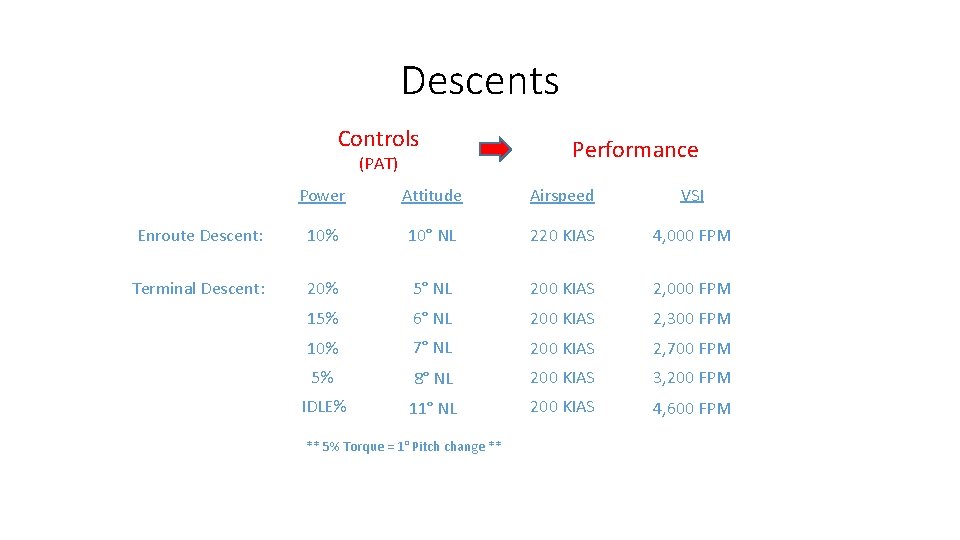
Descents Controls (PAT) Performance Power Attitude Airspeed VSI Enroute Descent: 10% 10° NL 220 KIAS 4, 000 FPM Terminal Descent: 20% 5° NL 200 KIAS 2, 000 FPM 15% 6° NL 200 KIAS 2, 300 FPM 10% 7° NL 200 KIAS 2, 700 FPM 5% 8° NL 200 KIAS 3, 200 FPM IDLE% 11° NL 200 KIAS 4, 600 FPM ** 5% Torque = 1° Pitch change **
Summary • Information Sources • Attitude Instrument Flying • Control-Performance Method • Scanning (Cross-check) • Scanning Errors • Scan Pattern • Power & Attitude Combinations • Transition Points • Descents
Basic Instrument Scan T 6 BDriver. com
- Slides: 70