
Basic Instruction Timings Pipelining 1 Making some assumptions
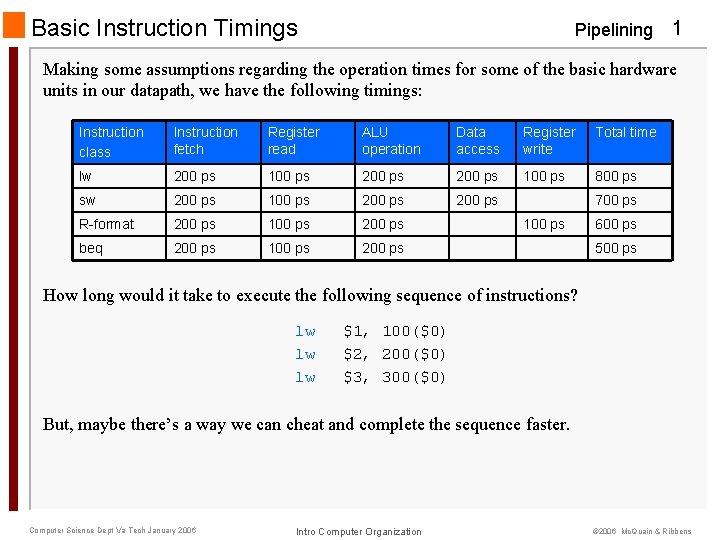
Basic Instruction Timings Pipelining 1 Making some assumptions regarding the operation times for some of the basic hardware units in our datapath, we have the following timings: Instruction class Instruction fetch Register read ALU operation Data access Register write Total time lw 200 ps 100 ps 800 ps sw 200 ps 100 ps 200 ps R-format 200 ps 100 ps 200 ps beq 200 ps 100 ps 200 ps 700 ps 100 ps 600 ps 500 ps How long would it take to execute the following sequence of instructions? lw lw lw $1, 100($0) $2, 200($0) $3, 300($0) But, maybe there’s a way we can cheat and complete the sequence faster. Computer Science Dept Va Tech January 2006 Intro Computer Organization © 2006 Mc. Quain & Ribbens
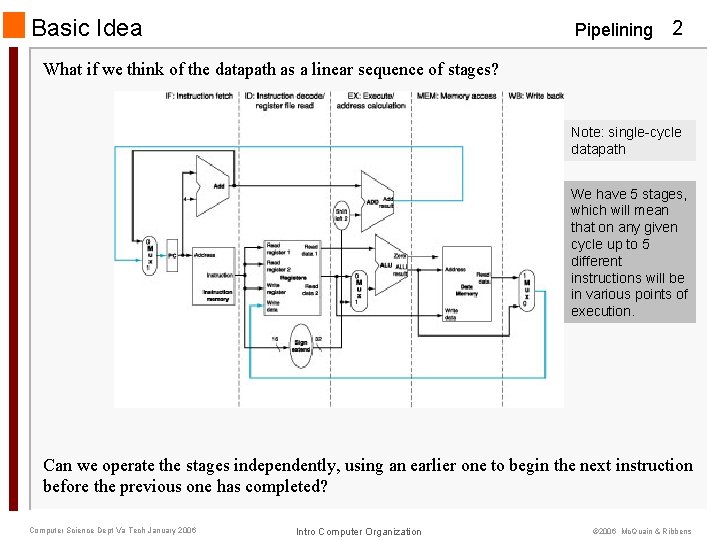
Basic Idea Pipelining 2 What if we think of the datapath as a linear sequence of stages? Note: single-cycle datapath We have 5 stages, which will mean that on any given cycle up to 5 different instructions will be in various points of execution. Can we operate the stages independently, using an earlier one to begin the next instruction before the previous one has completed? Computer Science Dept Va Tech January 2006 Intro Computer Organization © 2006 Mc. Quain & Ribbens
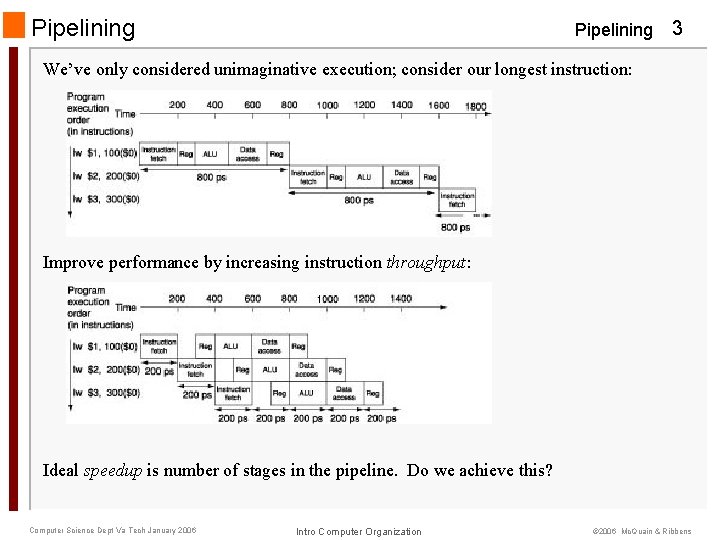
Pipelining 3 We’ve only considered unimaginative execution; consider our longest instruction: Improve performance by increasing instruction throughput: Ideal speedup is number of stages in the pipeline. Do we achieve this? Computer Science Dept Va Tech January 2006 Intro Computer Organization © 2006 Mc. Quain & Ribbens
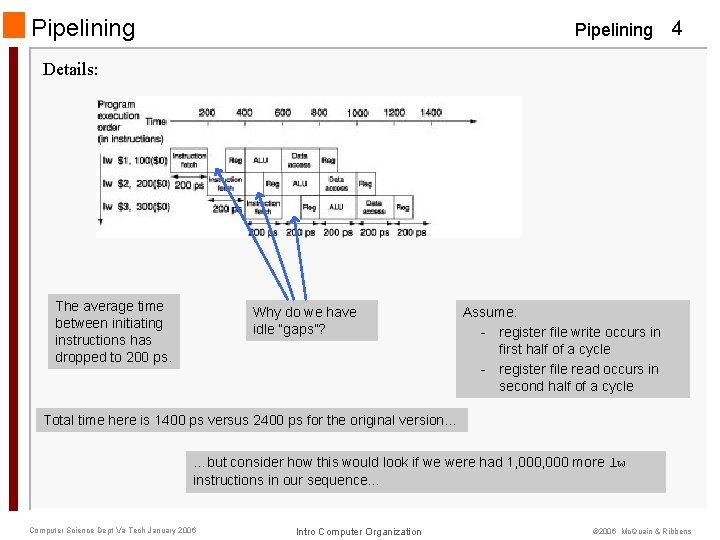
Pipelining 4 Details: The average time between initiating instructions has dropped to 200 ps. Why do we have idle “gaps”? Assume: - register file write occurs in first half of a cycle - register file read occurs in second half of a cycle Total time here is 1400 ps versus 2400 ps for the original version… …but consider how this would look if we were had 1, 000 more lw instructions in our sequence… Computer Science Dept Va Tech January 2006 Intro Computer Organization © 2006 Mc. Quain & Ribbens
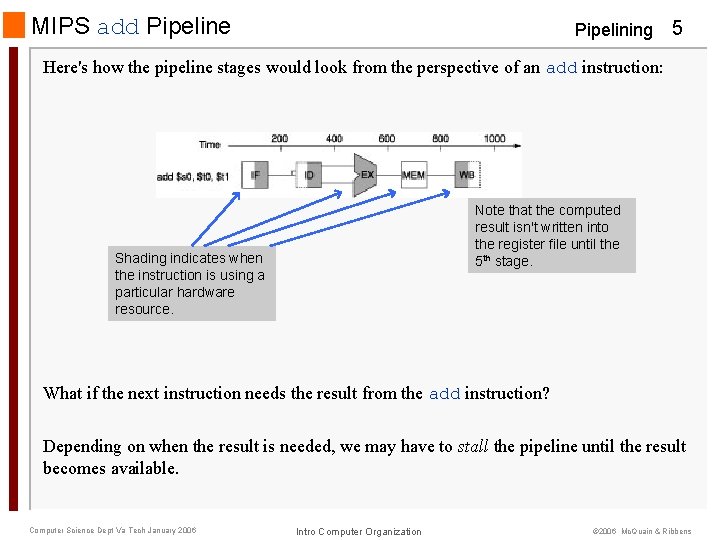
MIPS add Pipeline Pipelining 5 Here's how the pipeline stages would look from the perspective of an add instruction: Note that the computed result isn't written into the register file until the 5 th stage. Shading indicates when the instruction is using a particular hardware resource. What if the next instruction needs the result from the add instruction? Depending on when the result is needed, we may have to stall the pipeline until the result becomes available. Computer Science Dept Va Tech January 2006 Intro Computer Organization © 2006 Mc. Quain & Ribbens
Pipelining 6 What makes it easy - all instructions are the same length - just a few instruction formats - memory operands appear only in loads and stores What makes it hard? - structural hazards: suppose we had only one memory - control hazards: need to worry about branch instructions - data hazards: an instruction depends on a previous instruction We’ll build a simple pipeline and look at these issues We’ll talk about modern processors and what really makes it hard: - exception handling - trying to improve performance with out-of-order execution, etc. Computer Science Dept Va Tech January 2006 Intro Computer Organization © 2006 Mc. Quain & Ribbens
Pipeline Hazards Pipelining 7 In some cases, the next instruction cannot execute in the following clock cycle. We will introduce some of the potential issues in the next few slides. structural hazard - hardware cannot support the necessary combination of operations at once - reconsider the earlier example with a single memory unit and a fourth lw instruction data hazard - data that is necessary to execute the instruction is not yet available - consider: add $s 0, $t 1 sub $t 2, $s 0, $s 3 - load-use hazard occurs when data imported by a load instruction is not available when it is requested Computer Science Dept Va Tech January 2006 Intro Computer Organization © 2006 Mc. Quain & Ribbens
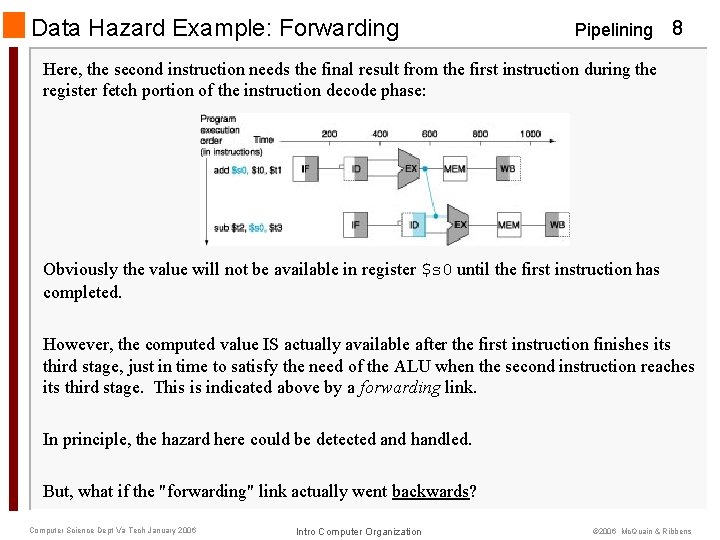
Data Hazard Example: Forwarding Pipelining 8 Here, the second instruction needs the final result from the first instruction during the register fetch portion of the instruction decode phase: Obviously the value will not be available in register $s 0 until the first instruction has completed. However, the computed value IS actually available after the first instruction finishes its third stage, just in time to satisfy the need of the ALU when the second instruction reaches its third stage. This is indicated above by a forwarding link. In principle, the hazard here could be detected and handled. But, what if the "forwarding" link actually went backwards? Computer Science Dept Va Tech January 2006 Intro Computer Organization © 2006 Mc. Quain & Ribbens

Data Hazard Example: Stalling Pipelining 9 Here the first instruction is a load, and its result simply won't be available in time: As indicated, this can be resolved by stalling the pipeline, delaying the initiation of the second instruction for 1 cycle. Again, if we can detect this situation, we can in principle impose the solution shown above. A pipeline stall is often referred to as a bubble. Computer Science Dept Va Tech January 2006 Intro Computer Organization © 2006 Mc. Quain & Ribbens
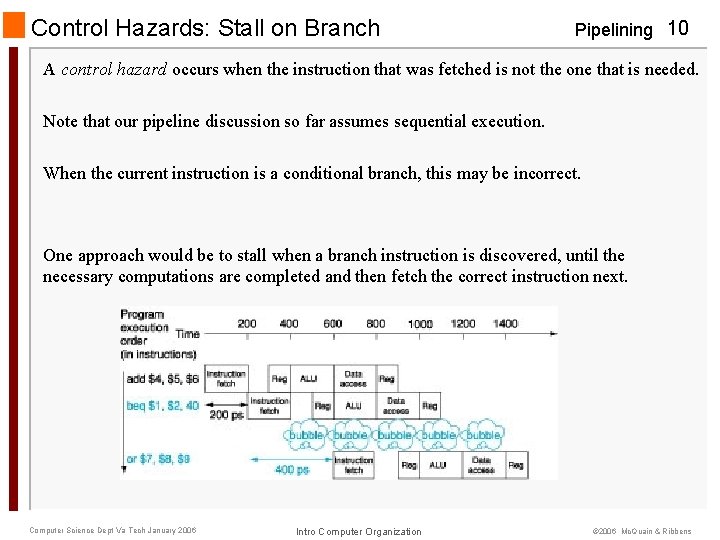
Control Hazards: Stall on Branch Pipelining 10 A control hazard occurs when the instruction that was fetched is not the one that is needed. Note that our pipeline discussion so far assumes sequential execution. When the current instruction is a conditional branch, this may be incorrect. One approach would be to stall when a branch instruction is discovered, until the necessary computations are completed and then fetch the correct instruction next. Computer Science Dept Va Tech January 2006 Intro Computer Organization © 2006 Mc. Quain & Ribbens
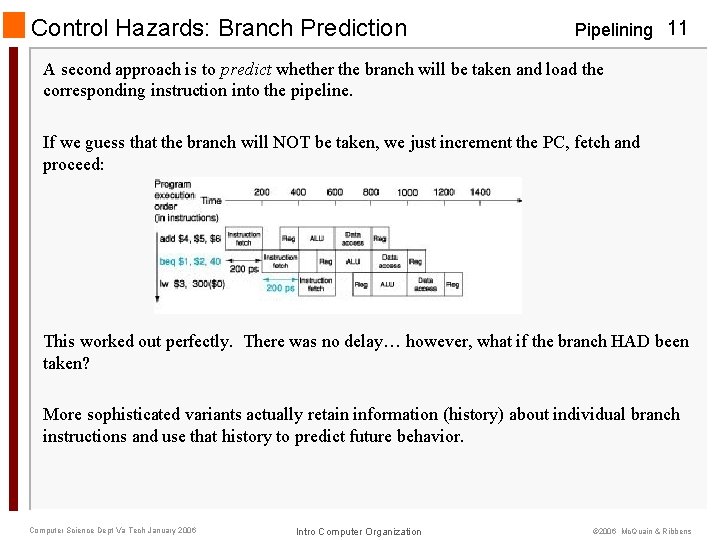
Control Hazards: Branch Prediction Pipelining 11 A second approach is to predict whether the branch will be taken and load the corresponding instruction into the pipeline. If we guess that the branch will NOT be taken, we just increment the PC, fetch and proceed: This worked out perfectly. There was no delay… however, what if the branch HAD been taken? More sophisticated variants actually retain information (history) about individual branch instructions and use that history to predict future behavior. Computer Science Dept Va Tech January 2006 Intro Computer Organization © 2006 Mc. Quain & Ribbens
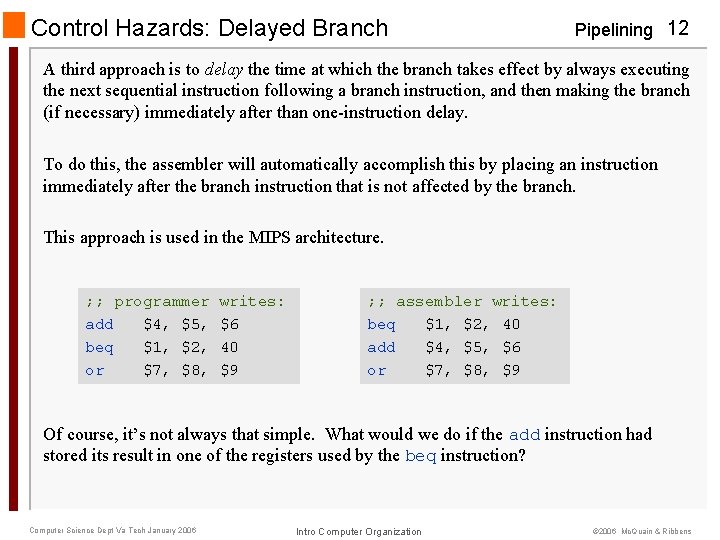
Control Hazards: Delayed Branch Pipelining 12 A third approach is to delay the time at which the branch takes effect by always executing the next sequential instruction following a branch instruction, and then making the branch (if necessary) immediately after than one-instruction delay. To do this, the assembler will automatically accomplish this by placing an instruction immediately after the branch instruction that is not affected by the branch. This approach is used in the MIPS architecture. ; ; programmer add $4, $5, beq $1, $2, or $7, $8, writes: $6 40 $9 ; ; assembler writes: beq $1, $2, 40 add $4, $5, $6 or $7, $8, $9 Of course, it’s not always that simple. What would we do if the add instruction had stored its result in one of the registers used by the beq instruction? Computer Science Dept Va Tech January 2006 Intro Computer Organization © 2006 Mc. Quain & Ribbens
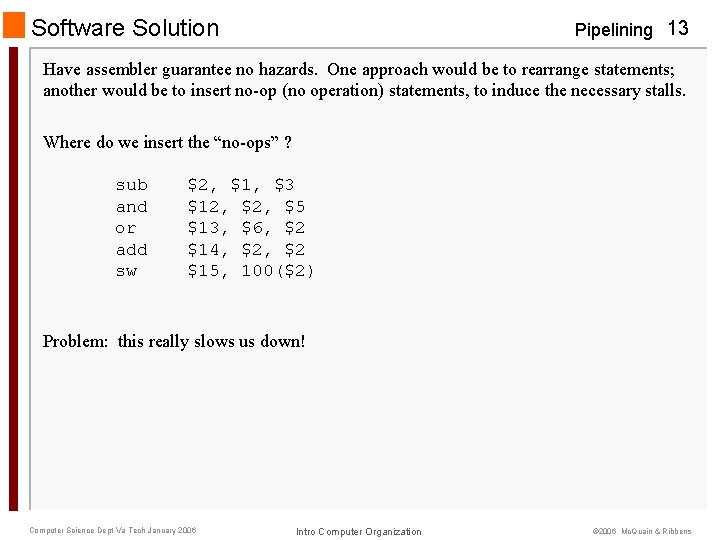
Software Solution Pipelining 13 Have assembler guarantee no hazards. One approach would be to rearrange statements; another would be to insert no-op (no operation) statements, to induce the necessary stalls. Where do we insert the “no-ops” ? sub and or add sw $2, $1, $3 $12, $5 $13, $6, $2 $14, $2 $15, 100($2) Problem: this really slows us down! Computer Science Dept Va Tech January 2006 Intro Computer Organization © 2006 Mc. Quain & Ribbens
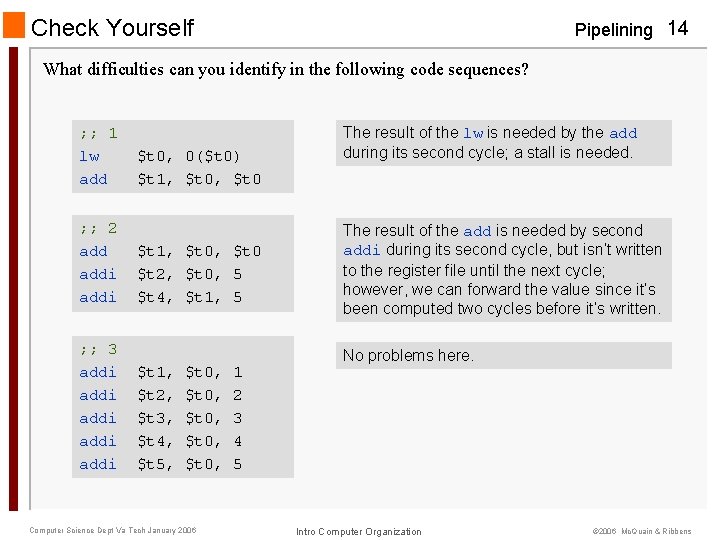
Check Yourself Pipelining 14 What difficulties can you identify in the following code sequences? ; ; 1 lw add ; ; 2 addi ; ; 3 addi addi $t 0, 0($t 0) $t 1, $t 0, $t 0 $t 2, $t 0, 5 $t 4, $t 1, 5 $t 1, $t 2, $t 3, $t 4, $t 5, $t 0, $t 0, Computer Science Dept Va Tech January 2006 1 2 3 4 5 The result of the lw is needed by the add during its second cycle; a stall is needed. The result of the add is needed by second addi during its second cycle, but isn’t written to the register file until the next cycle; however, we can forward the value since it’s been computed two cycles before it’s written. No problems here. Intro Computer Organization © 2006 Mc. Quain & Ribbens
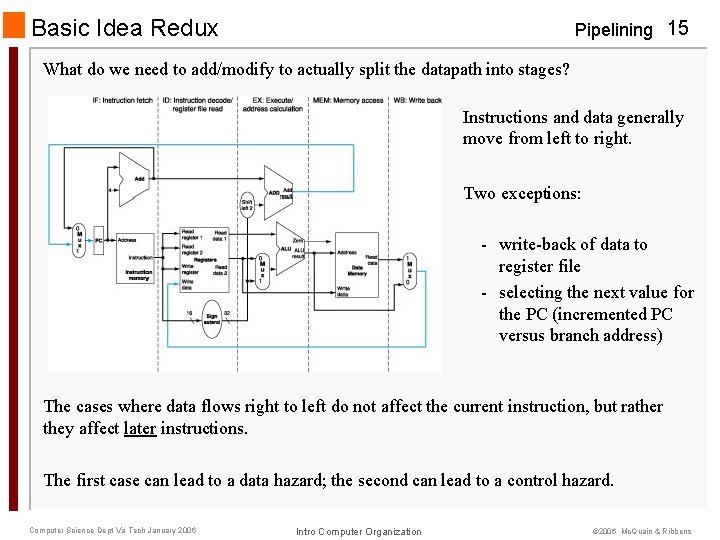
Basic Idea Redux Pipelining 15 What do we need to add/modify to actually split the datapath into stages? Instructions and data generally move from left to right. Two exceptions: - write-back of data to register file - selecting the next value for the PC (incremented PC versus branch address) The cases where data flows right to left do not affect the current instruction, but rather they affect later instructions. The first case can lead to a data hazard; the second can lead to a control hazard. Computer Science Dept Va Tech January 2006 Intro Computer Organization © 2006 Mc. Quain & Ribbens
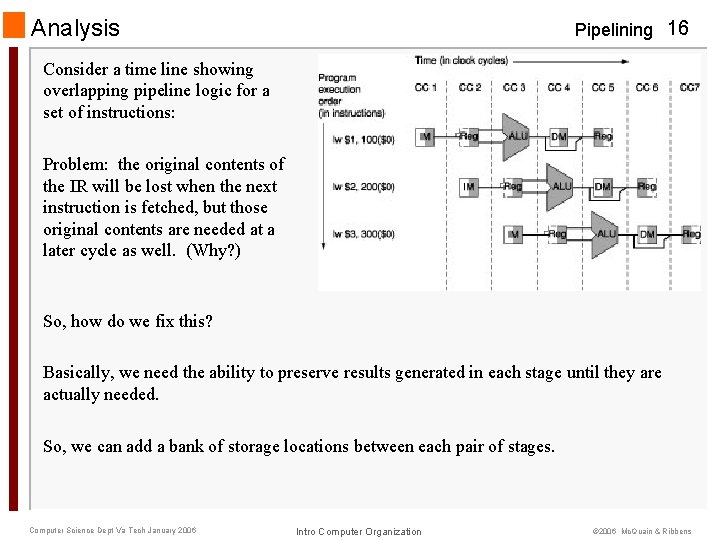
Analysis Pipelining 16 Consider a time line showing overlapping pipeline logic for a set of instructions: Problem: the original contents of the IR will be lost when the next instruction is fetched, but those original contents are needed at a later cycle as well. (Why? ) So, how do we fix this? Basically, we need the ability to preserve results generated in each stage until they are actually needed. So, we can add a bank of storage locations between each pair of stages. Computer Science Dept Va Tech January 2006 Intro Computer Organization © 2006 Mc. Quain & Ribbens
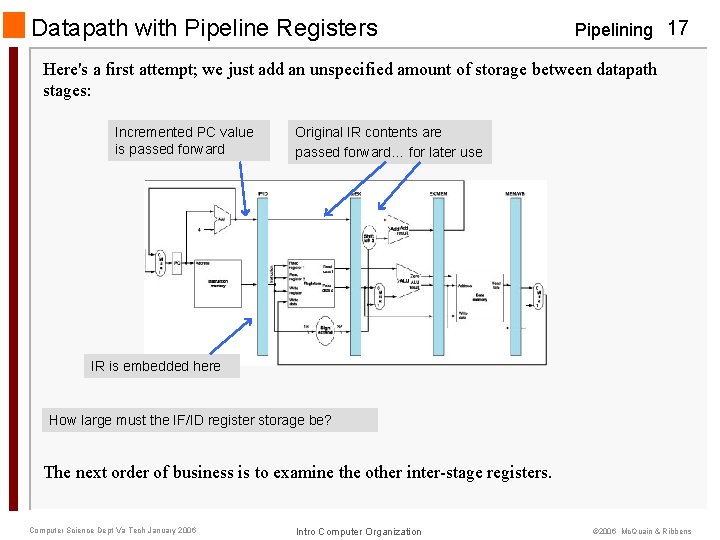
Datapath with Pipeline Registers Pipelining 17 Here's a first attempt; we just add an unspecified amount of storage between datapath stages: Incremented PC value is passed forward Original IR contents are passed forward… for later use IR is embedded here How large must the IF/ID register storage be? The next order of business is to examine the other inter-stage registers. Computer Science Dept Va Tech January 2006 Intro Computer Organization © 2006 Mc. Quain & Ribbens
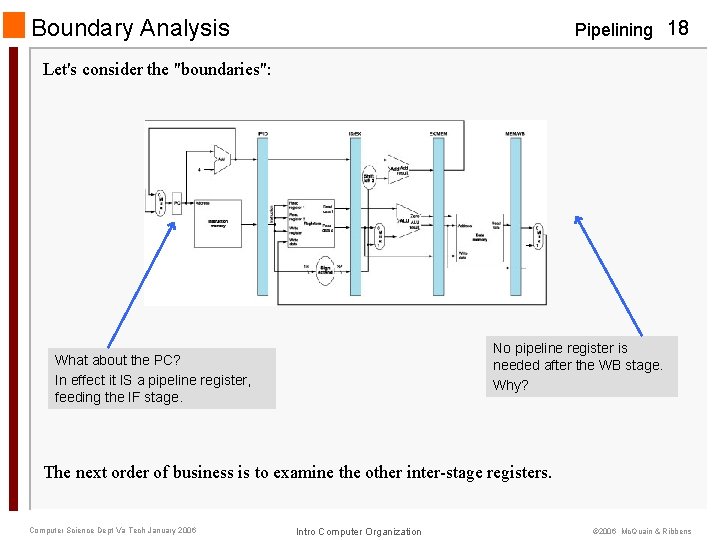
Boundary Analysis Pipelining 18 Let's consider the "boundaries": No pipeline register is needed after the WB stage. Why? What about the PC? In effect it IS a pipeline register, feeding the IF stage. The next order of business is to examine the other inter-stage registers. Computer Science Dept Va Tech January 2006 Intro Computer Organization © 2006 Mc. Quain & Ribbens
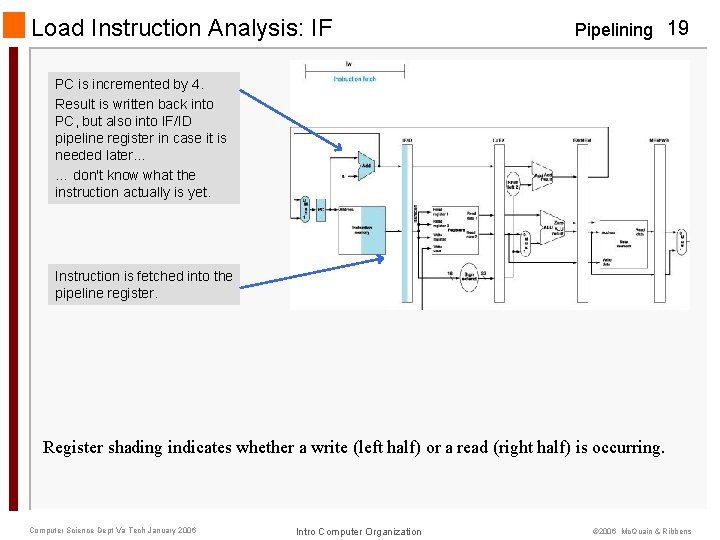
Load Instruction Analysis: IF Pipelining 19 PC is incremented by 4. Result is written back into PC, but also into IF/ID pipeline register in case it is needed later… … don't know what the instruction actually is yet. Instruction is fetched into the pipeline register. Register shading indicates whether a write (left half) or a read (right half) is occurring. Computer Science Dept Va Tech January 2006 Intro Computer Organization © 2006 Mc. Quain & Ribbens
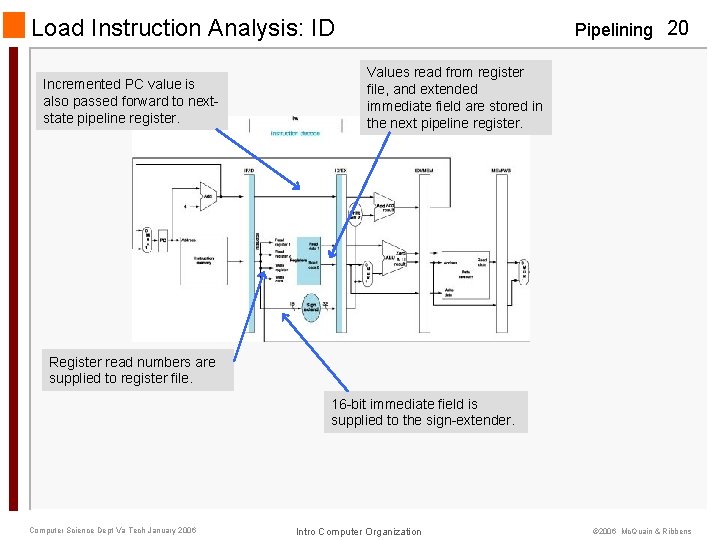
Load Instruction Analysis: ID Incremented PC value is also passed forward to nextstate pipeline register. Pipelining 20 Values read from register file, and extended immediate field are stored in the next pipeline register. Register read numbers are supplied to register file. 16 -bit immediate field is supplied to the sign-extender. Computer Science Dept Va Tech January 2006 Intro Computer Organization © 2006 Mc. Quain & Ribbens
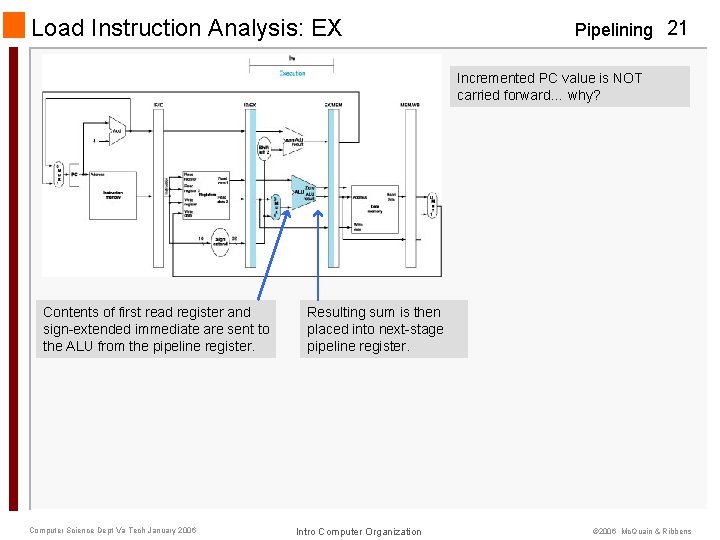
Load Instruction Analysis: EX Pipelining 21 Incremented PC value is NOT carried forward… why? Contents of first read register and sign-extended immediate are sent to the ALU from the pipeline register. Computer Science Dept Va Tech January 2006 Resulting sum is then placed into next-stage pipeline register. Intro Computer Organization © 2006 Mc. Quain & Ribbens
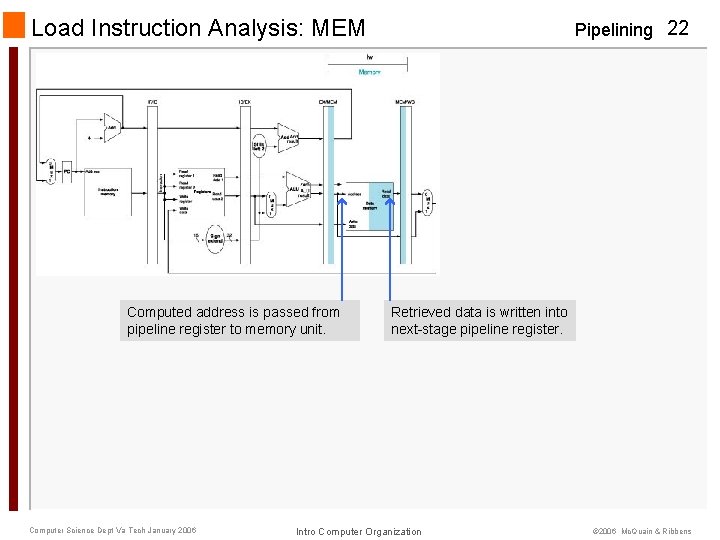
Load Instruction Analysis: MEM Computed address is passed from pipeline register to memory unit. Computer Science Dept Va Tech January 2006 Pipelining 22 Retrieved data is written into next-stage pipeline register. Intro Computer Organization © 2006 Mc. Quain & Ribbens
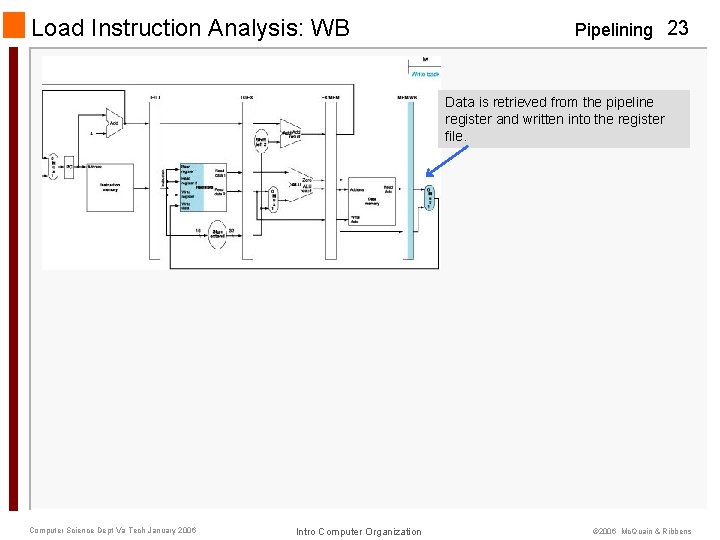
Load Instruction Analysis: WB Pipelining 23 Data is retrieved from the pipeline register and written into the register file. Computer Science Dept Va Tech January 2006 Intro Computer Organization © 2006 Mc. Quain & Ribbens
Load Instruction Analysis Pipelining 24 So, what have we learned? One key point: a logical component of the datapath, like the ALU, must be used only in a single pipeline stage… otherwise, we have a structural hazard. If you were paying very close attention, we've uncovered a bug in the proposed handling of a load instruction. Take another look at what happens in the final stage… where does the number of the write register come from? Alas, we will no longer have the original instruction in the IF/ID pipeline register, and so we won't have the information we need. Solution: pass the write register number forward to the MEM/WB pipeline register, so it is still available during the final stage. Computer Science Dept Va Tech January 2006 Intro Computer Organization © 2006 Mc. Quain & Ribbens
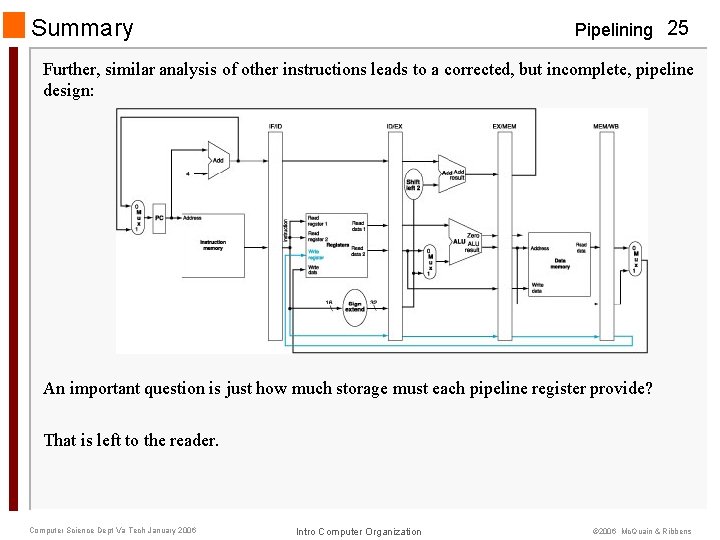
Summary Pipelining 25 Further, similar analysis of other instructions leads to a corrected, but incomplete, pipeline design: An important question is just how much storage must each pipeline register provide? That is left to the reader. Computer Science Dept Va Tech January 2006 Intro Computer Organization © 2006 Mc. Quain & Ribbens
Pipeline Control Pipelining 26 We have 5 stages. What needs to be controlled in each stage? - Instruction Fetch and PC Increment Instruction Decode / Register Fetch Execution Memory Stage Write Back How would control be handled in an automobile plant? - a fancy control center telling everyone what to do? - should we use a finite state machine? Computer Science Dept Va Tech January 2006 Intro Computer Organization © 2006 Mc. Quain & Ribbens
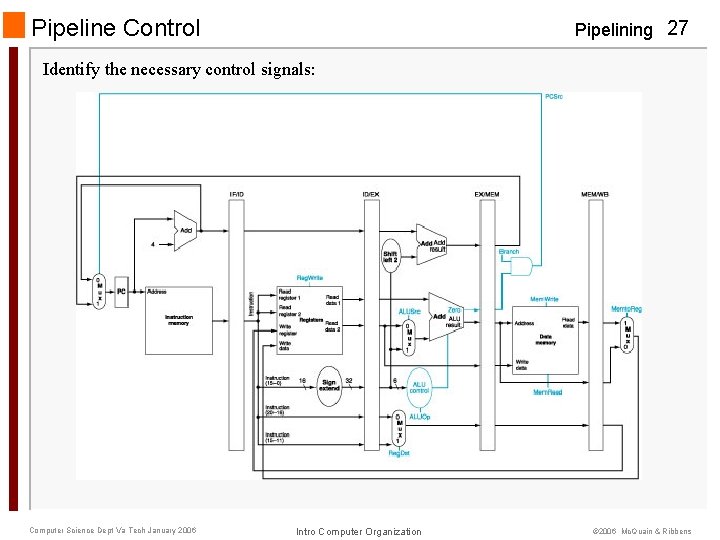
Pipeline Control Pipelining 27 Identify the necessary control signals: Computer Science Dept Va Tech January 2006 Intro Computer Organization © 2006 Mc. Quain & Ribbens
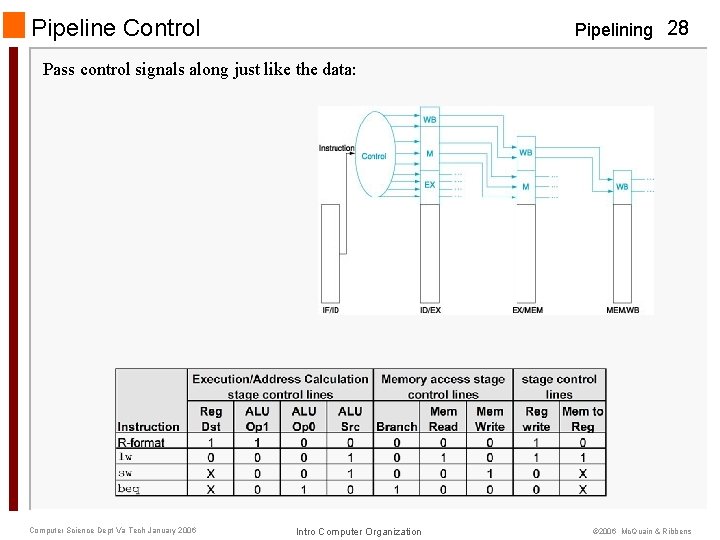
Pipeline Control Pipelining 28 Pass control signals along just like the data: Computer Science Dept Va Tech January 2006 Intro Computer Organization © 2006 Mc. Quain & Ribbens
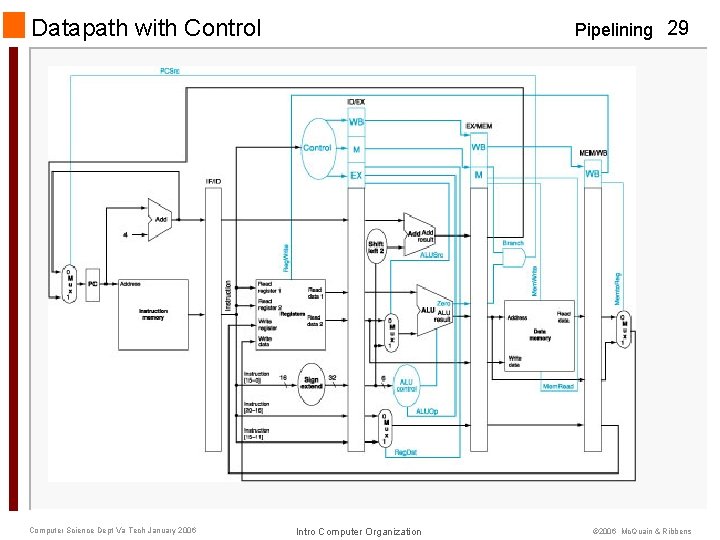
Datapath with Control Computer Science Dept Va Tech January 2006 Pipelining 29 Intro Computer Organization © 2006 Mc. Quain & Ribbens
- Slides: 29