
BASIC INSIGHTS OF FIBER TO FASHION WHAT IS
BASIC INSIGHTS OF FIBER TO FASHION
WHAT IS FIBER? Fiber is a hair-like strand of material. It is a substance that is very long in relation to its width, at least hundred times longer than its width. It is the smallest visible unit of a textile product. They are flexible and may be made into fabric. Natural fibers and manmade fibers are the two types of fibers.

Natural fibers Fibers obtained from plants and animals that can be spun into filament, thread or rope are termed as Natural fibers. They may be woven, knitted, matted or bonded. Example- seed fibre, leaf fibre, fruit fibre, bast fibre, step fibre, animal fibre, etc. Man-made fibers Fibers whose chemical composition, structure, properties, are modified during the manufacturing process are called man-made fibers. They are spun and woven into a huge number of consumer and industrial products, including garments, home furnishings, drive belts, etc. Example- nylon, polyester, chiffon, rayon, plastic etc.
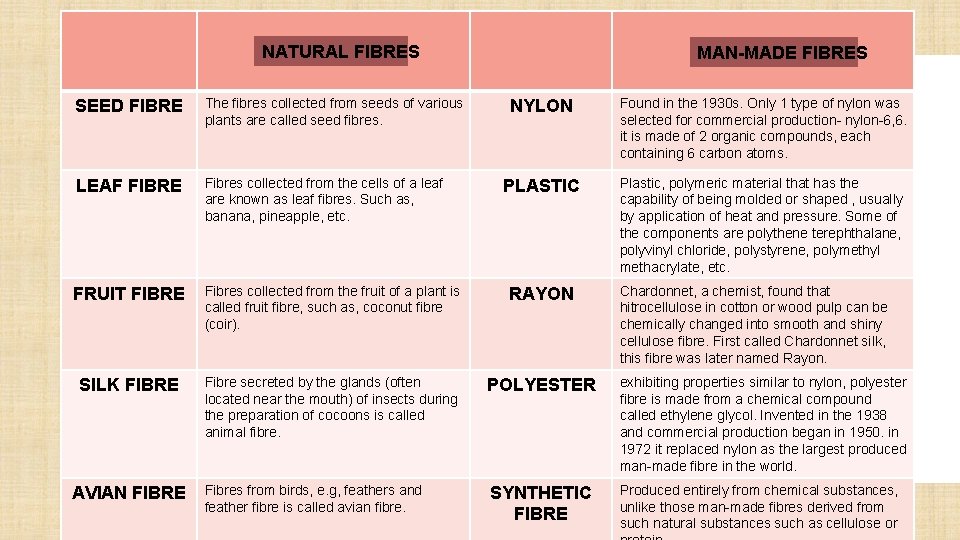
NATURAL FIBRES MAN-MADE FIBRES SEED FIBRE The fibres collected from seeds of various plants are called seed fibres. LEAF FIBRE Fibres collected from the cells of a leaf are known as leaf fibres. Such as, banana, pineapple, etc. FRUIT FIBRE Fibres collected from the fruit of a plant is called fruit fibre, such as, coconut fibre (coir). RAYON SILK FIBRE Fibre secreted by the glands (often located near the mouth) of insects during the preparation of cocoons is called animal fibre. POLYESTER exhibiting properties similar to nylon, polyester fibre is made from a chemical compound called ethylene glycol. Invented in the 1938 and commercial production began in 1950. in 1972 it replaced nylon as the largest produced man-made fibre in the world. Fibres from birds, e. g, feathers and feather fibre is called avian fibre. SYNTHETIC FIBRE Produced entirely from chemical substances, unlike those man-made fibres derived from such natural substances such as cellulose or AVIAN FIBRE NYLON Found in the 1930 s. Only 1 type of nylon was selected for commercial production- nylon-6, 6. it is made of 2 organic compounds, each containing 6 carbon atoms. PLASTIC Plastic, polymeric material that has the capability of being molded or shaped , usually by application of heat and pressure. Some of the components are polythene terephthalane, polyvinyl chloride, polystyrene, polymethyl methacrylate, etc. Chardonnet, a chemist, found that hitrocellulose in cotton or wood pulp can be chemically changed into smooth and shiny cellulose fibre. First called Chardonnet silk, this fibre was later named Rayon.
- Slides: 4