
Basic Inorganic Chemistry For B Tech B Sc

Basic Inorganic Chemistry For B. Tech & B. Sc I yr Organometallic Chemistry ( 4 lectures) The 18 electron rule, Metal Carbonyls and sandwich compounds, Unique reactions of organometallics and their use in explaining homogeneous catalysis Prepared by Prof. Anil J. Elias, IIT Delhi
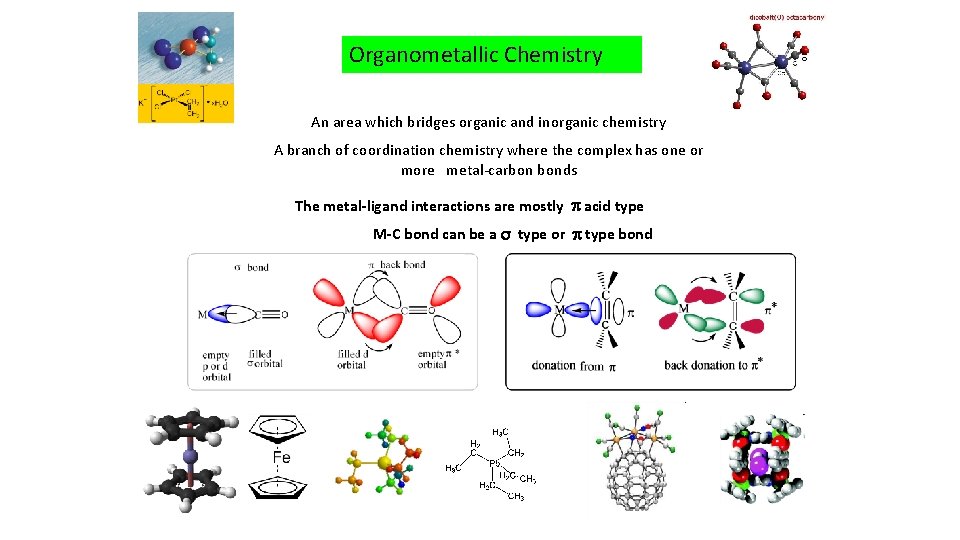
Organometallic Chemistry An area which bridges organic and inorganic chemistry A branch of coordination chemistry where the complex has one or more metal carbon bonds The metal-ligand interactions are mostly acid type M-C bond can be a type or type bond
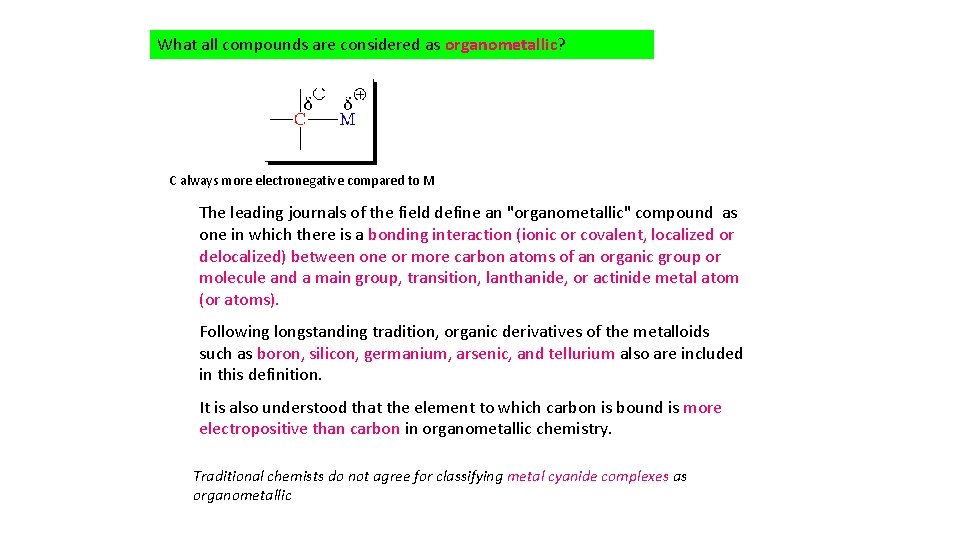
What all compounds are considered as organometallic? C always more electronegative compared to M The leading journals of the field define an "organometallic" compound as one in which there is a bonding interaction (ionic or covalent, localized or delocalized) between one or more carbon atoms of an organic group or molecule and a main group, transition, lanthanide, or actinide metal atom (or atoms). Following longstanding tradition, organic derivatives of the metalloids such as boron, silicon, germanium, arsenic, and tellurium also are included in this definition. It is also understood that the element to which carbon is bound is more electropositive than carbon in organometallic chemistry. Traditional chemists do not agree for classifying metal cyanide complexes as organometallic

Zeise’s Salt The first transition metal organometallic compound Discovery 1827 W C Zeise, Danish pharmacist, I 789 - I 847 Also father of the chemistry of mercaptans R-SH Structure ~ 150 years later ‘The breakthrough, the isolation of a pure, crystalline compound came when Zeise added potassium chloride to a concentrated Pt. Cl 4 /ethyl alcohol reaction solution and evaporated the resulting solution. Beautiful lemon yellow crystals, often one half inch or more in length were isolated. On longer exposure to air and light, they gradually became covered with a black crust. They contained water of hydration, which was lost when they were kept over concentrated sulfuric acid in vacuo or when heated to around 100°C. Chemists in those days often reported how the compounds that they had prepared tasted. Zeise described the taste of this potassium salt as metallic, astringent and long lasting. ’ Dietmar Seyferth, Organometallics, 2001, 20, 2
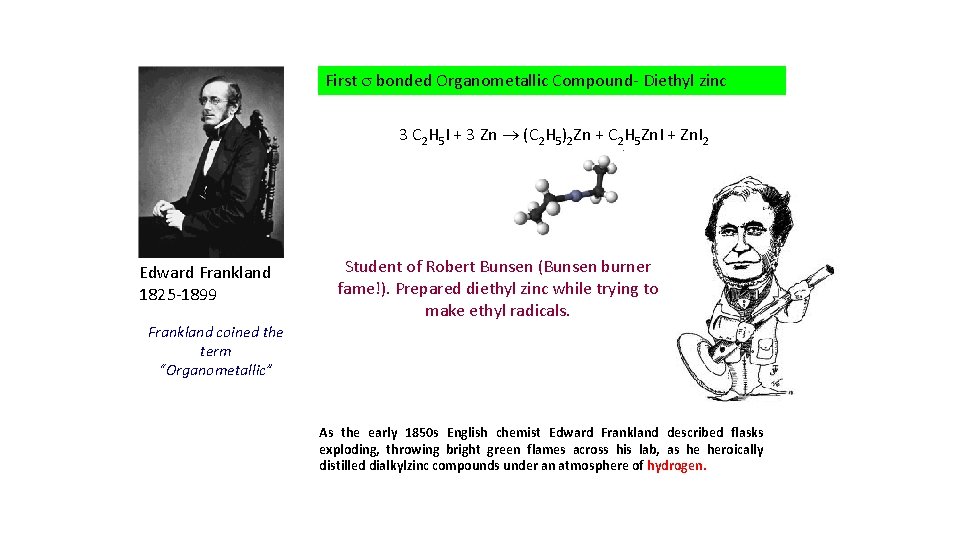
First bonded Organometallic Compound Diethyl zinc 3 C 2 H 5 I + 3 Zn (C 2 H 5)2 Zn + C 2 H 5 Zn. I + Zn. I 2 Edward Frankland 1825 1899 Student of Robert Bunsen (Bunsen burner fame!). Prepared diethyl zinc while trying to make ethyl radicals. Frankland coined the term “Organometallic” As the early 1850 s English chemist Edward Frankland described flasks exploding, throwing bright green flames across his lab, as he heroically distilled dialkylzinc compounds under an atmosphere of hydrogen.

Metal carbonyls Ludwig Mond 1839 1909 Father of Metal Carbonyl Chemistry Founder of Imperial Chemical Industry, England ‘Mond nickel company’ was making over 3000 tons of nickel in 1910 with a purity level of 99. 9% 1890 1930 textbooks Mo(CO)6

The Grignard Reagent He was the student of Philippe Barbier (Barbier reaction [Zn]) He discovered the Grignard reaction [Mg]) in 1900. He became a professor at the University of Nancy in 1910 and was awarded the Nobel Prize in Chemistry in 1912. François Auguste Victor Grignard 1871 1935

Hapto ligands and Sandwich compounds The hapto symbol, , with a numerical superscript, provides a topological description by indicating the number of carbon atoms at a bonding distance to the metal Sandwich ( 6 C 6 H 6)2 Cr ( 5 C 5 H 5)2 Fe Bent Sandwich Half Sandwich Triple decker & polycyclic
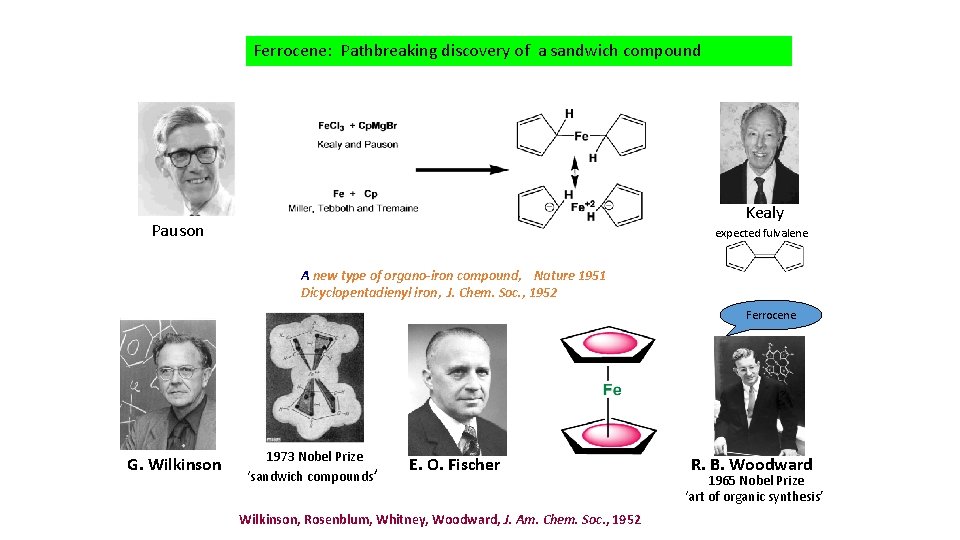
Ferrocene: Pathbreaking discovery of a sandwich compound Kealy Pauson expected fulvalene A new type of organo-iron compound, Nature 1951 Dicyclopentadienyl iron, J. Chem. Soc. , 1952 Ferrocene G. Wilkinson 1973 Nobel Prize ‘sandwich compounds’ E. O. Fischer Wilkinson, Rosenblum, Whitney, Woodward, J. Am. Chem. Soc. , 1952 R. B. Woodward 1965 Nobel Prize ‘art of organic synthesis’
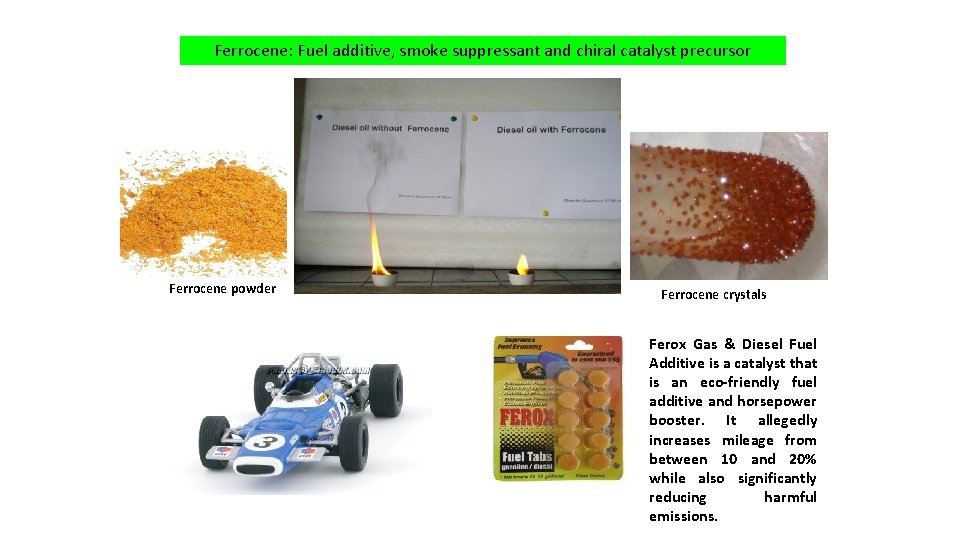
Ferrocene: Fuel additive, smoke suppressant and chiral catalyst precursor Ferrocene powder Ferrocene crystals Ferox Gas & Diesel Fuel Additive is a catalyst that is an eco-friendly fuel additive and horsepower booster. It allegedly increases mileage from between 10 and 20% while also significantly reducing harmful emissions.
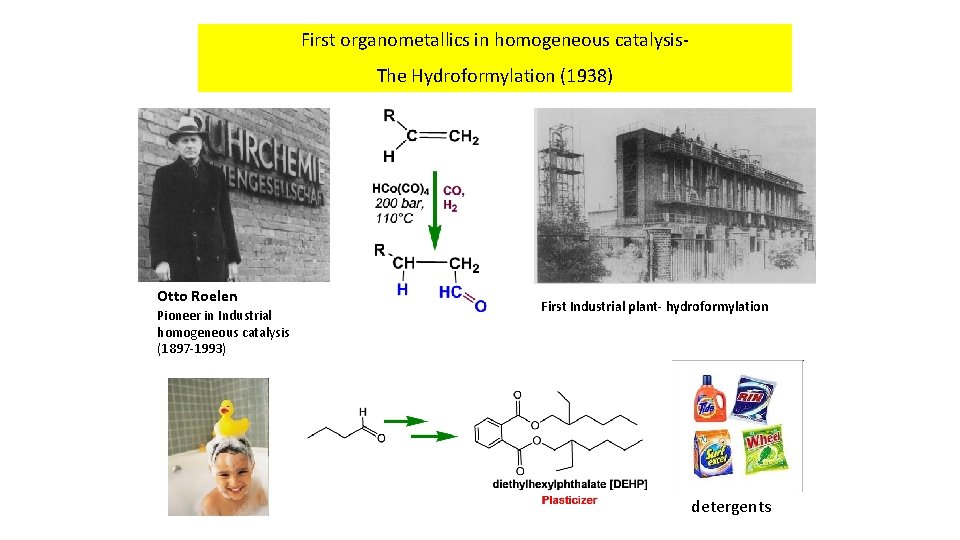
First organometallics in homogeneous catalysis The Hydroformylation (1938) Otto Roelen Pioneer in Industrial homogeneous catalysis (1897 1993) First Industrial plant- hydroformylation detergents
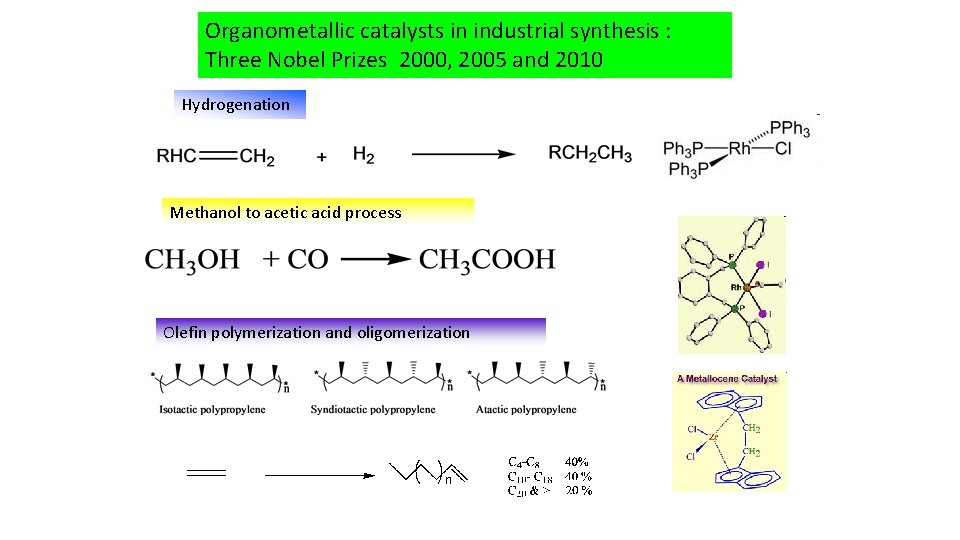
Organometallic catalysts in industrial synthesis : Three Nobel Prizes 2000, 2005 and 2010 Hydrogenation Methanol to acetic acid process Olefin polymerization and oligomerization
18 electron rule : How to count electrons The rule states that thermodynamically stable transition metal organometallic compounds are formed when the sum of the metal d electrons and the electrons conventionally considered as being supplied by the surrounding ligands equals 18. In general, the conditions favouring adherence to the 18 electron rule are, an electron rich metal (one that is in a low oxidation state) and ligands that are good acceptors The hapto symbol, , with a numerical superscript, provides a topological description by indicating the connectivity between the ligand the central atom. For example, if all the five carbon atoms of a cyclopentadienyl moiety are equidistant from a metal atom, we term it as 5 cyclopentadienyl Examples: 1 R, 1 Ar 2 C 2 R 4 1 allyl, 3 allyl, 4 Cb, 5 Cp, 6 C 6 H 6 8 C 8 H 8 2 C 60, 5 R 5 C 60. The symbol indicates bridging normally we have 2 and rarely 3 bridging Examples: 2 CO, 3 CO, 2 CH 3, 2 H, 2 Cl, , 3 Cl, 2 OR, 2 PR 2, 2 NR 2
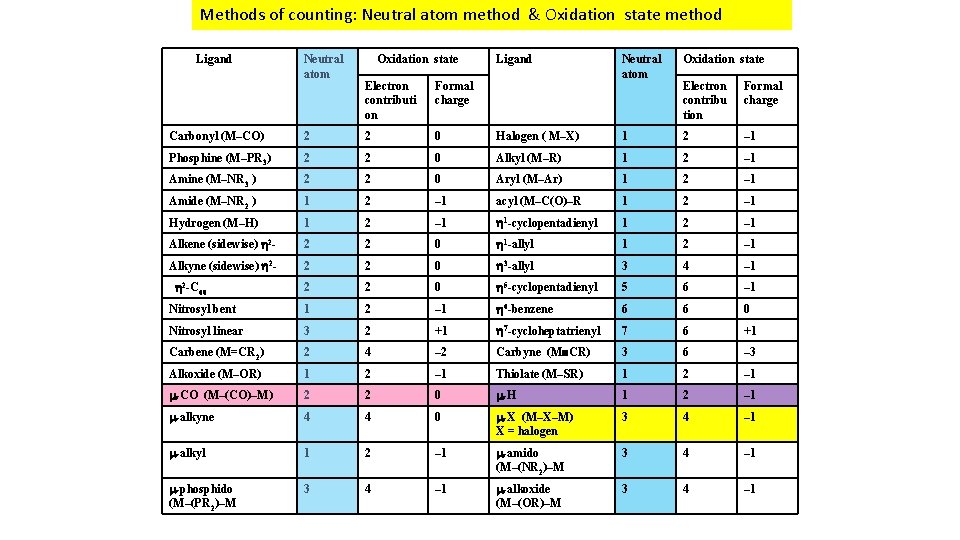
Methods of counting: Neutral atom method & Oxidation state method Ligand Neutral atom Oxidation state Electron contributi on Formal charge Ligand Neutral atom Oxidation state Electron contribu tion Formal charge Carbonyl (M–CO) 2 2 0 Halogen ( M–X) 1 2 – 1 Phosphine (M–PR 3) 2 2 0 Alkyl (M–R) 1 2 – 1 Amine (M–NR 3 ) 2 2 0 Aryl (M–Ar) 1 2 – 1 Amide (M–NR 2 ) 1 2 – 1 acyl (M–C(O)–R 1 2 – 1 Hydrogen (M–H) 1 2 – 1 1 -cyclopentadienyl 1 2 – 1 Alkene (sidewise) 2 - 2 2 0 1 -allyl 1 2 – 1 Alkyne (sidewise) 2 - 2 2 0 3 -allyl 3 4 – 1 2 2 0 5 -cyclopentadienyl 5 6 – 1 Nitrosyl bent 1 2 – 1 6 -benzene 6 6 0 Nitrosyl linear 3 2 +1 7 -cycloheptatrienyl 7 6 +1 Carbene (M=CR 2) 2 4 – 2 Carbyne (M CR) 3 6 – 3 Alkoxide (M–OR) 1 2 – 1 Thiolate (M–SR) 1 2 – 1 -CO (M–(CO)–M) 2 2 0 -H 1 2 – 1 -alkyne 4 4 0 -X (M–X–M) X = halogen 3 4 – 1 -alkyl 1 2 – 1 -amido (M–(NR 2)–M 3 4 – 1 -phosphido (M–(PR 2)–M 3 4 – 1 -alkoxide (M–(OR)–M 3 4 – 1 2 -C 60
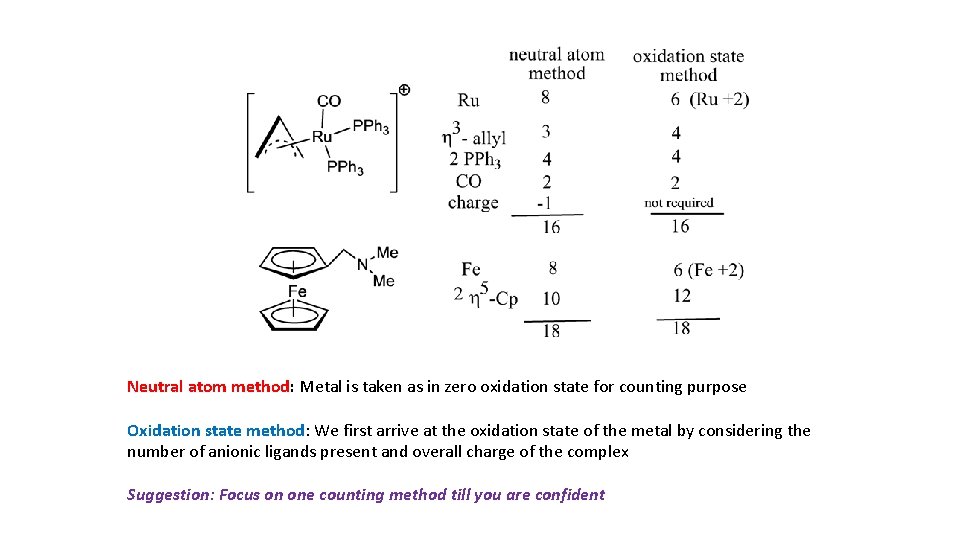
Neutral atom method: Metal is taken as in zero oxidation state for counting purpose Oxidation state method: We first arrive at the oxidation state of the metal by considering the number of anionic ligands present and overall charge of the complex Suggestion: Focus on one counting method till you are confident
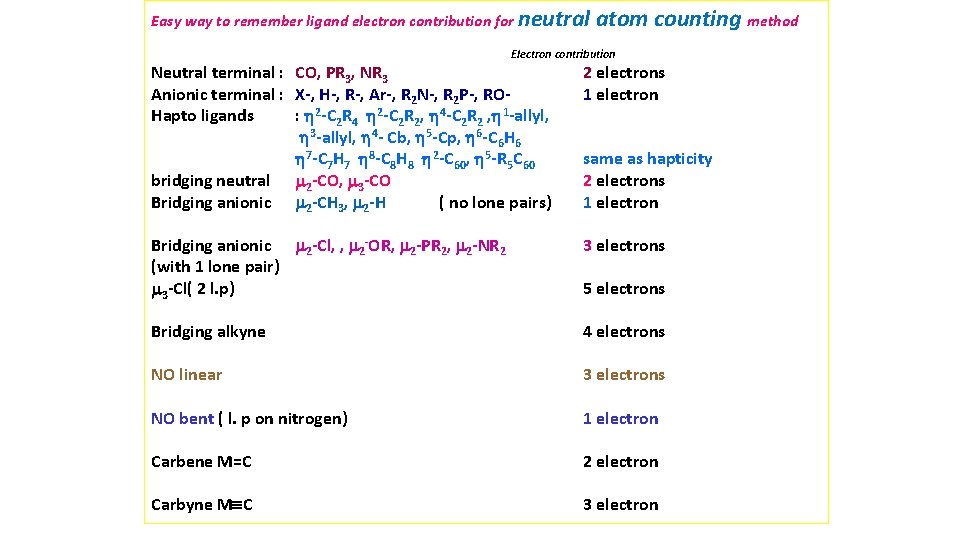
Easy way to remember ligand electron contribution for neutral atom counting method Electron contribution Neutral terminal : CO, PR 3, NR 3 Anionic terminal : X-, H-, R-, Ar-, R 2 N-, R 2 P-, ROHapto ligands : 2 -C 2 R 4 2 -C 2 R 2, 4 -C 2 R 2 , 1 -allyl, 3 -allyl, 4 - Cb, 5 -Cp, 6 -C 6 H 6 7 -C 7 H 7 8 -C 8 H 8 2 -C 60, 5 -R 5 C 60 bridging neutral 2 -CO, 3 -CO Bridging anionic 2 -CH 3, 2 -H ( no lone pairs) 2 electrons 1 electron Bridging anionic 2 -Cl, , 2 -OR, 2 -PR 2, 2 -NR 2 (with 1 lone pair) 3 -Cl( 2 l. p) 3 electrons Bridging alkyne 4 electrons NO linear 3 electrons NO bent ( l. p on nitrogen) 1 electron Carbene M=C 2 electron Carbyne M C 3 electron same as hapticity 2 electrons 1 electron 5 electrons
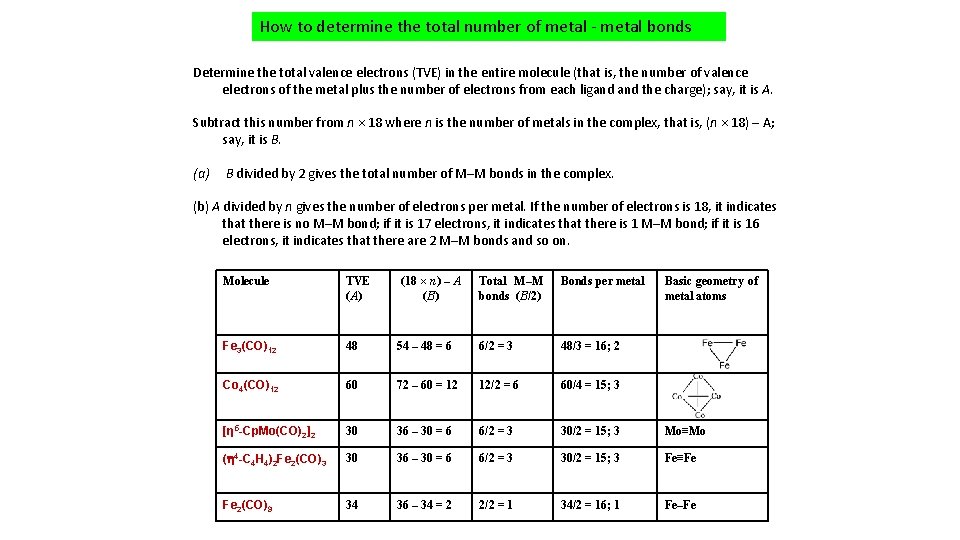
How to determine the total number of metal bonds Determine the total valence electrons (TVE) in the entire molecule (that is, the number of valence electrons of the metal plus the number of electrons from each ligand the charge); say, it is A. Subtract this number from n × 18 where n is the number of metals in the complex, that is, (n × 18) – A; say, it is B. (a) B divided by 2 gives the total number of M–M bonds in the complex. (b) A divided by n gives the number of electrons per metal. If the number of electrons is 18, it indicates that there is no M–M bond; if it is 17 electrons, it indicates that there is 1 M–M bond; if it is 16 electrons, it indicates that there are 2 M–M bonds and so on. Molecule TVE (A) Fe 3(CO)12 48 Co 4(CO)12 (18 × n) – A (B) Total M–M bonds (B/2) Bonds per metal Basic geometry of metal atoms 54 – 48 = 6 6/2 = 3 48/3 = 16; 2 60 72 – 60 = 12 12/2 = 6 60/4 = 15; 3 [η 5 -Cp. Mo(CO)2]2 30 36 – 30 = 6 6/2 = 3 30/2 = 15; 3 Mo≡Mo ( 4 -C 4 H 4)2 Fe 2(CO)3 30 36 – 30 = 6 6/2 = 3 30/2 = 15; 3 Fe≡Fe Fe 2(CO)9 34 36 – 34 = 2 2/2 = 1 34/2 = 16; 1 Fe–Fe
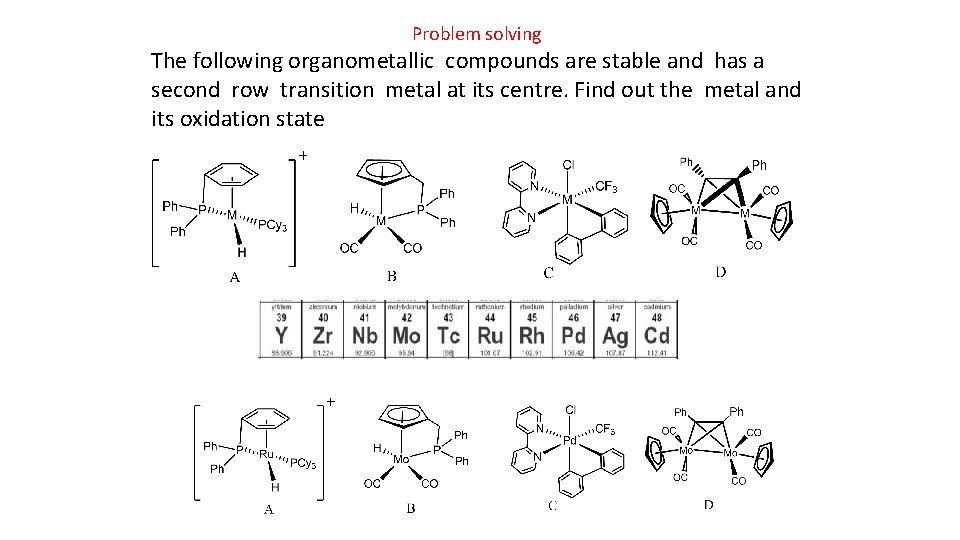
Problem solving The following organometallic compounds are stable and has a second row transition metal at its centre. Find out the metal and its oxidation state
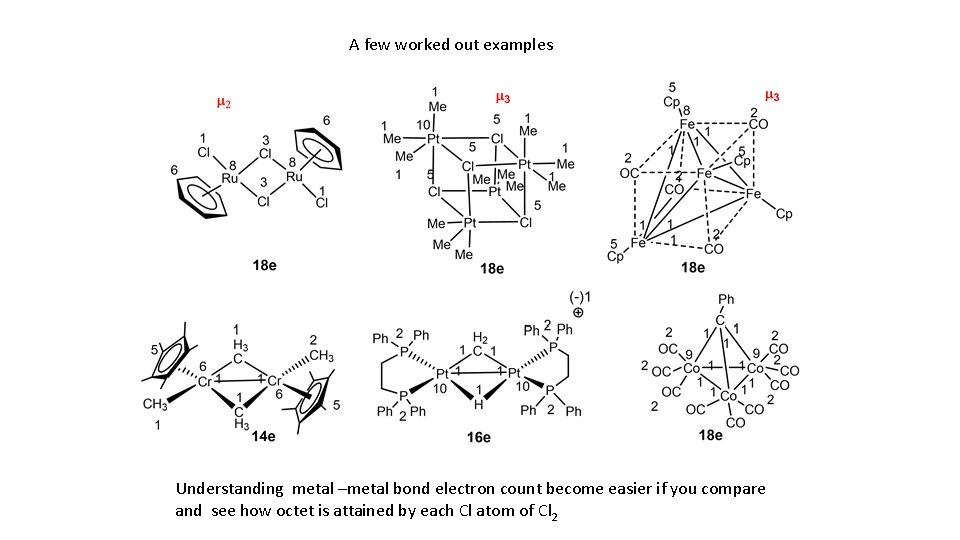
A few worked out examples Understanding metal –metal bond electron count become easier if you compare and see how octet is attained by each Cl atom of Cl 2
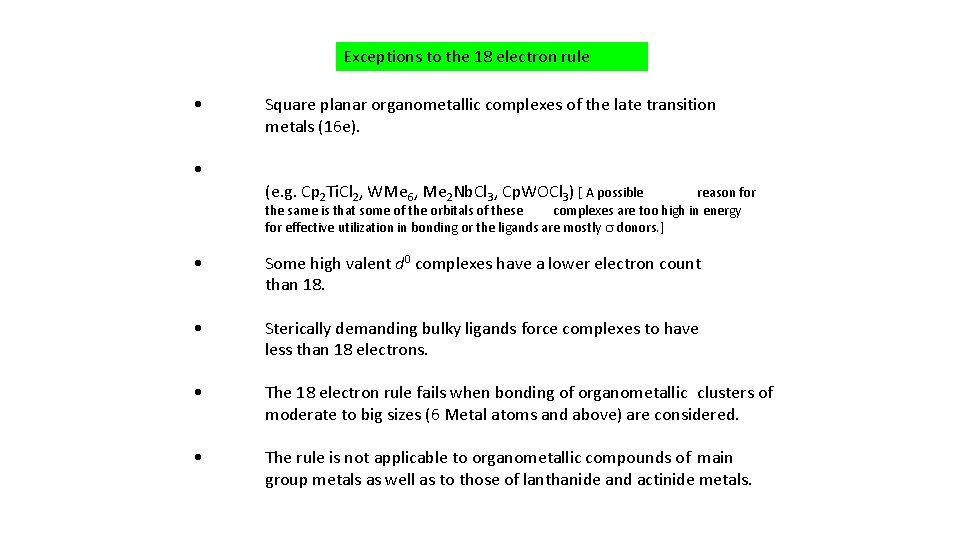
Exceptions to the 18 electron rule • • Square planar organometallic complexes of the late transition metals (16 e). (e. g. Cp 2 Ti. Cl 2, WMe 6, Me 2 Nb. Cl 3, Cp. WOCl 3) [ A possible reason for the same is that some of the orbitals of these complexes are too high in energy for effective utilization in bonding or the ligands are mostly donors. ] • Some high valent d 0 complexes have a lower electron count than 18. • Sterically demanding bulky ligands force complexes to have less than 18 electrons. • The 18 electron rule fails when bonding of organometallic clusters of moderate to big sizes (6 Metal atoms and above) are considered. • The rule is not applicable to organometallic compounds of main group metals as well as to those of lanthanide and actinide metals.
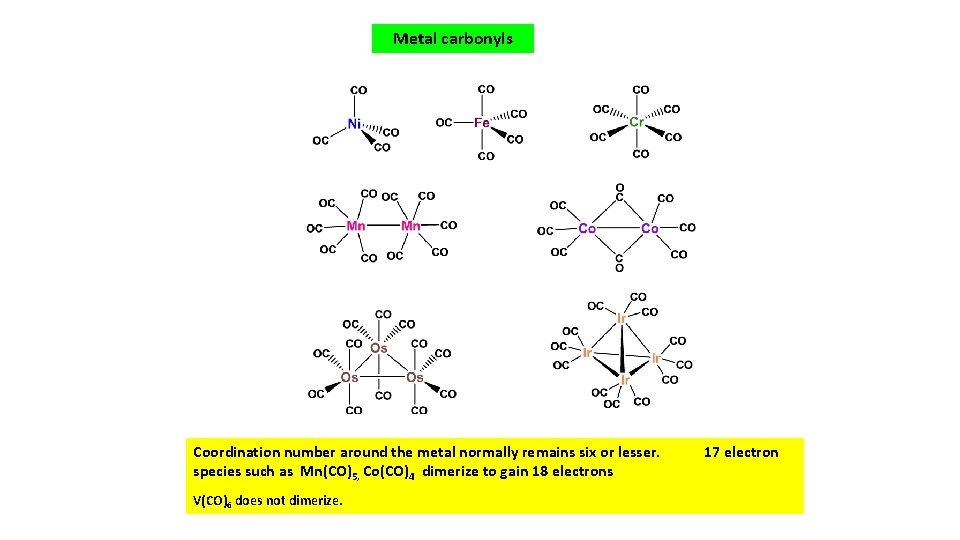
Metal carbonyls Coordination number around the metal normally remains six or lesser. 17 electron species such as Mn(CO)5, Co(CO)4 dimerize to gain 18 electrons V(CO)6 does not dimerize.
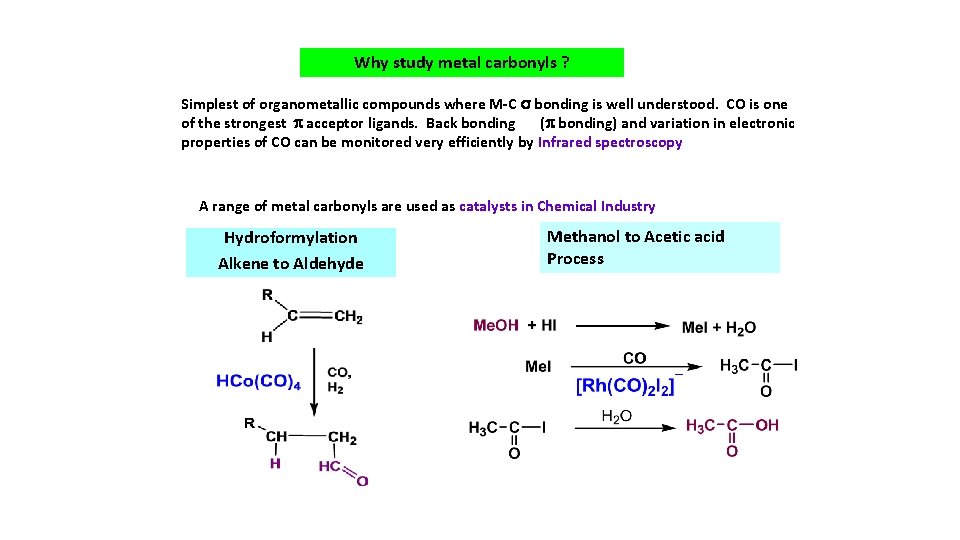
Why study metal carbonyls ? Simplest of organometallic compounds where M-C bonding is well understood. CO is one of the strongest acceptor ligands. Back bonding ( bonding) and variation in electronic properties of CO can be monitored very efficiently by Infrared spectroscopy A range of metal carbonyls are used as catalysts in Chemical Industry Hydroformylation Alkene to Aldehyde Methanol to Acetic acid Process

Molecular Orbital diagram of CO Why does CO bind a metal through its less electronegative carbon atom than its more electronegative oxygen ? What makes it a good acceptor ? The highest occupied molecular orbital (HOMO) of CO is weakly antibonding (compared with the O atomic orbitals) and is an MO which is carbon based. Secondly, the * antibonding orbital which is the lowest unoccupied molecular orbital (LUMO) is also of comparatively lower energy which makes it possible to interact with metal t 2 g orbitals for bonding. There exists a strong back bonding of metal electrons to the * antibonding orbitals of CO
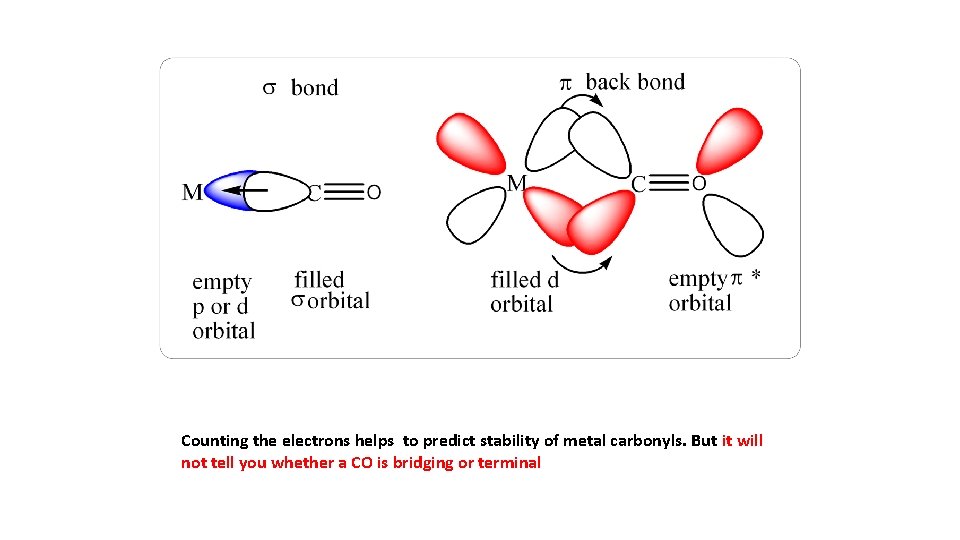
Counting the electrons helps to predict stability of metal carbonyls. But it will not tell you whether a CO is bridging or terminal
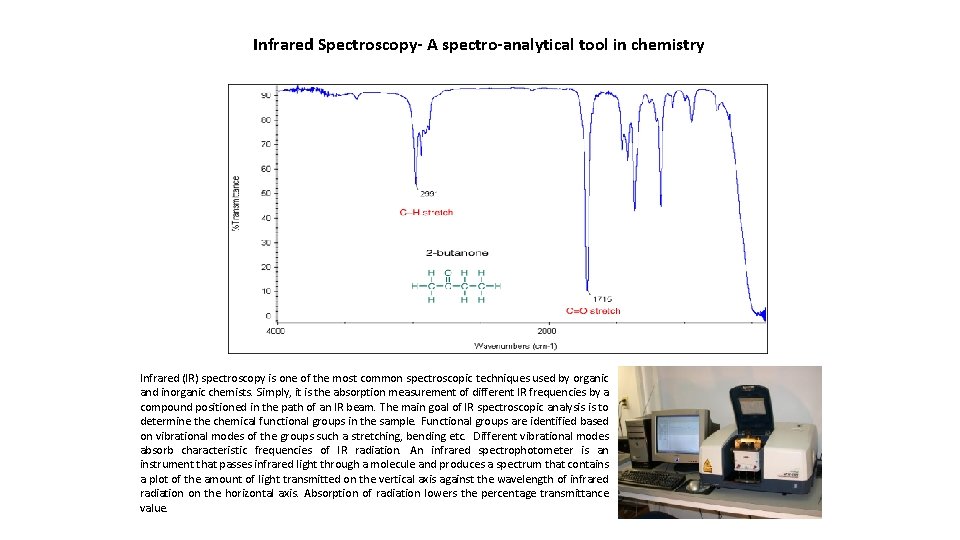
Infrared Spectroscopy- A spectro-analytical tool in chemistry Infrared (IR) spectroscopy is one of the most common spectroscopic techniques used by organic and inorganic chemists. Simply, it is the absorption measurement of different IR frequencies by a compound positioned in the path of an IR beam. The main goal of IR spectroscopic analysis is to determine the chemical functional groups in the sample. Functional groups are identified based on vibrational modes of the groups such a stretching, bending etc. Different vibrational modes absorb characteristic frequencies of IR radiation. An infrared spectrophotometer is an instrument that passes infrared light through a molecule and produces a spectrum that contains a plot of the amount of light transmitted on the vertical axis against the wavelength of infrared radiation on the horizontal axis. Absorption of radiation lowers the percentage transmittance value.
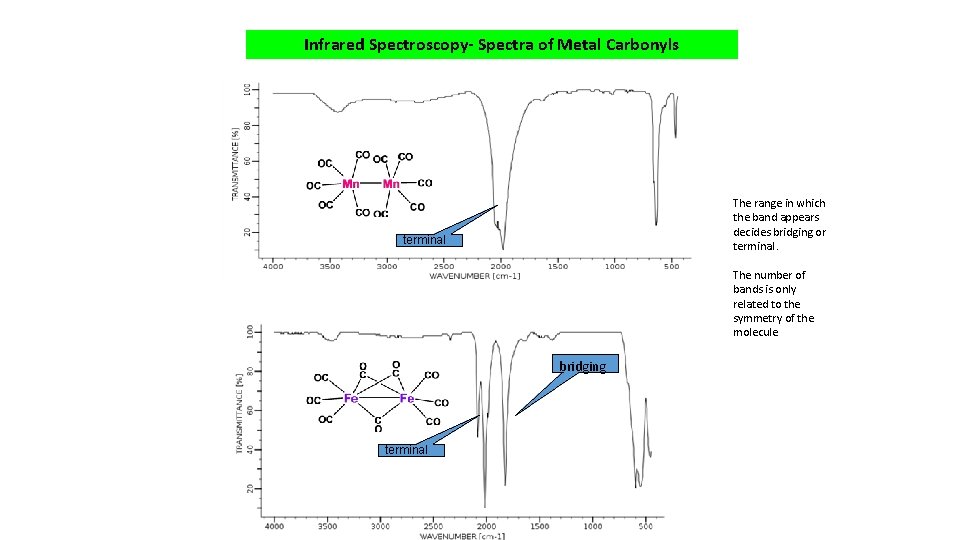
Infrared Spectroscopy- Spectra of Metal Carbonyls The range in which the band appears decides bridging or terminal The number of bands is only related to the symmetry of the molecule bridging terminal
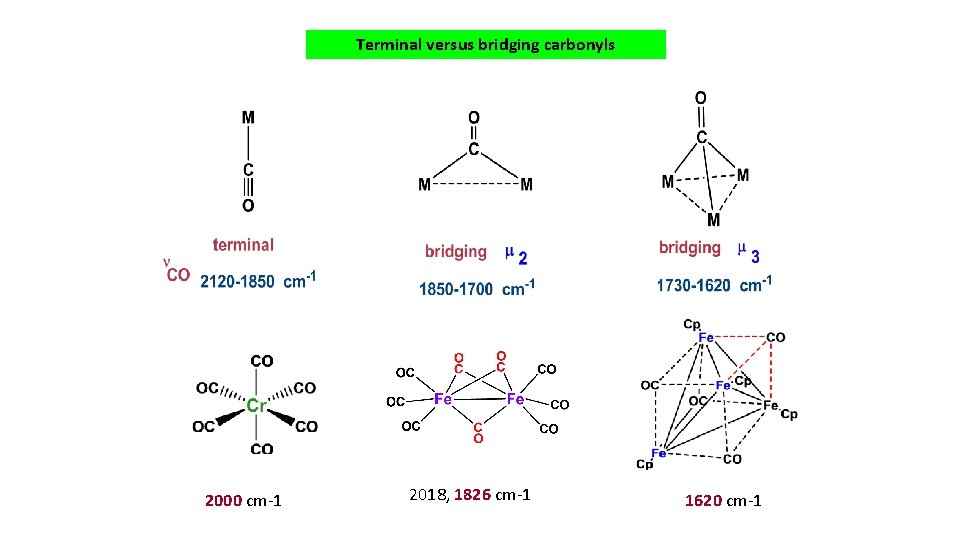
Terminal versus bridging carbonyls 2000 cm 1 2018, 1826 cm 1 1620 cm 1
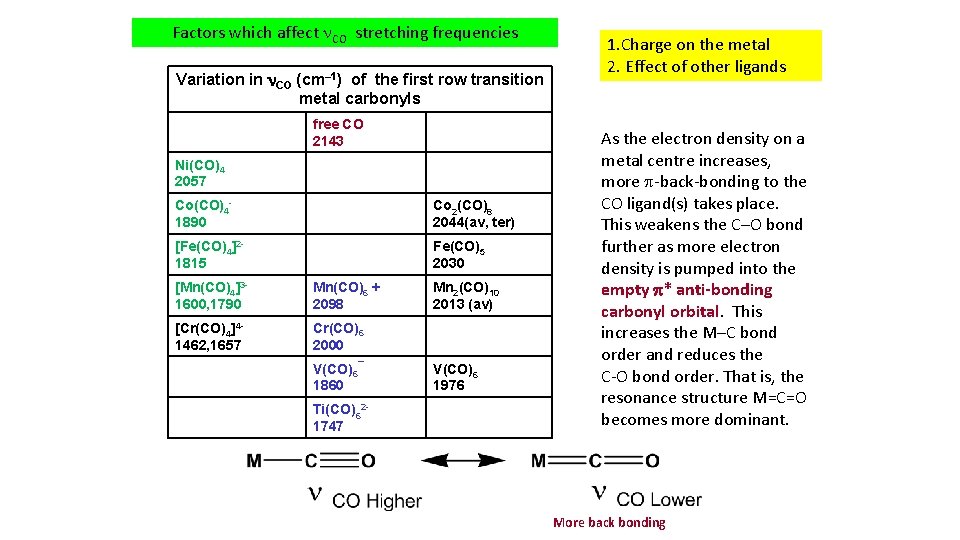
Factors which affect CO stretching frequencies Variation in CO (cm– 1) of the first row transition metal carbonyls free CO 2143 Ni(CO)4 2057 Co(CO)41890 Co 2(CO)8 2044(av, ter) [Fe(CO)4]21815 Fe(CO)5 2030 [Mn(CO)4]31600, 1790 Mn(CO)6 + 2098 [Cr(CO)4]41462, 1657 Cr(CO)6 2000 V(CO)6¯ 1860 Ti(CO)621747 Mn 2(CO)10 2013 (av) V(CO)6 1976 1. Charge on the metal 2. Effect of other ligands As the electron density on a metal centre increases, more back bonding to the CO ligand(s) takes place. This weakens the C–O bond further as more electron density is pumped into the empty * anti-bonding carbonyl orbital. This increases the M–C bond order and reduces the C O bond order. That is, the resonance structure M=C=O becomes more dominant. More back bonding
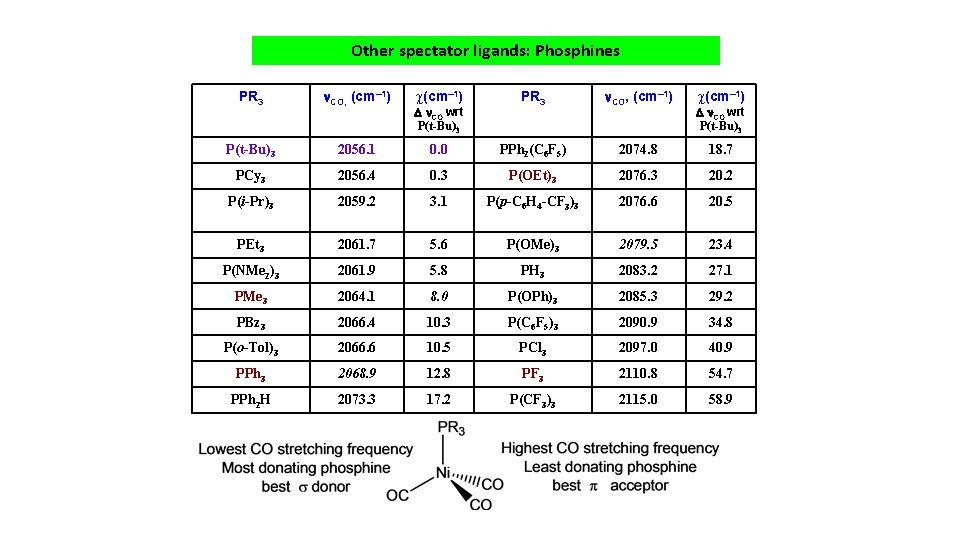
Other spectator ligands: Phosphines c(cm– 1) PR 3 CO, (cm– 1) 2056. 1 0. 0 PPh 2(C 6 F 5) 2074. 8 18. 7 PCy 3 2056. 4 0. 3 P(OEt)3 2076. 3 20. 2 P(i-Pr)3 2059. 2 3. 1 P(p-C 6 H 4 -CF 3)3 2076. 6 20. 5 PEt 3 2061. 7 5. 6 P(OMe)3 2079. 5 23. 4 P(NMe 2)3 2061. 9 5. 8 PH 3 2083. 2 27. 1 PMe 3 2064. 1 8. 0 P(OPh)3 2085. 3 29. 2 PBz 3 2066. 4 10. 3 P(C 6 F 5)3 2090. 9 34. 8 P(o-Tol)3 2066. 6 10. 5 PCl 3 2097. 0 40. 9 PPh 3 2068. 9 12. 8 PF 3 2110. 8 54. 7 PPh 2 H 2073. 3 17. 2 P(CF 3)3 2115. 0 58. 9 PR 3 CO, (cm– 1) P(t-Bu)3 CO wrt P(t-Bu)3 c(cm– 1) CO wrt P(t-Bu)3
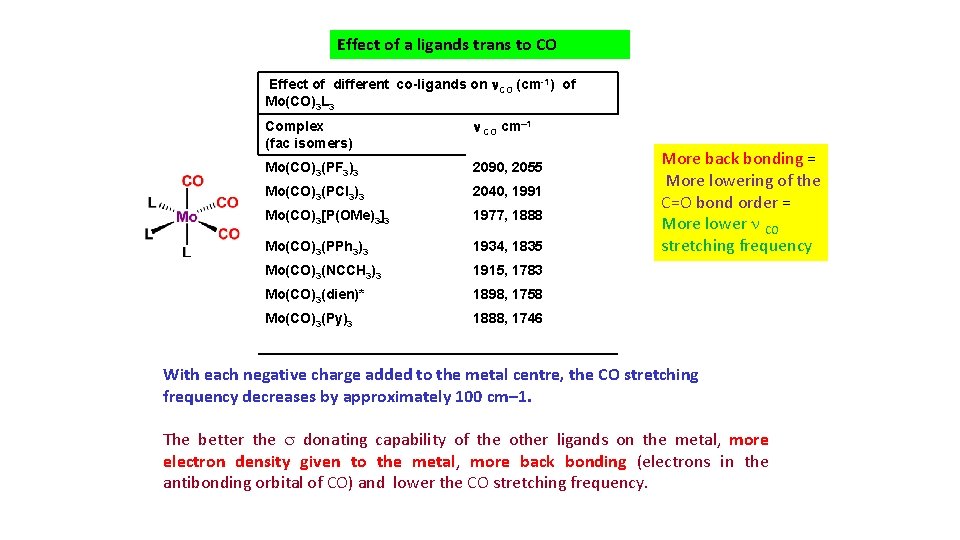
Effect of a ligands trans to CO Effect of different co-ligands on CO (cm-1) of Mo(CO)3 L 3 Complex (fac isomers) CO cm– 1 Mo(CO)3(PF 3)3 2090, 2055 Mo(CO)3(PCl 3)3 2040, 1991 Mo(CO)3[P(OMe)3]3 1977, 1888 Mo(CO)3(PPh 3)3 1934, 1835 Mo(CO)3(NCCH 3)3 1915, 1783 Mo(CO)3(dien)* 1898, 1758 Mo(CO)3(Py)3 1888, 1746 More back bonding = More lowering of the C=O bond order = More lower CO stretching frequency With each negative charge added to the metal centre, the CO stretching frequency decreases by approximately 100 cm– 1. The better the donating capability of the other ligands on the metal, more electron density given to the metal, more back bonding (electrons in the antibonding orbital of CO) and lower the CO stretching frequency.
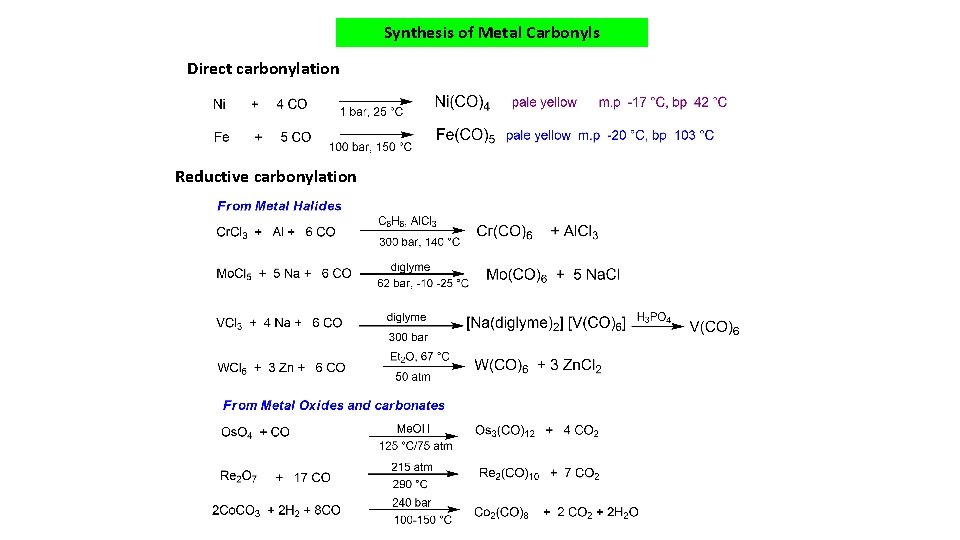
Synthesis of Metal Carbonyls Direct carbonylation Reductive carbonylation
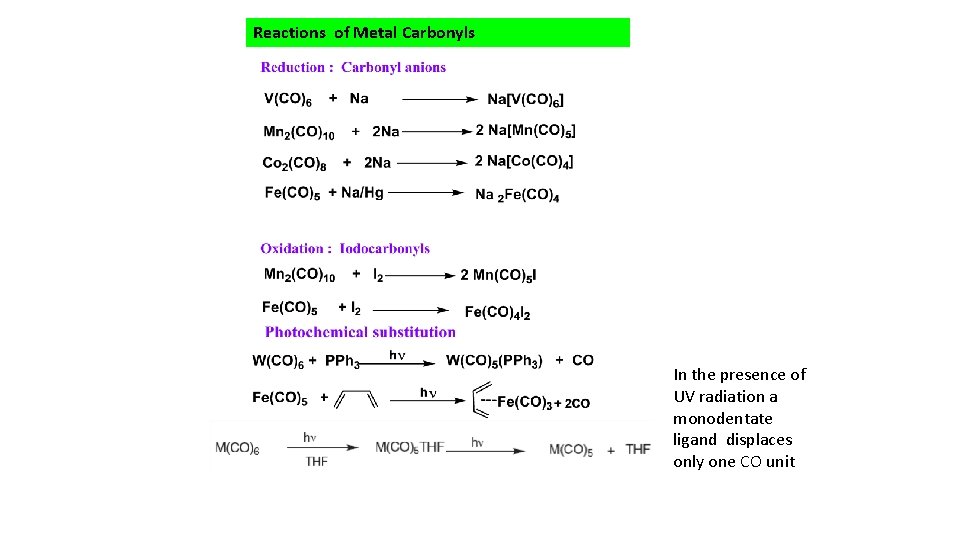
Reactions of Metal Carbonyls In the presence of UV radiation a monodentate ligand displaces only one CO unit
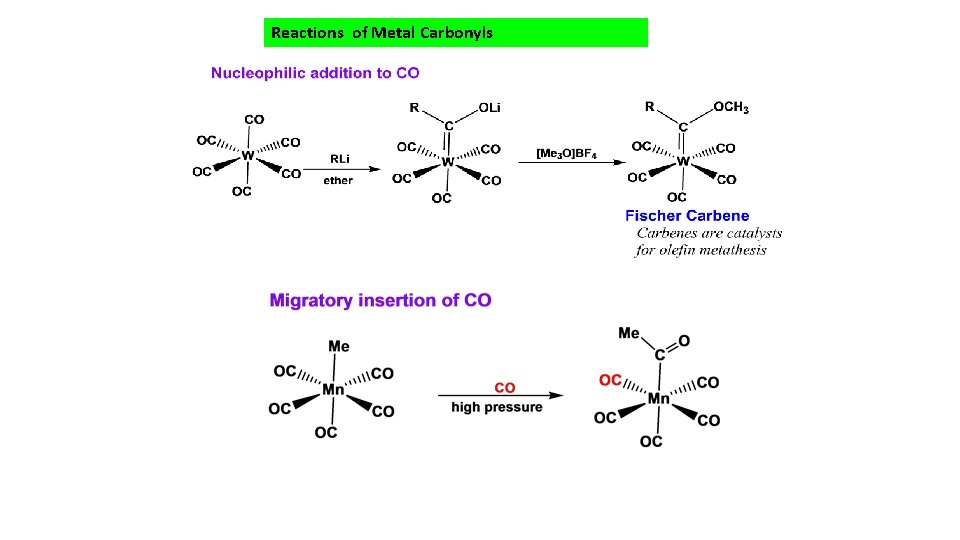
Reactions of Metal Carbonyls
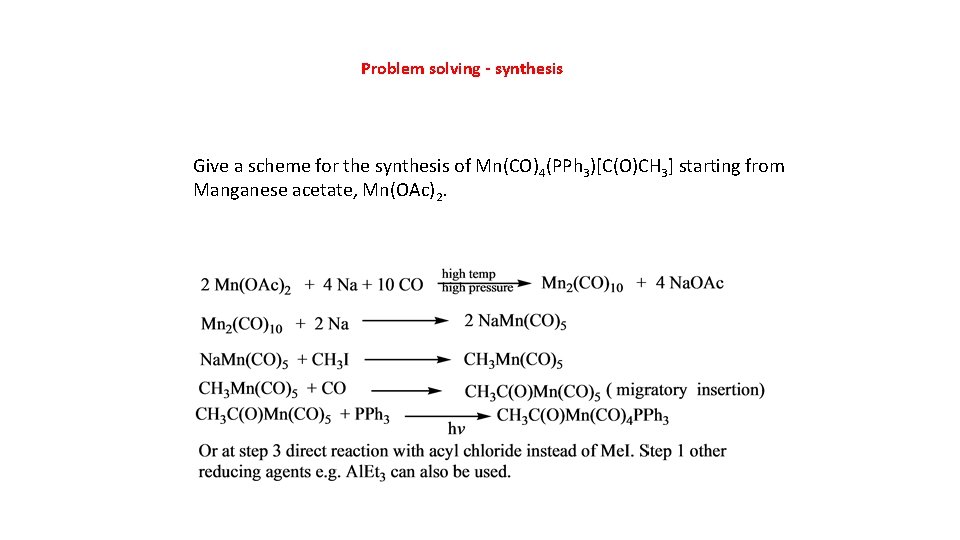
Problem solving - synthesis Give a scheme for the synthesis of Mn(CO)4(PPh 3)[C(O)CH 3] starting from Manganese acetate, Mn(OAc)2.

Metal- Sandwich compounds Hapticity of sandwich compounds varies from 1 8

Why metal – sandwich compounds are important? 1. Transition metal/ metal ion embedded inside an organic matrix: Makes a metal ion soluble even in hydrocarbon solvents. E. g. Ferrocene is soluble in hexane while Fe 2+ as such is not. Outcome: a hydrocarbon soluble additive/catalyst 2. Coordination to an electropositive metal often changes the reactivity and electronic properties of the system bound to it (benzene vs ferrocene) 3. A stericially protected metal site where a wide range of catalytic applications are possible on the. e. g alkene polymerization 4. Metal sandwich compounds are excellent substrates to make planar chiral compounds. Applications as chiral catalysts in asymmetric catalysis Planr chirality: Non- super-imposable mirror images

Cyclopentadienyl (Cp ) • Cyclopentadienyl (Cp ) the most important of all the polyenyl ligands • It gets firmly bound to the metal • generally inert to nucleophilic reagents. • used as a stabilising ligand for many complexes. ( 5 -Cp)( 3 -Cp)W(CO)2 • Neutral cyclopentadiene (C 5 H 6) is a weak acid with a p. Ka of around 15 • Deprotonated with strong base or alkali metals to generate the anionic Cp
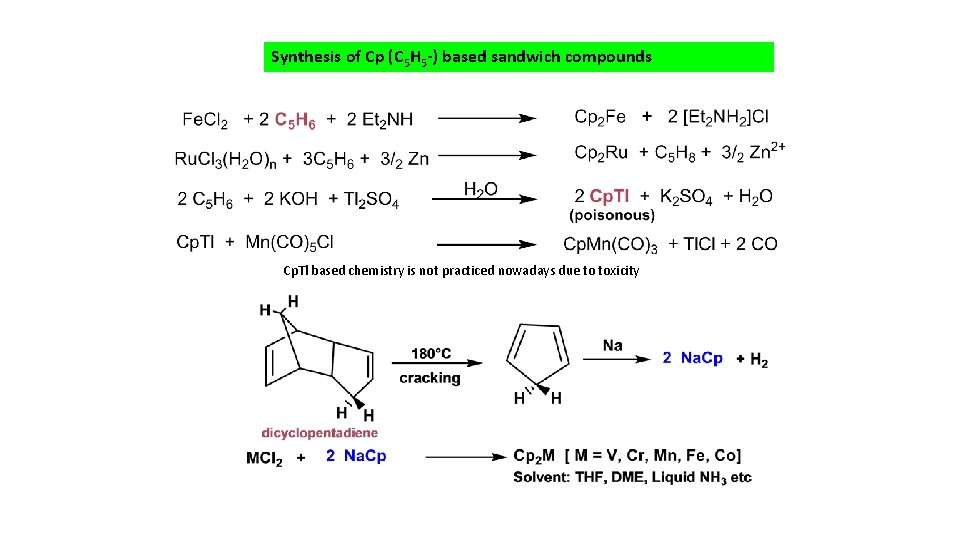
Synthesis of Cp (C 5 H 5 -) based sandwich compounds Cp. Tl based chemistry is not practiced nowadays due to toxicity
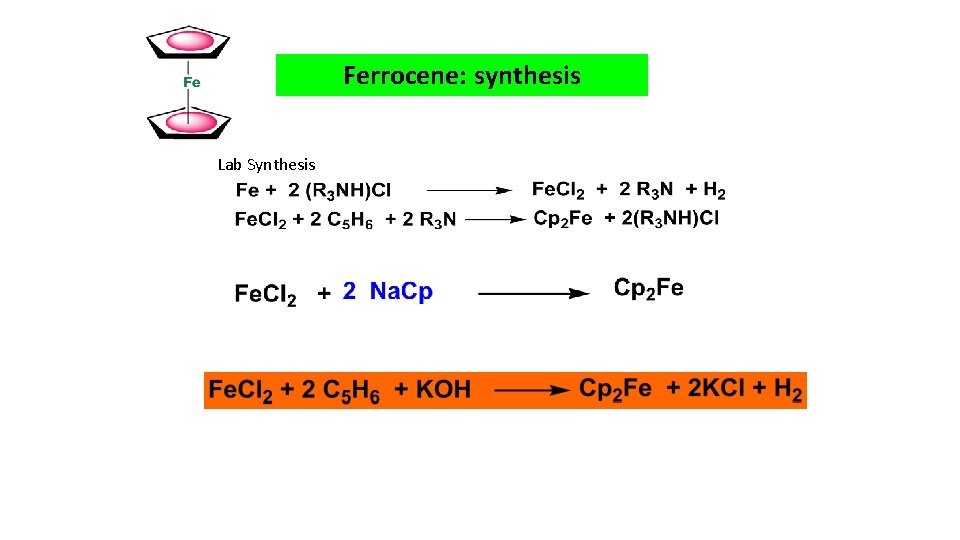
Ferrocene: synthesis Lab Synthesis

Reactions of Ferrocene undergoes electrophilic substitution reactions. Many of its reactions are faster than similar reactions of benzene Necessary requirement: The electrophile should not be oxidizing in nature The oxidized Cp 2 Fe+, ferrocenium cation, will repel the electrophile away. Therefore direct nitration, halogenation and similar reactions cannot be carried out on ferrocene. Acetylation 3. 3 x 10⁶ times faster than benzene
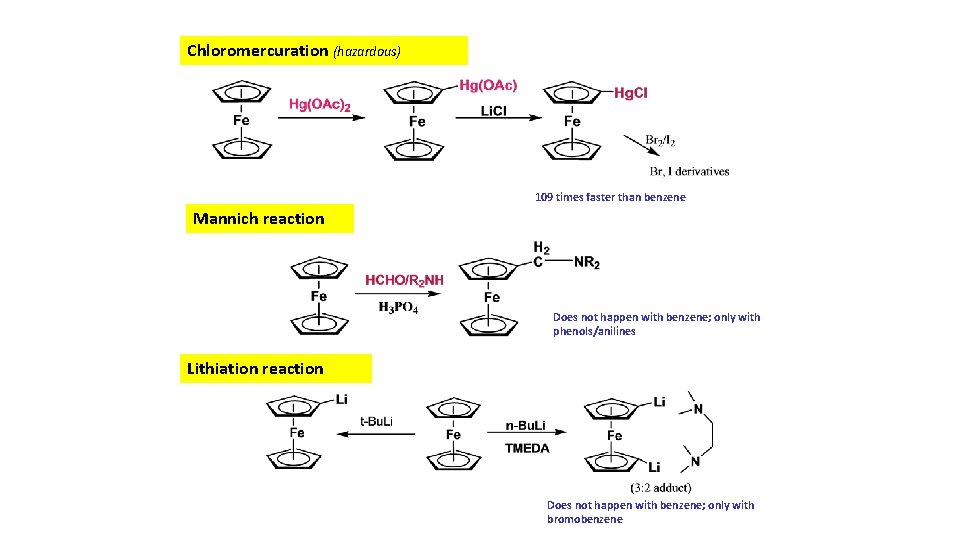
Chloromercuration (hazardous) 109 times faster than benzene Mannich reaction Does not happen with benzene; only with phenols/anilines Lithiation reaction Does not happen with benzene; only with bromobenzene
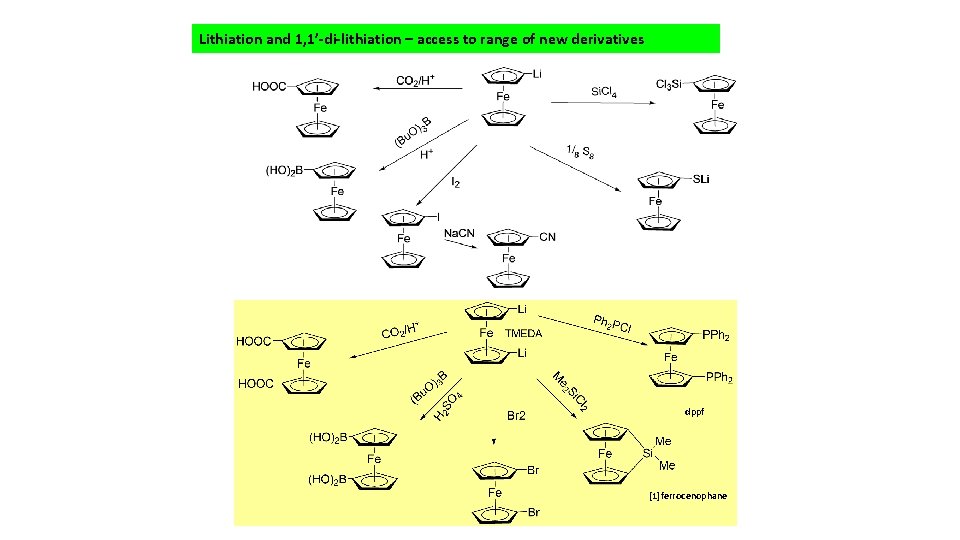
Lithiation and 1, 1’-di-lithiation – access to range of new derivatives dppf [1]ferrocenophane
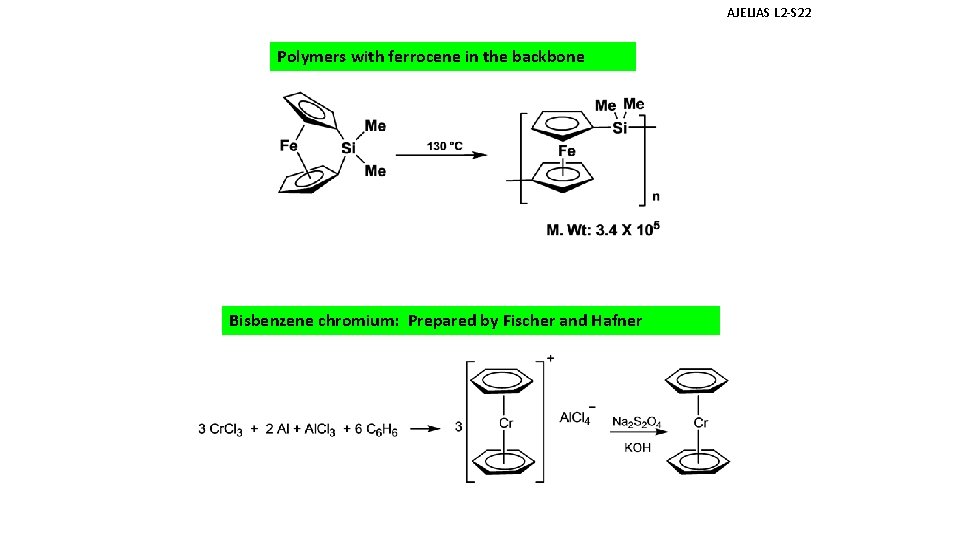
AJELIAS L 2 S 22 Polymers with ferrocene in the backbone Bisbenzene chromium: Prepared by Fischer and Hafner
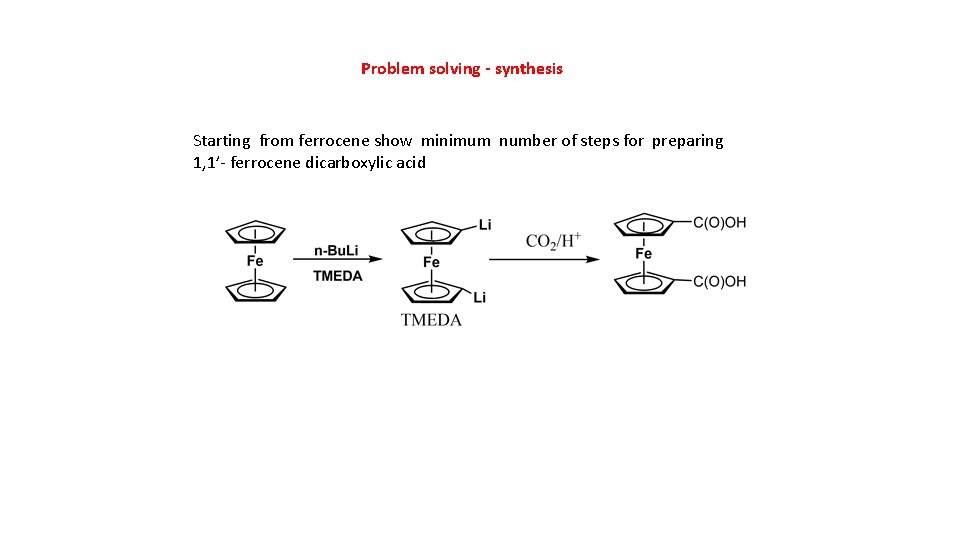
Problem solving - synthesis Starting from ferrocene show minimum number of steps for preparing 1, 1’ ferrocene dicarboxylic acid
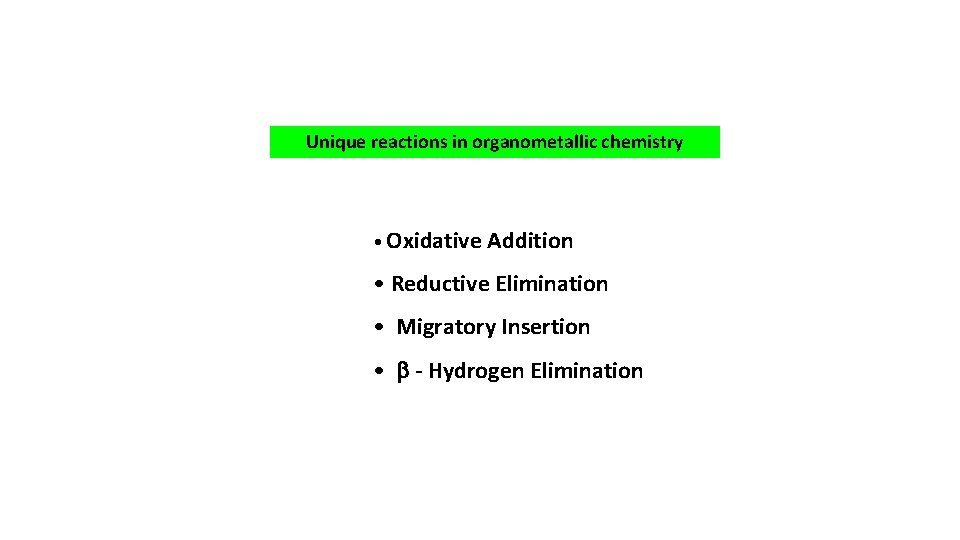
Unique reactions in organometallic chemistry • Oxidative Addition • Reductive Elimination • Migratory Insertion • - Hydrogen Elimination
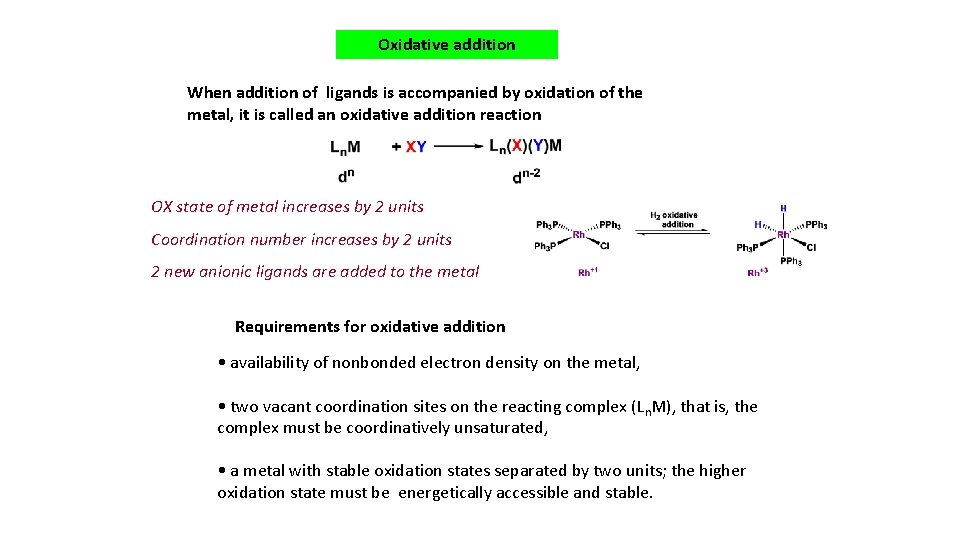
Oxidative addition When addition of ligands is accompanied by oxidation of the metal, it is called an oxidative addition reaction OX state of metal increases by 2 units Coordination number increases by 2 units 2 new anionic ligands are added to the metal Requirements for oxidative addition • availability of nonbonded electron density on the metal, • two vacant coordination sites on the reacting complex (Ln. M), that is, the complex must be coordinatively unsaturated, • a metal with stable oxidation states separated by two units; the higher oxidation state must be energetically accessible and stable.
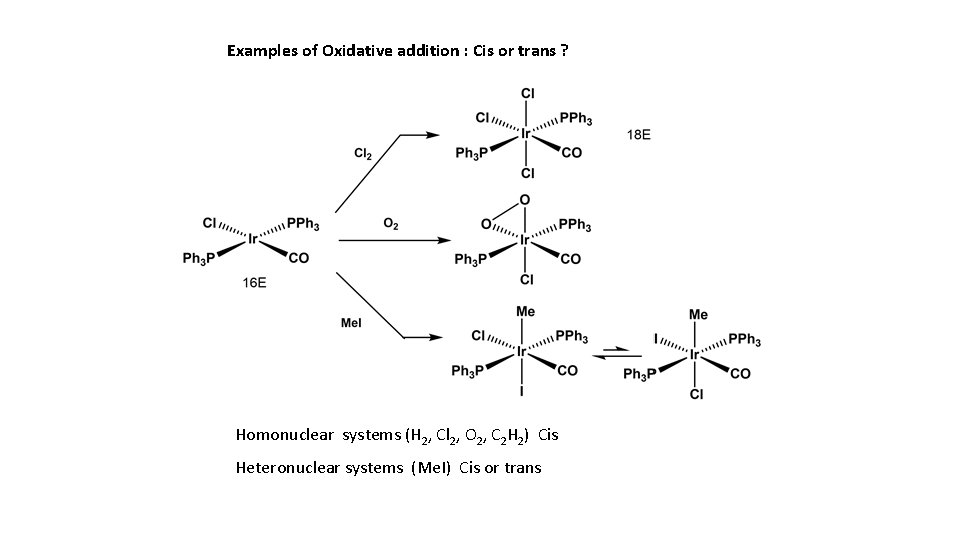
Examples of Oxidative addition : Cis or trans ? Homonuclear systems (H 2, Cl 2, O 2, C 2 H 2) Cis Heteronuclear systems (Me. I) Cis or trans
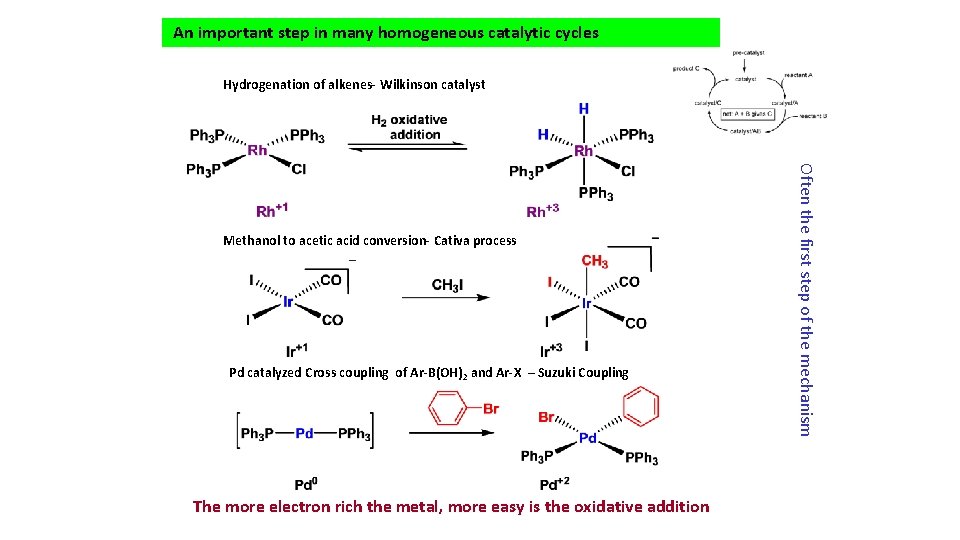
An important step in many homogeneous catalytic cycles Hydrogenation of alkenes- Wilkinson catalyst Pd catalyzed Cross coupling of Ar-B(OH)2 and Ar-X – Suzuki Coupling The more electron rich the metal, more easy is the oxidative addition Often the first step of the mechanism Methanol to acetic acid conversion- Cativa process
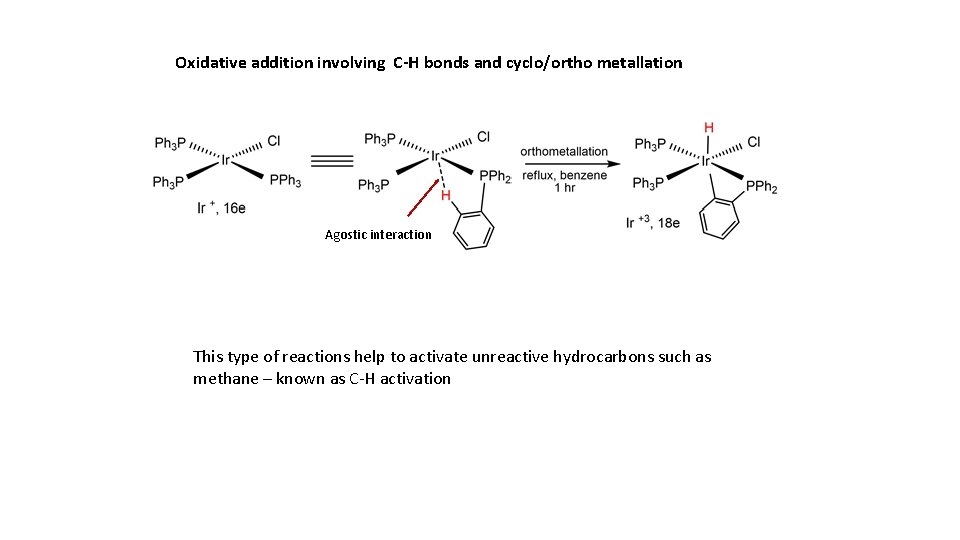
Oxidative addition involving C-H bonds and cyclo/ortho metallation Agostic interaction This type of reactions help to activate unreactive hydrocarbons such as methane – known as C H activation
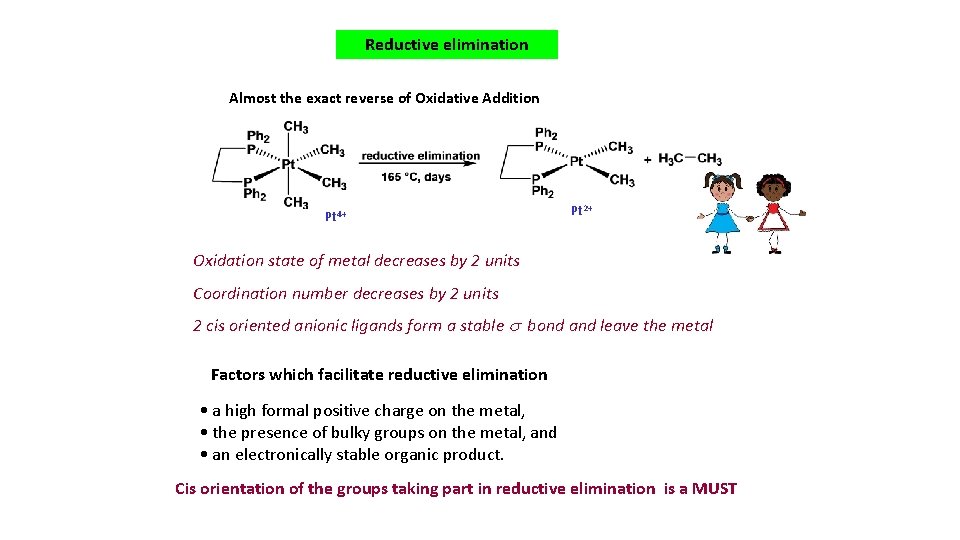
Reductive elimination Almost the exact reverse of Oxidative Addition Pt 4+ Pt 2+ Oxidation state of metal decreases by 2 units Coordination number decreases by 2 units 2 cis oriented anionic ligands form a stable bond and leave the metal Factors which facilitate reductive elimination • a high formal positive charge on the metal, • the presence of bulky groups on the metal, and • an electronically stable organic product. Cis orientation of the groups taking part in reductive elimination is a MUST
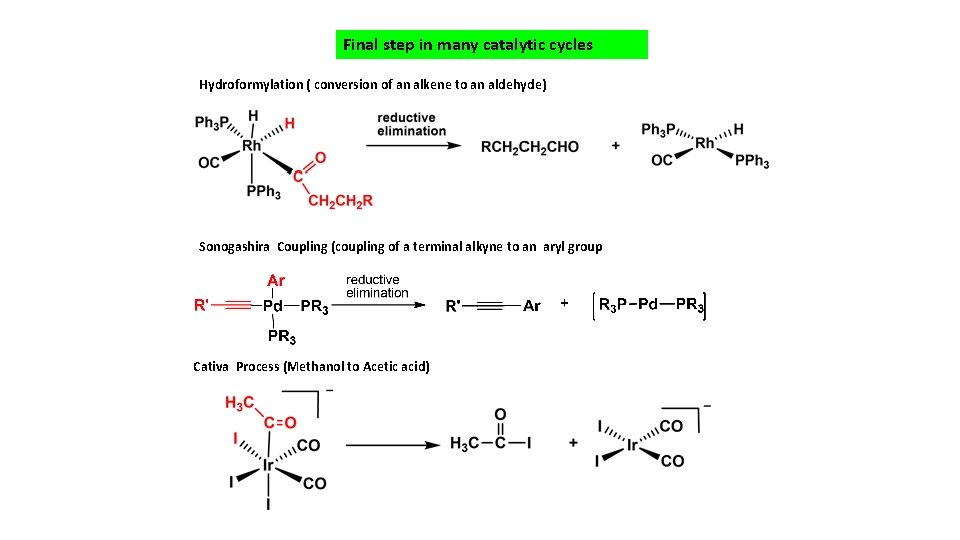
Final step in many catalytic cycles Hydroformylation ( conversion of an alkene to an aldehyde) Sonogashira Coupling (coupling of a terminal alkyne to an aryl group Cativa Process (Methanol to Acetic acid)
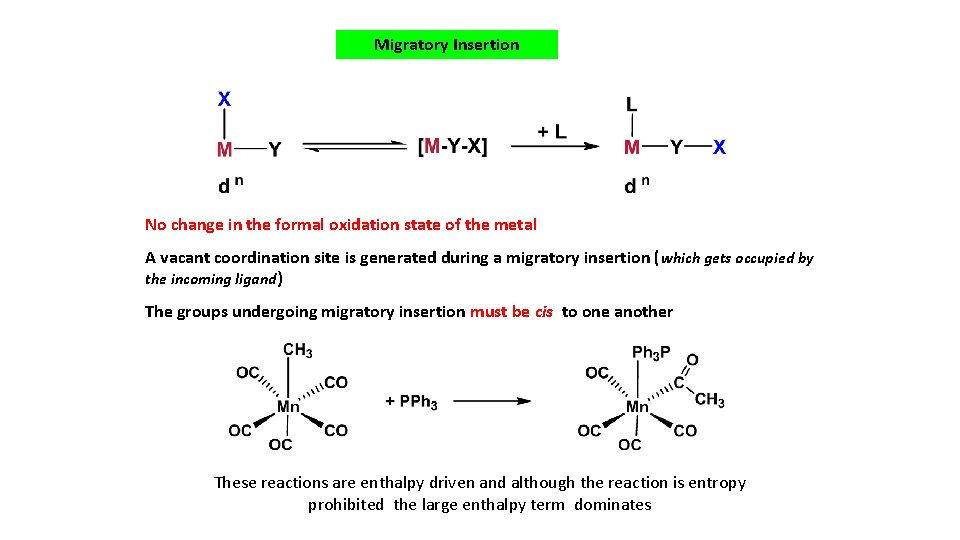
Migratory Insertion No change in the formal oxidation state of the metal A vacant coordination site is generated during a migratory insertion ( which gets occupied by the incoming ligand) The groups undergoing migratory insertion must be cis to one another These reactions are enthalpy driven and although the reaction is entropy prohibited the large enthalpy term dominates
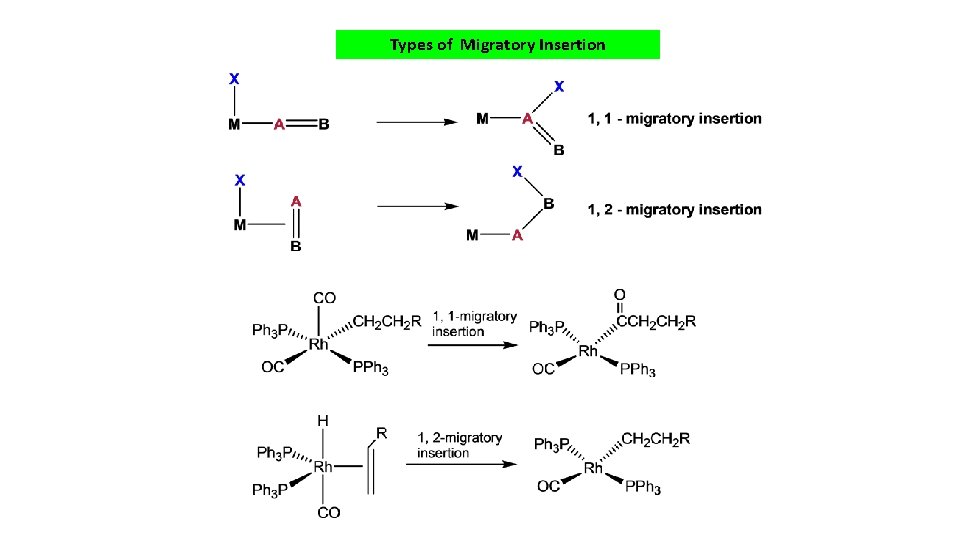
Types of Migratory Insertion
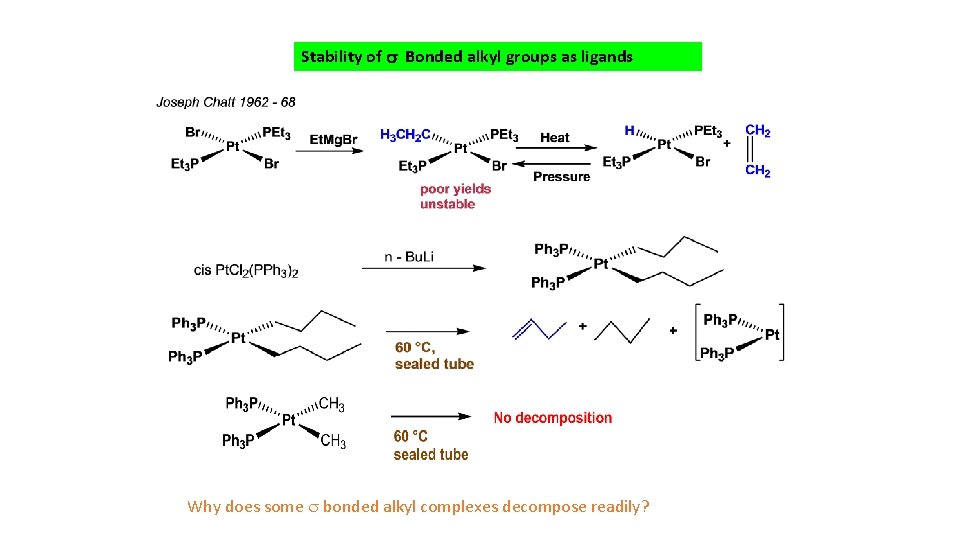
Stability of Bonded alkyl groups as ligands Why does some bonded alkyl complexes decompose readily?
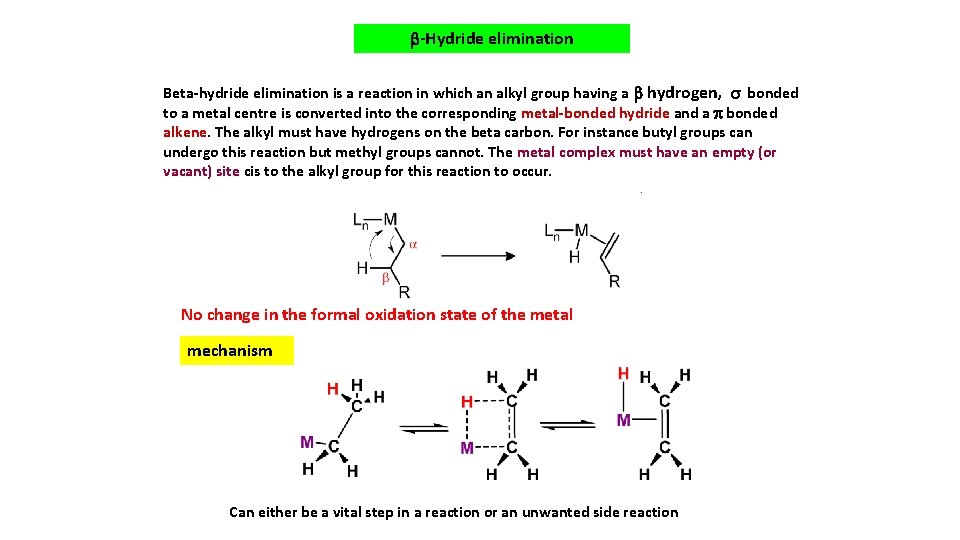
-Hydride elimination Beta-hydride elimination is a reaction in which an alkyl group having a hydrogen, bonded to a metal centre is converted into the corresponding metal-bonded hydride and a bonded alkene. The alkyl must have hydrogens on the beta carbon. For instance butyl groups can undergo this reaction but methyl groups cannot. The metal complex must have an empty (or vacant) site cis to the alkyl group for this reaction to occur. No change in the formal oxidation state of the metal mechanism Can either be a vital step in a reaction or an unwanted side reaction
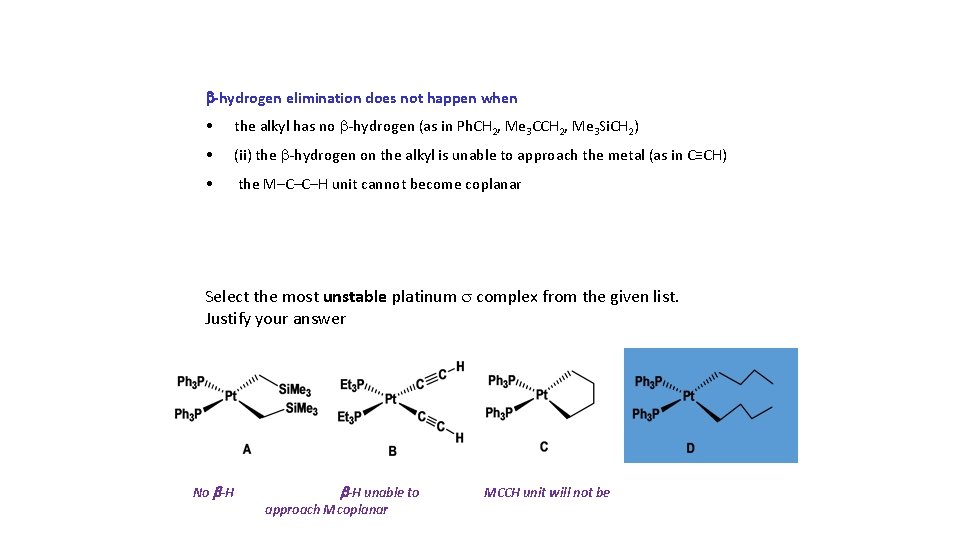
-hydrogen elimination does not happen when • the alkyl has no hydrogen (as in Ph. CH 2, Me 3 CCH 2, Me 3 Si. CH 2) • (ii) the hydrogen on the alkyl is unable to approach the metal (as in C≡CH) • the M–C–C–H unit cannot become coplanar Select the most unstable platinum complex from the given list. Justify your answer No -H unable to approach M coplanar MCCH unit will not be
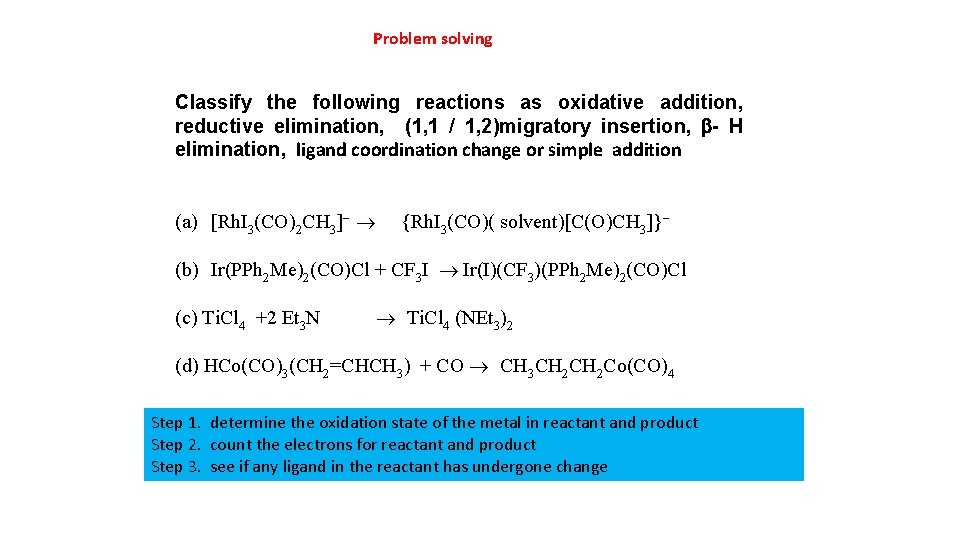
Problem solving Classify the following reactions as oxidative addition, reductive elimination, (1, 1 / 1, 2)migratory insertion, - H elimination, ligand coordination change or simple addition (a) [Rh. I 3(CO)2 CH 3] {Rh. I 3(CO)( solvent)[C(O)CH 3]} (b) Ir(PPh 2 Me)2(CO)Cl + CF 3 I Ir(I)(CF 3)(PPh 2 Me)2(CO)Cl (c) Ti. Cl 4 +2 Et 3 N Ti. Cl 4 (NEt 3)2 (d) HCo(CO)3(CH 2=CHCH 3) + CO CH 3 CH 2 Co(CO)4 Step 1. determine the oxidation state of the metal in reactant and product Step 2. count the electrons for reactant and product Step 3. see if any ligand in the reactant has undergone change

Homogeneous catalysis using organometallic Catalysts A catalyst typically increases the reaction rates by lowering the activation energy by opening up pathways with lower Gibbs free energies of activation (G). Heterogeneous Homogeneous
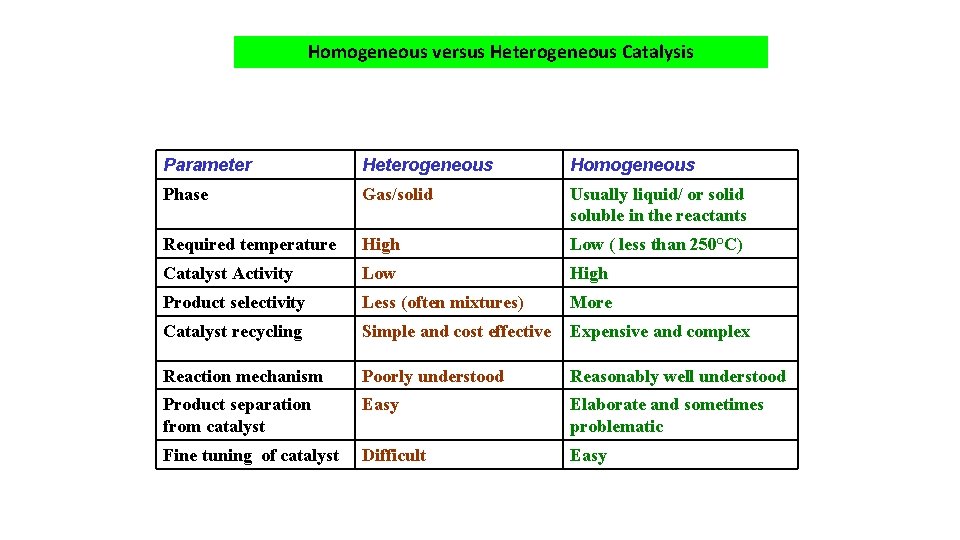
Homogeneous versus Heterogeneous Catalysis Parameter Heterogeneous Homogeneous Phase Gas/solid Usually liquid/ or solid soluble in the reactants Required temperature High Low ( less than 250°C) Catalyst Activity Low High Product selectivity Less (often mixtures) More Catalyst recycling Simple and cost effective Expensive and complex Reaction mechanism Poorly understood Reasonably well understood Product separation from catalyst Easy Elaborate and sometimes problematic Fine tuning of catalyst Difficult Easy
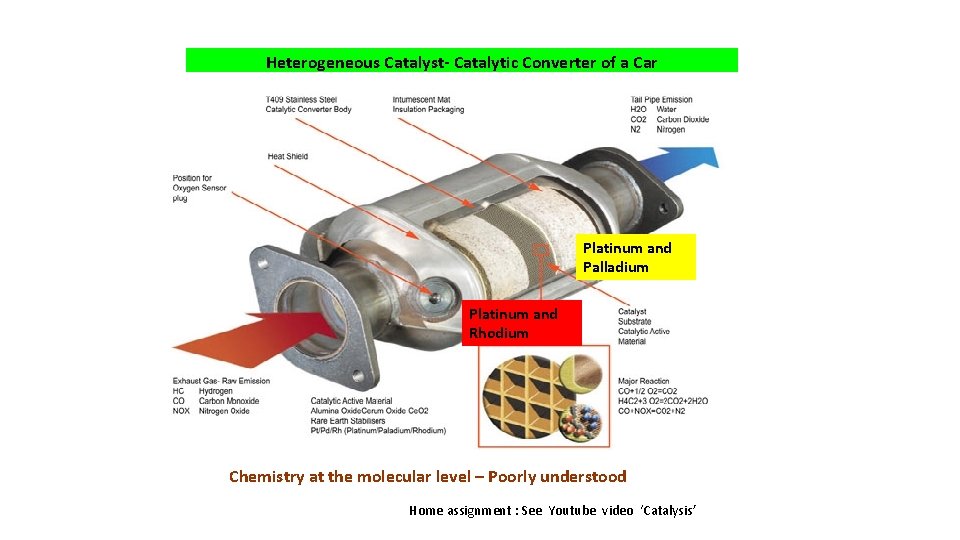
Heterogeneous Catalyst- Catalytic Converter of a Car Platinum and Palladium Platinum and Rhodium Chemistry at the molecular level – Poorly understood Home assignment : See Youtube video ‘Catalysis’
AJELIAS L 7 S 16 Comparing different catalysts; Catalyst life and Catalyst efficiency Turnover Number (TON) TON is defined as the amount of reactant (in moles) divided by the amount of catalyst (in moles) times the percentage yield of product. A large TON indicates a stable catalyst with a long life. Turnover Frequency (TOF) It is the number of passes through the catalytic cycle per unit time (often per hour). Effectively this is dividing the TON by the time taken for the reaction. The units are just time– 1. A higher TOF indicates better efficiency for the catalyst

AJELIAS L 7 S 17 Wilkinson’s Catalyst for alkene hydrogenation Wilkinson’s catalyst: The first example of an effective and rapid homogeneous catalyst for hydrogenation of alkenes, active at room temperature and atmospheric pressure. Square planar 16 electron d 8 complex (Ph 3 P)3 Rh. Cl Discovered by G Wilkinson as well as by R Coffey almost at the same time (1964– 65)
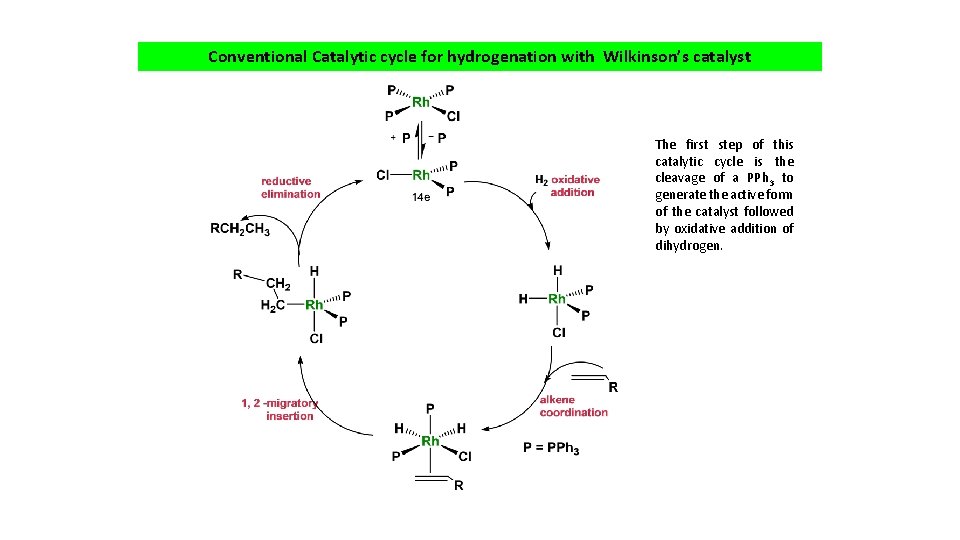
Conventional Catalytic cycle for hydrogenation with Wilkinson’s catalyst The first step of this catalytic cycle is the cleavage of a PPh 3 to generate the active form of the catalyst followed by oxidative addition of dihydrogen.

Conventional Catalytic cycle for hydrogenation with Wilkinson’s catalyst The first step of this catalytic cycle is the cleavage of a PPh 3 to generate the active form of the catalyst followed by oxidative addition of dihydrogen.
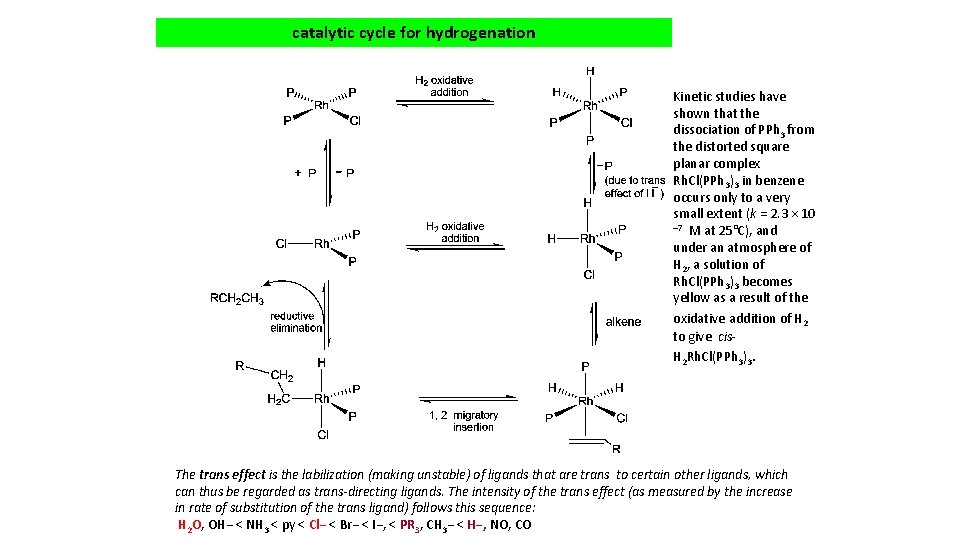
catalytic cycle for hydrogenation Kinetic studies have shown that the dissociation of PPh 3 from the distorted square planar complex Rh. Cl(PPh 3)3 in benzene occurs only to a very small extent (k = 2. 3 × 10 – 7 M at 25°C), and under an atmosphere of H 2, a solution of Rh. Cl(PPh 3)3 becomes yellow as a result of the oxidative addition of H 2 to give cis H 2 Rh. Cl(PPh 3)3. The trans effect is the labilization (making unstable) of ligands that are trans to certain other ligands, which can thus be regarded as trans-directing ligands. The intensity of the trans effect (as measured by the increase in rate of substitution of the trans ligand) follows this sequence: H 2 O, OH− < NH 3 < py < Cl− < Br− < I−, < PR 3, CH 3− < H−, NO, CO
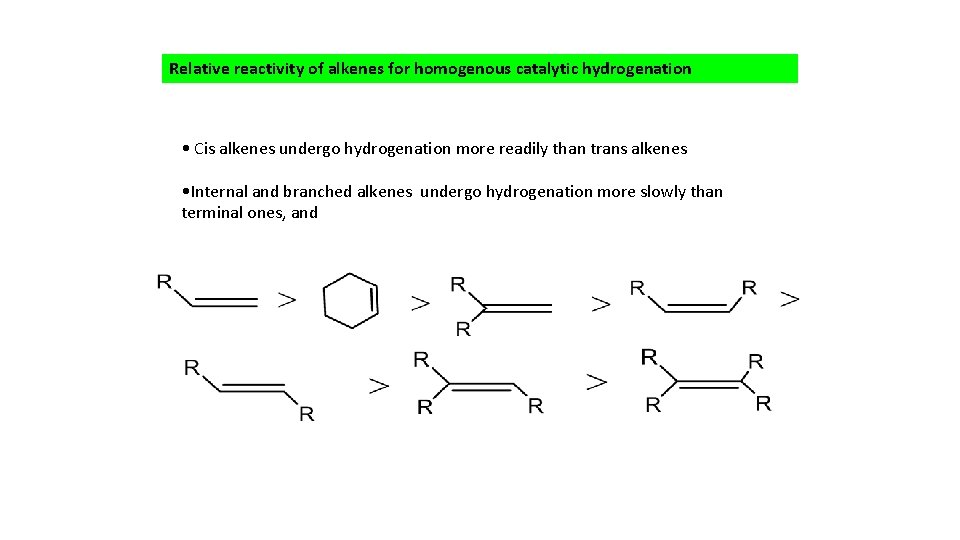
Relative reactivity of alkenes for homogenous catalytic hydrogenation • Cis alkenes undergo hydrogenation more readily than trans alkenes • Internal and branched alkenes undergo hydrogenation more slowly than terminal ones, and
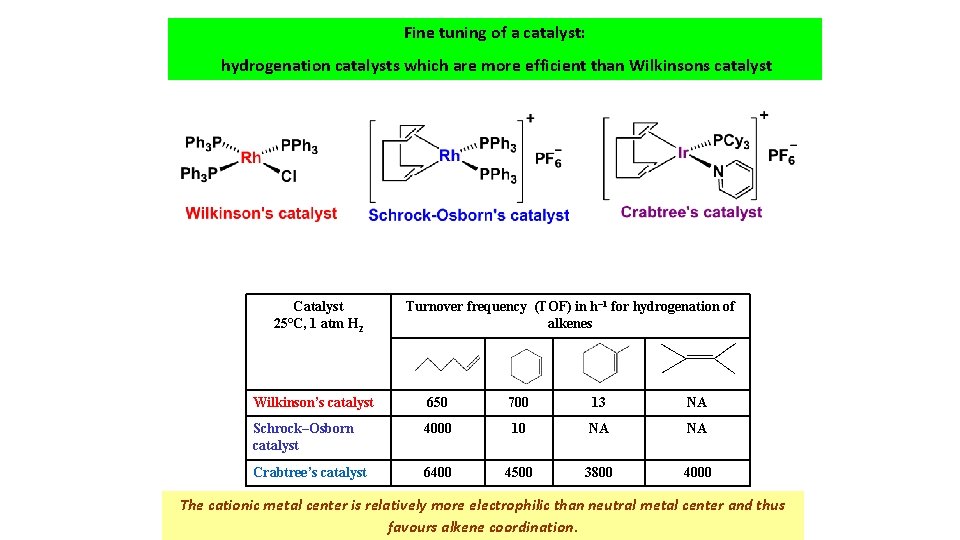
Fine tuning of a catalyst: hydrogenation catalysts which are more efficient than Wilkinsons catalyst Catalyst 25°C, 1 atm H 2 Turnover frequency (TOF) in h– 1 for hydrogenation of alkenes Wilkinson’s catalyst 650 700 13 NA Schrock–Osborn catalyst 4000 10 NA NA Crabtree’s catalyst 6400 4500 3800 4000 The cationic metal center is relatively more electrophilic than neutral metal center and thus favours alkene coordination.

Hydrogenation with Crabtree’s catalyst The di-solvated form of the active catalyst generated by the removal of COD [after it gets hydrogenated and leaves] favors coordination of sterically bulky alkenes as well. This mechanism is only for understanding not for the exam
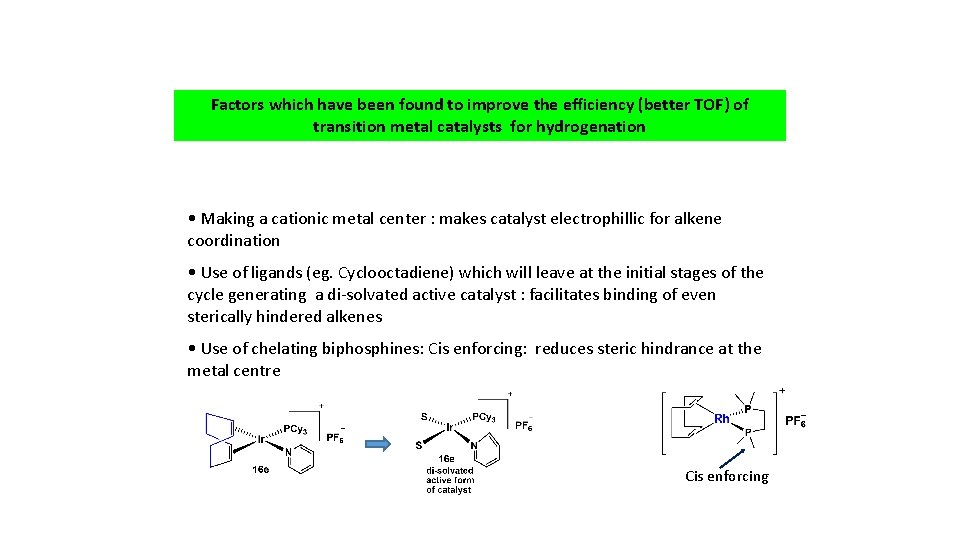
Factors which have been found to improve the efficiency (better TOF) of transition metal catalysts for hydrogenation • Making a cationic metal center : makes catalyst electrophillic for alkene coordination • Use of ligands (eg. Cyclooctadiene) which will leave at the initial stages of the cycle generating a di solvated active catalyst : facilitates binding of even sterically hindered alkenes • Use of chelating biphosphines: Cis enforcing: reduces steric hindrance at the metal centre Cis enforcing
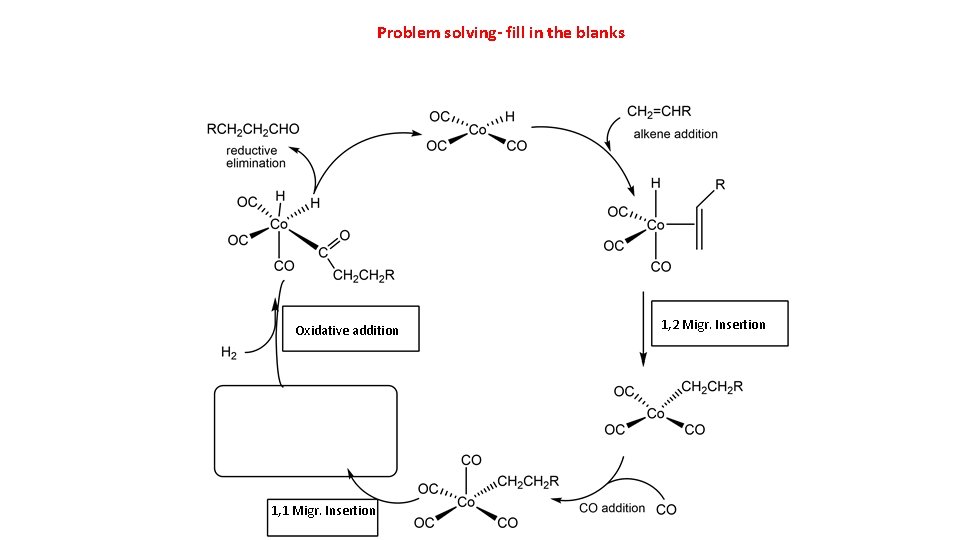
Problem solving- fill in the blanks Oxidative addition 1, 1 Migr. Insertion 1, 2 Migr. Insertion
- Slides: 70