
Basic Imaging Principles Chapter 1 Biomedical Engineering Dr
Basic Imaging Principles Chapter 1 Biomedical Engineering Dr. Mohamed Bingabr University of Central Oklahoma
ENGR 4223: Biomedical Imaging ( Syllabus) INSTRUCTOR: Mohamed Bingabr, Ph. D. CONTACTS: Office: Howell 221 D ; Phone: 974 5718; Email: mbingabr@uco. edu OFFICE HOURS: MWF 10: 00 – 10: 50, MW 3: 00 – 3: 50, and by appointment CLASS HOURS: MW 4: 00 – 5: 15 Howell Hall 112 TEXTBOOK: “Medical Imaging Signals and Systems”, 2 nd edition by J. Prince and J. Links. REFERENCE: “Physics of Radiology”, by Anthony Wolbarst. PREREQUISITE: ENGR 3323 Signals and Systems COURSE WEBSITE: http: //www. engineering. uco. edu/~mbingabr GRADES: Homework and Attendance 15 % Attendance 10 % Quizzes 20 % 2 Tests 30 % Final Exam 25 % A 90% 80% ≤ B < 90% 70% ≤ C < 80% 60%≤ D <70% F < 60% Note: Dates of the 2 tests and the final exam will be announced during the semester. Quizzes will be given every Monday.
Subject Introduction Physical Signals Imaging Modalities Signals and Systems Signals Systems The Fourier Transform Properties of Fourier Transform Transfer Function Circular Symmetry and the Hankel Transform Sampling Image Quality Contrast Resolution Noise Signal-to-Noise Ratio Nonrandom Effects Accuracy TEST 1 Physics of Radiography Ionization Forms of Ionizing radiation Nature and Properties of Ionizing Radiation Attenuation of Electromagnetic Radiation Dosimetry Projection Radiography Instrumentation Image Formation Reading Ch 1 Ch 2 Ch 3 Ch 4 Notes Ch 5 Computed Tomography CT Instrumentation Image Formation Image Quality in CT TEST 2 Physics of Magnetic Resonance Microscopic Magnetization Macroscopic Magnetization Precession and Larmor Frequency Transverse and Longitudinal Magnetization RF Excitation Relaxation The Bloch Equations Spin Echoes Contrast Mechanisms Magnetic Resonance Imaging Instrumentation MRI Data Acquisition Image Reconstruction Image Quality Final Ch 6 Notes Ch 12 Ch 13 It is expected that each student will actually spend a total of 6 to 8 hours per week on the course (not including lecture times). I don’t expect you to memorize formulas but I expect you to understand them. So, you will be allowed to bring to the exam one sheet of paper that contains any relative formulas you might need, but make sure you know how to use them conceptually and not just mechanically.
Basic Imaging Principles What does the human body look like on the inside? Invasive Techniques: • Operation • Endoscope Noninvasive Techniques: Imaging Modality • Magnetic Resonance Imaging (MRI) • Ultrasound Imaging • x-ray • Computed Tomography (CT) • Nuclear Medicine • Functional Magnetic Resonance Imaging (f. MRI) • Positron Emission Tomography (PET)
What do Images look like, and why? Image depends on the measured parameters of the body’s tissues (signal) such as: - Reflectivity in ultrasound imaging - Linear attenuation coefficient in x-ray and CT scan - Hydrogen proton density in MRI - Metabolism or receptor binding in PET Measured parameters must have important medical information about the tissue. Image reconstruction: the process of creating an image from measurement of signals (parameters). Image quality determined by: Accurate spatial distribution of the physical parameters. Resolution, Noise, Contrast, Geometric Distortion, Artifacts
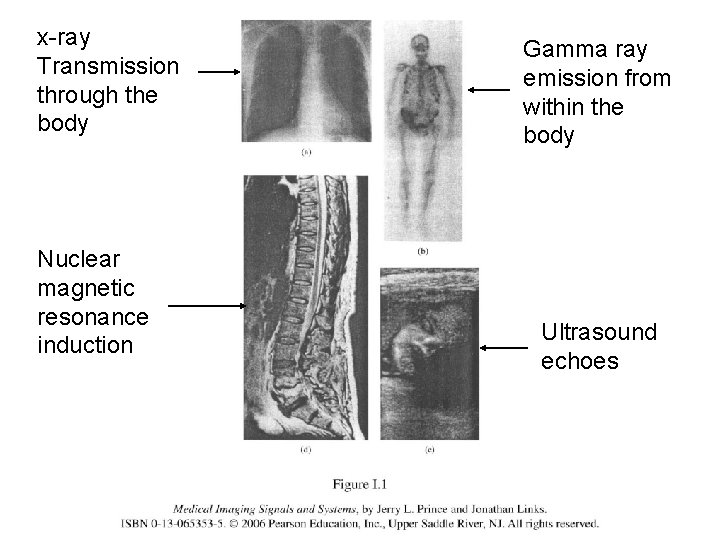
x-ray Transmission through the body Nuclear magnetic resonance induction Gamma ray emission from within the body Ultrasound echoes
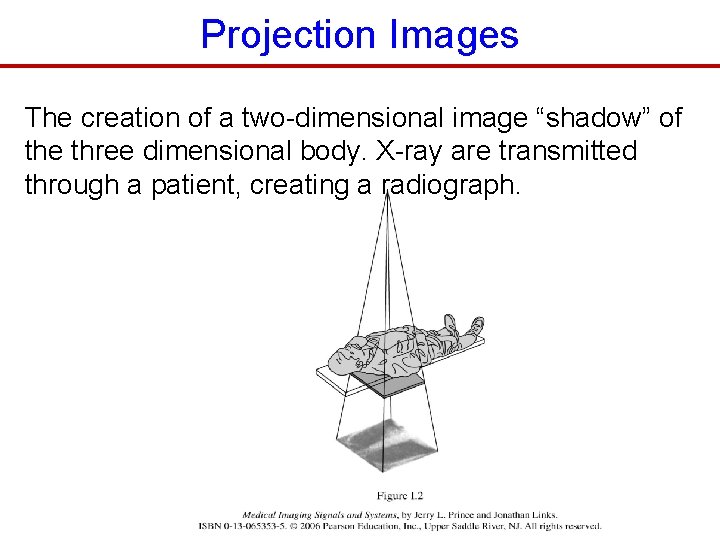
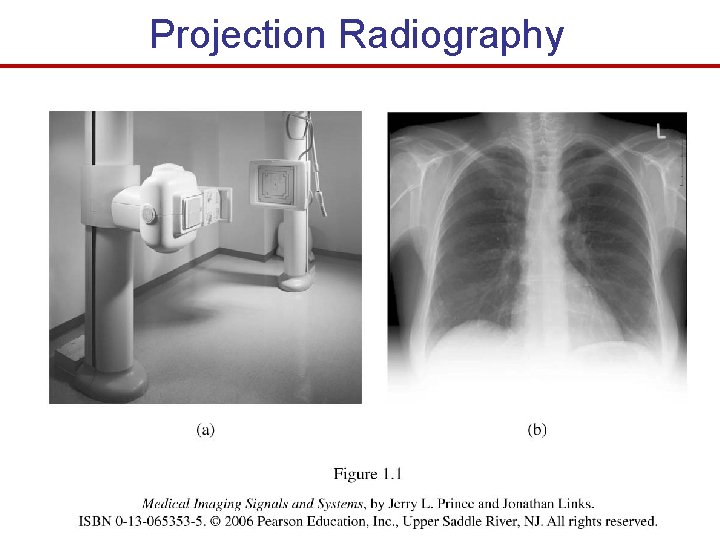
Projection Images The creation of a two-dimensional image “shadow” of the three dimensional body. X-ray are transmitted through a patient, creating a radiograph.
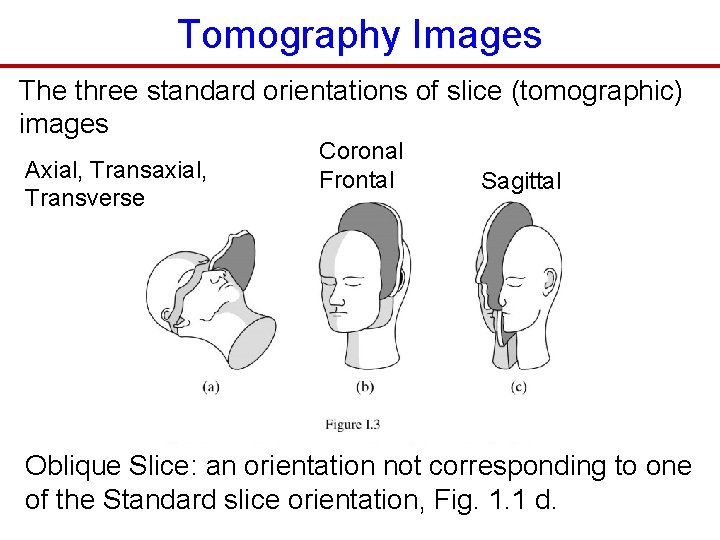
Tomography Images The three standard orientations of slice (tomographic) images Axial, Transaxial, Transverse Coronal Frontal Sagittal Oblique Slice: an orientation not corresponding to one of the Standard slice orientation, Fig. 1. 1 d.
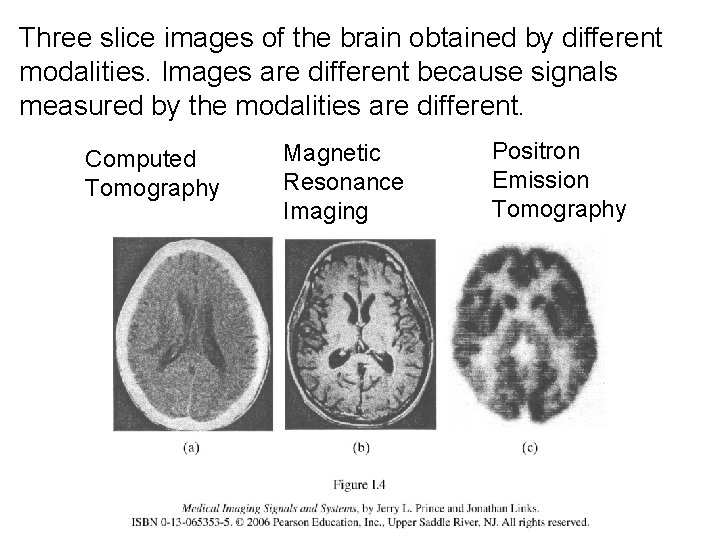
Three slice images of the brain obtained by different modalities. Images are different because signals measured by the modalities are different. Computed Tomography Magnetic Resonance Imaging Positron Emission Tomography
Introduction Chapter 1 Biomedical Engineering Dr. Mohamed Bingabr University of Central Oklahoma
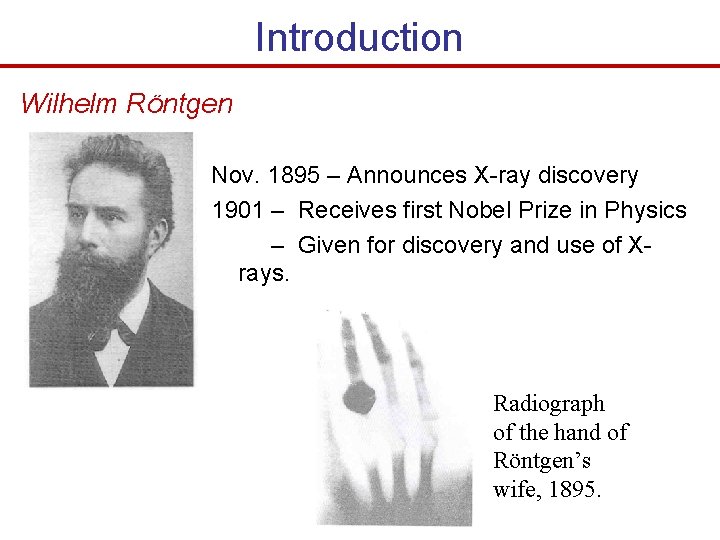
Introduction Wilhelm Röntgen Nov. 1895 – Announces X-ray discovery 1901 – Receives first Nobel Prize in Physics – Given for discovery and use of Xrays. Radiograph of the hand of Röntgen’s wife, 1895.
1940’s, 1950’s Background laid for ultrasound and nuclear medicine 1960’s Revolution in imaging – ultrasound and nuclear medicine 1972 CT (Computerized Tomography) - true 3 D imaging - Allan Cormack and Hounsfield win Nobel Prize in 1979 1980’s -In 1952 Felix Bloch and Edward Purcell received Nobel Prize in Physics for describing the phenomena of NMR -In 1991 Richard Ernst received Nobel Prize in chemistry for a paper describing the use of MRI in medicine in 1973. - In 2003 Paul Lauterbur and Peter Mansfield received Nobel Prize for developing Key method in MRI image construction.
Physical Signal Detection of physical signals arising from the body and transform these signals to images. Typical signals - Transmission of x-ray through the body ( Projection radiography) - Emission of gamma rays from radiotracer in the body (NM) - Reflection of ultrasonic waves within the body (in ultrasound imaging) - Precession of spin systems in a large magnetic field (MRI) All signals above use Electromagnetic waves (EM) except the ultrasound imaging. f 1/ f Energy
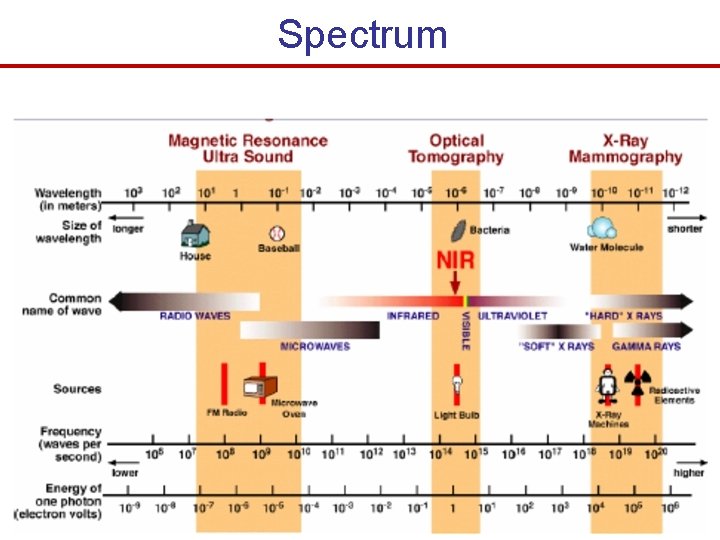
Physical Signal Characteristics of spectrum that are useful for medical imaging For Electromagnetic Imaging > 1 Angstrom (Ao) : Energy is highly attenuated by the body < 0. 01 Angstrom : Energy is too high and less contrast Unit of energy for EM is electron volts (e. V): 1 e. V is the amount of energy an electron gains when accelerated across 1 volt potential. Useful energy for medical imaging: 25 k e. V – 500 k e. V For Ultrasound Imaging In ultrasound, image resolution is poor for long wavelength, and attenuation is too high for short wavelength. Ideal frequency range for ultrasound imaging is 1 to 20 MHz
Spectrum
Imaging modalities 1. Projection Radiology - Ionized radiation, transmission imaging 2. Computed Tomography - Ionized radiation, transmission imaging 3. Nuclear Medicine - Ionized radiation, emission imaging 4. Ultrasound Imaging - Reflection imaging 5. Magnetic Resonance Imaging
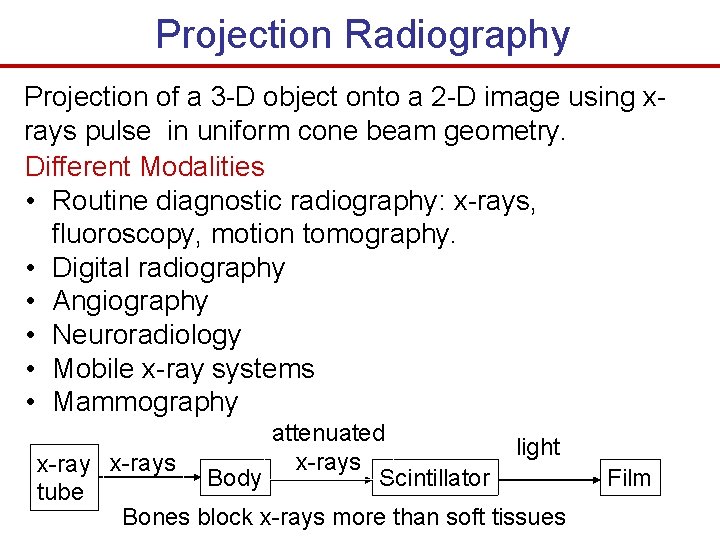
Projection Radiography Projection of a 3 -D object onto a 2 -D image using xrays pulse in uniform cone beam geometry. Different Modalities • Routine diagnostic radiography: x-rays, fluoroscopy, motion tomography. • Digital radiography • Angiography • Neuroradiology • Mobile x-ray systems • Mammography attenuated x-rays Body Scintillator light x-rays tube Bones block x-rays more than soft tissues Film
Projection Radiography
Computed Tomography (CT-scan) The x-rays are collimated (restricted in their geometric spread) to travel within an approximate 2 -D “Fan beam” CT collects multiple projections of the same tissues from different orientations by moving the x-ray source around the body. CT systems have rows of digital detectors whose signals are inputted to a computer. The computer reconstruct cross sections (slice) of the human body.
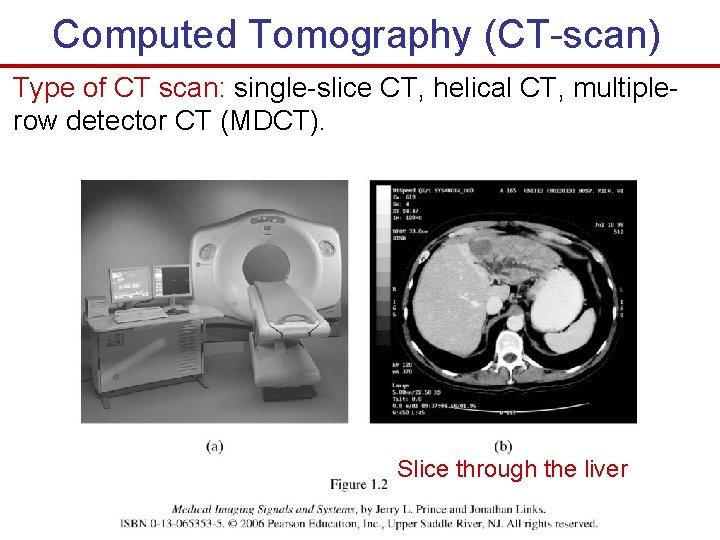
Computed Tomography (CT-scan) Type of CT scan: single-slice CT, helical CT, multiplerow detector CT (MDCT). Slice through the liver
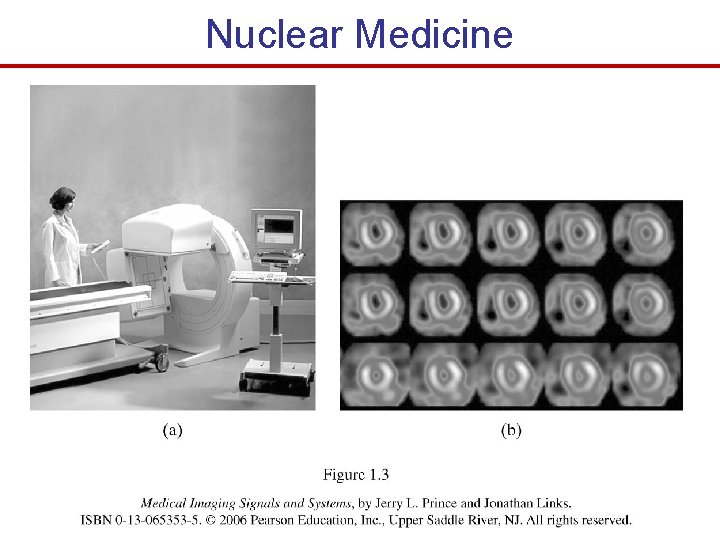
Nuclear Medicine Imaging (NMI) NMI is imaging methods of the tissue physiology. Imaging of gamma rays emitted by radioactive substance introduced into the body. These radiotracers are bound to biological molecules that are naturally consumed by body tissues. Nuclear medicine imaging reflects the local concentration of a radiotracer within the body. Since this concentration is tied to the physiological behavior of the carrier molecule within the body, nuclear medicine imaging is functional imaging methods. Example radioactive iodine to study thyroid function.
Nuclear Medicine Modalities of Nuclear Medicine: -Conventional radionuclide imaging or scintigraphy -Single-photon emission computed tomography (SPECT) -Positron emission tomography (PET) In Conventional and SPECT: a radioactive atom’s decay produces a single gamma ray, which may intercept the Anger camera (scintillation detector). In PET, a radionuclide decay produces a positron, which immediately annihilates (with an electron) to produce two gamma rays flying off in opposite directions.
Nuclear Medicine
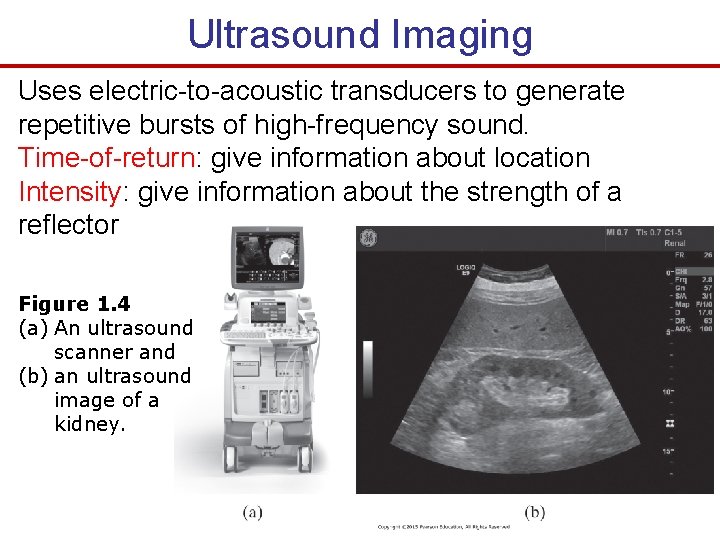
Ultrasound Imaging Uses electric-to-acoustic transducers to generate repetitive bursts of high-frequency sound. Time-of-return: give information about location Intensity: give information about the strength of a reflector Figure 1. 4 (a) An ultrasound scanner and (b) an ultrasound image of a kidney.
Modalities of Ultrasound - A-mode imaging: generate one-dimensional waveform. - - - Does not produce image but provide detail information about rapid or subtle motion (heart valve). B-mode imaging: cross-sectional anatomical imaging. M-mode imaging: generate a succession of A-mode signals and displayed as image in computer screen. Used to measure time-varying displacement such as a heart valve. Doppler imaging: uses the property of frequency and phase shift caused by moving objects. Phase shift is converted to sound that reveal information about motion such as blood flow. Nonlinear imaging: higher resolution, greater depth, image different properties of tissues.
Magnetic Resonance Imaging (MRI) MRI measure the hydrogen atoms density in tissues. - Hydrogen nucleus align itself with an external Magnetic field - Radio frequency pulse cause hydrogen atoms to tip a way from the direction of the external magnetic field. - When excitation pulse end, hydrogen nucleus realign itself with the magnetic field and release a radio-frequency.
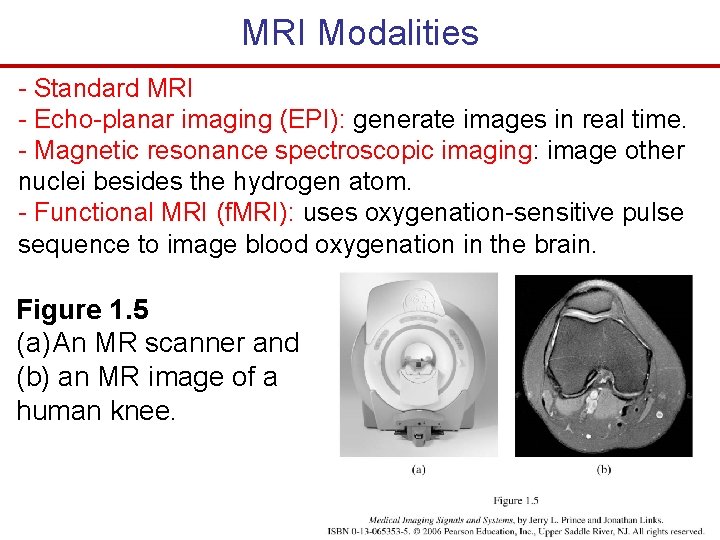
MRI Modalities - Standard MRI - Echo-planar imaging (EPI): generate images in real time. - Magnetic resonance spectroscopic imaging: image other nuclei besides the hydrogen atom. - Functional MRI (f. MRI): uses oxygenation-sensitive pulse sequence to image blood oxygenation in the brain. Figure 1. 5 (a) An MR scanner and (b) an MR image of a human knee.
Multimodalities Imaging system that consist of two different medical imaging modalities to reveal different properties of the human body. CT Bones anatomy MRI Tissue anatomy PET tissue physiology PET/CT systems improve the construction of the PET images.
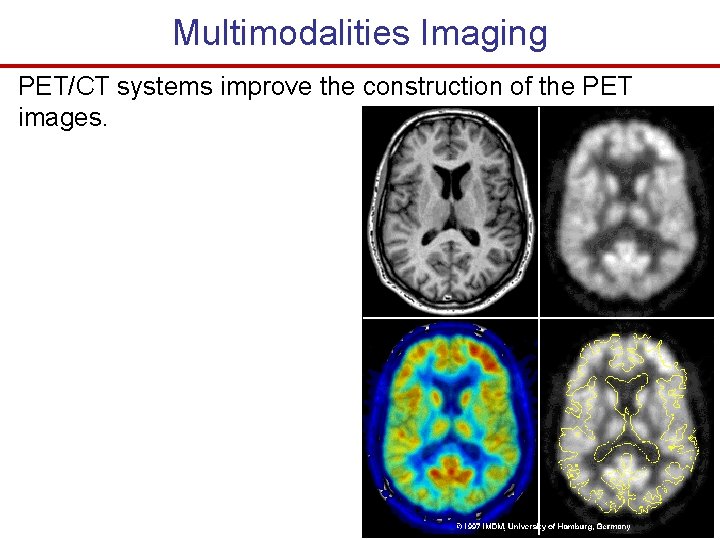
Multimodalities Imaging PET/CT systems improve the construction of the PET images.
- Slides: 29