
Basic ICD10 CM and ICD10 PCS Coding 2016
Basic ICD-10 -CM and ICD-10 -PCS Coding 2016 Edition Chapter 20: Congenital Malformations, Deformations, and Chromosomal Abnormalities (Q 00 -Q 99) © 2016

Learning Objectives • Review the chapter’s learning objectives • Review the chapter’s key terms • At the conclusion of this chapter, what must you know about the coding of congenital anomalies? © 2016
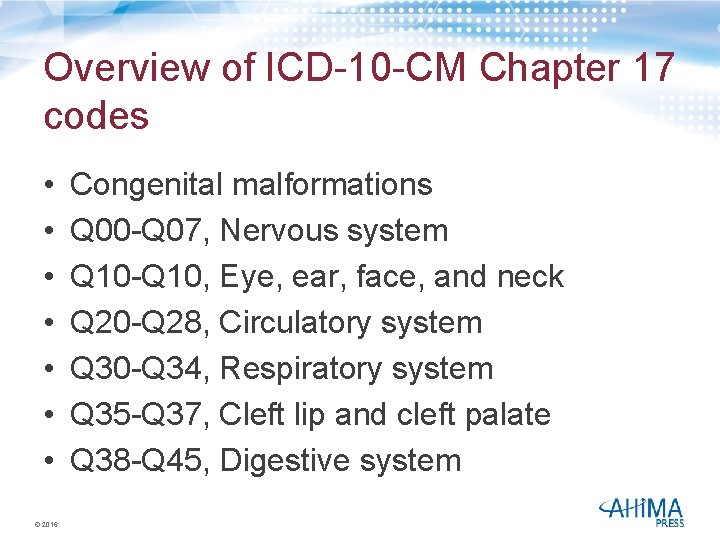
Overview of ICD-10 -CM Chapter 17 codes • • © 2016 Congenital malformations Q 00 -Q 07, Nervous system Q 10 -Q 10, Eye, ear, face, and neck Q 20 -Q 28, Circulatory system Q 30 -Q 34, Respiratory system Q 35 -Q 37, Cleft lip and cleft palate Q 38 -Q 45, Digestive system
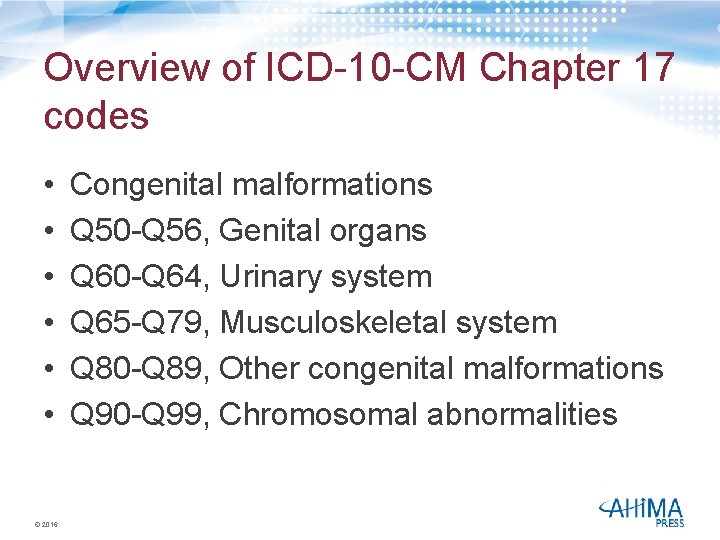
Overview of ICD-10 -CM Chapter 17 codes • • • © 2016 Congenital malformations Q 50 -Q 56, Genital organs Q 60 -Q 64, Urinary system Q 65 -Q 79, Musculoskeletal system Q 80 -Q 89, Other congenital malformations Q 90 -Q 99, Chromosomal abnormalities
Congenital Anomaly and Chromosomal Abnormality • A congenital anomaly, malformation, or deformation is an irregularity, abnormality, or a combination of abnormalities that are present at, and existing from, the time of birth • A chromosomal abnormality is an irregularity in the number or structure of chromosomes that may alter the course of the development of the embryo © 2016
Chapter 17 of ICD-10 -CM • Congenital conditions are grouped into subcategories to identify the type of condition present • For example, see category Q 61 for cystic kidney disease and the specific forms of it that exists • Other categories provide specificity according to the anatomic site and combination of congenital conditions © 2016
Instructional Notes for Chapter 17 • Codes are not used on the maternal record • Codes are used only on the infant or patient’s record who has the condition • When an infant is born with a congenital anomaly, during this encounter the first code is from category Z 38 for newborn status and an additional code for the congenital condition present at birth © 2016
Instructional Notes for Chapter 17 • If an infant is transferred to a second hospital for care of the congenital condition, the principal diagnosis at the second hospital would be the congenital anomaly • These codes can be used throughout the entire life of the patient as long as the congenital condition is still present • If condition is corrected, there is a code for personal history of (corrected) congenital malformation, Z 87. 7 © 2016
Instructional Notes for Chapter 17 • Use additional code notes are present in chapter • Spina bifida – use additional code for associated paraplegia • Cleft lip and cleft palate – use additional code to identify any associated malformation of the nose • When congenital condition does not have a unique code or may be described as a syndrome, the coder should assign additional code(s) for any manifestations that are present © 2016
Instructional Notes for Chapter 17 • Under section Q 90 -Q 99, Chromosomal abnormalities, a note appears to remind the coder to use additional codes to identify any associated physical condition or the degree of intellectual disabilities that are present with the chromosomal abnormality © 2016
Coding Overview for ICD-10 -CM Chapter 17 • Chapter 17 codes are assigned when a malformation, deformation, or chromosomal abnormality is documented • The code may be the principal or first listed diagnosis on a record or a secondary diagnosis • When the code identifies the condition, manifestations that are an inherent component of the anomaly should not be coded separately • Additional codes should be assigned for manifestations that are not an inherent component of the condition © 2016
Coding Guidelines for ICD-10 -CM Chapter 17 • Chapter-specific guidelines for categories Q 00 -Q 99 • Malformation/deformation or chromosomal abnormality may be the principal or first-listed diagnosis on a record or it can be a secondary diagnosis • When a malformation/deformation/chromosomal abnormality does not have a unique code, assign additional code(s) for any manifestations that may be present • Manifestations that are an inherent component of the anomaly should not be coded separately • Additional codes should be assigned for manifestation that are not an inherent component © 2016
Coding Guidelines for ICD-10 -CM Chapter 17 • Chapter-specific guidelines for categories Q 00 -Q 99 (continued) • Codes from Chapter 17 can be used through the life of the patient • If congenital malformation or deformity has been correct, a personal history code should be used to identify the history of the malformation or deformity • Although present at birth, the malformation, deformation, or chromosomal abnormality may not be identified until later in life • When the condition is diagnosed by the physician, it is appropriate to use the codes from Q 00 -Q 99 during patient’s life • At time of birth, Z 38 category code is principal followed by any congenital anomaly codes © 2016
Coding Congenital Malformations, Deformations, and Chromosomal Abnormalities • Conditions in Chapter 17 are organized by body system • Codes include limbs and laterality and specific forms of the congenital condition • Congenital conditions may be identified by eponyms such as Down, Patau and Edward • Chromosomal abnormalities are classified in nine categories to distinguish the nonmosaicism, mosaicism and translocation types of the abnormalities © 2016
Coding Congenital Malformations, Deformations , and Chromosomal Abnormalities • Three major categories of known causes of congenital anomalies – Chromosomal disorders (either hereditary or arising during conception) – Exposure to an environment chemical (for example, medications, alcohol, cigarettes, solvents) – Mother’s illness during pregnancy, exposing the infant to viral or bacterial infection • Stage of fetal development at the time of exposure to one of the two latter causes is critical, fetus most vulnerable in the first trimester © 2016
Coding Congenital Malformations, Deformations, and Chromosomal Abnormalities • Congenital Defects of the Nervous System (Q 00 -Q 07) • Involves the brain, spinal cord, and associated tissue • Neural tube defects, microencephalous, and hydrocephalus • Spina bifida is a defective closure of the vertebral column when a congenital neural tube defect in which there is a developmental anomaly in the posterior vertebral arch • Review figure 20. 1 for three most common types of spina bifida © 2016
Coding Congenital Malformations, Deformations, and Chromosomal Abnormalities • Congenital Defects of the Cardiovascular System Defects (Q 20 -Q 28) • Involves the heart and circulatory system and the most common groups of birth defects in infants • Surgical procedures repair defects and restore circulation to as normal as possible • Some of the more common defects are patent ductus arteriosus, atrial septal defect, ventricular septal defect, and pulmonary artery anomalies © 2016
Coding Congenital Malformations, Deformations, and Chromosomal Abnormalities • Respiratory System Defects (Q 30 -Q 34) • Involves the lungs, trachea, and nose • Lung hypoplasia or dysplasia is the underdevelopment or abnormal development of one or both lungs • Other defects may be underdevelopment or lack of development of respiratory system defects • All respiratory anomalies require immediate medical and surgical care to allow the infant to regain adequate respiratory function © 2016
Coding Congenital Malformations, Deformations, and Chromosomal Abnormalities • Digestive System and Orofacial Defects (Q 35 -Q 45) • Orofacial defects are cleft lip, cleft palate, or a combination of the two • Cleft palate is a split in the roof of the mouth or palate • Cleft lip is the presence of one or two splits in the upper lip • Cleft conditions are classified as partial or complete and can occur bilaterally or unilaterally • Figure 20. 2 is an illustration of a cleft lip © 2016
Coding Congenital Malformations, Deformations, and Chromosomal Abnormalities • Digestive System and Orofacial Defects (Q 35 -Q 45) • Pyloric stenosis is the obstruction of the pyloric opening of the stomach • Results from hypertrophy of the circular and longitudinal muscularis of the pylorus and distal antrum of the stomach • Usually infant eats well from birth until age 2 -3 weeks, but then has vomiting that may lead to dehydration and the diagnosis of pyloric stenosis © 2016
Coding Congenital Malformations, Deformations, and Chromosomal Abnormalities • Genitourinary Tract Defects (Q 50 -Q 56 and Q 60 Q 64) • Defects in the reproductive organs and the urinary system – Abnormalities of the uterus including agenesis and aplasia of uterus, cervix, and vagina • Bladder exstrophy – Bladder is turned inside out with portions of the abdominal and bladder walls missing • Epispadias (defect of the urethra) • Hypospadias (abnormal urethral opening) © 2016
Coding Congenital Malformations, Deformations, and Chromosomal Abnormalities • Genitourinary Tract Defects (Q 50 -Q 56 and Q 60 -Q 64) • Obstructive genitourinary defect involving the ureter, renal pelvis, urethra, or bladder neck • Renal agenesis or hypoplasia – Absence or underdevelopment of the kidneys, may be unilateral or bilateral – Bilateral condition is life threatening, but unilateral renal atresia may not be detected for years • Cystic or polycystic kidney disease (figure 20. 3) – Multiple, bilateral, grape-life clusters of fluid-filled cysts that grossly enlarge the kidney and damage the kidney function © 2016
Coding Congenital Malformations, Deformations, and Chromosomal Abnormalities • Musculoskeletal Defects (Q 65 -Q 79) • Relatively common disorders and range from minor to more serious conditions • Clubfoot or talipes equinovarus describes a variety of structural foot deformities involving the lower leg, ankle and foot joints, ligaments, and tendons – Varus deformities – feet turn inward – Valgus deformities – feet turn outward – Talipes cavus – increased arch of foot – Talipes calcaneus or equinus – foot misalignment up or down – Generic term “clubfoot” is talipes © 2016
Coding Congenital Malformations, Deformations, and Chromosomal Abnormalities • Chromosomal Defects (Q 90 -Q 99) • Defects arise from abnormal number of chromosomes or from defects in specific fragments of the chromosomes • Each disorder has a characteristic pattern of defects that arises as a consequence of underlying chromosomal abnormality • Chromosomal defects may be present with cardiac congenital defects © 2016
Coding Congenital Malformations, Deformations, and Chromosomal Abnormalities • Chromosomal Defects (Q 90 -Q 99) • More common conditions are – Down Syndrome is associated with the presence of a third number 21 chromosome, also known as trisomy 21 – Severity of the problems produced vary widely, may produce mental retardation and distinctive malformations of the face and head – Edward’s syndrome or trisomy 18 is associated with the presence of a third number 18 chromosome – Produces major physical abnormalities and severe mental retardation – Patau’s syndrome or trisomy 13 comes from the presence of a third number 13 chromosome – May produce severe respiratory difficulties, heart defects, and defects in other organ systems © 2016
ICD-10 -PCS Procedure Coding to Correct Congenital Malformations and Deformations • Specific group of procedure codes for malformation correction do not exist • Corrective procedures may be performed in the cardiovascular, respiratory, digestive, and other body systems to correct the malformations and deformations – Correction of hydrocephalus may be a shunt or bypass procedure – Spina bifida is corrected by a repair procedure of the spinal meninges – Cleft lips and palates are corrected by a repair, supplement, or transfer palatoplasty procedure and each body part repaired is coded separately – Congenital pyloric stenosis is likely corrected by a pyloroplasty that may be coded as a dilation, supplement, or repair © 2016
- Slides: 26