
Basic ICD10 CM and ICD10 PCS Coding 2016
Basic ICD-10 -CM and ICD-10 -PCS Coding 2016 Edition Chapter 17: Diseases of the Genitourinary System (N 00 -N 99) © 2016

Learning Objectives • Review the chapter’s learning objectives • Review the chapter’s key terms • At the conclusion of this chapter, what must you know about the coding of diseases of the genitourinary system and related procedures? © 2016
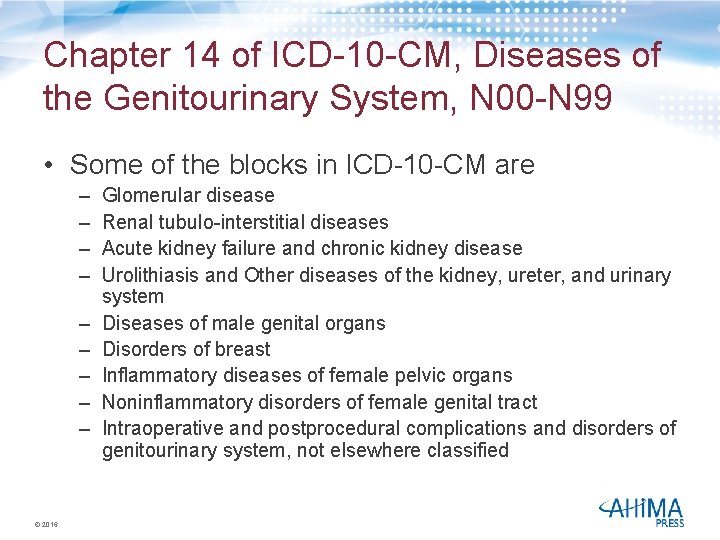
Chapter 14 of ICD-10 -CM, Diseases of the Genitourinary System, N 00 -N 99 • Some of the blocks in ICD-10 -CM are – – – – – © 2016 Glomerular disease Renal tubulo-interstitial diseases Acute kidney failure and chronic kidney disease Urolithiasis and Other diseases of the kidney, ureter, and urinary system Diseases of male genital organs Disorders of breast Inflammatory diseases of female pelvic organs Noninflammatory disorders of female genital tract Intraoperative and postprocedural complications and disorders of genitourinary system, not elsewhere classified
Chapter 14 of ICD-10 -CM • Contains diseases and disorders of – – Urinary system Male and female reproductive system Disorders of the breast Complications occurring in the intraoperative and postoperative period • Specificity includes identification of patient’s gender for certain disorders © 2016
Coding Instruction for ICD-10 -CM Chapter 14 • Instructional nodes appear throughout the chapter to indicate when additional code should occur, for example: – N 00 -N 08, Glomerular disease – code also any associated kidney failure – N 10, Acute tubule-interstitial nephritis – used additional code to identify infectious agent – N 17, Acute kidney failure – code also associated underlying condition – N 18, Chronic kidney disease – code first any associated underlying condition, such as diabetic chronic kidney disease or hypertensive chronic kidney disease, and use additional code to identify kidney transplant status – N 30, Cystitis – use additional code to identify infectious agent – N 31, Neuromuscular dysfunction of bladder, NEC – use additional code to identify any associated urinary incontinence © 2016
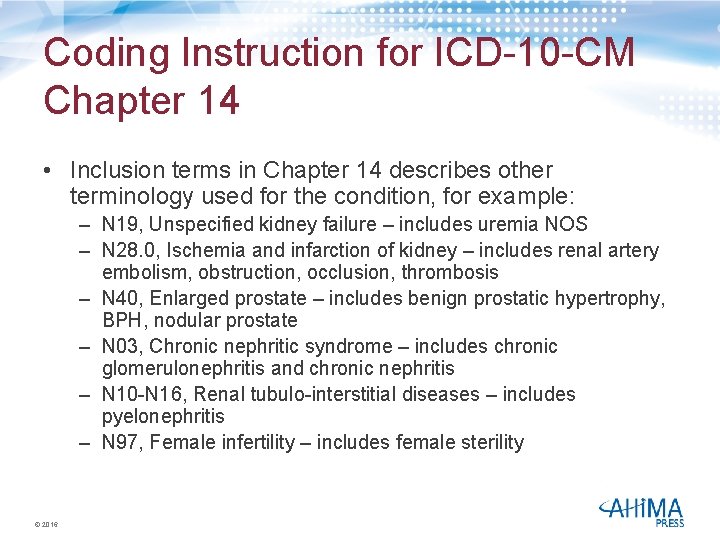
Coding Instruction for ICD-10 -CM Chapter 14 • Inclusion terms in Chapter 14 describes other terminology used for the condition, for example: – N 19, Unspecified kidney failure – includes uremia NOS – N 28. 0, Ischemia and infarction of kidney – includes renal artery embolism, obstruction, occlusion, thrombosis – N 40, Enlarged prostate – includes benign prostatic hypertrophy, BPH, nodular prostate – N 03, Chronic nephritic syndrome – includes chronic glomerulonephritis and chronic nephritis – N 10 -N 16, Renal tubulo-interstitial diseases – includes pyelonephritis – N 97, Female infertility – includes female sterility © 2016
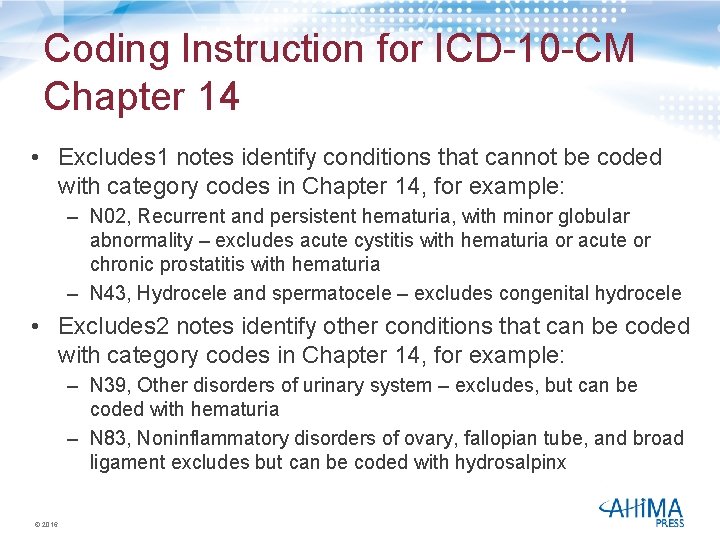
Coding Instruction for ICD-10 -CM Chapter 14 • Excludes 1 notes identify conditions that cannot be coded with category codes in Chapter 14, for example: – N 02, Recurrent and persistent hematuria, with minor globular abnormality – excludes acute cystitis with hematuria or acute or chronic prostatitis with hematuria – N 43, Hydrocele and spermatocele – excludes congenital hydrocele • Excludes 2 notes identify other conditions that can be coded with category codes in Chapter 14, for example: – N 39, Other disorders of urinary system – excludes, but can be coded with hematuria – N 83, Noninflammatory disorders of ovary, fallopian tube, and broad ligament excludes but can be coded with hydrosalpinx © 2016
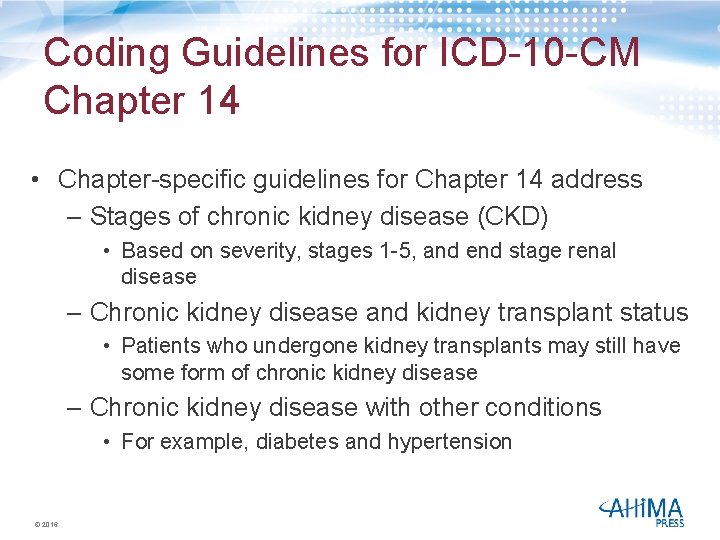
Coding Guidelines for ICD-10 -CM Chapter 14 • Chapter-specific guidelines for Chapter 14 address – Stages of chronic kidney disease (CKD) • Based on severity, stages 1 -5, and end stage renal disease – Chronic kidney disease and kidney transplant status • Patients who undergone kidney transplants may still have some form of chronic kidney disease – Chronic kidney disease with other conditions • For example, diabetes and hypertension © 2016
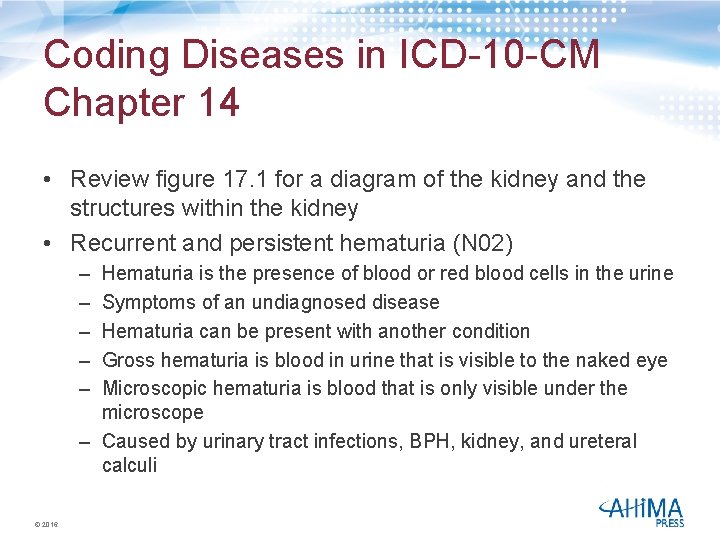
Coding Diseases in ICD-10 -CM Chapter 14 • Review figure 17. 1 for a diagram of the kidney and the structures within the kidney • Recurrent and persistent hematuria (N 02) – – – Hematuria is the presence of blood or red blood cells in the urine Symptoms of an undiagnosed disease Hematuria can be present with another condition Gross hematuria is blood in urine that is visible to the naked eye Microscopic hematuria is blood that is only visible under the microscope – Caused by urinary tract infections, BPH, kidney, and ureteral calculi © 2016
Coding Diseases in ICD-10 -CM Chapter 14 • Review figure 17. 2 that illustrated the organs of the urinary system • Acute Kidney Failure and Chronic Kidney Disease (N 17 N 19) • Kidneys have problems eliminating metabolic products from the blood • May be caused by various underlying diseases, such as hypertension and diabetes • Specific codes for the five stages of chronic kidney disease and end-stage renal disease © 2016
Coding Diseases in ICD-10 -CM Chapter 14 • Acute kidney failure also described as nontraumatic acute kidney injury (AKI) • Symptoms include oliguria and anuria with hyperkalemia and pulmonary edema • AKI causes waste products to collect in the blood • Build up of fluids affects the heart, lungs, brains, and other organs from functioning properly • AKI typically is corrected when the underlying kidney is treated • Causes include hypotension, blood/fluid loss, heart attack, heart failure, use of certain drugs, allergic reactions, burns, injuries, etc. © 2016
Coding Diseases in ICD-10 -CM Chapter 14 • Cystitis (N 30) • Inflammation of the urinary bladder • Most common in women, mostly due to vaginal infections that extend through the urethra to the bladder • Cystitis in men is due to urethral or prostatic infections or catheterizations • Review figure 17. 3 for a diagram of the urinary bladder • Codes identify the type, severity and location of the infection, whether or not hematuria is present with cystitis • Use an additional code to identify the infectious agent (B 95 B 97) © 2016
Coding Diseases in ICD-10 -CM Chapter 14 • • Enlarged prostate (N 40) Also known as benign prostatic hypertrophy Occurring in men by the age of 60 years and later Prostate enlarges and presses on the urethra, obstructing the flow of urine from the bladder and causing difficulty urinating – May be described as benign bladder neck obstruction • Symptoms of an enlarged prostate referred to as lower urinary tract symptoms and codes identify the enlarged or nodular prostate with or without lower urinary tract symptoms © 2016
Coding Diseases in ICD-10 -CM Chapter 14 • Disorders of the breast (N 60 -N 65) • Review figure 17. 4 for structures within the breast • Includes breast disease such as mastrodynia, induration of breast, nipple discharge, for example • Neoplasms of the breast are classified to chapter 2, neoplasms • Specific codes describe conditions of the breast related to staged breast reconstruction © 2016
Coding Diseases in ICD-10 -CM Chapter 14 • Inflammatory disease of female pelvic organs (N 70 -N 77) • Infections in this section are acute salpingitis, endometritis, acute, and chronic parametritis and pelvic cellulitis • Use additional code (B 95 -B 97) to identify infectious agent • Codes distinguish between acute and chronic forms of disease • Some inflammatory diseases are the result of another disease, for example, see category N 74 where there is a “code first underlying disease” note • Figure 17. 5 illustrates the body cavities in the female body © 2016
Coding Diseases in ICD-10 -CM Chapter 14 • Noninflammatory disorders of female genital tract (N 80 -N 98) • Examples of noninflammatory disorders are – Endometriosis, lining of the uterus outside the uterus – Female genital prolapse – Fistula involving female genital tract – Cysts of the ovary – Polyps in the female genital tract © 2016
Coding Diseases in ICD-10 -CM Chapter 14 • Dysplasia of cervix uteri (N 87) and vulva (N 90) • CIN I, cervical intraepithelial neoplasia I • CIN II, moderate cervical intraepithelial neoplasia II • CIN III, severe cervical dysplasia is classified to D 06 for carcinoma in situ of cervix • Vulvar intraepithelial neoplasia I and II • Severe dysplasia of vulva is coded to D 07. 1 as a neoplasm © 2016
Coding Diseases in ICD-10 -CM Chapter 14 • Menopause or menopausal syndrome • Defined as occurring 12 months after the last menstrual period and marks the end of menstrual cycles • Average for menopause is 51 years old • Code N 59. 1 has “use additional code” note to add codes for associated symptoms • Menopause is result of natural aging process or as an artificially induced menopause after surgical removal of uterus and ovaries • The fact the woman is experiencing symptoms as a result of menopausal process or is asymptomatic is required to code correctly © 2016
Coding Diseases in ICD-10 -CM Chapter 14 • Intraoperative and postprocedural complications examples: – – – Postprocedural (acute) (chronic) kidney failure Postprocedural urethral stricture Postprocedural adhesions of vagina Prolapse of vaginal vault after hysterectomy Complications of stoma of urinary tract Intraoperative hemorrhage and hematoma of a genitourinary system organ or structure complicating a procedure – Accidental puncture and laceration of a genitourinary system organ or structure during a procedure © 2016
ICD-10 -PCS Coding for Procedures Related to the Genitourinary System • In this chapter, there are procedures for the urinary system, female reproductive system, and male reproductive system • Root operations vary depending on these what part of the genitourinary system is being coded • Review table 17. 1 for the genitourinary system root operations in – Urinary system – Female reproductive system – Male reproductive system • Body parts include laterality • More common approach is endoscopic through a natural orifice © 2016
ICD-10 -PCS Coding for Procedures Related to the Genitourinary System • PCS section for urinary system (0 T 1 -0 TY) • Root operations in character 3 (see Table 17. 2) include – Bypass, change, destruction, dilation, division – Drainage, excision, extirpation, extraction – Fragmentation, insertion, inspection, occlusion – Reattachment, release, removal, repair, – Replacement, reposition, resection – Supplement, restriction, revision, transplantation © 2016
ICD-10 -PCS Coding for Procedures Related to the Genitourinary System • Character 4 identifies the body part involved in the procedure is shown in table 17. 3 – – – – – © 2016 Kidney right and left Kidney bilateral Kidney pelvis right and left Kidney Ureter right and left Ureters bilateral Ureter Bladder and bladder neck Urethra
ICD-10 -PCS Coding for Procedures Related to the Genitourinary System • Character 5 identifies the approach used in the procedure • See Table 17. 4 for the approaches – – – © 2016 Open Percutaneous endoscopic Via natural or artificial opening endoscopic External
ICD-10 -PCS Coding for Procedures Related to the Genitourinary System • Character 6 identifies the device if used in the procedure • See Table 17. 5 for the devices – – – – – © 2016 Drainage device Monitoring device Infusion device Autologous tissue substitute and Nonautologous tissue substitute Extraluminal device Intraluminal device Synthetic substitute Artificial sphincter Stimulator lead Other device and No device
ICD-10 -PCS Coding for Procedures Related to the Genitourinary System • Character 7 is a qualifier that specifies an additional attribute of the procedure; see table 17. 6 for possible qualifiers – – – – – © 2016 Allogeneic and syngeneic Zooplastic Kidney pelvis, right and left Ureter, right and left Colon and colocutaneous Ileum and ileocutaneous Bladder Cutaneous Diagnostic and No qualifier
- Slides: 25