
Basic Group Work Theory One definition of a
Basic Group Work Theory One definition of a Group: “A Group is a dynamic social entity composed of two or more individuals. These individuals interact interdependently to achieve one or more common goals for the group, or similar individual goals. . . each member influences and is influenced by every other member to some degree. ” Bertcher The Group process involves sharing and trust building, decision making issues and feelings of intimacy.

A Group offers members: - a place in which psychosocial difficulties can be resolved. - a place where their need for acceptance are met. - a place where they have membership, a sense of belonging. - a place where they can fulfill a role (role replacement) - emotional support - role model possibilities - new ideas for dealing with problems or situations.

In many groups typical roles develop such as: the organizational leader, the emotional leader, the black sheep, the mediator, etc. Values and norms that develop in a Group make for a feeling of cohesion. These group “rules” provide the sense of belonging. A Group should be a safe environment where the common needs are met. Indigenous Leadership develops within a group. A group atmosphere is one in which respect for one another in encouraged and where members support one another. Membership is closed - selection of group members is done carefully based on certain criteria. One has a homogeneous population.
SELECTION OF GROUP MEMBERS • Primarily use Time Confused individuals • 4 -6 People (begin with fewer) • 1 or 2 Individuals who are in Repetitive Motion • 1 Validation Group leader • 1 or 2 Co-Workers Members must: • feel comfortable in an intimate atmosphere where many feelings are being expressed; • enjoy being with other people. • It is best when at least half of the Group Members enjoy communicating verbally
GOALS OF A VALIDATION GROUP The stimulation of: • energy • social roles • identity • interaction • verbal behaviors • social controls • feelings of well being and happiness
GOALS OF A VALIDATION GROUP A group should also: • reduce fear • prevent vegetation • reduce the need for tranquillizers and other restraints • prevent staff burnout
ROLES Possible roles for group members: • Chairman • Hostess • Song Leader • Emotional Leader • Poetry reader • Secretary • Dance leader/ Activity leader • Advisor • Joke maker • Story teller
Roles and their purpose General points for all roles • Get respect and honor • Increase feelings of self-worth • Relive old behaviors • Resolve old issues
Roles and their purpose • • need for status, recognition, to be listened Welcomer to • expresses self through song/singing Song Leader • expresses self through caring for others, being solicitous - or - feeling useful and Hostess working, fulfilling an old role of being the hostess • expresses self through giving advice to Advisor others, being philosophical, caring or directive Activity Leader • gains energy, joy and a sense of community through movement, activities and other non-verbal expression Prayer Leader • gives and gets energy through prayer
The role and tasks of the group leader • • • To involve Staff. To have a group Validation on the same day, the same time, the same place, every time. To assign roles to members. To assign co-leaders To train co-leaders To be a stimulation (motivator). To facilitate interactions between group members. To maintain a safe environment.
The role and tasks of the group leader • • • To support roles of group members. To increase energy. To observe the emotions of group members. To prepare a topic. To instruct co-workers to support group members. • To stimulate nonverbal interaction between members using Validation techniques
The role and tasks of the group leader • To fill in Evaluation forms with co-workers. • To prepare for the next group validation. • To report about the group Validation to other staff members.

Co-Leaders in a Validation Group • assist in bringing people to and from the meeting • help with the movement/activity section of the program • sit next to the person who needs extra assistance • take people out of the group if they become disruptive • help evaluate progress after the meeting • help plan the next meeting • take over the leadership of the group when needed or planned
Co-Leaders in a Validation Group Skills to have or learn: • Centering • Calibration • Focusing of energy • Validation techniques, particularly ‘mirroring’ and the use of ‘anchored touch’ • Know the group songs by heart
SEATING ORDER Points to take into consideration: • • Friends/antagonists Energy A circle Equilibrium between all group members • Physical difficulties (hard of hearing, blind) • Emotional difficulties (crying, whining) • People in Repetitive Motion • Logistics (snacks, the door, windows) • Connections between people • Chairs should be close together • Eye contact should be easy to make • Physical contact should be easy
SEATING ORDER What diminishes energy in the seating order: • Low energy people seated next to each other in one part of the circle • Chairs that are too far apart or too big • A table in the middle of the circle
GROUP AGENDA Before V/W visits each group member Prepare the room and materials • The V/W greets each group member remind them of their roles - touch each group member • The Chairman stands and greets the group. • The Song Leader begins the opening song (always the same) • Poem or Prayer?
GROUP AGENDA • Verbal Interaction present the discussion topic solve a common problem • Summarize what was said • Activity/Movement/Music • Refreshments
GROUP AGENDA • • Song Leader beings the closing song Chairman closes the meeting V/W says goodbye to each Group member The group members are brought to a social situation After each group meeting – feedback and evaluation
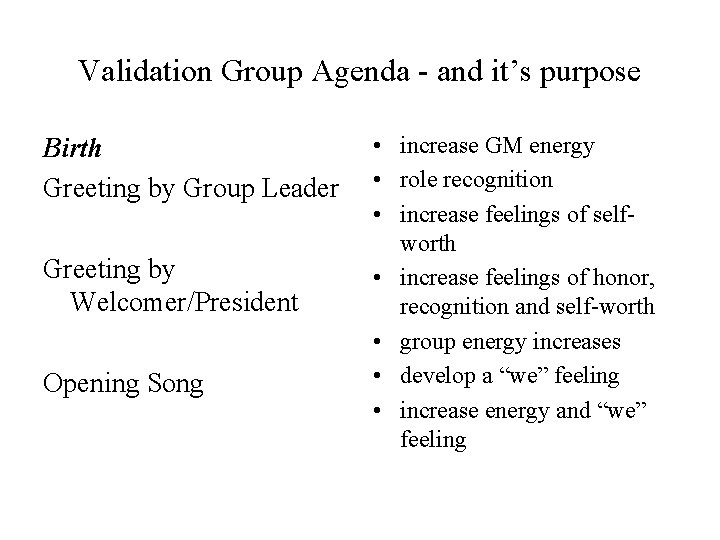
Validation Group Agenda - and it’s purpose Birth Greeting by Group Leader Greeting by Welcomer/President Opening Song • increase GM energy • role recognition • increase feelings of selfworth • increase feelings of honor, recognition and self-worth • group energy increases • develop a “we” feeling • increase energy and “we” feeling
Validation Group Agenda - and it’s purpose Life • Theme/Discussion • increase verbal communication • solve a problem together • exchange of feelings • offer the possibility to express feelings
Validation Group Agenda - and it’s purpose Life • Activity • increase energy through physical movement • create a “we” feeling through non-verbal communication
Validation Group Agenda - and it’s purpose Life • Refreshments • Increases familiar social behavior • Create interaction in a relaxed way • ‘small talk’ or ‘cocktail party’ talk.
Validation Group Agenda - and it’s purpose Closing • Closing song • increase energy • create a “we” feeling • strengthen and anchor a positive mood • Closing words • give a feeling of closure • maintain a strong, positive energy • continue the feeling of community • build a bridge to the next meeting
CHOOSING TOPICS Criteria: • Emotional core • Not time or seasonally oriented • Phrased as a problem to solve • Tied to universal needs, feelings or unfinished issues • Always have a backup topic, ‘plan B’ • Flexibly shift with GM when the topic changes • Try to use a topic that was expressed by a GM that day
REQUIREMENTS FOR A GROUP • • • a closed, private room enough chairs for all Group members refreshments tape or CD player and music equipment for the activity Validation Group folder
REQUIREMENTS FOR A GROUP • preparation of the Group members before the meeting • help in bringing the Group members to and from the meeting • time after the meeting to evaluate • agreements with personnel about not interrupting the meeting • agreements about reporting on the progress of your group to other staff members
Tips to avoid logistical pitfalls • Always allow yourself enough time to set up. This way you can solve potential problems before they occur. • Work with other departments to prevent scheduling conflicts before they occur. (Therapy, Dietary, Activities) • Know your residents. Do they have glasses, hearing aids, or dietary restrictions? Plan for these things. • Leave written weekly reminders for the unit staff. Be specific about residents, times and places. The staff get busy, don’t assume they will remember
Tips to avoid logistical pitfalls • Plan what you will need for the next week after the current meeting; decide who will be responsible for what. • Arrange for your follow-up activity if it is not a meal. Be sure they are expecting your members. • Work with families to avoid visits during group time when you can. • If the side effects from the medication are a problem, take time to review the facility’s policies and procedure with the nursing staff. Most likely, there are ways to fix this problem.
- Slides: 29