
Basic grammar The indefinite form a or an
Basic grammar
The indefinite form = a or an

The indefinite form ’a’ is used before consonant sounds a picture a red apple a university
The indefinite form ’an’ is used before vowel sounds an alien an hour
The indefinite form • The indefinite article is more common in English than in Swedish. • It’s used before occupation, nationality, religious belonging and other ’roles’. I’m a mother. (Jag är mamma) My sister is a nurse. (Min syster är sjuksköterska) Assem is a Muslim. (Assem är muslim)
The indefinite form • It’s also usually used before countable nouns. I watched a film before going to bed last night. Jag tittade på film innan jag gick och la mig igår kväll. • It’s is also used in many expressions. We’ll need to walk at a slow pace. Vi måste gå i lugn takt.
The indefinite form Exercise: _____ umbrella _____ tiger _____ interesting film _____ young boy
The indefinite form Exercise: an a umbrella tiger interesting film young boy
Singular - plural The most common plural form is –s one car – two cars one rocket – two rockets
Singular - plural Nouns that end with an s-sound or similar have the plural ending –es one kiss – two kisses one couch – two couches
Singular - plural Nouns that end with a consonant + y have the plural ending –ies one baby – three babies NB! Vowel + y have normal plural ending (-s) one toy – two toys
Singular - plural Most nouns that end with -o have normal plural ending (-s) one kilo – two kilos Some nouns with the ending –o have the plural ending –es one potato – two potatoes
Singular - plural Most nouns that end with -f or -fe have normal plural ending one roof – two roofs Some nouns that end with –f or –fe have the plural ending –ves one knife – two knives
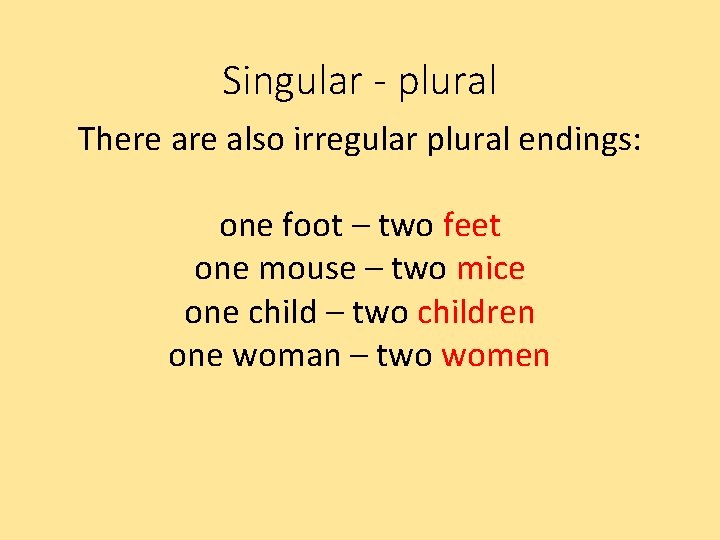
Singular - plural There also irregular plural endings: one foot – two feet one mouse – two mice one child – two children one woman – two women
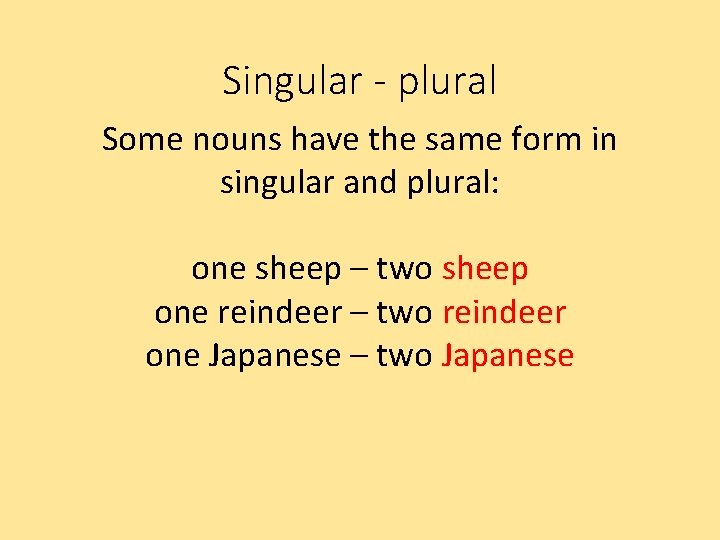
Singular - plural Some nouns have the same form in singular and plural: one sheep – two sheep one reindeer – two reindeer one Japanese – two Japanese
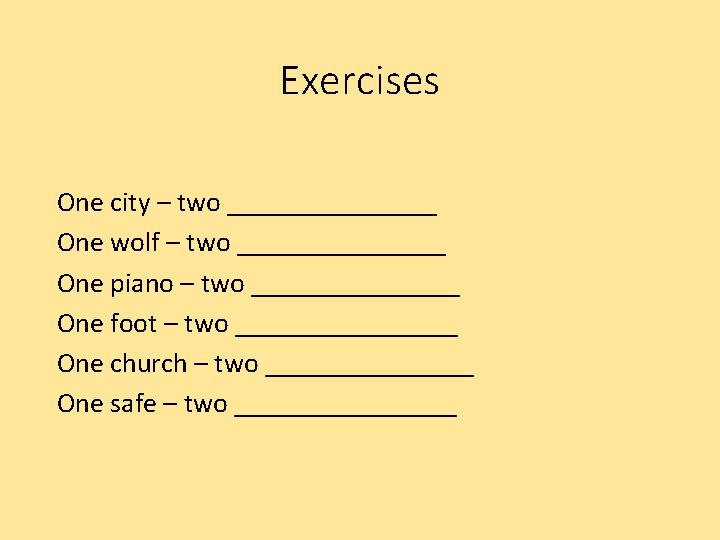
Exercises One city – two ________ One wolf – two ________ One piano – two ________ One foot – two ________ One church – two ________ One safe – two ________
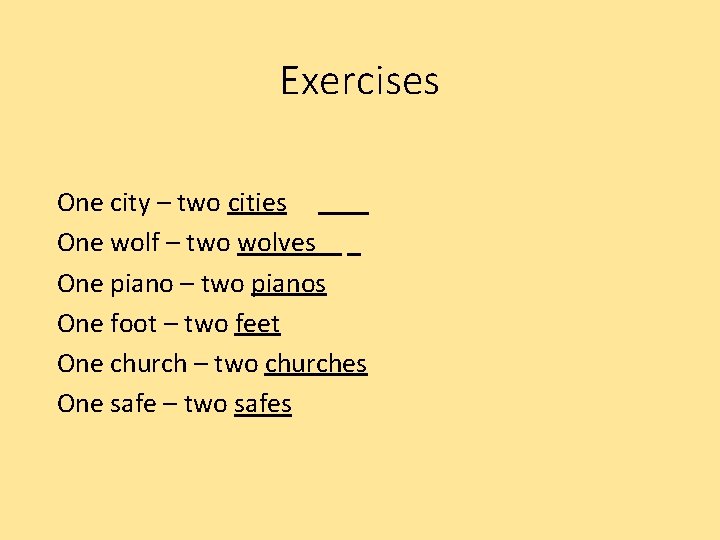
Exercises One city – two cities One wolf – two wolves One piano – two pianos One foot – two feet One church – two churches One safe – two safes
The auxiliary verb ’do’ • ’Do’ is mainly used in questions and negative sentences, and not normally in affirmative sentences. I work tonight. Do you work tonight? I don’t work tonight.
The auxiliary verb ’do’ • ’Do’ CAN be used in affirmative sentences, but with a specific meaning. I really did like the movie, honestly! • Remember that the main verb is always infinitive after auxiliary verbs. Could you help that man last night?
Relative pronouns • = who, whom, which, that, whose • Relative pronouns refer back to single words/expressions or entire clauses. There is a boy in my class who likes skateboarding. She said she had seen him before, which was a lie.
Relative pronouns • Who/whom is used to refer back to people. I know someone who can help you. • Which is used to refer back to items (and animals). The house, which my brother bought, is in Hove.
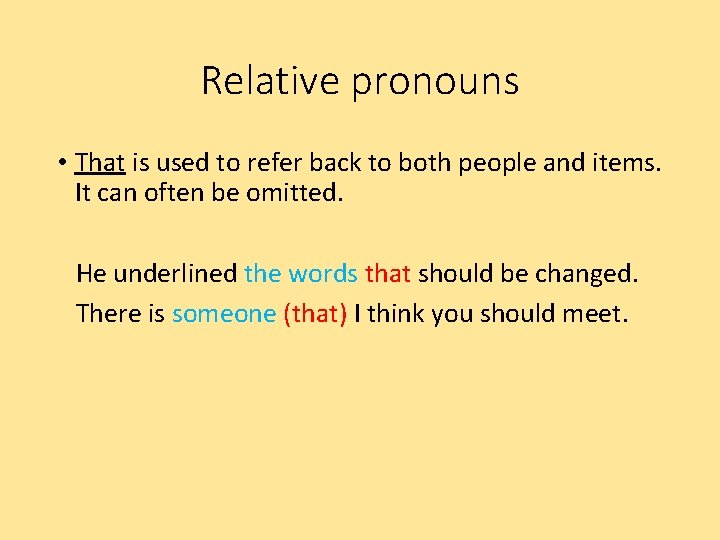
Relative pronouns • That is used to refer back to both people and items. It can often be omitted. He underlined the words that should be changed. There is someone (that) I think you should meet.
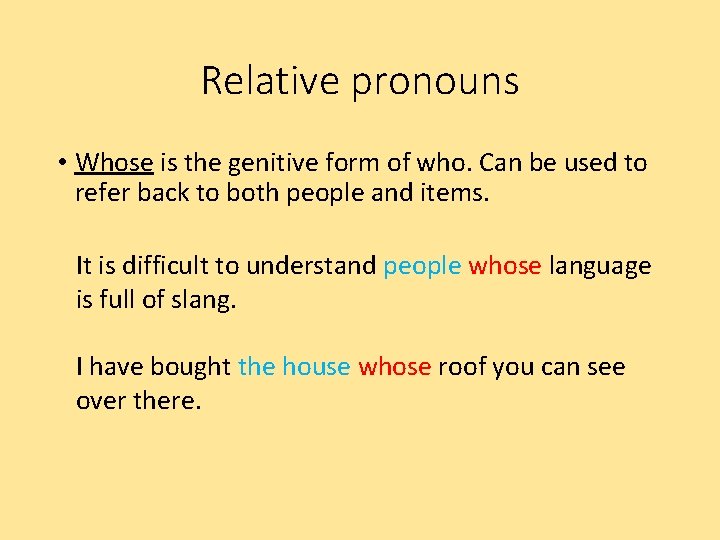
Relative pronouns • Whose is the genitive form of who. Can be used to refer back to both people and items. It is difficult to understand people whose language is full of slang. I have bought the house whose roof you can see over there.
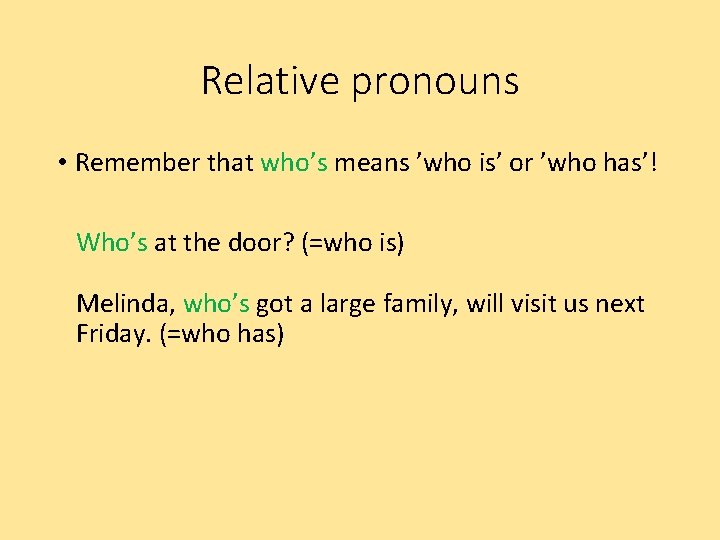
Relative pronouns • Remember that who’s means ’who is’ or ’who has’! Who’s at the door? (=who is) Melinda, who’s got a large family, will visit us next Friday. (=who has)
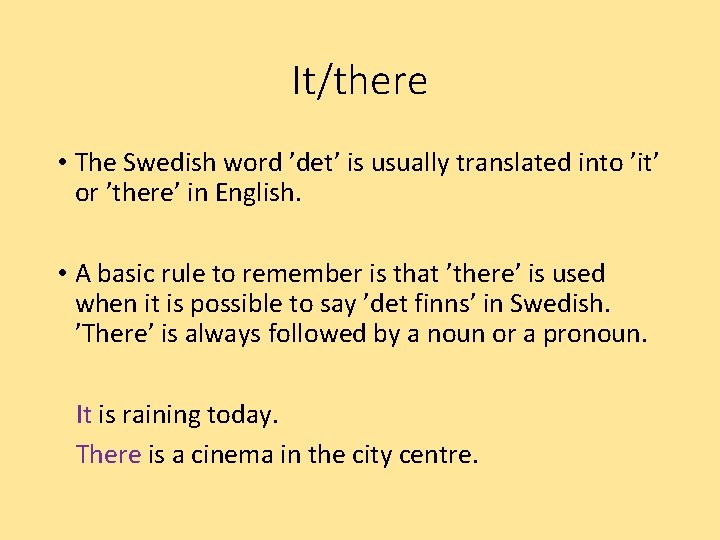
It/there • The Swedish word ’det’ is usually translated into ’it’ or ’there’ in English. • A basic rule to remember is that ’there’ is used when it is possible to say ’det finns’ in Swedish. ’There’ is always followed by a noun or a pronoun. It is raining today. There is a cinema in the city centre.
- Slides: 25