
Basic Geometry Review For Trigonometry Students 16 June
Basic Geometry Review For Trigonometry Students 16 June 2010 Ventura College Mathematics Department 1
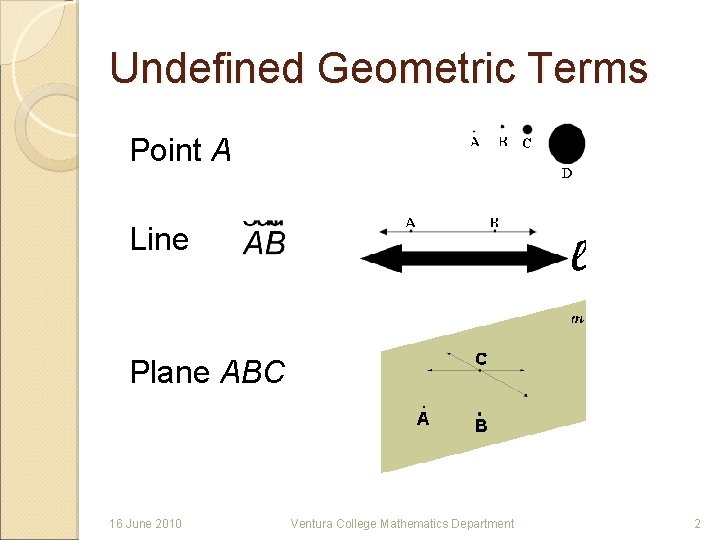
Undefined Geometric Terms Point A Line Plane ABC 16 June 2010 Ventura College Mathematics Department 2
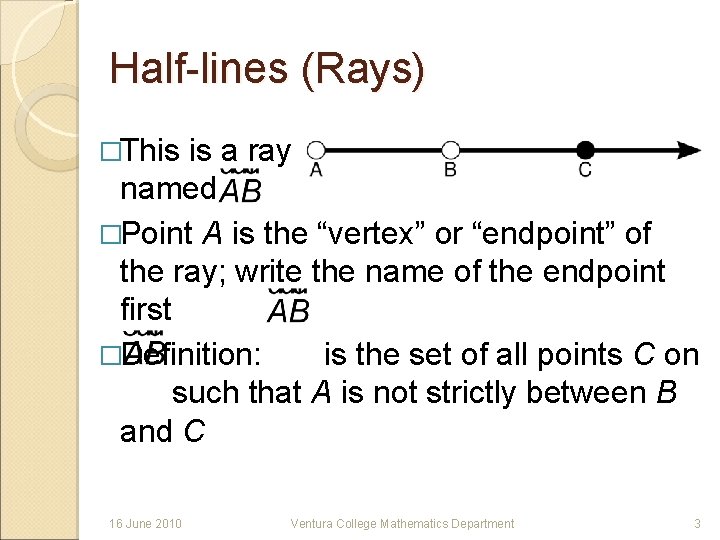
Half-lines (Rays) �This is a ray named �Point A is the “vertex” or “endpoint” of the ray; write the name of the endpoint first �Definition: is the set of all points C on such that A is not strictly between B and C 16 June 2010 Ventura College Mathematics Department 3
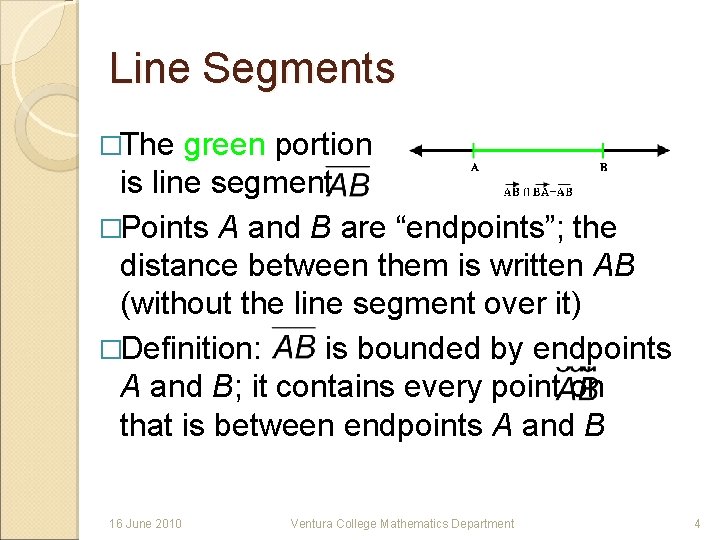
Line Segments �The green portion is line segment �Points A and B are “endpoints”; the distance between them is written AB (without the line segment over it) �Definition: is bounded by endpoints A and B; it contains every point on that is between endpoints A and B 16 June 2010 Ventura College Mathematics Department 4
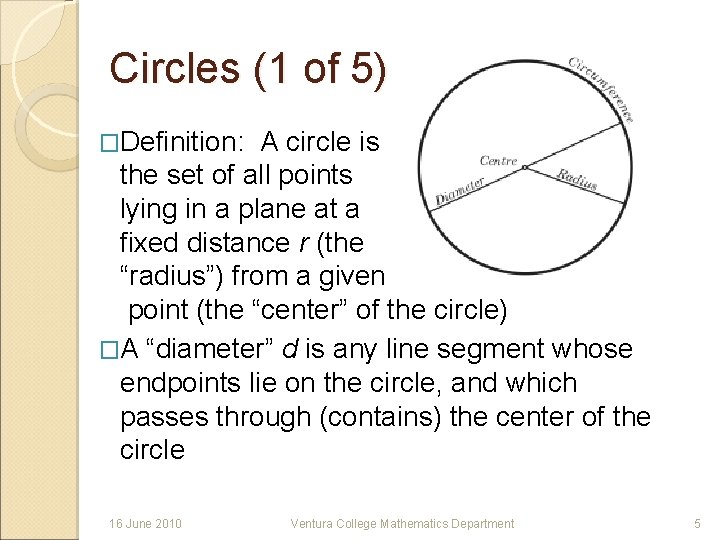
Circles (1 of 5) �Definition: A circle is the set of all points lying in a plane at a fixed distance r (the “radius”) from a given point (the “center” of the circle) �A “diameter” d is any line segment whose endpoints lie on the circle, and which passes through (contains) the center of the circle 16 June 2010 Ventura College Mathematics Department 5
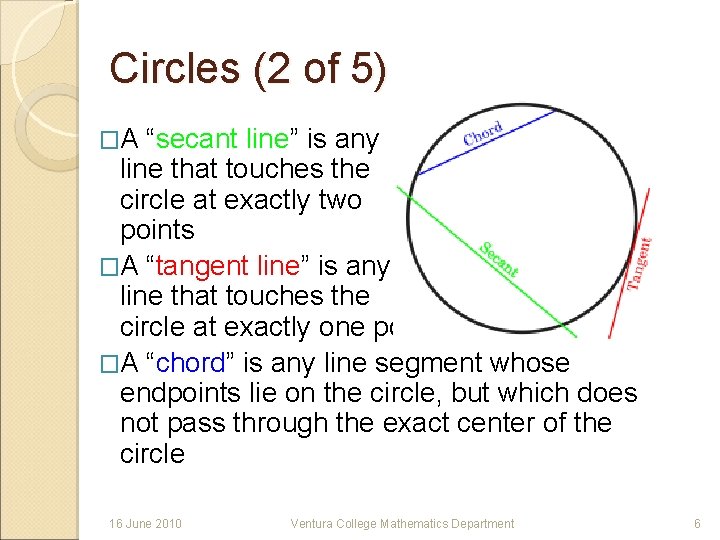
Circles (2 of 5) �A “secant line” is any line that touches the circle at exactly two points �A “tangent line” is any line that touches the circle at exactly one point �A “chord” is any line segment whose endpoints lie on the circle, but which does not pass through the exact center of the circle 16 June 2010 Ventura College Mathematics Department 6
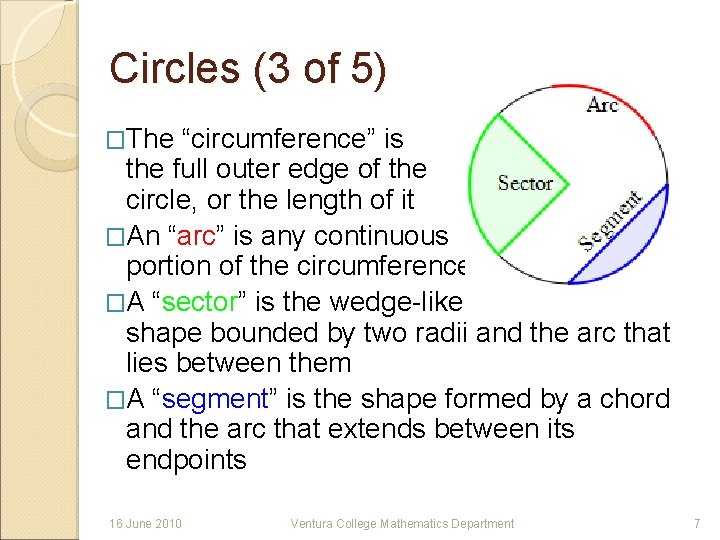
Circles (3 of 5) �The “circumference” is the full outer edge of the circle, or the length of it �An “arc” is any continuous portion of the circumference �A “sector” is the wedge-like shape bounded by two radii and the arc that lies between them �A “segment” is the shape formed by a chord and the arc that extends between its endpoints 16 June 2010 Ventura College Mathematics Department 7
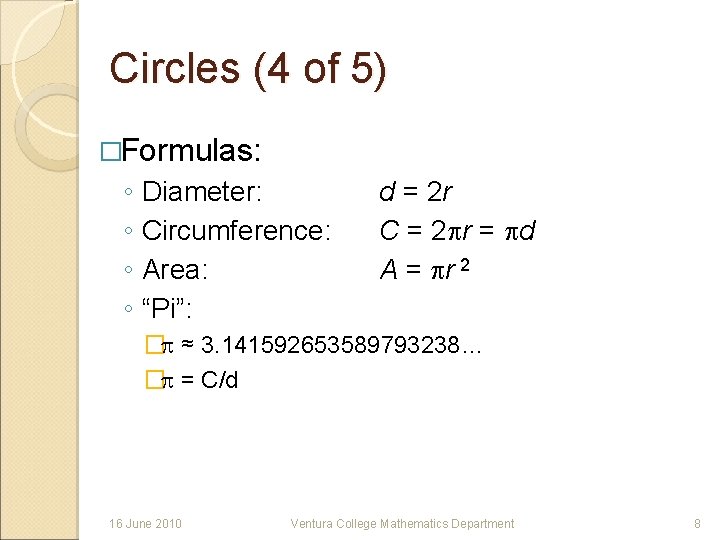
Circles (4 of 5) �Formulas: ◦ Diameter: ◦ Circumference: ◦ Area: ◦ “Pi”: d = 2 r C = 2 r = d A = r 2 � ≈ 3. 141592653589793238… � = C/d 16 June 2010 Ventura College Mathematics Department 8
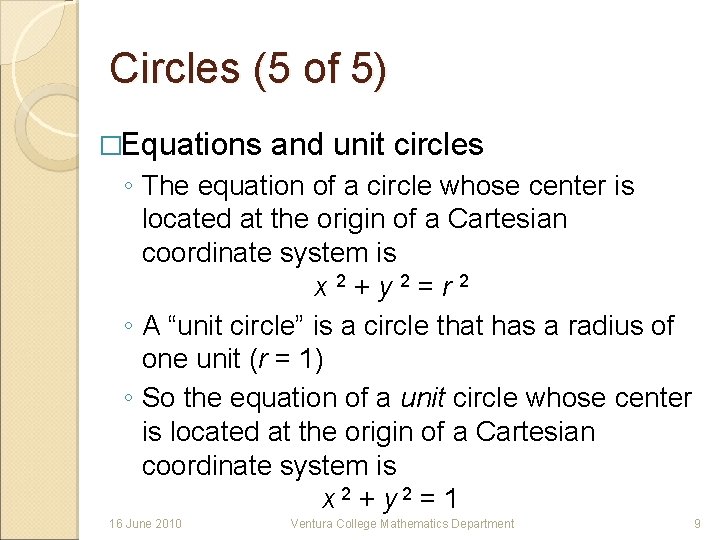
Circles (5 of 5) �Equations and unit circles ◦ The equation of a circle whose center is located at the origin of a Cartesian coordinate system is x 2+y 2=r 2 ◦ A “unit circle” is a circle that has a radius of one unit (r = 1) ◦ So the equation of a unit circle whose center is located at the origin of a Cartesian coordinate system is x 2 + y 2 = 1 16 June 2010 Ventura College Mathematics Department 9
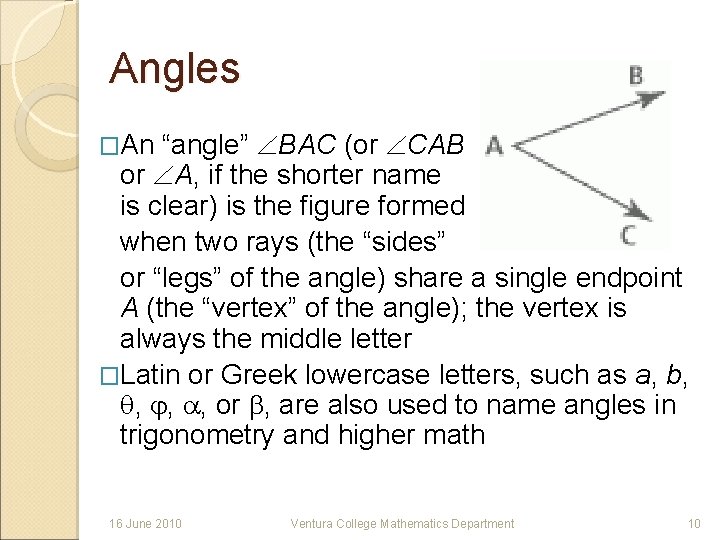
Angles “angle” BAC (or CAB or A, if the shorter name is clear) is the figure formed when two rays (the “sides” or “legs” of the angle) share a single endpoint A (the “vertex” of the angle); the vertex is always the middle letter �Latin or Greek lowercase letters, such as a, b, , or , are also used to name angles in trigonometry and higher math �An 16 June 2010 Ventura College Mathematics Department 10
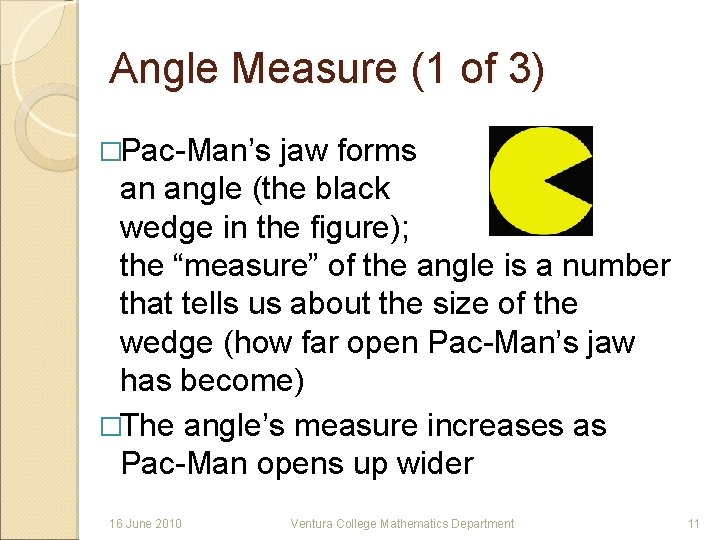
Angle Measure (1 of 3) �Pac-Man’s jaw forms an angle (the black wedge in the figure); the “measure” of the angle is a number that tells us about the size of the wedge (how far open Pac-Man’s jaw has become) �The angle’s measure increases as Pac-Man opens up wider 16 June 2010 Ventura College Mathematics Department 11
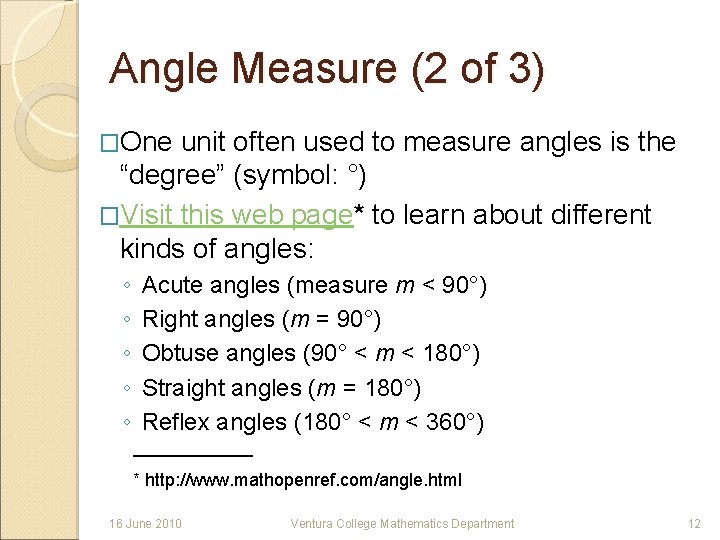
Angle Measure (2 of 3) �One unit often used to measure angles is the “degree” (symbol: °) �Visit this web page* to learn about different kinds of angles: ◦ ◦ ◦ Acute angles (measure m < 90°) Right angles (m = 90°) Obtuse angles (90° < m < 180°) Straight angles (m = 180°) Reflex angles (180° < m < 360°) ______ * http: //www. mathopenref. com/angle. html 16 June 2010 Ventura College Mathematics Department 12
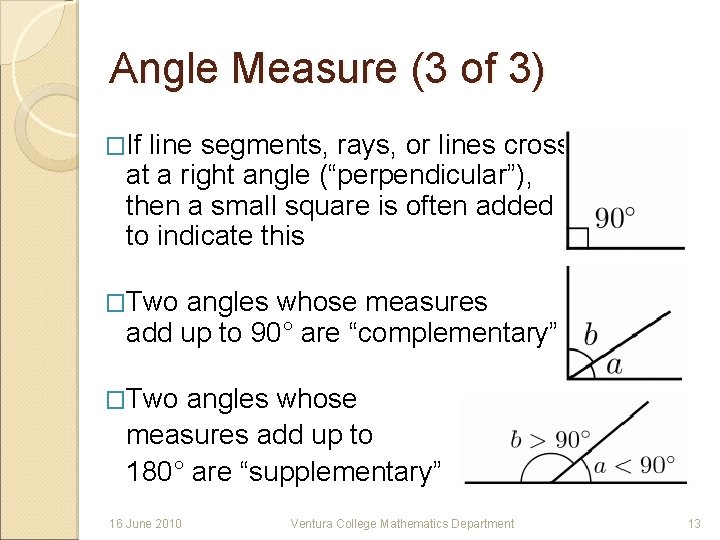
Angle Measure (3 of 3) �If line segments, rays, or lines cross at a right angle (“perpendicular”), then a small square is often added to indicate this �Two angles whose measures add up to 90° are “complementary” �Two angles whose measures add up to 180° are “supplementary” 16 June 2010 Ventura College Mathematics Department 13
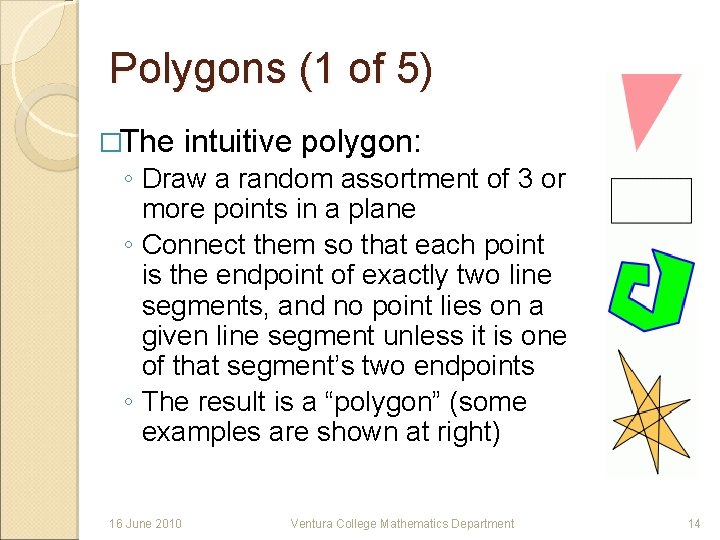
Polygons (1 of 5) �The intuitive polygon: ◦ Draw a random assortment of 3 or more points in a plane ◦ Connect them so that each point is the endpoint of exactly two line segments, and no point lies on a given line segment unless it is one of that segment’s two endpoints ◦ The result is a “polygon” (some examples are shown at right) 16 June 2010 Ventura College Mathematics Department 14
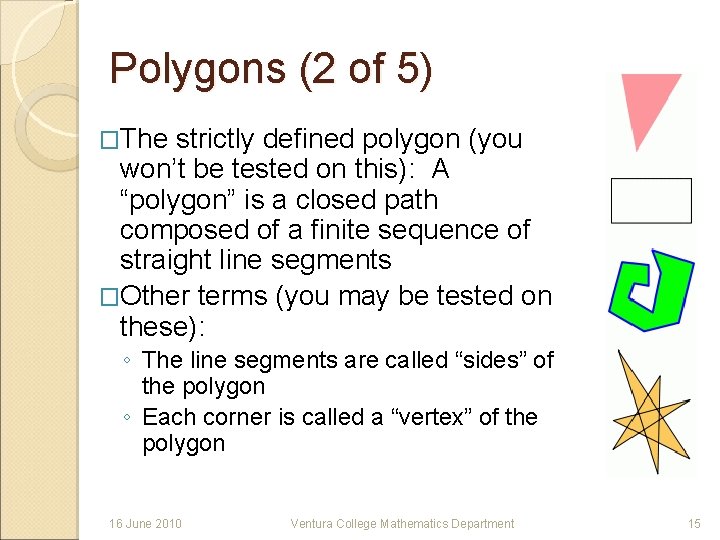
Polygons (2 of 5) �The strictly defined polygon (you won’t be tested on this): A “polygon” is a closed path composed of a finite sequence of straight line segments �Other terms (you may be tested on these): ◦ The line segments are called “sides” of the polygon ◦ Each corner is called a “vertex” of the polygon 16 June 2010 Ventura College Mathematics Department 15
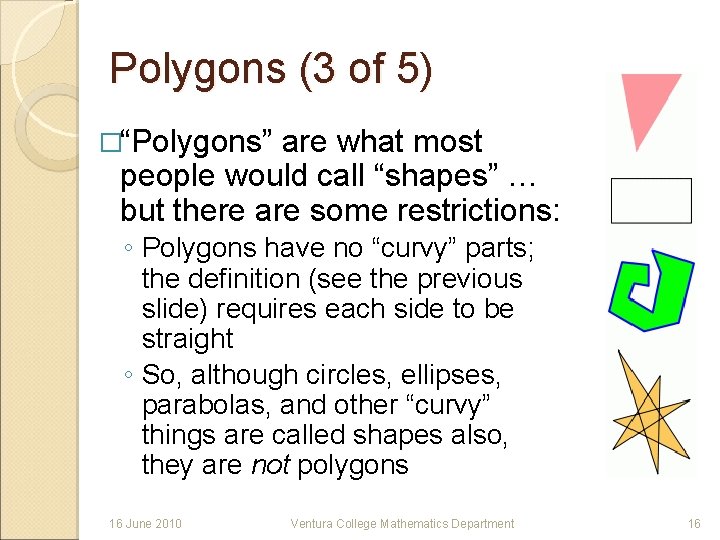
Polygons (3 of 5) �“Polygons” are what most people would call “shapes” … but there are some restrictions: ◦ Polygons have no “curvy” parts; the definition (see the previous slide) requires each side to be straight ◦ So, although circles, ellipses, parabolas, and other “curvy” things are called shapes also, they are not polygons 16 June 2010 Ventura College Mathematics Department 16
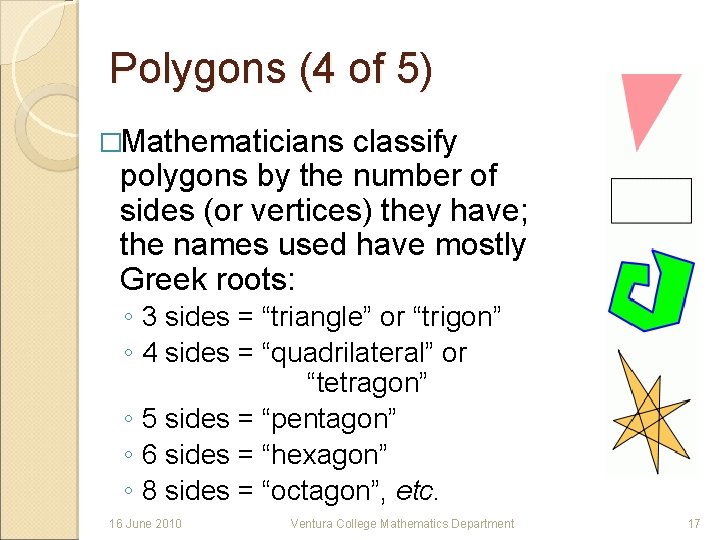
Polygons (4 of 5) �Mathematicians classify polygons by the number of sides (or vertices) they have; the names used have mostly Greek roots: ◦ 3 sides = “triangle” or “trigon” ◦ 4 sides = “quadrilateral” or “tetragon” ◦ 5 sides = “pentagon” ◦ 6 sides = “hexagon” ◦ 8 sides = “octagon”, etc. 16 June 2010 Ventura College Mathematics Department 17
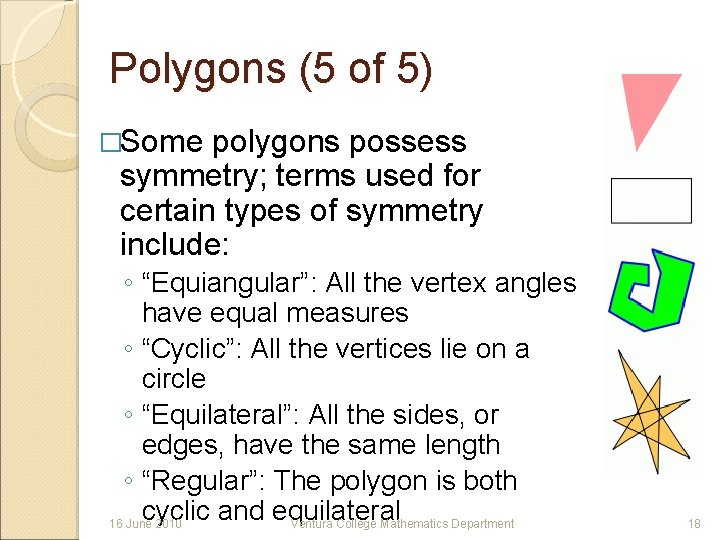
Polygons (5 of 5) �Some polygons possess symmetry; terms used for certain types of symmetry include: ◦ “Equiangular”: All the vertex angles have equal measures ◦ “Cyclic”: All the vertices lie on a circle ◦ “Equilateral”: All the sides, or edges, have the same length ◦ “Regular”: The polygon is both cyclic and equilateral 16 June 2010 Ventura College Mathematics Department 18
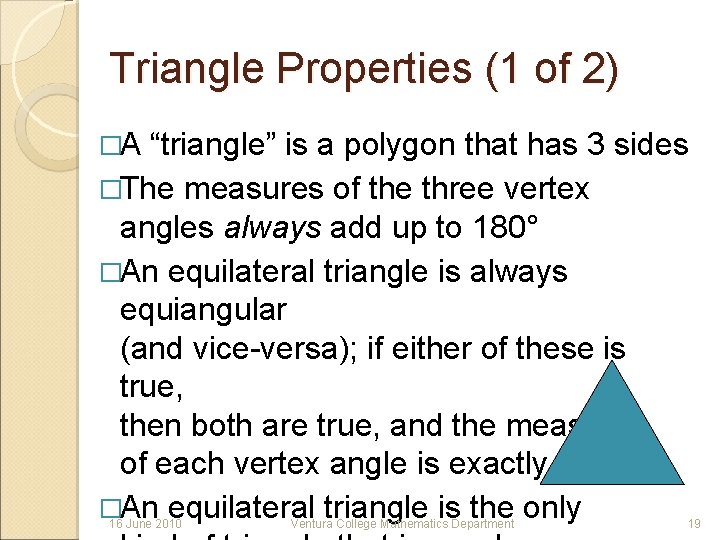
Triangle Properties (1 of 2) �A “triangle” is a polygon that has 3 sides �The measures of the three vertex angles always add up to 180° �An equilateral triangle is always equiangular (and vice-versa); if either of these is true, then both are true, and the measure of each vertex angle is exactly 60° �An equilateral triangle is the only 16 June 2010 Ventura College Mathematics Department 19
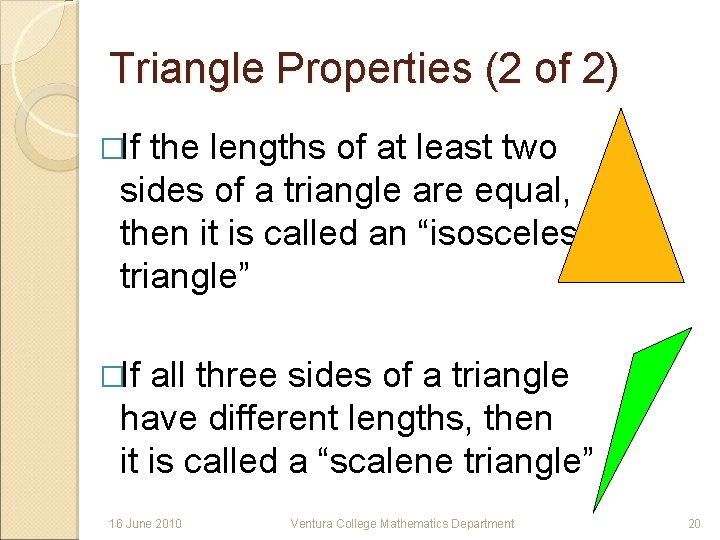
Triangle Properties (2 of 2) �If the lengths of at least two sides of a triangle are equal, then it is called an “isosceles triangle” �If all three sides of a triangle have different lengths, then it is called a “scalene triangle” 16 June 2010 Ventura College Mathematics Department 20
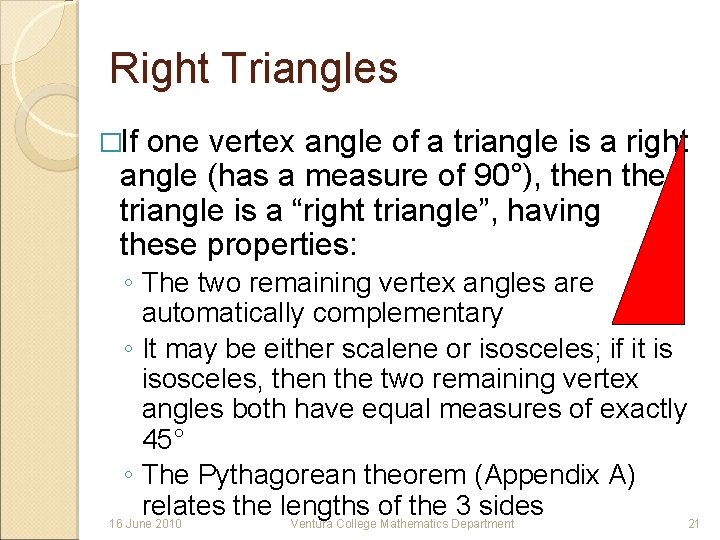
Right Triangles �If one vertex angle of a triangle is a right angle (has a measure of 90°), then the triangle is a “right triangle”, having these properties: ◦ The two remaining vertex angles are automatically complementary ◦ It may be either scalene or isosceles; if it is isosceles, then the two remaining vertex angles both have equal measures of exactly 45° ◦ The Pythagorean theorem (Appendix A) relates the lengths of the 3 sides 16 June 2010 Ventura College Mathematics Department 21
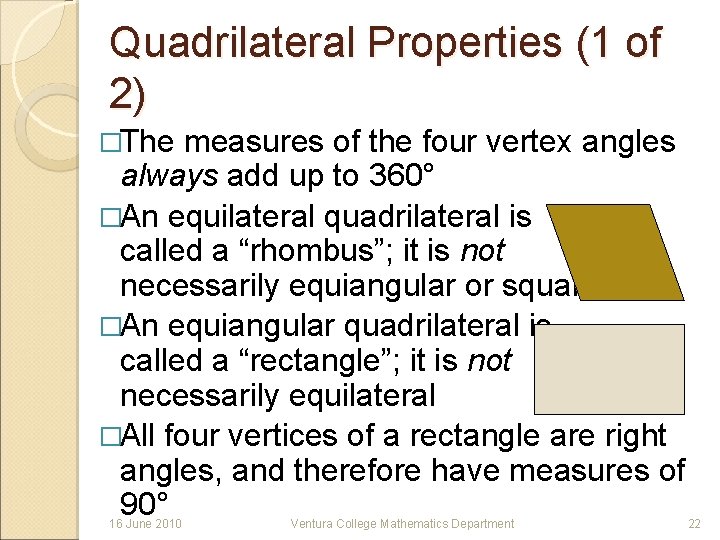
Quadrilateral Properties (1 of 2) �The measures of the four vertex angles always add up to 360° �An equilateral quadrilateral is called a “rhombus”; it is not necessarily equiangular or square �An equiangular quadrilateral is called a “rectangle”; it is not necessarily equilateral �All four vertices of a rectangle are right angles, and therefore have measures of 90° 16 June 2010 Ventura College Mathematics Department 22
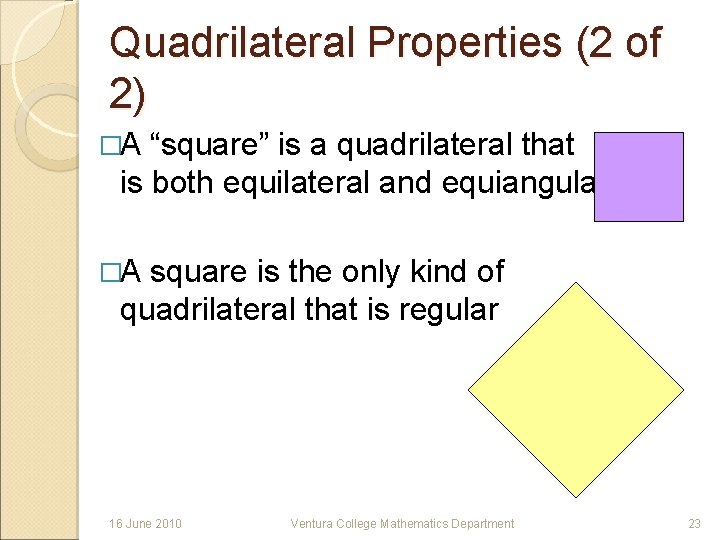
Quadrilateral Properties (2 of 2) �A “square” is a quadrilateral that is both equilateral and equiangular �A square is the only kind of quadrilateral that is regular 16 June 2010 Ventura College Mathematics Department 23
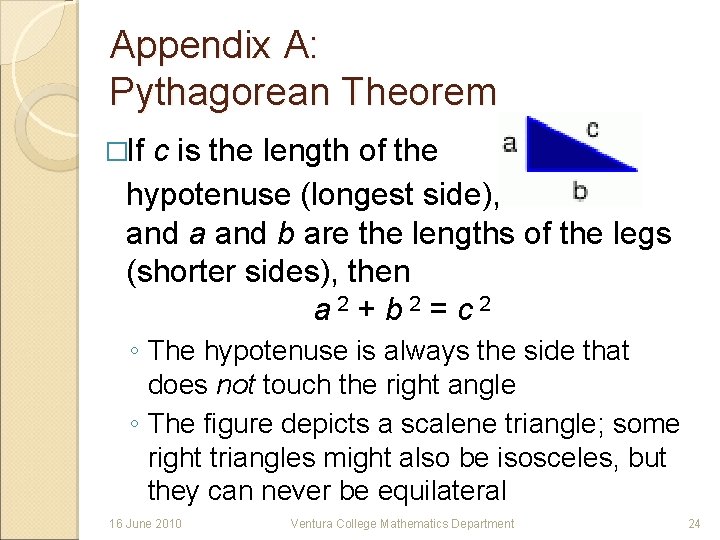
Appendix A: Pythagorean Theorem �If c is the length of the hypotenuse (longest side), and a and b are the lengths of the legs (shorter sides), then a 2 + b 2 = c 2 ◦ The hypotenuse is always the side that does not touch the right angle ◦ The figure depicts a scalene triangle; some right triangles might also be isosceles, but they can never be equilateral 16 June 2010 Ventura College Mathematics Department 24
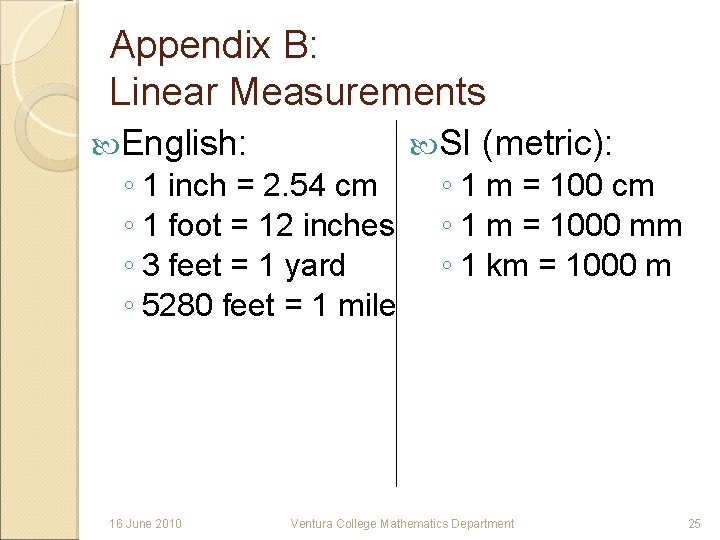
Appendix B: Linear Measurements English: SI ◦ 1 inch = 2. 54 cm ◦ 1 foot = 12 inches ◦ 3 feet = 1 yard ◦ 5280 feet = 1 mile 16 June 2010 (metric): ◦ 1 m = 100 cm ◦ 1 m = 1000 mm ◦ 1 km = 1000 m Ventura College Mathematics Department 25
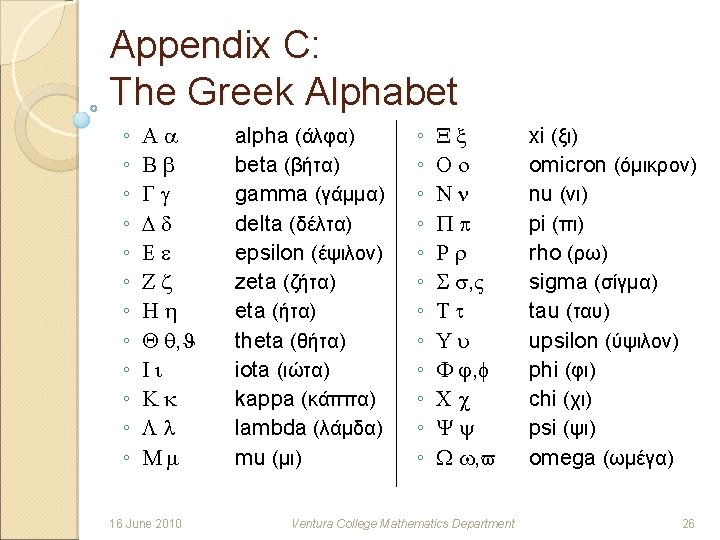
Appendix C: The Greek Alphabet ◦ ◦ ◦ , 16 June 2010 alpha (άλφα) beta (βήτα) gamma (γάμμα) delta (δέλτα) epsilon (έψιλον) zeta (ζήτα) eta (ήτα) theta (θήτα) iota (ιώτα) kappa (κάππα) lambda (λάμδα) mu (μι) ◦ ◦ ◦ , , , Ventura College Mathematics Department xi (ξι) omicron (όμικρον) nu (νι) pi (πι) rho (ρω) sigma (σίγμα) tau (ταυ) upsilon (ύψιλον) phi (φι) chi (χι) psi (ψι) omega (ωμέγα) 26
- Slides: 26