
Basic Geometry Review Basic Entities Scalars real numbers
Basic Geometry Review Basic Entities Scalars - real numbers • sizes/lengths/angles Vectors - typically 2 D, 3 D, 4 D • directions Points - typically 2 D, 3 D, 4 D • locations

Spaces Scalar field: formed by scalars and the operations between them (+, *). Vector space: formed by vectors, scalars, and the operations between them. Note: a purely abstract vector space has no notion of: distance, size, angle, or point!
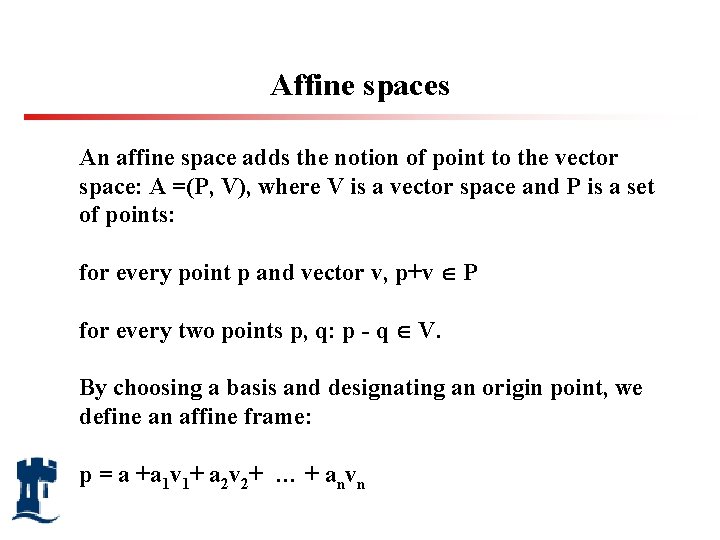
Affine spaces An affine space adds the notion of point to the vector space: A =(P, V), where V is a vector space and P is a set of points: for every point p and vector v, p+v P for every two points p, q: p - q V. By choosing a basis and designating an origin point, we define an affine frame: p = a +a 1 v 1+ a 2 v 2+ … + anvn
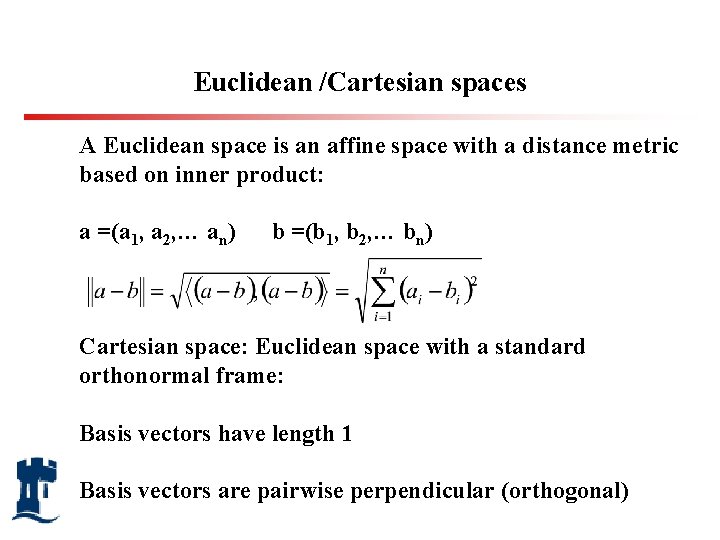
Euclidean /Cartesian spaces A Euclidean space is an affine space with a distance metric based on inner product: a =(a 1, a 2, … an) b =(b 1, b 2, … bn) Cartesian space: Euclidean space with a standard orthonormal frame: Basis vectors have length 1 Basis vectors are pairwise perpendicular (orthogonal)
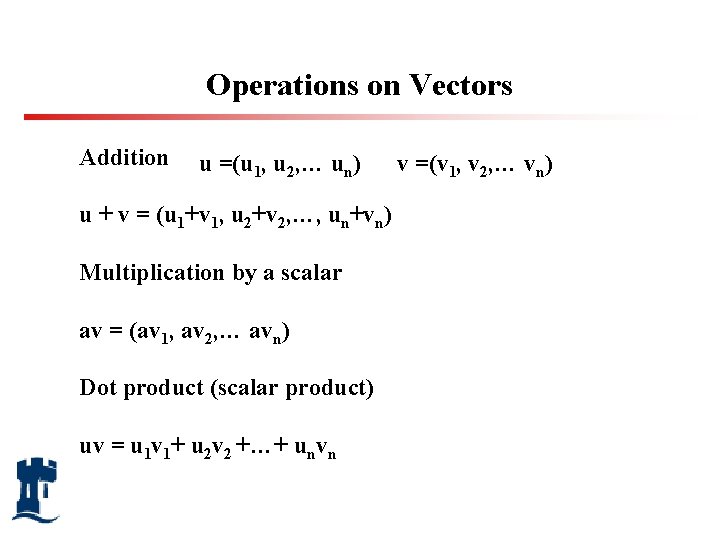
Operations on Vectors Addition u =(u 1, u 2, … un) u + v = (u 1+v 1, u 2+v 2, …, un+vn) Multiplication by a scalar av = (av 1, av 2, … avn) Dot product (scalar product) uv = u 1 v 1+ u 2 v 2 +…+ unvn v =(v 1, v 2, … vn)
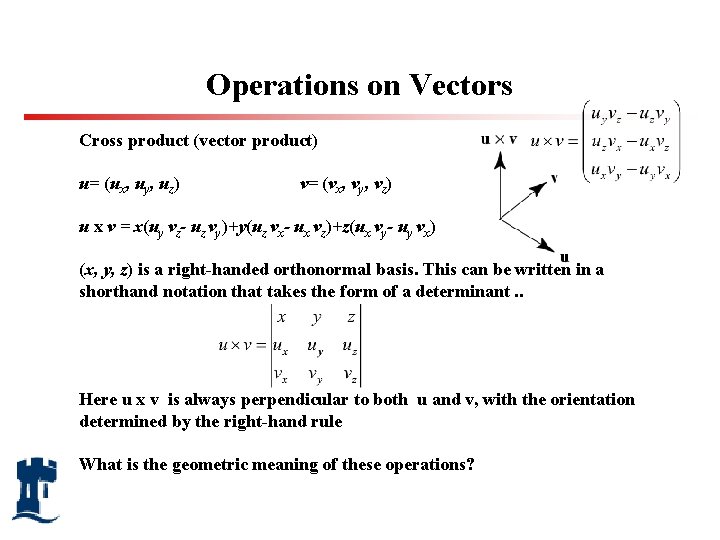
Operations on Vectors Cross product (vector product) u= (ux, uy, uz) v= (vx, vy, vz) u x v = x(uy vz- uz vy)+y(uz vx- ux vz)+z(ux vy- uy vx) (x, y, z) is a right-handed orthonormal basis. This can be written in a shorthand notation that takes the form of a determinant. . Here u x v is always perpendicular to both u and v, with the orientation determined by the right-hand rule What is the geometric meaning of these operations?
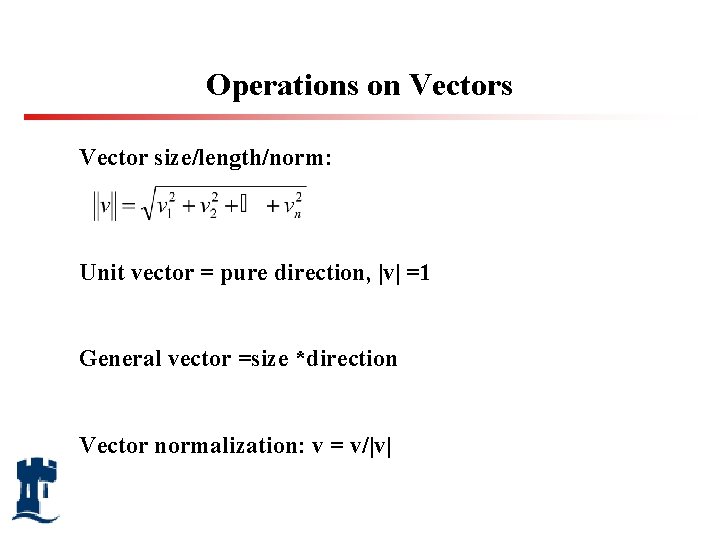
Operations on Vectors Vector size/length/norm: Unit vector = pure direction, |v| =1 General vector =size *direction Vector normalization: v = v/|v|
Operations on Points Can’t add points… but can add a vector to a point: a+v = b also can subtract points v = b - a Can’t multiply a point by a scalar… but can take the affine combination of two points: c = sa + t b where s + t =1 can also take the affine combination of n > 2 points.
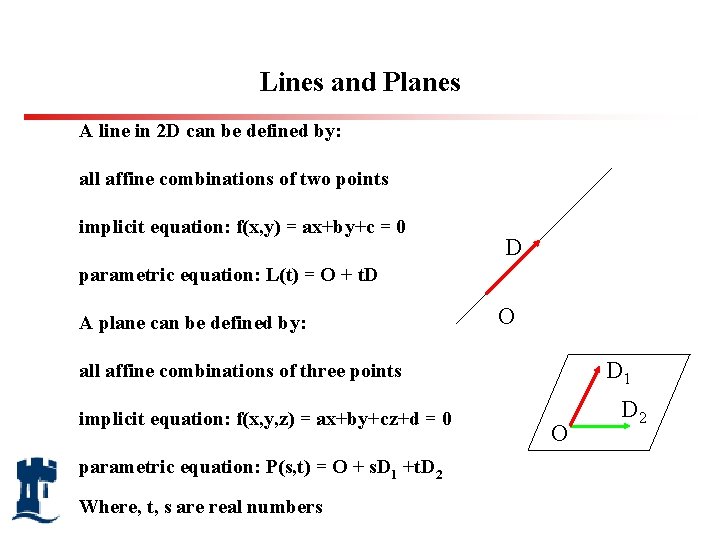
Lines and Planes A line in 2 D can be defined by: all affine combinations of two points implicit equation: f(x, y) = ax+by+c = 0 D parametric equation: L(t) = O + t. D A plane can be defined by: O D 1 all affine combinations of three points implicit equation: f(x, y, z) = ax+by+cz+d = 0 parametric equation: P(s, t) = O + s. D 1 +t. D 2 Where, t, s are real numbers O D 2
- Slides: 9