
Basic genetics Haixu Tang School of Informatics Mendels
Basic genetics Haixu Tang School of Informatics
Mendel’s two innovations • Developed pure lines – a population that breeds true for a particular trait • Counted his results and kept statistical notes

Phenotypes of Mendel's pea plants • • round or wrinkled seed phenotype yellow or green seed phenotype red or white flower phenotype tall or dwarf plant phenotype
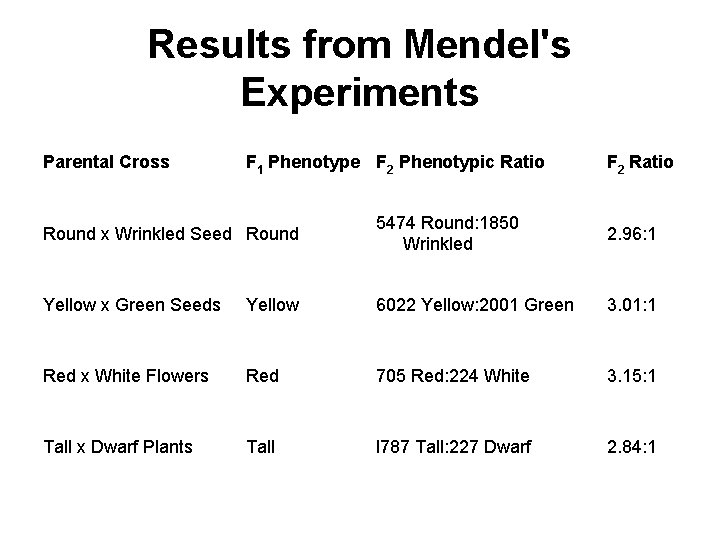
Results from Mendel's Experiments Parental Cross F 1 Phenotype F 2 Phenotypic Ratio F 2 Ratio Round x Wrinkled Seed Round 5474 Round: 1850 Wrinkled 2. 96: 1 Yellow x Green Seeds Yellow 6022 Yellow: 2001 Green 3. 01: 1 Red x White Flowers Red 705 Red: 224 White 3. 15: 1 Tall x Dwarf Plants Tall l 787 Tall: 227 Dwarf 2. 84: 1
Phenotypes • Dominant - the allele that expresses itself at the expense of an alternate allele; the phenotype that is expressed in the F 1 generation from the cross of two pure lines • Recessive - an allele whose expression is suppressed in the presence of a dominant allele; the phenotype that disappears in the F 1 generation from the cross of two pure lines and reappears in the F 2 generation
Conclusion • • The hereditary determinants are of a particulate nature. These determinants are called genes. Each parent has a gene pair in each cell for each trait studied. The F 1 from a cross of two pure lines contains one allele for the dominant phenotype and one for the recessive phenotype. These two alleles comprise the gene pair. One member of the gene pair segregates into a gamete, thus each gamete only carries one member of the gene pair. Gametes unite at random and irrespective of the other gene pairs involved.
Some terms • Allele - one alternative form of a given allelic pair; tall and dwarf are the alleles for the height of a pea plant; more than two alleles can exist for any specific gene, but only two of them will be found within any individual • Allelic pair - the combination of two alleles which comprise the gene pair • Homozygote - an individual which contains only one allele at the allelic pair; for example DD is homozygous dominant and dd is homozygous recessive; pure lines are homozygous for the gene of interest • Heterozygote - an individual which contains one of each member of the gene pair; for example the Dd heterozygote • Genotype - the specific allelic combination for a certain gene or set of genes
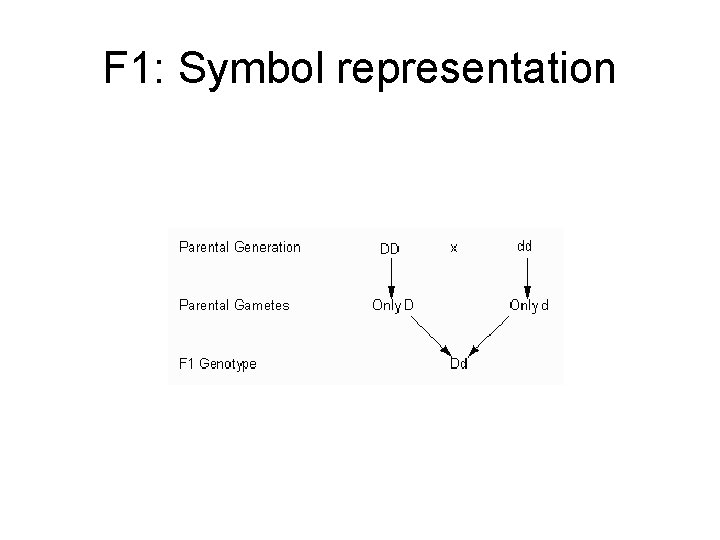
F 1: Symbol representation
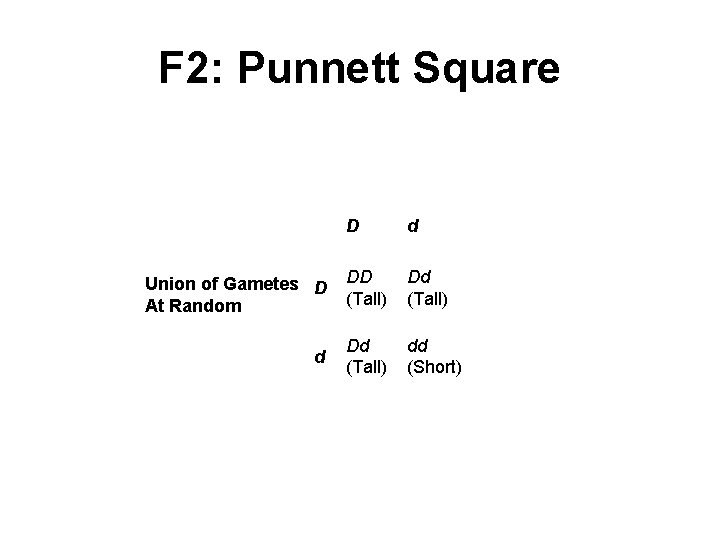
F 2: Punnett Square D d Dd Union of Gametes D DD (Tall) At Random d Dd dd (Tall) (Short)
Mendel's First Law • The law of segregation: during gamete formation each member of the allelic pair separates from the other member to form the genetic constitution of the gamete
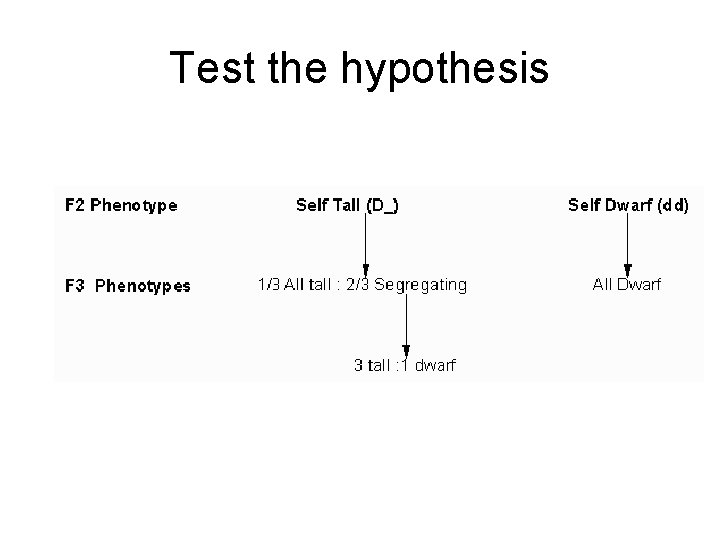
Test the hypothesis
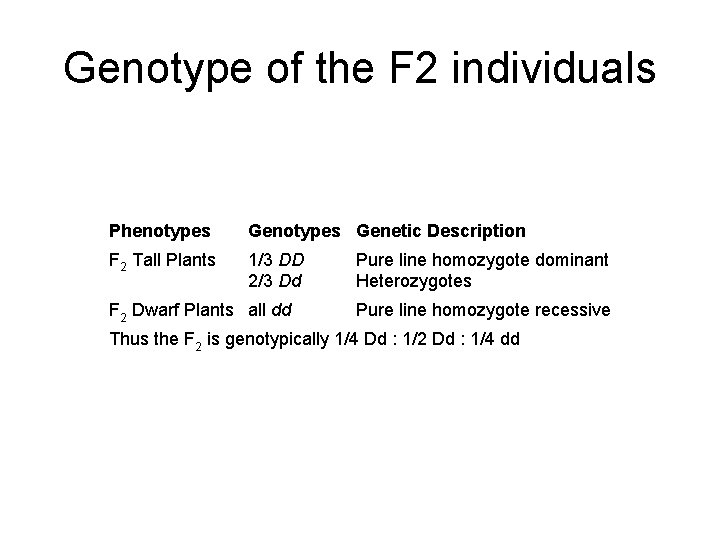
Genotype of the F 2 individuals Phenotypes Genotypes Genetic Description F 2 Tall Plants 1/3 DD 2/3 Dd F 2 Dwarf Plants all dd Pure line homozygote dominant Heterozygotes Pure line homozygote recessive Thus the F 2 is genotypically 1/4 Dd : 1/2 Dd : 1/4 dd
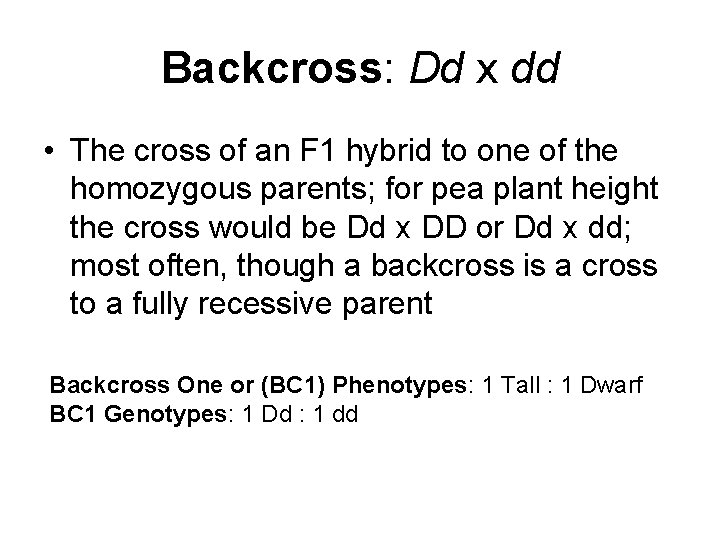
Backcross: Dd x dd • The cross of an F 1 hybrid to one of the homozygous parents; for pea plant height the cross would be Dd x DD or Dd x dd; most often, though a backcross is a cross to a fully recessive parent Backcross One or (BC 1) Phenotypes: 1 Tall : 1 Dwarf BC 1 Genotypes: 1 Dd : 1 dd
Monohybrid • Monohybrid cross - a cross between parents that differ at a single gene pair (usually AA x aa) • Monohybrid - the offspring of two parents that are homozygous for alternate alleles of a gene pair • Remember --- a monohybrid cross is not the cross of two monohybrids.
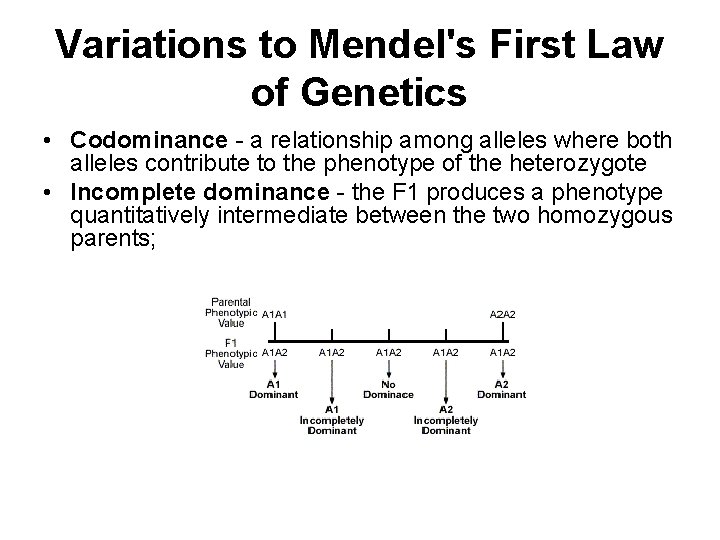
Variations to Mendel's First Law of Genetics • Codominance - a relationship among alleles where both alleles contribute to the phenotype of the heterozygote • Incomplete dominance - the F 1 produces a phenotype quantitatively intermediate between the two homozygous parents;

Pedigree Analysis
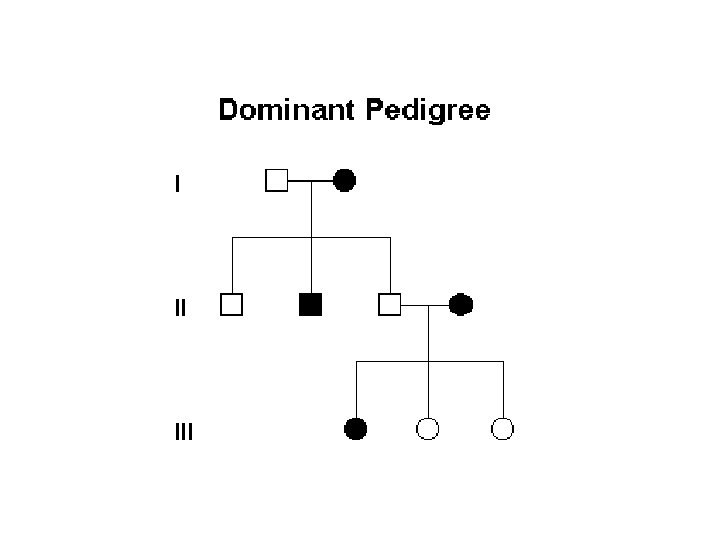
Traits exhibiting dominant gene action • affected individuals have at least one affected parent • the phenotype generally appears every generation • two unaffected parents only have unaffected offspring
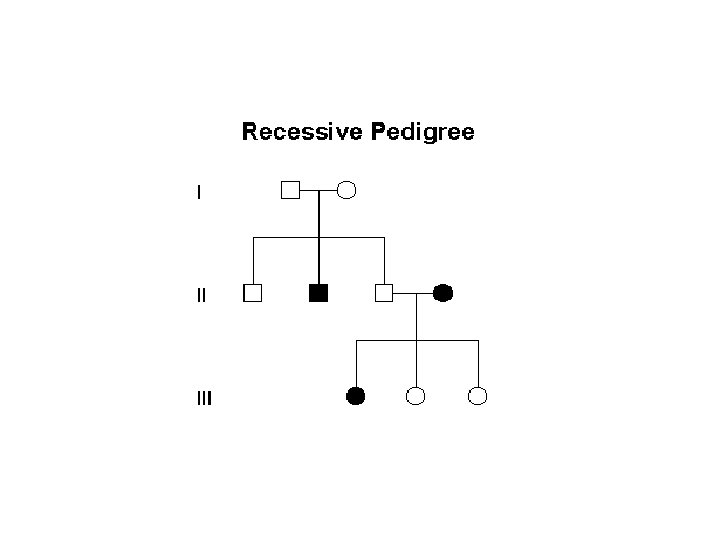
Traits exhibiting recessive gene action • unaffected parents can have affected offspring • affected progeny are both male and female
Mendel's Law of Independent Assortment We have followed the expression of only one gene. Mendel also performed crosses in which he followed the segregation of two genes. These experiments formed the basis of his discovery of his second law, the law of independent assortment.
Dihybrid cross • Dihybrid cross - a cross between two parents that differ by two pairs of alleles (AABB x aabb) • Dihybrid- an individual heterozygous for two pairs of alleles (Aa. Bb)
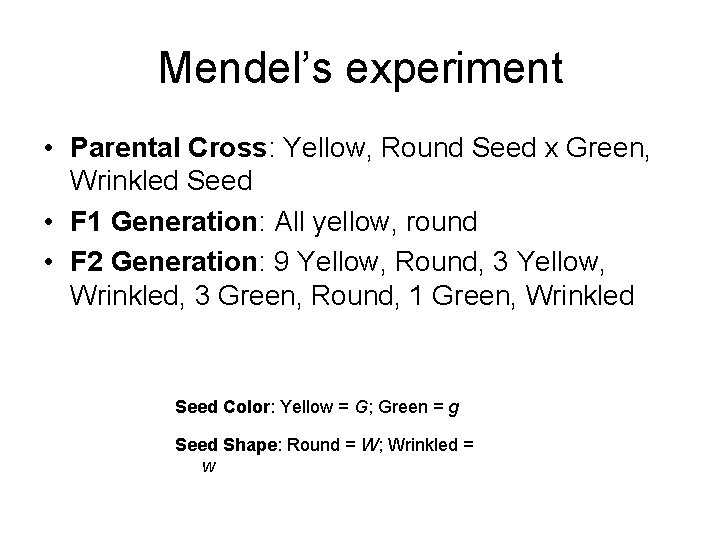
Mendel’s experiment • Parental Cross: Yellow, Round Seed x Green, Wrinkled Seed • F 1 Generation: All yellow, round • F 2 Generation: 9 Yellow, Round, 3 Yellow, Wrinkled, 3 Green, Round, 1 Green, Wrinkled Seed Color: Yellow = G; Green = g Seed Shape: Round = W; Wrinkled = w

Parental cross
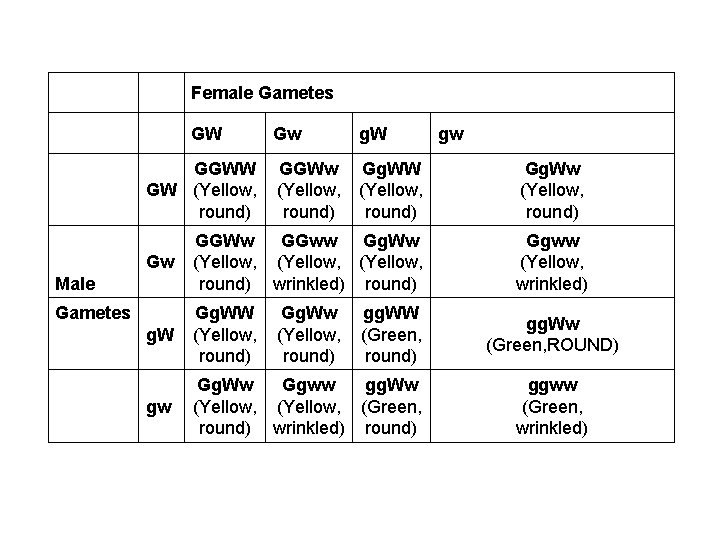
Female Gametes GW Gw g. W gw GGWW GGWw Gg. WW GW (Yellow, round) Gg. Ww (Yellow, round) Gw GGWw GGww Gg. Ww (Yellow, round) wrinkled) round) Ggww (Yellow, wrinkled) g. W Gg. Ww (Yellow, round) gw Gg. Ww Ggww gg. Ww (Yellow, (Green, round) wrinkled) round) Male Gametes gg. WW (Green, round) gg. Ww (Green, ROUND) ggww (Green, wrinkled)
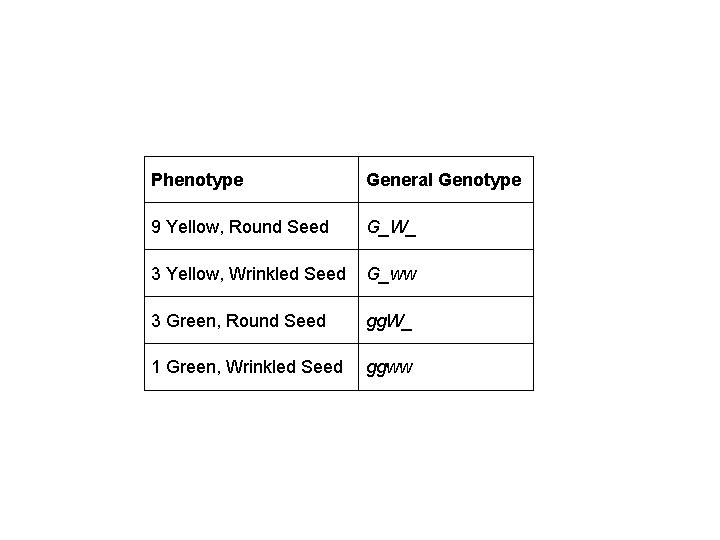
Phenotype General Genotype 9 Yellow, Round Seed G_W_ 3 Yellow, Wrinkled Seed G_ww 3 Green, Round Seed gg. W_ 1 Green, Wrinkled Seed ggww
Mendel's Second Law - the law of independent assortment • During gamete formation the segregation of the alleles of one allelic pair is independent of the segregation of the alleles of another allelic pair.
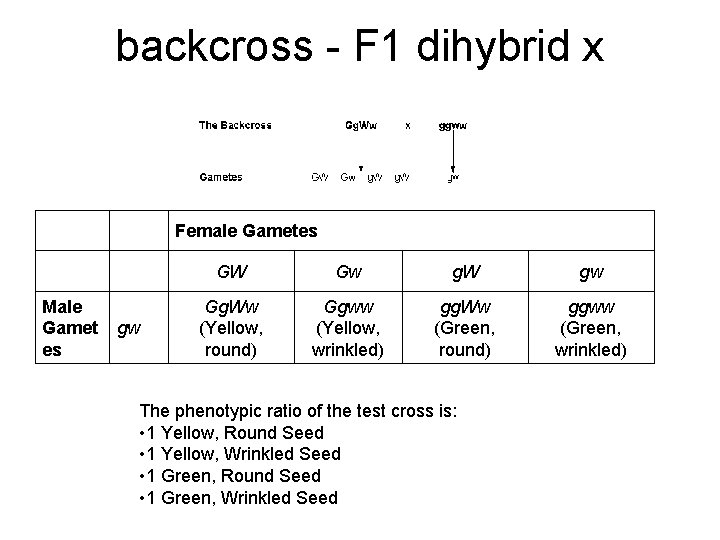
backcross - F 1 dihybrid x Female Gametes Male Gamet es gw GW Gw g. W gw Gg. Ww (Yellow, round) Ggww (Yellow, wrinkled) gg. Ww (Green, round) ggww (Green, wrinkled) The phenotypic ratio of the test cross is: • 1 Yellow, Round Seed • 1 Yellow, Wrinkled Seed • 1 Green, Round Seed • 1 Green, Wrinkled Seed
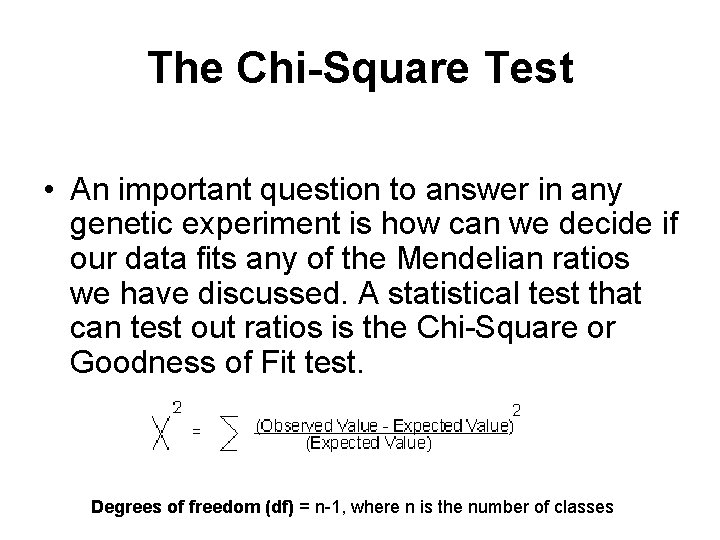
The Chi-Square Test • An important question to answer in any genetic experiment is how can we decide if our data fits any of the Mendelian ratios we have discussed. A statistical test that can test out ratios is the Chi-Square or Goodness of Fit test. Degrees of freedom (df) = n-1, where n is the number of classes
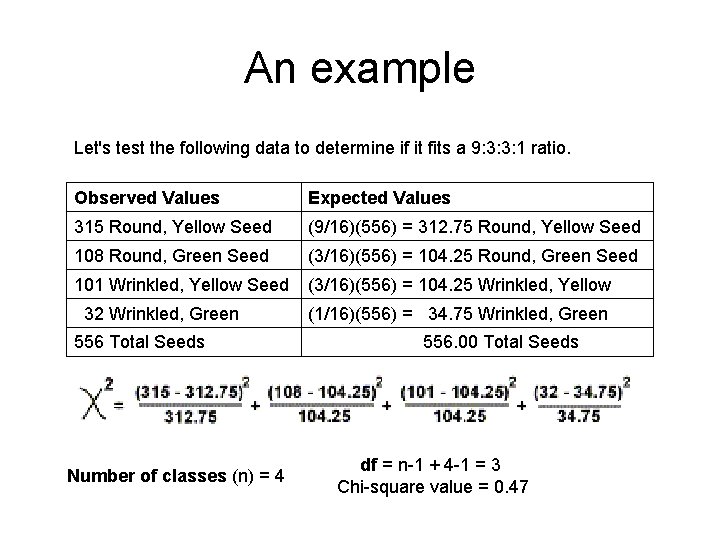
An example Let's test the following data to determine if it fits a 9: 3: 3: 1 ratio. Observed Values Expected Values 315 Round, Yellow Seed (9/16)(556) = 312. 75 Round, Yellow Seed 108 Round, Green Seed (3/16)(556) = 104. 25 Round, Green Seed 101 Wrinkled, Yellow Seed (3/16)(556) = 104. 25 Wrinkled, Yellow 32 Wrinkled, Green (1/16)(556) = 34. 75 Wrinkled, Green 556 Total Seeds 556. 00 Total Seeds Number of classes (n) = 4 df = n-1 + 4 -1 = 3 Chi-square value = 0. 47
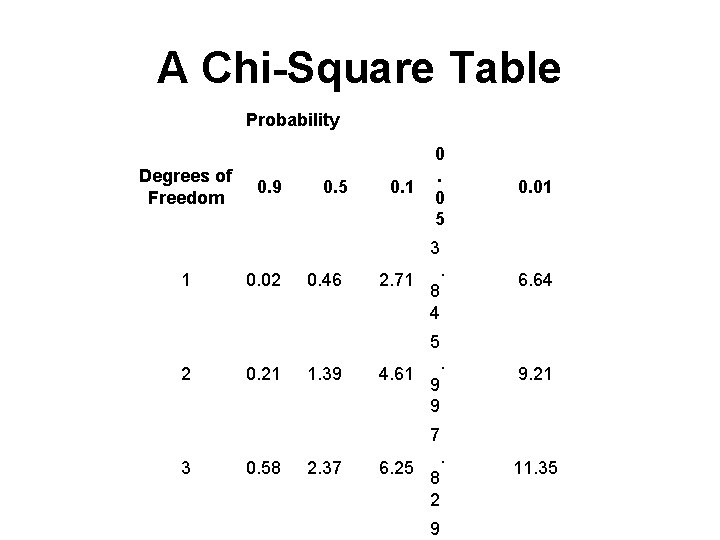
A Chi-Square Table Probability Degrees of Freedom 0. 9 0. 5 0. 1 0. 0 5 0. 01 3 1 0. 02 0. 46 2. 71 . 8 4 6. 64 5 2 0. 21 1. 39 4. 61 . 9 9 9. 21 7 3 0. 58 2. 37 6. 25 . 8 2 9 11. 35
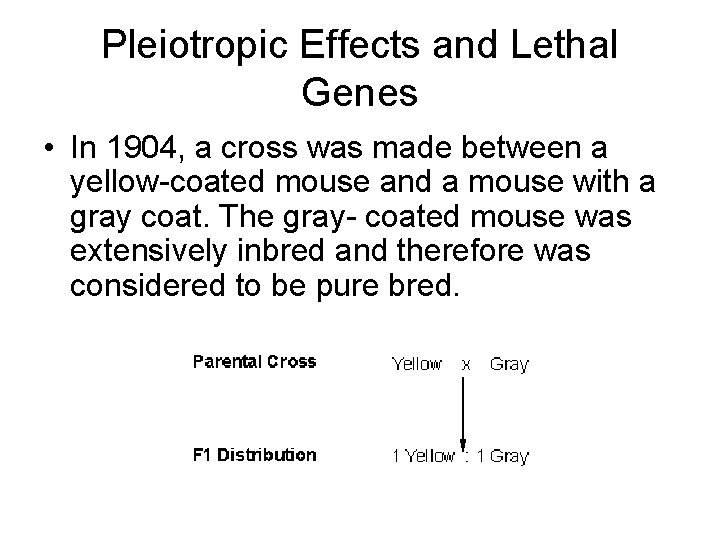
Pleiotropic Effects and Lethal Genes • In 1904, a cross was made between a yellow-coated mouse and a mouse with a gray coat. The gray- coated mouse was extensively inbred and therefore was considered to be pure bred.
• Next a cross was made between two yellow mice. What genetic ratio would we expect to see? Yy x Yy should give a ratio of 3 yellow: 1 gray. The result, though, was a ratio of 2 yellow to 1 gray mice. How can this result be explained? Let's first set up a Punnett Square.
Testcross • All testcross data with the yellow mice give a 1: 1 ratio. This ratio is typical of what is seen with heterozygous individuals. • All of the yellow mice from the cross of two heterozygous yellow mice are genotypically Yy. Somehow the YY genotype is lethal. The 2: 1 ratio is the typical ratio for a lethal gene.
Lethal gene • Lethal Gene - a gene that leads to the death of an individual; these can be either dominant or recessive in nature. • Pleiotropic gene - a gene that affects more than one phenotype
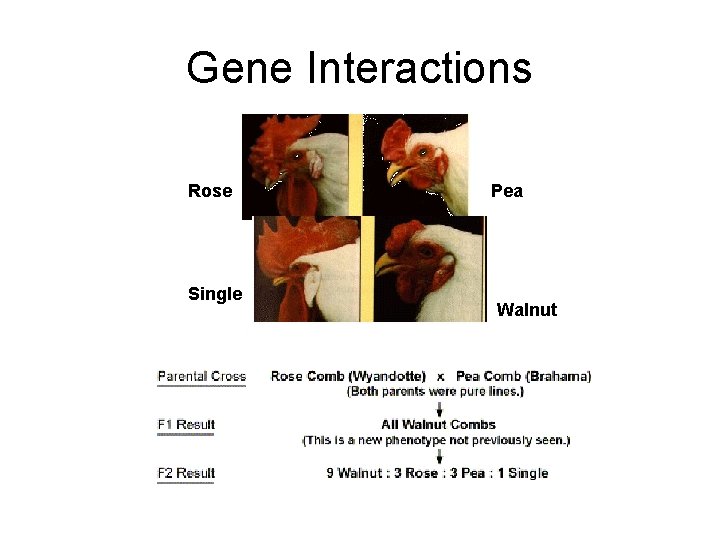
Gene Interactions Rose Single Pea Walnut
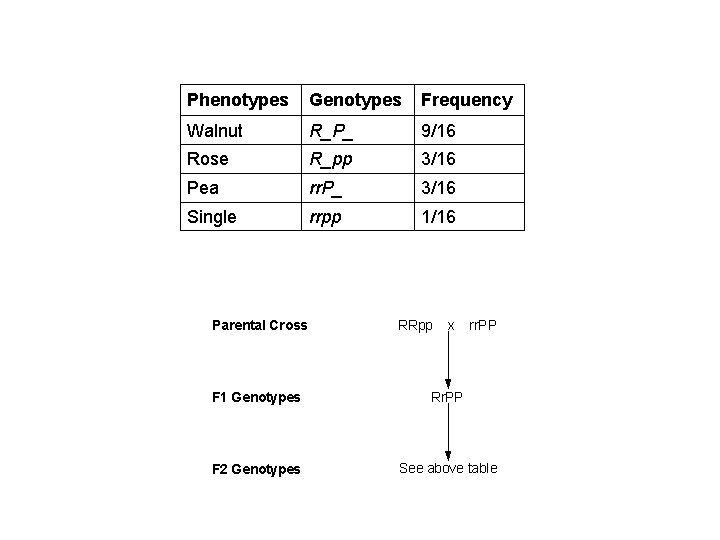
Phenotypes Genotypes Frequency Walnut R_P_ 9/16 Rose R_pp 3/16 Pea rr. P_ 3/16 Single rrpp 1/16
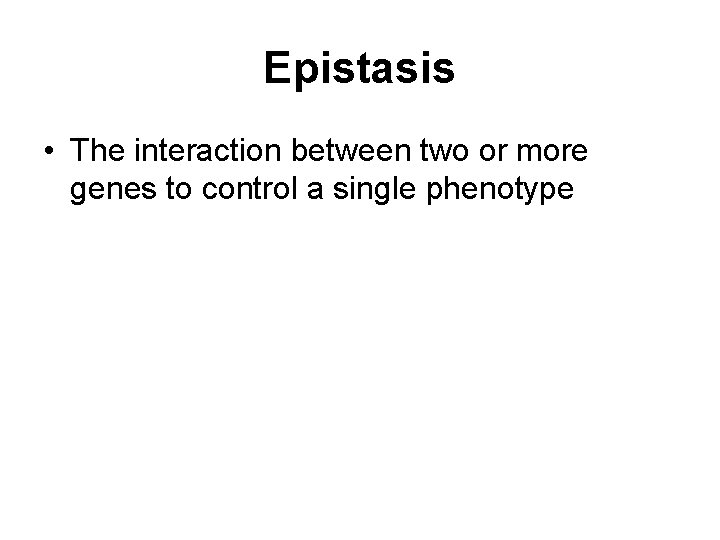
Epistasis • The interaction between two or more genes to control a single phenotype
Modifier Genes • Instead of masking the effects of another gene, a gene can modify the expression of a second gene. In mice, coat color is controlled by the B gene. The B allele conditions black coat color and is dominant to the b allele that produces a brown coat. The intensity of the color, either black or brown is controlled by another gene, the D gene. At this gene, the dominant D allele controls full color whereas the recessive d allele conditions a dilute or faded expression of the color expression at the B gene. Therefore, if a cross is made among mice that are Bd. Dd, the following phenotypic distribution will be seen: – – 9 B_D_ (black) 3 B_dd (dilute black) 3 bb. D_ (brown) 1 bbdd (dilute brown) • The D gene does not mask the effect of the B gene, rather it modifies its expression.
Gene linkage • One experiment was performed by Bateson and Punnett with sweet peas. They performed a typical dihybrid cross between one pure line with purple flowers and long pollen grains and a second pure line with red flowers and round pollen grains. Because they knew that purple flowers and long pollen grains were both dominant, they expected a typical 9: 3: 3: 1 ratio when the F 1 plants were crossed.
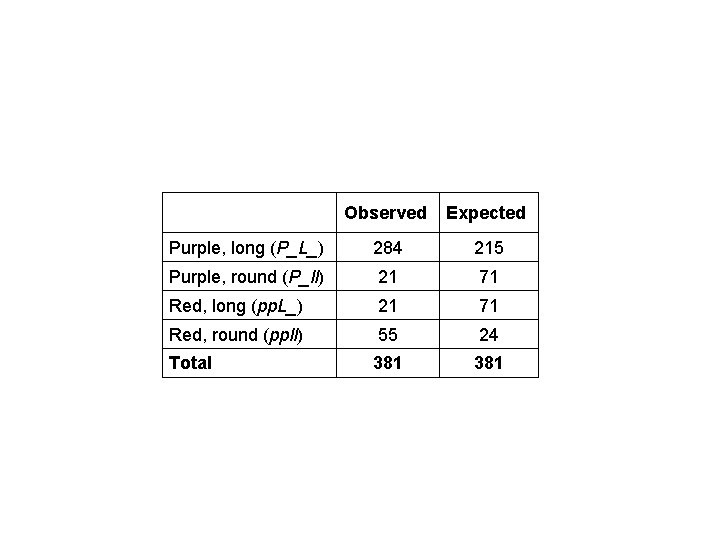
Observed Expected Purple, long (P_L_) 284 215 Purple, round (P_ll) 21 71 Red, long (pp. L_) 21 71 Red, round (ppll) 55 24 Total 381
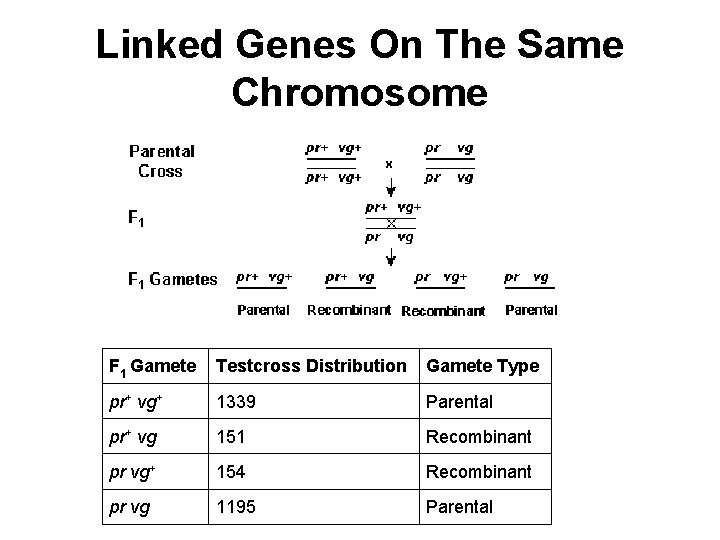
Linked Genes On The Same Chromosome F 1 Gamete Testcross Distribution Gamete Type pr+ vg+ 1339 Parental pr+ vg 151 Recombinant pr vg+ 154 Recombinant pr vg 1195 Parental
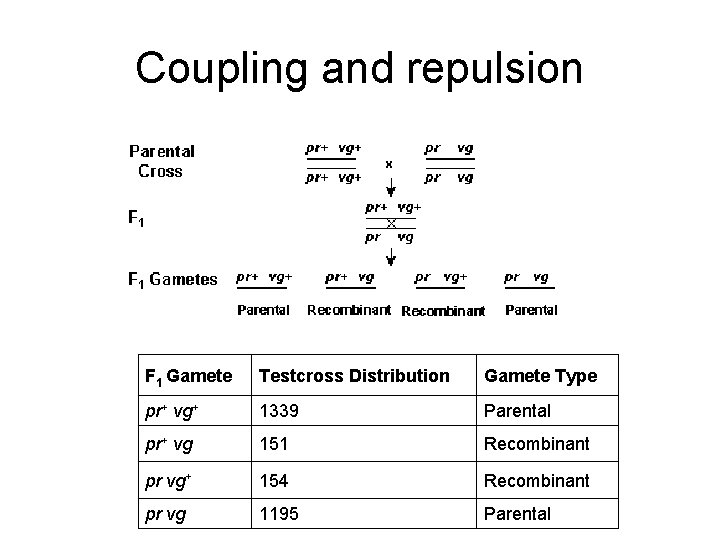
Coupling and repulsion F 1 Gamete Testcross Distribution Gamete Type pr+ vg+ 1339 Parental pr+ vg 151 Recombinant pr vg+ 154 Recombinant pr vg 1195 Parental
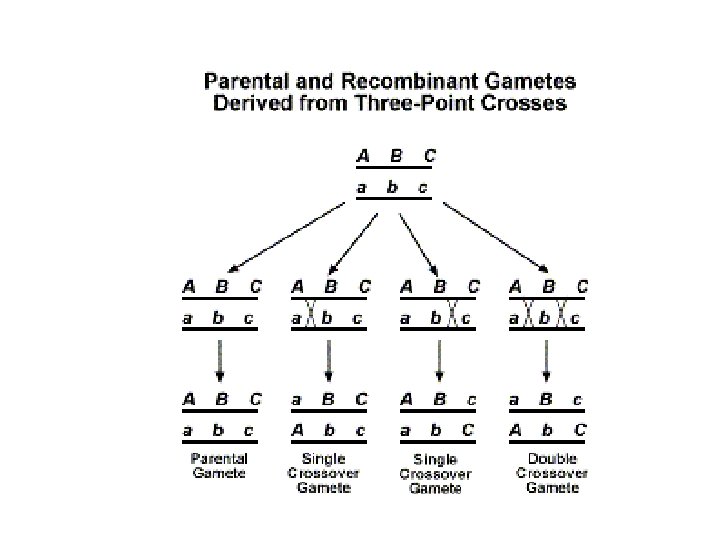
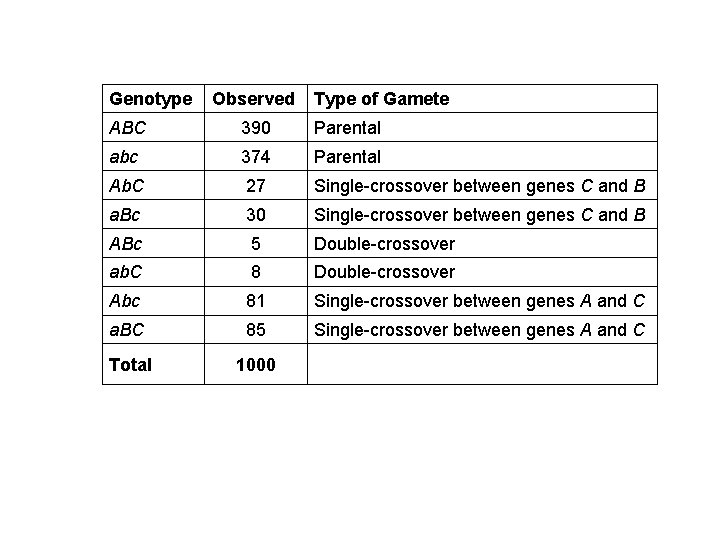
Genotype Observed Type of Gamete ABC 390 Parental abc 374 Parental Ab. C 27 Single-crossover between genes C and B a. Bc 30 Single-crossover between genes C and B ABc 5 Double-crossover ab. C 8 Double-crossover Abc 81 Single-crossover between genes A and C a. BC 85 Single-crossover between genes A and C Total 1000
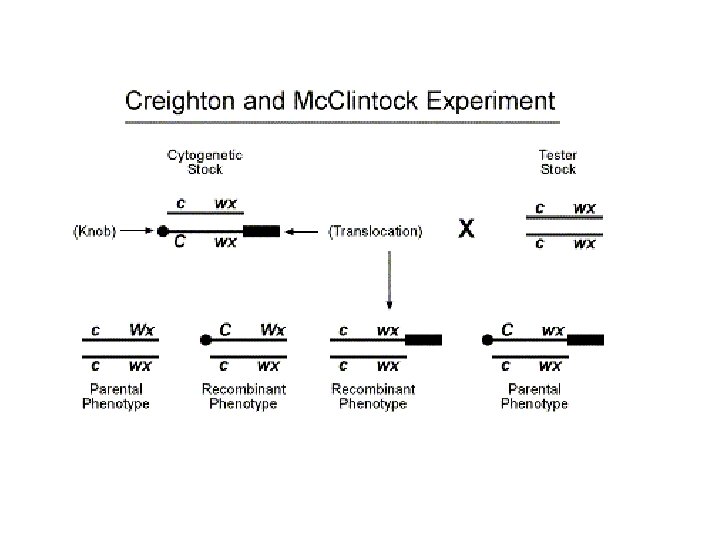
- Slides: 46