
BASIC FIRE PREVENTION AND CONTROL SEMINAR Fire Extinguisher
BASIC FIRE PREVENTION AND CONTROL SEMINAR Fire Extinguisher Handling Safety Committee
Goal To equip the participants with the basic knowledge and skills on Fire Prevention and Control in order for them to be conscious on the ill-effects of fire. Safety Committee

What is FIRE? Is a rapid, self sustaining oxidation process accompanied by the evolution of heat and light of varying intensities. Safety Committee
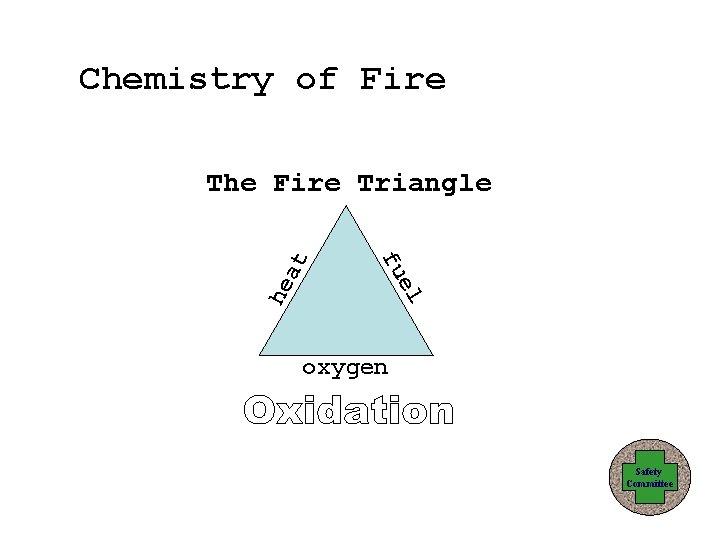
Chemistry of Fire he el fu at The Fire Triangle oxygen Safety Committee
Elements of Fire Fuel - any substance that burns: 1. SOLID (wood, paper, cloth) 2. LIQUID (gasoline, alcohol, oil) 3. GAS (natural gas, acetylene) Safety Committee

Elements of Fire Oxygen - makes up 21% of air Heat - is a form of energy w/c, if sufficiently intense, will ignite a combustible material Safety Committee
Heat Transfer Conduction - there is physical contact Convection - heat transferred by circulation Radiation - heat transferred through electromagnetic waves Safety Committee
Sources of Ignition Chemical - chemical reaction Mechanical - friction and heat compression Electrical - resistance heating, arcing, sparking, static electric charge & lightning Nuclear - nuclear fission by nuclear materials Safety Committee

Classes of Fire Class A - involves ordinary combustible matl’s such as wood, paper, cloth & plastics Class B - flammable liquids such as gasoline - flammable gas such as LPG Class C - energized electrical equipment Class D - involves combustible metals such as Safety titanium, zirconium, magnesium Committee
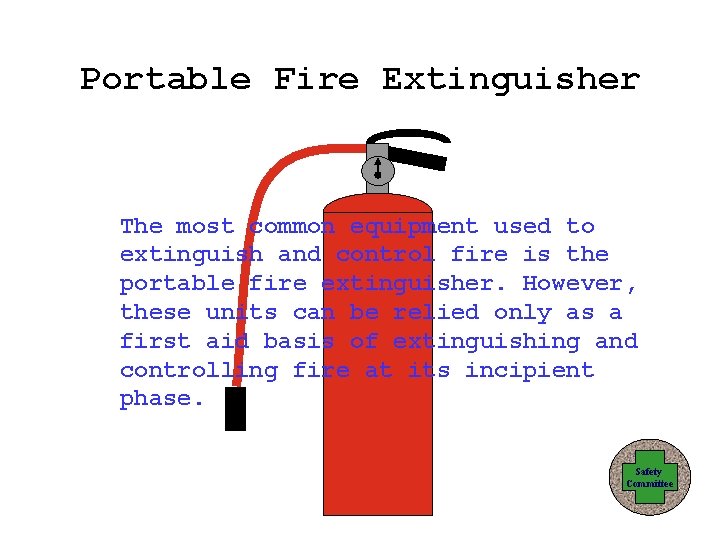
Portable Fire Extinguisher The most common equipment used to extinguish and control fire is the portable fire extinguisher. However, these units can be relied only as a first aid basis of extinguishing and controlling fire at its incipient phase. Safety Committee
Types of Fire Extinguisher A F F F - Aqueous Film Forming Foam (water based) DRY CHEMICAL - Mono-ammonium phosphateless hygroscopic or moisture absorbing (gas based) HALON (BCF 1211) - Bromo. Chlorodi. Fluoromethane (gas based) CO 2 - Carbon Dioxide (gas) DRY POWDER - Graphite or Sodium Chloride Safety Committee
How to Operate FE’s P - Pull the safety pin A - Aim the nozzle at the base of fire approx. 1 - 3 meters S - Squeeze the lever of the fire extinguisher S - Sweep the nozzle sidewards to cover the area of the fire Safety Committee

How to Control Fire Four Methods of Fire and Explosion Control: 1. COOLING - removal of heat 2. SMOTHERING - removal of oxygen 3. STARVATION - removal of fuel 4. FLAME INHIBITION - interruption of the “chain reaction” Safety Committee

FIRE PREVENTION Refers primarily to measures directed towards avoiding the occurrence of fire. Fire prevention in general is “Fire Protection. ” Safety Committee
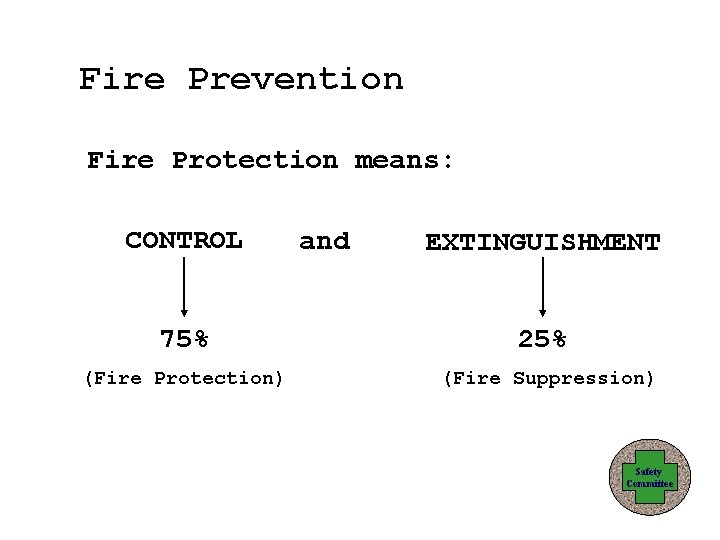
Fire Prevention Fire Protection means: CONTROL and EXTINGUISHMENT 75% 25% (Fire Protection) (Fire Suppression) Safety Committee
Fire Prevention Remember!!! “ An ounce of prevention is better than a pound of cure” Safety Committee
- Slides: 16