
Basic Field Epidemiology Session 7 Transmission and spread
Basic Field Epidemiology Session 7 – Transmission and spread of disease Recorded Power. Point file AUSTRALIA INDONESIA PARTNERSHIP FOR EMERGING INFECTIOUS DISEASES
In Session 7 we will explore: • How infectious agents move from one animal to another within a population • How infectious agents move between populations of animals • How infectious agents can survive or continue to occur in a population over time AUSTRALIA INDONESIA PARTNERSHIP FOR EMERGING INFECTIOUS DISEASES
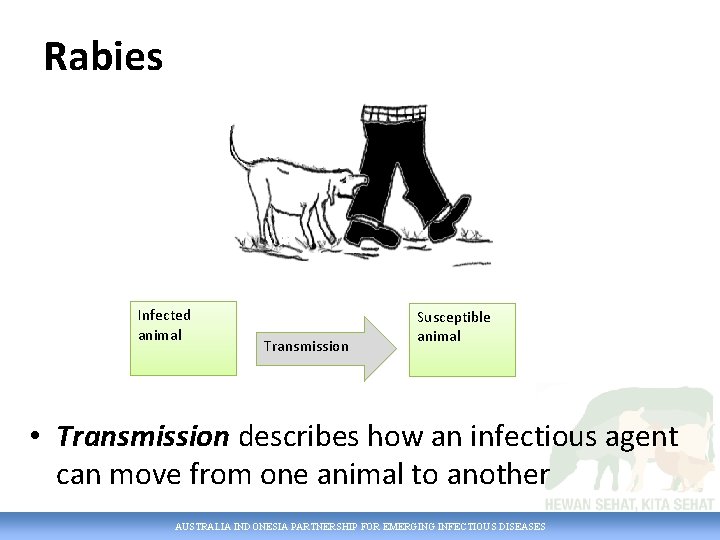
Rabies Infected animal Transmission Susceptible animal • Transmission describes how an infectious agent can move from one animal to another AUSTRALIA INDONESIA PARTNERSHIP FOR EMERGING INFECTIOUS DISEASES

How agents get out of the animal • Body surface – hair, pus or scabs (ringworm) • Nose secretions (influenza virus) • Mouth – saliva (rabies and foot and mouth viruses, tuberculosis) • Mammary – milk (bacteria causing mastitis) • Anus – faeces (salmonella bacteria) • Urogenital tract – urine and sperm (leptospirosis, campylobacter) • Eyes – tears (pinkeye) • Blood – (Q fever by tick vectors) AUSTRALIA INDONESIA PARTNERSHIP FOR EMERGING INFECTIOUS DISEASES

How agents get into an animal • Oral – (parasites) • Respiratory – upper (influenza virus) – Lower (pneumonia in cattle – Mannheimia haemolytica) • Mucous membranes – (pinkeye) AUSTRALIA INDONESIA PARTNERSHIP FOR EMERGING INFECTIOUS DISEASES

How agents get into an animal • Skin – (rabies) • Coitus – (brucellosis) • Iatrogenic – (bluetongue virus) AUSTRALIA INDONESIA PARTNERSHIP FOR EMERGING INFECTIOUS DISEASES
Type of contact between infected and susceptible animals during transmisison • Direct contact between animals • Infected animal sheds infectious agent in saliva, faeces, milk, … • Susceptible animal licks the infected animal and gets exposed • Calves may get infected with some diseases during pregnancy or from close contact with mother after birth AUSTRALIA INDONESIA PARTNERSHIP FOR EMERGING INFECTIOUS DISEASES

How agents get from one animal to another - Transmission • Transmission of infectious agents – Indirect • Living things (intermediate host) – Mosquitoes (Babesia in cattle, Malaria in humans) – Flies (pinkeye) • Non-living – – Feed Equipment Clothing Needles, syringes AUSTRALIA INDONESIA PARTNERSHIP FOR EMERGING INFECTIOUS DISEASES
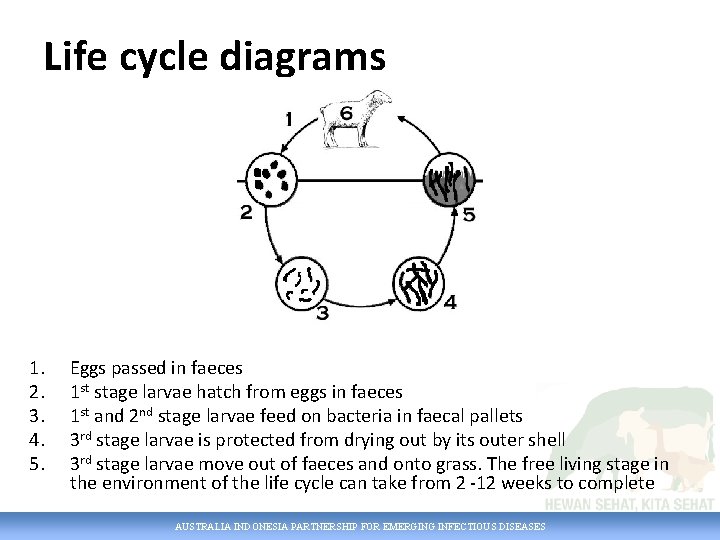
Life cycle diagrams 1. 2. 3. 4. 5. Eggs passed in faeces 1 st stage larvae hatch from eggs in faeces 1 st and 2 nd stage larvae feed on bacteria in faecal pallets 3 rd stage larvae is protected from drying out by its outer shell 3 rd stage larvae move out of faeces and onto grass. The free living stage in the environment of the life cycle can take from 2 -12 weeks to complete AUSTRALIA INDONESIA PARTNERSHIP FOR EMERGING INFECTIOUS DISEASES
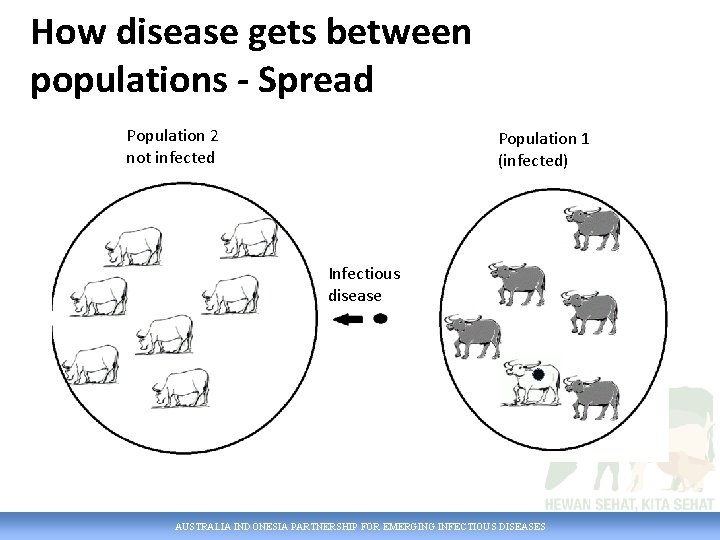
How disease gets between populations - Spread Population 2 not infected Population 1 (infected) Infectious disease AUSTRALIA INDONESIA PARTNERSHIP FOR EMERGING INFECTIOUS DISEASES
How infectious agents can survive or continue to occur - Maintenance • Maintenance of infectious agents – Rapid spread – Resistant form that can survive in the environment for long periods AUSTRALIA INDONESIA PARTNERSHIP FOR EMERGING INFECTIOUS DISEASES
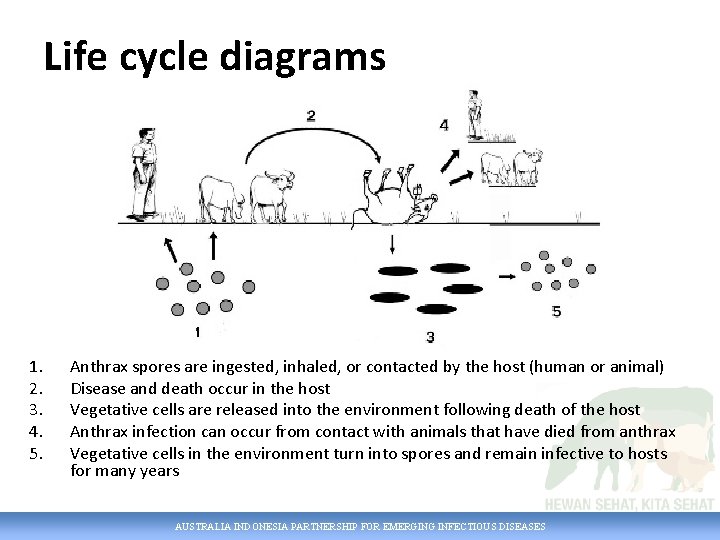
Life cycle diagrams 1. 2. 3. 4. 5. Anthrax spores are ingested, inhaled, or contacted by the host (human or animal) Disease and death occur in the host Vegetative cells are released into the environment following death of the host Anthrax infection can occur from contact with animals that have died from anthrax Vegetative cells in the environment turn into spores and remain infective to hosts for many years AUSTRALIA INDONESIA PARTNERSHIP FOR EMERGING INFECTIOUS DISEASES
How infectious agents can survive or continue to occur - Maintenance • Maintenance of infectious agents – Continual transmission – Resistant form that can survive in the environment for long periods – Persistent infections (carriers) – Ability to infect multiple- species AUSTRALIA INDONESIA PARTNERSHIP FOR EMERGING INFECTIOUS DISEASES
Session 7 - Summary • Transmission describes how an infectious agent can move from one animal to another • Spread describes how an infectious agent moves from one population to another • Maintenance refers to how an infectious agent can survive or continue to occur in a population over time AUSTRALIA INDONESIA PARTNERSHIP FOR EMERGING INFECTIOUS DISEASES
Close of video AUSTRALIA INDONESIA PARTNERSHIP FOR EMERGING INFECTIOUS DISEASES
- Slides: 15