
Basic FBA to BSP Using Functional Behavioral Assessment
Basic FBA to BSP Using Functional Behavioral Assessment (FBA) to Develop Function-Based Behavior Support Plans (BSP) Adapted from Sheldon Loman and others Day One Presented by Lauralee Keach and Jeremy Tretiak Materials at: https: //www. pbisvermont. org/training-resources/functional-behavior-assessmentbehavior-support-plan-fbabsp/
Welcome! You will be muted during this session unless in breakout rooms. Need help? Type into the chat box. You can show or hide your video. This session will be recorded. If you’d like to access the recording, please email anne. dubie@uvm. edu.
Learning Objectives Day One: • Consider how FBA/BSP fits within a multi-tiered system of supports • Understand the concepts of “function of behavior” and “functional behavior assessment” • Start to learn the FBA process and begin practice with selected student Day Two: • Continue to learn the FBA process and deepen practice with selected student Day Three: • Develop a BSP for selected student • Plan for implementing FBA/BSP within your multi-tiered system 3
Materials https: //www. pbisvermont. org/training-resources/functional-behaviorassessmentbehavior-support-plan-fbabsp/ Introduction and Practice in Functional Behavior Assessment and Behavior Support Planning (FBA/BSP) From FBA to BSP Planning Workbook 4
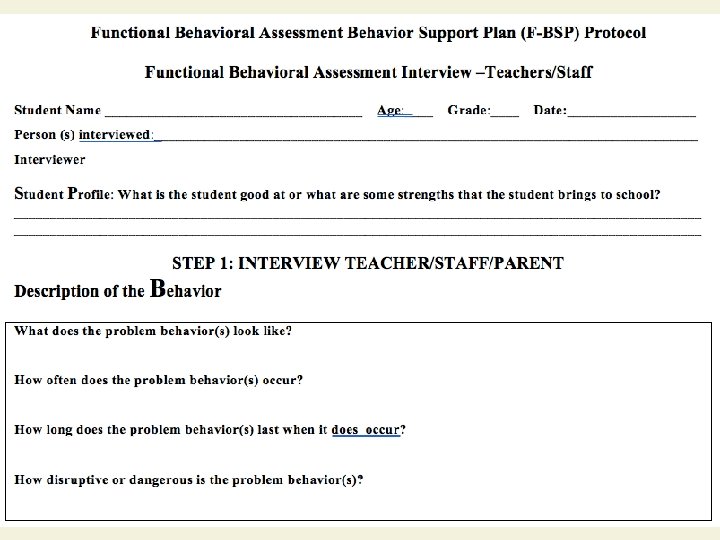
Materials Functional (Behavioral Assessment) Behavior Support Plan (F-BSP) Protocol • Interview tool for collecting information about problem behaviors • For staff, parents, and students • The F-BSP then leads the team to create a competing behavior pathway and behavior support plan 5
What’s the function of this behavior? http: //www. youtube. com/watch? v=hk. KOqij_Tdw 6
7
Restorative Principles The Restorative Approach is about: • • Voluntary Participation Exploring Relationships Meaningful Engagement Participatory Decision-Making
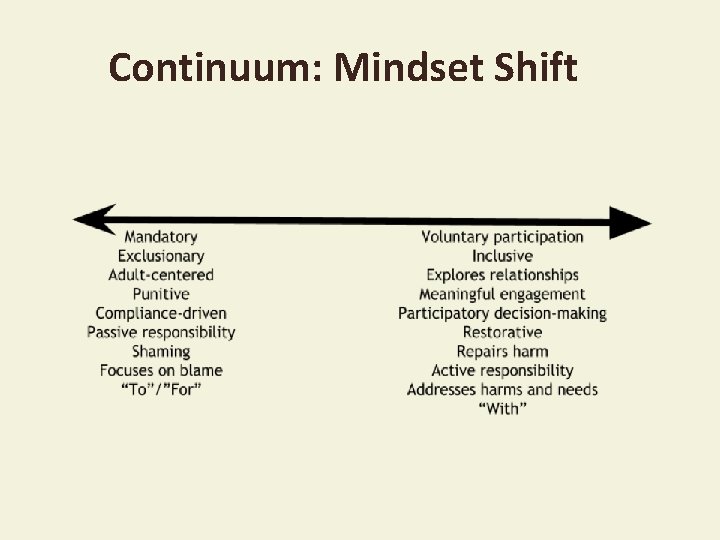
Continuum: Mindset Shift
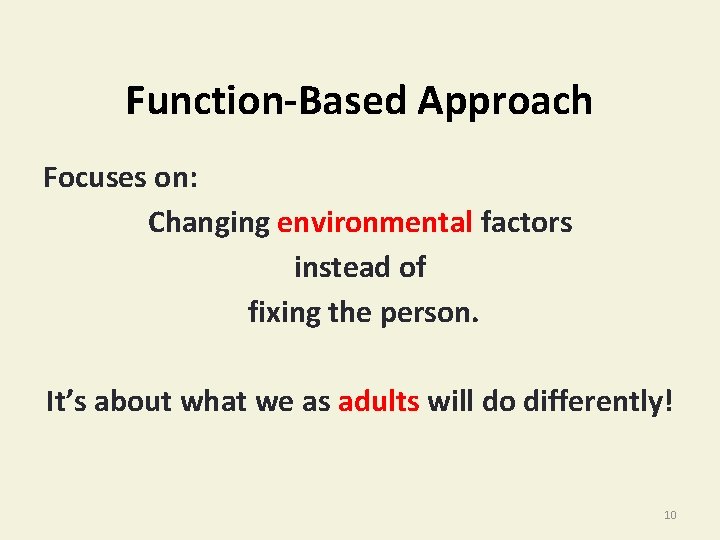
Function-Based Approach Focuses on: Changing environmental factors instead of fixing the person. It’s about what we as adults will do differently! 10
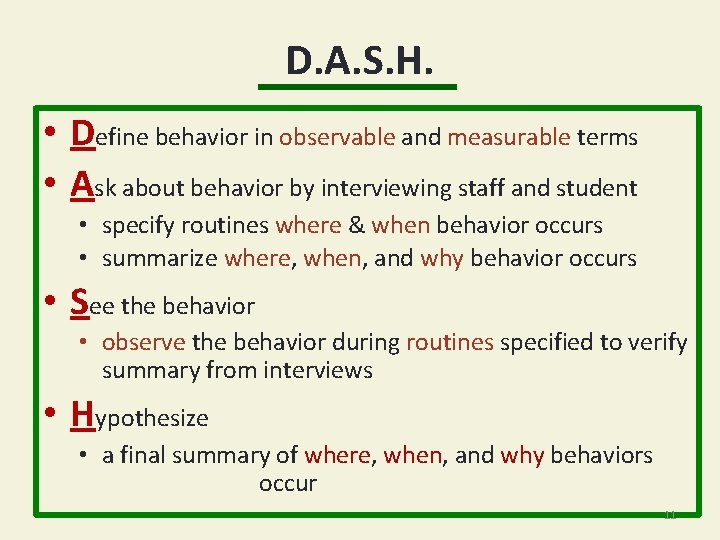
D. A. S. H. • Define behavior in observable and measurable terms • Ask about behavior by interviewing staff and student • specify routines where & when behavior occurs • summarize where, when, and why behavior occurs • See the behavior • observe the behavior during routines specified to verify summary from interviews • Hypothesize • a final summary of where, when, and why behaviors occur 11
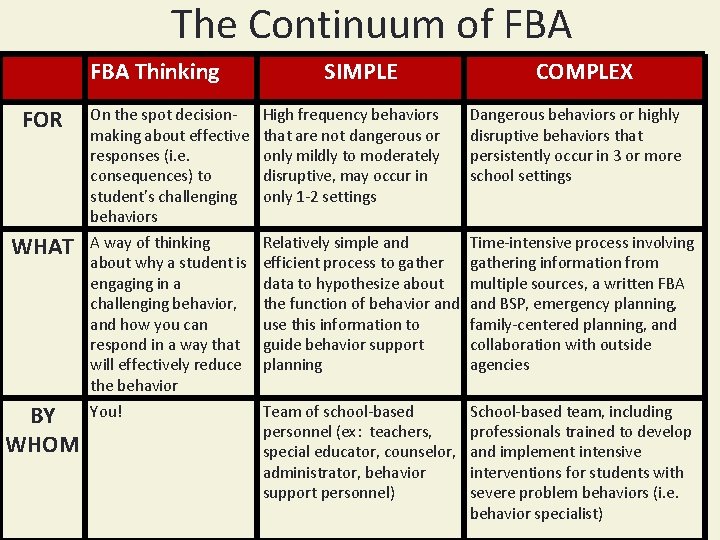
The Continuum of FBA Thinking SIMPLE COMPLEX FOR On the spot decisionmaking about effective responses (i. e. consequences) to student’s challenging behaviors High frequency behaviors that are not dangerous or only mildly to moderately disruptive, may occur in only 1 -2 settings Dangerous behaviors or highly disruptive behaviors that persistently occur in 3 or more school settings WHAT A way of thinking about why a student is engaging in a challenging behavior, and how you can respond in a way that will effectively reduce the behavior Relatively simple and efficient process to gather data to hypothesize about the function of behavior and use this information to guide behavior support planning Time-intensive process involving gathering information from multiple sources, a written FBA and BSP, emergency planning, family-centered planning, and collaboration with outside agencies You! Team of school-based personnel (ex: teachers, special educator, counselor, administrator, behavior support personnel) School-based team, including professionals trained to develop and implement intensive interventions for students with severe problem behaviors (i. e. behavior specialist) BY WHOM
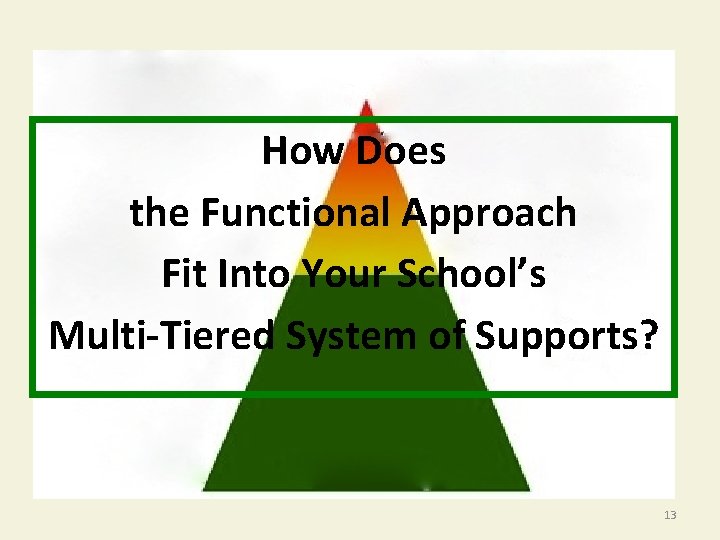
How Does the Functional Approach Fit Into Your School’s Multi-Tiered System of Supports? 13
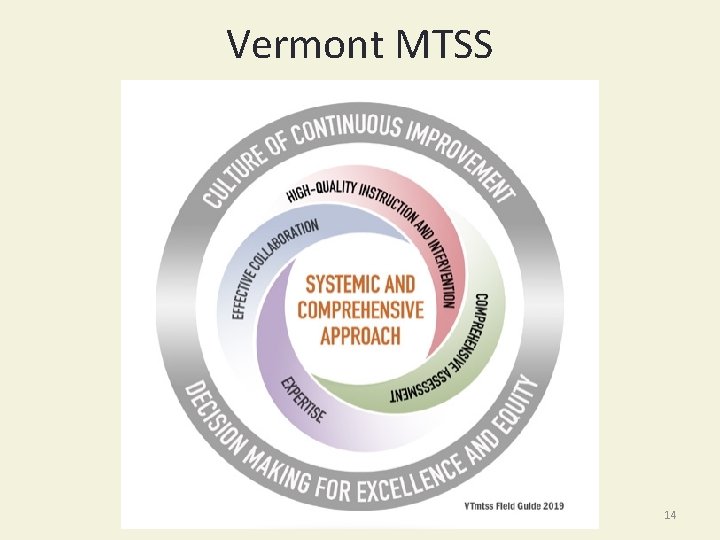
Vermont MTSS 14
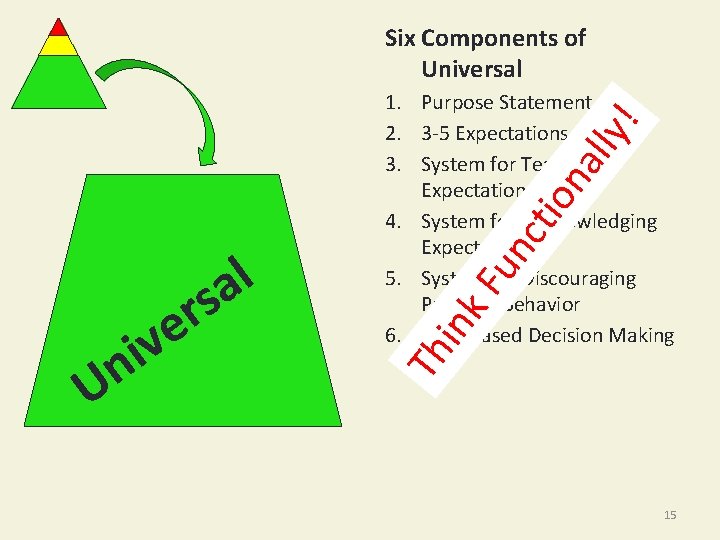
Six Components of Universal U k. F s r e v i n Th in l a un cti on all y! 1. Purpose Statement 2. 3 -5 Expectations 3. System for Teaching Expectations 4. System for Acknowledging Expectations 5. System for Discouraging Problem Behavior 6. Data-based Decision Making 15
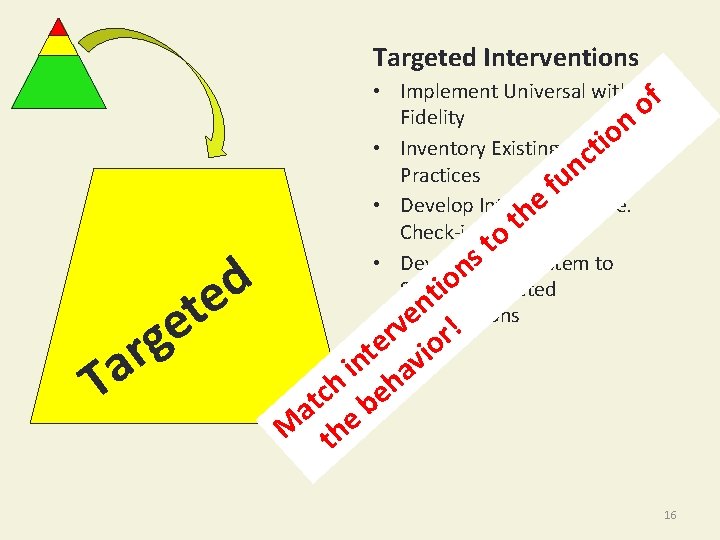
Targeted Interventions a T e rg d te • Implement Universal with f o Fidelity n o i • Inventory Existing Targeted t c n Practices u f e – ie. • Develop Intervention h t Check-in/Check-out o t • Developns. Data System to io Targeted Support t Interventions en v r! r e io t in hav h e c at e b M th 16
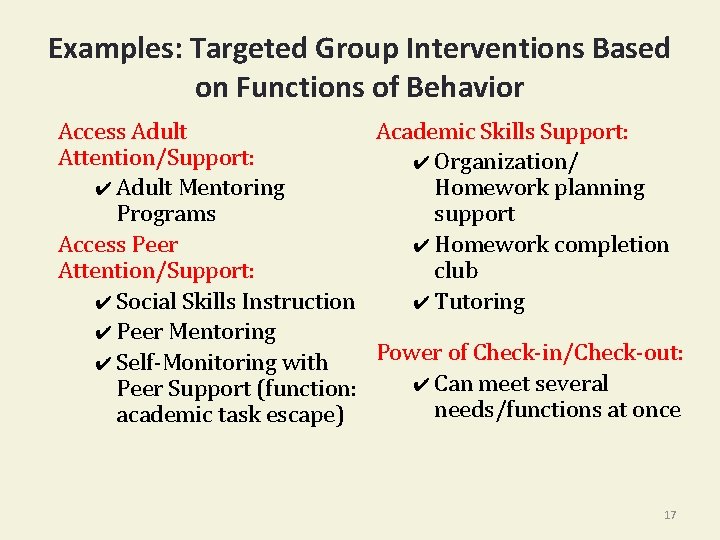
Examples: Targeted Group Interventions Based on Functions of Behavior Access Adult Academic Skills Support: Attention/Support: ✔ Organization/ ✔ Adult Mentoring Homework planning Programs support Access Peer ✔ Homework completion Attention/Support: club ✔ Social Skills Instruction ✔ Tutoring ✔ Peer Mentoring Power of Check-in/Check-out: ✔ Self-Monitoring with ✔ Can meet several Peer Support (function: needs/functions at once academic task escape) 17
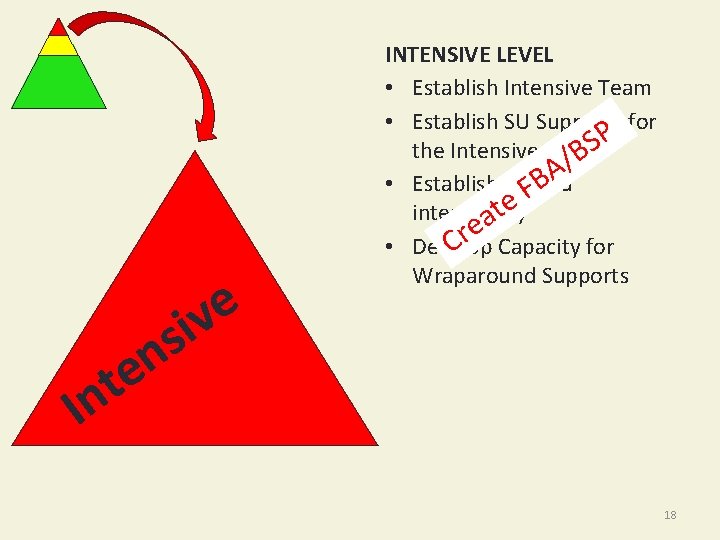
e v i s INTENSIVE LEVEL • Establish Intensive Team • Establish SU Supports for P S the Intensive Level B / BA • Establish SUFand e t interagency ea r • Develop C Capacity for Wraparound Supports n e t In 18
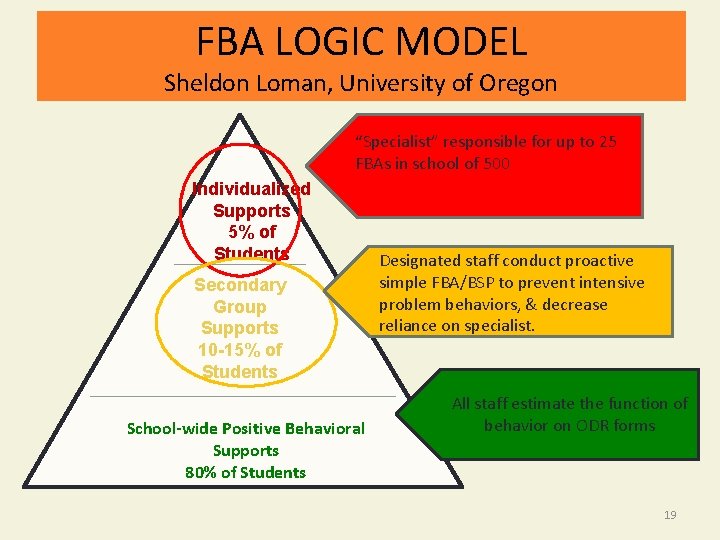
FBA LOGIC MODEL Sheldon Loman, University of Oregon “Specialist” responsible for up to 25 FBAs in school of 500 Individualized Supports 5% of Students Secondary Group Supports 10 -15% of Students School-wide Positive Behavioral Supports 80% of Students Designated staff conduct proactive simple FBA/BSP to prevent intensive problem behaviors, & decrease reliance on specialist. All staff estimate the function of behavior on ODR forms 19
Break! 15 -minute break 20
Who is responsible for conducting FBA/BSPs in your school? How does someone access this FBA/BSP? 21
Requesting an FBA • Teachers & school teams should be able to identify the system for requesting assistance • Teachers should be able to identify who to access assistance from • The targeted team/EST will determine when an FBA/BSP referral is necessary, based on data 22
ACTIVITY 1: Using the questions in the workbook, review/develop your school’s process for accessing an FBA/BSP 23
D. A. S. H. • Define behavior in observable and measurable terms • Ask about behavior by interviewing staff and student • specify routines where & when behavior occurs • summarize where, when, and why behavior occurs • See the behavior • observe the behavior during routines specified to verify summary from interviews • Hypothesize • a final summary of where, when, and why behaviors occur 24
Defining and Understanding Behavior 25
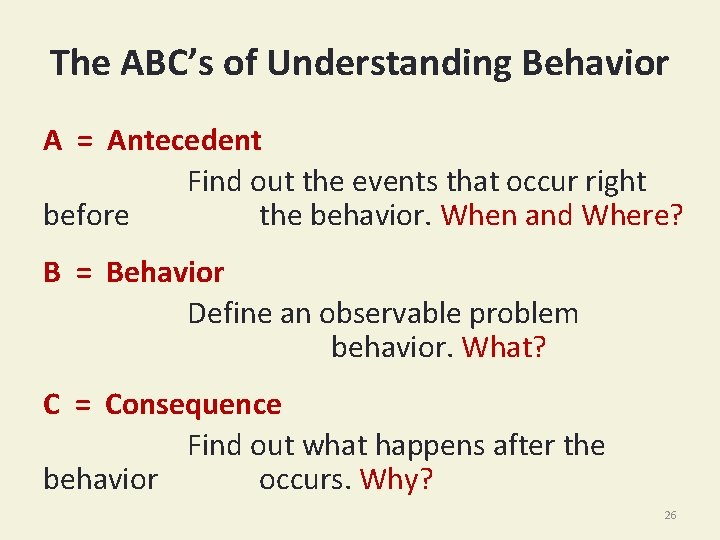
The ABC’s of Understanding Behavior A = Antecedent Find out the events that occur right before the behavior. When and Where? B = Behavior Define an observable problem behavior. What? C = Consequence Find out what happens after the behavior occurs. Why? 26
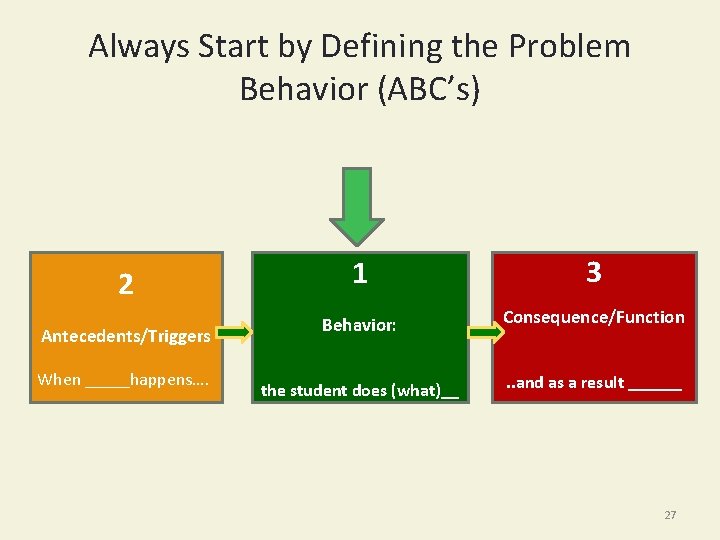
Always Start by Defining the Problem Behavior (ABC’s) 2 Antecedents/Triggers When _____happens…. 1 3 Behavior: Consequence/Function the student does (what)__ . . and as a result ______ 27
Defining Observable Behaviors Definitions of behaviors need to be: *Observable: an action that can be seen *Measurable: can be counted or timed *Defined so clearly that a person unfamiliar with the student could recognize the behavior without any doubts! 28
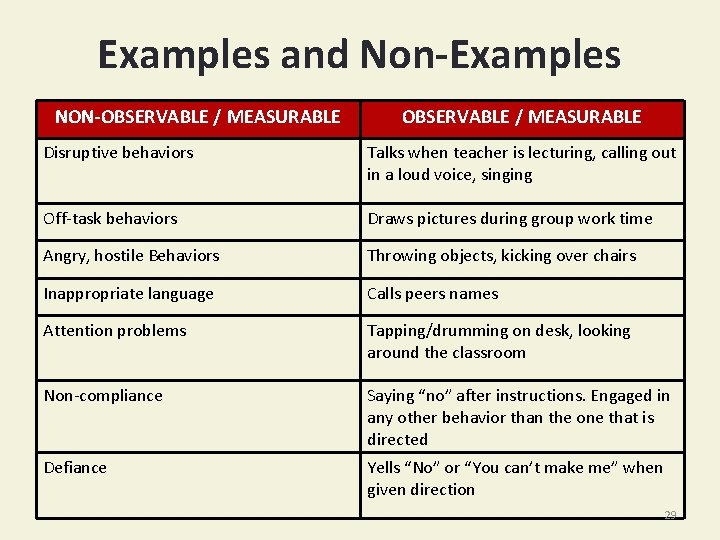
Examples and Non-Examples NON-OBSERVABLE / MEASURABLE Disruptive behaviors Talks when teacher is lecturing, calling out in a loud voice, singing Off-task behaviors Draws pictures during group work time Angry, hostile Behaviors Throwing objects, kicking over chairs Inappropriate language Calls peers names Attention problems Tapping/drumming on desk, looking around the classroom Non-compliance Saying “no” after instructions. Engaged in any other behavior than the one that is directed Defiance Yells “No” or “You can’t make me” when given direction 29
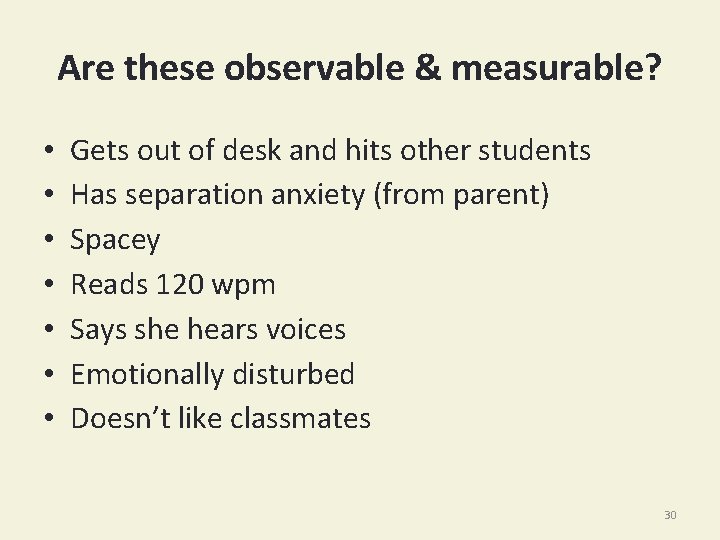
Are these observable & measurable? • • Gets out of desk and hits other students Has separation anxiety (from parent) Spacey Reads 120 wpm Says she hears voices Emotionally disturbed Doesn’t like classmates 30
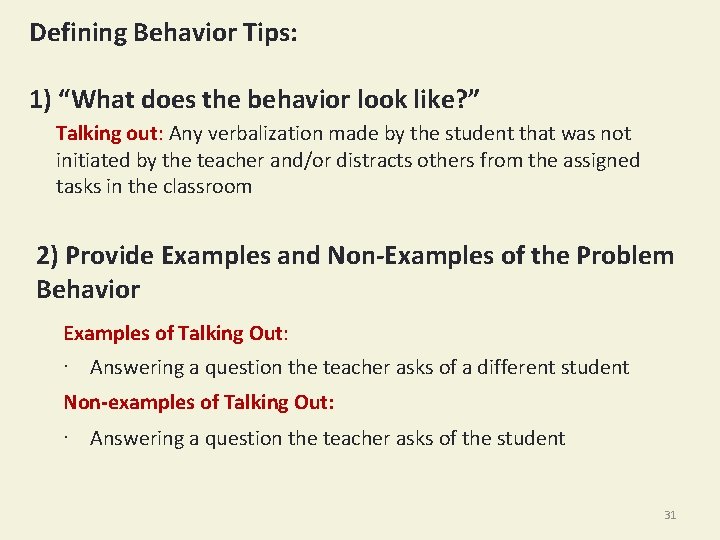
Defining Behavior Tips: 1) “What does the behavior look like? ” Talking out: Any verbalization made by the student that was not initiated by the teacher and/or distracts others from the assigned tasks in the classroom 2) Provide Examples and Non-Examples of the Problem Behavior Examples of Talking Out: ∙ Answering a question the teacher asks of a different student Non-examples of Talking Out: ∙ Answering a question the teacher asks of the student 31
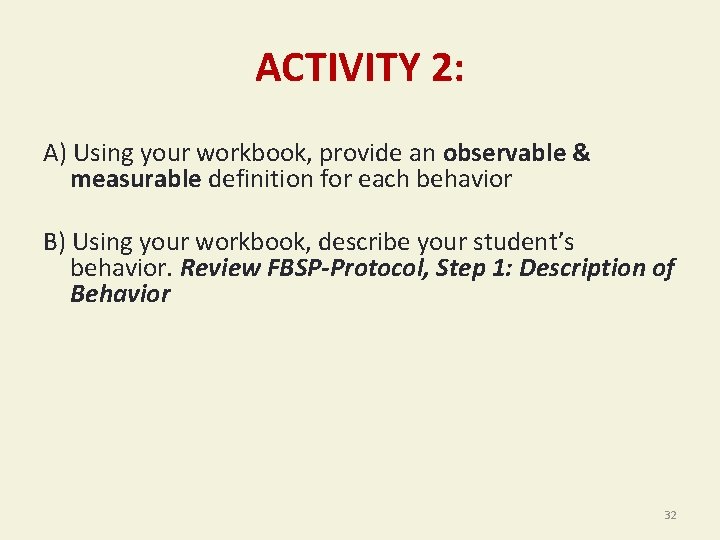
ACTIVITY 2: A) Using your workbook, provide an observable & measurable definition for each behavior B) Using your workbook, describe your student’s behavior. Review FBSP-Protocol, Step 1: Description of Behavior 32
Break! 15 -minute break 33
D. A. S. H. • Define behavior in observable and measurable terms • Ask about behavior by interviewing staff and student • specify routines where & when behavior occurs • summarize where, when, and why behavior occurs • See the behavior • observe the behavior during routines specified to verify summary from interviews • Hypothesize • a final summary of where, when, and why behaviors occur 34
Asking About When, Where, and Why the Behavior Occurs 35
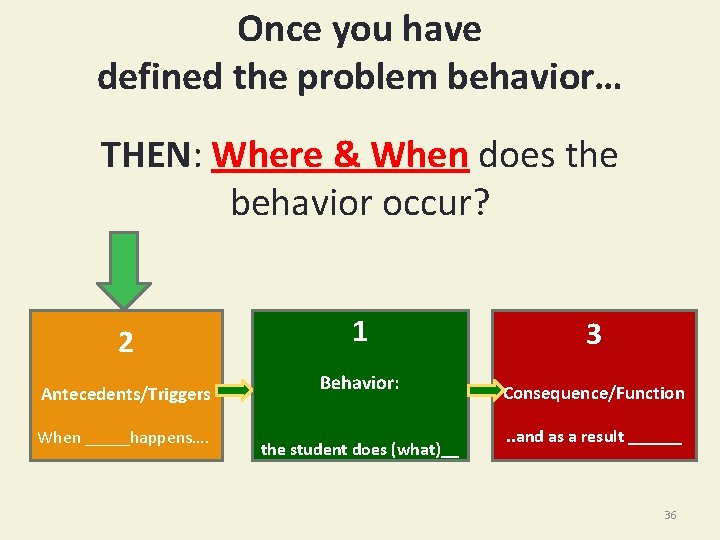
Once you have defined the problem behavior… THEN: Where & When does the behavior occur? 2 Antecedents/Triggers When _____happens…. 1 3 Behavior: Consequence/Function the student does (what)__ . . and as a result ______ 36
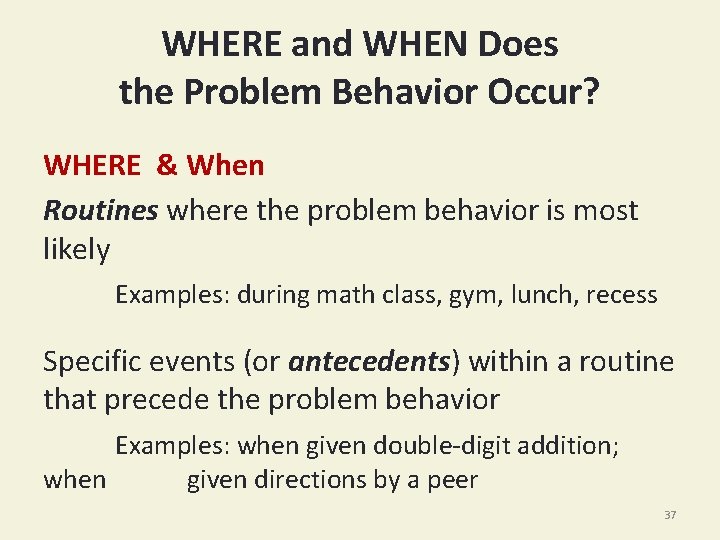
WHERE and WHEN Does the Problem Behavior Occur? WHERE & When Routines where the problem behavior is most likely Examples: during math class, gym, lunch, recess Specific events (or antecedents) within a routine that precede the problem behavior Examples: when given double-digit addition; when given directions by a peer 37
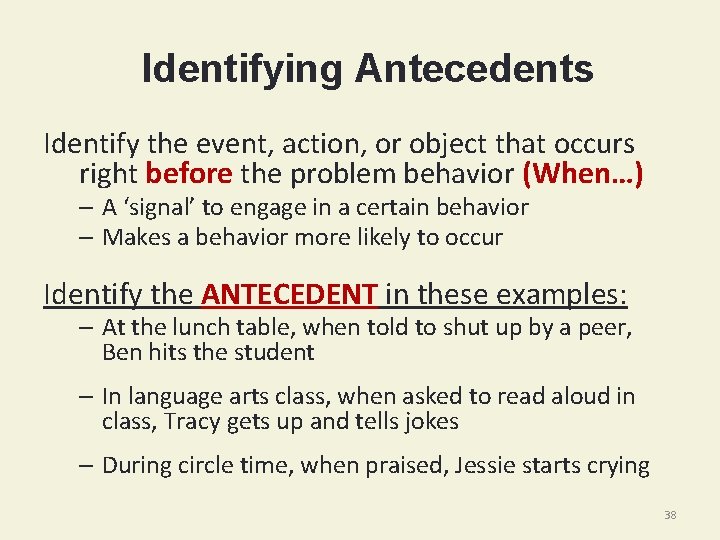
Identifying Antecedents Identify the event, action, or object that occurs right before the problem behavior (When…) – A ‘signal’ to engage in a certain behavior – Makes a behavior more likely to occur Identify the ANTECEDENT in these examples: – At the lunch table, when told to shut up by a peer, Ben hits the student – In language arts class, when asked to read aloud in class, Tracy gets up and tells jokes – During circle time, when praised, Jessie starts crying 38
ACTIVITY 3: Using your workbook, identify the behavior and antecedent in the scenarios. 39
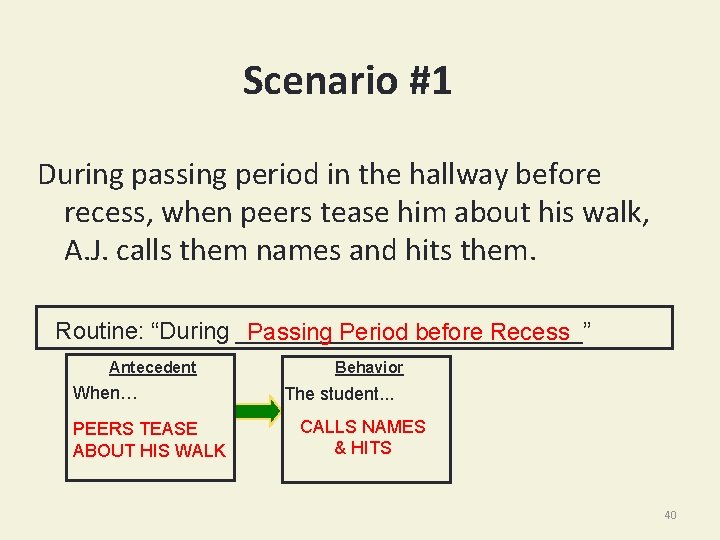
Scenario #1 During passing period in the hallway before recess, when peers tease him about his walk, A. J. calls them names and hits them. Routine: “During _____________” Passing Period before Recess Antecedent When… PEERS TEASE ABOUT HIS WALK Behavior The student. . . CALLS NAMES & HITS 40
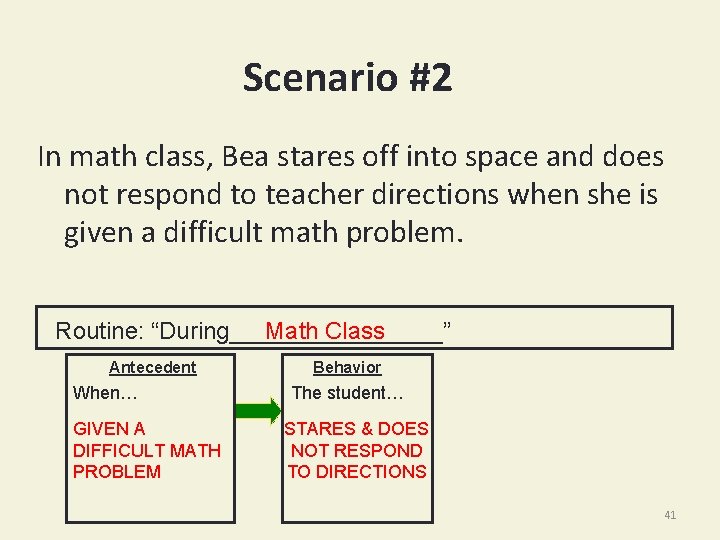
Scenario #2 In math class, Bea stares off into space and does not respond to teacher directions when she is given a difficult math problem. Routine: “During________” Math Class Antecedent When… GIVEN A DIFFICULT MATH PROBLEM Behavior The student… STARES & DOES NOT RESPOND TO DIRECTIONS 41
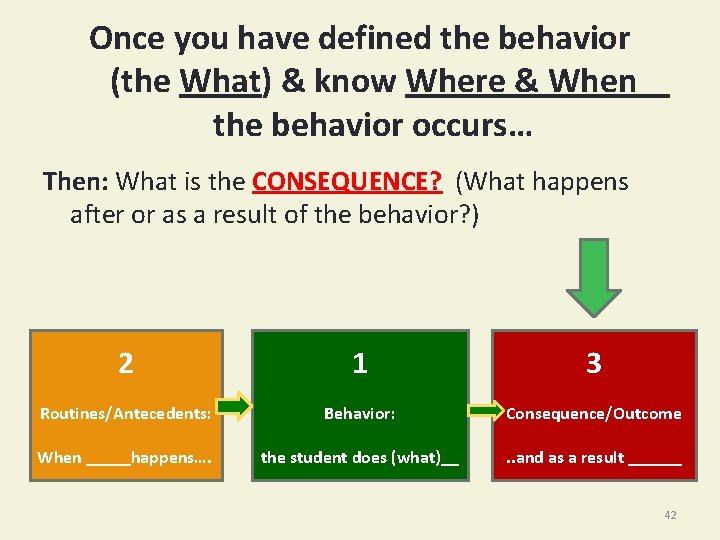
Once you have defined the behavior (the What) & know Where & When the behavior occurs… Then: What is the CONSEQUENCE? (What happens after or as a result of the behavior? ) 2 1 3 Routines/Antecedents: Behavior: Consequence/Outcome When _____happens…. the student does (what)__ . . and as a result ______ 42
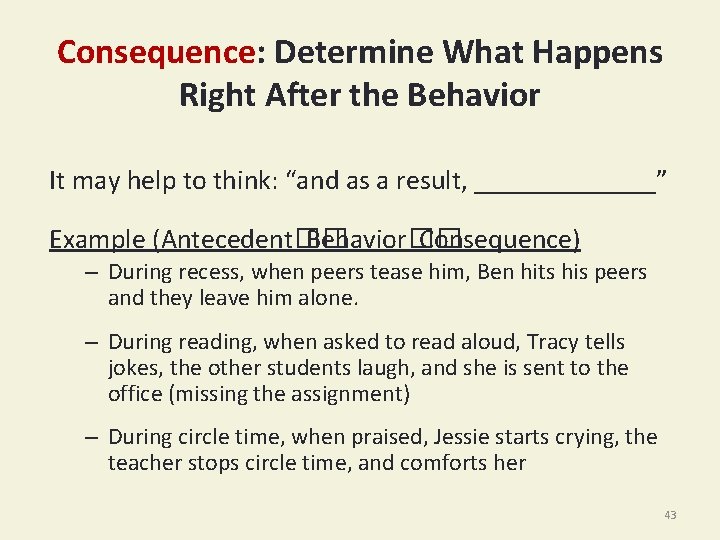
Consequence: Determine What Happens Right After the Behavior It may help to think: “and as a result, _______” Example (Antecedent�� Behavior�� Consequence) – During recess, when peers tease him, Ben hits his peers and they leave him alone. – During reading, when asked to read aloud, Tracy tells jokes, the other students laugh, and she is sent to the office (missing the assignment) – During circle time, when praised, Jessie starts crying, the teacher stops circle time, and comforts her 43
ACTIVITY 4: A) Using your workbook, identify the behavior, routine, antecedent, and consequence in the scenario #1 and scenario #2 B) Using your workbook, Identify the ABC’s of your student’s behavior. Also, review FBSPProtocol, Step 1: Description of Antecedent and Consequences 44
Homework A) Use the provided Structured Interview Forms to gather anecdotal information related to the ABC’s of your selected student’s target behavior. B) Next session: we will look at these interview data, talk about observation strategies, and develop a hypothesis for the function of your selected student’s target behavior. 45
- Slides: 45