
Basic events during B cell development Stem cells
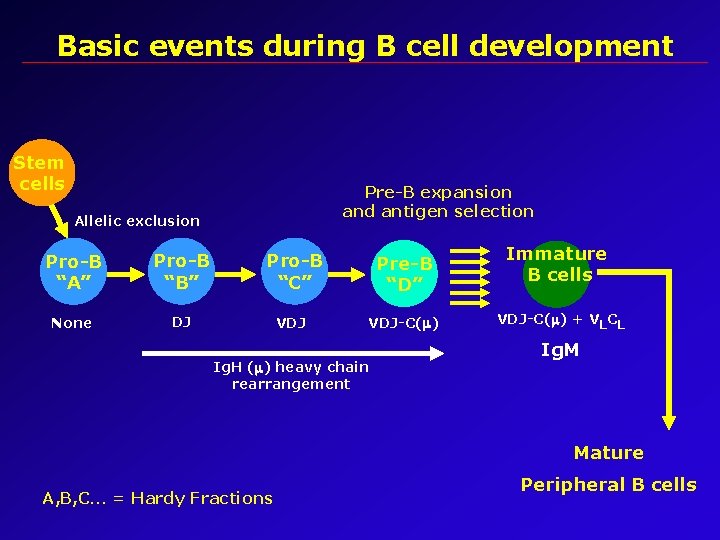
Basic events during B cell development Stem cells Pre-B expansion and antigen selection Allelic exclusion Pro-B “A” Pro-B “B” Pro-B “C” Pre-B “D” None DJ VDJ-C(m) Ig. H (m) heavy chain rearrangement Immature B cells VDJ-C(m) + VLCL Ig. M Mature A, B, C… = Hardy Fractions Peripheral B cells
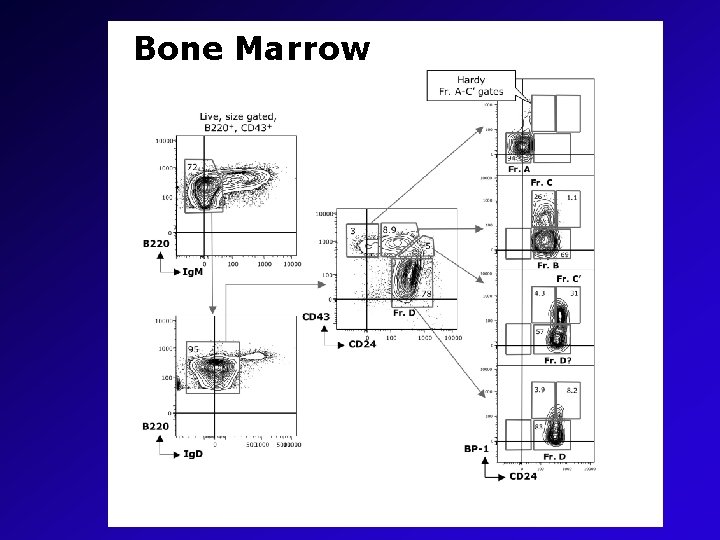
Bone Marrow
But: not all mature B cells are the same
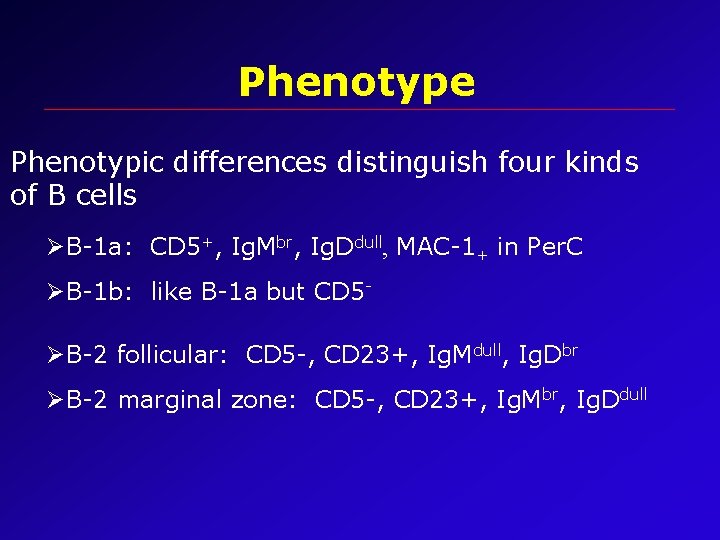
Phenotype Phenotypic differences distinguish four kinds of B cells ØB-1 a: CD 5+, Ig. Mbr, Ig. Ddull, MAC-1+ in Per. C ØB-1 b: like B-1 a but CD 5ØB-2 follicular: CD 5 -, CD 23+, Ig. Mdull, Ig. Dbr ØB-2 marginal zone: CD 5 -, CD 23+, Ig. Mbr, Ig. Ddull
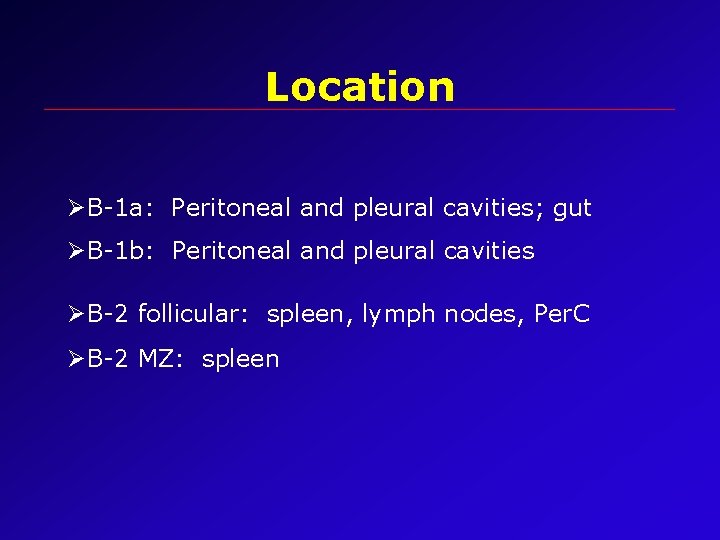
Location ØB-1 a: Peritoneal and pleural cavities; gut ØB-1 b: Peritoneal and pleural cavities ØB-2 follicular: spleen, lymph nodes, Per. C ØB-2 MZ: spleen
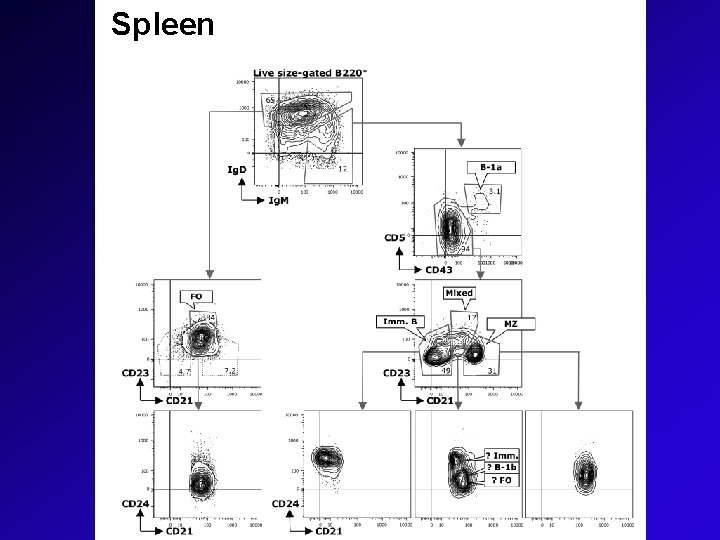
Spleen
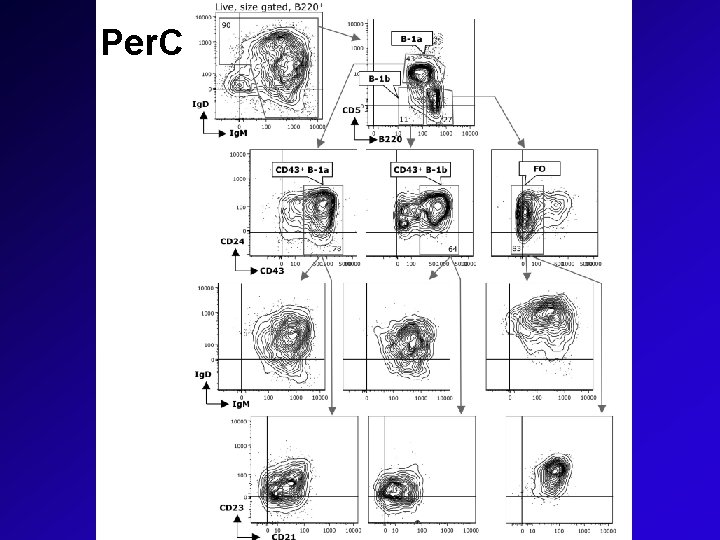
Per. C
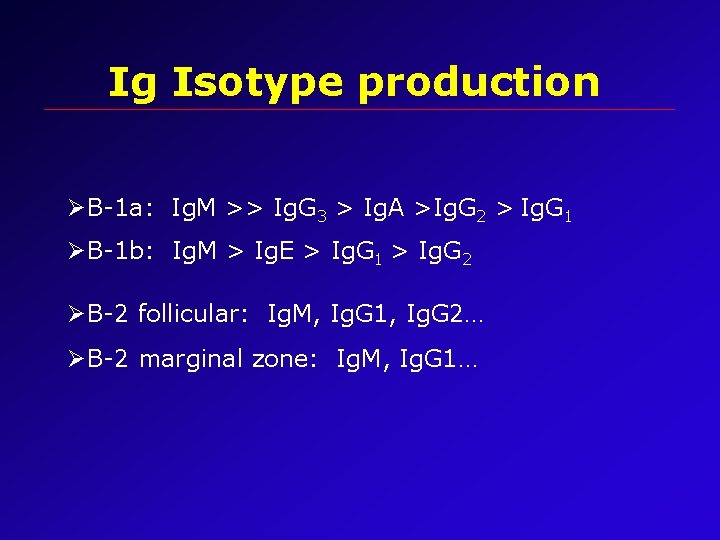
Ig Isotype production ØB-1 a: Ig. M >> Ig. G 3 > Ig. A >Ig. G 2 > Ig. G 1 ØB-1 b: Ig. M > Ig. E > Ig. G 1 > Ig. G 2 ØB-2 follicular: Ig. M, Ig. G 1, Ig. G 2… ØB-2 marginal zone: Ig. M, Ig. G 1…
Function: adaptive responses ØMade in response to antigenic stimulation ØUsually T dependent ØDifferentiate to Ig. G memory cells ØUsually made by B-2, but B-1 clearly respond
Function: natural antibodies ØMade by B-1 ØProduced and secreted without (known) specific antigenic stimulation ØCytokines increase secretion ØIL-9 increases Ig. E and Ig. G 1 production by B-1 b ØIL-5 increases secretion by B-1 a (? ) ØProduction is T-independent in the ordinary sense ØDifferentiation to Ig. G producing cells has been reported in pathologic conditions
Ontogeny ØB-1 a: Arise in fetus and neonate ØB-1 b: Arise in neonate; adult? ? ØB-2 follicular: Arise around weaning ØB-2 MZ: Strains differ but mostly after weaning
Subset maintenance ØB-2 are replenished by de novo development from progenitors in BM throughout life ØB-1 cells develop de novo during fetal and neonatal life but persist thereafter as a selfreplenishing population
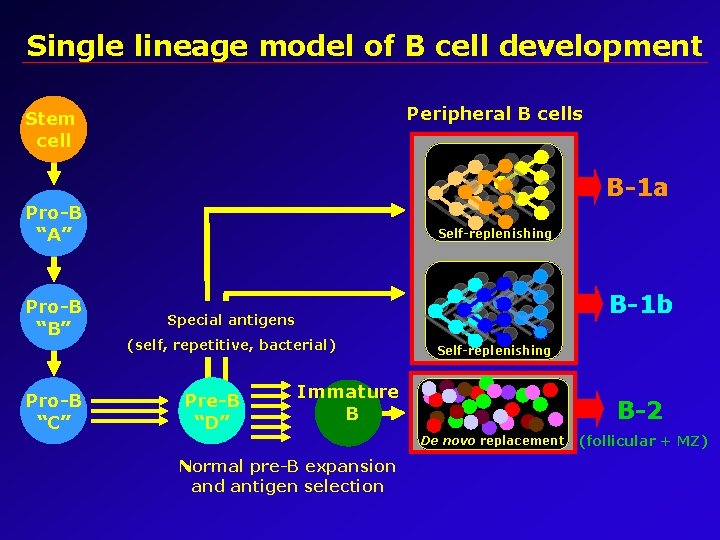
Single lineage model of B cell development Peripheral B cells Stem cell B-1 a Pro-B “A” Pro-B “B” Pro-B “C” Self-replenishing Specialantigens (self, repetitive, bacterial) B-1 b DH DJ Pre-B “D” Self-replenishing Immature B B-2 De novo replacement Normal pre-B expansion and antigen selection (follicular + MZ)
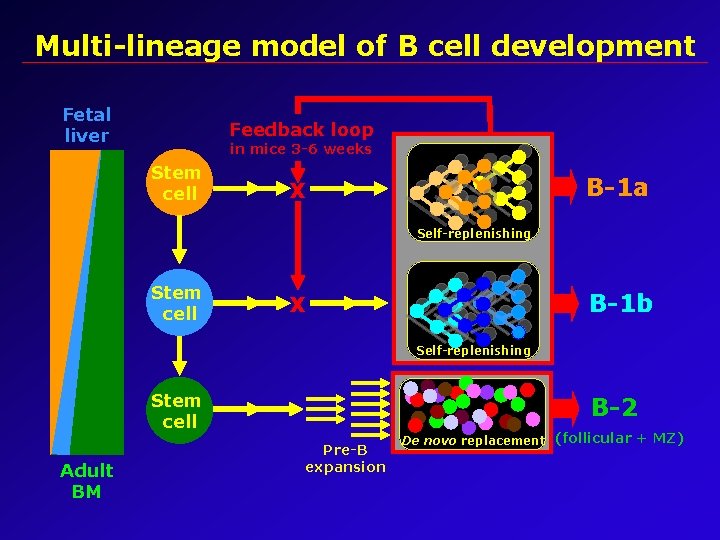
Multi-lineage model of B cell development Fetal liver Feedback loop in mice 3 -6 weeks Stem cell B-1 a X Self-replenishing Stem cell B-1 b X Self-replenishing Stem cell Adult BM B-2 Pre-B expansion De novo replacement (follicular + MZ)
So how do we determine which hypothesis is valid? Study B cell progenitors activity in mixture-transfer experiments Use Ig allotype expression to mark the mature progeny B cells
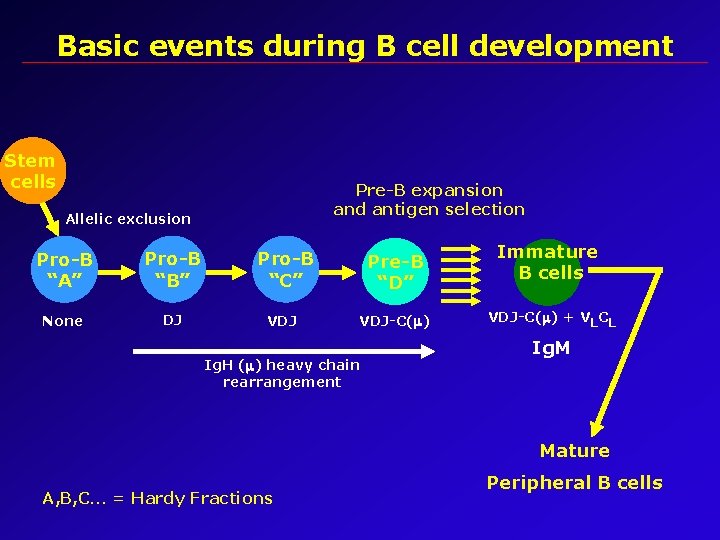
Basic events during B cell development Stem cells Pre-B expansion and antigen selection Allelic exclusion Pro-B “A” Pro-B “B” Pro-B “C” Pre-B “D” None DJ VDJ-C(m) Ig. H (m) heavy chain rearrangement Immature B cells VDJ-C(m) + VLCL Ig. M Mature A, B, C… = Hardy Fractions Peripheral B cells
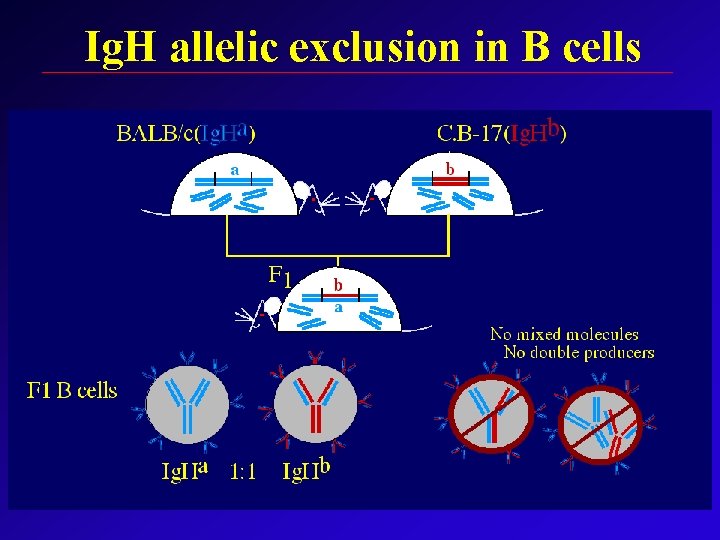
Ig. H allelic exclusion in B cells
“Allelic” exclusion The Ig. H of the antibody molecules produced by an individual B cell are all encoded by a single VDJ-C rearrangement that occurred on one of the two parental chromosomes
So how do we determine which hypothesis is valid? Study B cell progenitors activity in mixture-transfer experiments Use Ig allotype expression to mark the mature progeny B cells
Results of mixture-transfer studies ØB-2 are replenished by de novo development from progenitors in BM throughout life ØAdult BM readily regenerates the entire B-2 population in adoptive recipients ØB-1 cells develop de novo during fetal and neonatal life but persist thereafter as a selfreplenishing population ØAdult BM regenerates only a few B-1 cells, mainly B-1 b ØFetal and neonatal progenitor sources fully regenerate the B-1 population
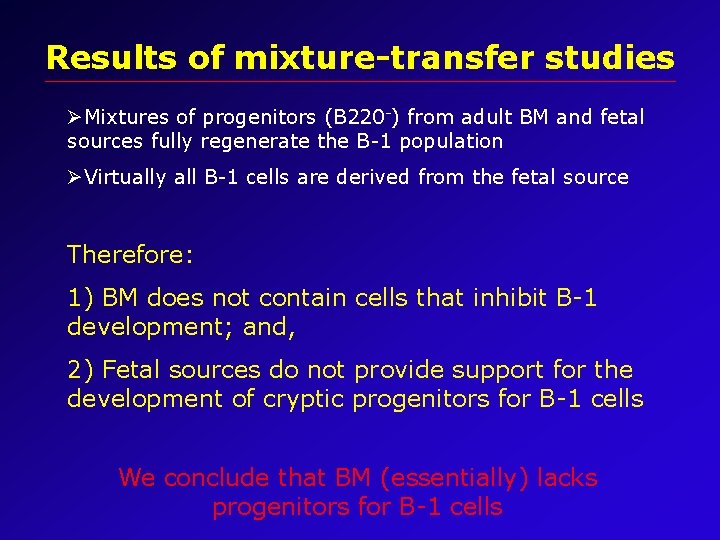
Results of mixture-transfer studies ØMixtures of progenitors (B 220 -) from adult BM and fetal sources fully regenerate the B-1 population ØVirtually all B-1 cells are derived from the fetal source Therefore: 1) BM does not contain cells that inhibit B-1 development; and, 2) Fetal sources do not provide support for the development of cryptic progenitors for B-1 cells We conclude that BM (essentially) lacks progenitors for B-1 cells
- Slides: 21