
BASIC EPIDEMIOLOGY Definition of epidemiology The epidemiological sequence

BASIC EPIDEMIOLOGY
Definition of epidemiology
The epidemiological sequence: Observation. Counting cases or events. Relating cases or events to the population at risk. Making comparisons.

The epidemiological sequence: Developing the hypothesis. Testing the hypothesis. Making scientific inferences. Conducting experimental studies Intervention and evaluation.
Scope of epidemiology
Importance of epidemiology
Measurements in epidemiology
Tools of measurements in epidemiology: Rate: the rate measures the occurrence of some particular event (disease, death) in a population during a given time period. It is a statement of the risk of developing a condition.
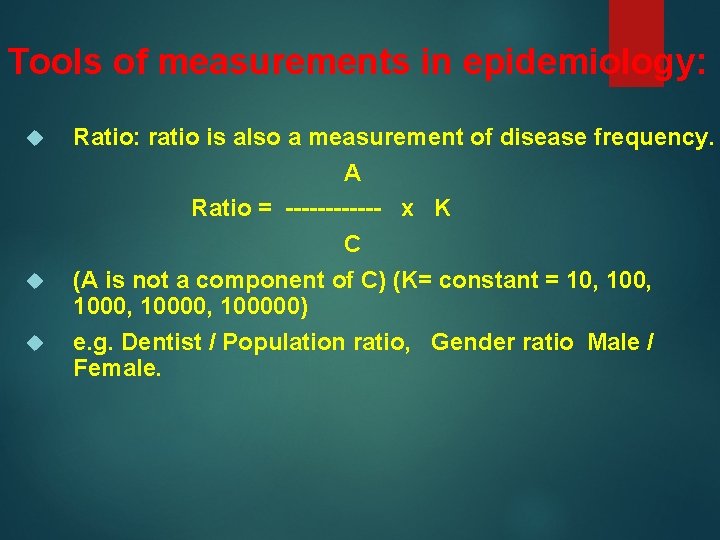
Tools of measurements in epidemiology: Ratio: ratio is also a measurement of disease frequency. A Ratio = ------ x K C (A is not a component of C) (K= constant = 10, 1000, 100000) e. g. Dentist / Population ratio, Gender ratio Male / Female.
Tools of measurements in epidemiology: Proportion: proportion is a rate which indicate the relation in magnitude of a part to the whole, it is usually expressed as a percentage. E. g. proportional death rat of a cause to all deaths
Prevalence: It is the frequency of all current cases of disease in a population at a specified time. It can be measured at a single point in time (Point Prevalence) or over a period of time (Period Prevalence).
Uses of prevalence rates
Prevalence rate best used for measurements of: Chronic, long-term illness Monitoring diseases of changes in chronic
Factors influencing prevalence rate
Factors influencing prevalence rate The number of new cases (if many people develop a disease its prevalence rate is higher than if few people do so)
Incidence: It is the frequency of new cases in the population at risk during a specified period of time.
Uses of incidence
Example: In a class of 100 students some of the students become ill with mumps during the month of Oct. On the 30 th Sept. , 5 students reported mumps recovered within 5 days, during Oct. 30 students had got mumps. Calculate : Incidence during Oct v Period prevalence on Oct. v. Point prevalence at 30 th Sep. v
Endemic: It is the habitual presence of a disease within a geographical area or the usual occurrence of a disease within such area. Epidemic: It is an unusual increase in frequency of disease above the expected (endemic) occurrence.
- Slides: 19