
Basic English Grammar Lessons 1 Singular and Plural
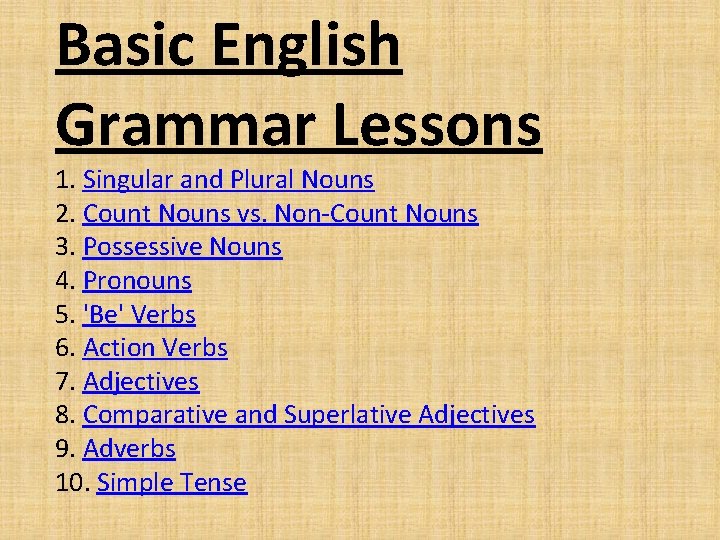
Basic English Grammar Lessons 1. Singular and Plural Nouns 2. Count Nouns vs. Non-Count Nouns 3. Possessive Nouns 4. Pronouns 5. 'Be' Verbs 6. Action Verbs 7. Adjectives 8. Comparative and Superlative Adjectives 9. Adverbs 10. Simple Tense
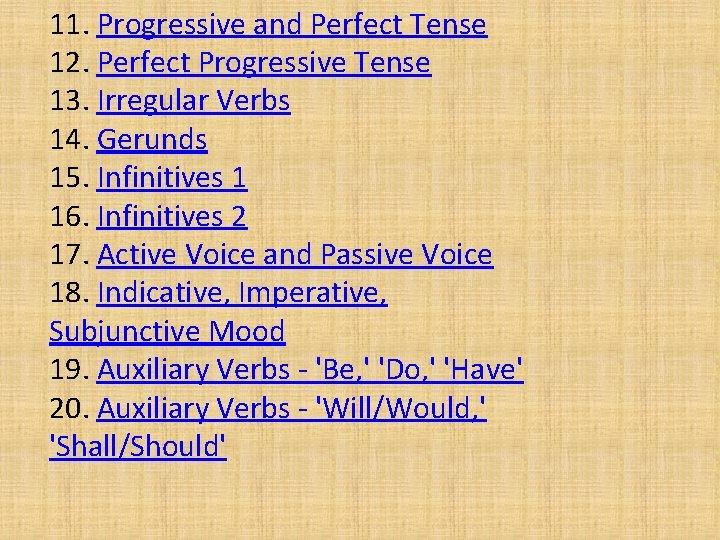
11. Progressive and Perfect Tense 12. Perfect Progressive Tense 13. Irregular Verbs 14. Gerunds 15. Infinitives 1 16. Infinitives 2 17. Active Voice and Passive Voice 18. Indicative, Imperative, Subjunctive Mood 19. Auxiliary Verbs - 'Be, ' 'Do, ' 'Have' 20. Auxiliary Verbs - 'Will/Would, ' 'Shall/Should'
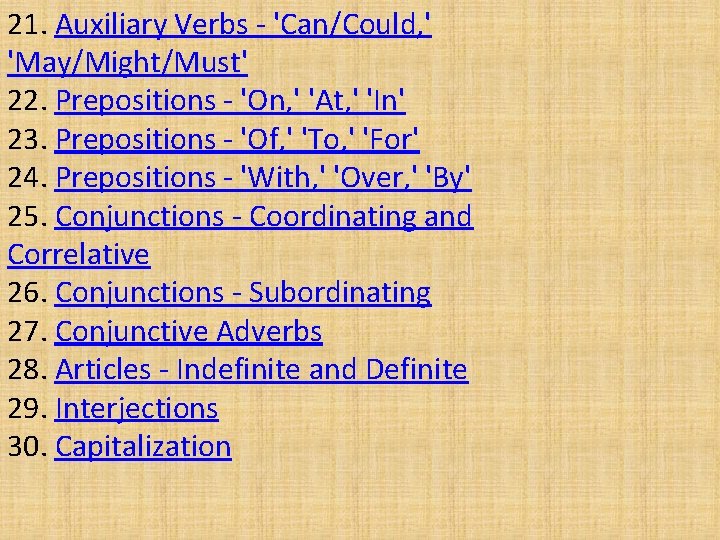
21. Auxiliary Verbs - 'Can/Could, ' 'May/Might/Must' 22. Prepositions - 'On, ' 'At, ' 'In' 23. Prepositions - 'Of, ' 'To, ' 'For' 24. Prepositions - 'With, ' 'Over, ' 'By' 25. Conjunctions - Coordinating and Correlative 26. Conjunctions - Subordinating 27. Conjunctive Adverbs 28. Articles - Indefinite and Definite 29. Interjections 30. Capitalization
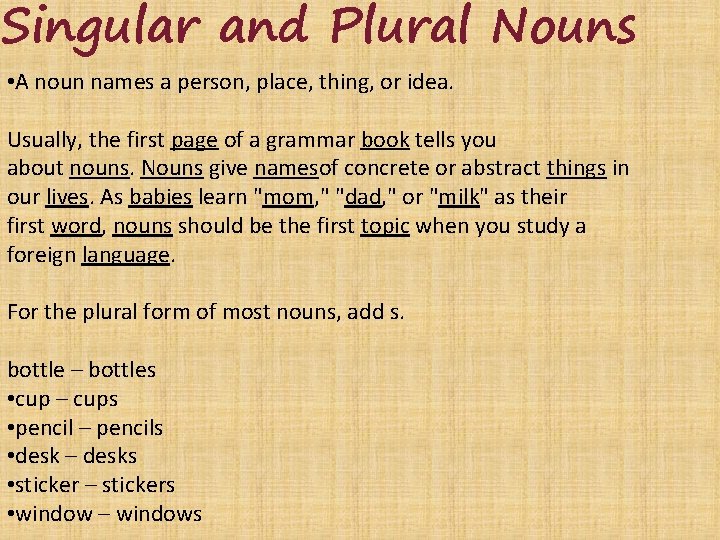
Singular and Plural Nouns • A noun names a person, place, thing, or idea. Usually, the first page of a grammar book tells you about nouns. Nouns give namesof concrete or abstract things in our lives. As babies learn "mom, " "dad, " or "milk" as their first word, nouns should be the first topic when you study a foreign language. For the plural form of most nouns, add s. bottle – bottles • cup – cups • pencil – pencils • desk – desks • sticker – stickers • window – windows
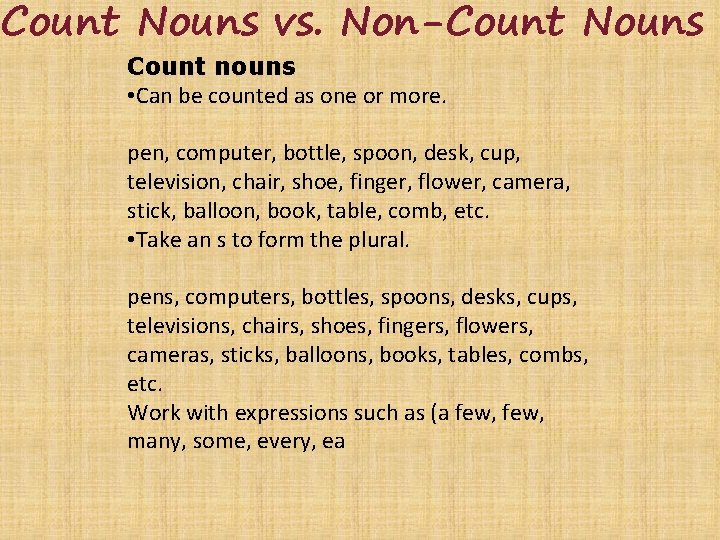
Count Nouns vs. Non-Count Nouns Count nouns • Can be counted as one or more. pen, computer, bottle, spoon, desk, cup, television, chair, shoe, finger, flower, camera, stick, balloon, book, table, comb, etc. • Take an s to form the plural. pens, computers, bottles, spoons, desks, cups, televisions, chairs, shoes, fingers, flowers, cameras, sticks, balloons, books, tables, combs, etc. Work with expressions such as (a few, many, some, every, ea
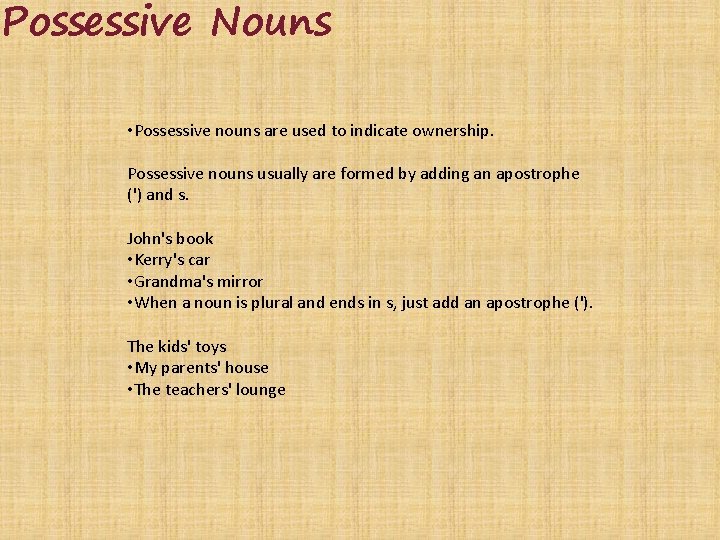
Possessive Nouns • Possessive nouns are used to indicate ownership. Possessive nouns usually are formed by adding an apostrophe (') and s. John's book • Kerry's car • Grandma's mirror • When a noun is plural and ends in s, just add an apostrophe ('). The kids' toys • My parents' house • The teachers' lounge
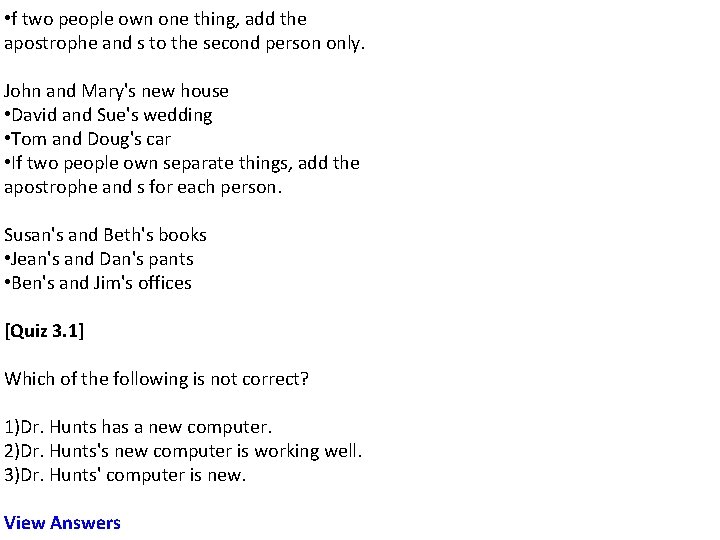
• f two people own one thing, add the apostrophe and s to the second person only. John and Mary's new house • David and Sue's wedding • Tom and Doug's car • If two people own separate things, add the apostrophe and s for each person. Susan's and Beth's books • Jean's and Dan's pants • Ben's and Jim's offices [Quiz 3. 1] Which of the following is not correct? 1)Dr. Hunts has a new computer. 2)Dr. Hunts's new computer is working well. 3)Dr. Hunts' computer is new. View Answers
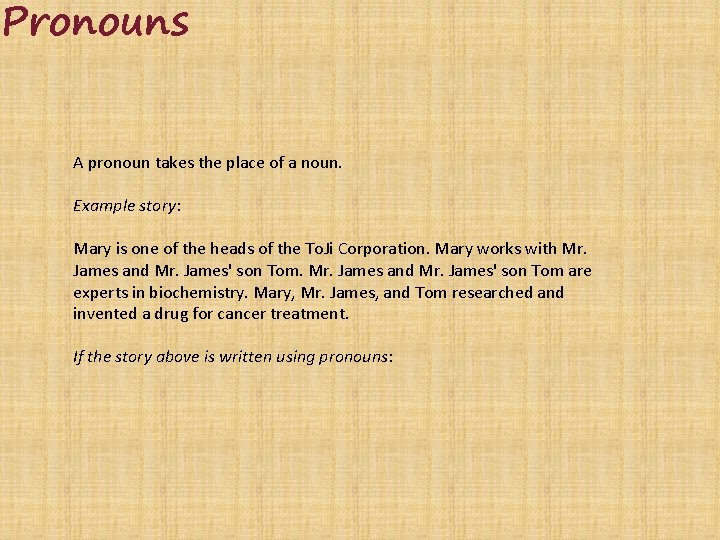
Pronouns A pronoun takes the place of a noun. Example story: Mary is one of the heads of the To. Ji Corporation. Mary works with Mr. James and Mr. James' son Tom are experts in biochemistry. Mary, Mr. James, and Tom researched and invented a drug for cancer treatment. If the story above is written using pronouns:
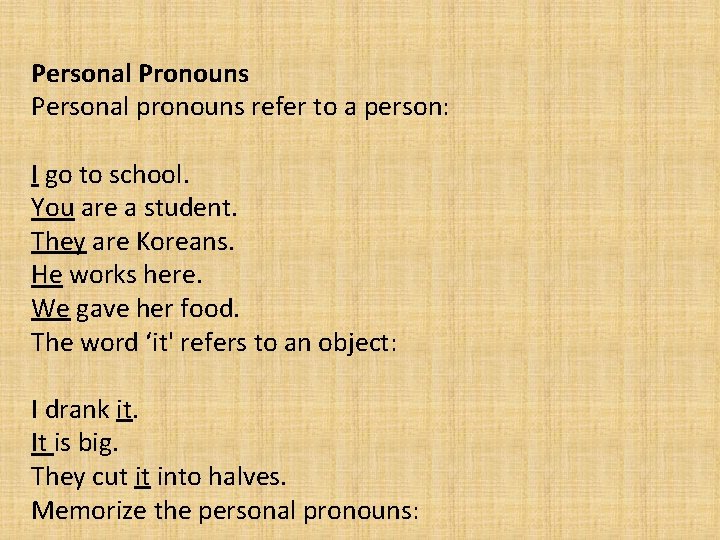
Personal Pronouns Personal pronouns refer to a person: I go to school. You are a student. They are Koreans. He works here. We gave her food. The word ‘it' refers to an object: I drank it. It is big. They cut it into halves. Memorize the personal pronouns:
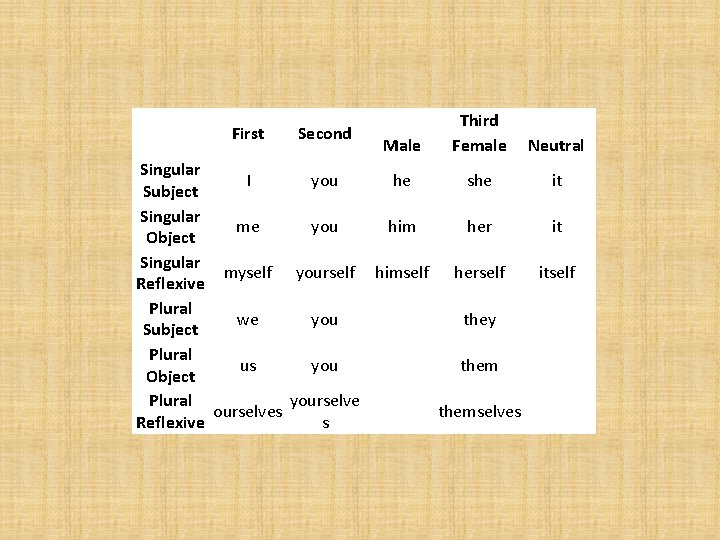
First Second Male Third Female Neutral Singular I you he she it Subject Singular me you him her it Object Singular myself yourself himself herself itself Reflexive Plural we you they Subject Plural us you them Object Plural yourselves themselves Reflexive s
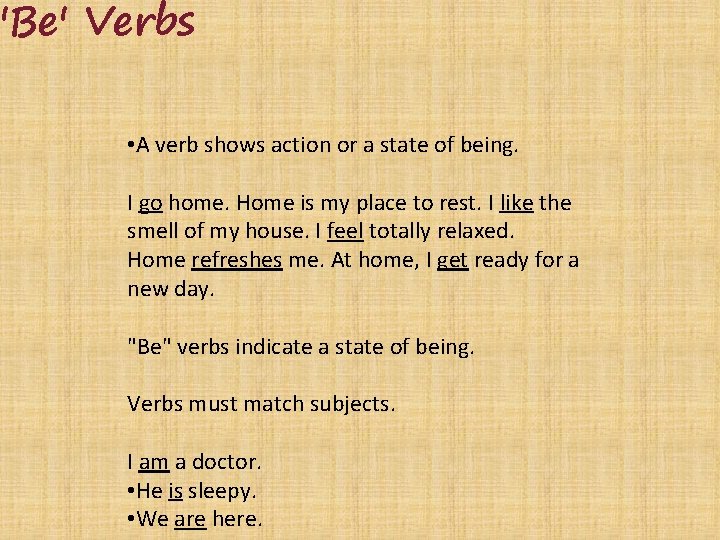
'Be' Verbs • A verb shows action or a state of being. I go home. Home is my place to rest. I like the smell of my house. I feel totally relaxed. Home refreshes me. At home, I get ready for a new day. "Be" verbs indicate a state of being. Verbs must match subjects. I am a doctor. • He is sleepy. • We are here.
Negative sentences need ‘not' after the verb. I am not a doctor. He is not sleepy. We are not there. The verb comes first in interrogative sentences. Am I a doctor? Is he sleepy? Are we there?
Mahatma gandhi vidyalaya, manchar


Made by Mr. Mundhe. S. V
- Slides: 16