
Basic Employee Training on COVID19 Infection Prevention Manufacturing
Basic Employee Training on COVID-19 Infection Prevention Manufacturing Sector Presented by: This presentation was created by the N. C. Department of Labor for safety and health training.
Objectives In this course, we will discuss the following: l What COVID-19 is, the symptoms, how it’s spread and what to do if you feel sick l Exposure risk levels and exposure controls l Face coverings, masks, respirators and face shields l Cleaning, sanitizing and disinfecting l Applicable OSHA standards related to COVID-19 l Additional assistance and resources This presentation was created by the N. C. Department of Labor for safety and health training.
What is COVID-19? l COVID-19 (Coronavirus Disease 2019) is the primary disease caused by infection with the novel 2019 coronavirus, SARS-Co. V-2. l The virus is related to other coronaviruses that cause the common cold but can cause much more serious health effects. l It is highly contagious, easily spreading from person to person. l In just a few months, it has infected millions of people worldwide. This presentation was created by the N. C. Department of Labor for safety and health training.
What are the symptoms of infection? l COVID-19 typically causes mild respiratory illness, but can cause severe disease, including pneumonia-like illness. l Symptoms may include any of the following: fever, cough, shortness of breath, headaches, chills, muscle aches, sore throat, fatigue, congestion, runny nose, loss of sense of taste or smell, nausea, vomiting, and/or diarrhea. l Symptoms typically begin 2 - 14 days after exposure. Some infected people show no symptoms (asymptomatic). This presentation was created by the N. C. Department of Labor for safety and health training.
How is COVID-19 spread? l It is spread from person to person, mainly through respiratory droplets from someone who is infected. l It can spread to others from coughing, sneezing, singing, yelling, or from just talking. l It can also spread through contact with contaminated surfaces or objects. This presentation was created by the N. C. Department of Labor for safety and health training.
What do you do if you feel sick? l If you believe you have infected with the novel 2019 coronavirus, stay home and call your healthcare provider. - If your healthcare provider advises you to be tested for the virus, get tested, and let your employer know the results as soon as possible. - Your employer is required to maintain confidentiality regarding this information. Note: If you have been infected, you may not have had symptoms for several days but may have passed the infection onto co-workers. This presentation was created by the N. C. Department of Labor for safety and health training.
If you test positive for COVID-19 l Your healthcare provider will advise you on procedures to follow (i. e. , self-quarantine). l Immediately let your employer know as they will need to implement control measures (i. e. , cleaning and disinfecting the workplace, notifying co-workers that may have been exposed). l Your Human Resources department will also let you know of procedures required in order to return to work (i. e. , no longer infectious, doctor’s note). This presentation was created by the N. C. Department of Labor for safety and health training.
COVID-19 Protective Measures l Employers are required to have specific procedures for protection against COVID-19 and employees need to be trained on those procedures. - Develop and implement a preparedness and response plan for COVID-19. - Perform hazard analysis or risk assessment to identify risk exposure levels. - Provide PPE where applicable. - Train employees. This presentation was created by the N. C. Department of Labor for safety and health training.
COVID-19 Preparedness/Response Plan l Plan elements - Identifies exposure risk levels for work activities. - Establishes protective measures and procedures. - Identifies engineering controls, administrative controls and safe work practices. - Lists protective equipment to be worn (i. e. , gloves, masks). - Includes employee training on the risk exposure levels, safe work practices, what to do when sick, cleaning and disinfecting protocols, PPE and other protective measures. This presentation was created by the N. C. Department of Labor for safety and health training.
Determining Exposure Risk Levels This presentation was created by the N. C. Department of Labor for safety and health training.
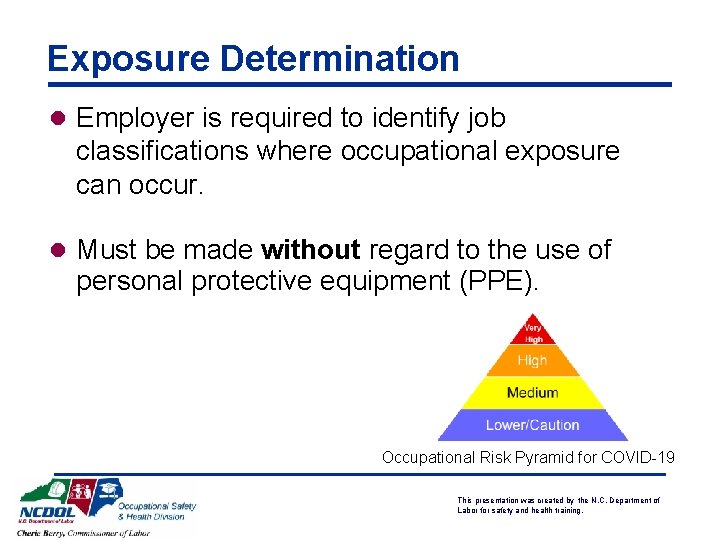
Exposure Determination l Employer is required to identify job classifications where occupational exposure can occur. l Must be made without regard to the use of personal protective equipment (PPE). Occupational Risk Pyramid for COVID-19 This presentation was created by the N. C. Department of Labor for safety and health training.
Exposure Risk Levels l Assess the hazards to which employees may be exposed. l Evaluate the risk of exposure through a job hazard analysis or risk assessment (i. e. , distance between workers, duration of contact, type of contact). l Select, implement, and ensure employees use controls to prevent exposure. This presentation was created by the N. C. Department of Labor for safety and health training.
Hazard Analysis/Risk Assessment l Both methods can help identify work activities that require close contact (within 6 feet) between workers and others. - Implement controls (i. e. , engineering, administrative, work practice controls) based on your analysis or assessment such as: » Staggered shifts » Handwashing stations, sanitation supplies » Physical barriers (i. e. , strip curtains, partitions) » Rearrange/remove workstations, tables, and work areas » Adequate ventilation This presentation was created by the N. C. Department of Labor for safety and health training.
Risk Exposure Levels Extremely High Risk (Examples*): l An employee performing first aid on an employee where atomized droplets from coughing and sneezing may be present. l An employee treating or transporting sick employees and cleaning their work areas. l An employee at facilities where no sanitization protocols are in place. *These are examples of potential extremely high-risk exposures. It is up to the employer to assess the work activity to determine the actual level of risk exposure. This presentation was created by the N. C. Department of Labor for safety and health training.
Risk Exposure Levels High Risk (Examples*): l Work areas where 10 or more employees are working (i. e. , production lines, assembly lines), and 6 -foot separation cannot be maintained. l Employees performing tasks requiring close-proximity with other employees for 15 minutes or more. *These are examples of potential high-risk exposures. It is up to the employer to assess the work activity to determine the actual level of risk exposure. This presentation was created by the N. C. Department of Labor for safety and health training.
Risk Exposure Levels Medium Risk (Examples*): l Employees working within 6 feet of other employees several times per day without barriers or other protective measures. l Jobs where tools and workstations are shared and not sanitized between different users. l Choke points such as locker rooms, break rooms, and entrances/exits. *These are examples of potential medium-risk exposures. It is up to the employer to assess the work activity to determine the actual level of risk exposure. This presentation was created by the N. C. Department of Labor for safety and health training.
Risk Exposure Levels Low Risk (Examples*): l Jobs where you can mostly stay at least 6 feet away from coworkers; only needing to briefly pass by them a few times a day. l Work areas where 6 -foot separation is easily maintained. l Jobs where tools are shared but sanitized between users. *These are examples of potential low-risk exposures. It is up to the employer to assess the work activity to determine the actual level of risk exposure. This presentation was created by the N. C. Department of Labor for safety and health training.
Risk Exposure Levels Negligible Risk (Examples*): l Employees that work alone or outside where 6 -foot separation is always maintained. l 9 or fewer employees working inside buildings with adequate ventilation. l Jobs where tools are not shared between employees. *These are examples of potential negligible-risk exposures. It is up to the employer to assess the work activity to determine the actual level of risk exposure. This presentation was created by the N. C. Department of Labor for safety and health training.
Engineering Controls l Modify workstation alignment, including along production or assembly lines, where feasible, so that workers are at least 6 feet apart in all directions. l Use physical barriers, such as strip curtains, plexiglass or similar materials, or other impermeable dividers or partitions to separate manufacturing employees from each other. l Place handwashing stations or hand sanitizers (60% alcohol or more) in multiple locations to encourage hand hygiene. This presentation was created by the N. C. Department of Labor for safety and health training.
Engineering Controls l Ensure adequate ventilation in work areas to help minimize employees’ potential exposures. l If pedestal fans, hard-mounted fans or other similar type of fan are used in the facility, minimize air from fans blowing from one employee directly at another. - If fans are removed, employers should remain aware of, and take steps to prevent heat stress. NCDOL Photo Library This presentation was created by the N. C. Department of Labor for safety and health training.
Administrative Controls l Limit facility access to only essential workers. l Break meetings into smaller groups. l Encourage single-file movement with 6 -foot social distancing. l Adjust breaks and lunches to handle congestion. l Stagger arrival and departure times. This presentation was created by the N. C. Department of Labor for safety and health training.
Administrative Controls l Provide additional short breaks to increase hand washing. l Post signs in bathrooms regarding proper hand washing techniques (i. e. , 20 seconds). l Provide additional hand sanitizers at work areas for employee use. l Establish and maintain cleaning and disinfecting protocols. This presentation was created by the N. C. Department of Labor for safety and health training.
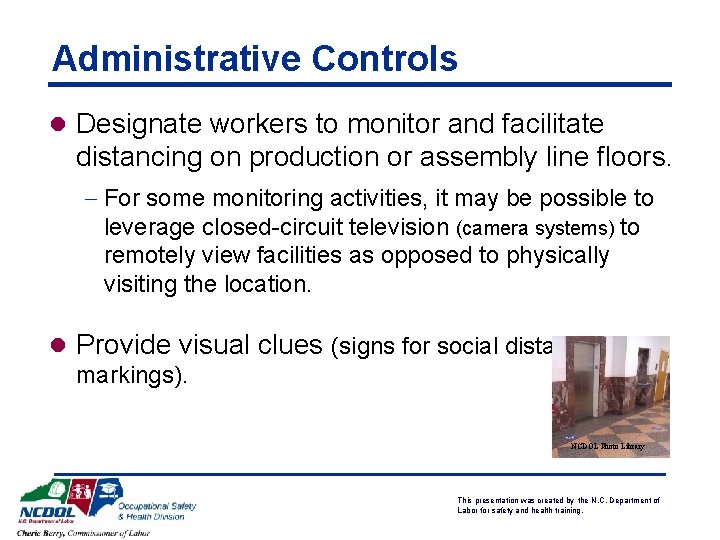
Administrative Controls l Designate workers to monitor and facilitate distancing on production or assembly line floors. - For some monitoring activities, it may be possible to leverage closed-circuit television (camera systems) to remotely view facilities as opposed to physically visiting the location. l Provide visual clues (signs for social distancing/floor markings). NCDOL Photo Library This presentation was created by the N. C. Department of Labor for safety and health training.
Administrative Controls l Encourage workers to avoid carpooling to and from work. l Modify production or assembly lines and stagger employees across shifts to maintain overall manufacturing capacity while instituting measures to minimize exposure (e. g. , add new shifts, clean/sanitize beginning/ending of shift, cohorting employees). This presentation was created by the N. C. Department of Labor for safety and health training.
Administrative Controls l Monitor and respond to absenteeism (i. e. , address essential business functions). l Review leave and incentive policies (i. e. , train employees, ensure employees aren’t penalized, sick leave flexibilities, returning to work). l Screen and monitor employees for COVID-19 symptoms (i. e. , such as temperature checks, questionnaire for symptoms such as cough, shortness of breath, chills, muscle aches). This presentation was created by the N. C. Department of Labor for safety and health training.
Administrative Controls l Restrict or suspend business travel, allow for teleworking and electronic meetings, where possible. l Ensure onsite contractors institute similar procedures/controls or follow the employers. l Screen visitors before entry into the facility. l Provide employee training/communication (i. e. , protective measures, policies, personal protective equipment, signs and symptoms, posting notices on bulletin boards). This presentation was created by the N. C. Department of Labor for safety and health training.
Employee Training l Train on policies, procedures and protective measures that are applicable to the employee's duties as they relate to potential exposures. - Information on appropriate social distancing and hygiene practices. - Signs and symptoms of COVID-19 and how the disease is spread. - Report safety and health concerns. This presentation was created by the N. C. Department of Labor for safety and health training.
Employee Training - Stay home when sick and avoiding co-workers who appear to be sick. - Alternatives to shaking hands (i. e. , elbow/fist bumps). - Drive to work individually instead of carpooling. - Follow cleaning and disinfecting protocols for tools/equipment (i. e. , especially areas touched frequently). - Use a face mask/covering if social distancing of 6 feet or more can’t be maintained. - Other site-specific safe work practices. This presentation was created by the N. C. Department of Labor for safety and health training.
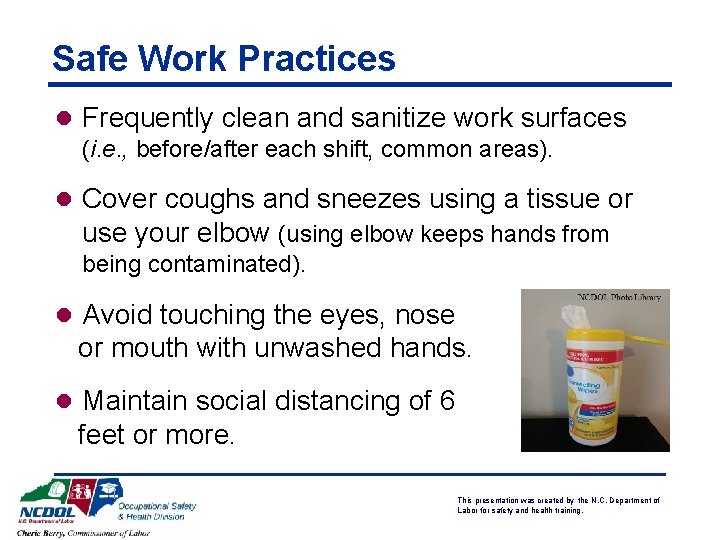
Safe Work Practices l Frequently clean and sanitize work surfaces (i. e. , before/after each shift, common areas). l Cover coughs and sneezes using a tissue or use your elbow (using elbow keeps hands from being contaminated). l Avoid touching the eyes, nose or mouth with unwashed hands. l Maintain social distancing of 6 feet or more. This presentation was created by the N. C. Department of Labor for safety and health training.
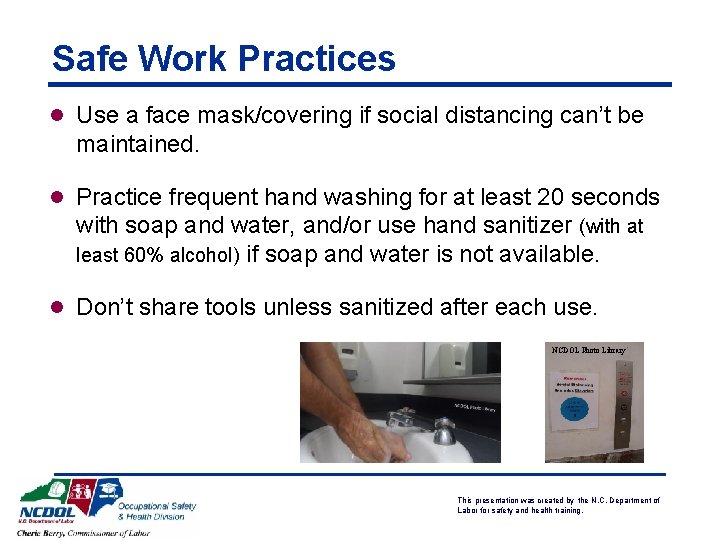
Safe Work Practices l Use a face mask/covering if social distancing can’t be maintained. l Practice frequent hand washing for at least 20 seconds with soap and water, and/or use hand sanitizer (with at least 60% alcohol) if soap and water is not available. l Don’t share tools unless sanitized after each use. NCDOL Photo Library This presentation was created by the N. C. Department of Labor for safety and health training.
Safe Work Practices l Coordinate site deliveries to minimize contact and be in line with cleaning protocols (i. e. , have delivery driver stay in vehicle, screen driver/delivery person before entry). l Keep in-person meetings short (i. e. , safety meetings, toolbox talks). - Limit number of workers, practice social distancing. l Ensure toilet/handwashing facilities and break rooms are kept clean (clean and disinfect regularly). This presentation was created by the N. C. Department of Labor for safety and health training.
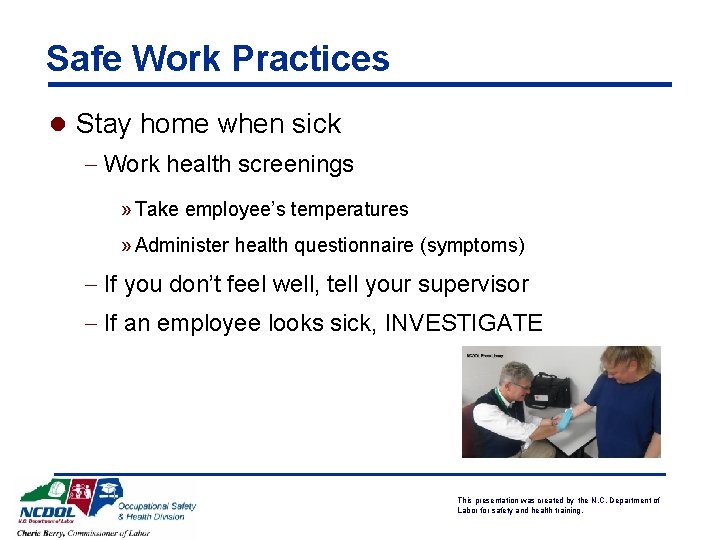
Safe Work Practices l Stay home when sick - Work health screenings » Take employee’s temperatures » Administer health questionnaire (symptoms) - If you don’t feel well, tell your supervisor - If an employee looks sick, INVESTIGATE This presentation was created by the N. C. Department of Labor for safety and health training.
Cleaning, Sanitizing, Disinfecting This presentation was created by the N. C. Department of Labor for safety and health training.
Cleaning, Sanitizing and Disinfecting l High contact surfaces should be frequently cleaned, sanitized and disinfected: - Workstations, assembly line areas - Desks and chairs (i. e. , offices) - Counters and tables (i. e. , lunchrooms, break areas) - Door handles and push plates (i. e. , bathroom doors, exit ways) - Handrails - Sink faucets (i. e. , break rooms, bathrooms) - Light switches - Shared phones and electronics (i. e. , computer stations) This presentation was created by the N. C. Department of Labor for safety and health training.
Cleaning, Sanitizing and Disinfecting l Use PPE as recommended on product labels. l Steps: 1. Cleaning: • Clean surfaces prior to use of disinfectants to remove soil and germs 2. Disinfection: • • • Use EPA approved disinfectants Allow adequate contact time Follow product label instructions 3. Disposal: • • Place disposable items in closed bag Wash hands completely This presentation was created by the N. C. Department of Labor for safety and health training.
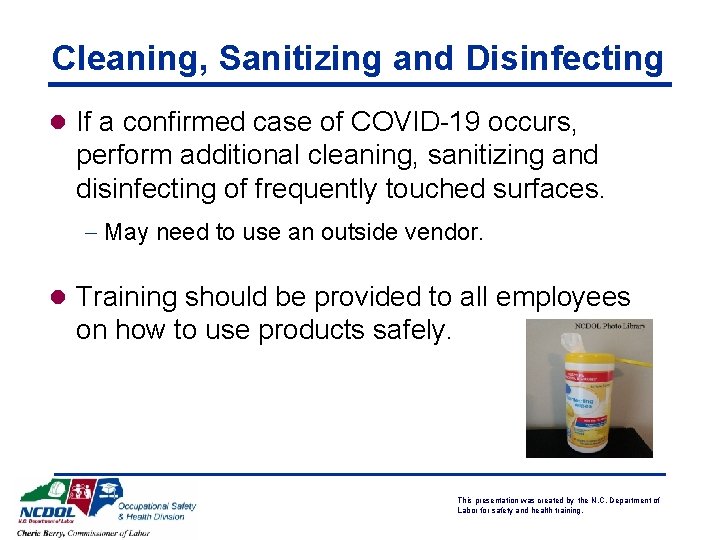
Cleaning, Sanitizing and Disinfecting l If a confirmed case of COVID-19 occurs, perform additional cleaning, sanitizing and disinfecting of frequently touched surfaces. - May need to use an outside vendor. l Training should be provided to all employees on how to use products safely. This presentation was created by the N. C. Department of Labor for safety and health training.
N 95 Respirators, Masks, Face Coverings and Face Shields This presentation was created by the N. C. Department of Labor for safety and health training.
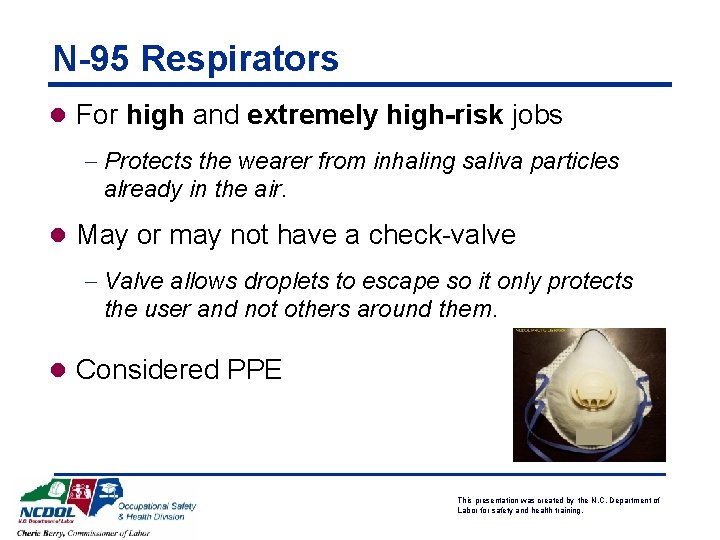
N-95 Respirators l For high and extremely high-risk jobs - Protects the wearer from inhaling saliva particles already in the air. l May or may not have a check-valve - Valve allows droplets to escape so it only protects the user and not others around them. l Considered PPE This presentation was created by the N. C. Department of Labor for safety and health training.
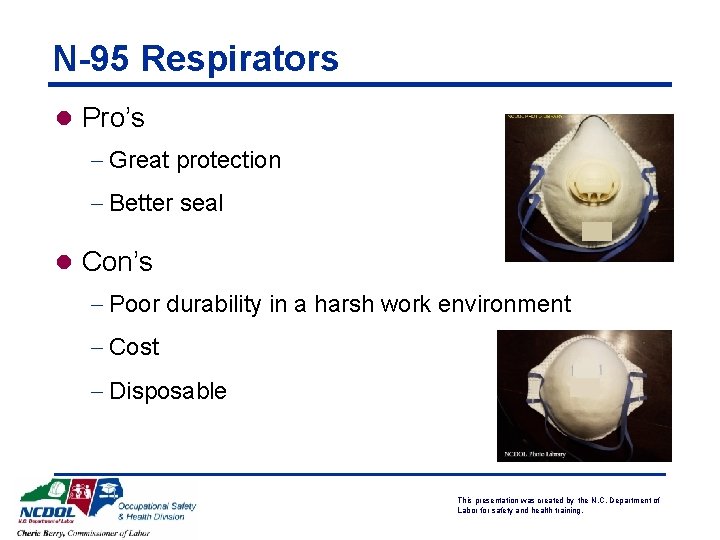
N-95 Respirators l Pro’s - Great protection - Better seal l Con’s - Poor durability in a harsh work environment - Cost - Disposable This presentation was created by the N. C. Department of Labor for safety and health training.
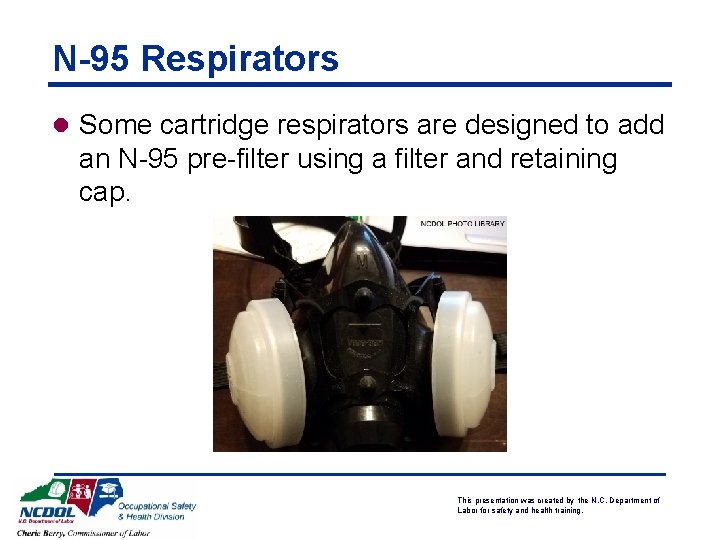
N-95 Respirators l Some cartridge respirators are designed to add an N-95 pre-filter using a filter and retaining cap. This presentation was created by the N. C. Department of Labor for safety and health training.
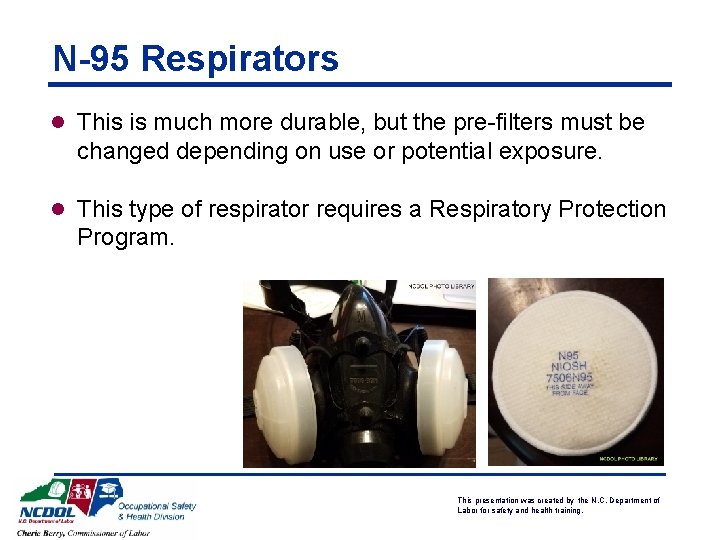
N-95 Respirators l This is much more durable, but the pre-filters must be changed depending on use or potential exposure. l This type of respirator requires a Respiratory Protection Program. This presentation was created by the N. C. Department of Labor for safety and health training.
N-95 Respirators l Voluntary use - An employer may provide respirators or permit employees to use their own respirators, if respirator use will not in itself create a hazard (Medically able to use respirator, respirators cleaned and maintained). - If voluntary respirator use is permissible, the employer must provide the users with the information contained in Appendix D. Exception: Employers are not required to include in a written respiratory protection program those employees whose only use of respirators involves the voluntary use of filtering facepieces (dust masks). This presentation was created by the N. C. Department of Labor for safety and health training.
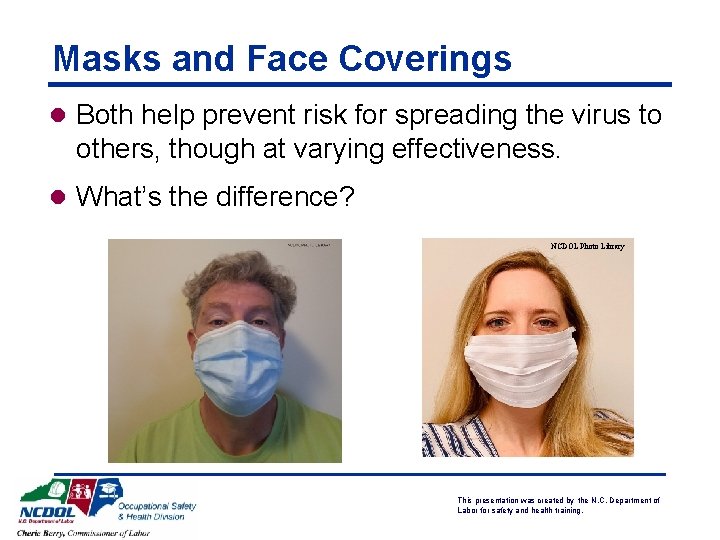
Masks and Face Coverings l Both help prevent risk for spreading the virus to others, though at varying effectiveness. l What’s the difference? NCDOL Photo Library This presentation was created by the N. C. Department of Labor for safety and health training.
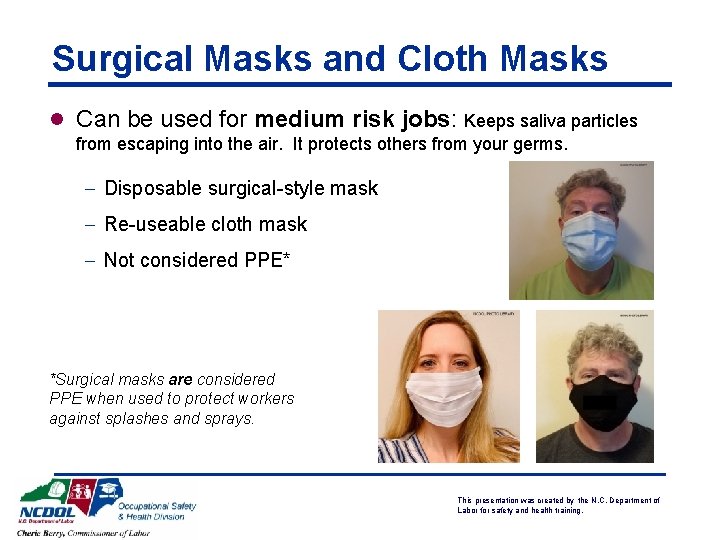
Surgical Masks and Cloth Masks l Can be used for medium risk jobs: Keeps saliva particles from escaping into the air. It protects others from your germs. - Disposable surgical-style mask - Re-useable cloth mask - Not considered PPE* *Surgical masks are considered PPE when used to protect workers against splashes and sprays. This presentation was created by the N. C. Department of Labor for safety and health training.
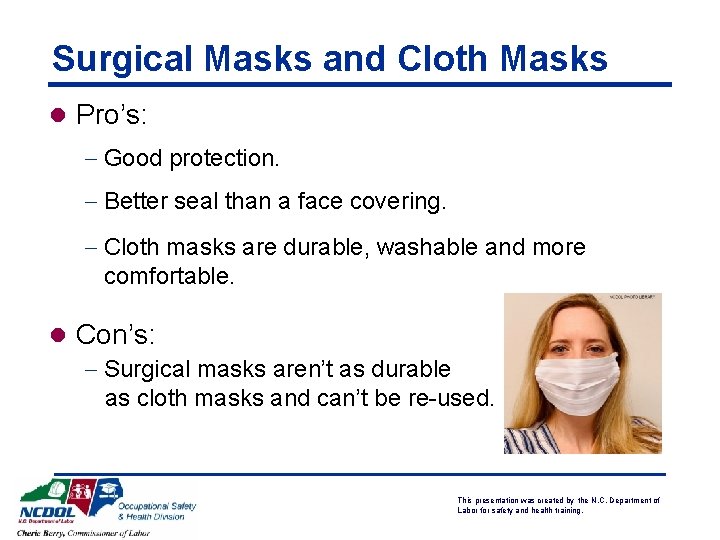
Surgical Masks and Cloth Masks l Pro’s: - Good protection. - Better seal than a face covering. - Cloth masks are durable, washable and more comfortable. l Con’s: - Surgical masks aren’t as durable as cloth masks and can’t be re-used. This presentation was created by the N. C. Department of Labor for safety and health training.
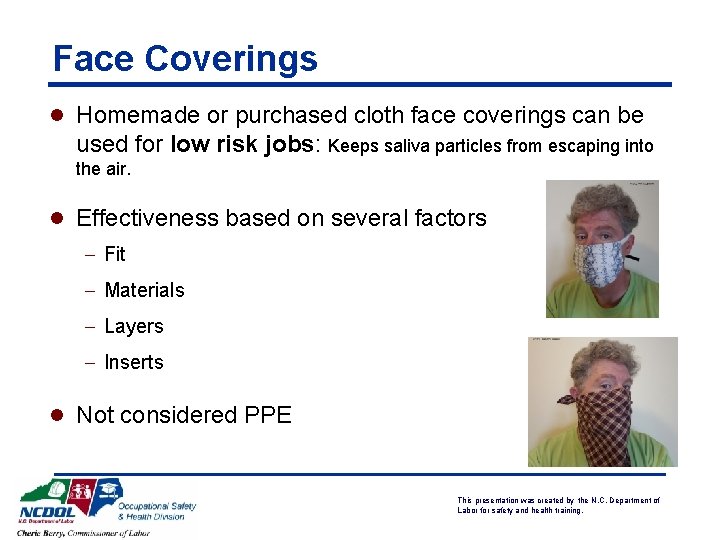
Face Coverings l Homemade or purchased cloth face coverings can be used for low risk jobs: Keeps saliva particles from escaping into the air. l Effectiveness based on several factors - Fit - Materials - Layers - Inserts l Not considered PPE This presentation was created by the N. C. Department of Labor for safety and health training.
Face Shields l If wearing a mask/covering is not feasible (i. e. , people who are deaf or hard of hearing, due to equipment used/work being done), a face shield may be used. l If reusable, clean and disinfect after each use. l Face shields that wrap around the sides of the wearer’s face and extend below the chin, or hooded, offer the best protection. l Current CDC recommendations are to combine with face covering for full protection. This presentation was created by the N. C. Department of Labor for safety and health training.
Relevant OSHA Standards This presentation was created by the N. C. Department of Labor for safety and health training.
Hazard Communication 1910. 1200 l Cleaning/disinfecting due to COVID-19 may require a hazard communication program. - Increase in frequency and duration in cleaning and disinfecting may expose employees to hazardous chemicals. - These increases can exceed normal household use criteria. l If workers are exposed to hazardous chemicals, employers must comply with the hazard communication standard. This presentation was created by the N. C. Department of Labor for safety and health training.
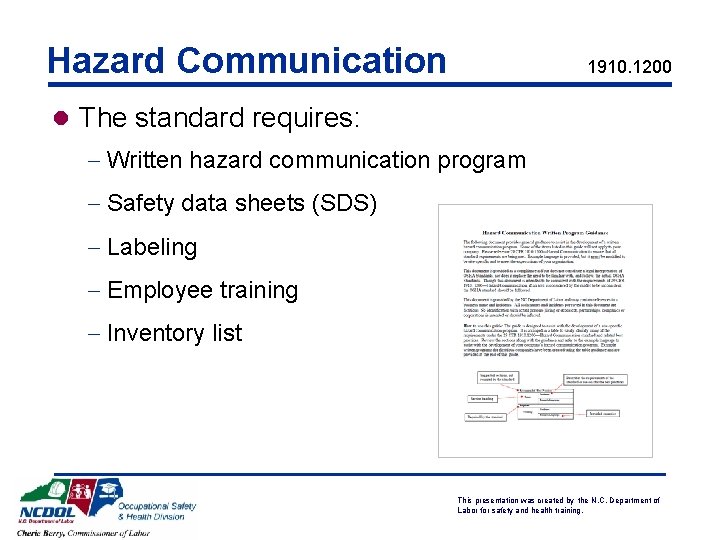
Hazard Communication 1910. 1200 l The standard requires: - Written hazard communication program - Safety data sheets (SDS) - Labeling - Employee training - Inventory list This presentation was created by the N. C. Department of Labor for safety and health training.
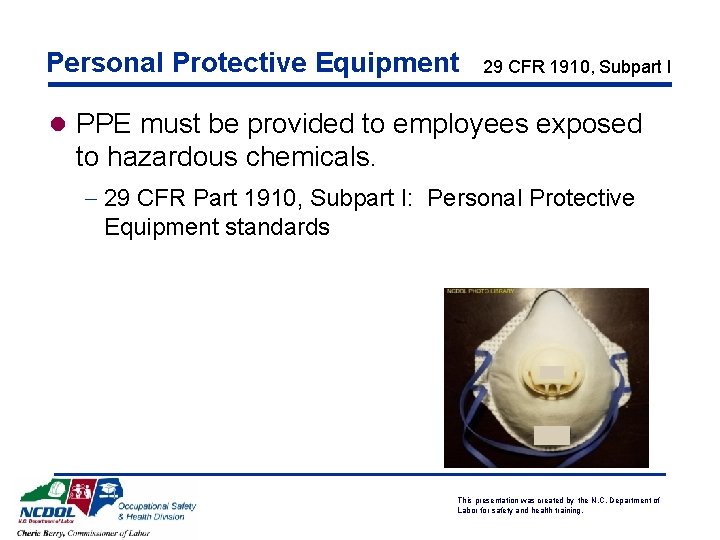
Personal Protective Equipment 29 CFR 1910, Subpart I l PPE must be provided to employees exposed to hazardous chemicals. - 29 CFR Part 1910, Subpart I: Personal Protective Equipment standards This presentation was created by the N. C. Department of Labor for safety and health training.
Personal Protective Equipment 29 CFR 1910, Subpart I l Other applicable PPE standards relating to chemical exposure: - 1910. 132 – General requirements – Written certification of a hazard assessment – Training - 1910. 133 – Eye and face protection - 1910. 134 – Respiratory protection - 1910. 138 – Hand protection This presentation was created by the N. C. Department of Labor for safety and health training.
Sanitation 1910. 141 l All places of employment shall be kept clean to the extent that the nature of the work allows. l Lavatories available, provided with hot and cold running water and soap. l Washing facilities maintained in a sanitary condition. l Common drinking cup and other common utensils are prohibited. l Food service facilities and operations should maintain sound hygienic principles. This presentation was created by the N. C. Department of Labor for safety and health training.
Laboratories 1910. 1450 l When employees are exposed to hazardous chemicals, employers must comply with the standard on Occupational Exposure to Hazardous Chemicals in Laboratories. - This standard would apply to research labs studying the virus, developing vaccines and other treatments and then applying disinfection and decontamination protocols following completion of work (e. g. , at end of shift). This presentation was created by the N. C. Department of Labor for safety and health training.
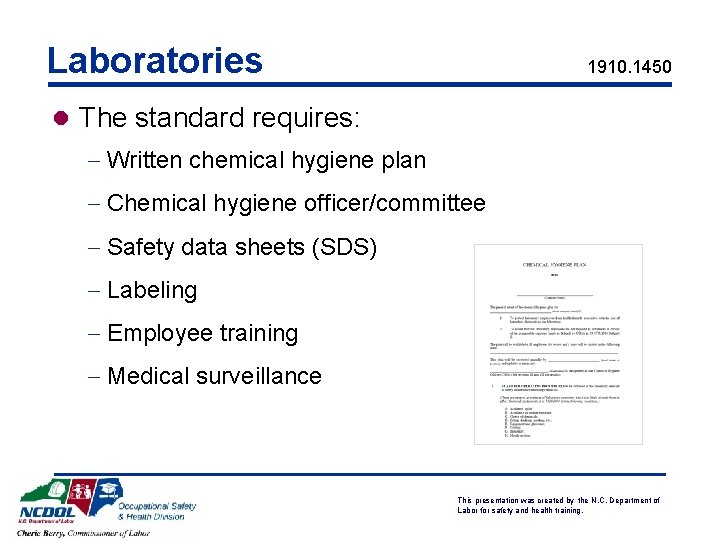
Laboratories 1910. 1450 l The standard requires: - Written chemical hygiene plan - Chemical hygiene officer/committee - Safety data sheets (SDS) - Labeling - Employee training - Medical surveillance This presentation was created by the N. C. Department of Labor for safety and health training.
Medical Services and First Aid 1910. 151 l Where the eyes or body of any person may be exposed to injurious corrosive materials: - Suitable quick drenching/flushing facilities shall be provided. - These facilities shall be within the work area for immediate emergency use. l Bleach, used as a disinfectant, is a common example. This presentation was created by the N. C. Department of Labor for safety and health training.
Bloodborne Pathogens 1910. 1030 l Applies to reasonably anticipated occupational exposure to blood and other potentially infectious materials. - Standard doesn’t apply to respiratory secretions that may contain SARS-Co. V-2 (unless visible blood is present). - Provisions found in the standard may provide helpful guidance in controlling some sources of the virus. This presentation was created by the N. C. Department of Labor for safety and health training.
Bloodborne Pathogens 1910. 1030 l The standard requires: - Written exposure control plan - Engineering and work practice controls - Employee training - PPE - Medical surveillance This presentation was created by the N. C. Department of Labor for safety and health training.
Exposure and Medical Records 1910. 1020 l Employer shall assure that access to employee exposure and medical records are provided in a reasonable time, place, and manner. - Medical records maintained for duration of employment plus 30 years (i. e. , medical questionnaires, examination records, lab tests, medical opinions, treatments) - Exposure records maintained 30 years (i. e. , SDS, environmental monitoring, biological monitoring). This presentation was created by the N. C. Department of Labor for safety and health training.
General Duty Clause NCGS 95 -129(1) l The General Duty Clause (GDC) is used when there isn't a standard for a recognized hazard that can cause death or serious injury or serious physical harm. - "Each employer shall furnish to each of his employee’s conditions of employment and a place of employment free from recognized hazards that are causing or are likely to cause death or serious injury or serious physical harm to his employees. " This presentation was created by the N. C. Department of Labor for safety and health training.
Recordkeeping 1904. 5 & 7 l COVID-19 is a recordable illness. l Employers are responsible for recording cases of COVID-19, if: - It is a confirmed case of COVID-19, as defined by the Centers for Disease Control and Prevention (CDC); - It is work-related as defined by 1904. 5, and - It involves one or more of the general recording criteria set forth in 1904. 7. This presentation was created by the N. C. Department of Labor for safety and health training.
Recordkeeping 1904. 39 l You must report: - Any work-related fatalities within eight hours after the death of any employee as a result of a workrelated incident. - Any in-patient hospitalization of one or more employees withing 24 hours, as a result of a workrelated incident. Note: You must only report a fatality if the fatality occurs within thirty days of the work-related incident. For an in-patient hospitalization, you must only report the event if it occurs within twenty-four hours of the work-related incident. This presentation was created by the N. C. Department of Labor for safety and health training.
Employee Rights l Receive information and training on job hazards in your workplace. l Raise a safety or health concern with your employer or NC Dept of Labor’s OSH Division. l Report a work-related hazard, including COVID-19 to NC Dept of Labor’s OSH Division. NC Dept of Labor – OSH Division Website This presentation was created by the N. C. Department of Labor for safety and health training.
Additional Guidance l NC Government COVID-19 Information Hub l NC Dept of Labor’s COVID-19 Page l Federal OSHA’s COVID-19 Page l NC DHHS COVID-19 Page l CDC Cleaning and Disinfecting Page This presentation was created by the N. C. Department of Labor for safety and health training.
Summary In this course, we will discuss the following: l What COVID-19 is, the symptoms, how it’s spread and what to do if you feel sick l Exposure risk levels and exposure controls l Face coverings, masks, respirators and face shields l Cleaning, sanitizing and disinfecting l Applicable OSHA standards related to COVID-19 l Additional assistance and resources This presentation was created by the N. C. Department of Labor for safety and health training.
Thank You For Attending! Final Questions? This presentation was created by the N. C. Department of Labor for safety and health training.
- Slides: 66