
Basic Electronics Things to be covered What is
Basic Electronics Things to be covered: • What is electricity • Voltage, Current, Resistance • Ohm’s Law • Capacitors, Inductors • Semiconductors • Mechanical Components • Digital Electronics University of Pennsylvania
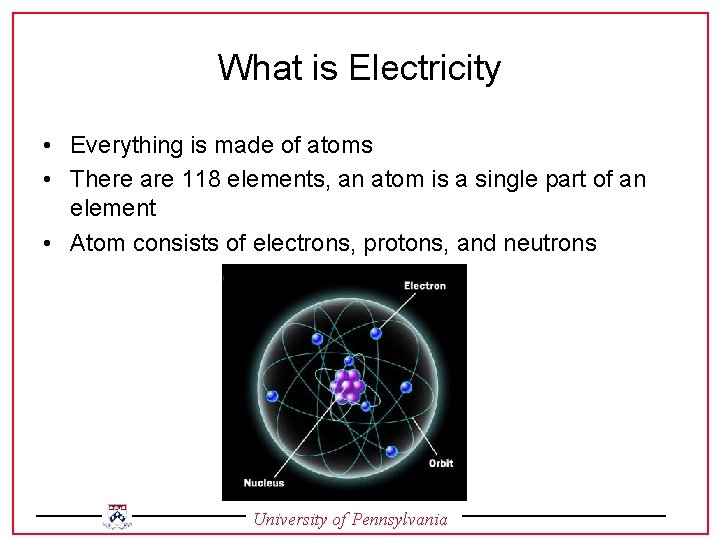
What is Electricity • Everything is made of atoms • There are 118 elements, an atom is a single part of an element • Atom consists of electrons, protons, and neutrons University of Pennsylvania
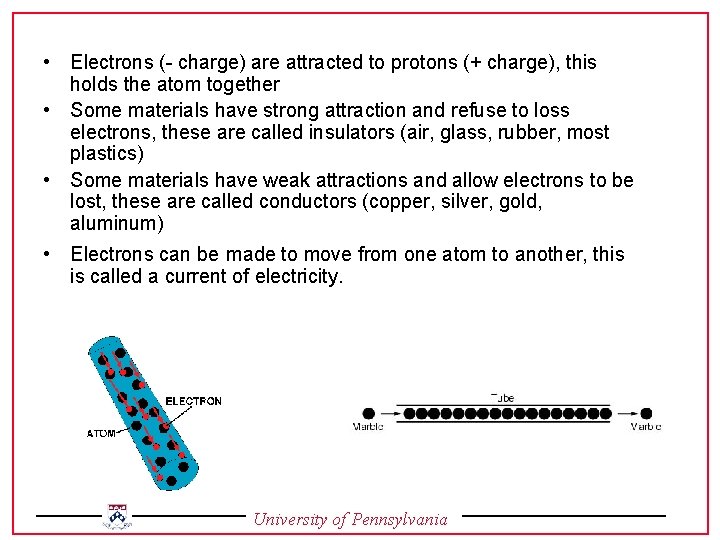
• Electrons (- charge) are attracted to protons (+ charge), this holds the atom together • Some materials have strong attraction and refuse to loss electrons, these are called insulators (air, glass, rubber, most plastics) • Some materials have weak attractions and allow electrons to be lost, these are called conductors (copper, silver, gold, aluminum) • Electrons can be made to move from one atom to another, this is called a current of electricity. University of Pennsylvania
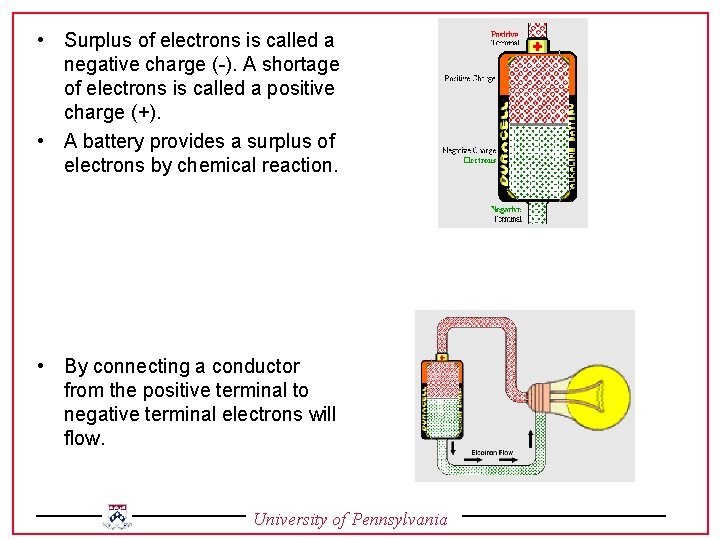
• Surplus of electrons is called a negative charge (-). A shortage of electrons is called a positive charge (+). • A battery provides a surplus of electrons by chemical reaction. • By connecting a conductor from the positive terminal to negative terminal electrons will flow. University of Pennsylvania
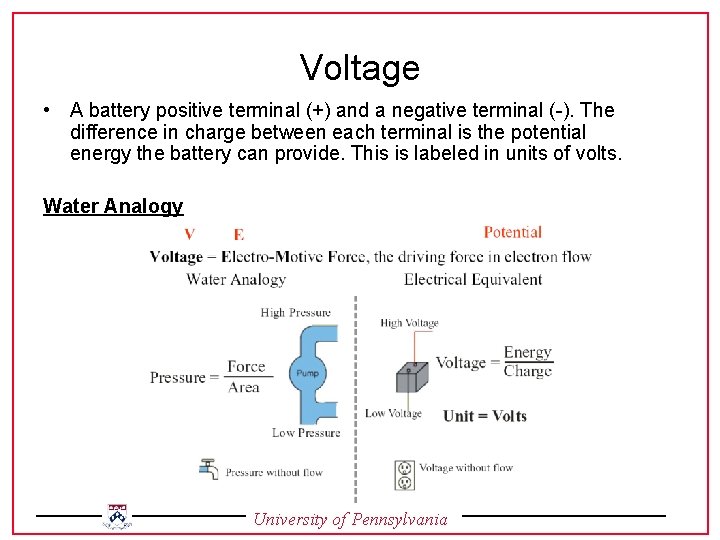
Voltage • A battery positive terminal (+) and a negative terminal (-). The difference in charge between each terminal is the potential energy the battery can provide. This is labeled in units of volts. Water Analogy University of Pennsylvania
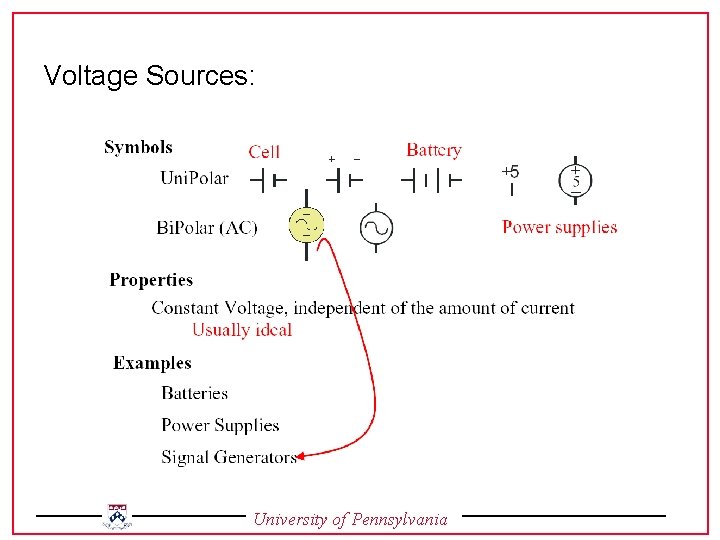
Voltage Sources: University of Pennsylvania
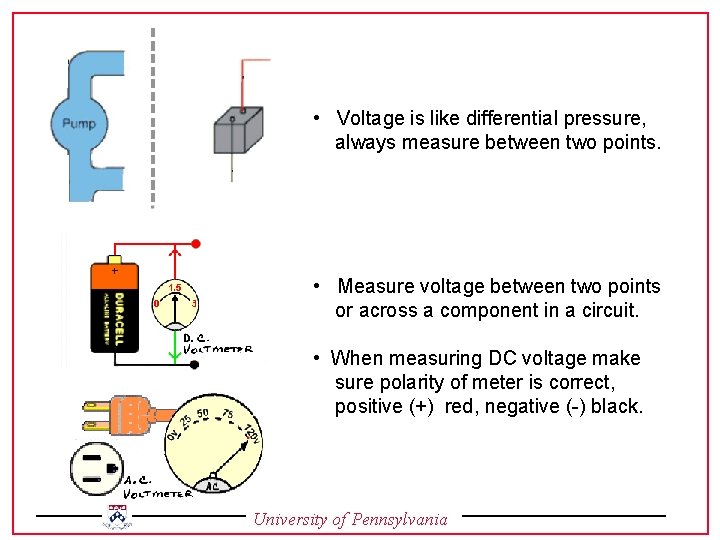
• Voltage is like differential pressure, always measure between two points. • Measure voltage between two points or across a component in a circuit. • When measuring DC voltage make sure polarity of meter is correct, positive (+) red, negative (-) black. University of Pennsylvania
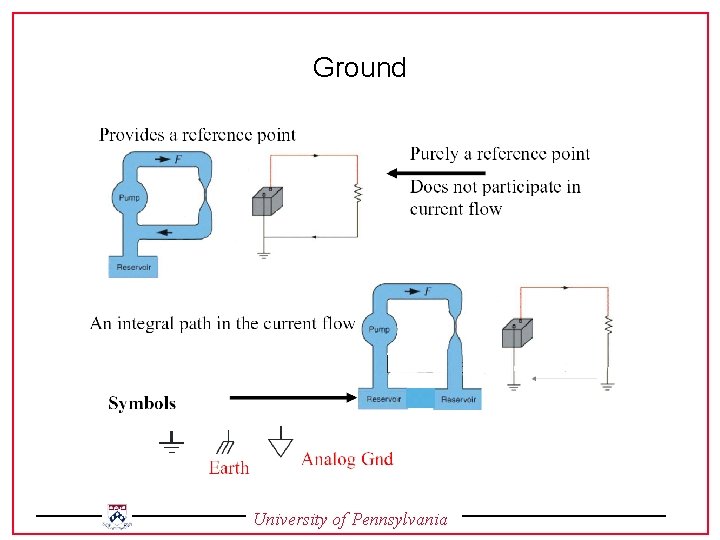
Ground University of Pennsylvania
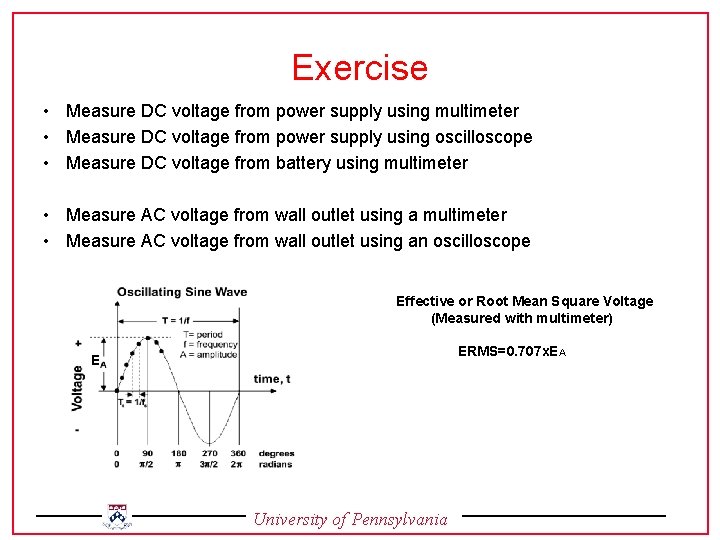
Exercise • Measure DC voltage from power supply using multimeter • Measure DC voltage from power supply using oscilloscope • Measure DC voltage from battery using multimeter • Measure AC voltage from wall outlet using an oscilloscope Effective or Root Mean Square Voltage (Measured with multimeter) ERMS=0. 707 x. EA E University of Pennsylvania
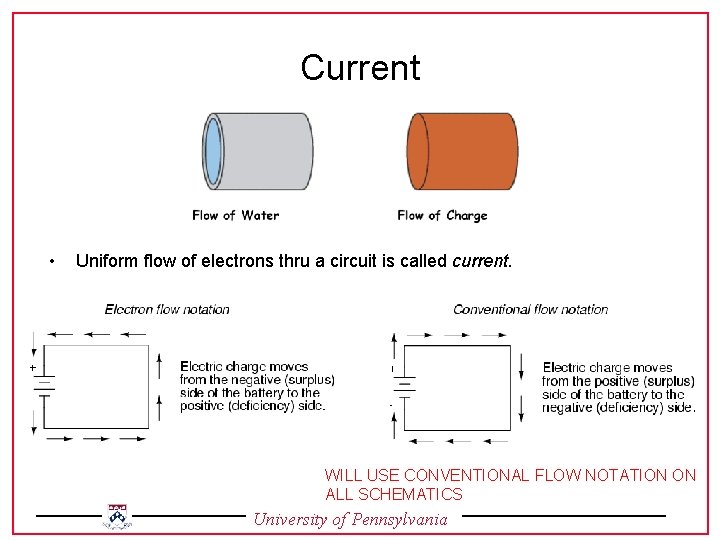
Current • Uniform flow of electrons thru a circuit is called current. WILL USE CONVENTIONAL FLOW NOTATION ON ALL SCHEMATICS University of Pennsylvania
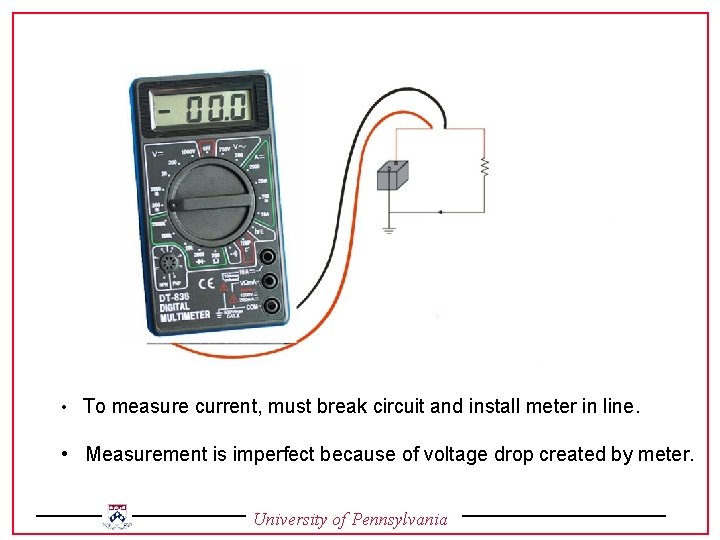
• To measure current, must break circuit and install meter in line. • Measurement is imperfect because of voltage drop created by meter. University of Pennsylvania
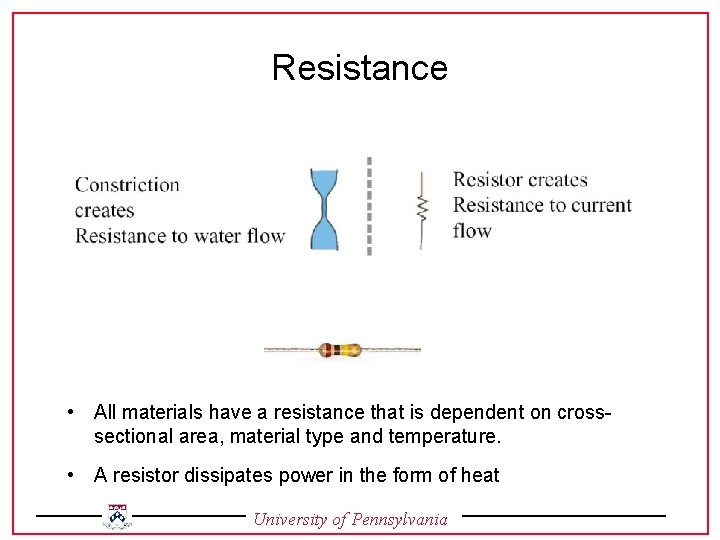
Resistance • All materials have a resistance that is dependent on crosssectional area, material type and temperature. • A resistor dissipates power in the form of heat University of Pennsylvania
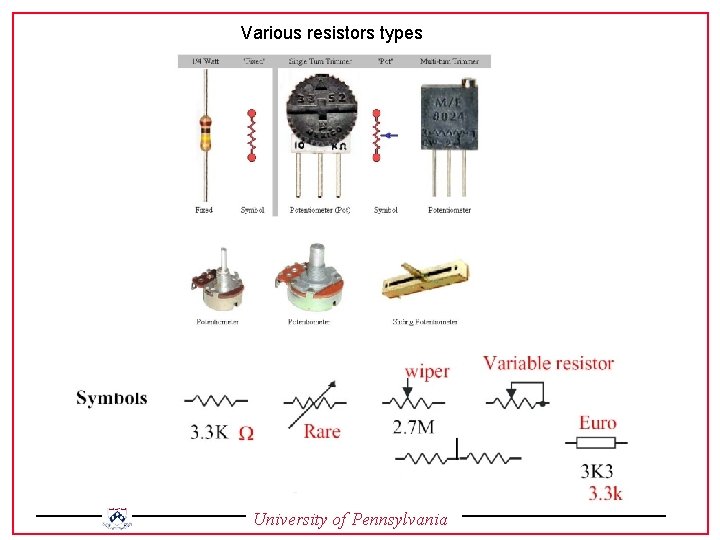
Various resistors types University of Pennsylvania
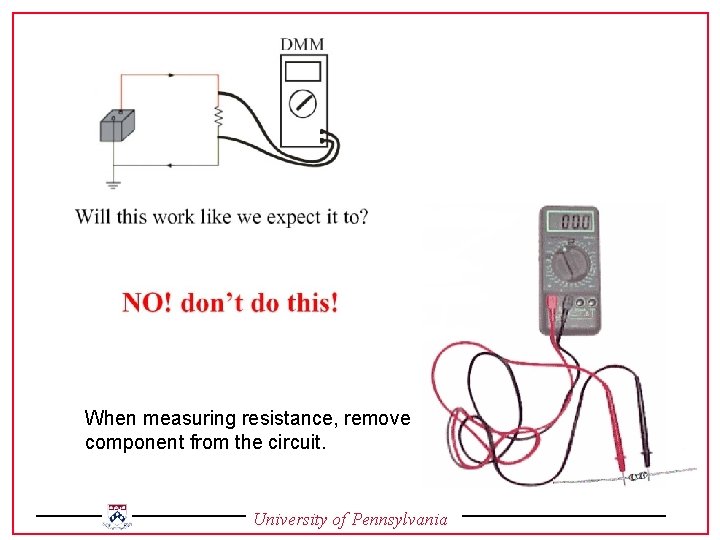
When measuring resistance, remove component from the circuit. University of Pennsylvania
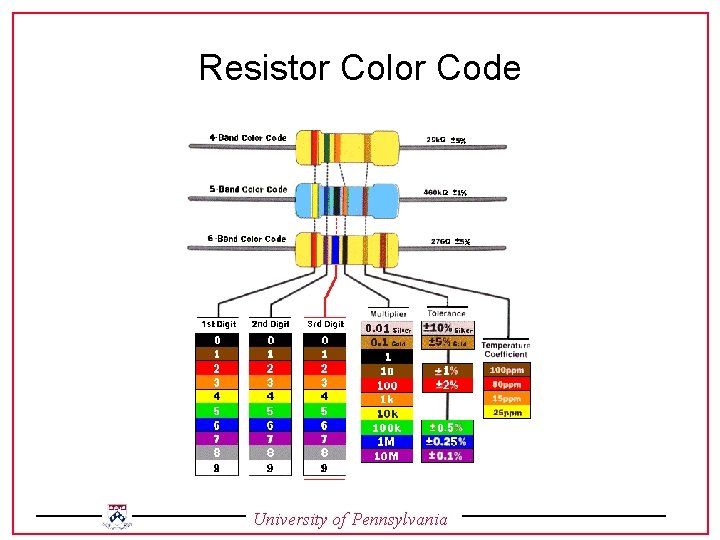
Resistor Color Code University of Pennsylvania
Exercise • Determine the resistance of various resistors of unknown value using the resistor color code • Using the multimeter, compare the specified resistance and measured resistance • Using the multimeter to examine the characteristics of various potentiometers University of Pennsylvania
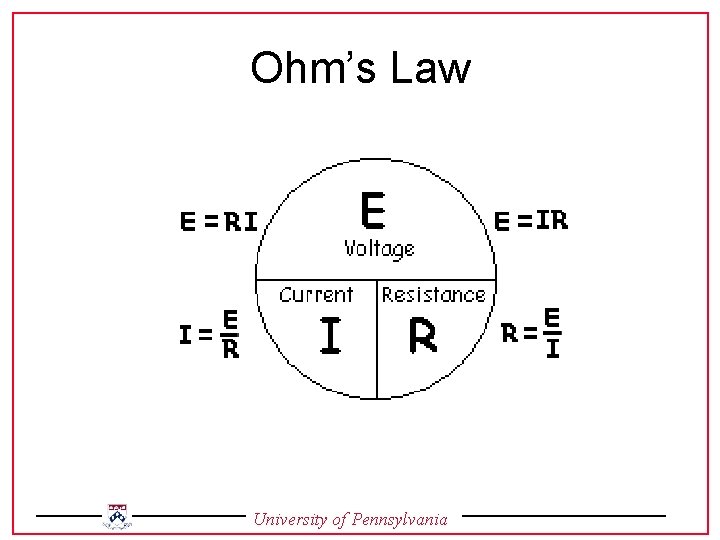
Ohm’s Law University of Pennsylvania
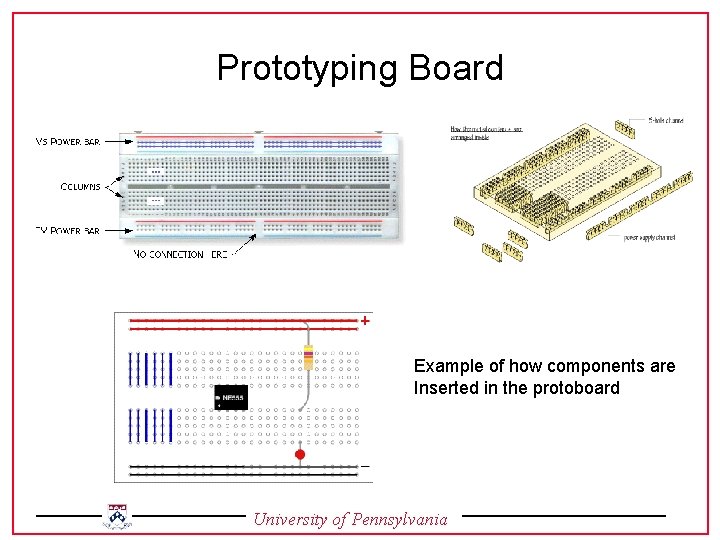
Prototyping Board Example of how components are Inserted in the protoboard University of Pennsylvania
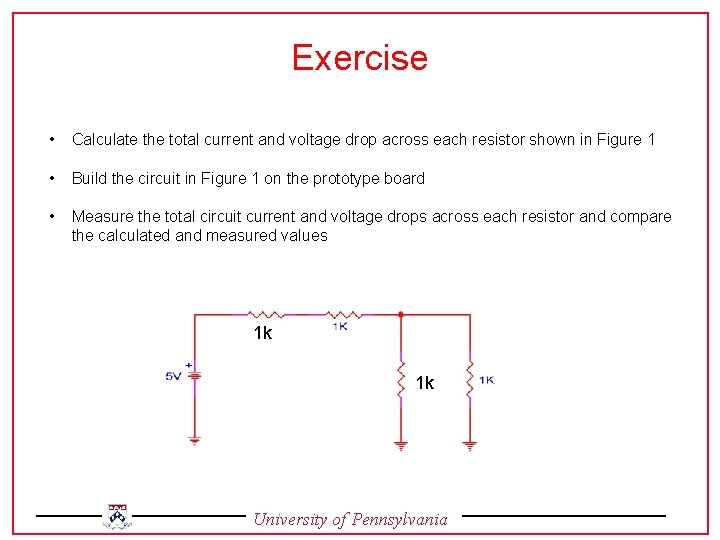
Exercise • Calculate the total current and voltage drop across each resistor shown in Figure 1 • Build the circuit in Figure 1 on the prototype board • Measure the total circuit current and voltage drops across each resistor and compare the calculated and measured values 1 k 1 k University of Pennsylvania
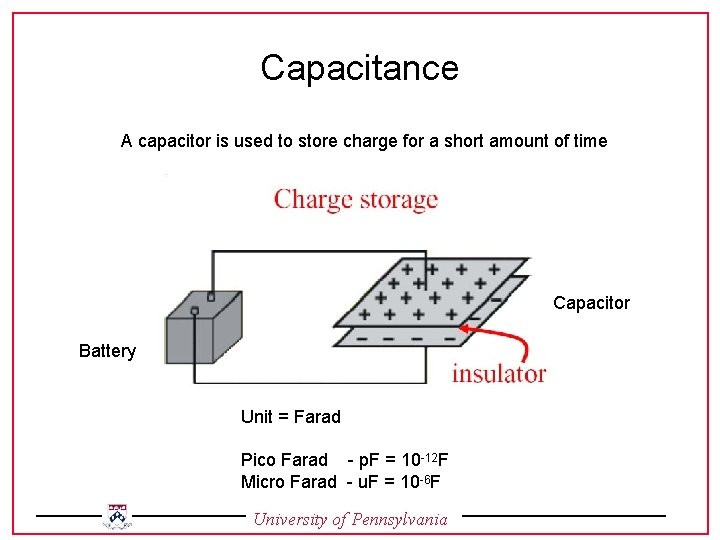
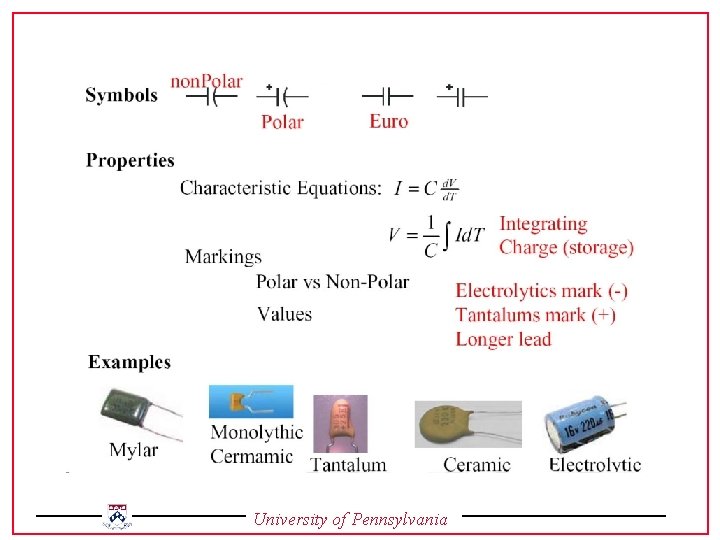
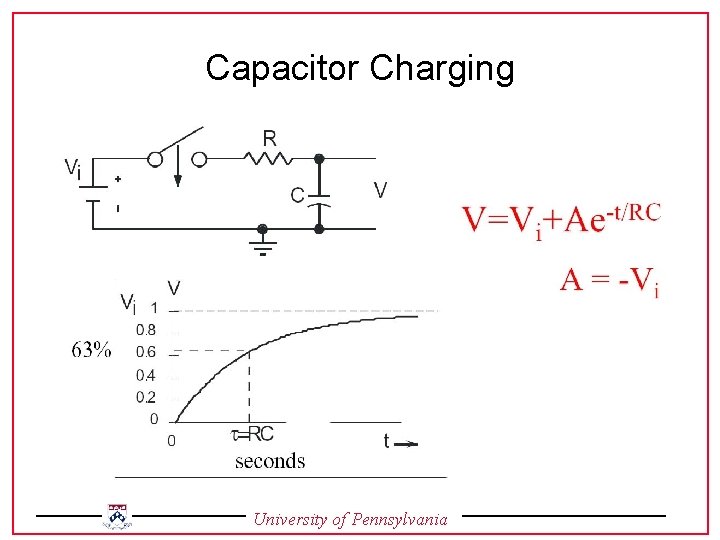
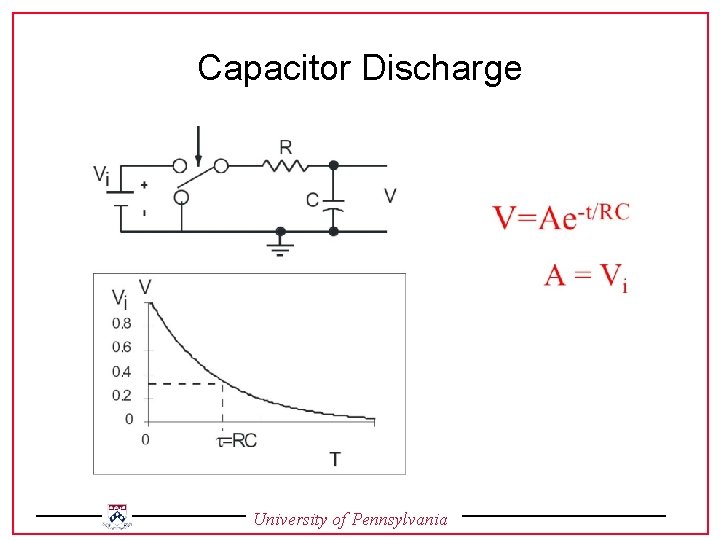
Capacitance A capacitor is used to store charge for a short amount of time Capacitor Battery Unit = Farad Pico Farad - p. F = 10 -12 F Micro Farad - u. F = 10 -6 F University of Pennsylvania
University of Pennsylvania
Capacitor Charging University of Pennsylvania
Capacitor Discharge University of Pennsylvania
- Slides: 23