
Basic Electronics Chapter 4 Bipolar Junction Transistors continue
Basic Electronics Chapter 4: Bipolar Junction Transistors (continue) 4– 4 The BJT as an Amplifier 4– 5 The BJT as a Switch

◆ Discuss how a BJT is used as a voltage amplifier ◆ Discuss how a BJT is used as a switch
4– 4 THE BJT AS AN AMPLIFIER Amplification is the process of linearly increasing the amplitude of an electrical signal and is one of the major properties of a transistor. When a BJT is biased in the active (or linear) region, the BE junction has a low resistance due to forward bias and the BC junction has a high resistance due to reverse bias. Voltage Amplification a transistor amplifies current because the collector current is equal to the base current multiplied by the current gain. The base current in a transistor is very small compared to the collector.
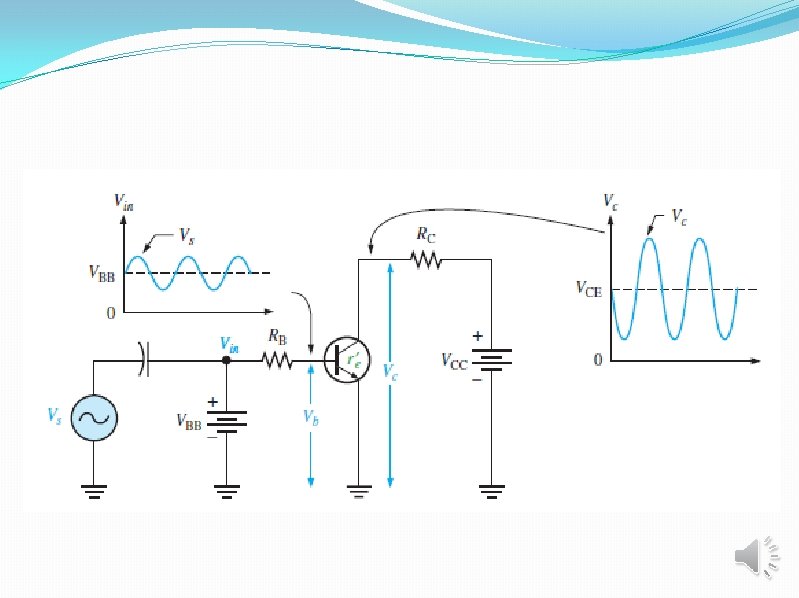
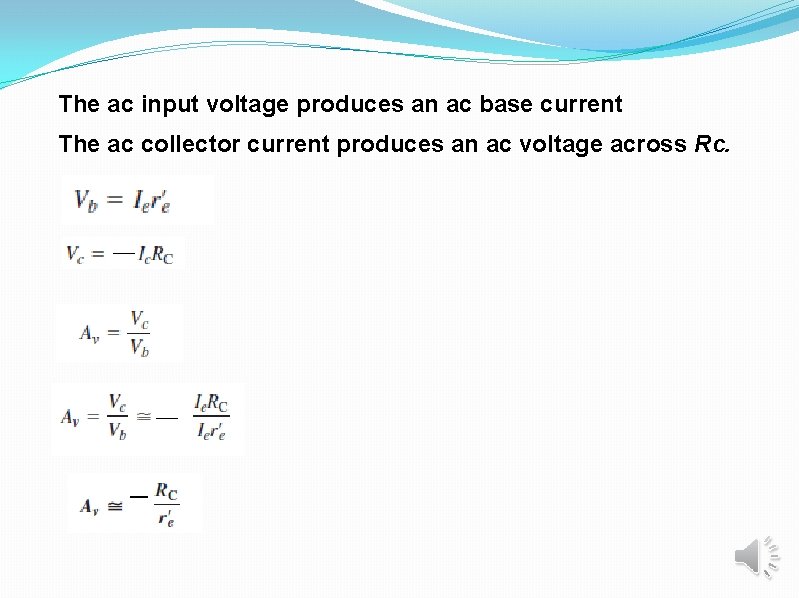
The ac input voltage produces an ac base current The ac collector current produces an ac voltage across RC.


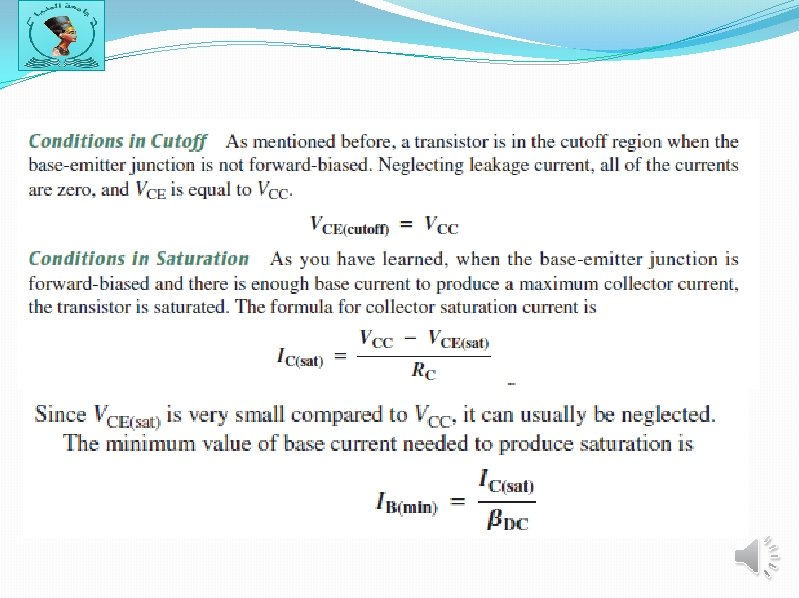
4– 5 THE BJT AS A SWITCH The second major application area is switching applications. When used as an electronic switch, a BJT is normally operated alternately in cutoff and saturation. Many digital circuits use the BJT as a switch. Switching Operation
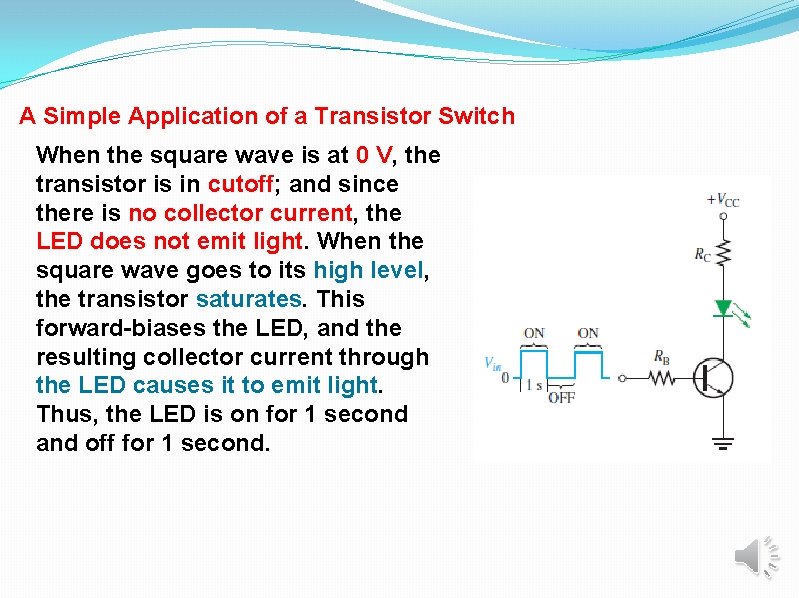
A Simple Application of a Transistor Switch When the square wave is at 0 V, the transistor is in cutoff; and since there is no collector current, the LED does not emit light. When the square wave goes to its high level, the transistor saturates. This forward-biases the LED, and the resulting collector current through the LED causes it to emit light. Thus, the LED is on for 1 second and off for 1 second.
- Slides: 9