
Basic Electromyography Needle Electromyography It is the study

Basic Electromyography

Needle Electromyography • It is the study of electrical potentials developed in the muscle both at rest and on volition. • There are over 400 skeletal muscles in the body for assessment by electromyography (EMG). • Clinical EMG involve examination of physiology / path physiology of MU activation and recruitment during different conditions of the muscle. • The term motor unit action potential ( MUAP ) is used to describe the recorded summated depolarization of the muscle fibers belonging to one motor unit.
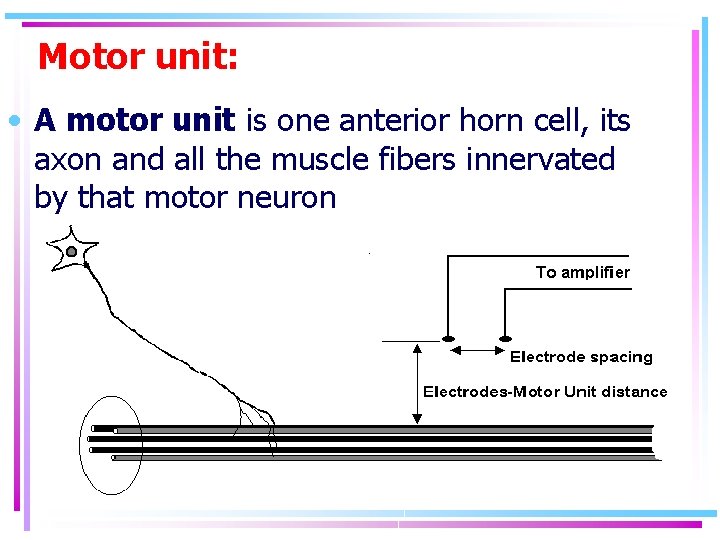
Motor unit: • A motor unit is one anterior horn cell, its axon and all the muscle fibers innervated by that motor neuron
Benefits of EMG • Electromyography is widely used to distinguish weakness due to muscle disease/ neuropathy. • Provide neurophysiologic information about ; diagnosis, localization, nature, severity of pathology and prognosis. Ø To detect the site of the lesion; Roots, Trunks, Cords & peripheral nerves Ø To know the extent of the lesion; axonal lesion/ conduction block Ø To detect & follow up signs of reinnervation
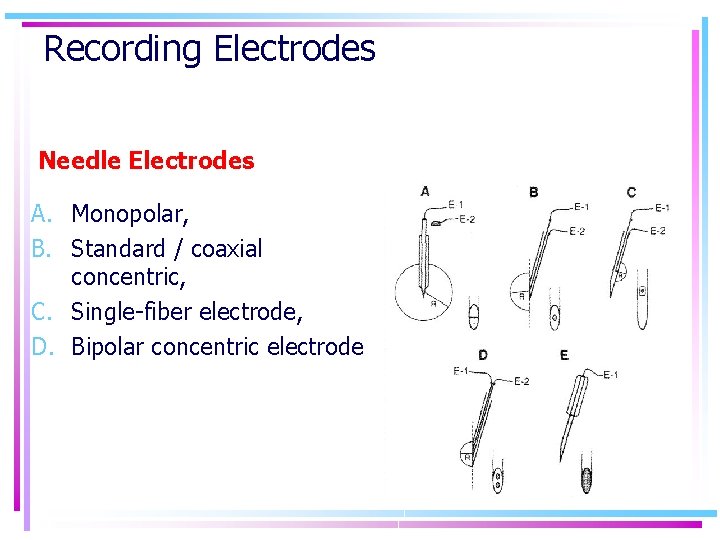
Recording Electrodes Needle Electrodes A. Monopolar, B. Standard / coaxial concentric, C. Single-fiber electrode, D. Bipolar concentric electrode
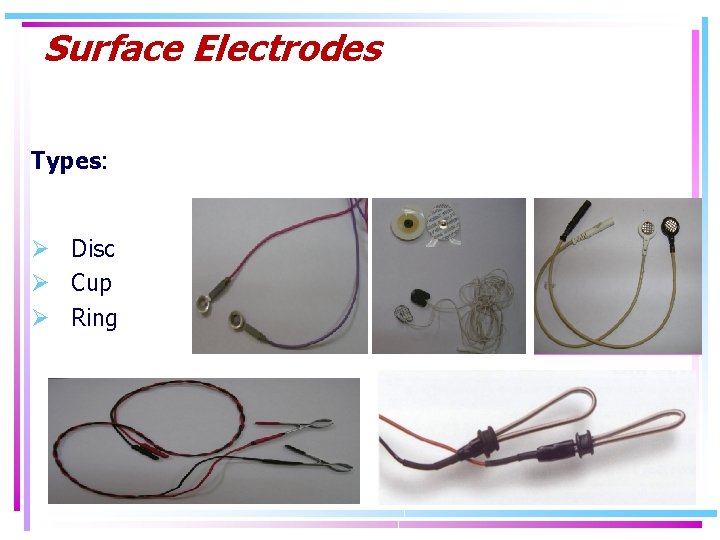
Surface Electrodes Types: Ø Disc Ø Cup Ø Ring
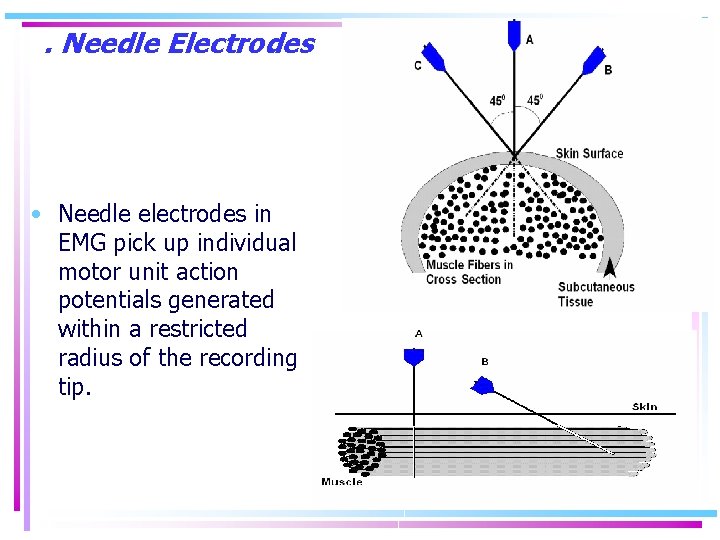
. Needle Electrodes • Needle electrodes in EMG pick up individual motor unit action potentials generated within a restricted radius of the recording tip.
EMG tests : Clinical EMG consists of application of the following steps q Insertion activity: insertion of the electrode into the target muscle. q Activity at rest: search for spontaneous activity. q On minimal volition: MUP analysis/ character q Interference pattern: when the patient is exerting a maximal effort to contract the muscle. q Turn/ Amplitude analysis.
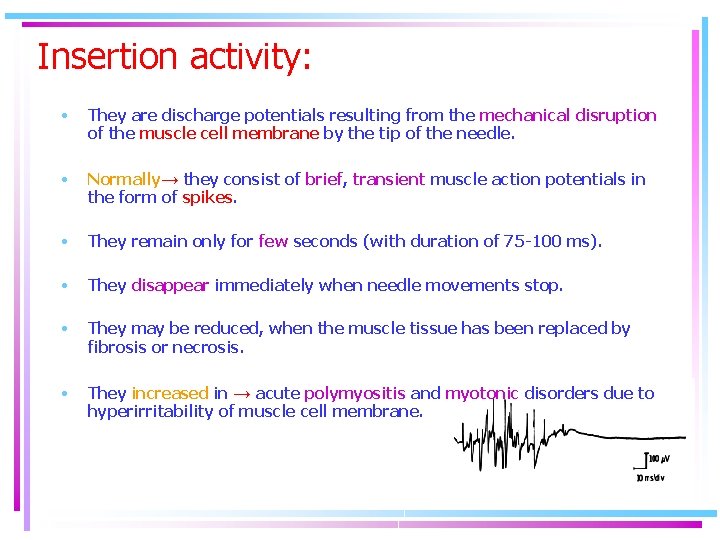
Insertion activity: • They are discharge potentials resulting from the mechanical disruption of the muscle cell membrane by the tip of the needle. • Normally→ they consist of brief, transient muscle action potentials in the form of spikes. • They remain only for few seconds (with duration of 75 -100 ms). • They disappear immediately when needle movements stop. • They may be reduced, when the muscle tissue has been replaced by fibrosis or necrosis. • They increased in → acute polymyositis and myotonic disorders due to hyperirritability of muscle cell membrane.
2 -Examination of muscle at rest: Healthy muscle at rest is clinically silent as soon as needle movement stops. Spontaneous activity: They are present at rest with complete muscle relaxation. Motor end plate Positive sharp wave & Fibrillation potentials Other pathological potentials
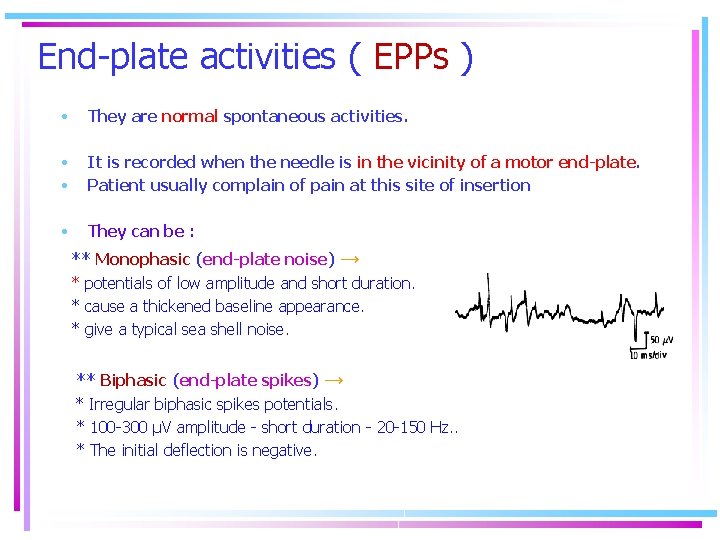
End-plate activities ( EPPs ) • They are normal spontaneous activities. • • It is recorded when the needle is in the vicinity of a motor end-plate. Patient usually complain of pain at this site of insertion • They can be : ** Monophasic (end-plate noise) → * potentials of low amplitude and short duration. * cause a thickened baseline appearance. * give a typical sea shell noise. ** Biphasic (end-plate spikes) → * Irregular biphasic spikes potentials. * 100 -300 µV amplitude - short duration - 20 -150 Hz. . * The initial deflection is negative.
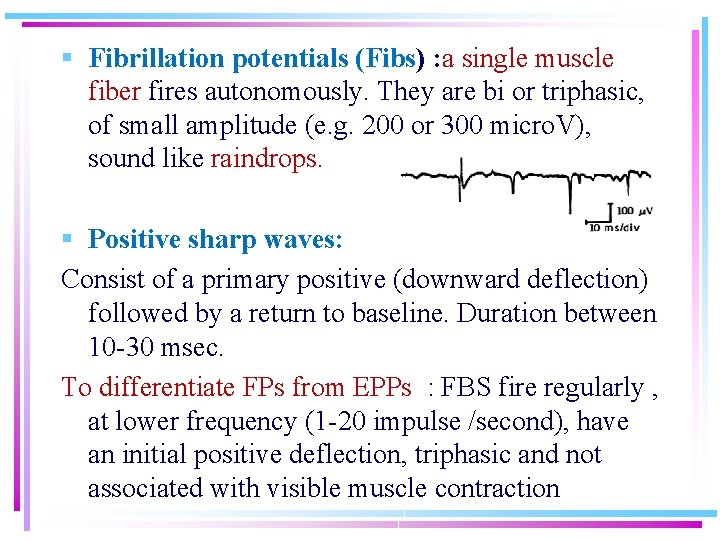
§ Fibrillation potentials (Fibs) : a single muscle fiber fires autonomously. They are bi or triphasic, of small amplitude (e. g. 200 or 300 micro. V), sound like raindrops. § Positive sharp waves: Consist of a primary positive (downward deflection) followed by a return to baseline. Duration between 10 -30 msec. To differentiate FPs from EPPs : FBS fire regularly , at lower frequency (1 -20 impulse /second), have an initial positive deflection, triphasic and not associated with visible muscle contraction
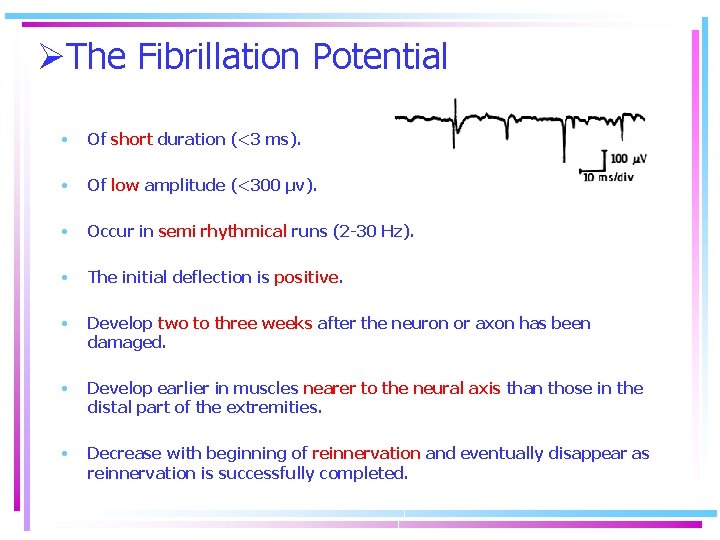
ØThe Fibrillation Potential • Of short duration (<3 ms). • Of low amplitude (<300 µv). • Occur in semi rhythmical runs (2 -30 Hz). • The initial deflection is positive. • Develop two to three weeks after the neuron or axon has been damaged. • Develop earlier in muscles nearer to the neural axis than those in the distal part of the extremities. • Decrease with beginning of reinnervation and eventually disappear as reinnervation is successfully completed.
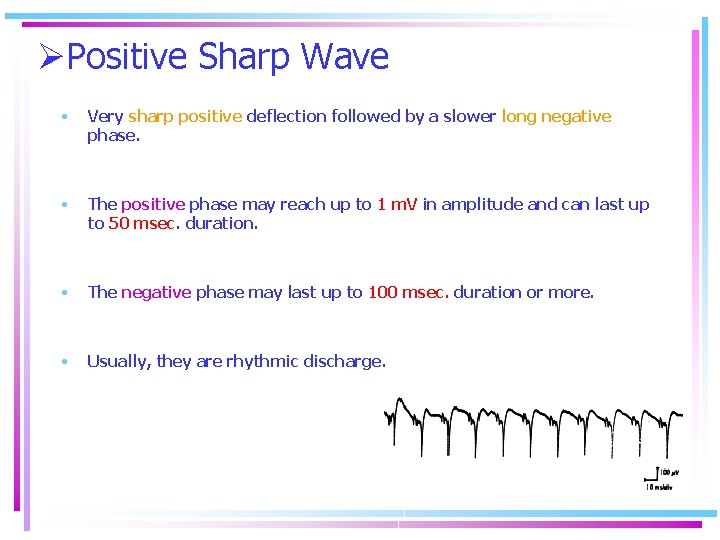
ØPositive Sharp Wave • Very sharp positive deflection followed by a slower long negative phase. • The positive phase may reach up to 1 m. V in amplitude and can last up to 50 msec. duration. • The negative phase may last up to 100 msec. duration or more. • Usually, they are rhythmic discharge.
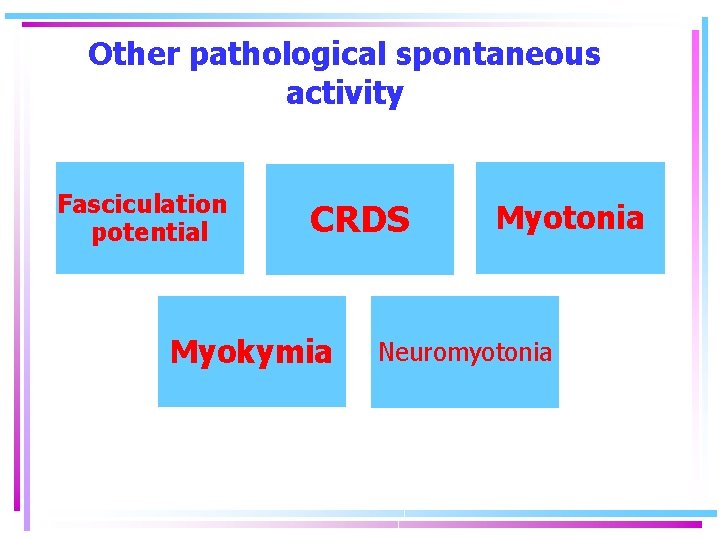
Other pathological spontaneous activity Fasciculation potential CRDS Myokymia Myotonia Neuromyotonia
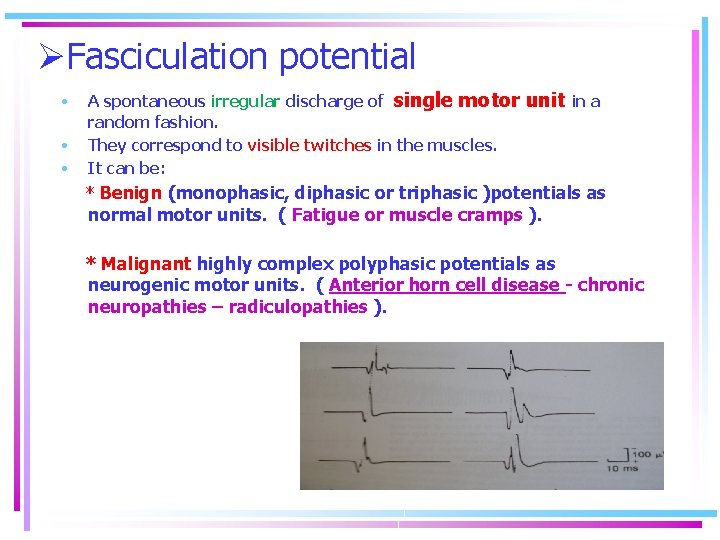
ØFasciculation potential • • • A spontaneous irregular discharge of single motor random fashion. They correspond to visible twitches in the muscles. It can be: unit in a * Benign (monophasic, diphasic or triphasic )potentials as normal motor units. ( Fatigue or muscle cramps ). * Malignant highly complex polyphasic potentials as neurogenic motor units. ( Anterior horn cell disease - chronic neuropathies – radiculopathies ).
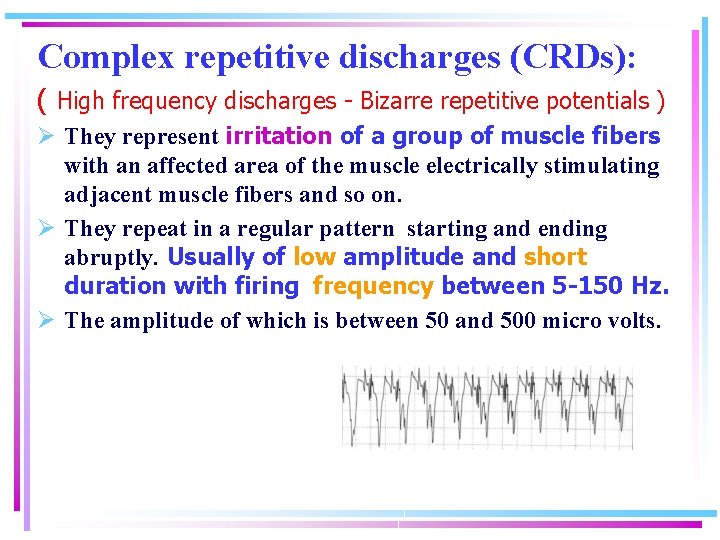
Complex repetitive discharges (CRDs): ( High frequency discharges - Bizarre repetitive potentials ) Ø They represent irritation of a group of muscle fibers with an affected area of the muscle electrically stimulating adjacent muscle fibers and so on. Ø They repeat in a regular pattern starting and ending abruptly. Usually of low amplitude and short duration with firing frequency between 5 -150 Hz. Ø The amplitude of which is between 50 and 500 micro volts.
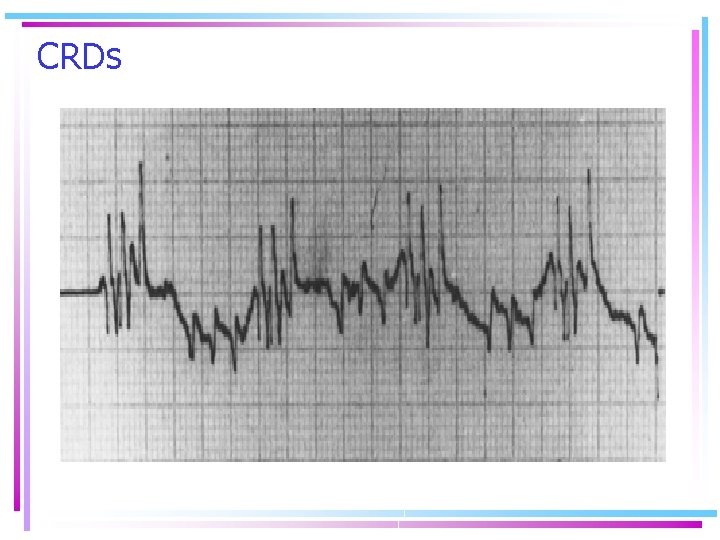
CRDs
ØComplex repetitive discharges (CRDs): They are nonspecific potentials seen in: * Neuropathic diseases ( chronic root lesions peripheral neuropathies - motor neuron diseases - nerve regeneration ). * Myopathic conditions ( early stages of Duchenne muscular dystrophy ). * Polymyositis. * Myxedema.
ØMyotonic discharges : This sustained run of spike potentials/PSW seen at rest and begins at high frequency and then slowly drops in frequency, producing so called dive-bomber sound on audio. *They represent action potentials of muscle fibers firing in a prolonged fashion i. e. failure of relaxation. *They fire at a variable rate with a waxing and waning appearance. *Myotonic discharges are seen in myotonia congenita, myotonic dystrophy, hyperkalemic periodic paralysis.
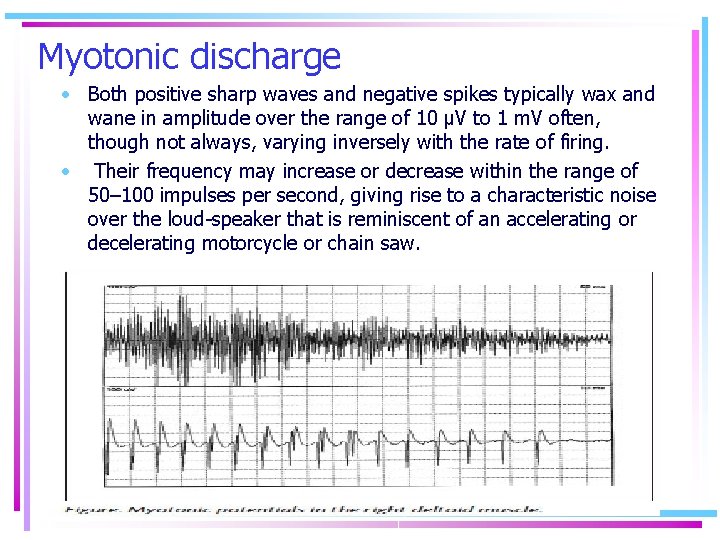
Myotonic discharge • Both positive sharp waves and negative spikes typically wax and wane in amplitude over the range of 10 µV to 1 m. V often, though not always, varying inversely with the rate of firing. • Their frequency may increase or decrease within the range of 50– 100 impulses per second, giving rise to a characteristic noise over the loud-speaker that is reminiscent of an accelerating or decelerating motorcycle or chain saw.
ØMyokymia • Abnormal rhythmic MU contraction. • Bursts of discharges from a single MU containing 2 -4 spikes firing at rate up to 40 discharge /second. • Associated with “wormlike” movements. • This bursts are due to ectopic generation of APs in demyelinating nerve fiber. myokymia involving face muscles is most commonly seen in patients with brain stem glioma, multiple sclerosis. • Myokymia in the limb muscles is most often related to chronic inflammatory polyradiculopthy. • Myokymic discharges also favor certain chronic neuropathic processes, such as Guillain Barre syndrome. • Hyperventilation induces hypocalcemia, which in turn amplifies axonal excitability and myokymic bursts, generated ectopically in demyelinated motor fibers.
Neuromyotonia • • Neuromyotonia / pseudomyotonia, describe continuous muscle fiber activity of peripheral origin. These syndromes probably constitute different diseases that vary in their clinical and electrophysiological presentations despite the shared feature of sustained involuntary motor activity. The sites of generator responsible for different discharges vary from proximal segments of the nerve to the intramuscular nerve terminals. Excess motor unit activity remains during sleep and after general or spinal anesthesia. Clinical examination shows undulating movements of the overlying skin and a delay of relaxation after muscle contraction, thus the name neuromyotonia. Needle studies demonstrate motor unit discharges with frequencies up to 300 Hz associated with a characteristic “pinging” sound. The firing motor unit potentials decline in amplitude slowly or rapidly as increasing numbers of muscle fibers fail to follow the high rate of repetitive pattern. Ischemia or electrical nerve stimulation provokes the high-frequency discharge. Patients respond well to treatment with phenytoin or carbamazepine, which effectively reduces involuntary movements.
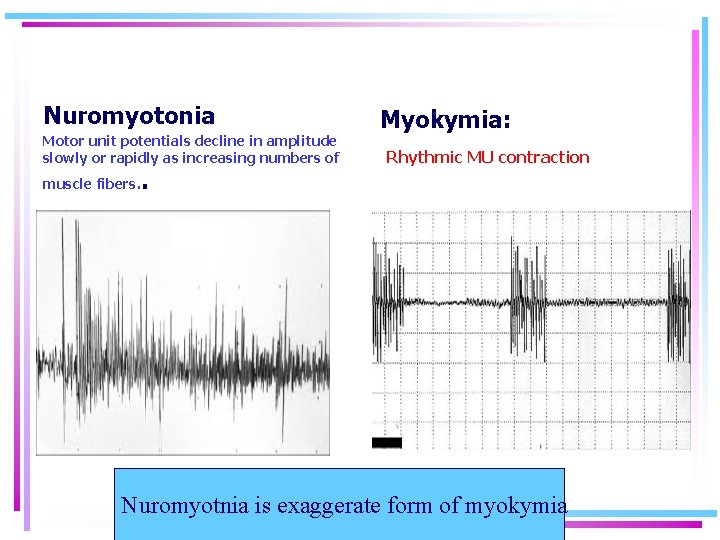
Nuromyotonia Motor unit potentials decline in amplitude slowly or rapidly as increasing numbers of muscle fibers. . Myokymia: Rhythmic MU contraction Nuromyotnia is exaggerate form of myokymia
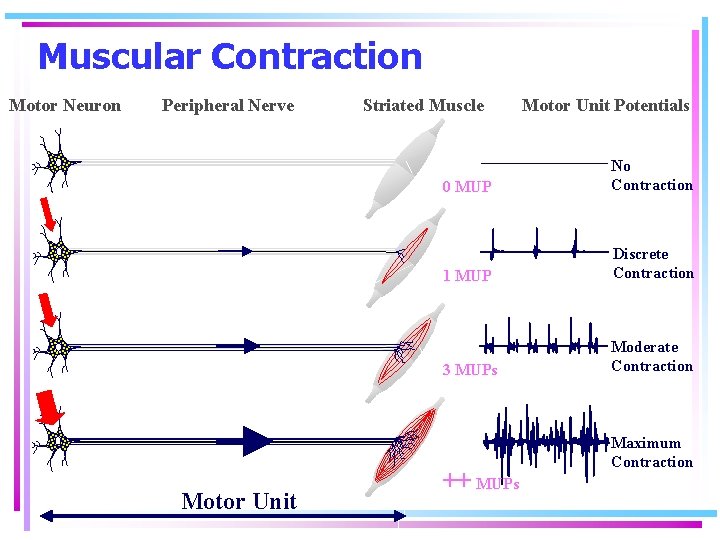
Muscular Contraction Motor Neuron Peripheral Nerve Motor Unit Striated Muscle Motor Unit Potentials 0 MUP No Contraction 1 MUP Discrete Contraction 3 MUPs Moderate Contraction ++ MUPs Maximum Contraction
On minimal volition: • A motor unit is a compound muscle fiber action potential synchronously generated in the muscle fiber of the MU overlap in time and are summated at the recording electrode. • It is considered as the electrophysiology correlate with the contraction of MU. • Shape of MUAP depend on the location of the electrode with respect to the active muscle fibers in the unite. with muscle contraction, a number of MUAPs are recruited. § § Changes in the number of muscle fibers → changes in MUAP duration. The MUAP duration is increased in neuropathy due to collateral sprouting which § ↑ the number of muscle fibers / motor unit. In myopathy, duration decreases due to loss of muscle fibers
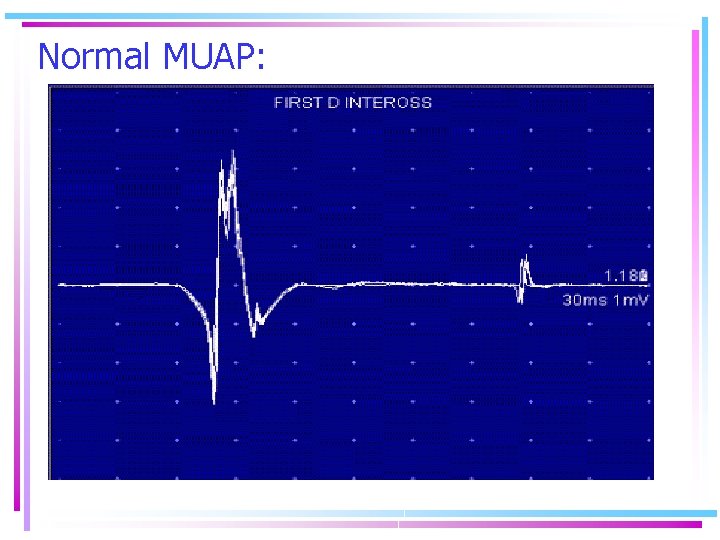
Normal MUAP:
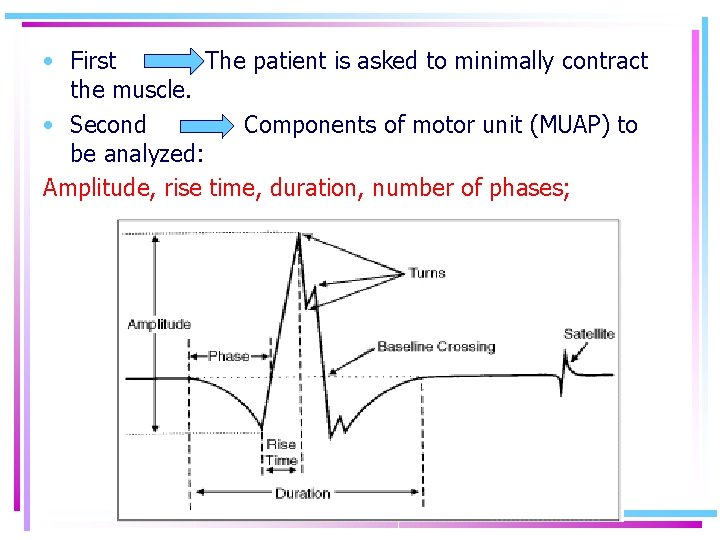
• First The patient is asked to minimally contract the muscle. • Second Components of motor unit (MUAP) to be analyzed: Amplitude, rise time, duration, number of phases;
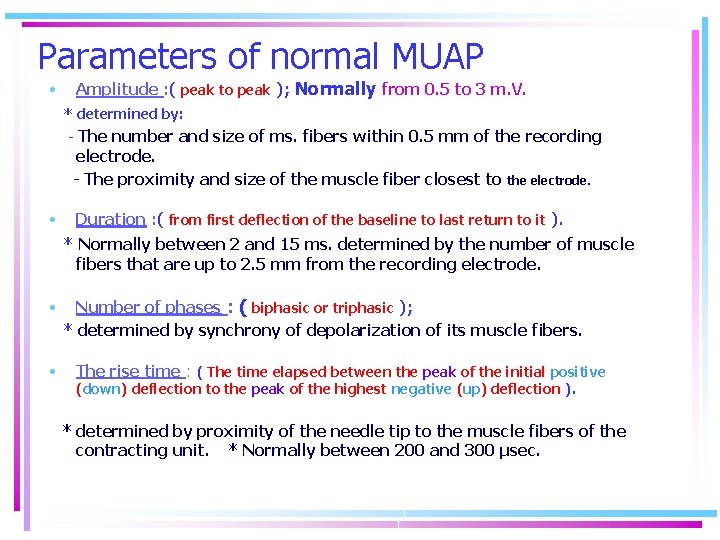
Parameters of normal MUAP • Amplitude : ( peak to peak ); Normally from 0. 5 to 3 m. V. * determined by: - The number and size of ms. fibers within 0. 5 mm of the recording electrode. - The proximity and size of the muscle fiber closest to the electrode. • Duration : ( from first deflection of the baseline to last return to it ). * Normally between 2 and 15 ms. determined by the number of muscle fibers that are up to 2. 5 mm from the recording electrode. • • Number of phases : ( biphasic or triphasic ); * determined by synchrony of depolarization of its muscle fibers. The rise time : ( The time elapsed between the peak of the initial positive (down) deflection to the peak of the highest negative (up) deflection ). * determined by proximity of the needle tip to the muscle fibers of the contracting unit. * Normally between 200 and 300 µsec.
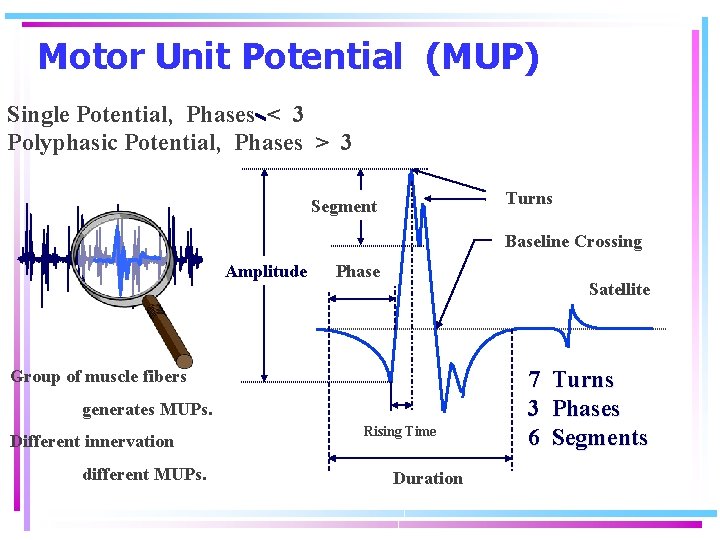
Motor Unit Potential (MUP) Single Potential, Phases < 3 Polyphasic Potential, Phases > 3 Turns Segment Baseline Crossing Amplitude Phase Satellite Group of muscle fibers generates MUPs. Different innervation different MUPs. Rising Time Duration 7 3 6 Turns Phases Segments
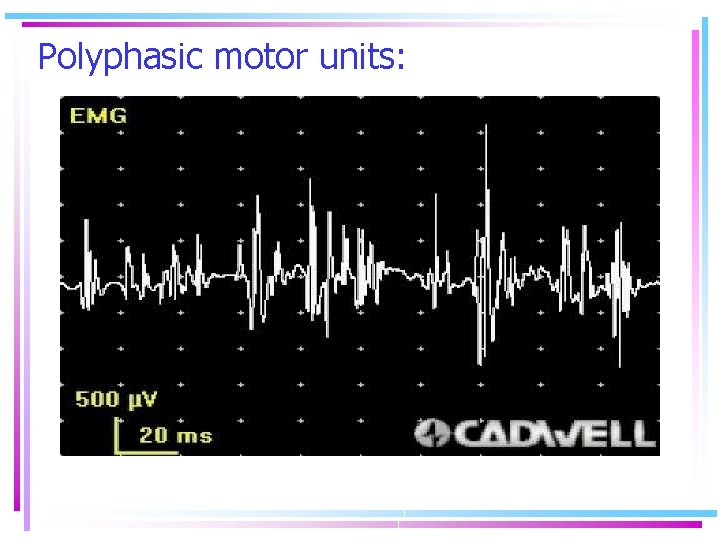
Polyphasic motor units:
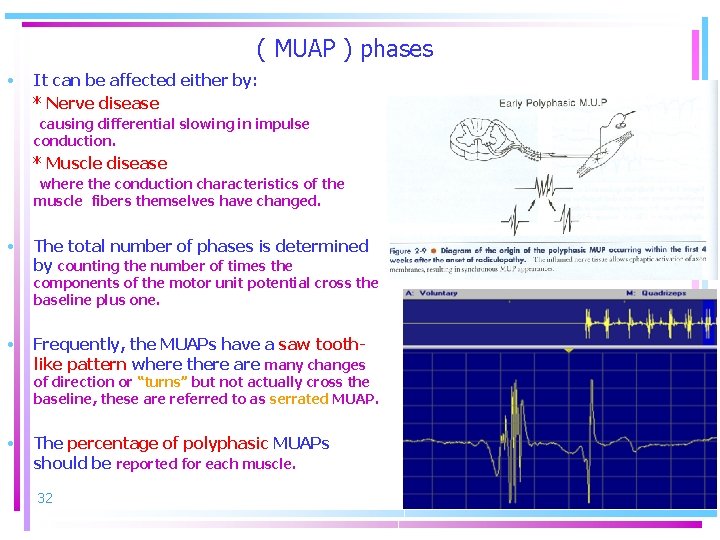
( MUAP ) phases • It can be affected either by: * Nerve disease causing differential slowing in impulse conduction. * Muscle disease where the conduction characteristics of the muscle fibers themselves have changed. • The total number of phases is determined by counting the number of times the components of the motor unit potential cross the baseline plus one. • Frequently, the MUAPs have a saw toothlike pattern where there are many changes of direction or “turns” but not actually cross the baseline, these are referred to as serrated MUAP. • The percentage of polyphasic MUAPs should be reported for each muscle. 32
Analysis of the interference pattern (IP) • The IP measured by the recording needle electrode contains → the MUAPs of all active motor units that are within the uptake area of the recording surface. • The primary method for analysis of the IP was the visual judgment → ( including the amplitude and the degree of recruitment ). • The IP is reported as → complete or incomplete.
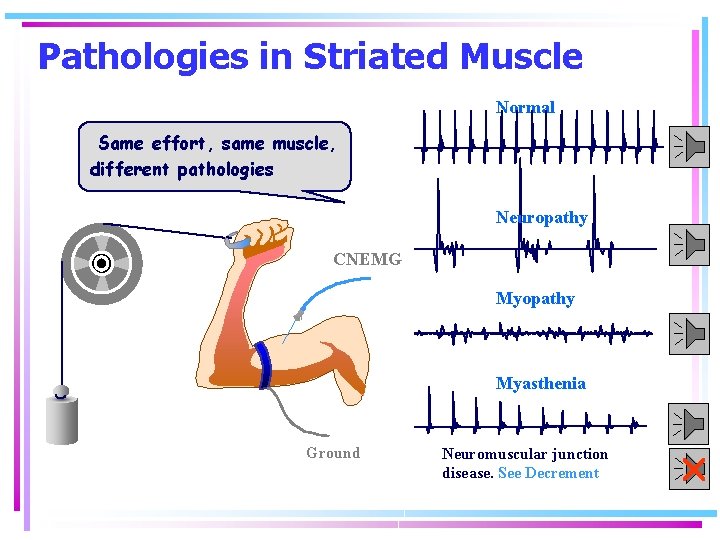
Pathologies in Striated Muscle Normal Same effort, same muscle, different pathologies Neuropathy CNEMG Myopathy Myasthenia Ground Neuromuscular junction disease. See Decrement
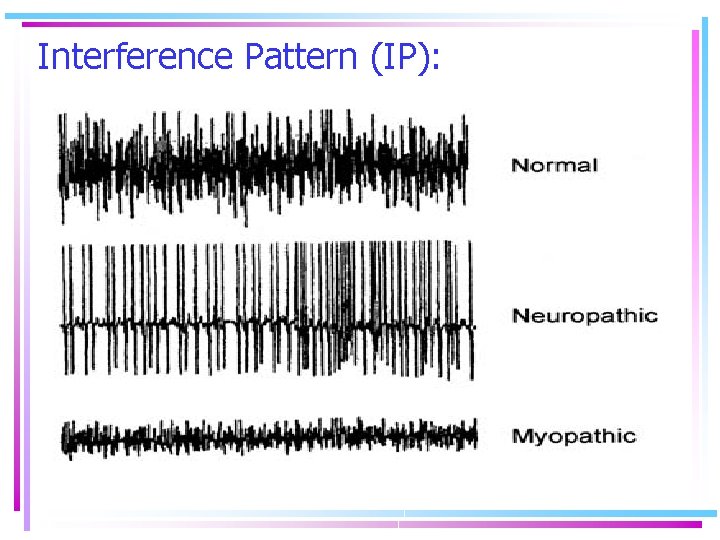
Interference Pattern (IP):
Number of Turns (T/S) • Turns → number of potential reversals of more than 100 μV/ time unit ( independent of baseline ). • The number of turns is counted over a certain time unit (turns/ second). • The number of turns is influenced by: * The number of motor units and the interaction between overlapping MUAPs. * Their firing rate. * The proportion of polyphasic MUAPs. * ↑ noise. • The more the action potentials, the higher the number of turns. • In neuropathies → decreased numbers of turns/ second and increased amplitude • In myopathies → increased numbers of turns/ second and reduced amplitude. 36
EMG report • Selected muscle examined by concentric needle electrode. • EMG findings at rest; spontaneous activity /pathological potentials (Fibs/PSW). • MUAP analysis. • IP……complete/reduced. • Recruitment…. early/late • Turn/S…. . cloud method. • Provisional diagnosis

- Slides: 38