
Basic electrical measurements Using handheld electronic test tools

Basic electrical measurements Using handheld electronic test tools © 2003 Fluke Corporation Basic electrical measurements 1
Goals of this presentation • Understand safety specifications and how to operate handheld electronic testers in a safe manner • Understand how handheld electronic testers and accessories perform basic measurements • Learn how to set a digital multimeter (DMM) to the correct function and range for a given measurement • Learn how to measure a variety of electrical parameters and test electrical components • Determine the proper measurement tool for safe and accurate measurements • Understand the differences between average responding and true-rms measurement on non-linear loads © 2003 Fluke Corporation Basic Electrical Measurements 2
Digital multimeter basics Agenda • Chapter 1: • Chapter 2: • Chapter 3: • Chapter 4: • • A first look at the DMM Multimeter safety Multimeter specifications Multimeter measurements Ohm’s Law: basic volts, amps, ohms measurement Special functions: Min/Max, Peak Hold Voltage: understanding high input impedance Current: using current clamps Resistance: DMM source voltage and multiple sources Testing components: diodes, caps Measuring temperature • Chapter 5: Non-linear loads • True-rms vs. average-sensing © 2003 Fluke Corporation Basic Electrical Measurements 3
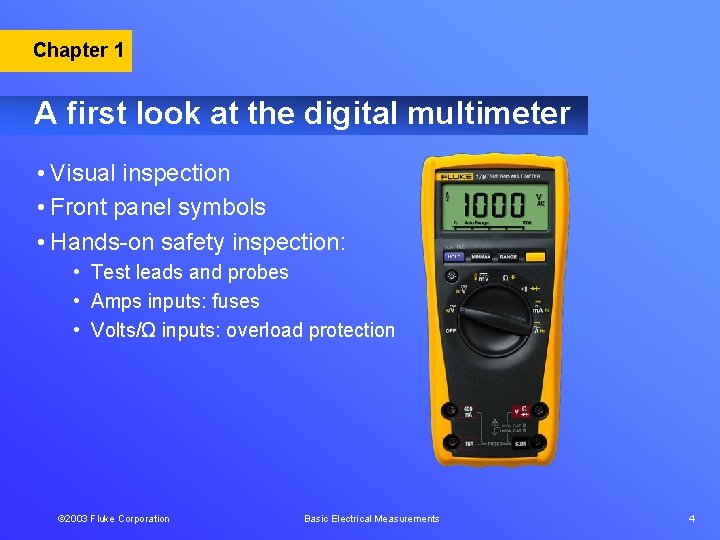
Chapter 1 A first look at the digital multimeter • Visual inspection • Front panel symbols • Hands-on safety inspection: • Test leads and probes • Amps inputs: fuses • Volts/Ω inputs: overload protection © 2003 Fluke Corporation Basic Electrical Measurements 4
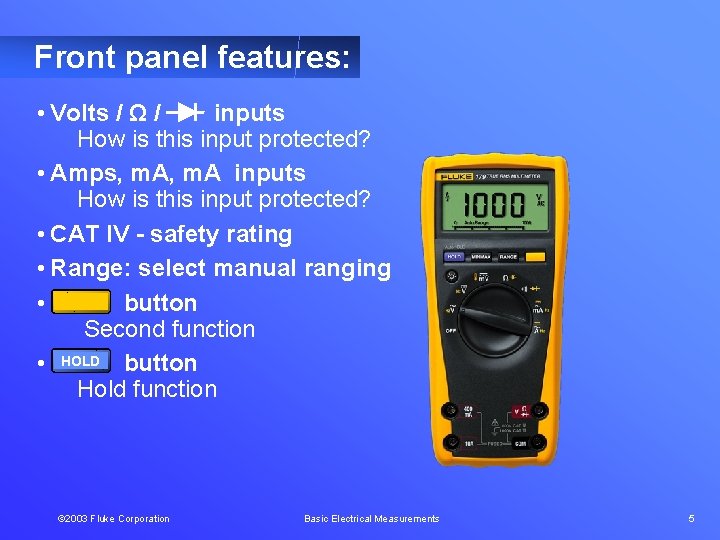
Front panel features: • Volts / Ω / inputs How is this input protected? • Amps, m. A inputs How is this input protected? • CAT IV - safety rating • Range: select manual ranging • button Second function • HOLD button Hold function © 2003 Fluke Corporation Basic Electrical Measurements 5
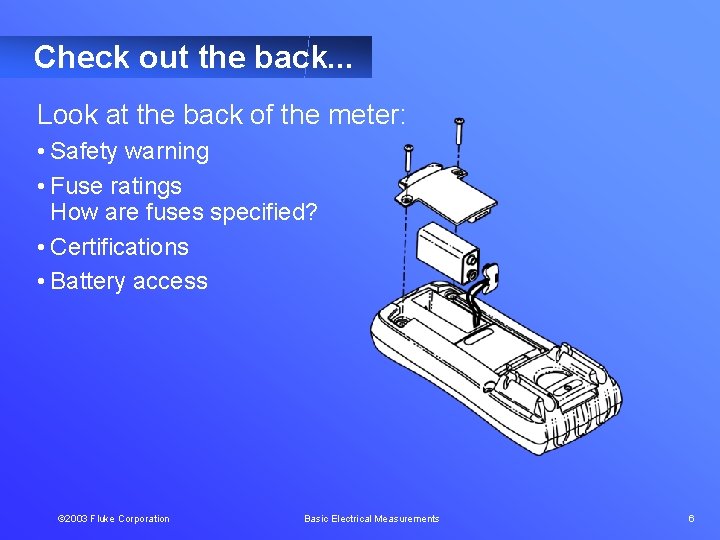
Check out the back. . . Look at the back of the meter: • Safety warning • Fuse ratings How are fuses specified? • Certifications • Battery access © 2003 Fluke Corporation Basic Electrical Measurements 6
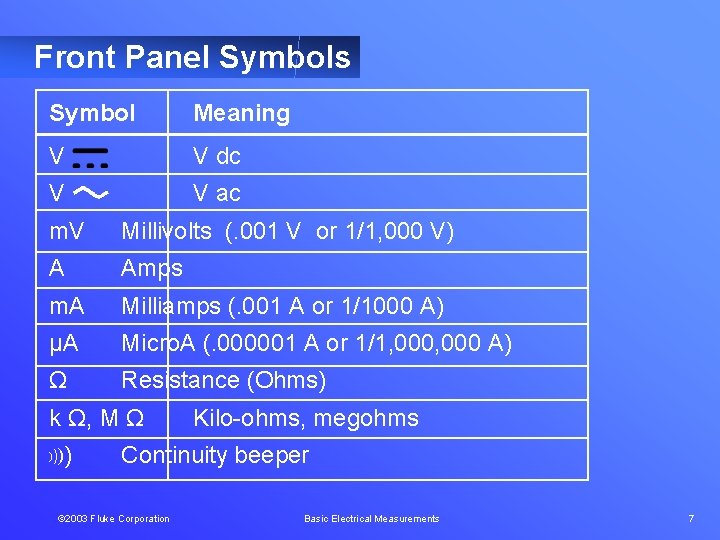
Front Panel Symbols Symbol Meaning V V dc V V ac m. V Millivolts (. 001 V or 1/1, 000 V) A Amps m. A Milliamps (. 001 A or 1/1000 A) µA Micro. A (. 000001 A or 1/1, 000 A) Ω Resistance (Ohms) k Ω, M Ω )) )) Kilo-ohms, megohms Continuity beeper © 2003 Fluke Corporation Basic Electrical Measurements 7

Front panel symbols Symbol Meaning Capacitance (u. F: microfarads, (n. F: nanofarads) Diode test Hz Hertz (cycles/sec) d. B Decibels Range Manual measurement ranging Hold Touch. Hold/Auto. HOLD - last stable reading MIN MAX Highest, lowest recorded readings Dangerous voltage levels Caution: see manual © 2003 Fluke Corporation Basic Electrical Measurements 8
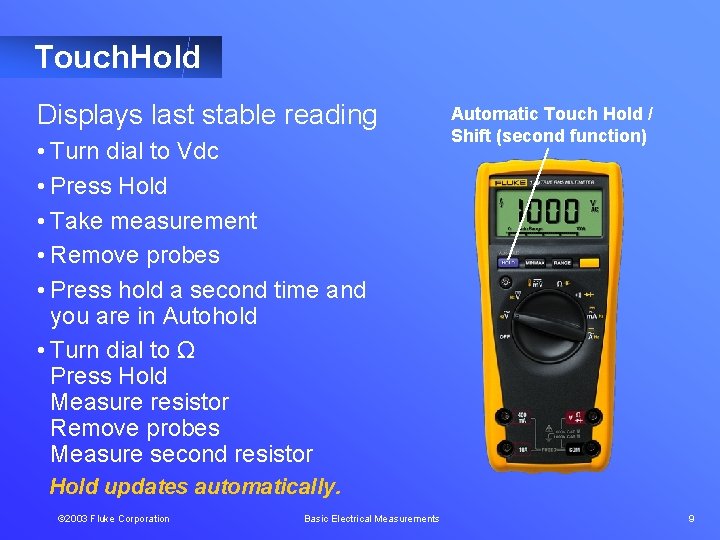
Touch. Hold Displays last stable reading • Turn dial to Vdc • Press Hold • Take measurement • Remove probes • Press hold a second time and you are in Autohold • Turn dial to Ω Press Hold Measure resistor Remove probes Measure second resistor Automatic Touch Hold / Shift (second function) Hold updates automatically. © 2003 Fluke Corporation Basic Electrical Measurements 9
First look at the DMM Summary • What we learned: • Meaning of front panel symbols • Back panel safety warning and other info • Touch. Hold & Autohold functions -- how they work © 2003 Fluke Corporation Basic Electrical Measurements 10
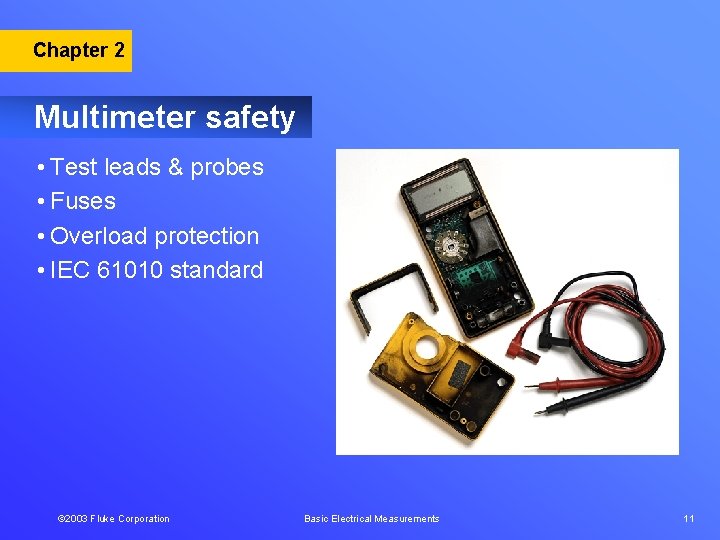
Chapter 2 Multimeter safety • Test leads & probes • Fuses • Overload protection • IEC 61010 standard © 2003 Fluke Corporation Basic Electrical Measurements 11
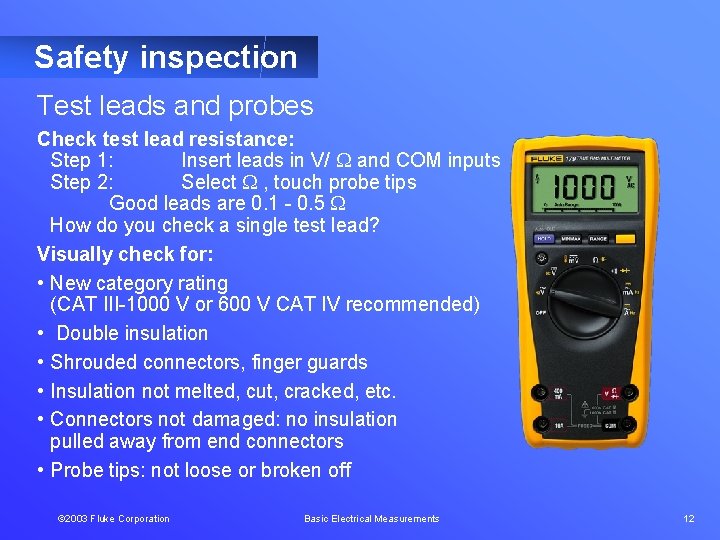
Safety inspection Test leads and probes Check test lead resistance: Step 1: Insert leads in V/ and COM inputs Step 2: Select , touch probe tips Good leads are 0. 1 - 0. 5 How do you check a single test lead? Visually check for: • New category rating (CAT III-1000 V or 600 V CAT IV recommended) • Double insulation • Shrouded connectors, finger guards • Insulation not melted, cut, cracked, etc. • Connectors not damaged: no insulation pulled away from end connectors • Probe tips: not loose or broken off © 2003 Fluke Corporation Basic Electrical Measurements 12
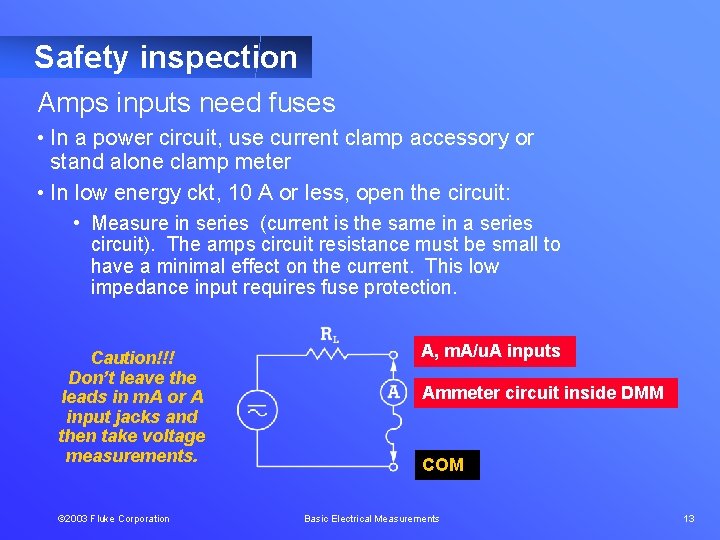
Safety inspection Amps inputs need fuses • In a power circuit, use current clamp accessory or stand alone clamp meter • In low energy ckt, 10 A or less, open the circuit: • Measure in series (current is the same in a series circuit). The amps circuit resistance must be small to have a minimal effect on the current. This low impedance input requires fuse protection. Caution!!! Don’t leave the leads in m. A or A input jacks and then take voltage measurements. © 2003 Fluke Corporation A, m. A/u. A inputs Ammeter circuit inside DMM COM Basic Electrical Measurements 13
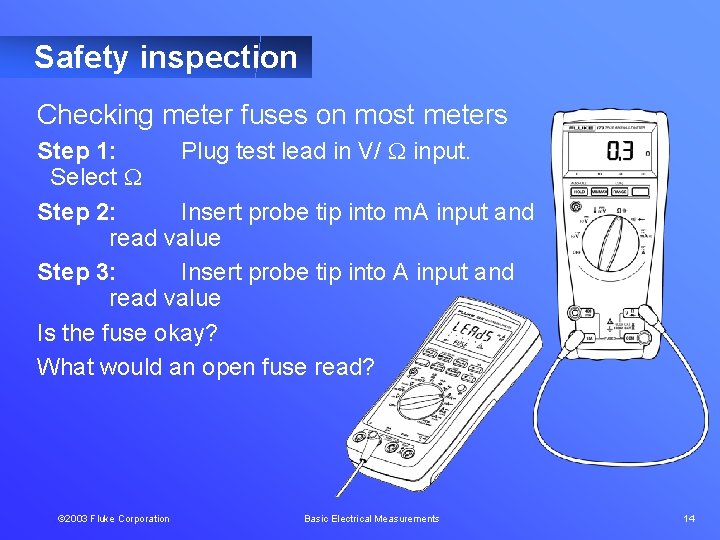
Safety inspection Checking meter fuses on most meters Step 1: Plug test lead in V/ input. Select Step 2: Insert probe tip into m. A input and read value Step 3: Insert probe tip into A input and read value Is the fuse okay? What would an open fuse read? © 2003 Fluke Corporation Basic Electrical Measurements 14

Safety inspection High impedance on Volts/ inputs • Volts measurements need high impedance circuit • Voltage measurements are in parallel Voltage is the same across each parallel branch • Parallel circuits divide current: High impedance branch = less current Low impedance branch = more current What about protection for ohms measurement? © 2003 Fluke Corporation Basic Electrical Measurements 15
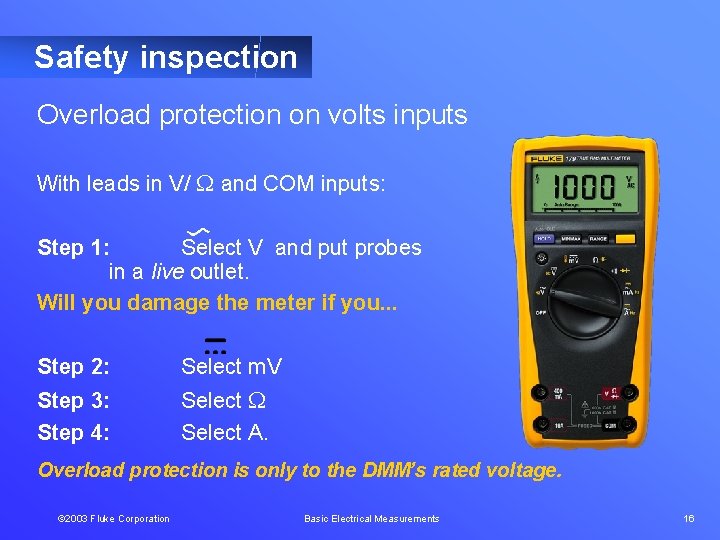
Safety inspection Overload protection on volts inputs With leads in V/ and COM inputs: Step 1: Select V and put probes in a live outlet. Will you damage the meter if you. . . Step 2: Select m. V Step 3: Step 4: Select A. Overload protection is only to the DMM’s rated voltage. © 2003 Fluke Corporation Basic Electrical Measurements 16
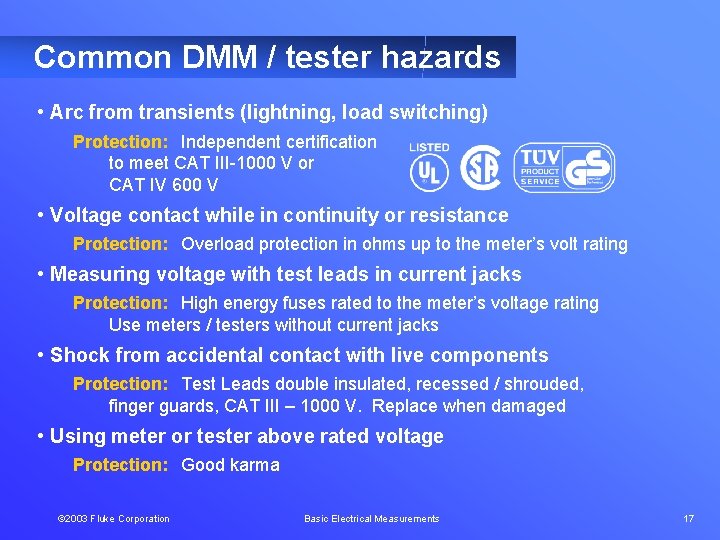
Common DMM / tester hazards • Arc from transients (lightning, load switching) Protection: Independent certification to meet CAT III-1000 V or CAT IV 600 V • Voltage contact while in continuity or resistance Protection: Overload protection in ohms up to the meter’s volt rating • Measuring voltage with test leads in current jacks Protection: High energy fuses rated to the meter’s voltage rating Use meters / testers without current jacks • Shock from accidental contact with live components Protection: Test Leads double insulated, recessed / shrouded, finger guards, CAT III – 1000 V. Replace when damaged • Using meter or tester above rated voltage Protection: Good karma © 2003 Fluke Corporation Basic Electrical Measurements 17
Multimeter safety Summary • What we learned: • How to check for good test leads • Why amps inputs need fuse protection • Low input impedance circuit • How to check for open fuses in the meter • Function of overload protection on V/ inputs © 2003 Fluke Corporation Basic Electrical Measurements 18
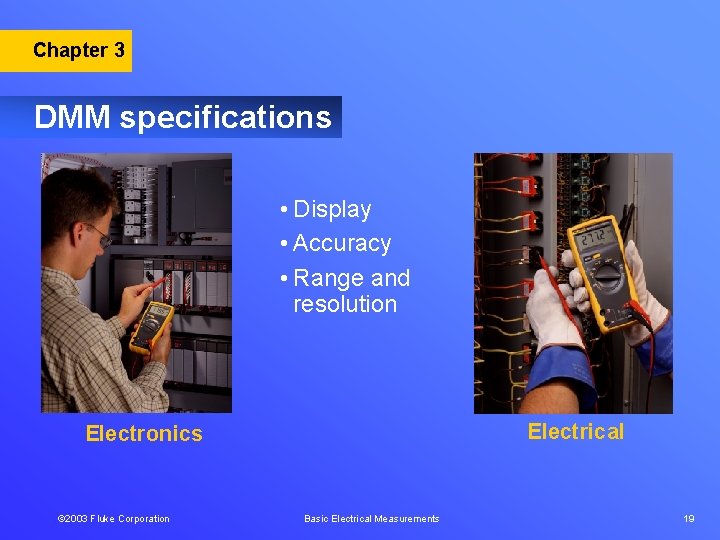
Chapter 3 DMM specifications • Display • Accuracy • Range and resolution Electrical Electronics © 2003 Fluke Corporation Basic Electrical Measurements 19
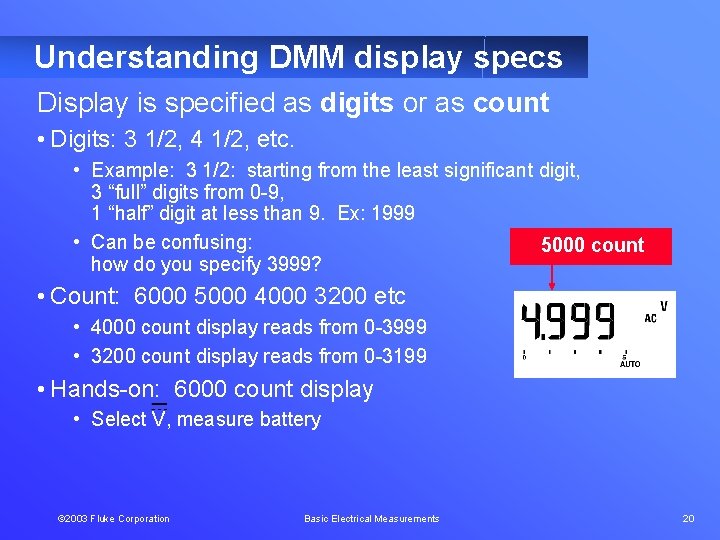
Understanding DMM display specs Display is specified as digits or as count • Digits: 3 1/2, 4 1/2, etc. • Example: 3 1/2: starting from the least significant digit, 3 “full” digits from 0 -9, 1 “half” digit at less than 9. Ex: 1999 • Can be confusing: 5000 count how do you specify 3999? • Count: 6000 5000 4000 3200 etc • 4000 count display reads from 0 -3999 • 3200 count display reads from 0 -3199 • Hands-on: 6000 count display • Select V, measure battery © 2003 Fluke Corporation Basic Electrical Measurements 20
Understanding DMM accuracy specs Accuracy is specified in percentage • Closeness with which an instrument reading approaches the true value being measured; largest allowable error • Percentage of reading (digital multimeters) vs. percentage of scale or range (analog meters): Example: 1 % scale vs. 1 % reading % scale: If scale or range is 1000 V, an accuracy of 1 % is equal to +/- 10 V. 120 V reading could = 110 -130 V % reading: 1 % accuracy with 120 V reading = 118. 8 -121. 2 V • Least significant digit unstable: Example: Accuracy spec = +/-(1 % +2) Reading of 200. 0 m. V= 197. 8 - 202. 2 m. V © 2003 Fluke Corporation Basic Electrical Measurements 21
Understanding DMM specs Range and resolution • Resolution is the smallest change in measured value to which the instrument will respond • As the range increases, the resolution decreases: Turn Fluke 179 to Vac and hit Range button (Auto disappears): Range: Resolution: 600. 0 m. V. 1 m. V (=1/10 m. V) 6. 000 V. 001 V (=1 m. V) 60. 00 V. 01 V (=10 m. V) 600. 0 V 0. 1 V (=100 m. V) 1000 V 1 V (=1000 m. V) (To exit Manual Range, hold Range button for 2 secs) • For maximum resolution, choose the lowest possible range © 2003 Fluke Corporation Basic Electrical Measurements 22
ABCs of DMM specs Summary • What we learned: • Display specifications: Digits or counts • Accuracy specifications: Percent of range or percent of reading • Range and resolution specs: Low range, high resolution (e. g. : 400. 0 m. V) High range, low resolution (e. g. : 400. 0 V) © 2003 Fluke Corporation Basic Electrical Measurements 23
Chapter 4 DMM measurements Basic measurements: Ohm’s Law Special functions: Min/Max How DMMs measure voltage: input impedance Understanding high How DMMs measure resistance: please How DMMs measure current: accessories Testing components: No other voltage Using clamp-on Capacitors, diodes, LEDs How DMMs measure temperature © 2003 Fluke Corporation Basic Electrical Measurements 24
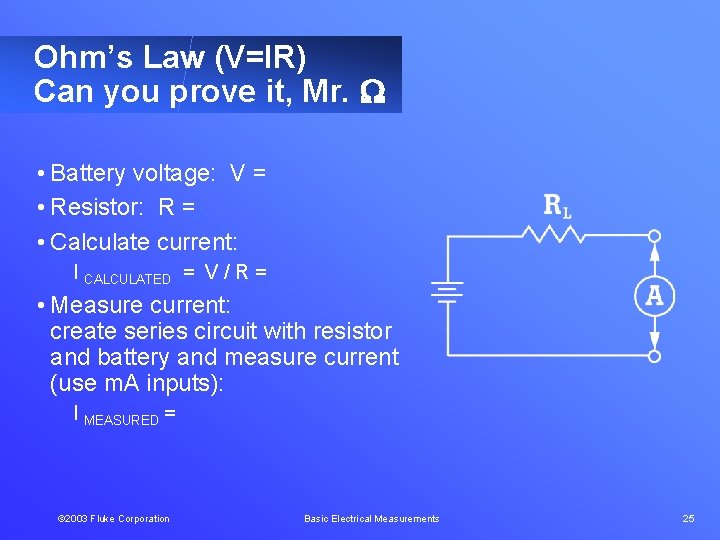
Ohm’s Law (V=IR) Can you prove it, Mr. • Battery voltage: V = • Resistor: R = • Calculate current: I CALCULATED = V / R = • Measure current: create series circuit with resistor and battery and measure current (use m. A inputs): I MEASURED = © 2003 Fluke Corporation Basic Electrical Measurements 25
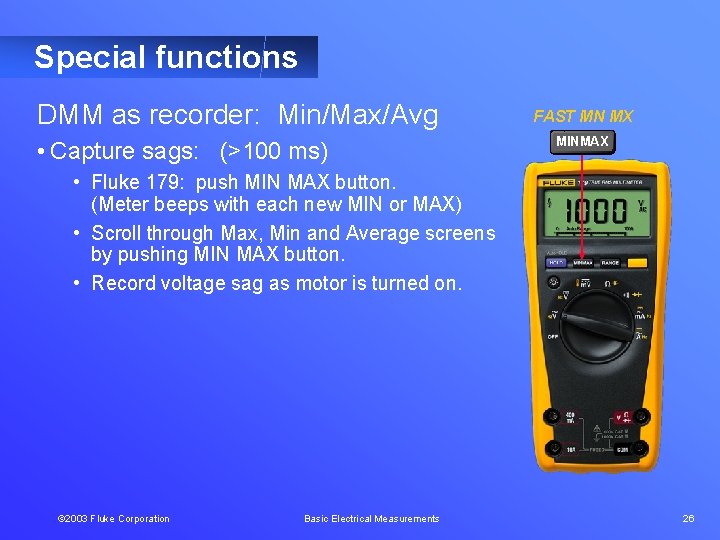
Special functions DMM as recorder: Min/Max/Avg • Capture sags: (>100 ms) FAST MN MX MINMAX • Fluke 179: push MIN MAX button. (Meter beeps with each new MIN or MAX) • Scroll through Max, Min and Average screens by pushing MIN MAX button. • Record voltage sag as motor is turned on. © 2003 Fluke Corporation Basic Electrical Measurements 26
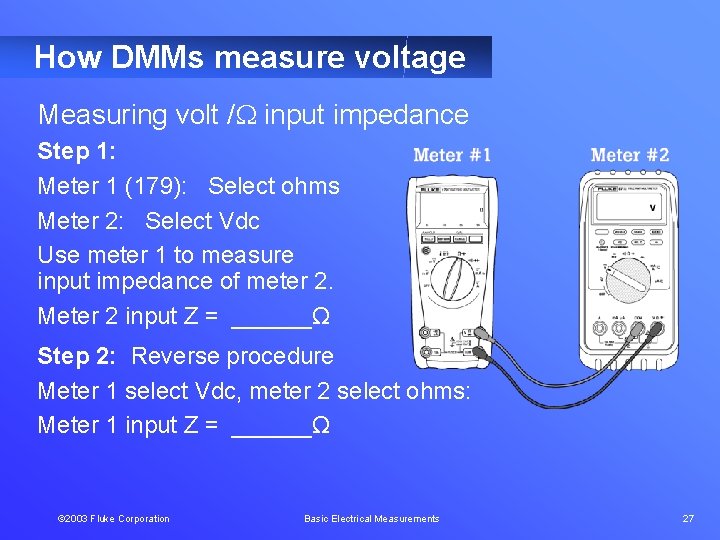
How DMMs measure voltage Measuring volt / input impedance Step 1: Meter 1 (179): Select ohms Meter 2: Select Vdc Use meter 1 to measure input impedance of meter 2. Meter 2 input Z = ______Ω Step 2: Reverse procedure Meter 1 select Vdc, meter 2 select ohms: Meter 1 input Z = ______Ω © 2003 Fluke Corporation Basic Electrical Measurements 27
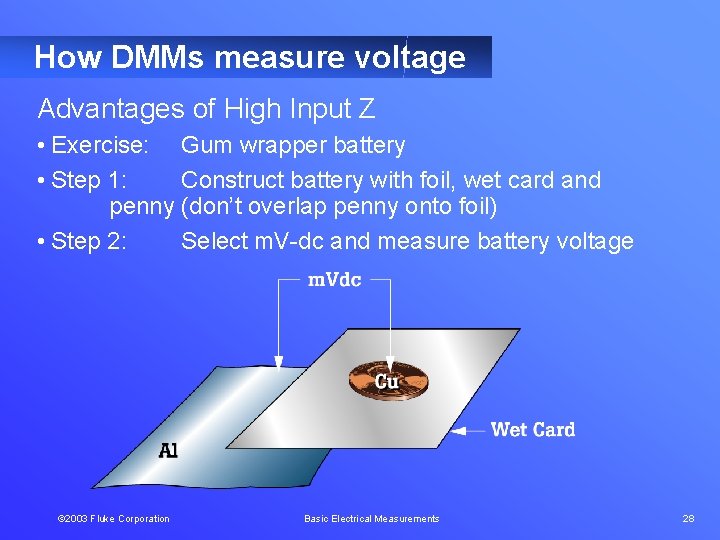
How DMMs measure voltage Advantages of High Input Z • Exercise: Gum wrapper battery • Step 1: Construct battery with foil, wet card and penny (don’t overlap penny onto foil) • Step 2: Select m. V-dc and measure battery voltage © 2003 Fluke Corporation Basic Electrical Measurements 28
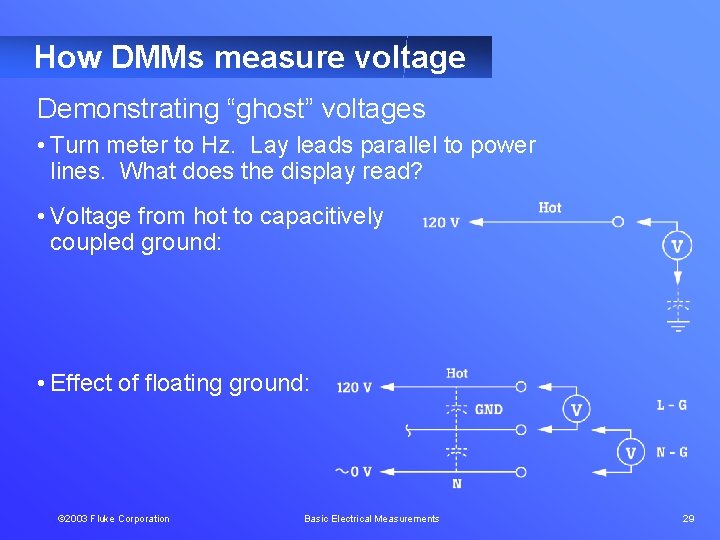
How DMMs measure voltage Demonstrating “ghost” voltages • Turn meter to Hz. Lay leads parallel to power lines. What does the display read? • Voltage from hot to capacitively coupled ground: • Effect of floating ground: © 2003 Fluke Corporation Basic Electrical Measurements 29
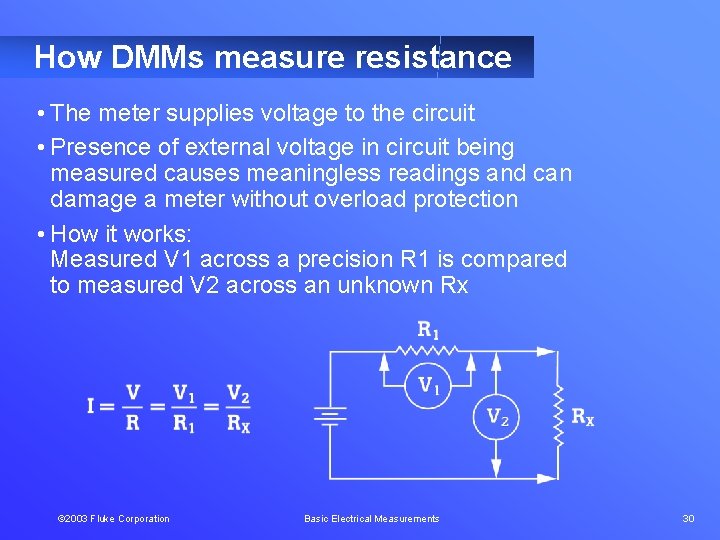
How DMMs measure resistance • The meter supplies voltage to the circuit • Presence of external voltage in circuit being measured causes meaningless readings and can damage a meter without overload protection • How it works: Measured V 1 across a precision R 1 is compared to measured V 2 across an unknown Rx © 2003 Fluke Corporation Basic Electrical Measurements 30
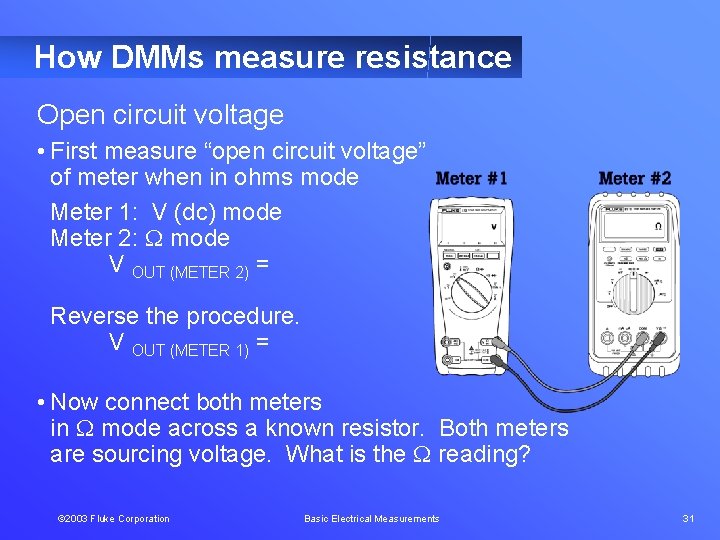
How DMMs measure resistance Open circuit voltage • First measure “open circuit voltage” of meter when in ohms mode Meter 1: V (dc) mode Meter 2: mode V OUT (METER 2) = Reverse the procedure. V OUT (METER 1) = • Now connect both meters in mode across a known resistor. Both meters are sourcing voltage. What is the reading? © 2003 Fluke Corporation Basic Electrical Measurements 31
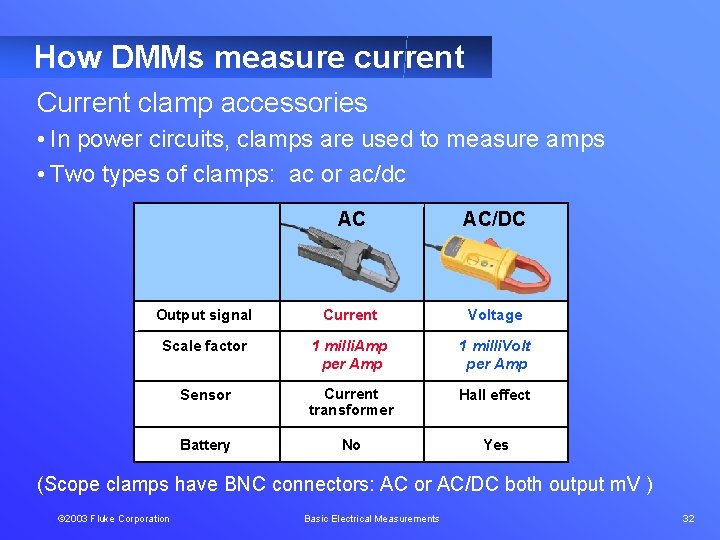
How DMMs measure current Current clamp accessories • In power circuits, clamps are used to measure amps • Two types of clamps: ac or ac/dc AC AC/DC Output signal Current Voltage Scale factor 1 milli. Amp per Amp 1 milli. Volt per Amp Sensor Current transformer Hall effect Battery No Yes (Scope clamps have BNC connectors: AC or AC/DC both output m. V ) © 2003 Fluke Corporation Basic Electrical Measurements 32
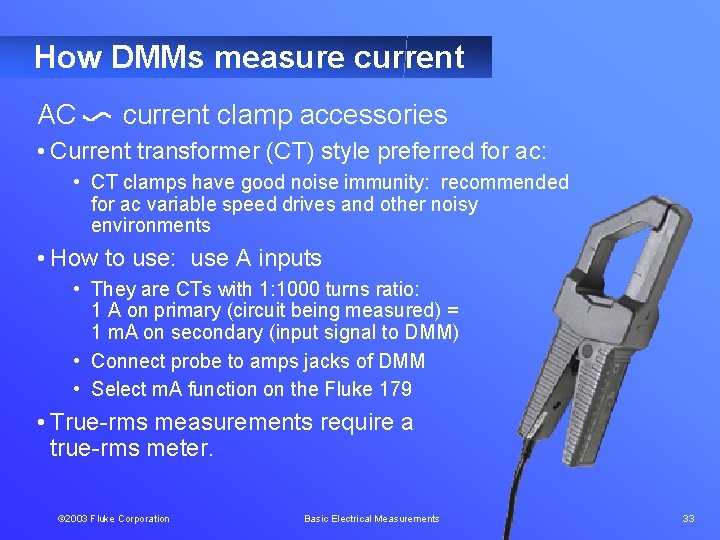
How DMMs measure current AC current clamp accessories • Current transformer (CT) style preferred for ac: • CT clamps have good noise immunity: recommended for ac variable speed drives and other noisy environments • How to use: use A inputs • They are CTs with 1: 1000 turns ratio: 1 A on primary (circuit being measured) = 1 m. A on secondary (input signal to DMM) • Connect probe to amps jacks of DMM • Select m. A function on the Fluke 179 • True-rms measurements require a true-rms meter. © 2003 Fluke Corporation Basic Electrical Measurements 33
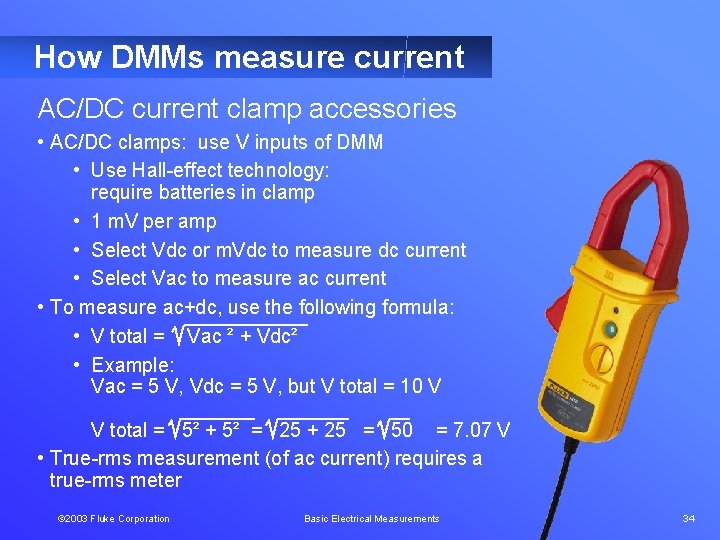
How DMMs measure current AC/DC current clamp accessories • AC/DC clamps: use V inputs of DMM • Use Hall-effect technology: require batteries in clamp • 1 m. V per amp • Select Vdc or m. Vdc to measure dc current • Select Vac to measure ac current • To measure ac+dc, use the following formula: • V total = Vac ² + Vdc² • Example: Vac = 5 V, Vdc = 5 V, but V total = 10 V V total = 5² + 5² = 25 + 25 = 50 = 7. 07 V • True-rms measurement (of ac current) requires a true-rms meter © 2003 Fluke Corporation Basic Electrical Measurements 34
How DMMs measure current Measuring load current and inrush Plug the ac current clamp accessory into the meter: Fluke 179: use m. A inputs Remember: 1 m. A = 1 A • Select m. A function • Select auto range and connect to m. A input and common • Measure motor inrush current: • Select MIN MAX © 2003 Fluke Corporation Basic Electrical Measurements 35
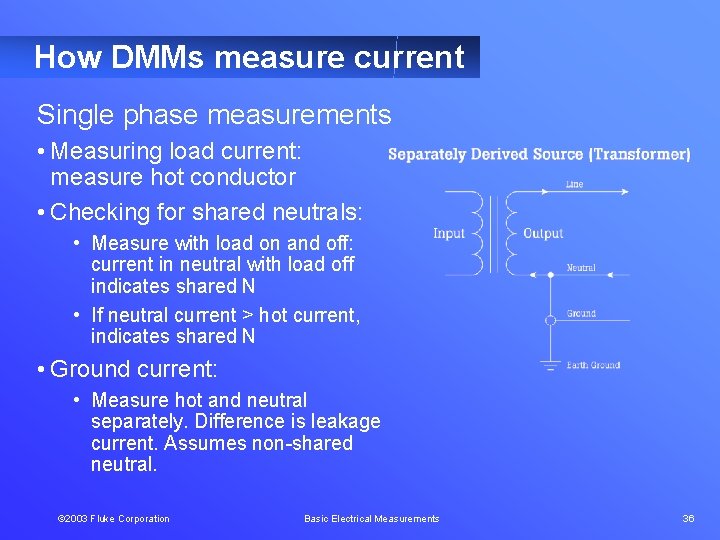
How DMMs measure current Single phase measurements • Measuring load current: measure hot conductor • Checking for shared neutrals: • Measure with load on and off: current in neutral with load off indicates shared N • If neutral current > hot current, indicates shared N • Ground current: • Measure hot and neutral separately. Difference is leakage current. Assumes non-shared neutral. © 2003 Fluke Corporation Basic Electrical Measurements 36
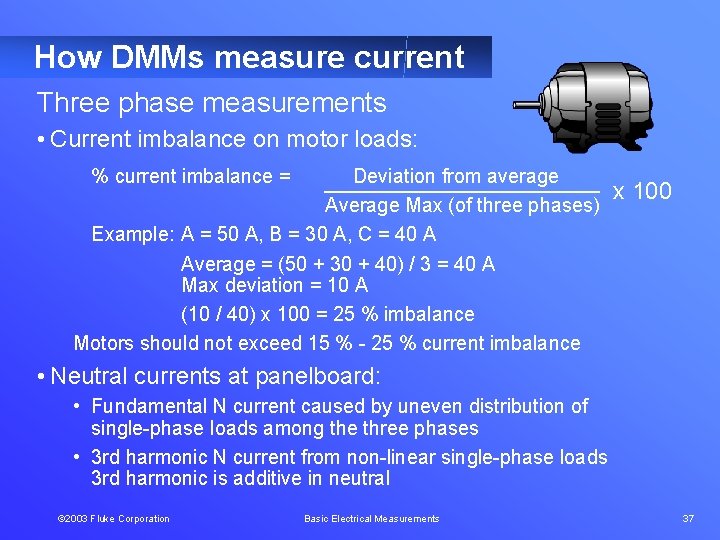
How DMMs measure current Three phase measurements • Current imbalance on motor loads: % current imbalance = Deviation from average Average Max (of three phases) Example: A = 50 A, B = 30 A, C = 40 A x 100 Average = (50 + 30 + 40) / 3 = 40 A Max deviation = 10 A (10 / 40) x 100 = 25 % imbalance Motors should not exceed 15 % - 25 % current imbalance • Neutral currents at panelboard: • Fundamental N current caused by uneven distribution of single-phase loads among the three phases • 3 rd harmonic N current from non-linear single-phase loads 3 rd harmonic is additive in neutral © 2003 Fluke Corporation Basic Electrical Measurements 37
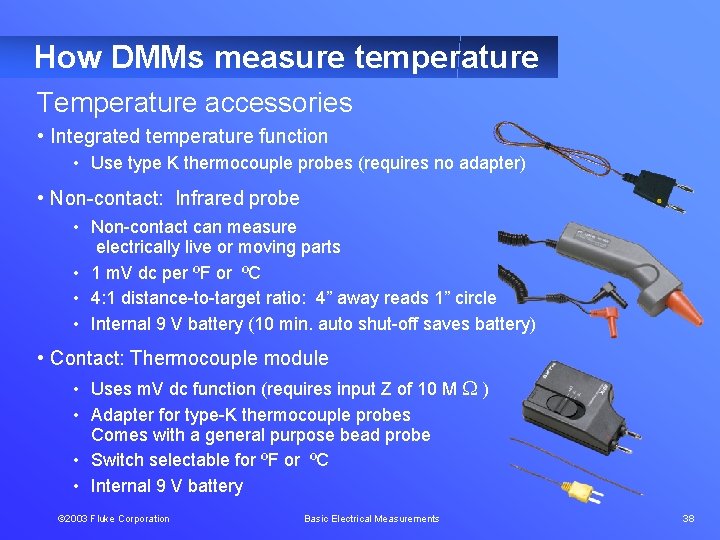
How DMMs measure temperature Temperature accessories • Integrated temperature function • Use type K thermocouple probes (requires no adapter) • Non-contact: Infrared probe • Non-contact can measure electrically live or moving parts • 1 m. V dc per ºF or ºC • 4: 1 distance-to-target ratio: 4” away reads 1” circle • Internal 9 V battery (10 min. auto shut-off saves battery) • Contact: Thermocouple module • Uses m. V dc function (requires input Z of 10 M ) • Adapter for type-K thermocouple probes Comes with a general purpose bead probe • Switch selectable for ºF or ºC • Internal 9 V battery © 2003 Fluke Corporation Basic Electrical Measurements 38
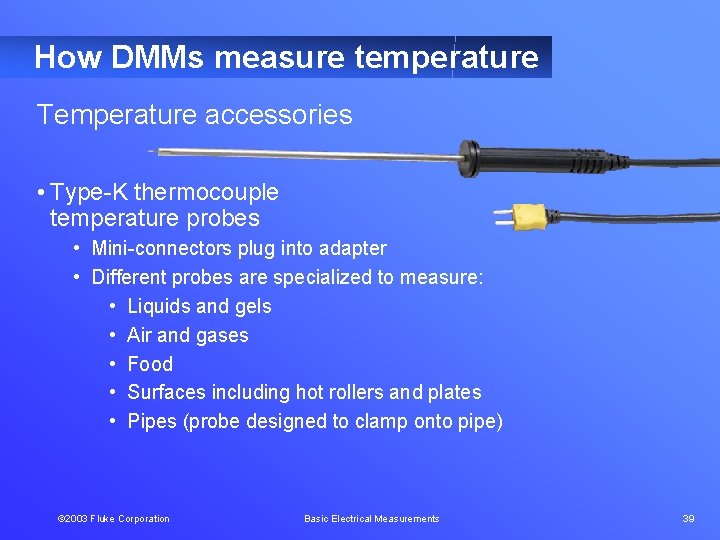
How DMMs measure temperature Temperature accessories • Type-K thermocouple temperature probes • Mini-connectors plug into adapter • Different probes are specialized to measure: • Liquids and gels • Air and gases • Food • Surfaces including hot rollers and plates • Pipes (probe designed to clamp onto pipe) © 2003 Fluke Corporation Basic Electrical Measurements 39
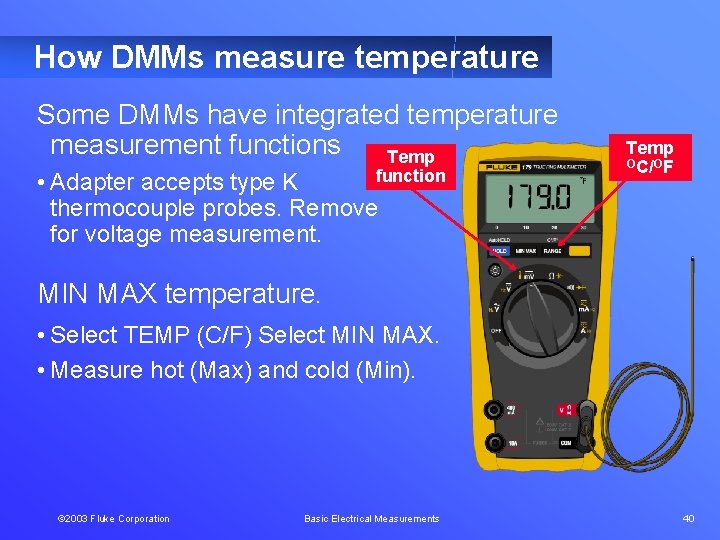
How DMMs measure temperature Some DMMs have integrated temperature measurement functions Temp function • Adapter accepts type K thermocouple probes. Remove for voltage measurement. Temp OC/OF MIN MAX temperature. • Select TEMP (C/F) Select MIN MAX. • Measure hot (Max) and cold (Min). © 2003 Fluke Corporation Basic Electrical Measurements 40
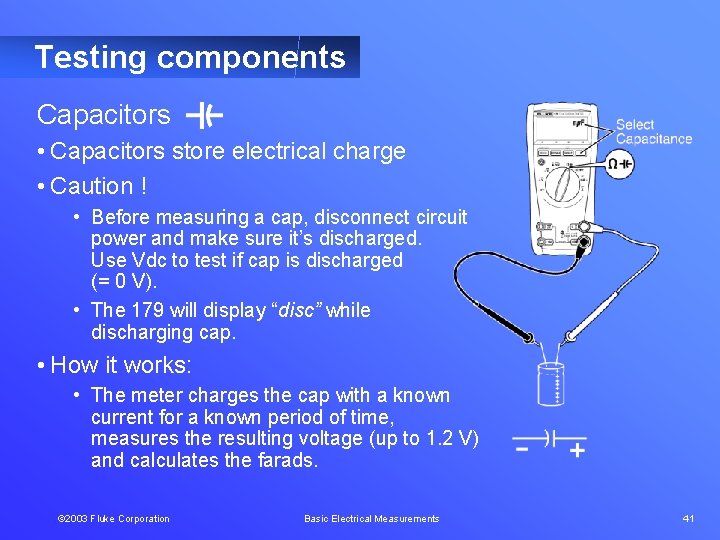
Testing components Capacitors • Capacitors store electrical charge • Caution ! • Before measuring a cap, disconnect circuit power and make sure it’s discharged. Use Vdc to test if cap is discharged (= 0 V). • The 179 will display “disc” while discharging cap. • How it works: • The meter charges the cap with a known current for a known period of time, measures the resulting voltage (up to 1. 2 V) and calculates the farads. © 2003 Fluke Corporation Basic Electrical Measurements 41
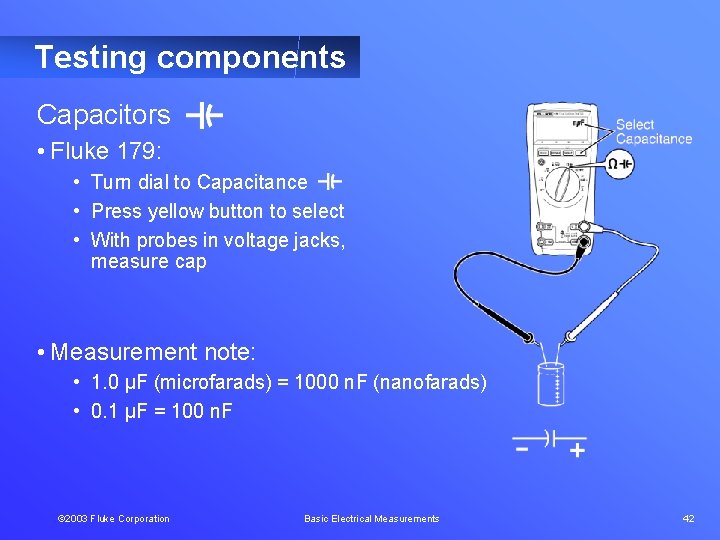
Testing components Capacitors • Fluke 179: • Turn dial to Capacitance • Press yellow button to select • With probes in voltage jacks, measure cap • Measurement note: • 1. 0 µF (microfarads) = 1000 n. F (nanofarads) • 0. 1 µF = 100 n. F © 2003 Fluke Corporation Basic Electrical Measurements 42
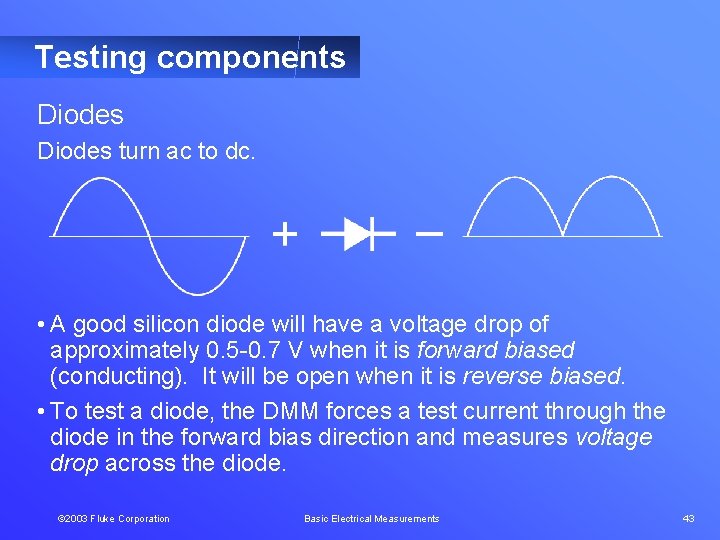
Testing components Diodes turn ac to dc. • A good silicon diode will have a voltage drop of approximately 0. 5 -0. 7 V when it is forward biased (conducting). It will be open when it is reverse biased. • To test a diode, the DMM forces a test current through the diode in the forward bias direction and measures voltage drop across the diode. © 2003 Fluke Corporation Basic Electrical Measurements 43
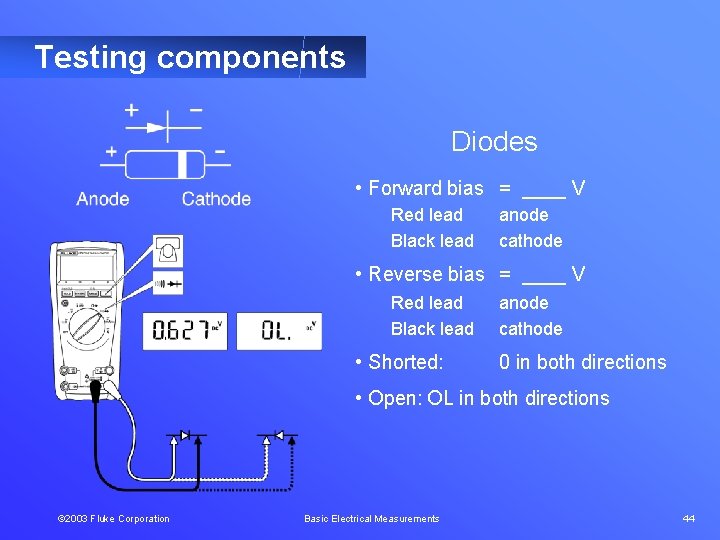
Testing components Diodes • Forward bias = ____ V Red lead Black lead anode cathode • Reverse bias = ____ V Red lead Black lead • Shorted: anode cathode 0 in both directions • Open: OL in both directions © 2003 Fluke Corporation Basic Electrical Measurements 44
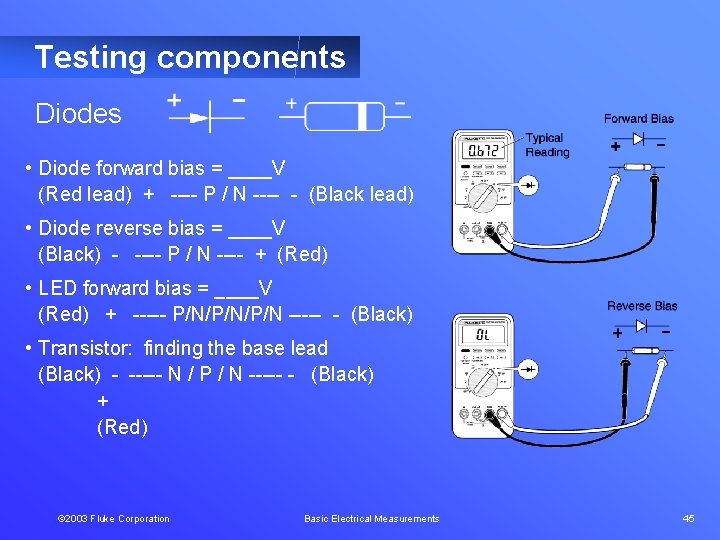
Testing components Diodes • Diode forward bias = ____V (Red lead) + ---- P / N ---- - (Black lead) • Diode reverse bias = ____V (Black) - ---- P / N ---- + (Red) • LED forward bias = ____V (Red) + ----- P/N/P/N ----- - (Black) • Transistor: finding the base lead (Black) - ----- N / P / N ----- - (Black) + (Red) © 2003 Fluke Corporation Basic Electrical Measurements 45
DMM measurements Summary What we learned • It’s the law: Mr. Ohm was right. • MIN MAX and other recorder functions • Voltage measurements: The ups and downs of high impedance inputs • Resistance: DMM is the only voltage source • Current: Capturing inrush current • Use of temperature accessories • Components: Capacitor and diode checks © 2003 Fluke Corporation Basic Electrical Measurements 46

Chapter 5 Measurement Issues with non-linear loads • True-rms vs. average-sensing • Crest factor © 2003 Fluke Corporation Basic Electrical Measurements 47
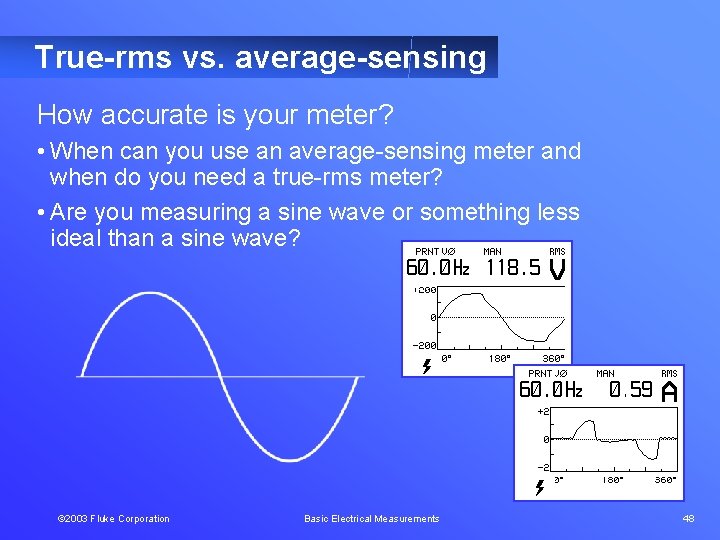
True-rms vs. average-sensing How accurate is your meter? • When can you use an average-sensing meter and when do you need a true-rms meter? • Are you measuring a sine wave or something less ideal than a sine wave? © 2003 Fluke Corporation Basic Electrical Measurements 48
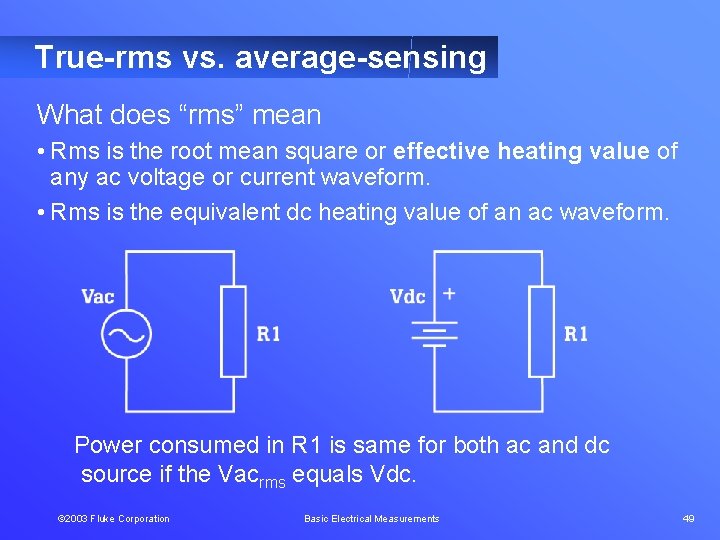
True-rms vs. average-sensing What does “rms” mean • Rms is the root mean square or effective heating value of any ac voltage or current waveform. • Rms is the equivalent dc heating value of an ac waveform. Power consumed in R 1 is same for both ac and dc source if the Vacrms equals Vdc. © 2003 Fluke Corporation Basic Electrical Measurements 49
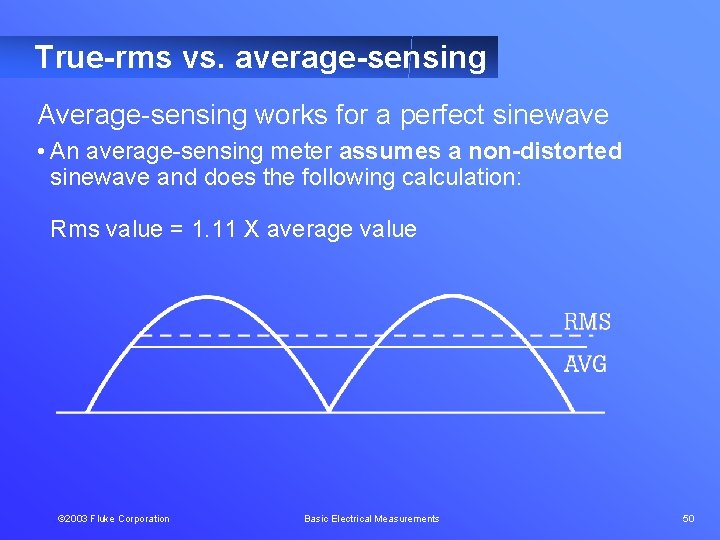
True-rms vs. average-sensing Average-sensing works for a perfect sinewave • An average-sensing meter assumes a non-distorted sinewave and does the following calculation: Rms value = 1. 11 X average value © 2003 Fluke Corporation Basic Electrical Measurements 50
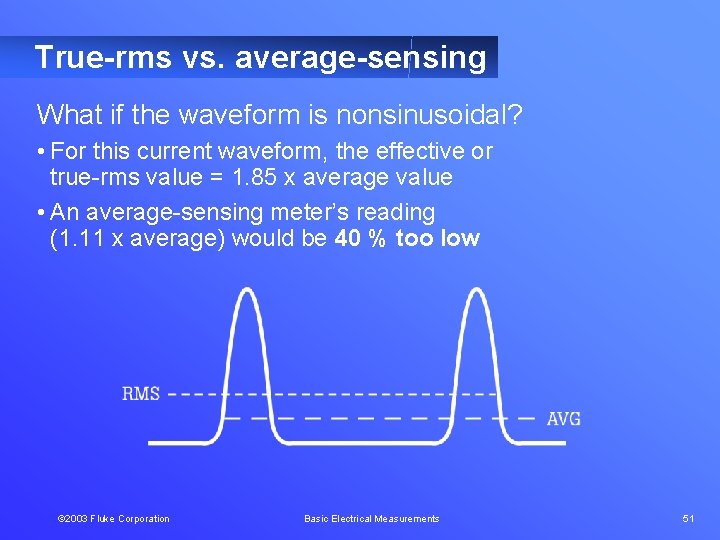
True-rms vs. average-sensing What if the waveform is nonsinusoidal? • For this current waveform, the effective or true-rms value = 1. 85 x average value • An average-sensing meter’s reading (1. 11 x average) would be 40 % too low © 2003 Fluke Corporation Basic Electrical Measurements 51
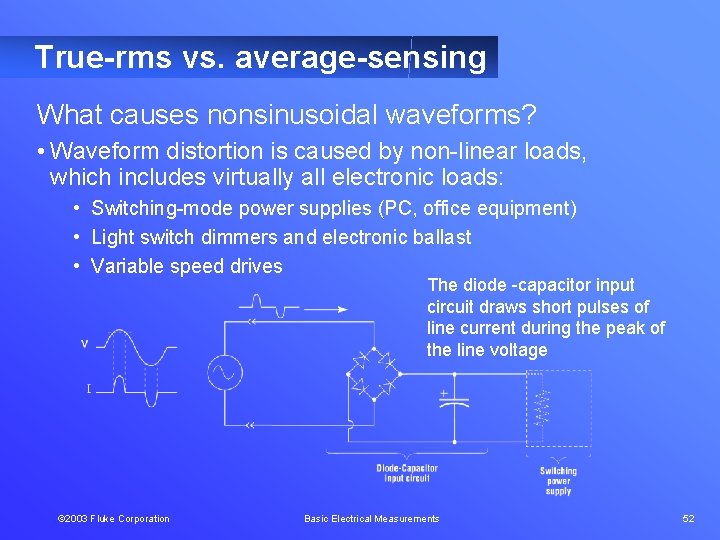
True-rms vs. average-sensing What causes nonsinusoidal waveforms? • Waveform distortion is caused by non-linear loads, which includes virtually all electronic loads: • Switching-mode power supplies (PC, office equipment) • Light switch dimmers and electronic ballast • Variable speed drives The diode -capacitor input circuit draws short pulses of line current during the peak of the line voltage © 2003 Fluke Corporation Basic Electrical Measurements 52
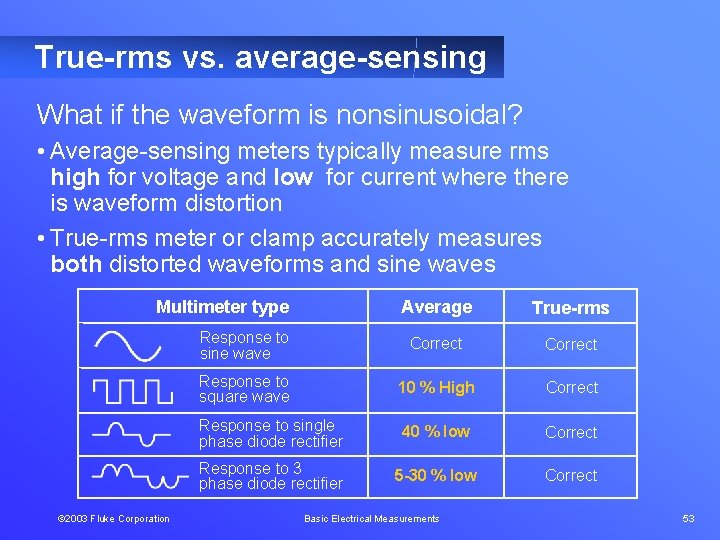
True-rms vs. average-sensing What if the waveform is nonsinusoidal? • Average-sensing meters typically measure rms high for voltage and low for current where there is waveform distortion • True-rms meter or clamp accurately measures both distorted waveforms and sine waves Multimeter type © 2003 Fluke Corporation Average True-rms Response to sine wave Correct Response to square wave 10 % High Correct Response to single phase diode rectifier 40 % low Correct Response to 3 phase diode rectifier 5 -30 % low Correct Basic Electrical Measurements 53
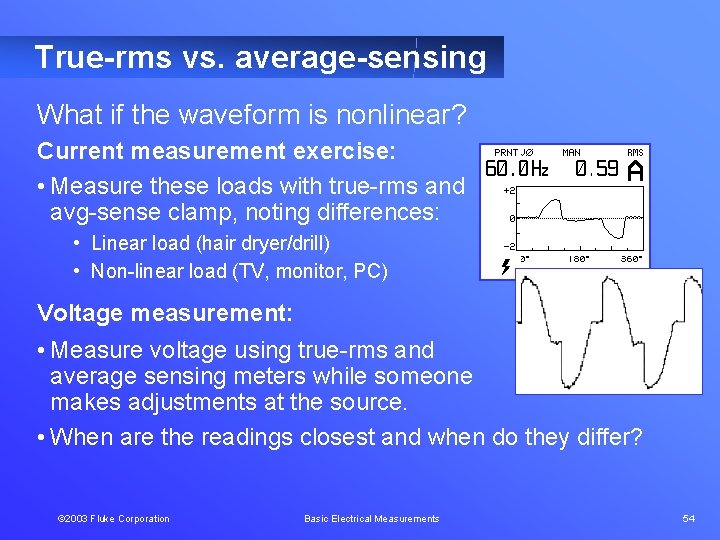
True-rms vs. average-sensing What if the waveform is nonlinear? Current measurement exercise: • Measure these loads with true-rms and avg-sense clamp, noting differences: • Linear load (hair dryer/drill) • Non-linear load (TV, monitor, PC) Voltage measurement: • Measure voltage using true-rms and average sensing meters while someone makes adjustments at the source. • When are the readings closest and when do they differ? © 2003 Fluke Corporation Basic Electrical Measurements 54
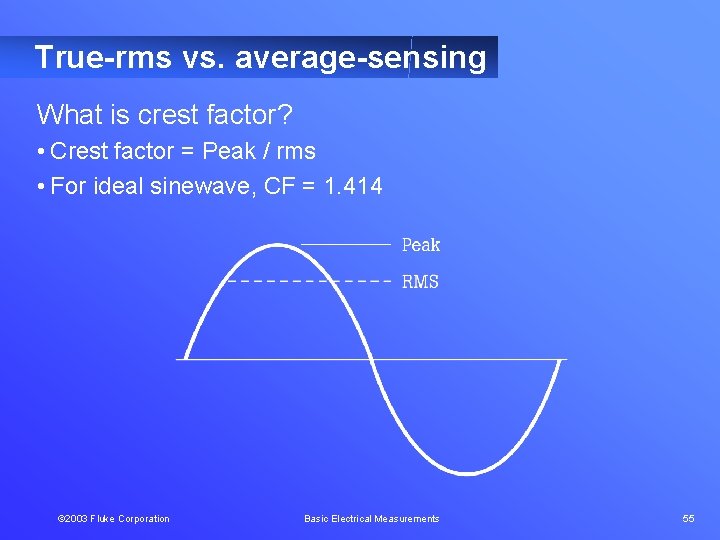
True-rms vs. average-sensing What is crest factor? • Crest factor = Peak / rms • For ideal sinewave, CF = 1. 414 © 2003 Fluke Corporation Basic Electrical Measurements 55
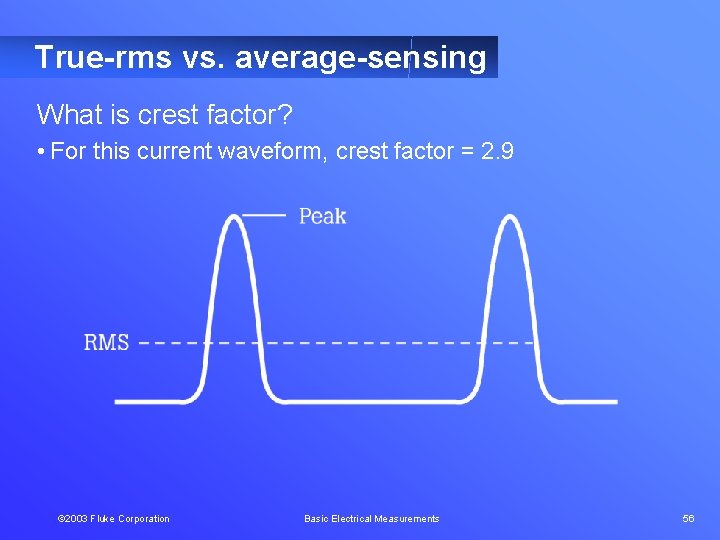
True-rms vs. average-sensing What is crest factor? • For this current waveform, crest factor = 2. 9 © 2003 Fluke Corporation Basic Electrical Measurements 56
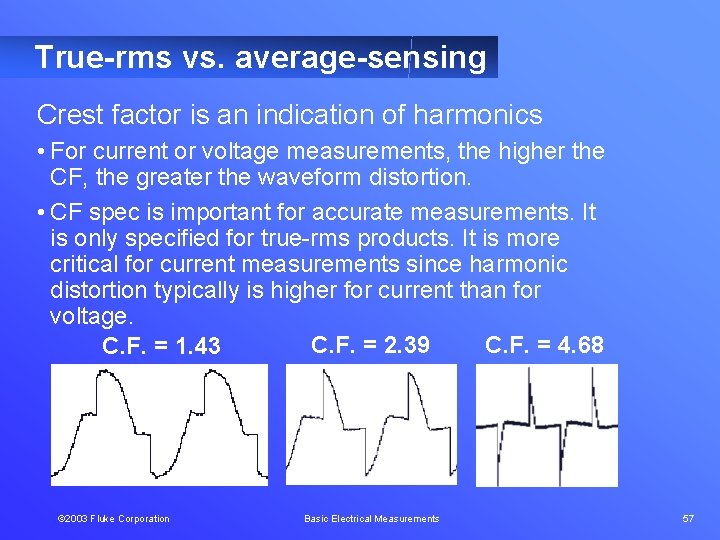
True-rms vs. average-sensing Crest factor is an indication of harmonics • For current or voltage measurements, the higher the CF, the greater the waveform distortion. • CF spec is important for accurate measurements. It is only specified for true-rms products. It is more critical for current measurements since harmonic distortion typically is higher for current than for voltage. C. F. = 2. 39 C. F. = 4. 68 C. F. = 1. 43 © 2003 Fluke Corporation Basic Electrical Measurements 57
True-rms vs. average-sensing Summary Minimum specifications for measurements on electrical power systems: • True-rms • Accurate for both linear and non-linear loads • Crest factor = 3 • Accurate for current waveforms with CF not exceeding 3 • CF = 3 at max range; CF = 6 at half-range • IEC 61010 -1 CAT III-600 V • Distribution level: power distribution equipment. © 2003 Fluke Corporation Basic Electrical Measurements 58
- Slides: 58