
Basic Electrical Engineering ENG 222 Lecture 1 1
Basic Electrical Engineering ENG 222 Lecture 1. 1
CONTENTS 1. Introduction 2. P. N Junction representation 3. Forward and reversed biased 4. Characteristics of Diodes 5. V-I Characteristics of diodes 6. Diodes Seven- segment displays. 7. Diodes as rectifier 2
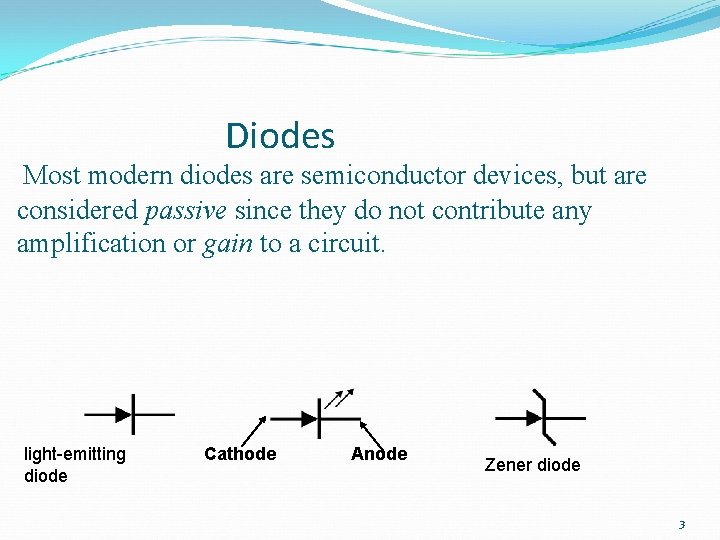
Diodes Most modern diodes are semiconductor devices, but are considered passive since they do not contribute any amplification or gain to a circuit. light-emitting diode Cathode Anode Zener diode 3

Diode types May be classified by semiconductor material silicon, germanium, gallium arsenide, etc. Or classified by circuit function Small signal detector or switching diode Rectifier diode Light-emitting diode (LED) 4
Diode handling and installation Diodes are polarized and must be installed in with correct orientation. Many diodes are modestly susceptible to ESD damage, so normal ESD precautions should be taken. Mechanical stress due to lead bending should be minimized. 5
6
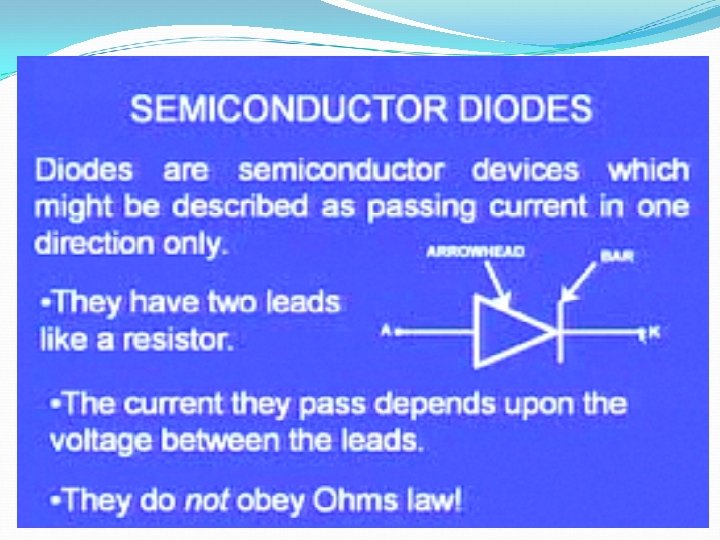
What is a Diodes are semiconductor devices which might be described as passing current in one direction only. It is an electrical device allowing current to move through it in one direction with far greater ease than in the other. The most common kind of diode in modern circuit design is the semiconductor diodes. Semiconductor diodes are symbolized in schematic diagrams below. When placed in a simple battery-lamp circuit, the diode will either allow or prevent current through the lamp, depending on the polarity of the voltage. 7
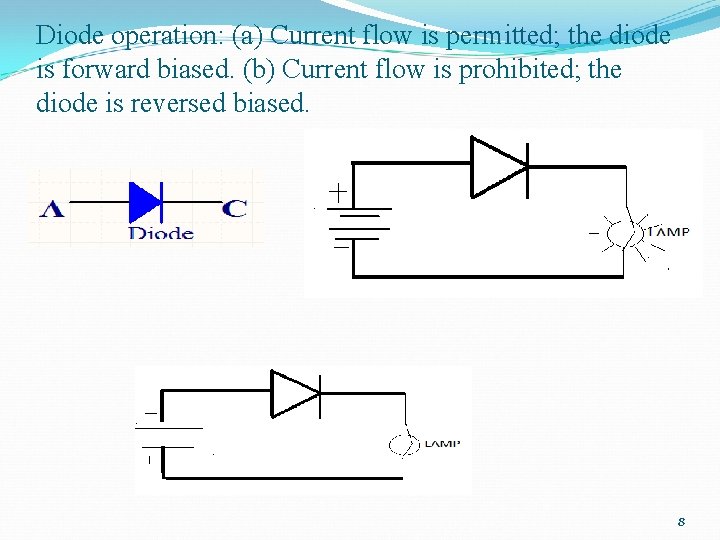
Diode operation: (a) Current flow is permitted; the diode is forward biased. (b) Current flow is prohibited; the diode is reversed biased. 8
9
10
DIODES When the polarity of the battery is such that electrons are allowed to flow through the diode, the diode is said to be forward –biased. Conversely, when the battery is “backward” and the diode blocks current, the diode is said to be reversed-biased. A diode may be thought of as like a switch: “Closed” when forward –biased and “open” when reversed –biased. A forward-biased diode conducts current and drops a small voltage across it, leaving most of the battery voltage dropped across the lamp. If the battery’s polarity is reversed, the diode becomes reverse-biased, and drops all of the battery’s voltage leaving none for the lamp. If we consider the diode to be a self-actuating switch (closed in the forward-bias mode and open in the reverse-bias mode), this behavior makes sense. 11
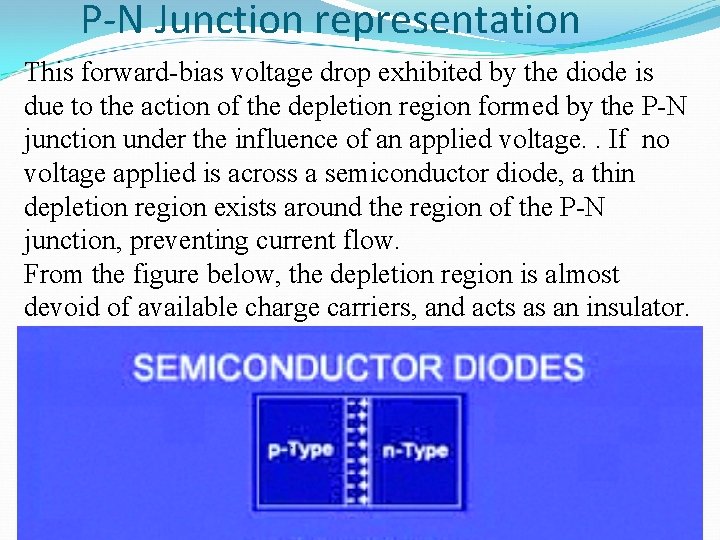
P-N Junction representation This forward-bias voltage drop exhibited by the diode is due to the action of the depletion region formed by the P-N junction under the influence of an applied voltage. . If no voltage applied is across a semiconductor diode, a thin depletion region exists around the region of the P-N junction, preventing current flow. From the figure below, the depletion region is almost devoid of available charge carriers, and acts as an insulator. 12
FORWARD AND REVERSED BIASED 13
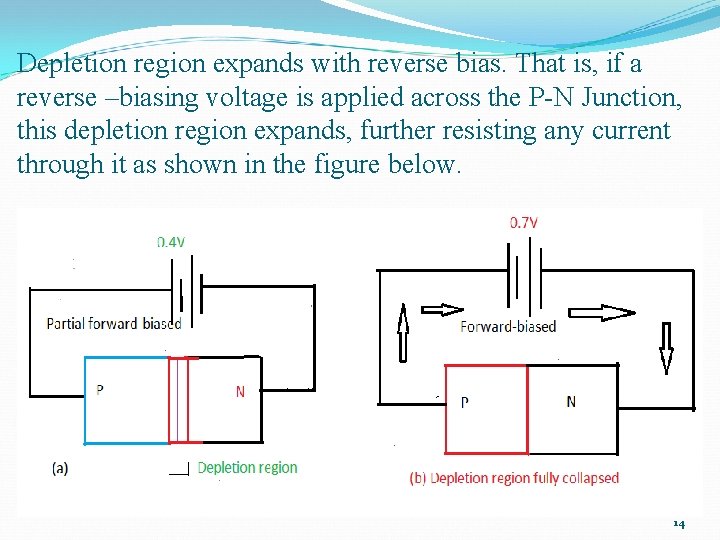
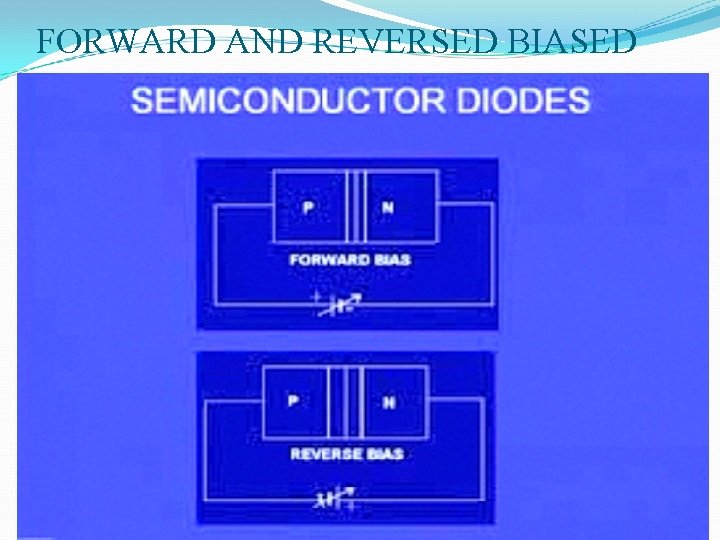
Depletion region expands with reverse bias. That is, if a reverse –biasing voltage is applied across the P-N Junction, this depletion region expands, further resisting any current through it as shown in the figure below. 14
FORWARD BIASED Conversely, if a forward-biasing voltage is applied across the P-N junction, the depletion region collapses becoming thinner. The diode becomes less resistive to current through it. In order for a sustained current to go through the diode; though, the depletion region must be fully collapsed by the applied voltage. This takes a certain minimum voltage to accomplish, called the “ forward voltage” as illustrated in figure For silicon diodes, the typical forward voltage is 0. 7 volts, nominal. For germanium diodes, the forward voltage is only 0. 3 volts. The chemical constituency of the P-N junction comprising the diode accounts for its nominal forward voltage figure, which is why silicon and germanium diodes have such different forward voltages. 15
CHARACTERISTIC OF A SILICON DIODE A reverse- biased diode prevents current from going through it, due to the expanded depletion region. In actuality, a very small amount of current can and does go through a reverse- biased diode, called the “leakage current” , but it can be ignored for most purposes. The ability of a diode to withstand reversed –bias voltage is limited, as it is for any insulator. If the applied reversedbias voltage becomes too great, the diode will experience a condition known as breakdown, which is usually destructive. A diode’s maximum reverse-bias voltage rating is known as the Peak Inverse Voltage, or PIV, and may be obtained from the manufacturer, except that PIV increases with increased temperature and decreases as the diode becomes cooler- exactly opposite that of forward voltage. 16
CHARACTERISTICS OF DIODES 17
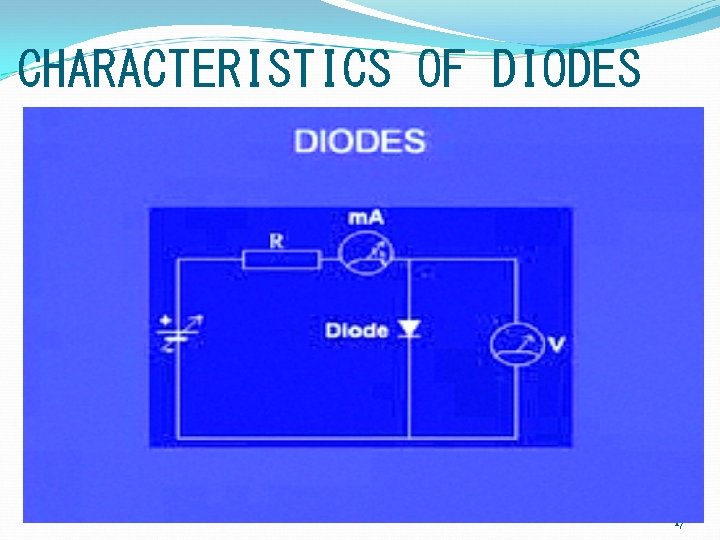
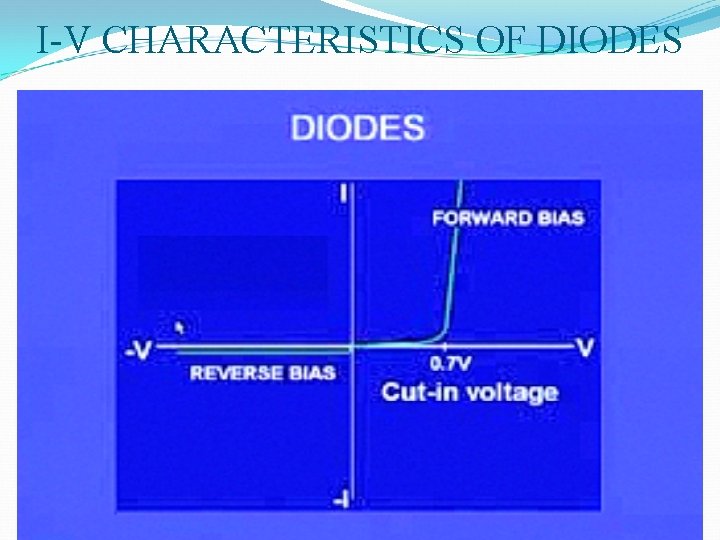
DIODE To measured the current and voltage flowing through the diode. If you keep varying the voltage, what happens to the current with reference to voltage? This is called “I-V Characteristics of diode. From the diagram, when you increase the voltage on the positive side, you find the current very slow at the beginning and at a point 0. 7 V the current starts increasing. So, this point [0. 7 v] which is the characteristics of silicon is called the “cut-in-voltage”. Beyond this cut-in-voltage, the current will be very large. Note, below it the current will be very small. That is the characteristics of the forward biased type. However, when you reverse the voltage polarity and apply negative voltage, you find that the current is very small. i. e. Reverse biased. 18
I-V CHARACTERISTICS OF DIODES 19
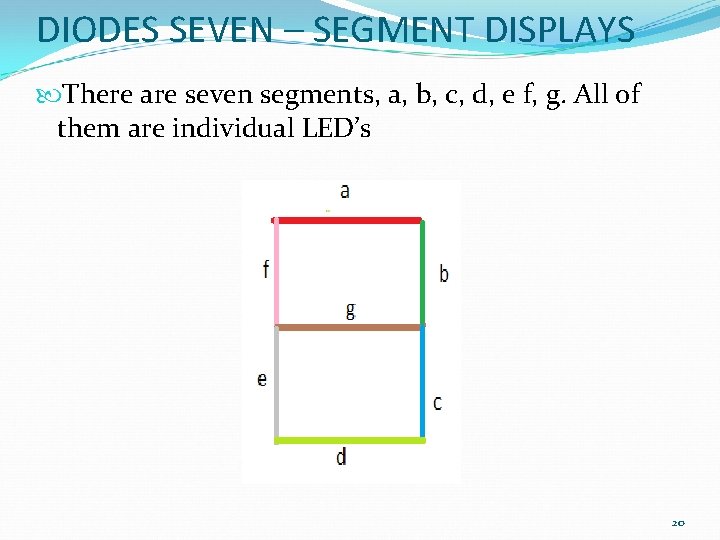
DIODES SEVEN – SEGMENT DISPLAYS There are seven segments, a, b, c, d, e f, g. All of them are individual LED’s 20
- Slides: 20