
Basic Electric Circuits Components Chapter 2 Introduction SI
Basic Electric Circuits & Components Chapter 2 § Introduction § SI Units and Common Prefixes § Electrical Circuits § Direct Currents and Alternating Currents § Resistors, Capacitors and Inductors § Ohm’s and Kirchhoff’s Laws § Power Dissipation in Resistors § Resistors in Series and Parallel § Resistive Potential Dividers § Sinusoidal Quantities § Circuit Symbols Storey: Electrical & Electronic Systems © Pearson Education Limited 2004 OHT 2. 1
Introduction 2. 1 § This lecture outlines the basics of Electrical Circuits § For most students much of this will be familiar – this lecture can be seen as a revision session for this material § If there any topics that you are unsure of (or that are new to you) you should get to grips with this material before the next lecture – the following lectures will assume a basic understanding of these topics § We will return to look at several of these topics in more detail in later lectures Storey: Electrical & Electronic Systems © Pearson Education Limited 2004 OHT 2. 2

SI Units 2. 2 Quantity Capacitance Charge Current Electromotive force Frequency Inductance (self) Period Potential difference Power Resistance Temperature Time Quantity symbol C Q I E f L T V P R T t Unit Farad Coulomb Ampere Volt Hertz Henry Second Volt Watt Ohm Kelvin Second Unit symbol F C A V Hz H s V W Ω K s Storey: Electrical & Electronic Systems © Pearson Education Limited 2004 OHT 2. 3
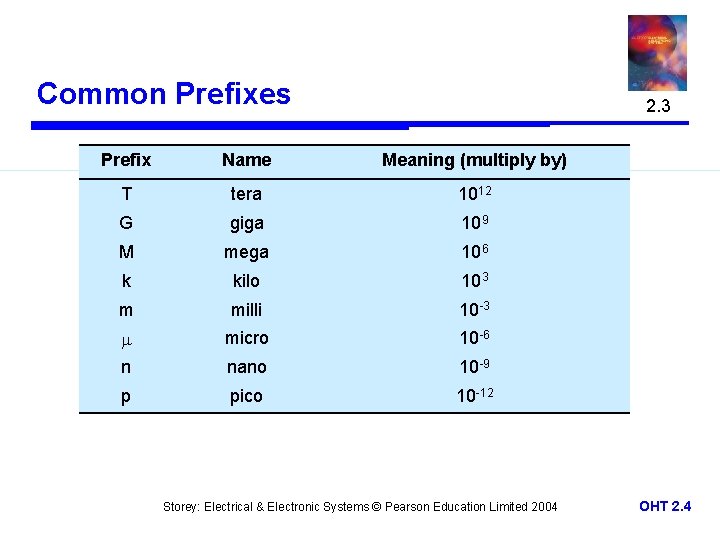
Common Prefixes 2. 3 Prefix Name Meaning (multiply by) T tera 1012 G giga 109 M mega 106 k kilo 103 m milli 10 -3 micro 10 -6 n nano 10 -9 p pico 10 -12 Storey: Electrical & Electronic Systems © Pearson Education Limited 2004 OHT 2. 4
Electrical Circuits 2. 4 § Electric charge – an amount of electrical energy – can be positive or negative § Electric current – a flow of electrical charge, often a flow of electrons – conventional current is in the opposite direction to a flow of electrons § Current flow in a circuit – a sustained current needs a complete circuit – also requires a stimulus to cause the charge to flow Storey: Electrical & Electronic Systems © Pearson Education Limited 2004 OHT 2. 5
§ Electromotive force and potential difference – the stimulus that causes a current to flow is an e. m. f. – this represents the energy introduced into the circuit by a battery or generator – this results in an electric potential at each point in the circuit – between any two points in the circuit there may exist a potential difference – both e. m. f. and potential difference are measured in volts Storey: Electrical & Electronic Systems © Pearson Education Limited 2004 OHT 2. 6
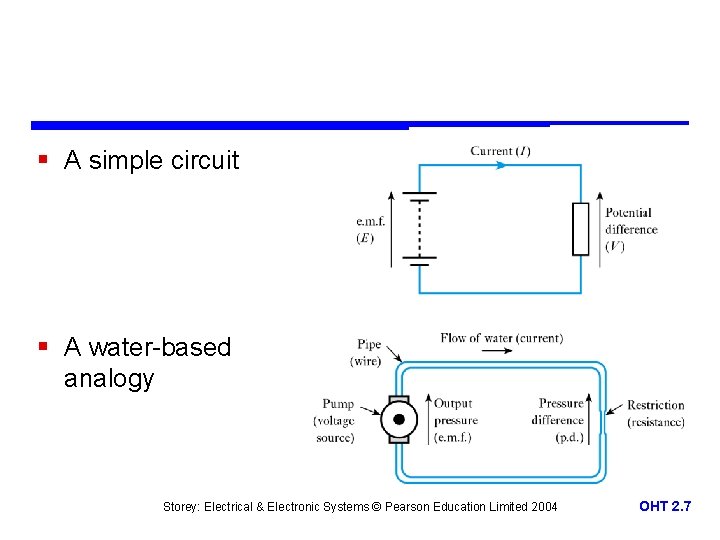
§ A simple circuit § A water-based analogy Storey: Electrical & Electronic Systems © Pearson Education Limited 2004 OHT 2. 7

§ Voltage reference points – all potentials within a circuit must be measured with respect to some other point – we often measure voltages with respect to a zero volt reference called the ground or earth Storey: Electrical & Electronic Systems © Pearson Education Limited 2004 OHT 2. 8
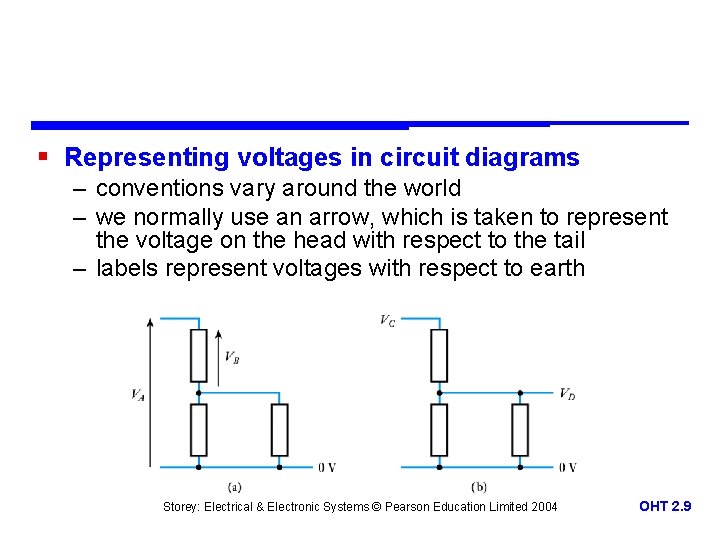
§ Representing voltages in circuit diagrams – conventions vary around the world – we normally use an arrow, which is taken to represent the voltage on the head with respect to the tail – labels represent voltages with respect to earth Storey: Electrical & Electronic Systems © Pearson Education Limited 2004 OHT 2. 9
Direct Current and Alternating Current 2. 5 § Currents in electrical circuits may be constant or may vary with time § When currents vary with time they may be unidirectional or alternating § When the current flowing in a conductor always flows in the same direction this is direct current (DC) § When the direction of the current periodically changes this is alternating current (AC) Storey: Electrical & Electronic Systems © Pearson Education Limited 2004 OHT 2. 10
Resistors, Capacitors and Inductors 2. 6 § Resistors provide resistance – they oppose the flow of electricity – measured in Ohms ( ) § Capacitors provide capacitance – they store energy in an electric field – measured in Farads (F) § Inductors provide inductance – they store energy in a magnetic field – measured in Henry (H) § We will look at each component in later lectures Storey: Electrical & Electronic Systems © Pearson Education Limited 2004 OHT 2. 11
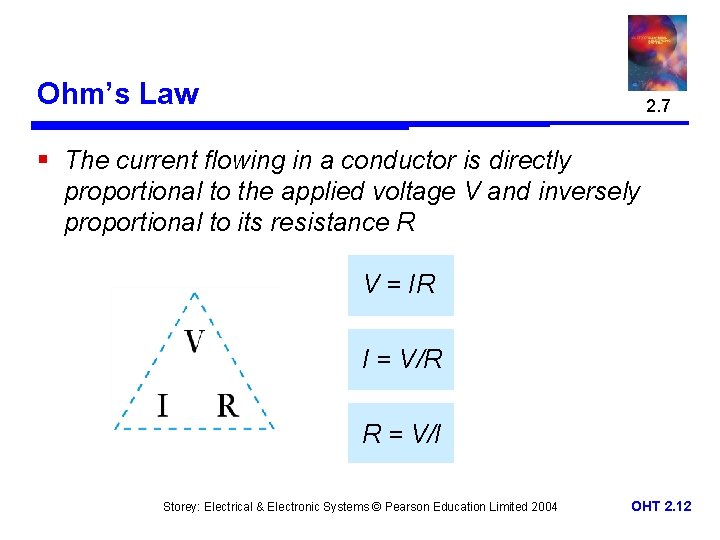
Ohm’s Law 2. 7 § The current flowing in a conductor is directly proportional to the applied voltage V and inversely proportional to its resistance R V = IR I = V/R R = V/I Storey: Electrical & Electronic Systems © Pearson Education Limited 2004 OHT 2. 12
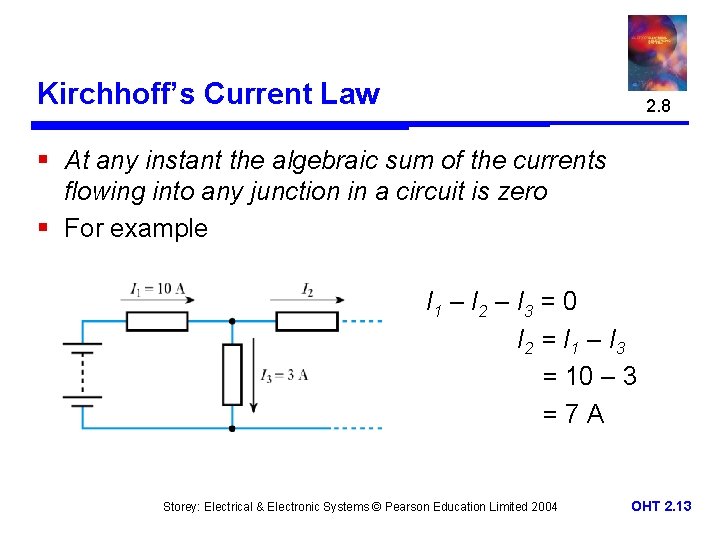
Kirchhoff’s Current Law 2. 8 § At any instant the algebraic sum of the currents flowing into any junction in a circuit is zero § For example I 1 – I 2 – I 3 = 0 I 2 = I 1 – I 3 = 10 – 3 =7 A Storey: Electrical & Electronic Systems © Pearson Education Limited 2004 OHT 2. 13
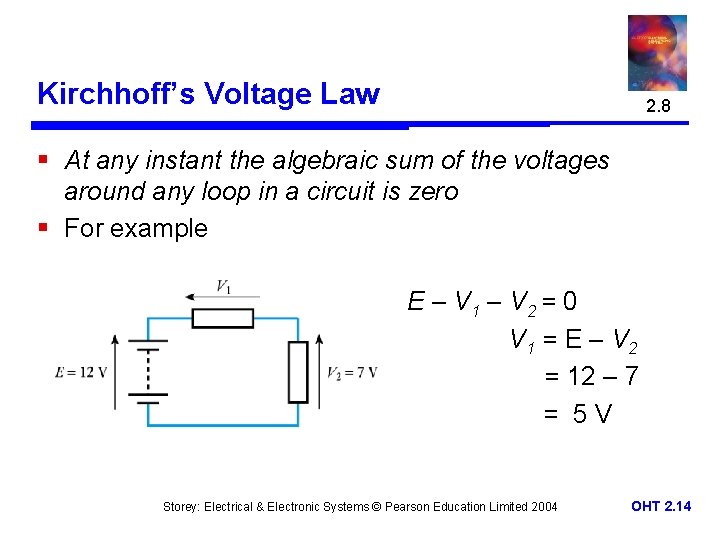
Kirchhoff’s Voltage Law 2. 8 § At any instant the algebraic sum of the voltages around any loop in a circuit is zero § For example E – V 1 – V 2 = 0 V 1 = E – V 2 = 12 – 7 = 5 V Storey: Electrical & Electronic Systems © Pearson Education Limited 2004 OHT 2. 14
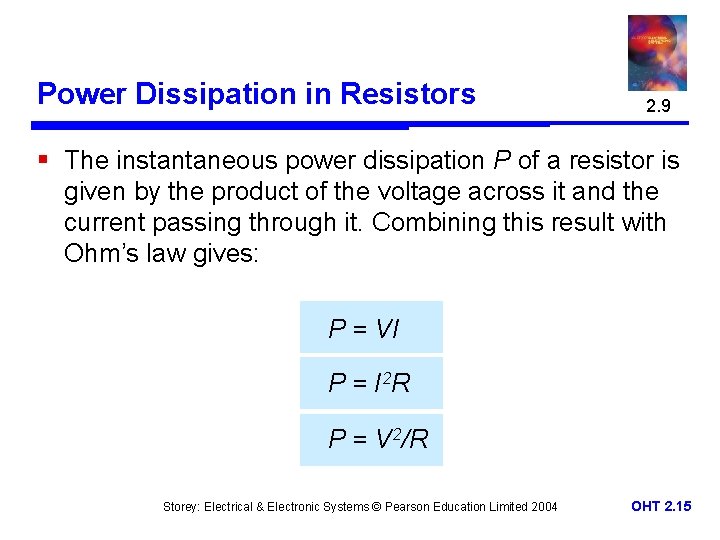
Power Dissipation in Resistors 2. 9 § The instantaneous power dissipation P of a resistor is given by the product of the voltage across it and the current passing through it. Combining this result with Ohm’s law gives: P = VI P = I 2 R P = V 2/R Storey: Electrical & Electronic Systems © Pearson Education Limited 2004 OHT 2. 15
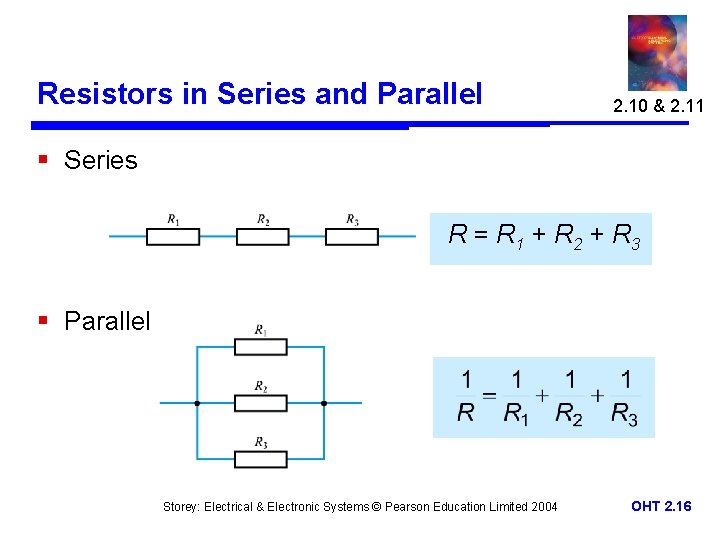
Resistors in Series and Parallel 2. 10 & 2. 11 § Series R = R 1 + R 2 + R 3 § Parallel Storey: Electrical & Electronic Systems © Pearson Education Limited 2004 OHT 2. 16
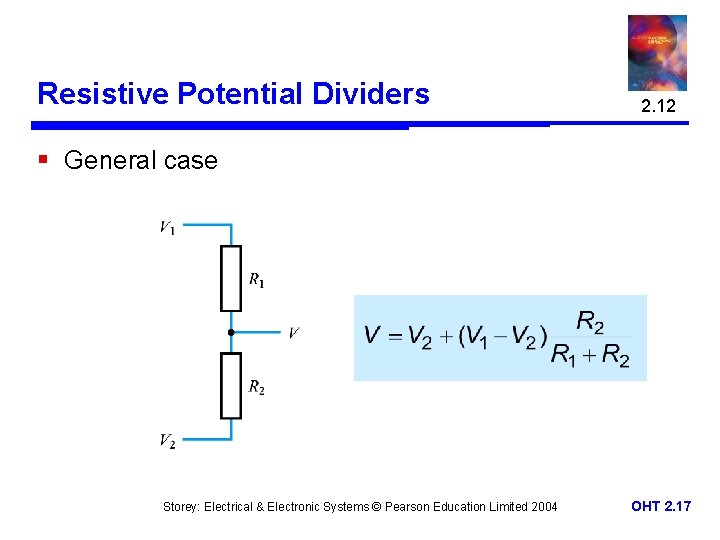
Resistive Potential Dividers 2. 12 § General case Storey: Electrical & Electronic Systems © Pearson Education Limited 2004 OHT 2. 17
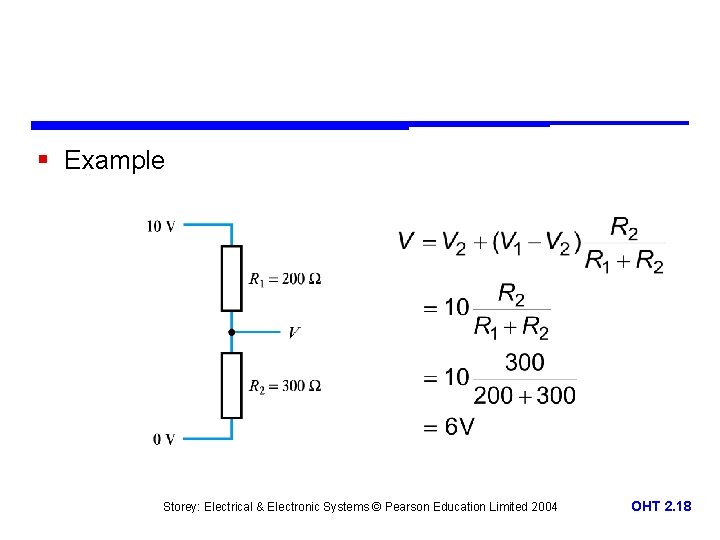
§ Example Storey: Electrical & Electronic Systems © Pearson Education Limited 2004 OHT 2. 18
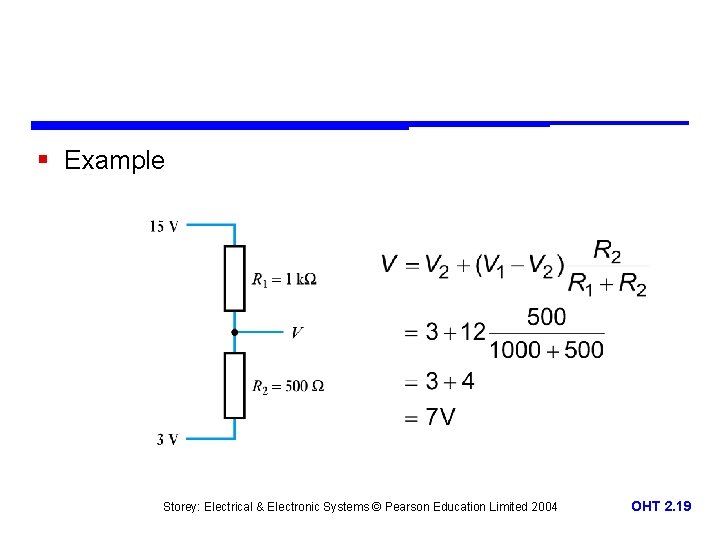
§ Example Storey: Electrical & Electronic Systems © Pearson Education Limited 2004 OHT 2. 19
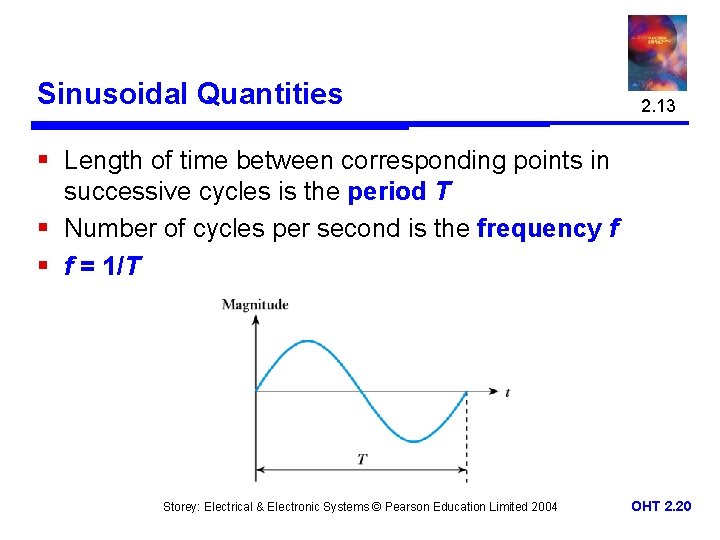
Sinusoidal Quantities 2. 13 § Length of time between corresponding points in successive cycles is the period T § Number of cycles per second is the frequency f § f = 1/T Storey: Electrical & Electronic Systems © Pearson Education Limited 2004 OHT 2. 20
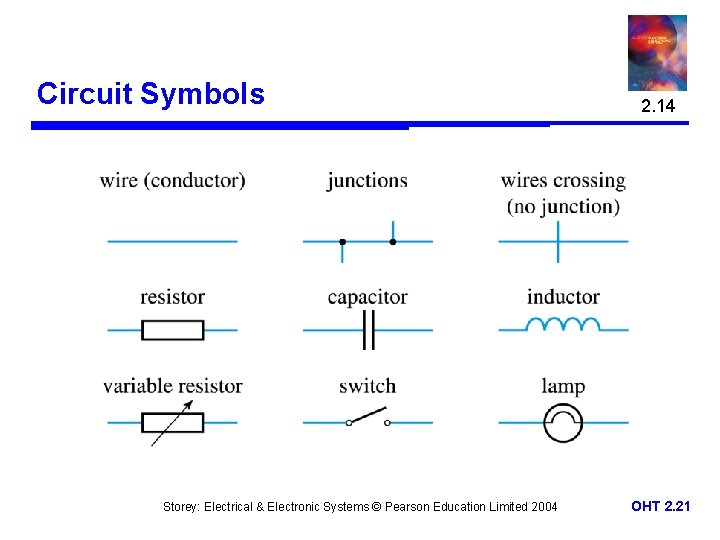
Circuit Symbols Storey: Electrical & Electronic Systems © Pearson Education Limited 2004 2. 14 OHT 2. 21
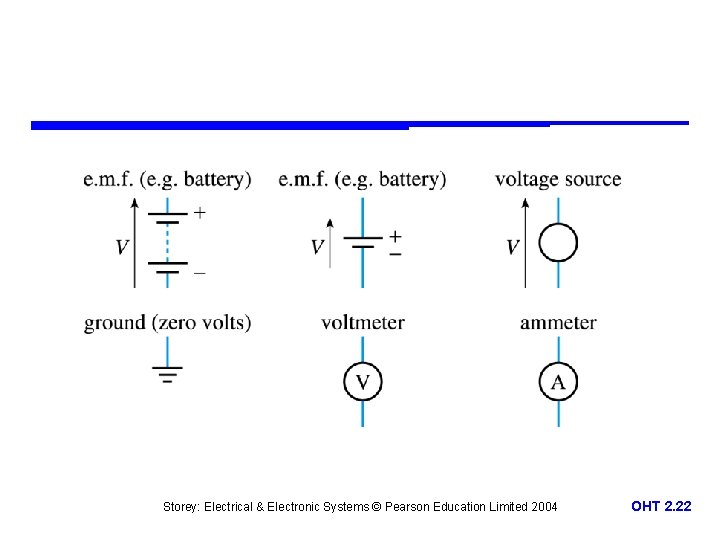
Storey: Electrical & Electronic Systems © Pearson Education Limited 2004 OHT 2. 22
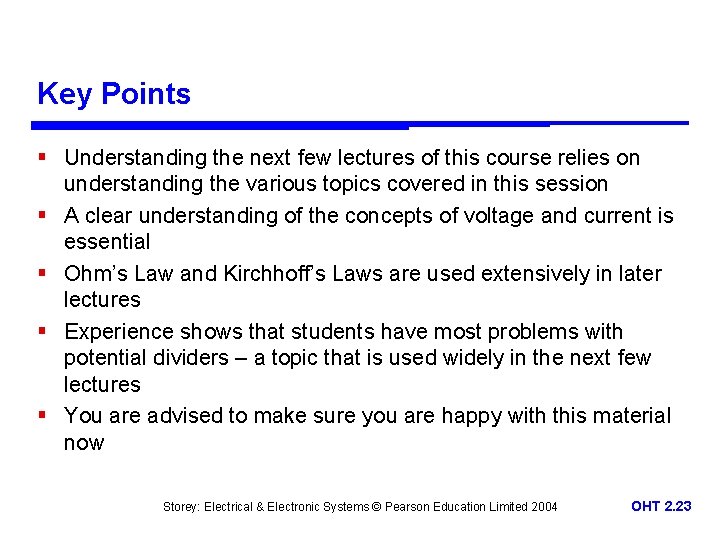
Key Points § Understanding the next few lectures of this course relies on understanding the various topics covered in this session § A clear understanding of the concepts of voltage and current is essential § Ohm’s Law and Kirchhoff’s Laws are used extensively in later lectures § Experience shows that students have most problems with potential dividers – a topic that is used widely in the next few lectures § You are advised to make sure you are happy with this material now Storey: Electrical & Electronic Systems © Pearson Education Limited 2004 OHT 2. 23
- Slides: 23