
BASIC ECONOMIC CONCEPTS 1 What are economic products
BASIC ECONOMIC CONCEPTS
1 -What are economic products? • Goods and services that are useful, relatively scarce and transferable to others. • They help us satisfy our wants and needs. Why do they command a price? • Because they are both scarce and useful, they command a price.
2 -What is a good? What is the difference between a durable good and a nondurable good? Provide examples for each. • Good- A useful, tangible item [book, car. . ]that satisfies a want. • Durable good- Any good that lasts three years or more when used on a regular basis. Capital goods: robot welders, bulldozers Consumer goods: cars, washing machines • Non-durable good- An item that lasts for fewer than three years when used on a regular basis: Food, paper, clothing
3 -What is a service? Provide examples. • Service- Work that is performed for someone • Examples. Haircuts, home repairs, concerts, doctors.
4 -What is a consumer? People who use goods and services to satisfy their wanta a needs
5 -Explain the “paradox of value” Contradiction between the high monetary value of a nonessential item [diamonds, ] and the low value of an essential item [water].
6 -What is utility? • The capacity to be useful and provide satisfaction What is required for something to have value? • The value varies from person to person
7 -What is wealth? The accumulation of products that are tangible, scarce, useful and transferable from one person to another. A nation’s wealth is comprised of: • Natural resources; • Factories; • Stores; • Houses; • Furniture; All tangible items that can be exchanged
8 -Define: market: A location that allows buyers and sellers to exchange a specific product
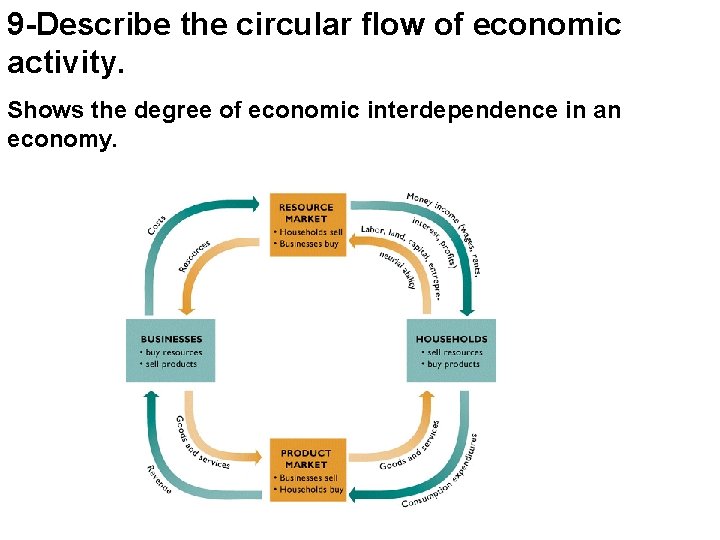
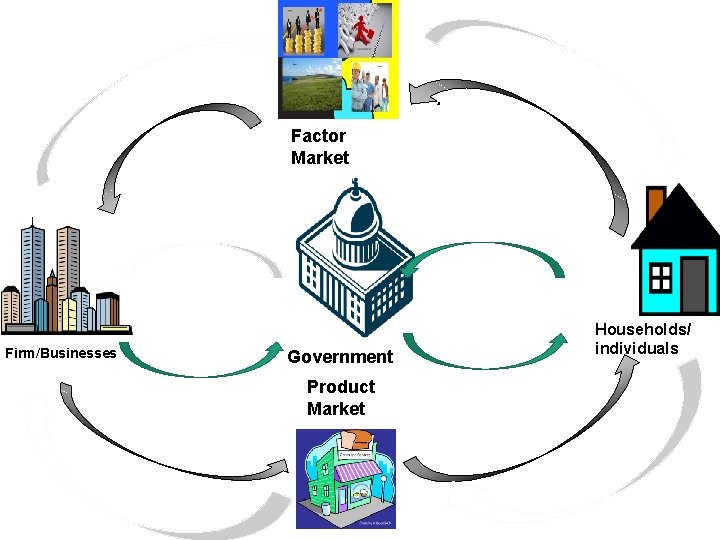
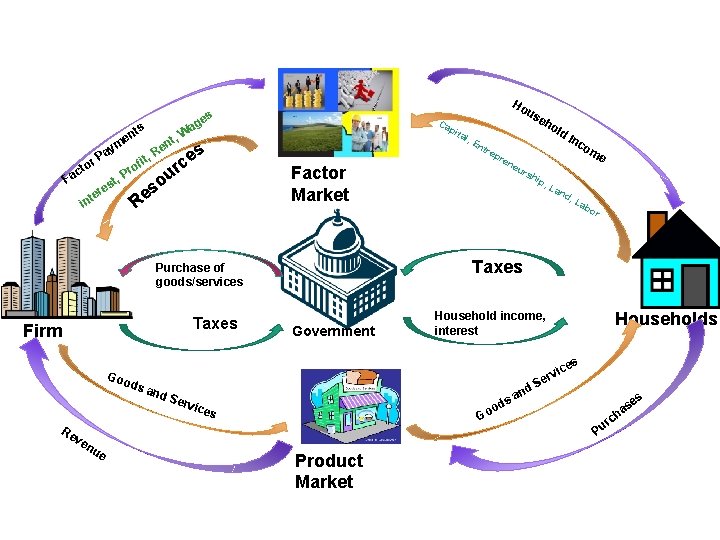
9 -Describe the circular flow of economic activity. Shows the degree of economic interdependence in an economy.
Households/individuals possess 4 scarce resources /factors of production: 1 -LAND: grow crops, minerals, catch fish, log forests. Owned by private individuals or households through the private sector. 2 -LABOR: work in the production of goods and services They live at home and go to work. 3 -CAPITAL: technology used to produce goods: computers, factory equipment, tractors for farmers. Provided through our savings of money. 4 -Entrepreneurs: start business/firms and also live at home/risk- takers

10 -What is a factor market? Provide examples People earn their incomes in factor markets, where the factors of production are bought and sold. This is where entrepreneurs hire labor for wages/salaries’ acquire land in return for rent and borrow money. People sell their resources there: land, capital, labor
11 -What is a product market? Provide examples. People spend the income from the resources they sell in the factor market to the product market. Producers sell their goods and services and wages and salaries that individuals receive from businesses in the factor market returns to businesses in the product market. Businesses then use this money to produce more goods and services and try to earn a profit.
![HOUSEHOLDS earn income in the form of: • Wages [labor] • Rent [land] •](http://slidetodoc.com/presentation_image_h2/c03895c0e7bde3097412cd7241eafe1a/image-14.jpg "HOUSEHOLDS earn income in the form of: • Wages [labor] • Rent [land] •")
HOUSEHOLDS earn income in the form of: • Wages [labor] • Rent [land] • Interest [capital] • Profits [Entrepreneurs who live in households and start businesses]. With incomes, households acquire the goods and services they demand in the Product Market.
The Circular Flow Model Draw the model Watch the video on the circular flow and add information to your model
, Factor Market Firm/Businesses Government Product Market Households/ individuals

https: //www. youtube. com/watch? v=2 w. M 0 j. HL 6 TQs
es Ca ag W , ts en pit nt m ay Re P es t, i r f c o o r r ct u , P Fa t es so er e t in R Factor Market Firm Goo ds a Re ve nu e nd al, se ho ld En tre pre ne u rsh ip, La Inc om nd , L e ab o r Taxes Purchase of goods/services Taxes Ho u Government nd sa Ser vice s d oo G Product Market Households Household income, interest s ce i v er S es r Pu c s ha
The Circular Flow Model Draw good copy of your model. On the back of your model. write a story that explains how money and resources and goods flow around the market economy. Your story should be about any product of your choosing
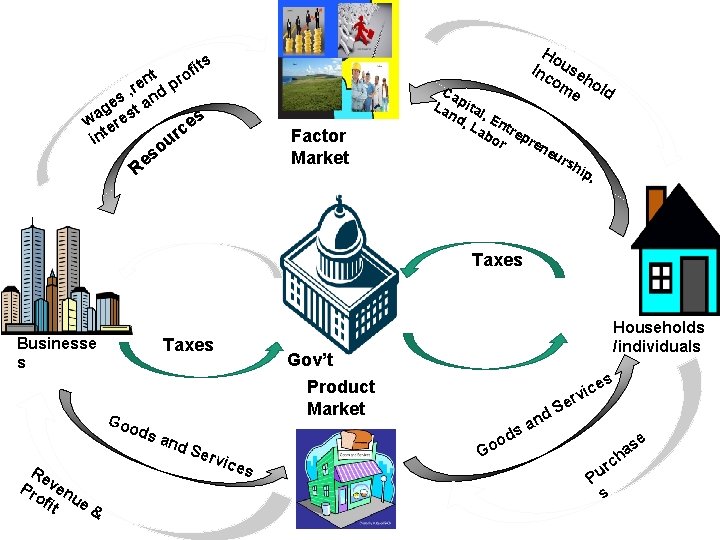
Ho Inc use om hol d e its f t n pro e r s , and e g t s wa eres e c t in ur Factor Market so Re Ca La pital nd , E , L nt ab rep or ren eu rsh ip, Taxes Businesse s Taxes Goo ds a Re Pr ven of ue it & nd Ser Households /individuals Gov’t Product Market s vice s od s Go a Se d n ce i v r se a h rc Pu s
It’s all about selling! Households: sell resources in the Resource Market Businesses: sell goods and services in the Product Market Businesses =suppliers/sell Households=demanders/buy goods and services in the Product Market
Households exchange these resources in the Factor/Resource Market Resources flow from households to Firms [businesses] in Factor/Resource Market Firms buy resources/Households sell resources in the Factor/Resource Market
Goals of Businesses and Households in the Marketplace BUSINESSES: maximize profits They must sell goods and services for more than they spend on resources [profit]. Their revenues must be greater than their cost. HOUSEHOLDS: It’s not about the money, which is just a medium of exchange. It is to maximize utility or “happiness. ” “Happiness” is achieved through consumption of goods and services. The market is where buyers and sellers meet to engage in a mutually beneficial exchange.
Goals: Households wish to improve their standard of living, so their goal is to earn a high enough income to enjoy a level of consumption of goods and services that improves their family’s standard of living. Firms: Profit
![HOUSEHOLDS • 15 mixed resource cards [Productive Resource Cards] [Human Resources/Capital/Natural Resources] GOALS: 1](http://slidetodoc.com/presentation_image_h2/c03895c0e7bde3097412cd7241eafe1a/image-25.jpg "HOUSEHOLDS • 15 mixed resource cards [Productive Resource Cards] [Human Resources/Capital/Natural Resources] GOALS: 1")
HOUSEHOLDS • 15 mixed resource cards [Productive Resource Cards] [Human Resources/Capital/Natural Resources] GOALS: 1 -Sell resources for as much money as you can negotiate. [Maximize the price for your resources] 2 -Buy ECONOS for a little money [Minimize what you pay for them] Your success will be the number of ECONOS you accumulate BUSINESSES [FIRMS] • 10 $100. Bills [$1, 000] • Business Badge Goals: Buy resources from households and minimize what you pay for them *Sell ECONOS and maximize your profit To produce 1 ECONO you must acquire one unit of: Human Resources/Natural Resources/ Capital Goods from households at the best price you can negotiate. Need all 3 for 1 ECONO. *Once you have accumulated one unit of each resource you can turn the set of 3 cards in at the ECONO FACTORY. The ECONO FACTORY will produce one ECONO for you *Then , sell the ECONO to any household for the best price you can negotiate.

12 -When does economic growth occur? When a nation’s total output of goods and services increases over time. The circular flow becomes larger with more factors of production, goods and services flowing in one direction and more payments in the opposite direction. Productivity is the most important factor contributing to economic growth
13 -Explain “Division of labor” and “Specialization. ” How do they both affect productivity? Division of labor: a way of organizing wealth so that each worker completes a separate part of the work. A worker who performs a few tasks many time a day is likely to be more proficient than one who specializes in many different tasks in the same period Specialization: When factors of production perform only tasks they can do better or more efficiently than others.
14 -Explain “economic interdependence” The mutual dependency of one person’s, firm’s, or region’s economic activities on another’s. We rely on others and others rely on us to provide most of the goods and services we consume. Events in one part of the world have a dramatic impact elsewhere.
- Slides: 29