
Basic Designing of Mechanical Vapor Compressor in MultiEffect
Basic Designing of Mechanical Vapor Compressor in Multi-Effect Distillation for Fresh Water Production Gyeongsang National University Hanshik Chung
CONTENTS § Background of Study § Introduction & Objective § Results and discussion § Conclusions
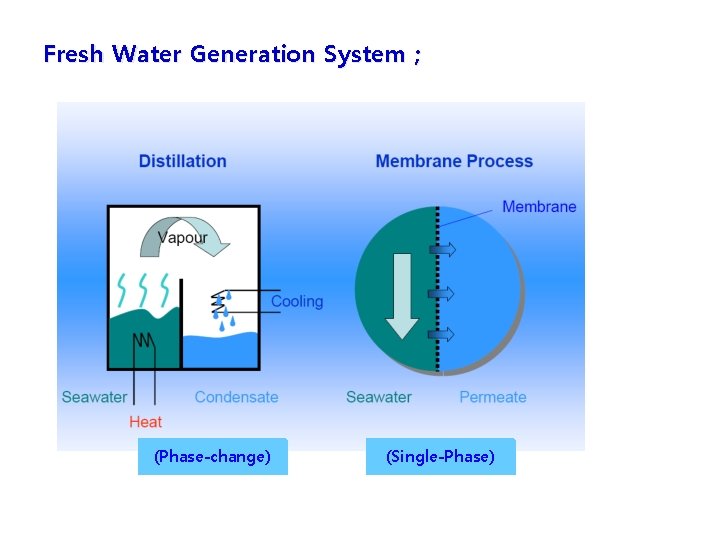
Fresh Water Generation System ; (Phase-change) (Single-Phase)

Why and What is MED ? • MSF ( Multi Stage Flash Desalination ) • MED ( Multi Effect Desalination ) (1) MED-TVC : MED by TVC (Thermo Vapor Compressor) (2) MED-MVC : MED by MVC (Mechanical Vapor Compressor)
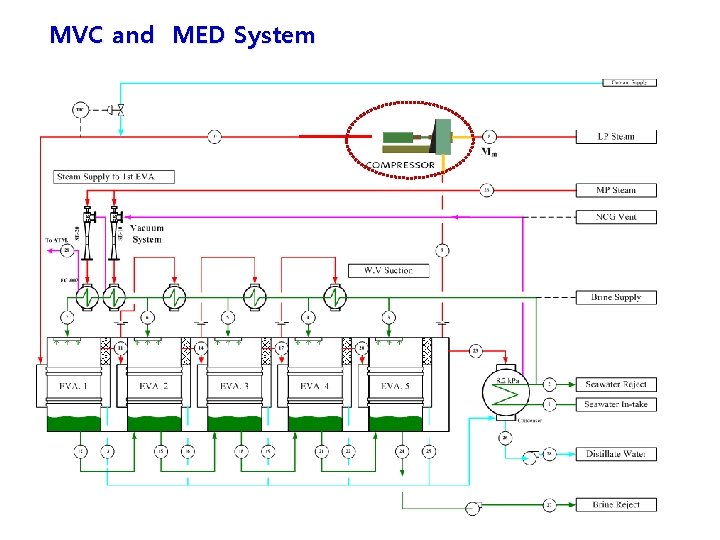
MVC and MED System
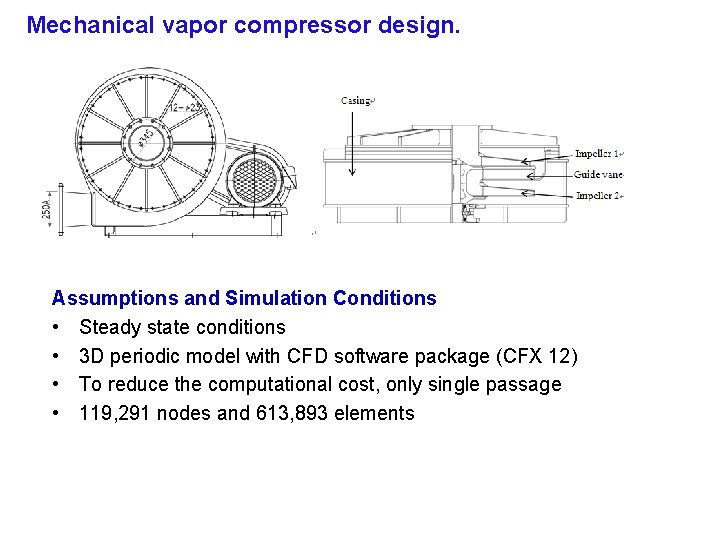
Mechanical vapor compressor design. Assumptions and Simulation Conditions • Steady state conditions • 3 D periodic model with CFD software package (CFX 12) • To reduce the computational cost, only single passage • 119, 291 nodes and 613, 893 elements
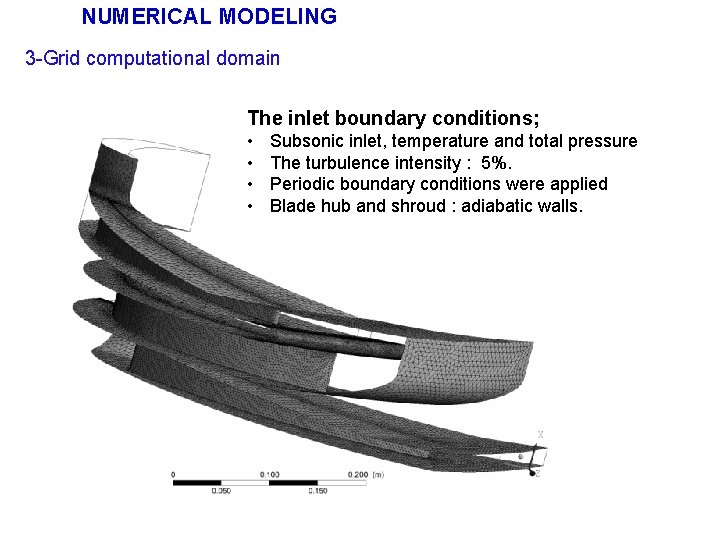
NUMERICAL MODELING 3 -Grid computational domain The inlet boundary conditions; • • Subsonic inlet, temperature and total pressure The turbulence intensity : 5%. Periodic boundary conditions were applied Blade hub and shroud : adiabatic walls.

Governing Equation • 3 -D Reynolds averaged compressible Navier-Stokes equations • SST k-ω turbulence model Mass and momentum conservation equations
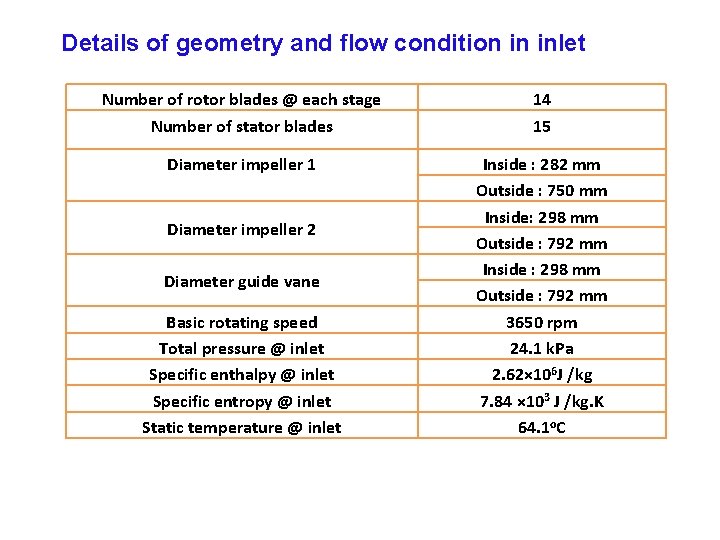
Details of geometry and flow condition in inlet Number of rotor blades @ each stage Number of stator blades 14 15 Diameter impeller 1 Inside : 282 mm Outside : 750 mm Inside: 298 mm Outside : 792 mm Inside : 298 mm Outside : 792 mm 3650 rpm 24. 1 k. Pa 2. 62× 106 J /kg 7. 84 × 103 J /kg. K 64. 1 o. C Diameter impeller 2 Diameter guide vane Basic rotating speed Total pressure @ inlet Specific enthalpy @ inlet Specific entropy @ inlet Static temperature @ inlet
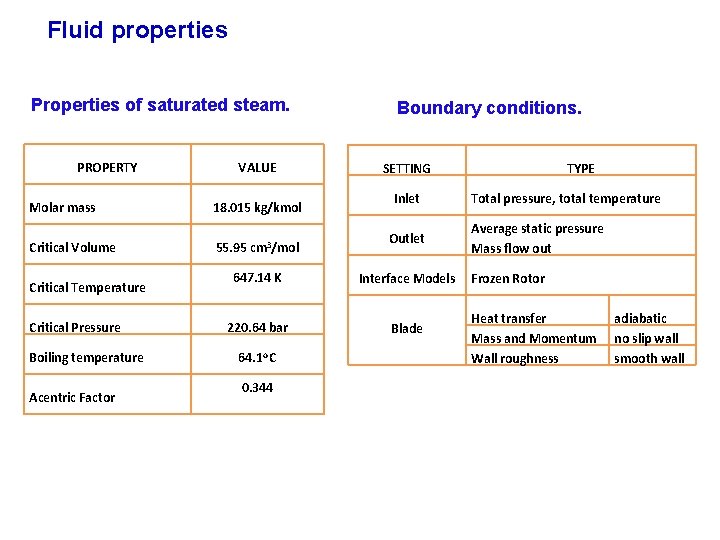
Fluid properties Properties of saturated steam. PROPERTY Molar mass Critical Volume Critical Temperature Critical Pressure Boiling temperature Acentric Factor VALUE 18. 015 kg/kmol 55. 95 cm 3/mol Boundary conditions. SETTING Inlet Outlet 647. 14 K Interface Models 220. 64 bar Blade 64. 1 o C 0. 344 TYPE Total pressure, total temperature Average static pressure Mass flow out Frozen Rotor Heat transfer Mass and Momentum Wall roughness adiabatic no slip wall smooth wall
RESULTS AND DISCUSSION Compressors performance map at various rotational speeds.
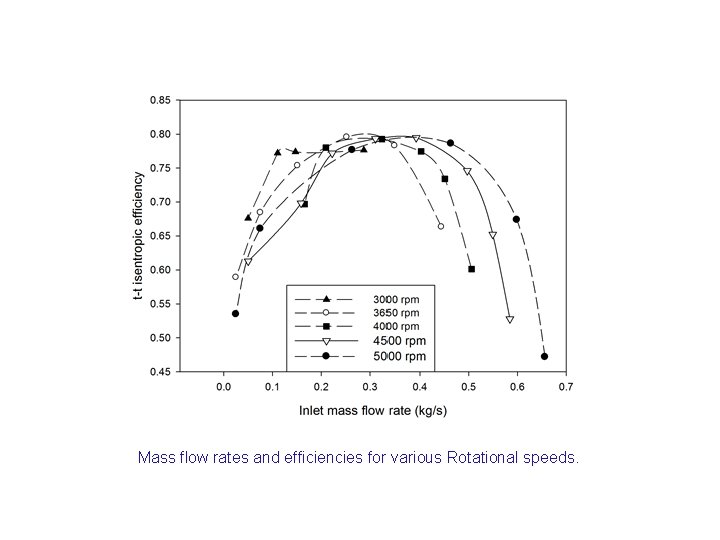
Mass flow rates and efficiencies for various Rotational speeds.
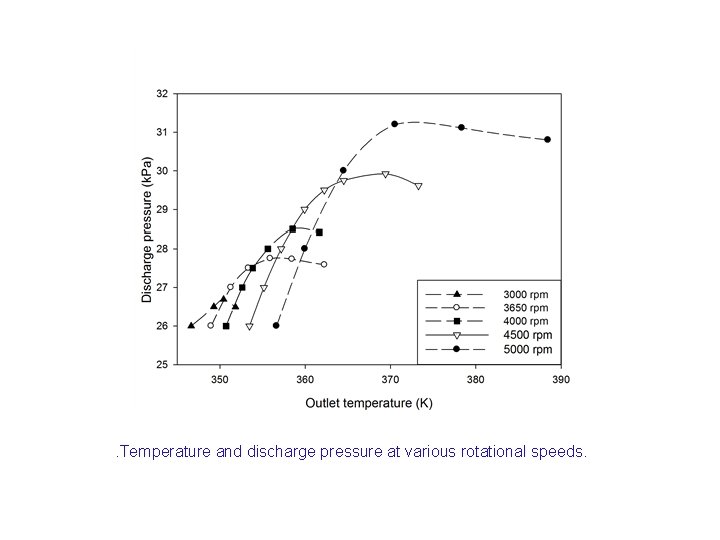
. Temperature and discharge pressure at various rotational speeds.
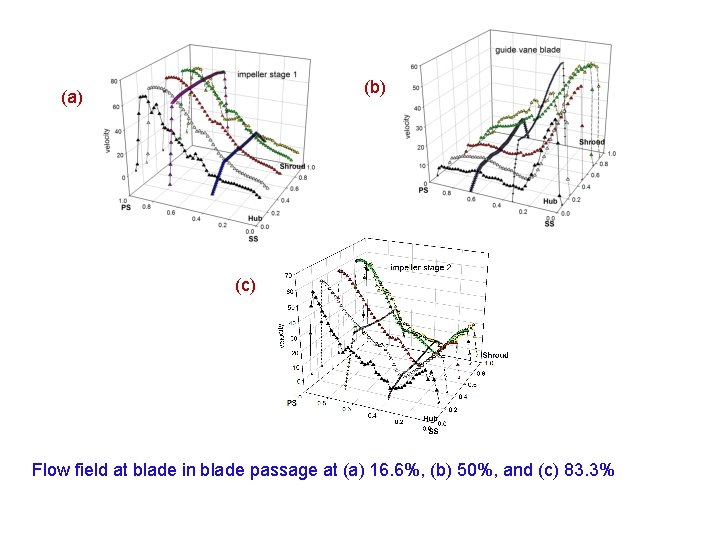
(b) (a) (c) Flow field at blade in blade passage at (a) 16. 6%, (b) 50%, and (c) 83. 3%
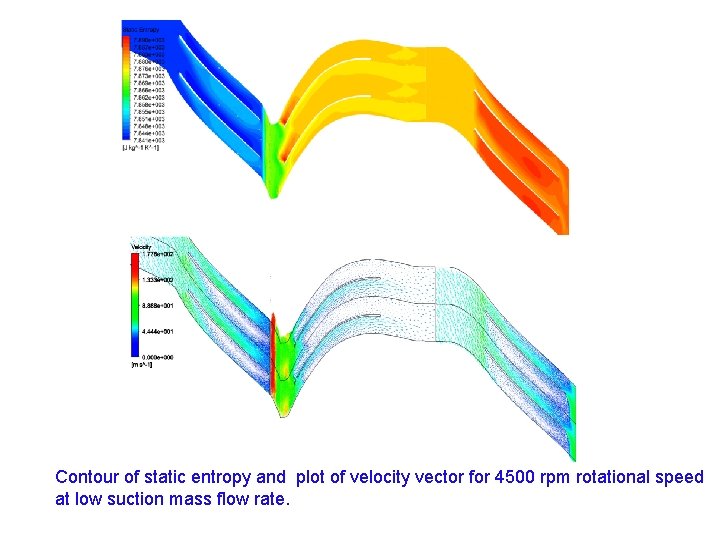
Contour of static entropy and plot of velocity vector for 4500 rpm rotational speed at low suction mass flow rate.
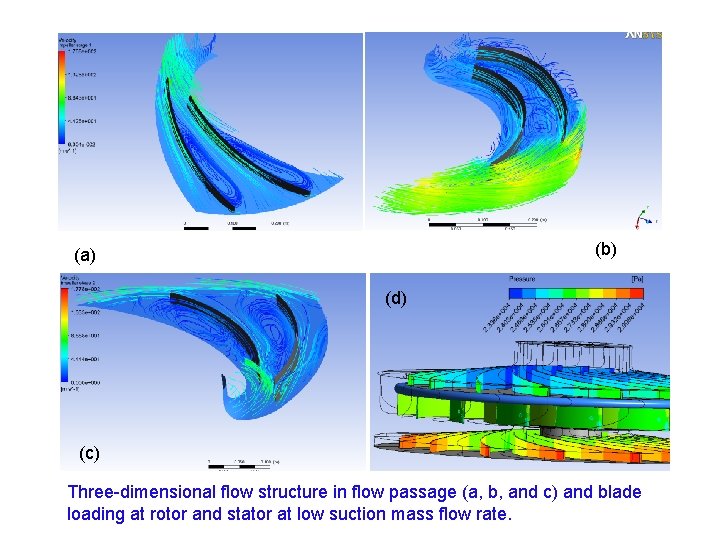
(b) (a) (d) (c) Three-dimensional flow structure in flow passage (a, b, and c) and blade loading at rotor and stator at low suction mass flow rate.
CONCLUSION • The effects of various operating conditions on the compressor performance have been investigated. At a high discharge pressure, the blockage effect was very dominant, restricting the flow rate. • A detailed flow analysis was performed in this simulation, along with an examination of secondary phenomena. • The results clearly show the flow characteristics inside the compressor under different operating conditions. • This simulation showed that the widest stable operating zone was located at a high rotational speed.

- Slides: 18