
Basic Definitions of Set Theory Lecture 23 Section
Basic Definitions of Set Theory Lecture 23 Section 5. 1 Wed, Mar 8, 2006
The Universal Set Whenever we use sets, there must be a universal set U which contains all elements under consideration. ¢ Typical examples are U = R and U = N. ¢ Without a universal set, taking complements of set is problematic. ¢
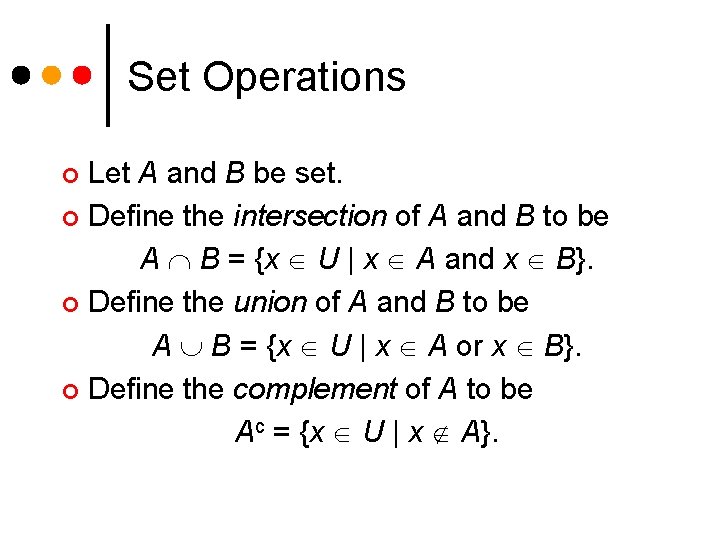
Set Operations Let A and B be set. ¢ Define the intersection of A and B to be A B = {x U | x A and x B}. ¢ Define the union of A and B to be A B = {x U | x A or x B}. ¢ Define the complement of A to be Ac = {x U | x A}. ¢
Set Operations ¢ Notice that the set operations of intersection, union, and complement correspond to the boolean operations of and, or, and not.

Set Differences Define the difference A minus B to be A – B = {x U | x A and x B}. ¢ Define the symmetric difference of A and B to be A B = (A – B) (B – A). ¢

Set Differences ¢ Do the operations of difference and symmetric difference correspond to boolean operations?
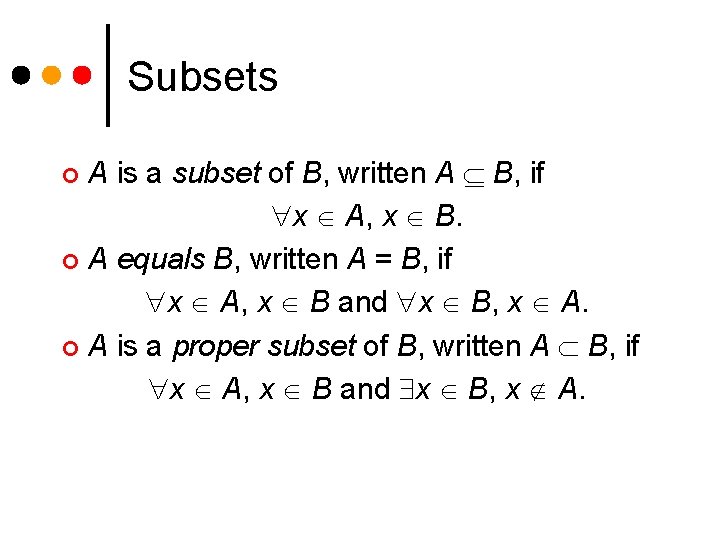
Subsets A is a subset of B, written A B, if x A, x B. ¢ A equals B, written A = B, if x A, x B and x B, x A. ¢ A is a proper subset of B, written A B, if x A, x B and x B, x A. ¢
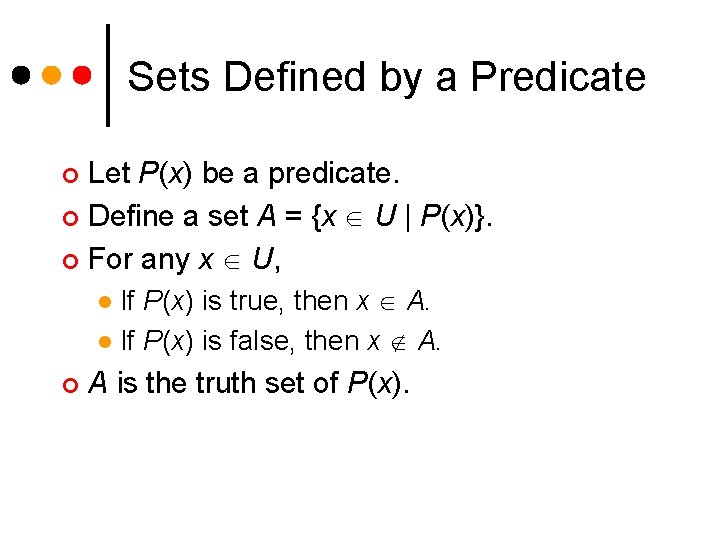
Sets Defined by a Predicate Let P(x) be a predicate. ¢ Define a set A = {x U | P(x)}. ¢ For any x U, ¢ If P(x) is true, then x A. l If P(x) is false, then x A. l ¢ A is the truth set of P(x).
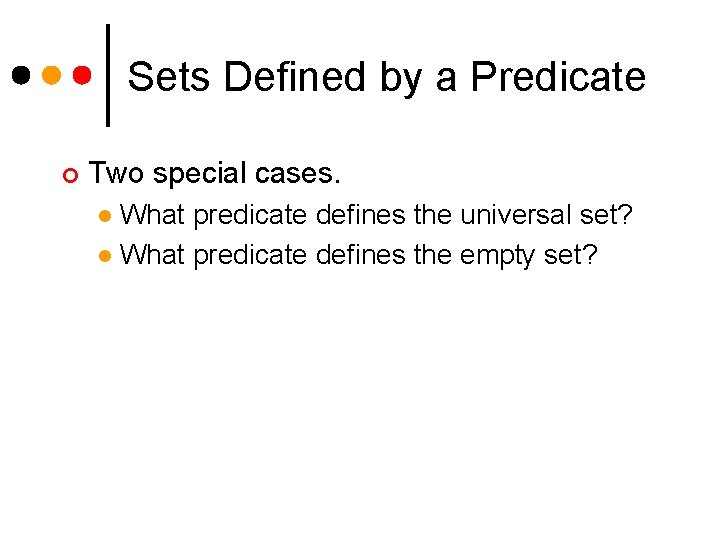
Sets Defined by a Predicate ¢ Two special cases. What predicate defines the universal set? l What predicate defines the empty set? l
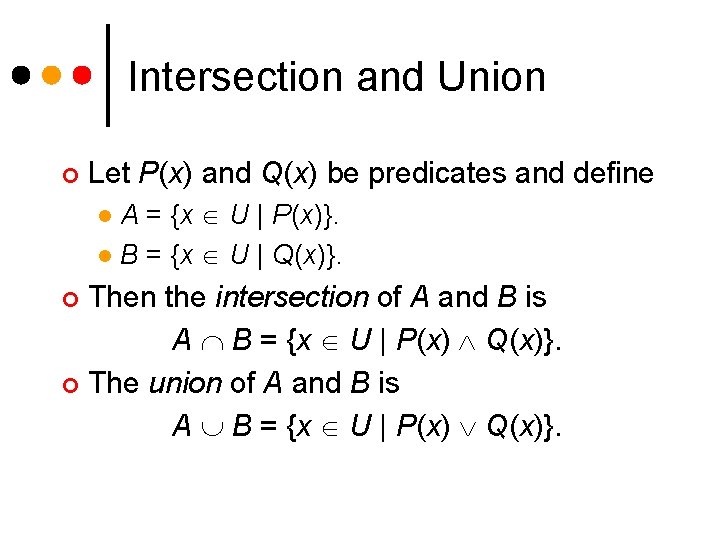
Intersection and Union ¢ Let P(x) and Q(x) be predicates and define A = {x U | P(x)}. l B = {x U | Q(x)}. l Then the intersection of A and B is A B = {x U | P(x) Q(x)}. ¢ The union of A and B is A B = {x U | P(x) Q(x)}. ¢
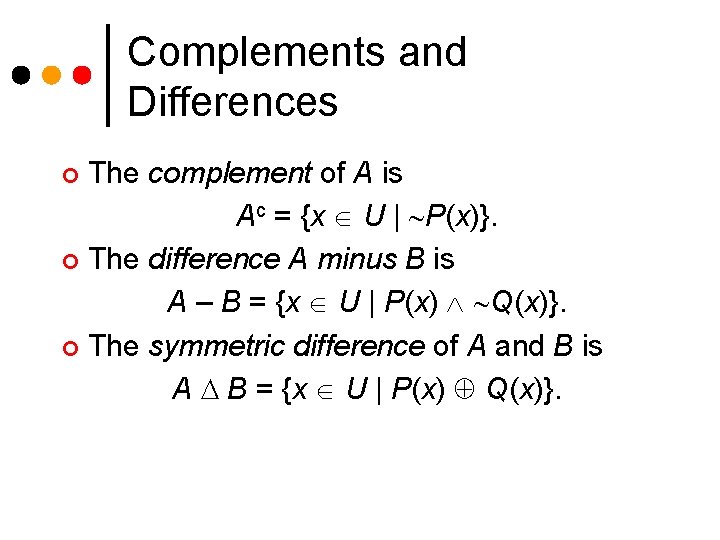
Complements and Differences The complement of A is Ac = {x U | P(x)}. ¢ The difference A minus B is A – B = {x U | P(x) Q(x)}. ¢ The symmetric difference of A and B is A B = {x U | P(x) Q(x)}. ¢
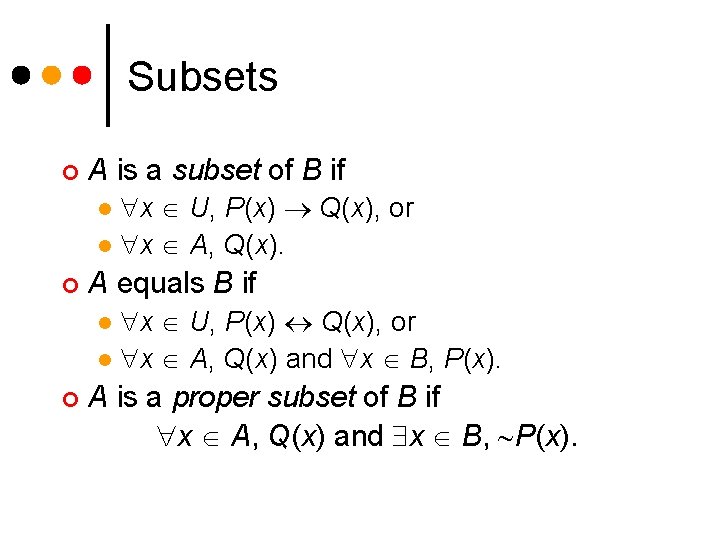
Subsets ¢ A is a subset of B if x U, P(x) Q(x), or l x A, Q(x). l ¢ A equals B if x U, P(x) Q(x), or l x A, Q(x) and x B, P(x). l ¢ A is a proper subset of B if x A, Q(x) and x B, P(x).
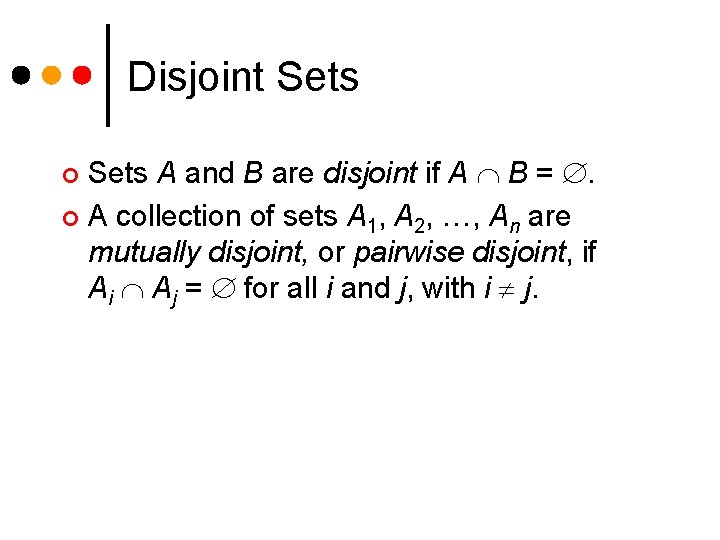
Disjoint Sets A and B are disjoint if A B = . ¢ A collection of sets A 1, A 2, …, An are mutually disjoint, or pairwise disjoint, if Ai Aj = for all i and j, with i j. ¢
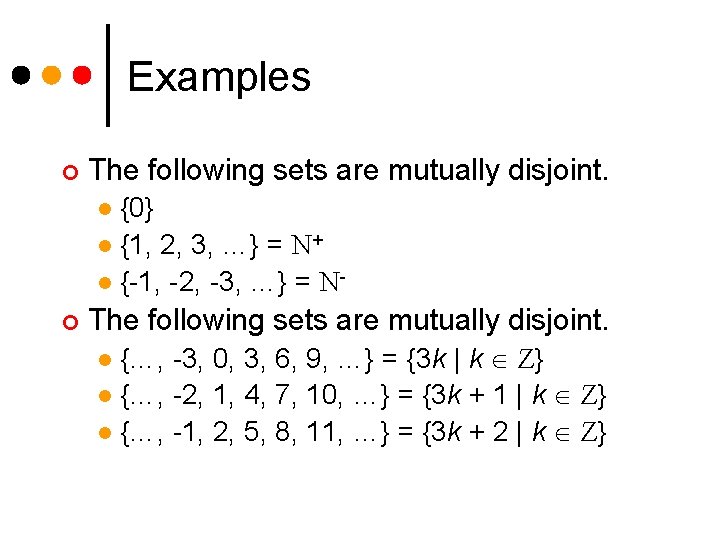
Examples ¢ The following sets are mutually disjoint. {0} l {1, 2, 3, …} = N+ l {-1, -2, -3, …} = Nl ¢ The following sets are mutually disjoint. {…, -3, 0, 3, 6, 9, …} = {3 k | k Z} l {…, -2, 1, 4, 7, 10, …} = {3 k + 1 | k Z} l {…, -1, 2, 5, 8, 11, …} = {3 k + 2 | k Z} l
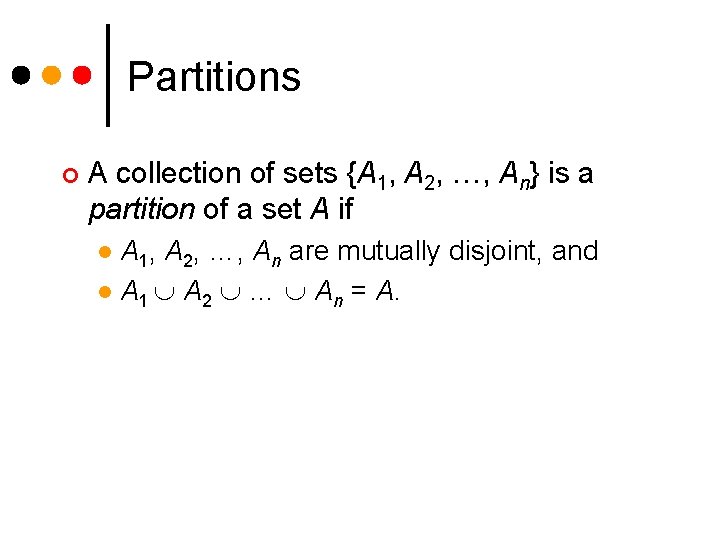
Partitions ¢ A collection of sets {A 1, A 2, …, An} is a partition of a set A if A 1, A 2, …, An are mutually disjoint, and l A 1 A 2 … An = A. l

Examples {{0}, {1, 2, 3, …}, {-1, -2, -3, …}} is a partition of Z. ¢ {{…, -3, 0, 3, 6, …}, {…, -2, 1, 4, 7, …}, {…, -1, 2, 5, 11, …}} is a partition of Z. ¢
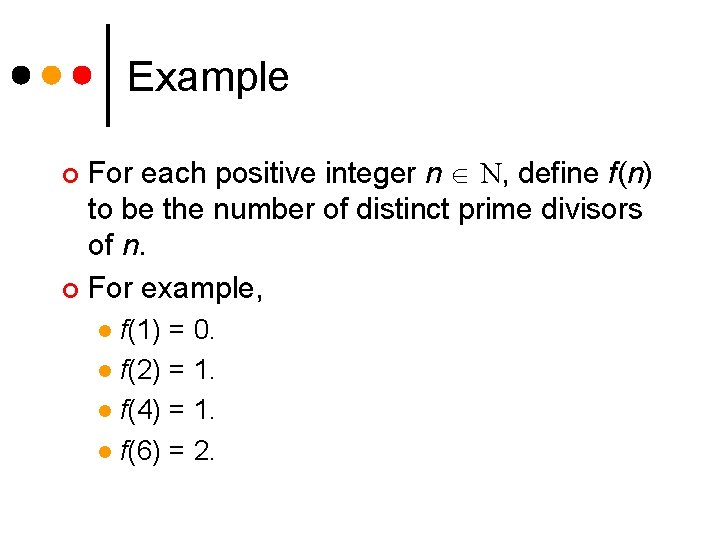
Example For each positive integer n N, define f(n) to be the number of distinct prime divisors of n. ¢ For example, ¢ f(1) = 0. l f(2) = 1. l f(4) = 1. l f(6) = 2. l
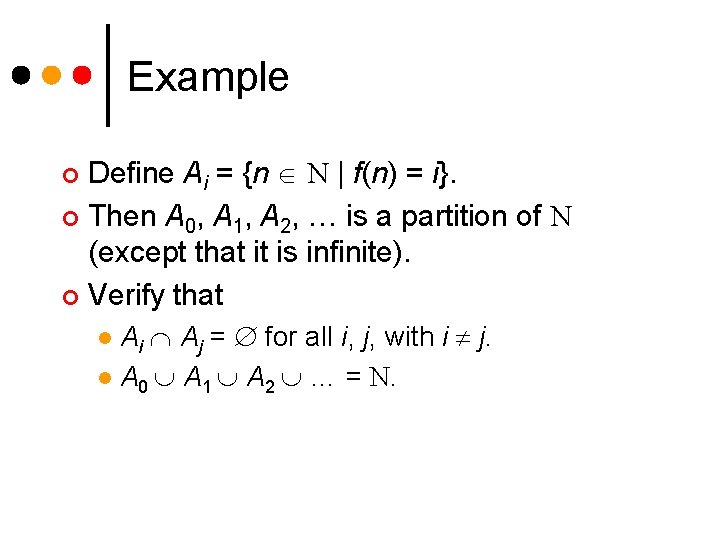
Example Define Ai = {n N | f(n) = i}. ¢ Then A 0, A 1, A 2, … is a partition of N (except that it is infinite). ¢ Verify that ¢ Ai Aj = for all i, j, with i j. l A 0 A 1 A 2 … = N. l
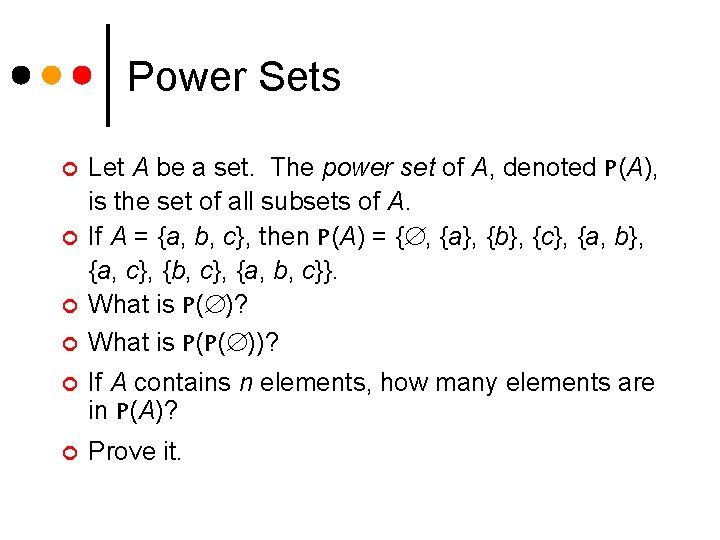
Power Sets ¢ ¢ Let A be a set. The power set of A, denoted P(A), is the set of all subsets of A. If A = {a, b, c}, then P(A) = { , {a}, {b}, {c}, {a, b}, {a, c}, {b, c}, {a, b, c}}. What is P( )? What is P(P( ))? ¢ If A contains n elements, how many elements are in P(A)? ¢ Prove it.
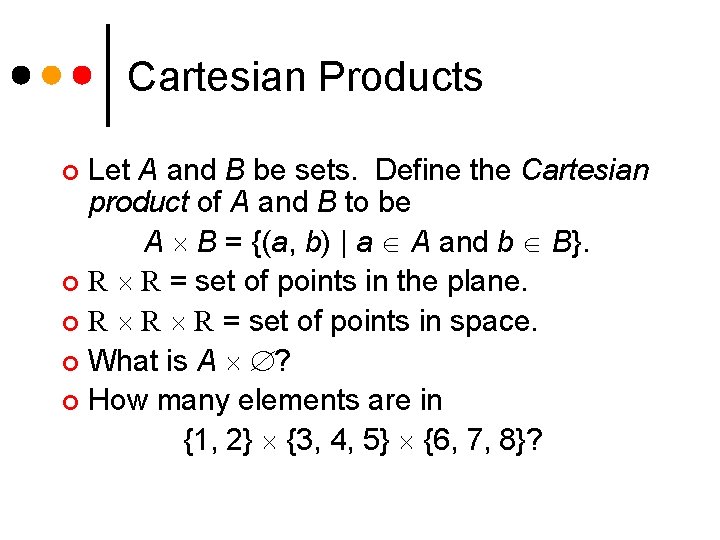
Cartesian Products Let A and B be sets. Define the Cartesian product of A and B to be A B = {(a, b) | a A and b B}. ¢ R R = set of points in the plane. ¢ R R R = set of points in space. ¢ What is A ? ¢ How many elements are in {1, 2} {3, 4, 5} {6, 7, 8}? ¢
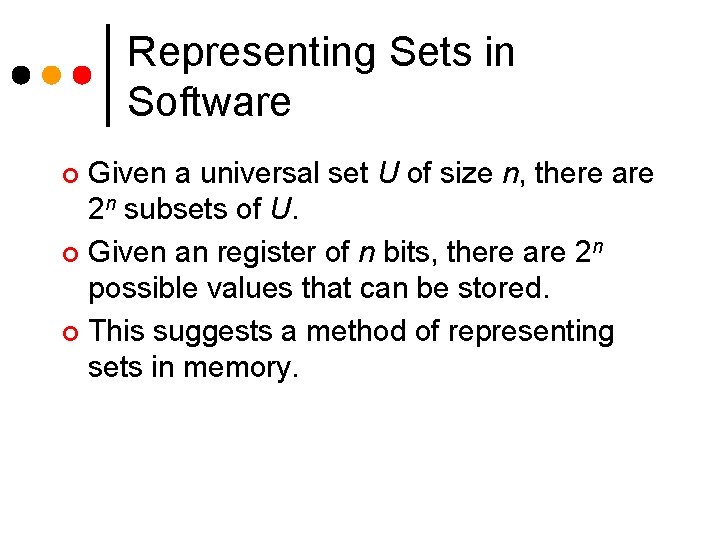
Representing Sets in Software Given a universal set U of size n, there are 2 n subsets of U. ¢ Given an register of n bits, there are 2 n possible values that can be stored. ¢ This suggests a method of representing sets in memory. ¢
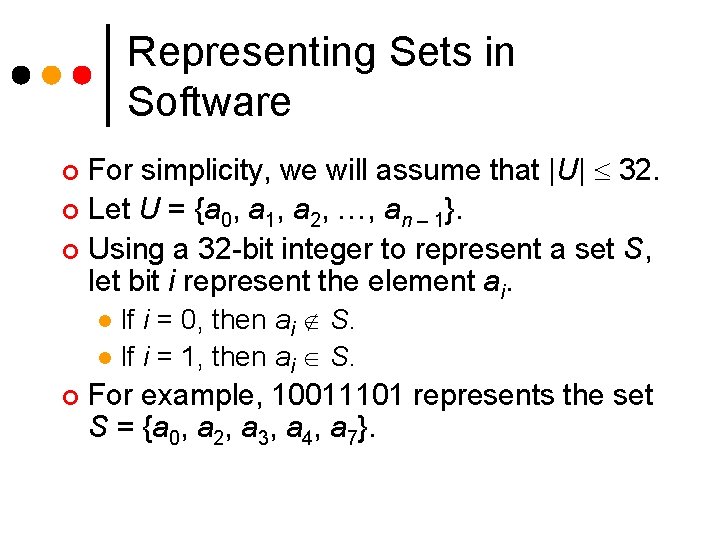
Representing Sets in Software For simplicity, we will assume that |U| 32. ¢ Let U = {a 0, a 1, a 2, …, an – 1}. ¢ Using a 32 -bit integer to represent a set S, let bit i represent the element ai. ¢ If i = 0, then ai S. l If i = 1, then ai S. l ¢ For example, 10011101 represents the set S = {a 0, a 2, a 3, a 4, a 7}.
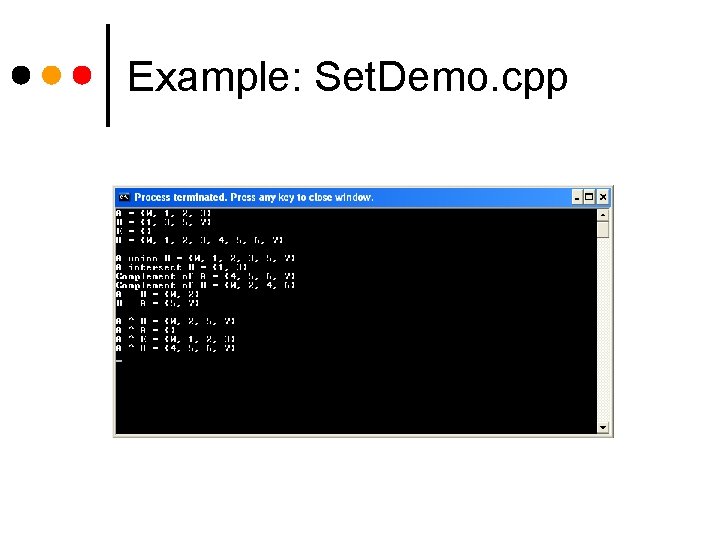
Example: Set. Demo. cpp
- Slides: 23