
Basic DC Circuits Review 2002 University of North
Basic DC Circuits Review © 2002 University of North Carolina at Charlotte, ALL RIGHTS RESERVED
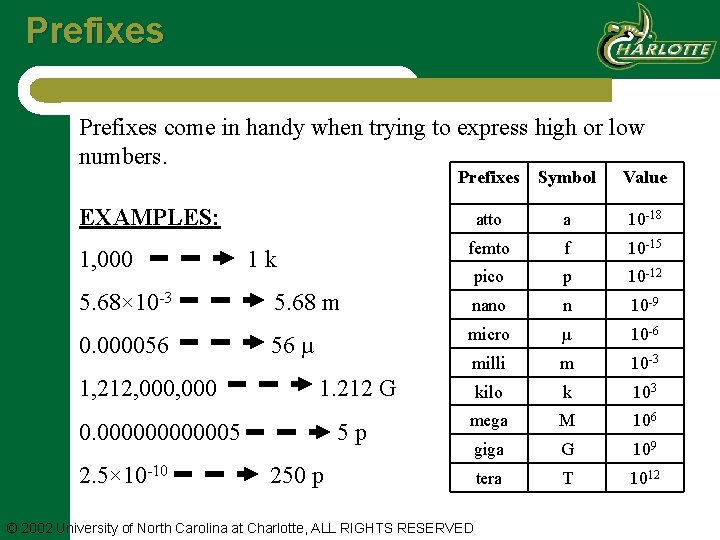
Prefixes come in handy when trying to express high or low numbers. Prefixes Symbol Value atto a 10 -18 femto f 10 -15 pico p 10 -12 5. 68 m nano n 10 -9 56 µ micro µ 10 -6 milli m 10 -3 kilo k 103 mega M 106 giga G 109 tera T 1012 EXAMPLES: 1, 000 5. 68× 10 -3 0. 000056 1, 212, 000 1 k 1. 212 G 0. 0000005 2. 5× 10 -10 5 p 250 p © 2002 University of North Carolina at Charlotte, ALL RIGHTS RESERVED
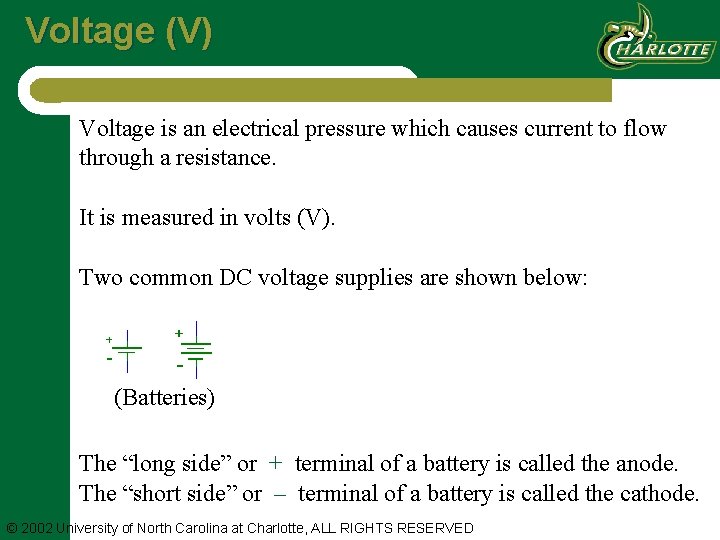
Voltage (V) Voltage is an electrical pressure which causes current to flow through a resistance. It is measured in volts (V). Two common DC voltage supplies are shown below: (Batteries) The “long side” or + terminal of a battery is called the anode. The “short side” or – terminal of a battery is called the cathode. © 2002 University of North Carolina at Charlotte, ALL RIGHTS RESERVED
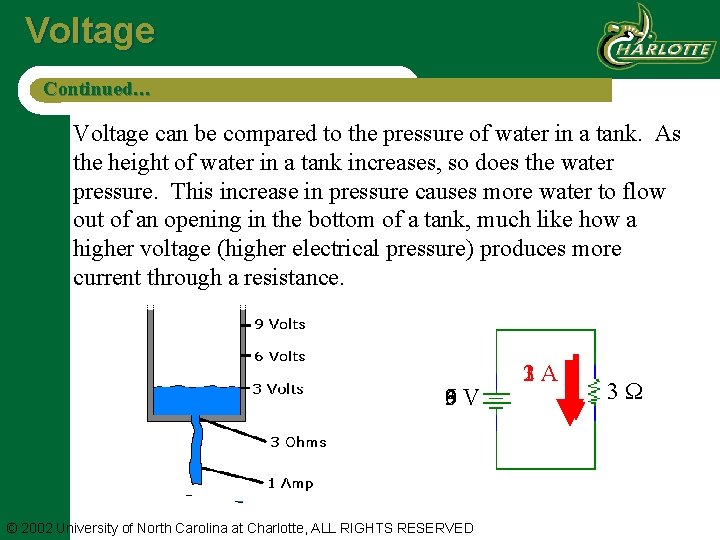
Voltage Continued… Voltage can be compared to the pressure of water in a tank. As the height of water in a tank increases, so does the water pressure. This increase in pressure causes more water to flow out of an opening in the bottom of a tank, much like how a higher voltage (higher electrical pressure) produces more current through a resistance. 369 V © 2002 University of North Carolina at Charlotte, ALL RIGHTS RESERVED 123 A 3Ω
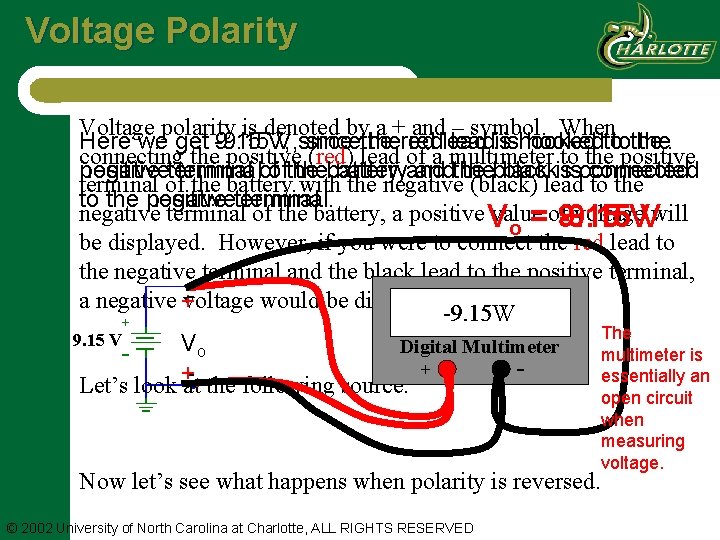
Voltage Polarity Voltage polarity is denoted by a + and – symbol. When Here we get 9. 15 -9. 15 V, V, sincethe thered redleadisishookedto tothe connecting the positive (red) lead of a multimeter to the positive negativeterminal positive terminalofofthe thebatteryand andthe theblackisisconnected terminal of the battery with the negative (black) lead to the negative positive terminal. negative terminal of the battery, a positive V value of 9. 15 voltage VVwill o = -9. 15 be displayed. However, if you were to connect the red lead to the negative terminal and the black lead to the positive terminal, a negative + voltage would be displayed. -9. 15 VV Vo Digital Multimeter + + Let’s look at the following source: 9. 15 V Now let’s see what happens when polarity is reversed. © 2002 University of North Carolina at Charlotte, ALL RIGHTS RESERVED The multimeter is essentially an open circuit when measuring voltage.

Current (I) Current is the movement of electrons through a conductor. It is established by a potential difference (or voltage) across a resistance and is measured in the quantity amperes or amps (A). The common DC current source is shown below: (Independent Current Sources) The arrow of the independent current source represents the direction of current flow. © 2002 University of North Carolina at Charlotte, ALL RIGHTS RESERVED
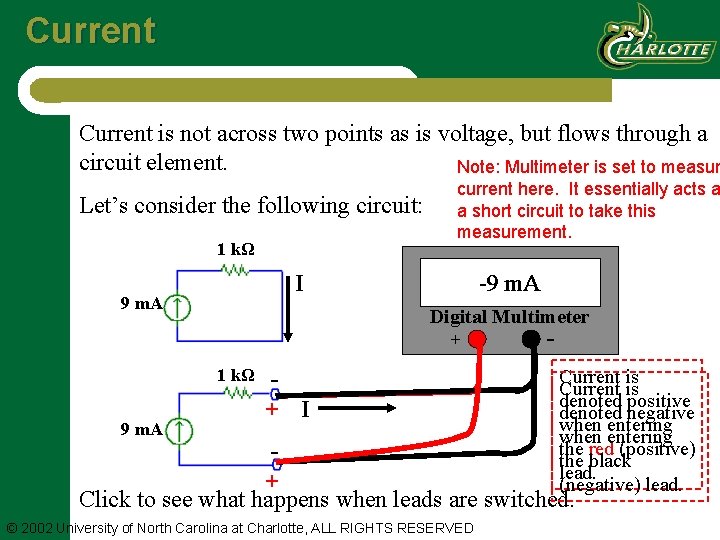
Current is not across two points as is voltage, but flows through a circuit element. Note: Multimeter is set to measur Let’s consider the following circuit: 1 kΩ current here. It essentially acts a a short circuit to take this measurement. I 9 m. A -9 9 m. A Digital Multimeter + 1 kΩ 9 m. A + I - Current is denoted positive denoted negative when entering the red (positive) the black lead. (negative) lead. + Click to see what happens when leads are switched. © 2002 University of North Carolina at Charlotte, ALL RIGHTS RESERVED
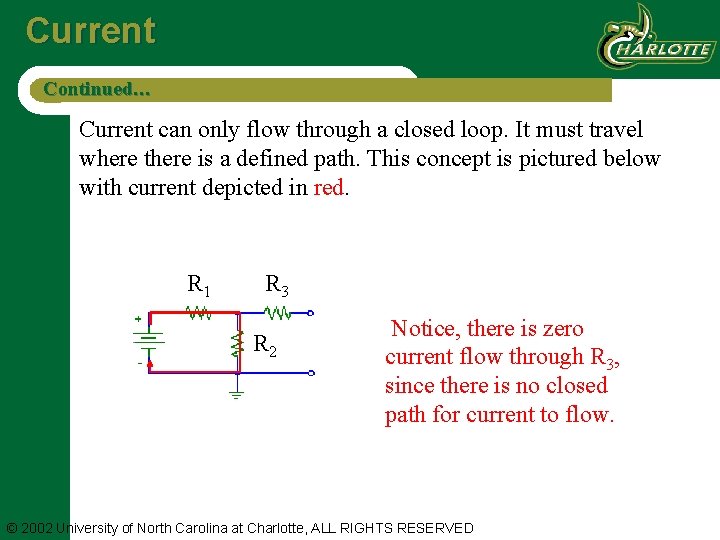
Current Continued… Current can only flow through a closed loop. It must travel where there is a defined path. This concept is pictured below with current depicted in red. R 1 R 3 R 2 Notice, there is zero current flow through R 3, since there is no closed path for current to flow. © 2002 University of North Carolina at Charlotte, ALL RIGHTS RESERVED
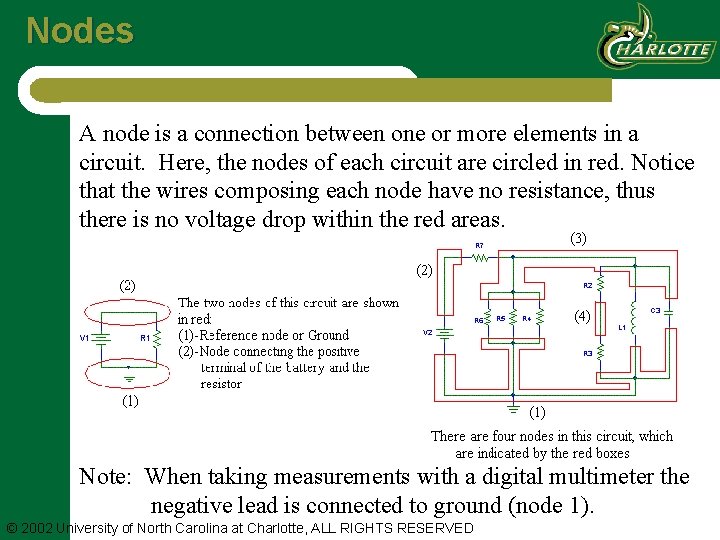
Nodes A node is a connection between one or more elements in a circuit. Here, the nodes of each circuit are circled in red. Notice that the wires composing each node have no resistance, thus there is no voltage drop within the red areas. Note: When taking measurements with a digital multimeter the negative lead is connected to ground (node 1). © 2002 University of North Carolina at Charlotte, ALL RIGHTS RESERVED
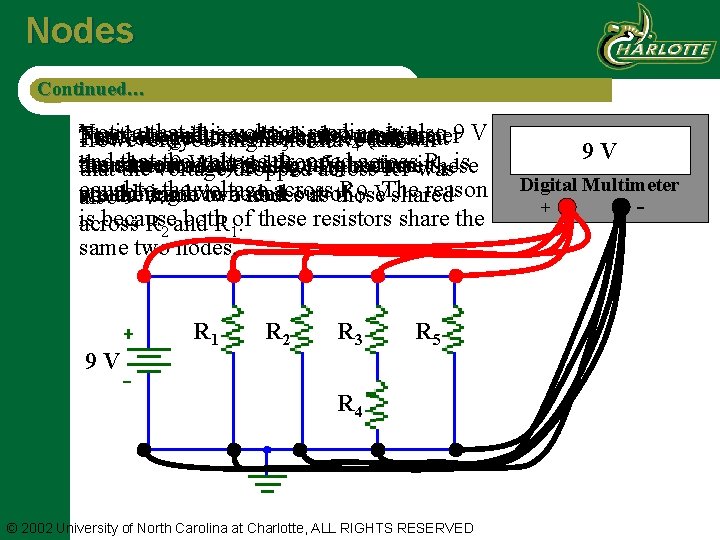
Nodes Continued… Notice that this voltage reading is also For same reason also measure Next, From the we will previous use the slides, digital you might The the voltage across Rwe and R 4 multimeter (taken at 9 V However, you might have known 3 not and that the voltage dropped Rthese the same 9 nodes) V across Rconfiguration to measure have known node that voltages this in because aacross circuit outer is also V 2 is that the voltage dropped R 1 was 5. 9 across equal thetwo voltage across R 91. V. The reason containing would result in nodes. a read out are same two nodes asof those shared alsothe 9 to V. is because both. R 1 of across R 2 and. these resistors share the same two nodes. 9 V R 1 R 2 R 3 R 5 R 4 © 2002 University of North Carolina at Charlotte, ALL RIGHTS RESERVED 9 V Digital Multimeter + -
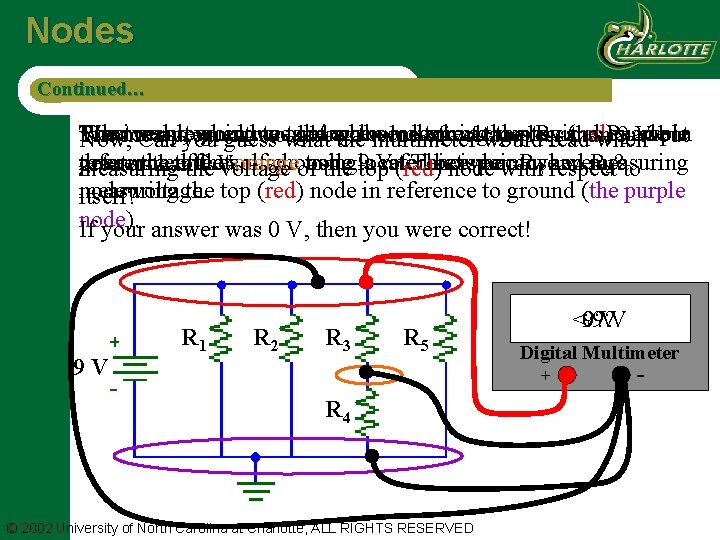
Nodes Continued… Now Previously, What we result when would going measuring to wewhat take getbe when athe closer measuring voltage look atacross theprevious top Rread (red) R example webut in The would athe value of voltage less than 9 node Now, measurement Canare you guess multimeter would 3 and when 4, V to determined reference see the to effects the voltage orange of choosing to node be 9 top located a V. reference This between ispoint because Rwhen and wemeasuring Rare greater than 0 V. measuring the voltage of the (red) node with 3 respect 4? to node measuring the top (red) node in reference to ground (the purple itself? voltage. node). If your answer was 0 V, then you were correct! 9 V R 1 R 2 R 3 R 5 <09? ? ? 9 VV Digital Multimeter + R 4 © 2002 University of North Carolina at Charlotte, ALL RIGHTS RESERVED -
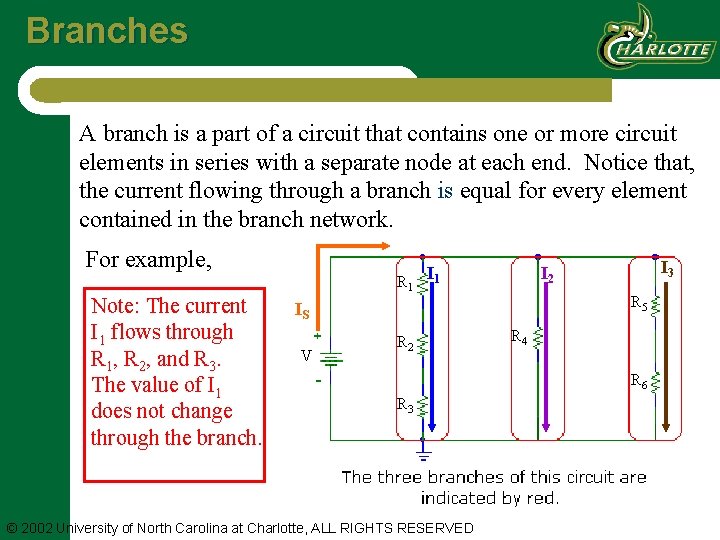
Branches A branch is a part of a circuit that contains one or more circuit elements in series with a separate node at each end. Notice that, the current flowing through a branch is equal for every element contained in the branch network. For example, Note: The current I 1 flows through R 1, R 2, and R 3. The value of I 1 does not change through the branch. R 1 I 1 R 5 IS V R 2 I 3 I 2 R 4 R 6 R 3 © 2002 University of North Carolina at Charlotte, ALL RIGHTS RESERVED
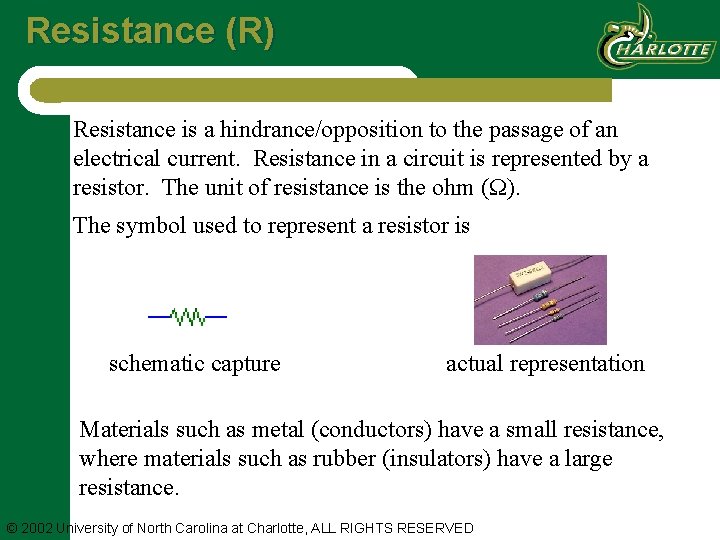
Resistance (R) Resistance is a hindrance/opposition to the passage of an electrical current. Resistance in a circuit is represented by a resistor. The unit of resistance is the ohm (Ω). The symbol used to represent a resistor is schematic capture actual representation Materials such as metal (conductors) have a small resistance, where materials such as rubber (insulators) have a large resistance. © 2002 University of North Carolina at Charlotte, ALL RIGHTS RESERVED
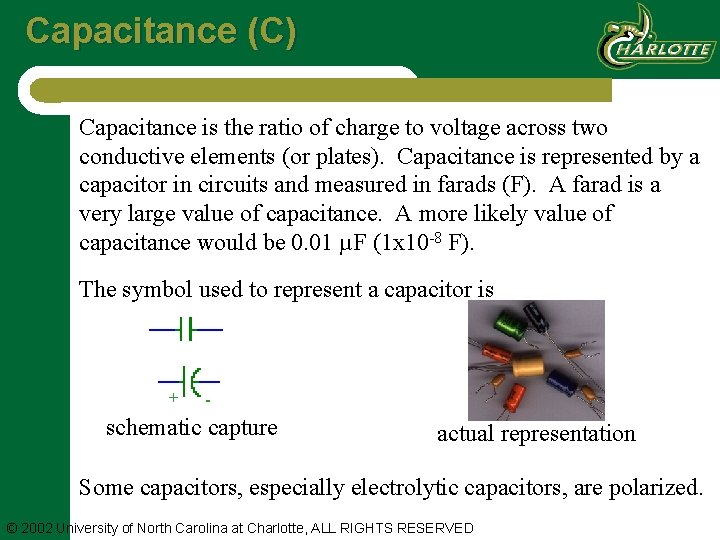
Capacitance (C) Capacitance is the ratio of charge to voltage across two conductive elements (or plates). Capacitance is represented by a capacitor in circuits and measured in farads (F). A farad is a very large value of capacitance. A more likely value of capacitance would be 0. 01 µF (1 x 10 -8 F). The symbol used to represent a capacitor is + - schematic capture actual representation Some capacitors, especially electrolytic capacitors, are polarized. © 2002 University of North Carolina at Charlotte, ALL RIGHTS RESERVED
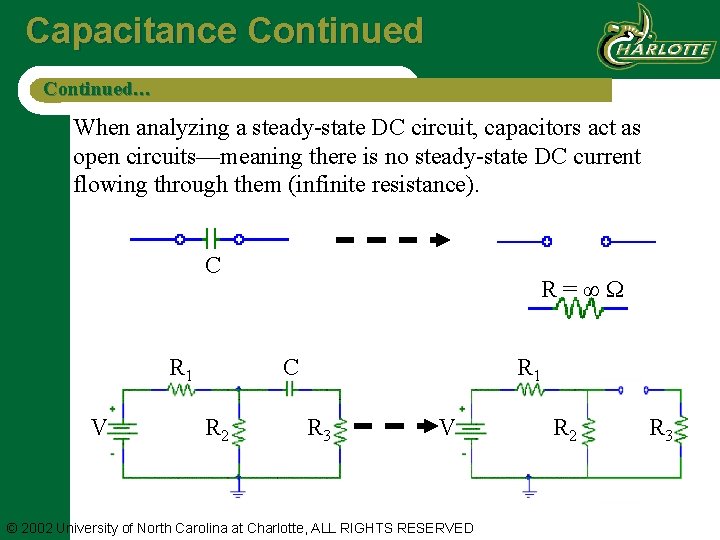
Capacitance Continued… When analyzing a steady-state DC circuit, capacitors act as open circuits—meaning there is no steady-state DC current flowing through them (infinite resistance). C R 1 V R=∞Ω C R 2 R 1 R 3 V © 2002 University of North Carolina at Charlotte, ALL RIGHTS RESERVED R 2 R 3
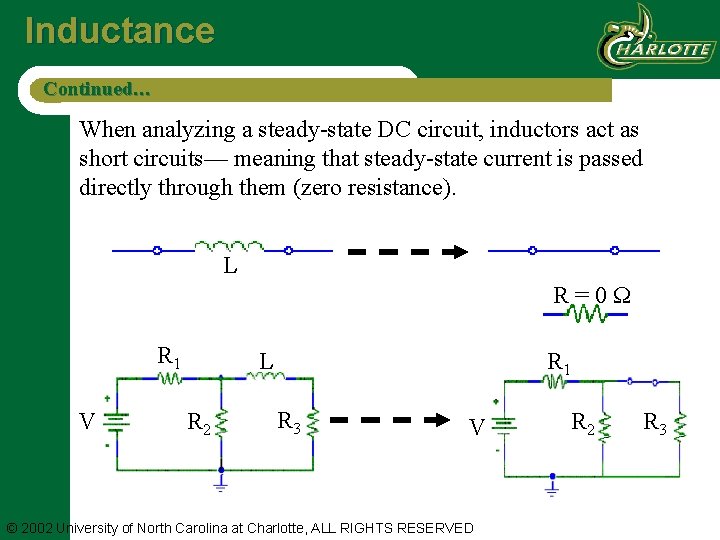
Inductance Continued… When analyzing a steady-state DC circuit, inductors act as short circuits— meaning that steady-state current is passed directly through them (zero resistance). L R=0Ω R 1 V L R 2 R 1 R 3 V © 2002 University of North Carolina at Charlotte, ALL RIGHTS RESERVED R 2 R 3
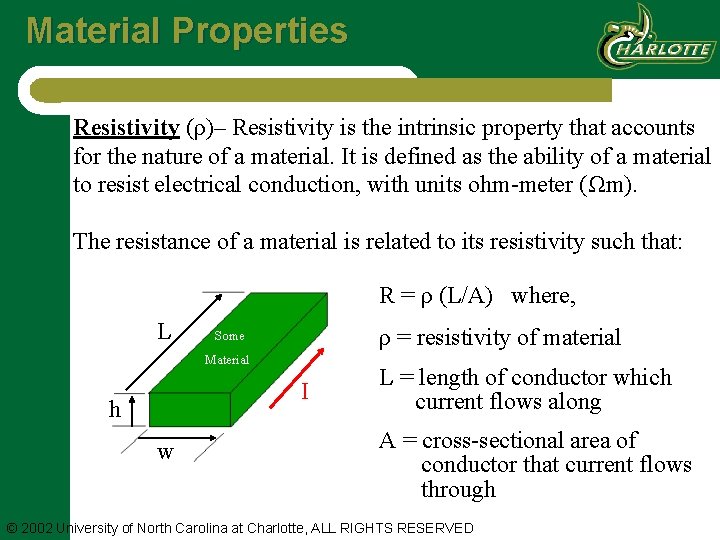
Material Properties Resistivity (ρ)– Resistivity is the intrinsic property that accounts for the nature of a material. It is defined as the ability of a material to resist electrical conduction, with units ohm-meter (Ωm). The resistance of a material is related to its resistivity such that: R = ρ (L/A) where, L ρ = resistivity of material Some Material I h w L = length of conductor which current flows along A = cross-sectional area of conductor that current flows through © 2002 University of North Carolina at Charlotte, ALL RIGHTS RESERVED
l Increasing the length of the resistor increases the resistance l Increasing the cross sectional area of the resistor decreases the resistance © 2002 University of North Carolina at Charlotte, ALL RIGHTS RESERVED
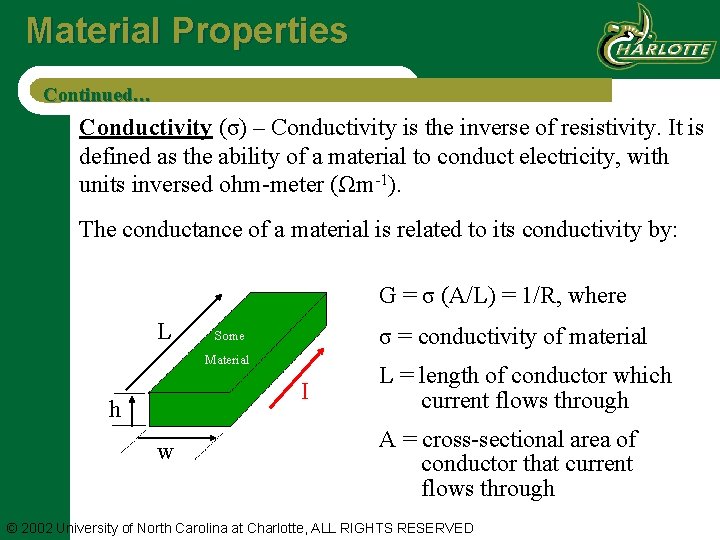
Material Properties Continued… Conductivity (σ) – Conductivity is the inverse of resistivity. It is defined as the ability of a material to conduct electricity, with units inversed ohm-meter (Ωm-1). The conductance of a material is related to its conductivity by: G = σ (A/L) = 1/R, where L σ = conductivity of material Some Material I h w L = length of conductor which current flows through A = cross-sectional area of conductor that current flows through © 2002 University of North Carolina at Charlotte, ALL RIGHTS RESERVED
l Increasing the cross sectional area of the conductor increases the conductance l Increasing the length of a conductor decreases the conductance © 2002 University of North Carolina at Charlotte, ALL RIGHTS RESERVED
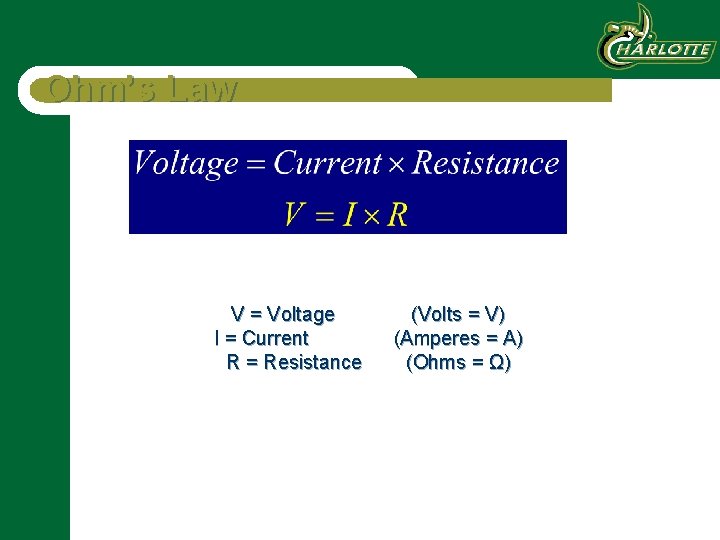
Ohm’s Law V = Voltage I = Current R = Resistance (Volts = V) (Amperes = A) (Ohms = Ω)
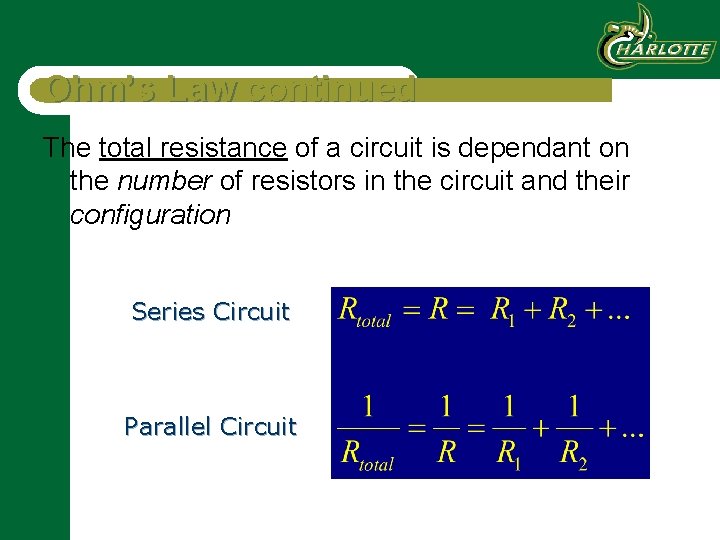
Ohm’s Law continued The total resistance of a circuit is dependant on the number of resistors in the circuit and their configuration Series Circuit Parallel Circuit
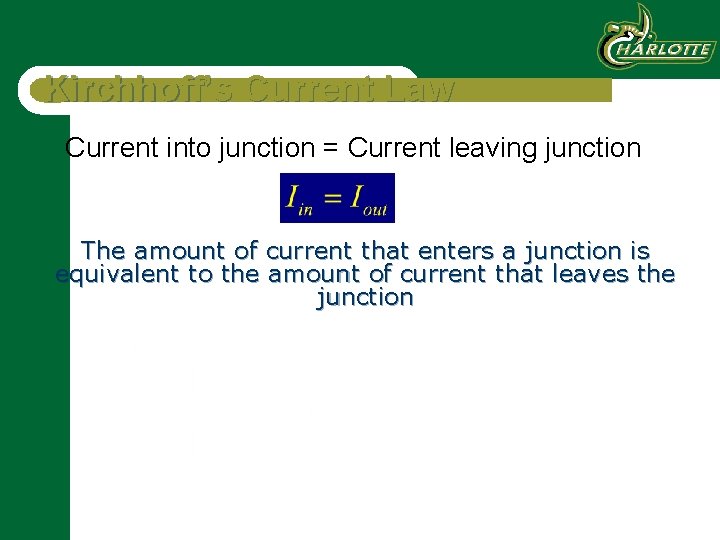
Kirchhoff’s Current Law Current into junction = Current leaving junction The amount of current that enters a junction is equivalent to the amount of current that leaves the junction
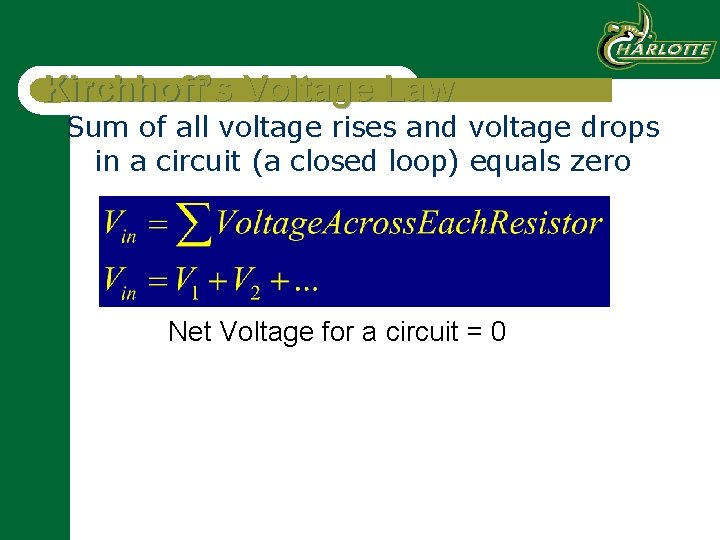
Kirchhoff’s Voltage Law Sum of all voltage rises and voltage drops in a circuit (a closed loop) equals zero Net Voltage for a circuit = 0
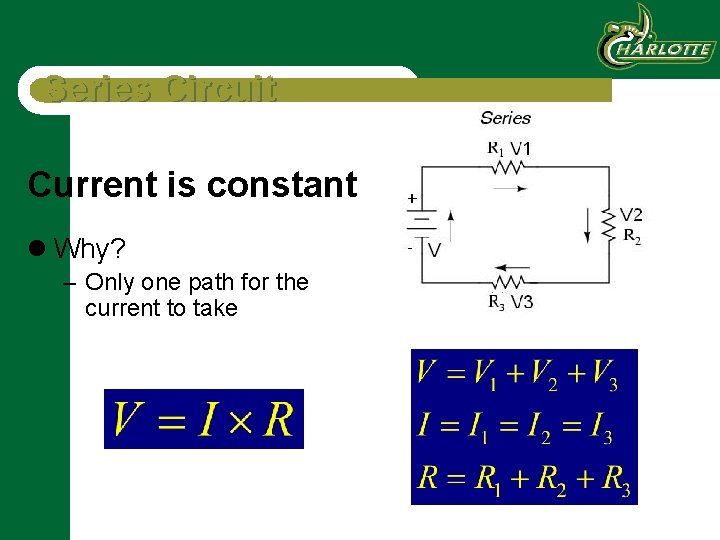
Series Circuit Current is constant l Why? – Only one path for the current to take
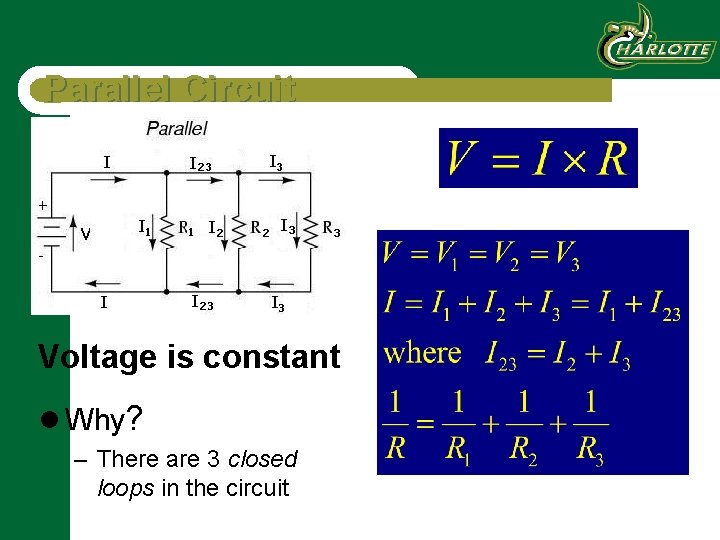
Parallel Circuit Voltage is constant l Why? – There are 3 closed loops in the circuit
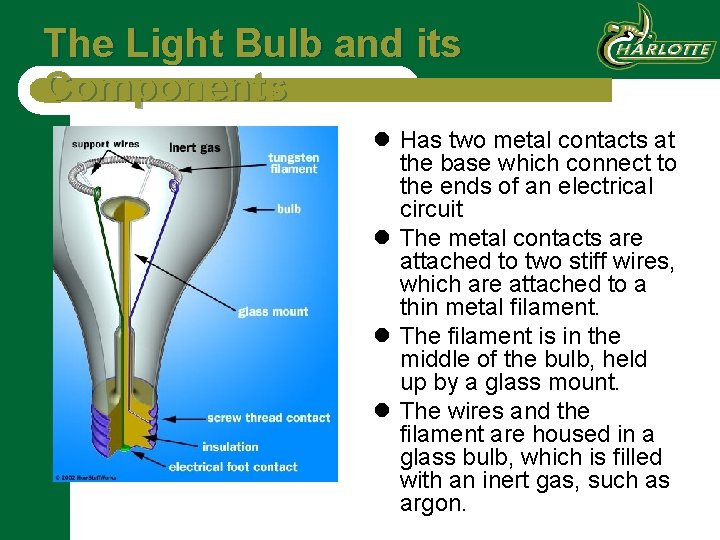
The Light Bulb and its Components l Has two metal contacts at the base which connect to the ends of an electrical circuit l The metal contacts are attached to two stiff wires, which are attached to a thin metal filament. l The filament is in the middle of the bulb, held up by a glass mount. l The wires and the filament are housed in a glass bulb, which is filled with an inert gas, such as argon.
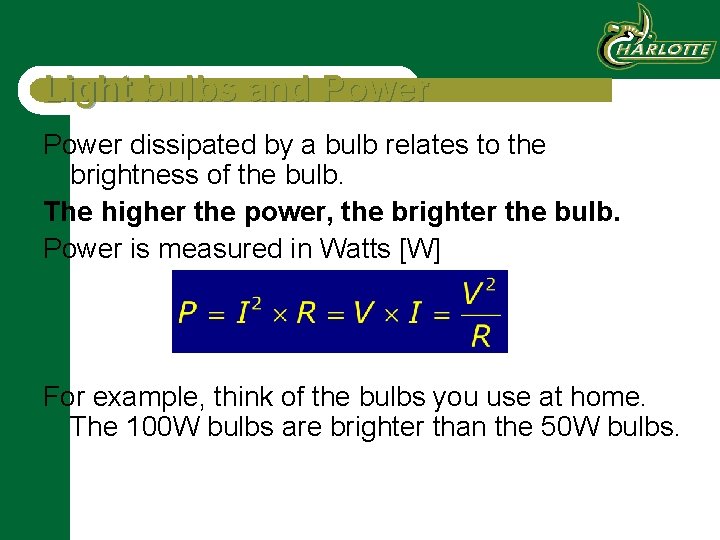
Light bulbs and Power dissipated by a bulb relates to the brightness of the bulb. The higher the power, the brighter the bulb. Power is measured in Watts [W] For example, think of the bulbs you use at home. The 100 W bulbs are brighter than the 50 W bulbs.
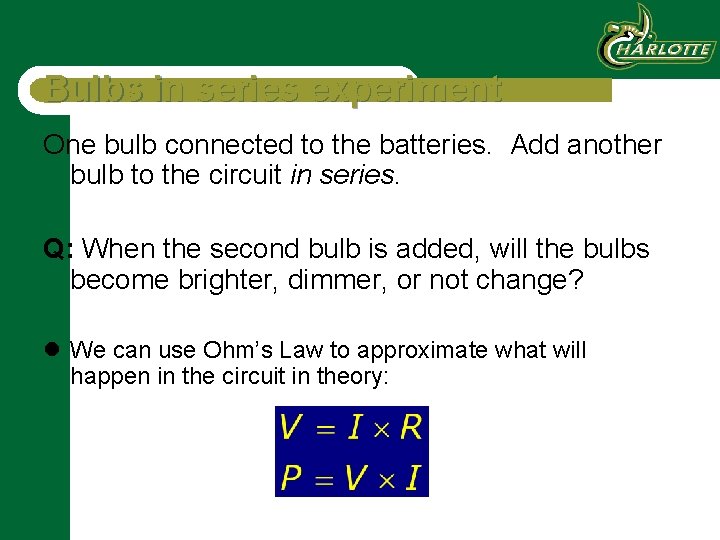
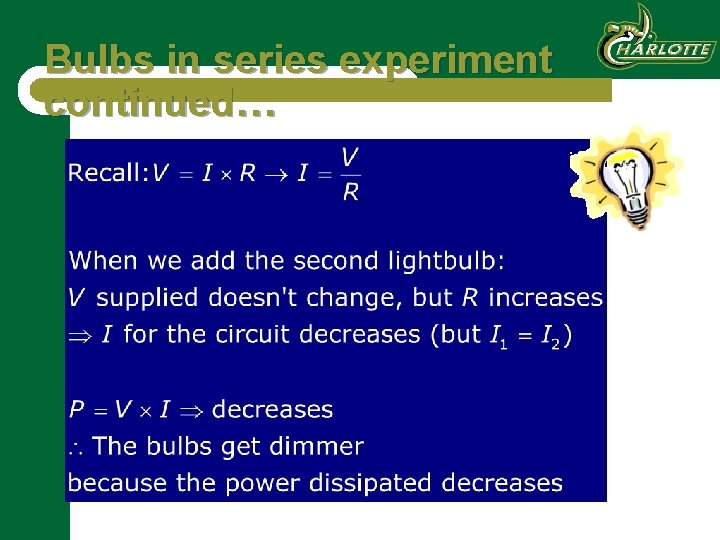
Bulbs in series experiment One bulb connected to the batteries. Add another bulb to the circuit in series. Q: When the second bulb is added, will the bulbs become brighter, dimmer, or not change? l We can use Ohm’s Law to approximate what will happen in the circuit in theory:
Bulbs in series experiment continued…
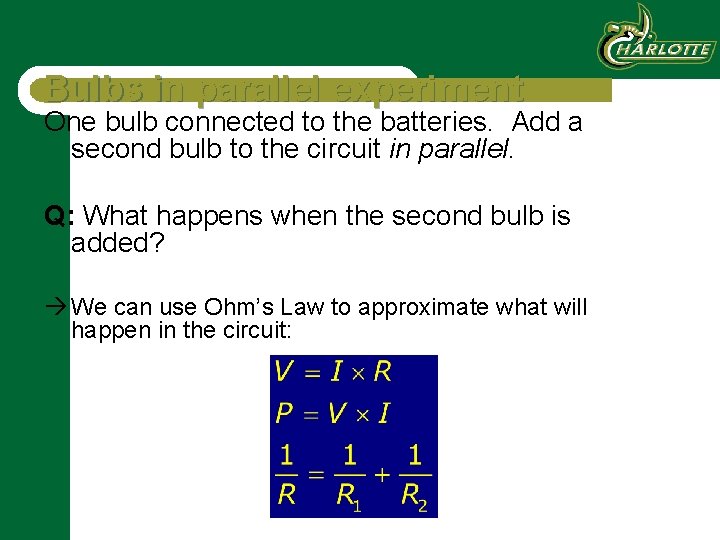
Bulbs in parallel experiment One bulb connected to the batteries. Add a second bulb to the circuit in parallel. Q: What happens when the second bulb is added? We can use Ohm’s Law to approximate what will happen in the circuit:
Bulbs in parallel experiment continued…
How to use a voltmeter: Voltmeter: - connect either end of the meter to each side of the resistor If you are reading a negative value, you have the probes switched. There should be no continuity beeping. If you hear beeping, STOP what you are doing and ask someone for help!
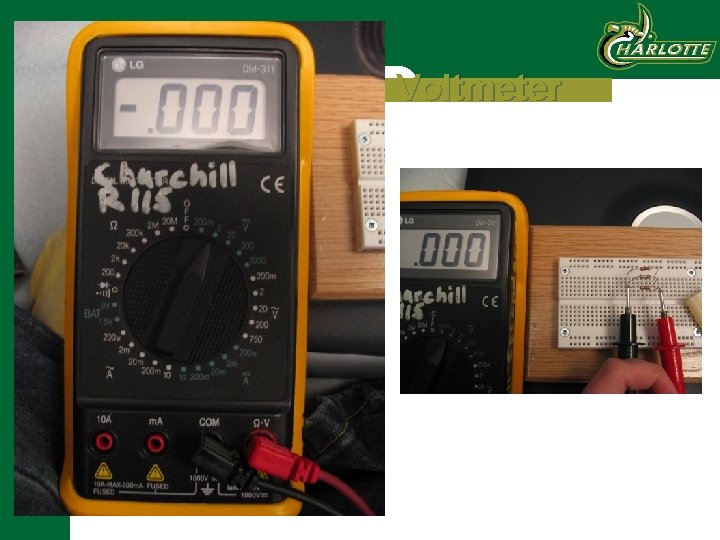
Voltmeter
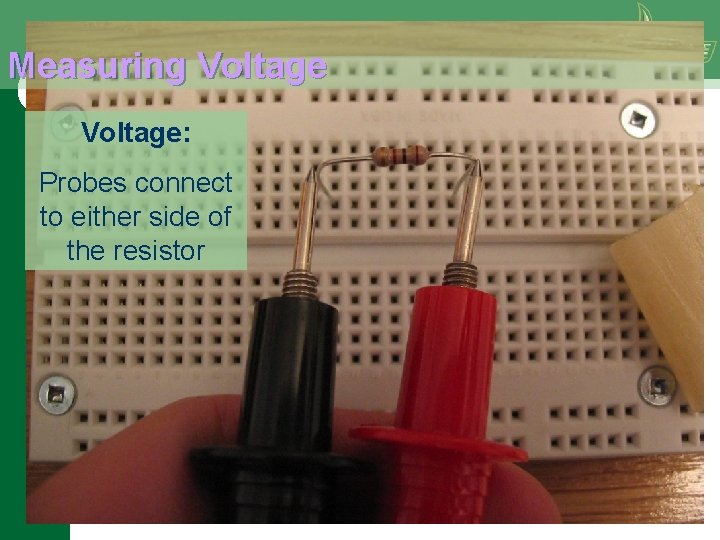
Measuring Voltage: Probes connect to either side of the resistor
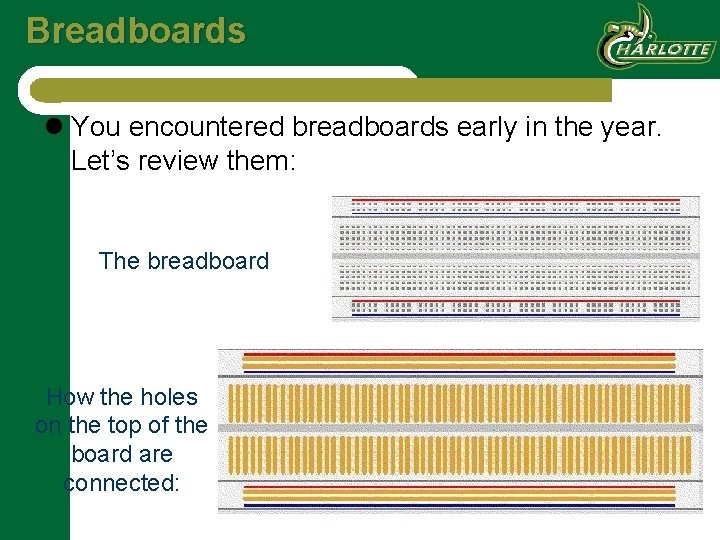
Breadboards l You encountered breadboards early in the year. Let’s review them: The breadboard How the holes on the top of the board are connected:
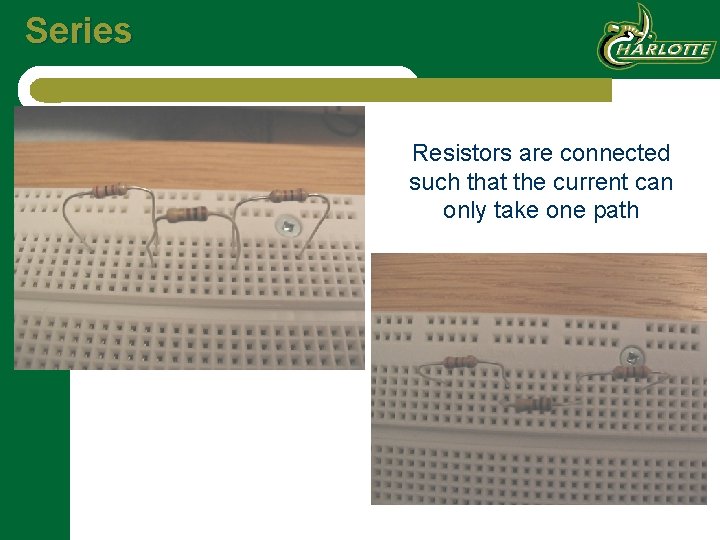
Series Resistors are connected such that the current can only take one path
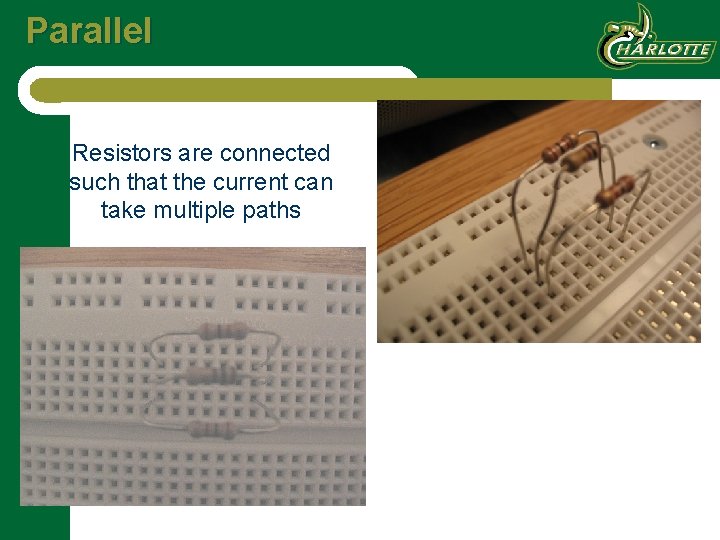
Parallel Resistors are connected such that the current can take multiple paths
- Slides: 38