
Basic Data Structures Review of DATA STRUCTURES class
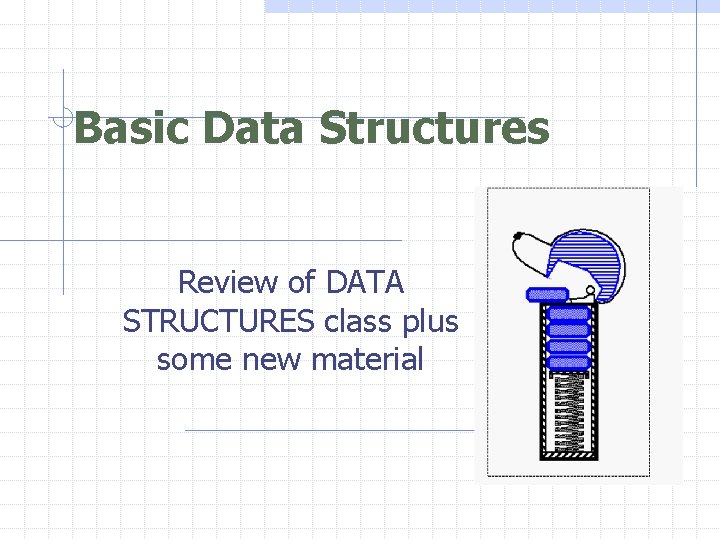
Basic Data Structures Review of DATA STRUCTURES class plus some new material
Stacks

Abstract Data Types (ADTs) Example: ADT modeling a An abstract data simple stock trading system type (ADT) is an n The data stored are buy/sell abstraction of a orders data structure n The operations supported are An ADT w order buy(stock, shares, price) specifies: w order sell(stock, shares, price) n n n Data stored Operations on the data Error conditions associated with operations w void cancel(order) n Error conditions: w Buy/sell a nonexistent stock w Cancel a nonexistent order 3
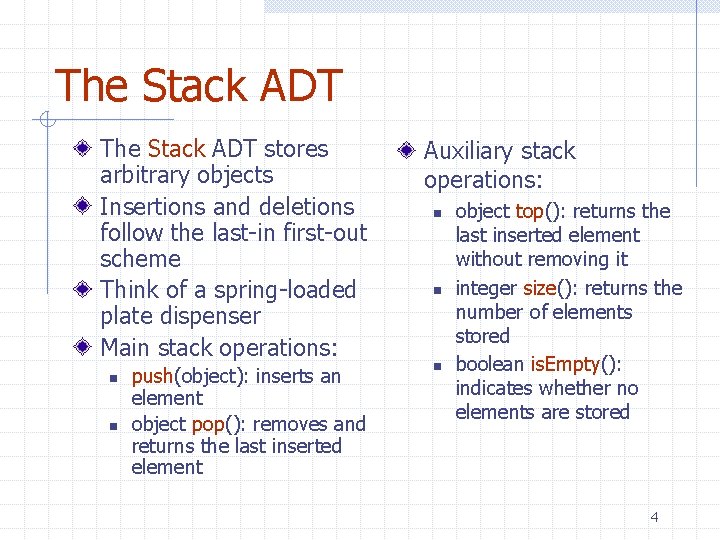
The Stack ADT stores arbitrary objects Insertions and deletions follow the last-in first-out scheme Think of a spring-loaded plate dispenser Main stack operations: n n push(object): inserts an element object pop(): removes and returns the last inserted element Auxiliary stack operations: n n n object top(): returns the last inserted element without removing it integer size(): returns the number of elements stored boolean is. Empty(): indicates whether no elements are stored 4
Exceptions Attempting the execution of an operation of ADT may sometimes cause an error condition, called an exception Exceptions are said to be “thrown” by an operation that cannot be executed In the Stack ADT, operations pop and top cannot be performed if the stack is empty Attempting the execution of pop or top on an empty stack throws an Empty. Stack. Exception 5
Applications of Stacks Direct applications n n n Page-visited history in a Web browser Undo sequence in a text editor Chain of method calls in the Java Virtual Machine Indirect applications n n Auxiliary data structure for algorithms Component of other data structures 6
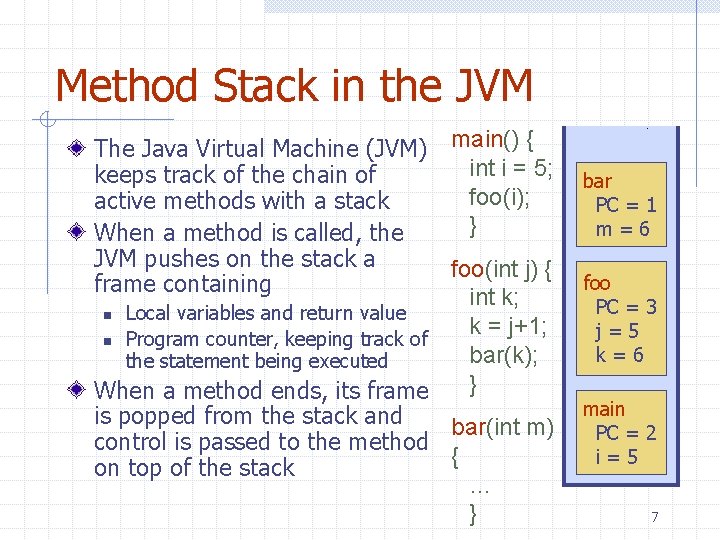
Method Stack in the JVM The Java Virtual Machine (JVM) keeps track of the chain of active methods with a stack When a method is called, the JVM pushes on the stack a frame containing main() { int i = 5; foo(i); } foo(int j) { int k; n Local variables and return value k = j+1; n Program counter, keeping track of bar(k); the statement being executed } When a method ends, its frame is popped from the stack and bar(int m) control is passed to the method { on top of the stack … } bar PC = 1 m=6 foo PC = 3 j=5 k=6 main PC = 2 i=5 7
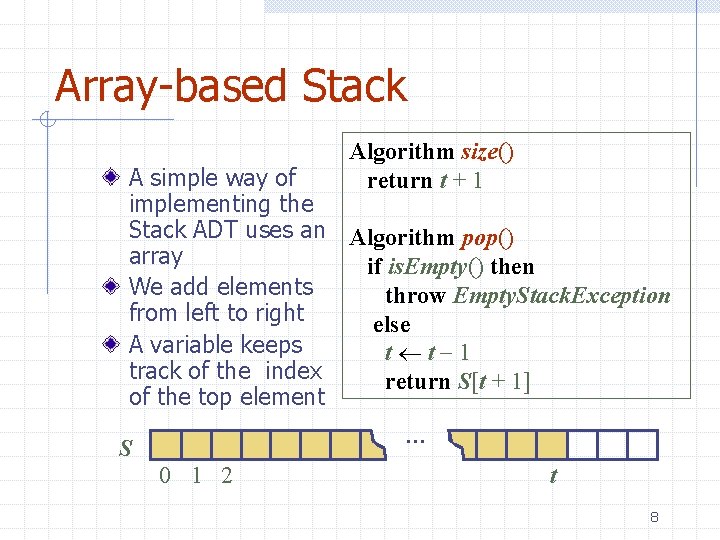
Array-based Stack Algorithm size() return t + 1 A simple way of implementing the Stack ADT uses an Algorithm pop() array if is. Empty() then We add elements throw Empty. Stack. Exception from left to right else A variable keeps t t 1 track of the index return S[t + 1] of the top element … S 0 1 2 t 8
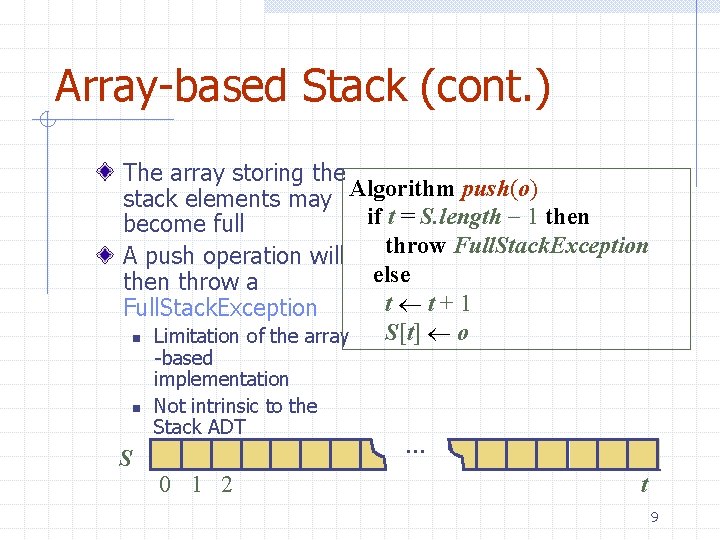
Array-based Stack (cont. ) The array storing the stack elements may Algorithm push(o) if t = S. length 1 then become full throw Full. Stack. Exception A push operation will else then throw a t t+1 Full. Stack. Exception S[t] o n Limitation of the array n -based implementation Not intrinsic to the Stack ADT S 0 1 2 … t 9
Performance and Limitations Performance n n n Let n be the number of elements in the stack The space used is O(n) Each operation runs in time O(1) Limitations n n The maximum size of the stack must be defined a priori and cannot be changed Trying to push a new element into a full stack causes an implementation-specific exception 10
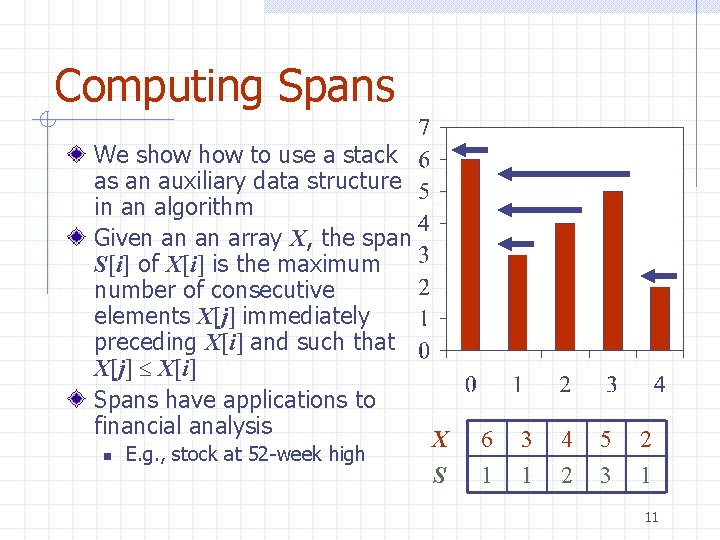
Computing Spans We show to use a stack as an auxiliary data structure in an algorithm Given an an array X, the span S[i] of X[i] is the maximum number of consecutive elements X[j] immediately preceding X[i] and such that X[j] X[i] Spans have applications to financial analysis n E. g. , stock at 52 -week high X S 6 1 3 1 4 2 5 3 2 1 11
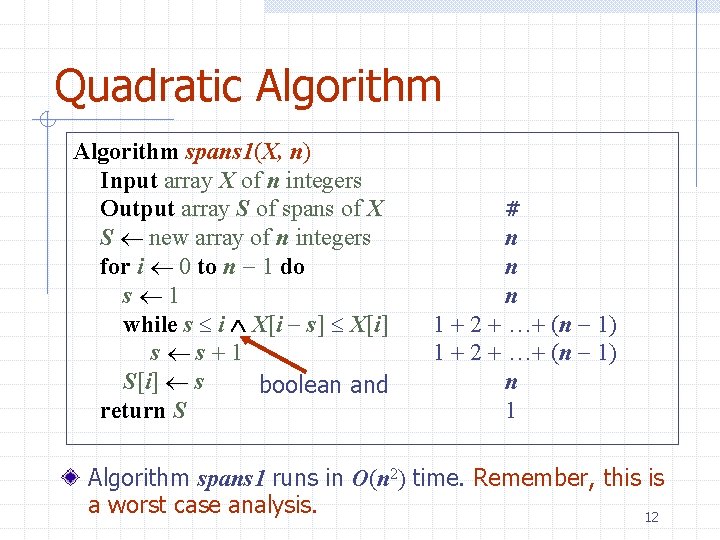
Quadratic Algorithm spans 1(X, n) Input array X of n integers Output array S of spans of X S new array of n integers for i 0 to n 1 do s 1 while s i X[i s] X[i] s s+1 S[i] s boolean and return S # n n n 1 + 2 + …+ (n 1) n 1 Algorithm spans 1 runs in O(n 2) time. Remember, this is a worst case analysis. 12
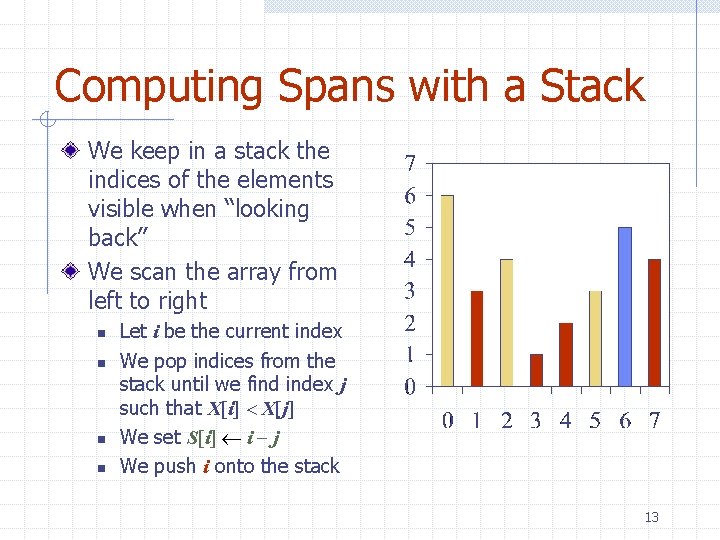
Computing Spans with a Stack We keep in a stack the indices of the elements visible when “looking back” We scan the array from left to right n n Let i be the current index We pop indices from the stack until we find index j such that X[i] X[j] We set S[i] i j We push i onto the stack 13
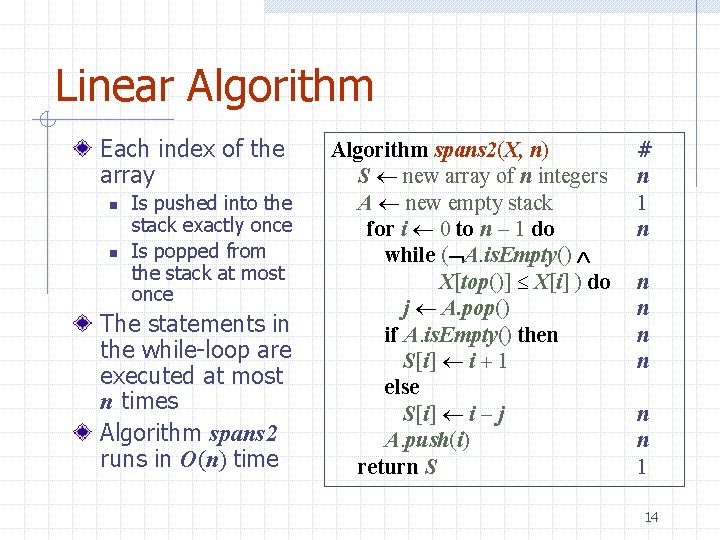
Linear Algorithm Each index of the array n n Is pushed into the stack exactly once Is popped from the stack at most once The statements in the while-loop are executed at most n times Algorithm spans 2 runs in O(n) time Algorithm spans 2(X, n) S new array of n integers A new empty stack for i 0 to n 1 do while ( A. is. Empty() X[top()] X[i] ) do j A. pop() if A. is. Empty() then S[i] i + 1 else S[i] i j A. push(i) return S # n 1 n n n n 1 14
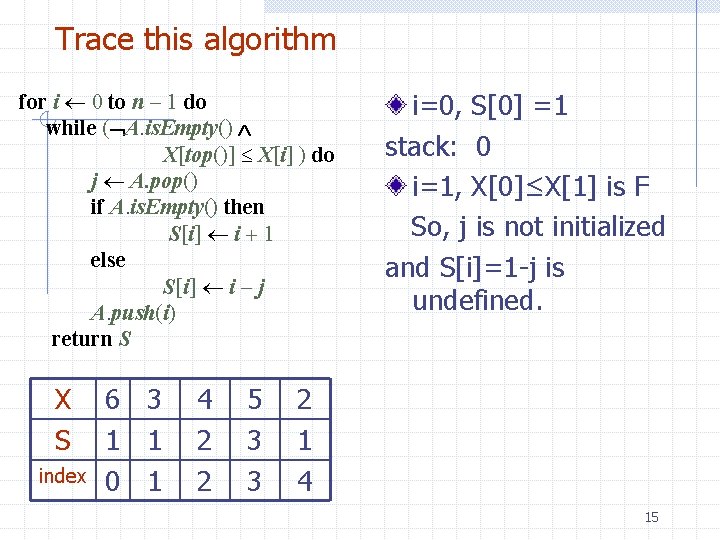
Trace this algorithm for i 0 to n 1 do while ( A. is. Empty() X[top()] X[i] ) do j A. pop() if A. is. Empty() then S[i] i + 1 else S[i] i j A. push(i) return S X S index 6 3 1 1 0 1 4 2 2 5 3 3 i=0, S[0] =1 stack: 0 i=1, X[0]≤X[1] is F So, j is not initialized and S[i]=1 -j is undefined. 2 1 4 15
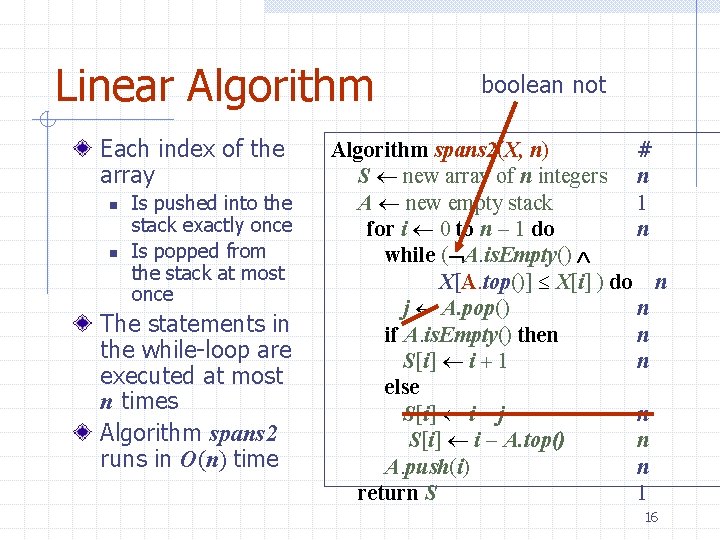
Linear Algorithm Each index of the array n n Is pushed into the stack exactly once Is popped from the stack at most once The statements in the while-loop are executed at most n times Algorithm spans 2 runs in O(n) time boolean not Algorithm spans 2(X, n) # S new array of n integers n A new empty stack 1 for i 0 to n 1 do n while ( A. is. Empty() X[A. top()] X[i] ) do n j A. pop() n if A. is. Empty() then n S[i] i + 1 n else S[i] i j n S[i] i A. top() n A. push(i) n return S 1 16
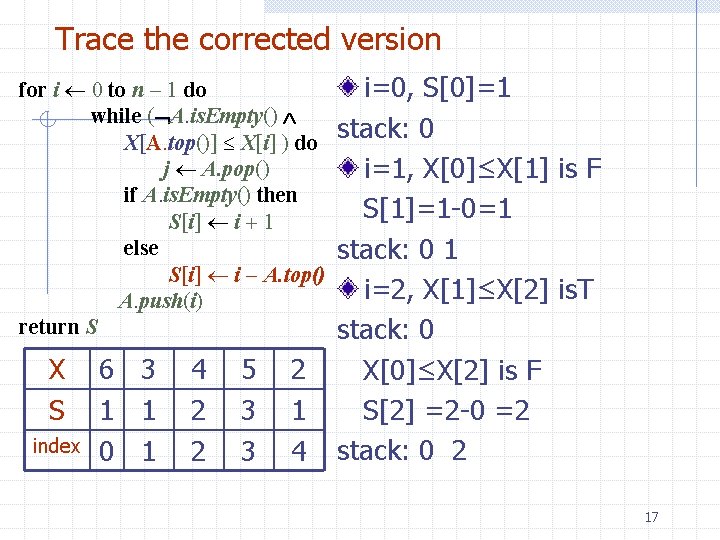
Trace the corrected version for i 0 to n 1 do while ( A. is. Empty() X[A. top()] X[i] ) do j A. pop() if A. is. Empty() then S[i] i + 1 else S[i] i A. top() A. push(i) return S X S index 6 3 1 1 0 1 4 2 2 5 3 3 2 1 4 i=0, S[0]=1 stack: 0 i=1, X[0]≤X[1] is F S[1]=1 -0=1 stack: 0 1 i=2, X[1]≤X[2] is. T stack: 0 X[0]≤X[2] is F S[2] =2 -0 =2 stack: 0 2 17
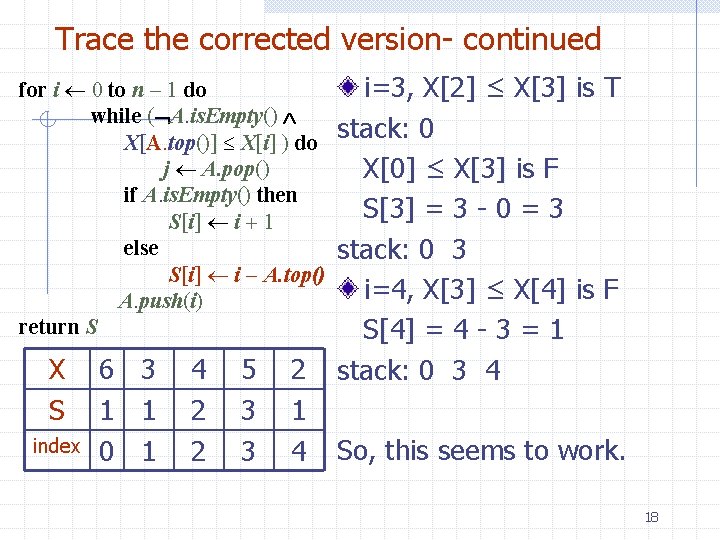
Trace the corrected version- continued for i 0 to n 1 do while ( A. is. Empty() X[A. top()] X[i] ) do j A. pop() if A. is. Empty() then S[i] i + 1 else S[i] i A. top() A. push(i) return S X S index 6 3 1 1 0 1 4 2 2 5 3 3 2 1 4 i=3, X[2] ≤ X[3] is T stack: 0 X[0] ≤ X[3] is F S[3] = 3 - 0 = 3 stack: 0 3 i=4, X[3] ≤ X[4] is F S[4] = 4 - 3 = 1 stack: 0 3 4 So, this seems to work. 18
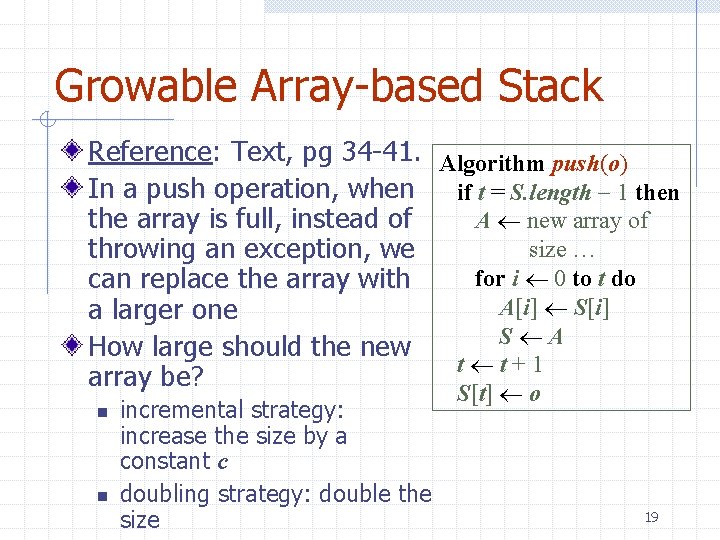
Growable Array-based Stack Reference: Text, pg 34 -41. Algorithm push(o) In a push operation, when if t = S. length 1 then the array is full, instead of A new array of size … throwing an exception, we for i 0 to t do can replace the array with A[i] S[i] a larger one S A How large should the new t t+1 array be? n n incremental strategy: increase the size by a constant c doubling strategy: double the size S[t] o 19
Comparison of the Strategies We compare the incremental strategy and the doubling strategy by analyzing the total time T(n) needed to perform a series of n push operations We assume that we start with an empty stack represented by an array of size 1 We will call the amortized time of a push operation the average time taken by a push over the series of operations. 20
Amortized Running Time There are two ways to calculate this n n 1) use a financial model - called the accounting method or 2) use an energy method - called the potential function model. We'll first use the accounting method. The accounting method determines the amortized running time with a system of credits and debits We view a computer as a coin-operated device requiring n 1 cyber-dollar for a constant amount of computing. 21
Amortization as a Tool Amortization is used to analyze the running times of algorithms with widely varying performance. The term comes from accounting. It is useful as it gives us a way of to do averagecase analysis without using any probability. Definition: The amortized running time of an operation that is defined by a series of operations is given by the worst-case total running time of the series of operations divided by the number of operations. 22
Accounting Method n n We set up a scheme for charging operations. This is known as an amortization scheme. The scheme must give us always enough money to pay for the actual cost of the operation. The total cost of the series of operations is no more than the total amount charged. (amortized time) ≤ (total $ charged) / (# operations) 23
Amortization n A typical data structure supports a wide variety of operations for accessing and updating the elements Each operation takes a varying amount of running time Rather than focusing on each operation w Consider the interactions between all the operations by studying the running time of a series of these operations n Average the operations’ running time 24
Amortized running time n n The amortized running time of an operation within a series of operations is defined as the worst-case running time of the series of operations divided by the number of operations Some operations may have much higher actual running time than its amortized running time, while some others have much lower 25
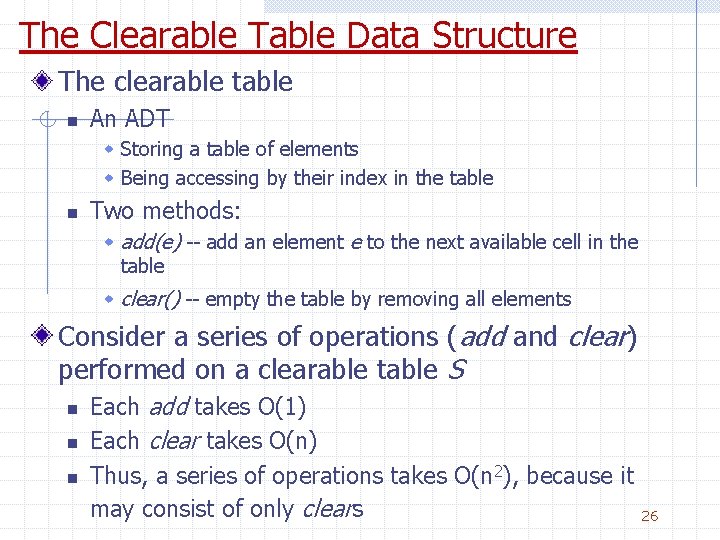
The Clearable Table Data Structure The clearable table n An ADT w Storing a table of elements w Being accessing by their index in the table n Two methods: w add(e) -- add an element e to the next available cell in the table w clear() -- empty the table by removing all elements Consider a series of operations (add and clear) performed on a clearable table S n n n Each add takes O(1) Each clear takes O(n) Thus, a series of operations takes O(n 2), because it may consist of only clears 26
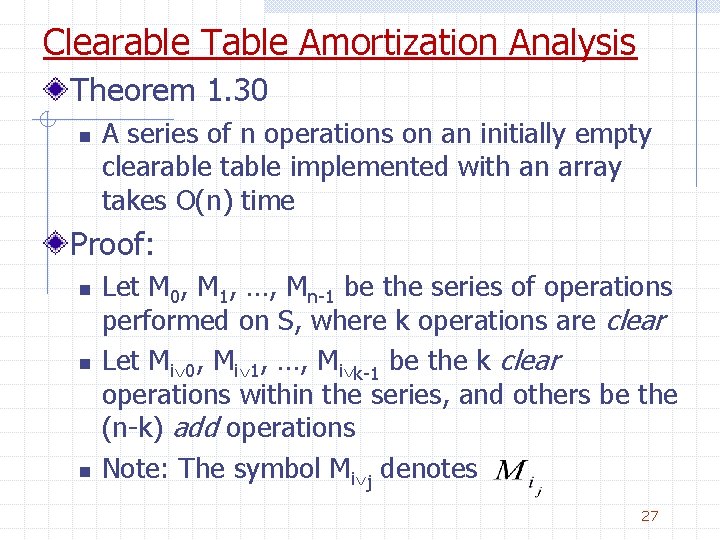
Clearable Table Amortization Analysis Theorem 1. 30 n A series of n operations on an initially empty clearable table implemented with an array takes O(n) time Proof: n n n Let M 0, M 1, …, Mn-1 be the series of operations performed on S, where k operations are clear Let Mi 0, Mi 1, …, Mi k-1 be the k clear operations within the series, and others be the (n-k) add operations Note: The symbol Mi j denotes 27
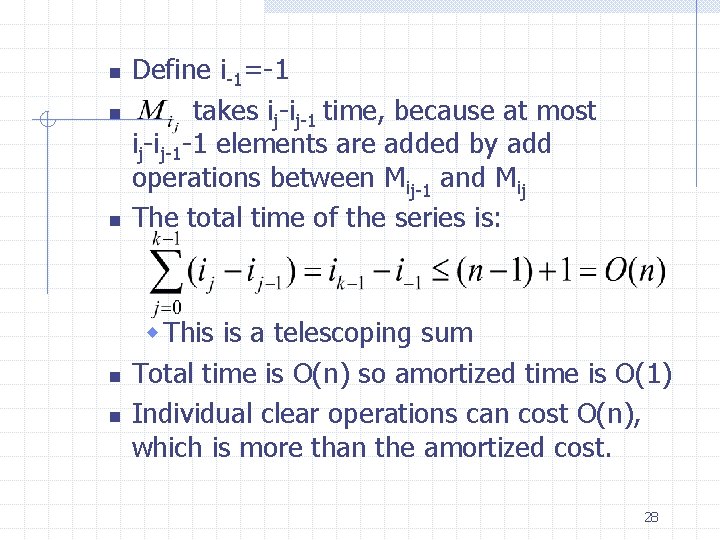
n n n Define i-1=-1 takes ij-ij-1 time, because at most ij-ij-1 -1 elements are added by add operations between Mij-1 and Mij The total time of the series is: w This is a telescoping sum Total time is O(n) so amortized time is O(1) Individual clear operations can cost O(n), which is more than the amortized cost. 28
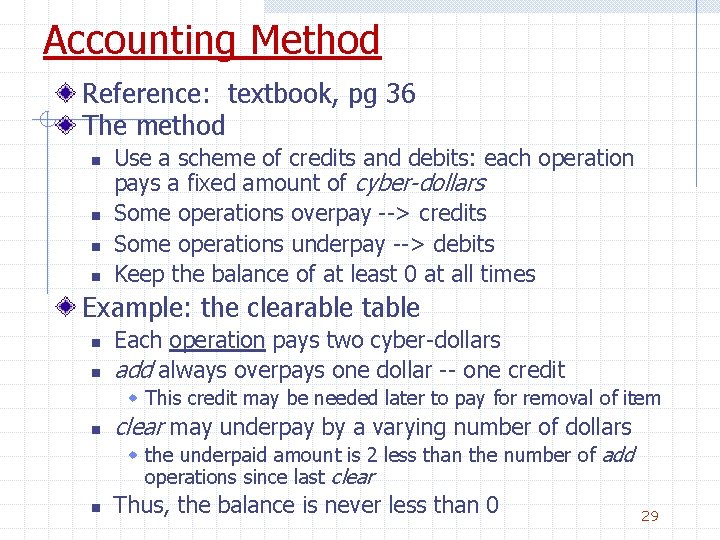
Accounting Method Reference: textbook, pg 36 The method n n Use a scheme of credits and debits: each operation pays a fixed amount of cyber-dollars Some operations overpay --> credits Some operations underpay --> debits Keep the balance of at least 0 at all times Example: the clearable table n n Each operation pays two cyber-dollars add always overpays one dollar -- one credit w This credit may be needed later to pay for removal of item n clear may underpay by a varying number of dollars w the underpaid amount is 2 less than the number of add operations since last clear n Thus, the balance is never less than 0 29
Accounting Method n (cont. ) The total cost for a sequence of n operations is 2 n and amortized cost is 2 w There may be some credits remaining at the end n It is often convenient to think of the cyber dollar profit in an add operation being stored in the data structure along with the element added. w This dollar is available to pay for the later possible removal of this element. n n The element is not actually stored in the data structure, so the data structure does not have to be altered. The worst case occurs when there are n-1 add operations and a single clear operation. w There are 2 remaining cyberdollars in this case 30
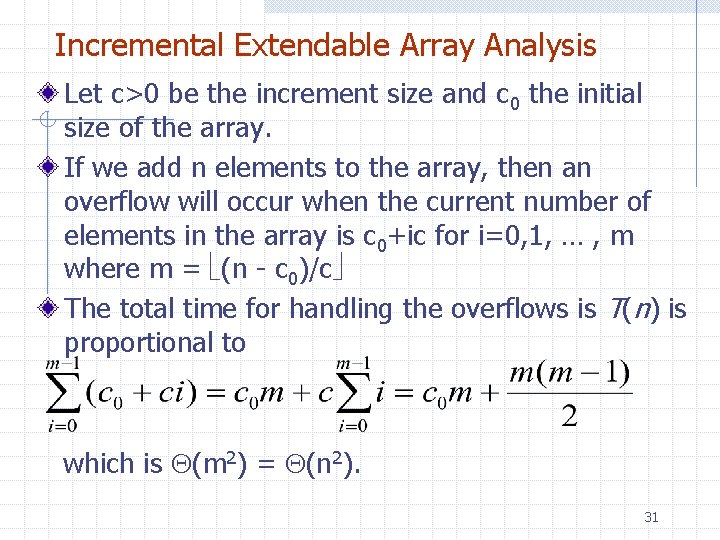
Incremental Extendable Array Analysis Let c>0 be the increment size and c 0 the initial size of the array. If we add n elements to the array, then an overflow will occur when the current number of elements in the array is c 0+ic for i=0, 1, … , m where m = (n - c 0)/c The total time for handling the overflows is T(n) is proportional to which is (m 2) = (n 2). 31
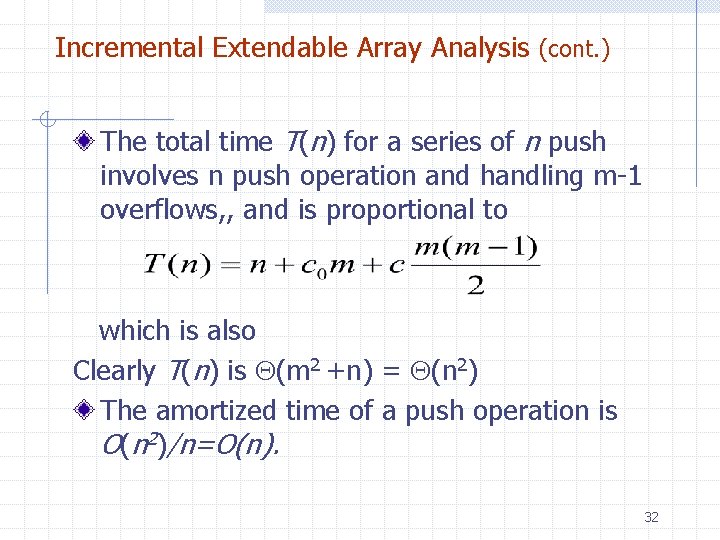
Incremental Extendable Array Analysis (cont. ) The total time T(n) for a series of n push involves n push operation and handling m-1 overflows, , and is proportional to which is also Clearly T(n) is (m 2 +n) = (n 2) The amortized time of a push operation is O(n 2)/n=O(n). 32
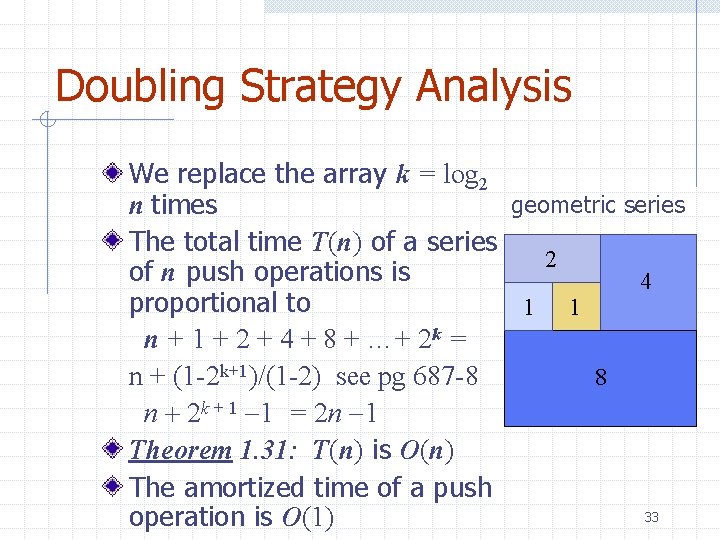
Doubling Strategy Analysis We replace the array k = log 2 geometric series n times The total time T(n) of a series 2 of n push operations is 4 proportional to 1 1 n + 1 + 2 + 4 + 8 + …+ 2 k = 8 n + (1 -2 k+1)/(1 -2) see pg 687 -8 n + 2 k + 1 1 = 2 n 1 Theorem 1. 31: T(n) is O(n) The amortized time of a push 33 operation is O(1)
Amortization Scheme for the Doubling Strategy Consider again the k phases, where each phase consisting of twice as many pushes as the one before. At the end of a phase we must have saved enough to pay for the array-growing push of the next phase. At the end of phase i, we want to have saved i cyber-dollars, to pay for the array growth for the beginning of the next phase. Can we do this? 34
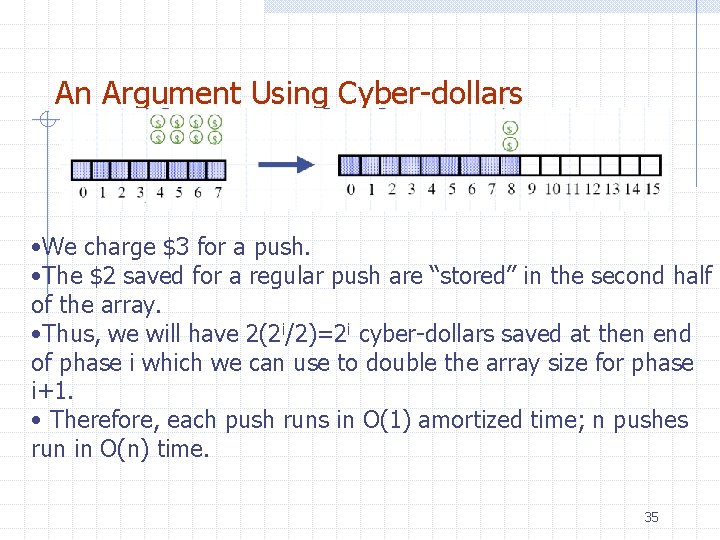
An Argument Using Cyber-dollars • We charge $3 for a push. • The $2 saved for a regular push are “stored” in the second half of the array. • Thus, we will have 2(2 i/2)=2 i cyber-dollars saved at then end of phase i which we can use to double the array size for phase i+1. • Therefore, each push runs in O(1) amortized time; n pushes run in O(n) time. 35
Queues
The Queue ADT stores arbitrary objects Insertions and deletions follow the first-in first-out scheme Insertions are at the rear of the queue and removals are at the front of the queue Main queue operations: n n enqueue(object): inserts an element at the end of the queue object dequeue(): removes and returns the element at the front of the queue Auxiliary queue operations: n n n object front(): returns the element at the front without removing it integer size(): returns the number of elements stored boolean is. Empty(): indicates whether no elements are stored Exceptions n Attempting the execution of dequeue or front on an empty queue throws an Empty. Queue. Exception 37
Applications of Queues Direct applications n n n Waiting lists, bureaucracy Access to shared resources (e. g. , printer) Multiprogramming Indirect applications n n Auxiliary data structure for algorithms Component of other data structures 38
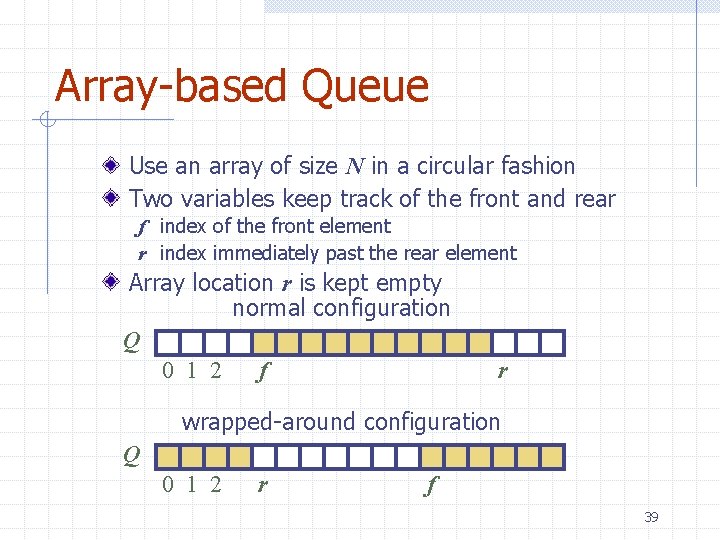
Array-based Queue Use an array of size N in a circular fashion Two variables keep track of the front and rear f index of the front element r index immediately past the rear element Array location r is kept empty normal configuration Q 0 1 2 f r wrapped-around configuration Q 0 1 2 r f 39
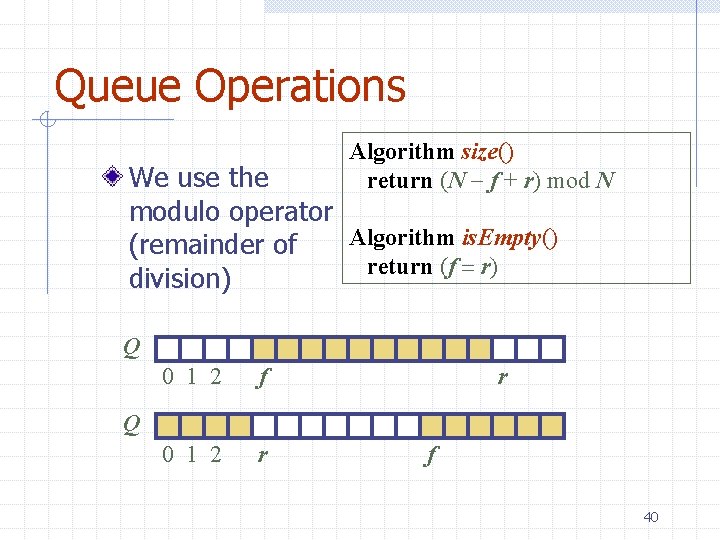
Queue Operations Algorithm size() return (N f + r) mod N We use the modulo operator Algorithm is. Empty() (remainder of return (f = r) division) Q 0 1 2 f 0 1 2 r r Q f 40
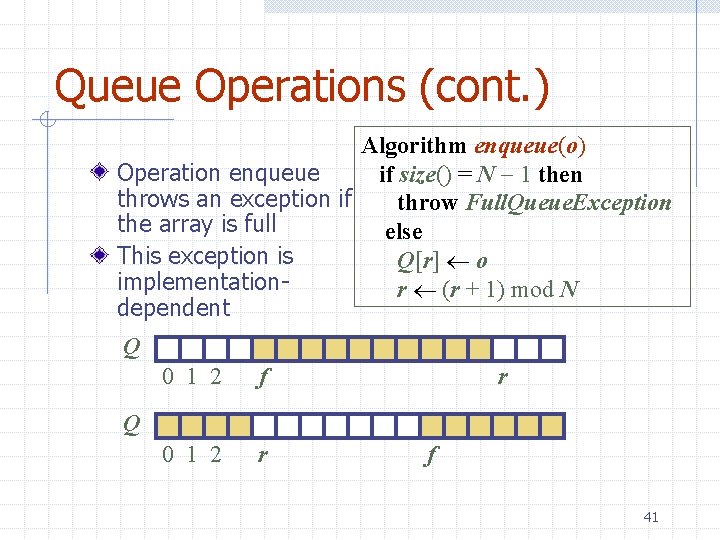
Queue Operations (cont. ) Algorithm enqueue(o) Operation enqueue if size() = N 1 then throws an exception if throw Full. Queue. Exception the array is full else This exception is Q[r] o implementationr (r + 1) mod N dependent Q 0 1 2 f 0 1 2 r r Q f 41
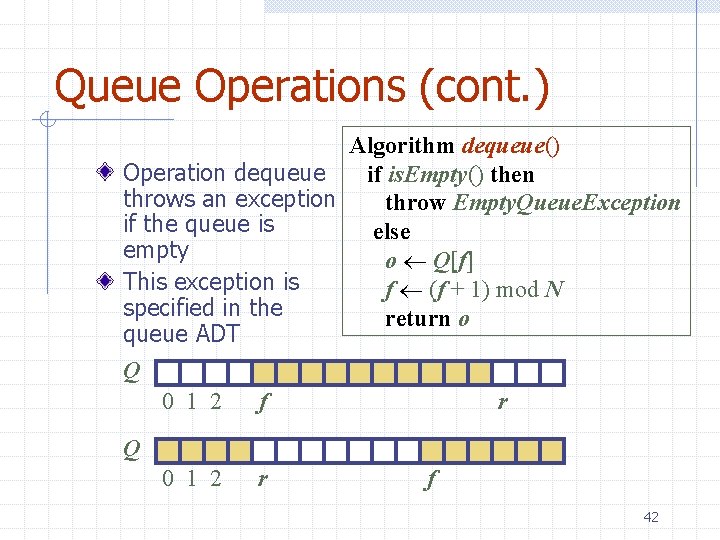
Queue Operations (cont. ) Algorithm dequeue() Operation dequeue if is. Empty() then throws an exception throw Empty. Queue. Exception if the queue is else empty o Q[f] This exception is f (f + 1) mod N specified in the return o queue ADT Q 0 1 2 f 0 1 2 r r Q f 42
Growable Array-based Queue In an enqueue operation, when the array is full, instead of throwing an exception, we can replace the array with a larger one Similar to what we did for an arraybased stack The enqueue operation has amortized running time n n O(n) with the incremental strategy O(1) with the doubling strategy 43
Vectors
The Vector ADT extends the notion of array by storing a sequence of arbitrary objects An element can be accessed, inserted or removed by specifying its rank (number of elements preceding it) An exception is thrown if an incorrect rank is specified (e. g. , a negative rank) Main vector operations: n object elem. At. Rank(integer r): returns the element at rank r without removing it n object replace. At. Rank(integer r, object o): replace the element at rank with o and return the old element n insert. At. Rank(integer r, object o): insert a new element o to have rank r n object remove. At. Rank(integer r): removes and returns the element at rank r Additional operations size() and is. Empty() 45
Applications of Vectors Direct applications n Sorted collection of objects (elementary database) Indirect applications n n Auxiliary data structure for algorithms Component of other data structures 46
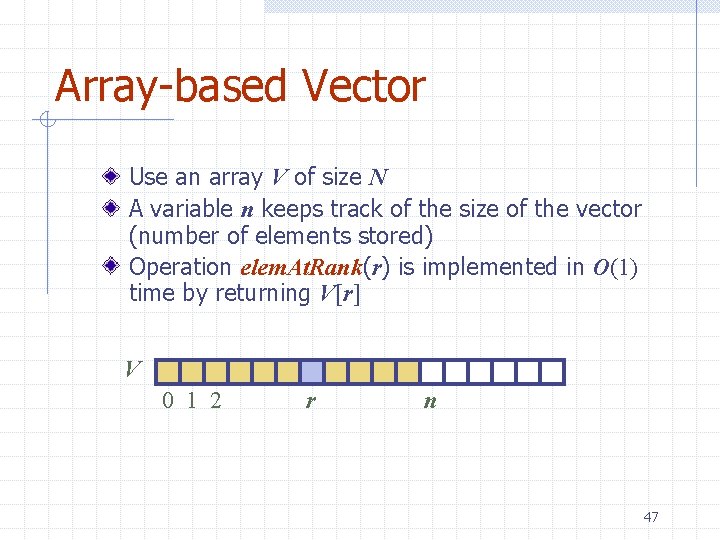
Array-based Vector Use an array V of size N A variable n keeps track of the size of the vector (number of elements stored) Operation elem. At. Rank(r) is implemented in O(1) time by returning V[r] V 0 1 2 r n 47
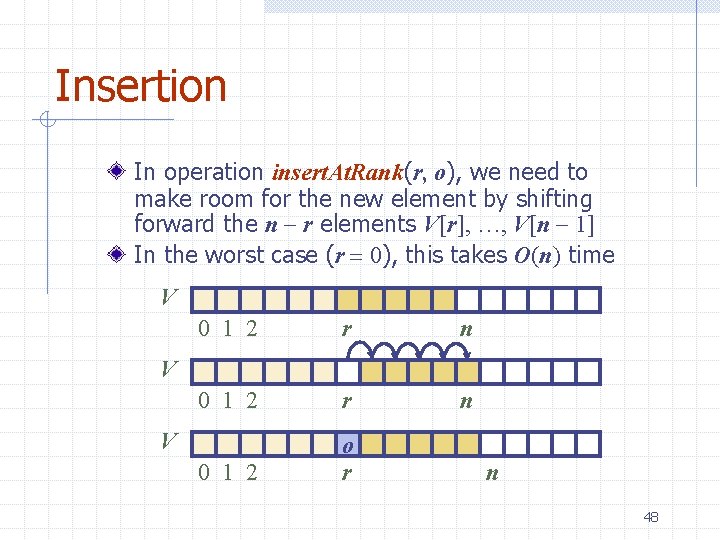
Insertion In operation insert. At. Rank(r, o), we need to make room for the new element by shifting forward the n r elements V[r], …, V[n 1] In the worst case (r = 0), this takes O(n) time V 0 1 2 r n 0 1 2 o r V V n 48
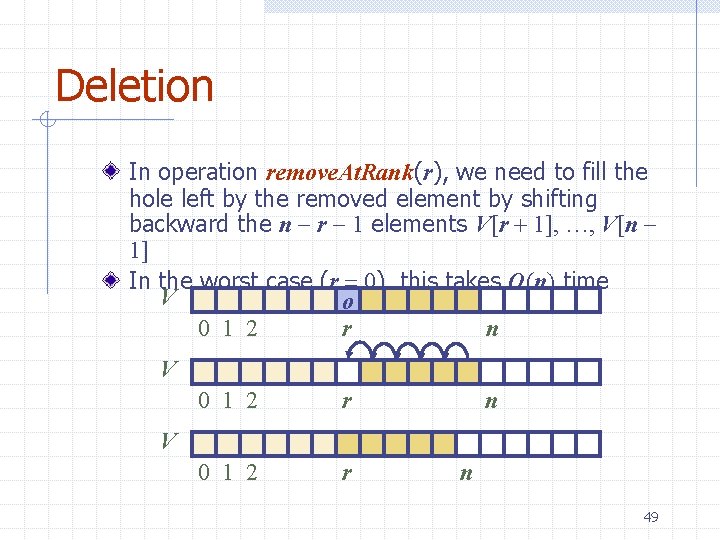
Deletion In operation remove. At. Rank(r), we need to fill the hole left by the removed element by shifting backward the n r 1 elements V[r + 1], …, V[n 1] In the worst case (r = 0), this takes O(n) time V o 0 1 2 n r V 0 1 2 r n V n 49
Performance In the array based implementation of a Vector n n n The space used by the data structure is O(n) size, is. Empty, elem. At. Rank and replace. At. Rank run in O(1) time insert. At. Rank and remove. At. Rank run in O(n) time If we use the array in a circular fashion, insert. At. Rank(0) and remove. At. Rank(0) run in O(1) time In an insert. At. Rank operation, when the array is full, instead of throwing an exception, we can replace the array with a larger one 50
Lists and Sequences
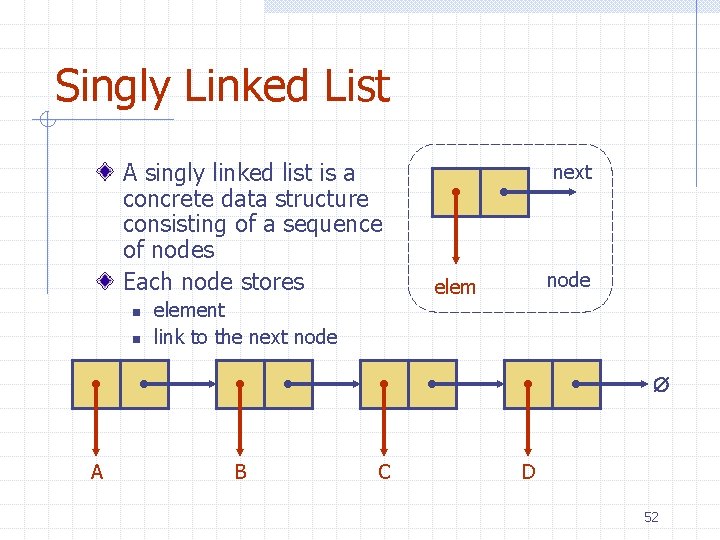
Singly Linked List A singly linked list is a concrete data structure consisting of a sequence of nodes Each node stores n n element link to the next node elem A B C D 52
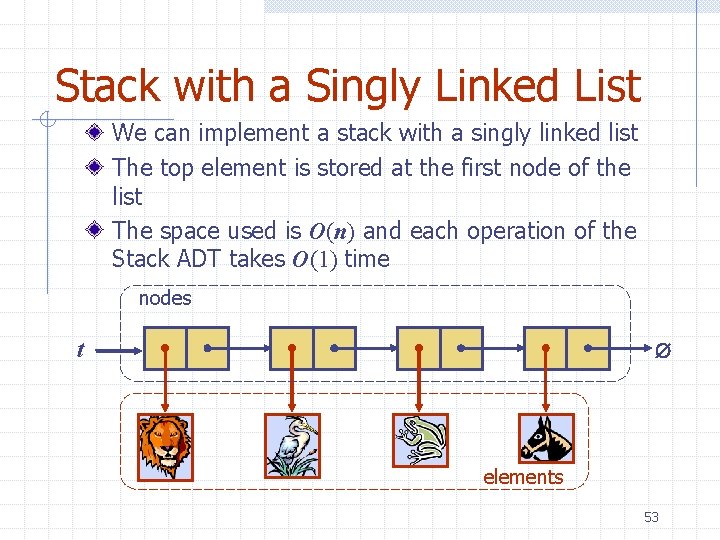
Stack with a Singly Linked List We can implement a stack with a singly linked list The top element is stored at the first node of the list The space used is O(n) and each operation of the Stack ADT takes O(1) time nodes t elements 53
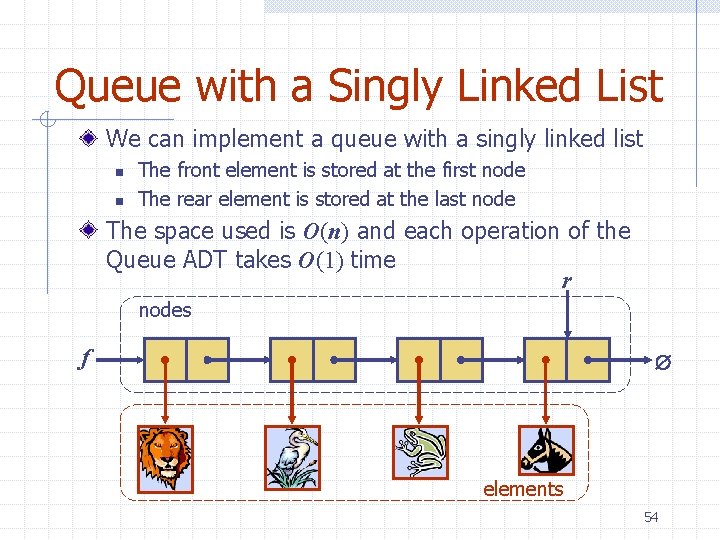
Queue with a Singly Linked List We can implement a queue with a singly linked list n n The front element is stored at the first node The rear element is stored at the last node The space used is O(n) and each operation of the Queue ADT takes O(1) time r nodes f elements 54
Position ADT The Position ADT models the notion of the place within a data structure where a single object is stored It gives a unified view of diverse ways of storing data, such as n n a cell of an array a node of a linked list Just one method: n object element(): returns the element stored at the position 55
List ADT The List ADT models a sequence of positions storing arbitrary objects It establishes a before/after relation between positions Generic methods: n size(), is. Empty() Query methods: n is. First(p), is. Last(p) Accessor methods: n n first(), last() before(p), after(p) Update methods: n n replace. Element(p, o), swap. Elements(p, q) insert. Before(p, o), insert. After(p, o), insert. First(o), insert. Last(o) remove(p) 56
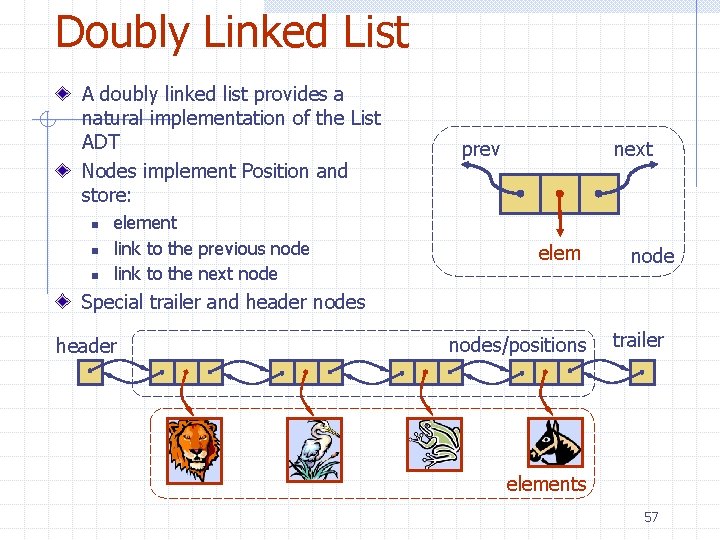
Doubly Linked List A doubly linked list provides a natural implementation of the List ADT Nodes implement Position and store: n n n element link to the previous node link to the next node prev next elem node Special trailer and header nodes/positions trailer elements 57
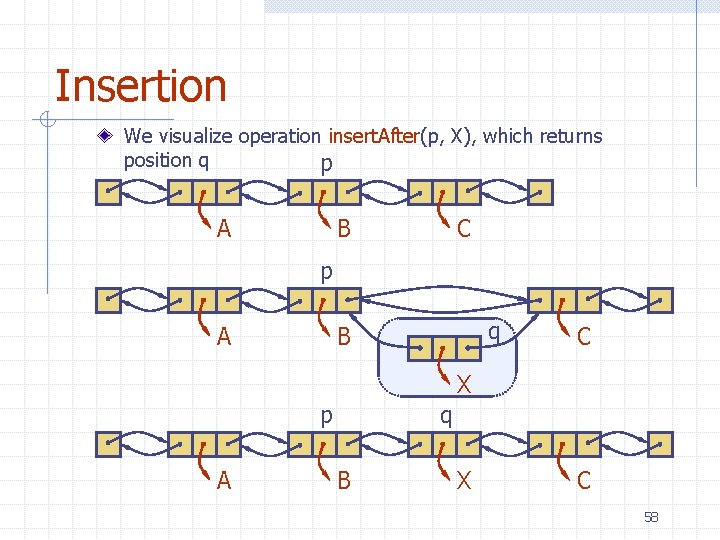
Insertion We visualize operation insert. After(p, X), which returns position q p A B C p A q B C X p A q B X C 58
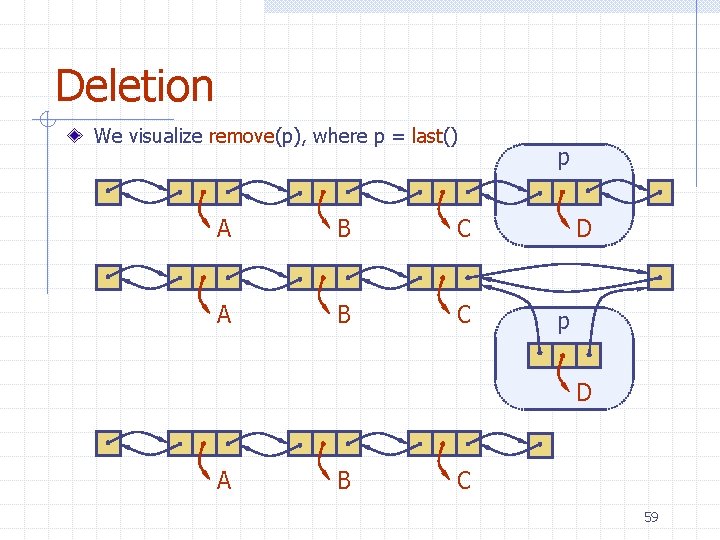
Deletion We visualize remove(p), where p = last() A B C p D A B C 59
Performance In the implementation of the List ADT by means of a doubly linked list n n The space used by a list with n elements is O(n) The space used by each position of the list is O(1) All the operations of the List ADT run in O(1) time Operation element() of the Position ADT runs in O(1) time 60
Sequence ADT The Sequence ADT is the union of the Vector and List ADTs Elements accessed by n n List-based methods: n Rank, or Position Generic methods: n size(), is. Empty() Vector-based methods: n elem. At. Rank(r), replace. At. Rank(r, o), insert. At. Rank(r, o), remove. At. Rank(r) first(), last(), before(p), after(p), replace. Element(p, o), swap. Elements(p, q), insert. Before(p, o), insert. After(p, o), insert. First(o), insert. Last(o), remove(p) Bridge methods: n at. Rank(r), rank. Of(p) 61
Applications of Sequences The Sequence ADT is a basic, generalpurpose, data structure for storing an ordered collection of elements Direct applications: n n Generic replacement for stack, queue, vector, or list small database (e. g. , address book) Indirect applications: n Building block of more complex data structures 62
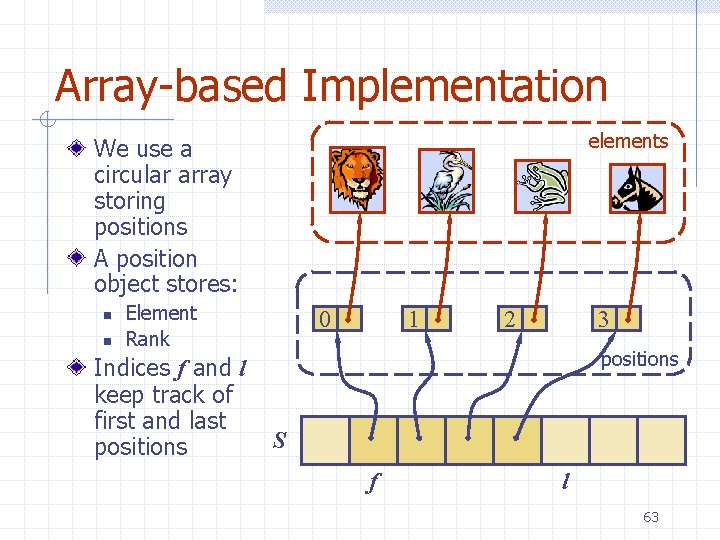
Array-based Implementation elements We use a circular array storing positions A position object stores: n n Element Rank Indices f and l keep track of first and last positions 0 1 2 3 positions S f l 63
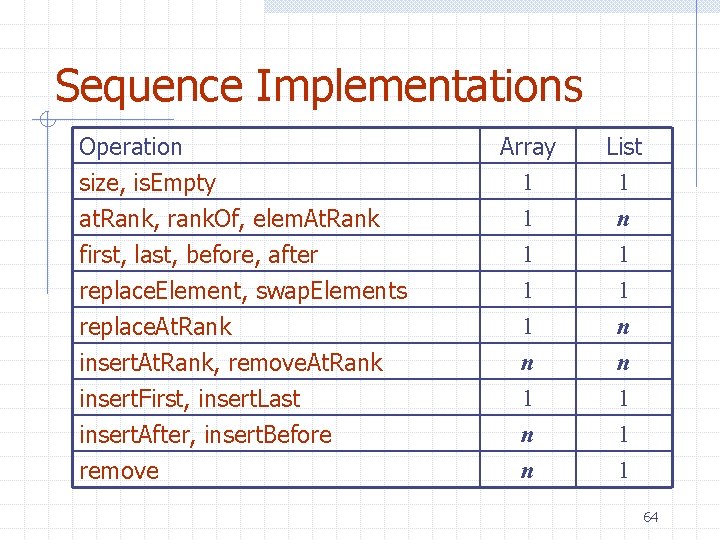
Sequence Implementations Operation size, is. Empty at. Rank, rank. Of, elem. At. Rank first, last, before, after replace. Element, swap. Elements replace. At. Rank insert. At. Rank, remove. At. Rank insert. First, insert. Last insert. After, insert. Before remove Array 1 1 1 List 1 n 1 1 1 n n 1 1 1 64
Iterators An iterator abstracts the process of scanning through a collection of elements Methods of the Object. Iterator ADT: n n object() boolean has. Next() object next. Object() reset() Extends the concept of Position by adding a traversal capability Implementation with an array or singly linked list An iterator is typically associated with an another data structure We can augment the Stack, Queue, Vector, List and Sequence ADTs with method: n Object. Iterator elements() Two notions of iterator: n n snapshot: freezes the contents of the data structure at a given time dynamic: follows changes to the data structure 65
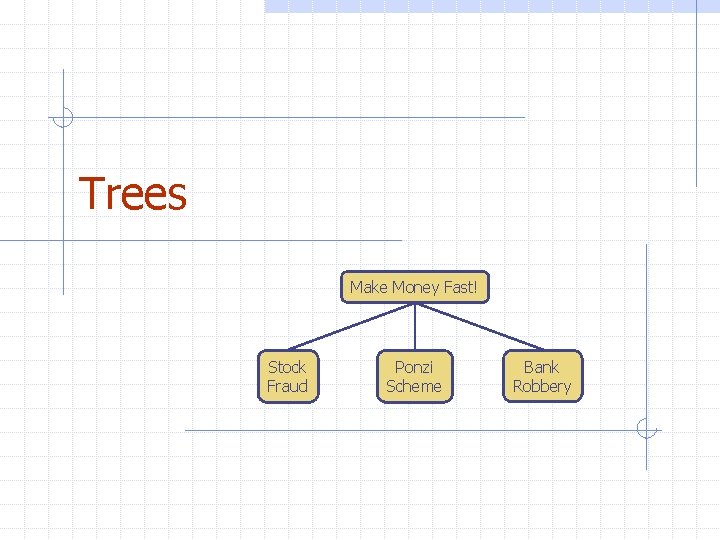
Trees Make Money Fast! Stock Fraud Ponzi Scheme Bank Robbery
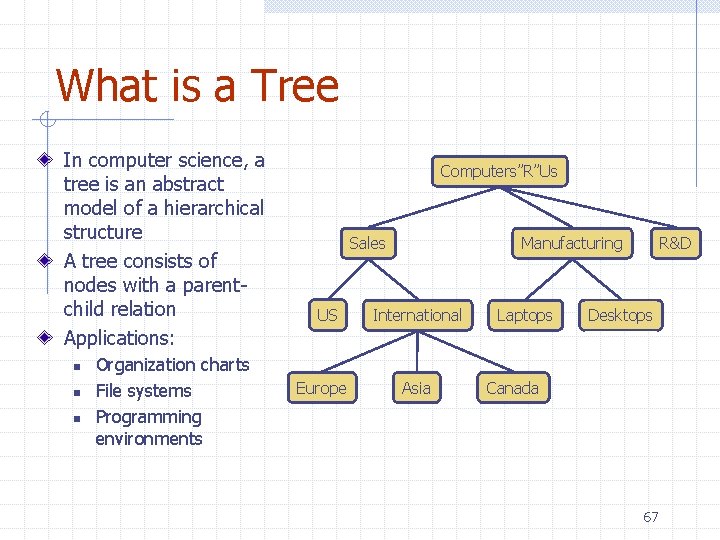
What is a Tree In computer science, a tree is an abstract model of a hierarchical structure A tree consists of nodes with a parentchild relation Applications: n n n Organization charts File systems Programming environments Computers”R”Us Sales US Europe Manufacturing International Asia Laptops R&D Desktops Canada 67
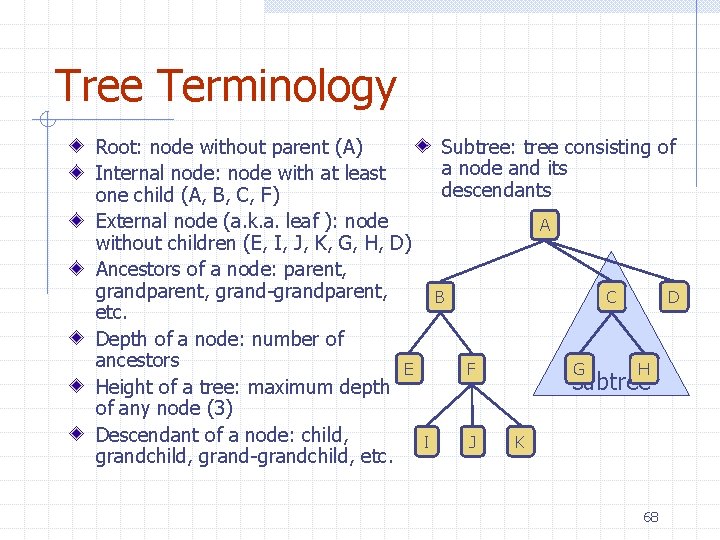
Tree Terminology Root: node without parent (A) Internal node: node with at least one child (A, B, C, F) External node (a. k. a. leaf ): node without children (E, I, J, K, G, H, D) Ancestors of a node: parent, grand-grandparent, etc. Depth of a node: number of ancestors E Height of a tree: maximum depth of any node (3) Descendant of a node: child, grand-grandchild, etc. Subtree: tree consisting of a node and its descendants A B C F I J G D H subtree K 68
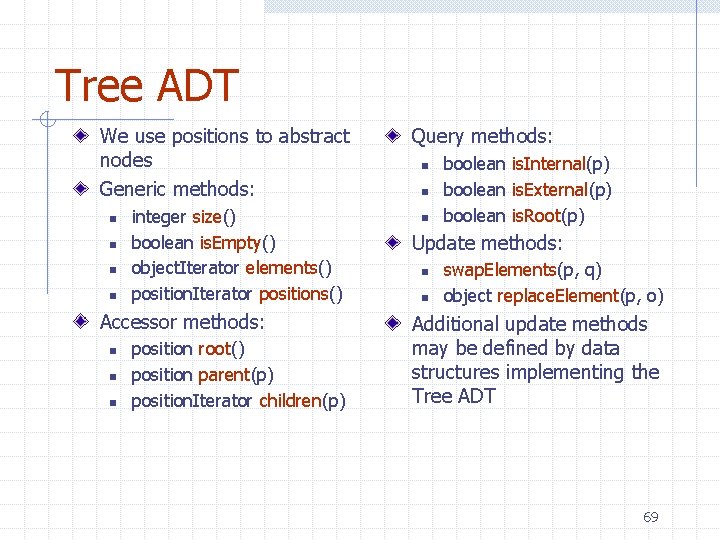
Tree ADT We use positions to abstract nodes Generic methods: n n integer size() boolean is. Empty() object. Iterator elements() position. Iterator positions() Accessor methods: n n n position root() position parent(p) position. Iterator children(p) Query methods: n n n boolean is. Internal(p) boolean is. External(p) boolean is. Root(p) Update methods: n n swap. Elements(p, q) object replace. Element(p, o) Additional update methods may be defined by data structures implementing the Tree ADT 69
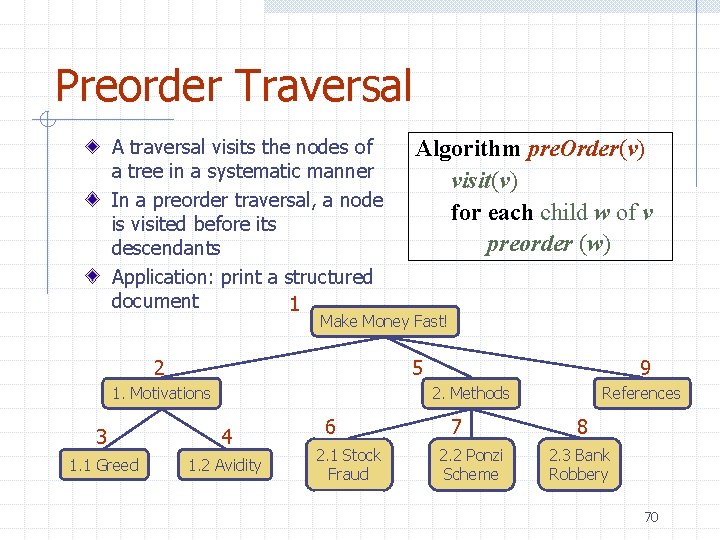
Preorder Traversal A traversal visits the nodes of a tree in a systematic manner In a preorder traversal, a node is visited before its descendants Application: print a structured document 1 Algorithm pre. Order(v) visit(v) for each child w of v preorder (w) Make Money Fast! 2 5 1. Motivations 9 2. Methods 3 4 1. 1 Greed 1. 2 Avidity 6 2. 1 Stock Fraud 7 2. 2 Ponzi Scheme References 8 2. 3 Bank Robbery 70
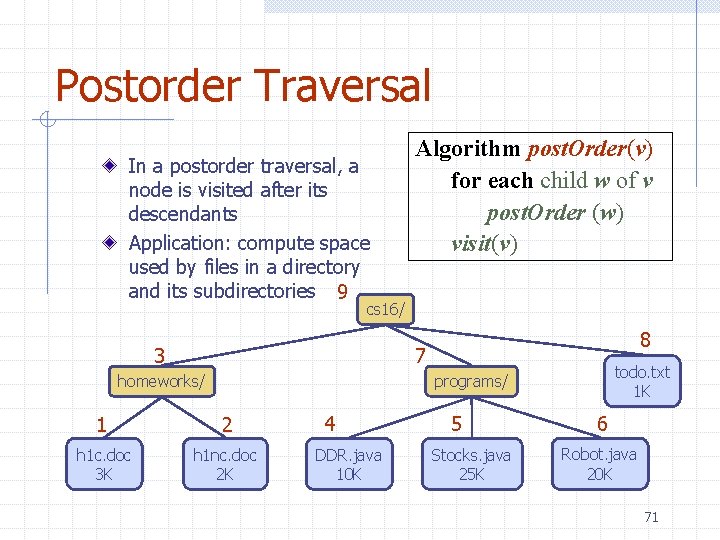
Postorder Traversal In a postorder traversal, a node is visited after its descendants Application: compute space used by files in a directory and its subdirectories 9 Algorithm post. Order(v) for each child w of v post. Order (w) visit(v) cs 16/ 3 8 7 homeworks/ todo. txt 1 K programs/ 1 2 h 1 c. doc 3 K h 1 nc. doc 2 K 4 DDR. java 10 K 5 Stocks. java 25 K 6 Robot. java 20 K 71
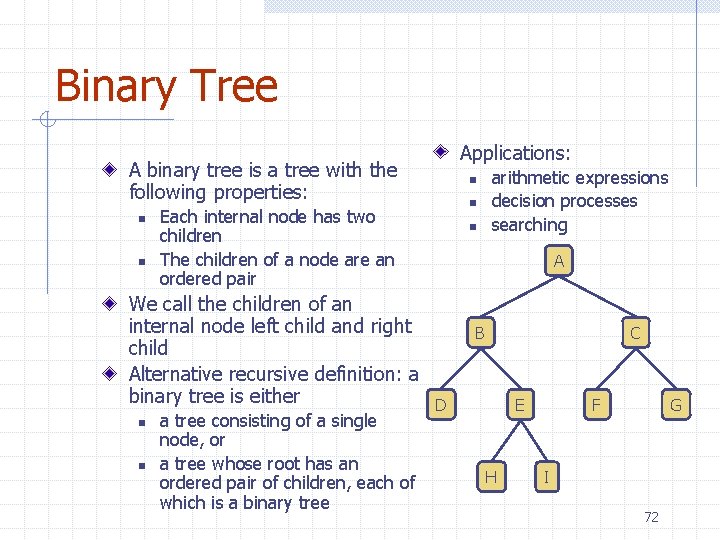
Binary Tree Applications: A binary tree is a tree with the following properties: n n Each internal node has two children The children of a node are an ordered pair We call the children of an internal node left child and right child Alternative recursive definition: a binary tree is either n n a tree consisting of a single node, or a tree whose root has an ordered pair of children, each of which is a binary tree n arithmetic expressions decision processes searching A B C D F E H G I 72
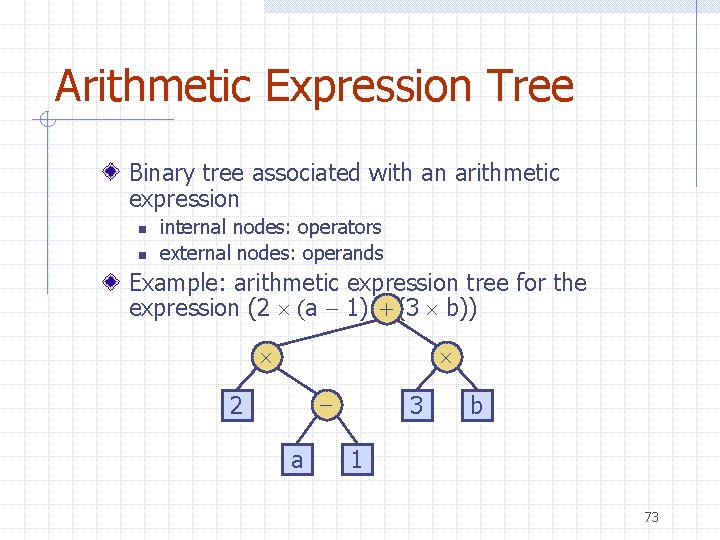
Arithmetic Expression Tree Binary tree associated with an arithmetic expression n n internal nodes: operators external nodes: operands Example: arithmetic expression tree for the expression (2 (a 1) ++ (3 b)) 2 a 3 b 1 73
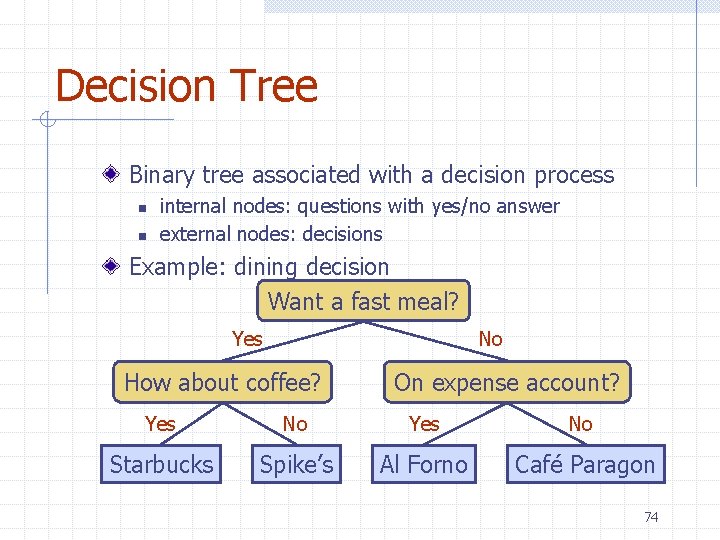
Decision Tree Binary tree associated with a decision process n n internal nodes: questions with yes/no answer external nodes: decisions Example: dining decision Want a fast meal? No Yes How about coffee? On expense account? Yes No Starbucks Spike’s Al Forno Café Paragon 74
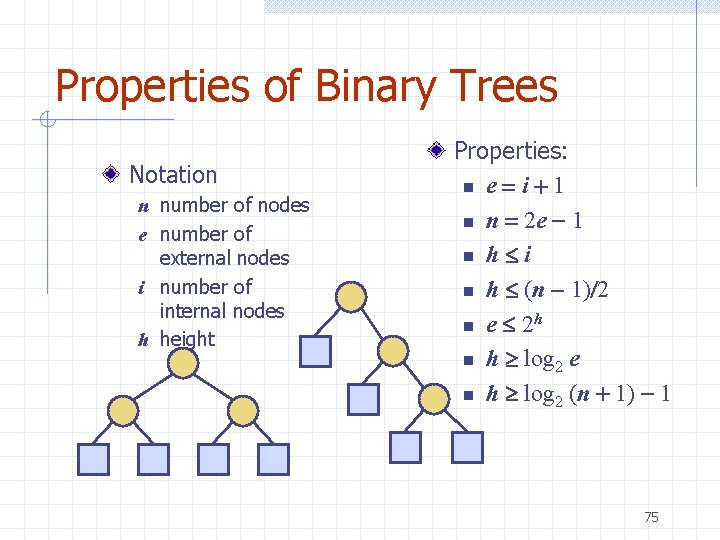
Properties of Binary Trees Notation n number of nodes e number of external nodes i number of internal nodes h height Properties: n e = i + 1 n n = 2 e - 1 n h i n h (n - 1)/2 n e 2 h n h log 2 e n h log 2 (n + 1) - 1 75
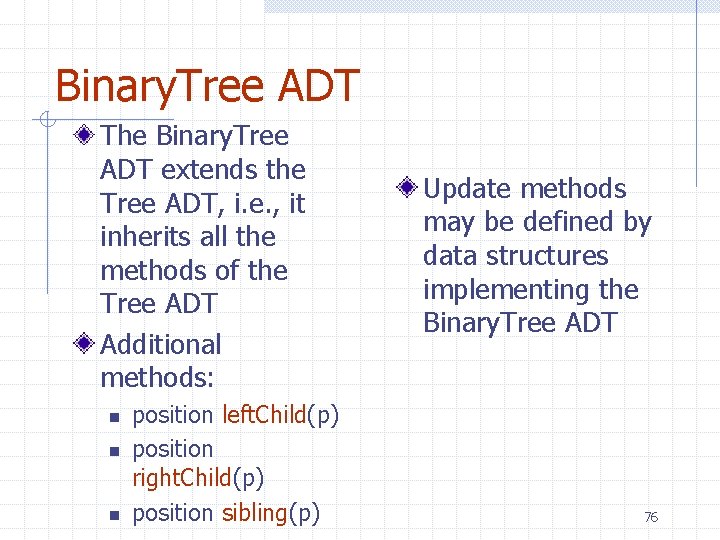
Binary. Tree ADT The Binary. Tree ADT extends the Tree ADT, i. e. , it inherits all the methods of the Tree ADT Additional methods: n n n position left. Child(p) position right. Child(p) position sibling(p) Update methods may be defined by data structures implementing the Binary. Tree ADT 76
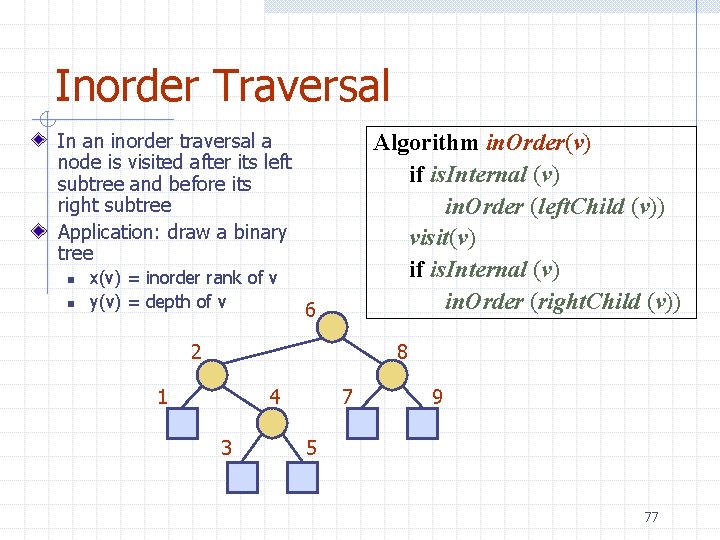
Inorder Traversal In an inorder traversal a node is visited after its left subtree and before its right subtree Application: draw a binary tree n n x(v) = inorder rank of v y(v) = depth of v Algorithm in. Order(v) if is. Internal (v) in. Order (left. Child (v)) visit(v) if is. Internal (v) in. Order (right. Child (v)) 6 2 8 1 4 3 7 9 5 77
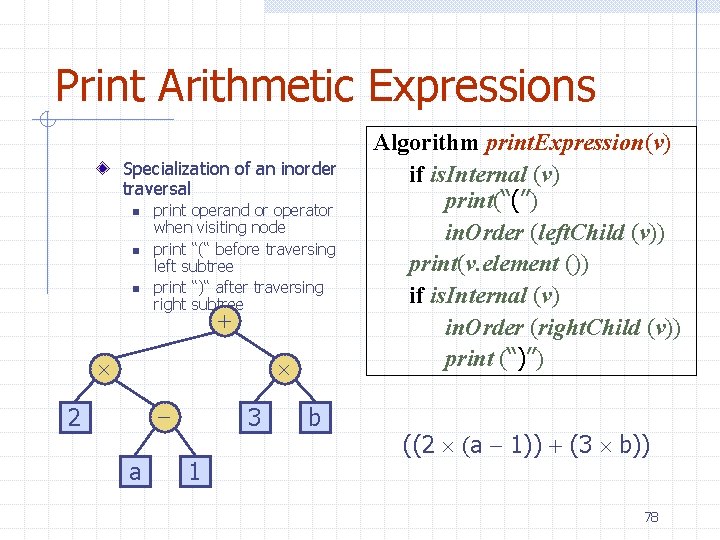
Print Arithmetic Expressions Specialization of an inorder traversal n n n print operand or operator when visiting node print “(“ before traversing left subtree print “)“ after traversing right subtree + 2 a 3 1 b Algorithm print. Expression(v) if is. Internal (v) print(“(’’) in. Order (left. Child (v)) print(v. element ()) if is. Internal (v) in. Order (right. Child (v)) print (“)’’) ((2 (a 1)) + (3 b)) 78
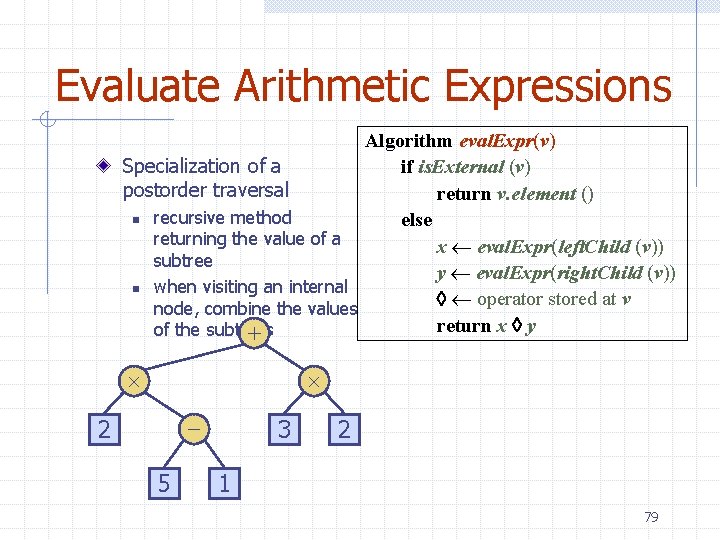
Evaluate Arithmetic Expressions Algorithm eval. Expr(v) if is. External (v) Specialization of a postorder traversal return v. element () n recursive method else returning the value of a x eval. Expr(left. Child (v)) subtree y eval. Expr(right. Child (v)) n when visiting an internal operator stored at v node, combine the values return x y of the subtrees + 2 5 3 2 1 79
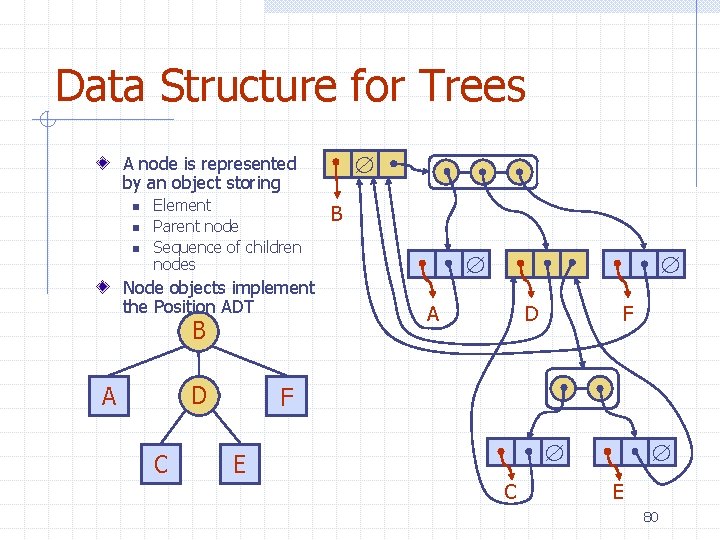
Data Structure for Trees A node is represented by an object storing n n n Element Parent node Sequence of children nodes Node objects implement the Position ADT B D A C B A D F F E C E 80
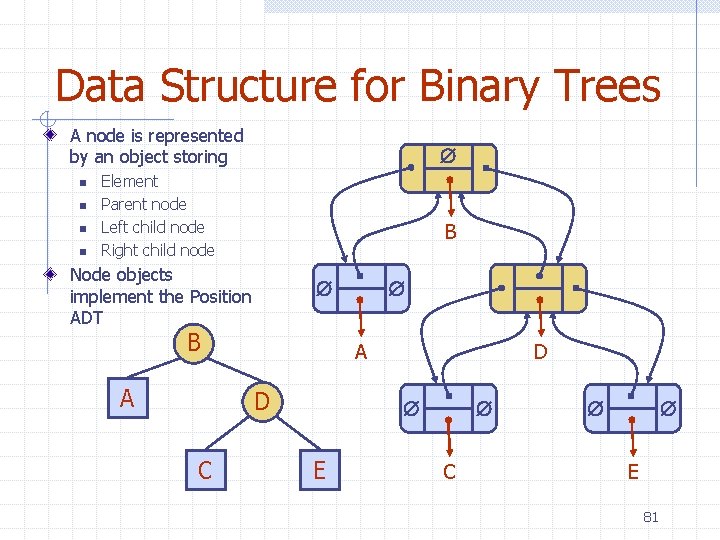
Data Structure for Binary Trees A node is represented by an object storing n n Element Parent node Left child node Right child node B Node objects implement the Position ADT B A A D C D E C E 81
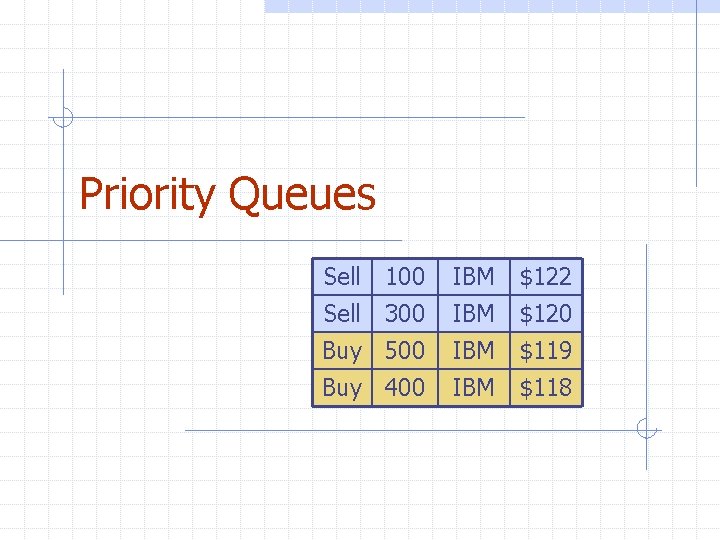
Priority Queues Sell 100 IBM $122 Sell 300 IBM $120 Buy 500 IBM $119 Buy 400 IBM $118
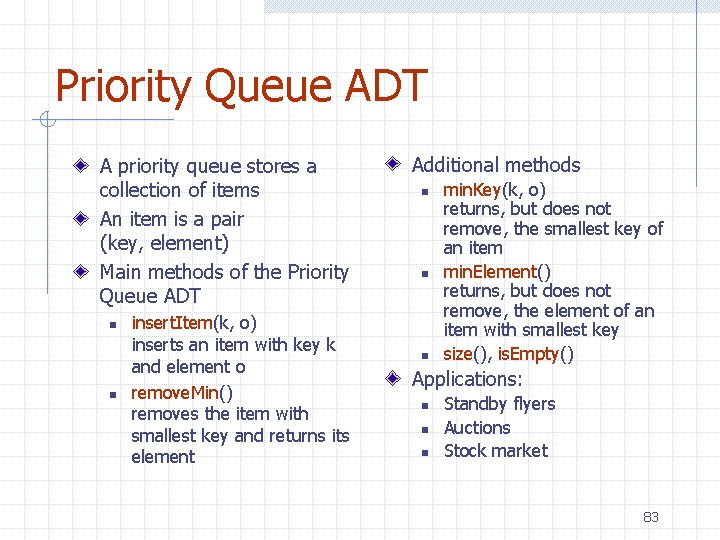
Priority Queue ADT A priority queue stores a collection of items An item is a pair (key, element) Main methods of the Priority Queue ADT n n insert. Item(k, o) inserts an item with key k and element o remove. Min() removes the item with smallest key and returns its element Additional methods n n n min. Key(k, o) returns, but does not remove, the smallest key of an item min. Element() returns, but does not remove, the element of an item with smallest key size(), is. Empty() Applications: n n n Standby flyers Auctions Stock market 83
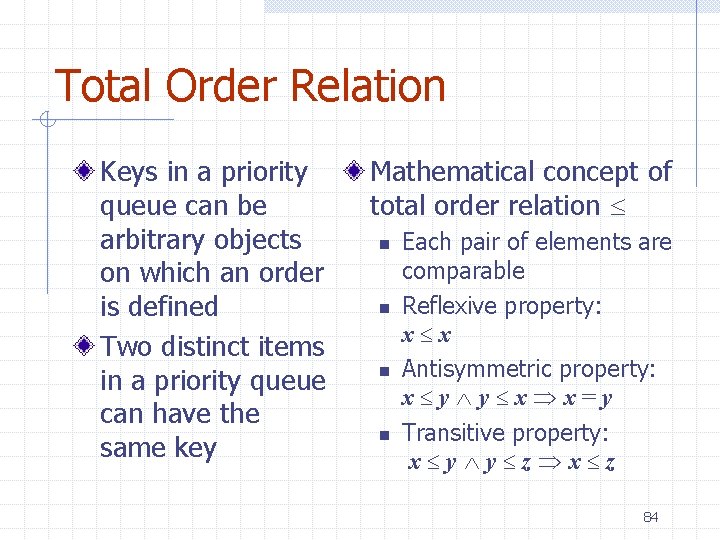
Total Order Relation Keys in a priority queue can be arbitrary objects on which an order is defined Two distinct items in a priority queue can have the same key Mathematical concept of total order relation n n Each pair of elements are comparable Reflexive property: x x Antisymmetric property: x y y x x=y Transitive property: x y y z x z 84
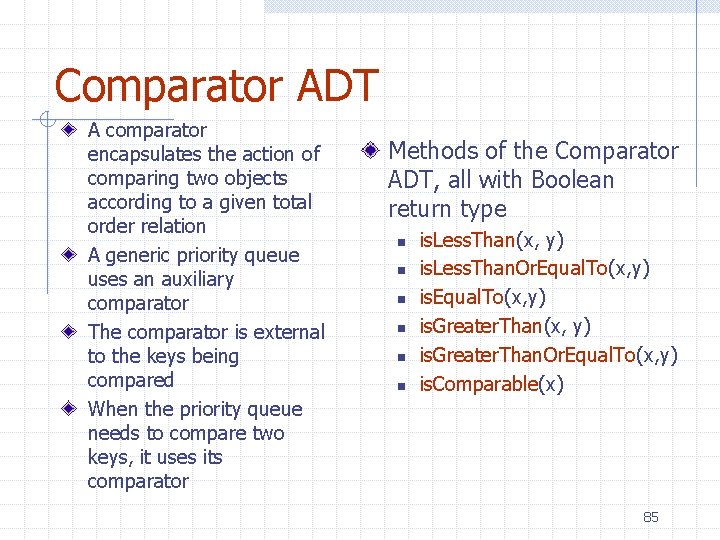
Comparator ADT A comparator encapsulates the action of comparing two objects according to a given total order relation A generic priority queue uses an auxiliary comparator The comparator is external to the keys being compared When the priority queue needs to compare two keys, it uses its comparator Methods of the Comparator ADT, all with Boolean return type n n n is. Less. Than(x, y) is. Less. Than. Or. Equal. To(x, y) is. Greater. Than(x, y) is. Greater. Than. Or. Equal. To(x, y) is. Comparable(x) 85
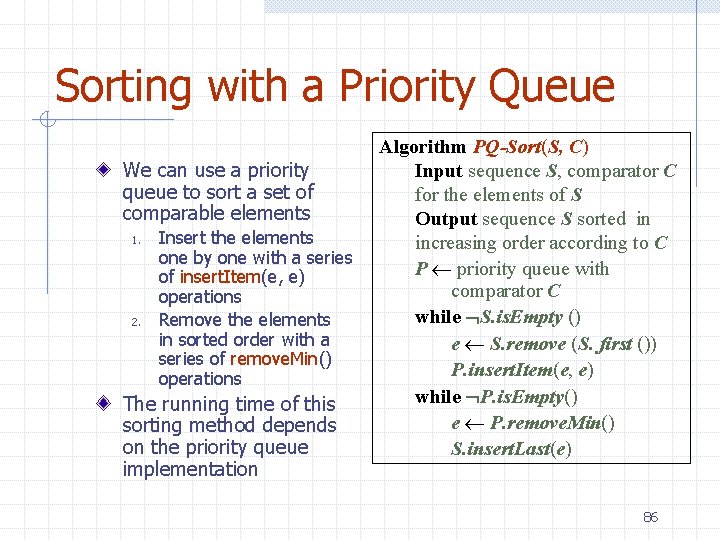
Sorting with a Priority Queue We can use a priority queue to sort a set of comparable elements 1. 2. Insert the elements one by one with a series of insert. Item(e, e) operations Remove the elements in sorted order with a series of remove. Min() operations The running time of this sorting method depends on the priority queue implementation Algorithm PQ-Sort(S, C) Input sequence S, comparator C for the elements of S Output sequence S sorted in increasing order according to C P priority queue with comparator C while S. is. Empty () e S. remove (S. first ()) P. insert. Item(e, e) while P. is. Empty() e P. remove. Min() S. insert. Last(e) 86
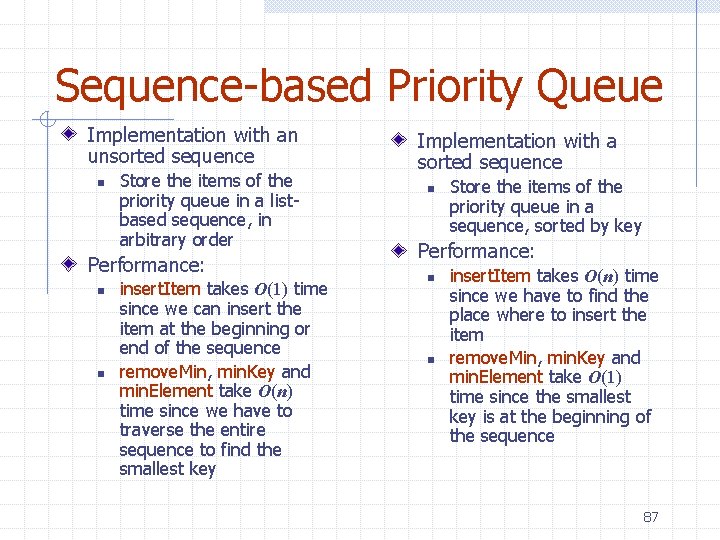
Sequence-based Priority Queue Implementation with an unsorted sequence n Store the items of the priority queue in a listbased sequence, in arbitrary order Performance: n n insert. Item takes O(1) time since we can insert the item at the beginning or end of the sequence remove. Min, min. Key and min. Element take O(n) time since we have to traverse the entire sequence to find the smallest key Implementation with a sorted sequence n Store the items of the priority queue in a sequence, sorted by key Performance: n n insert. Item takes O(n) time since we have to find the place where to insert the item remove. Min, min. Key and min. Element take O(1) time since the smallest key is at the beginning of the sequence 87
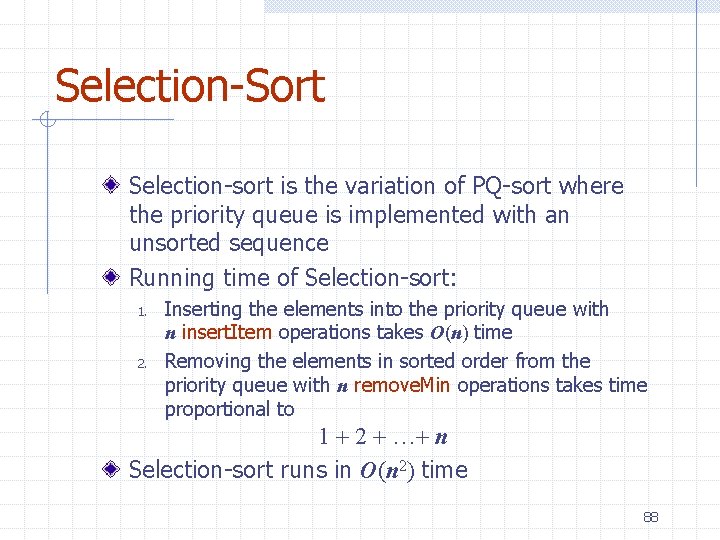
Selection-Sort Selection-sort is the variation of PQ-sort where the priority queue is implemented with an unsorted sequence Running time of Selection-sort: 1. 2. Inserting the elements into the priority queue with n insert. Item operations takes O(n) time Removing the elements in sorted order from the priority queue with n remove. Min operations takes time proportional to 1 + 2 + …+ n Selection-sort runs in O(n 2) time 88
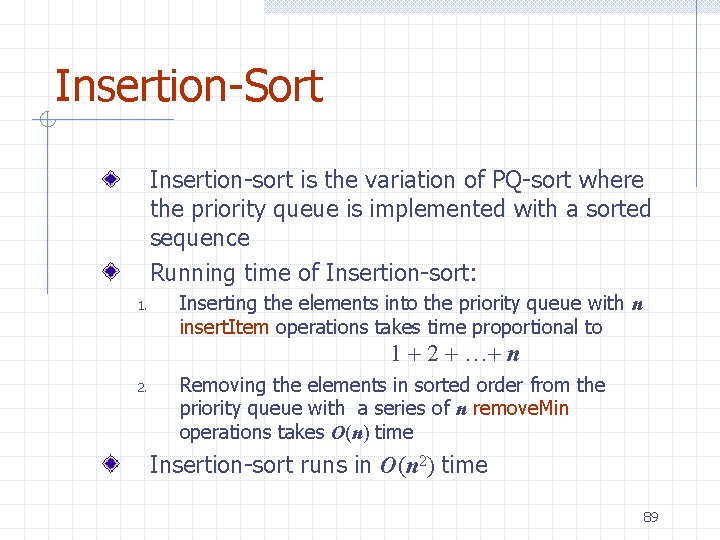
Insertion-Sort Insertion-sort is the variation of PQ-sort where the priority queue is implemented with a sorted sequence Running time of Insertion-sort: 1. Inserting the elements into the priority queue with n insert. Item operations takes time proportional to 1 + 2 + …+ n 2. Removing the elements in sorted order from the priority queue with a series of n remove. Min operations takes O(n) time Insertion-sort runs in O(n 2) time 89
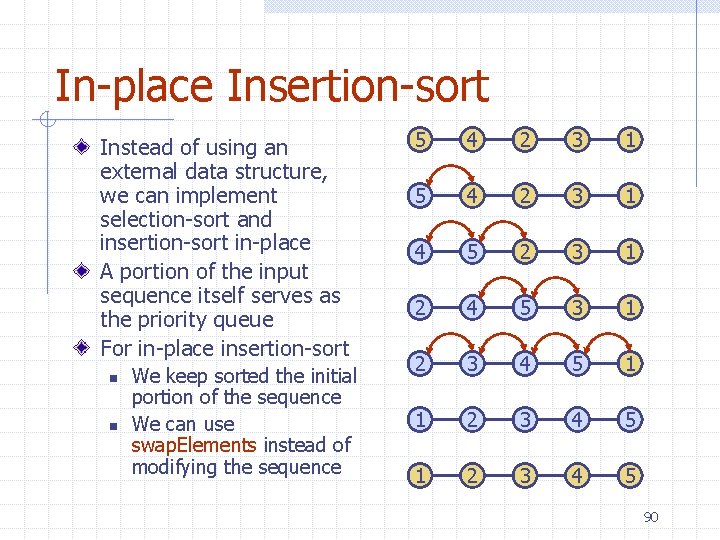
In-place Insertion-sort Instead of using an external data structure, we can implement selection-sort and insertion-sort in-place A portion of the input sequence itself serves as the priority queue For in-place insertion-sort n n We keep sorted the initial portion of the sequence We can use swap. Elements instead of modifying the sequence 5 4 2 3 1 4 5 2 3 1 2 4 5 3 1 2 3 4 5 90
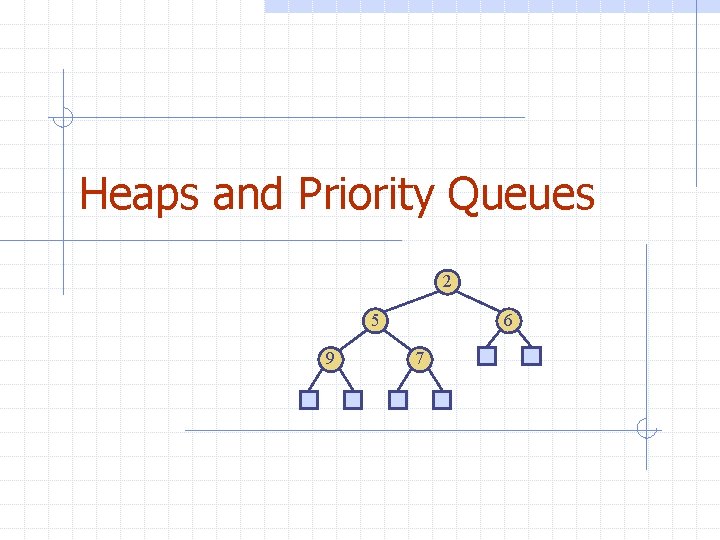
Heaps and Priority Queues 2 5 9 6 7
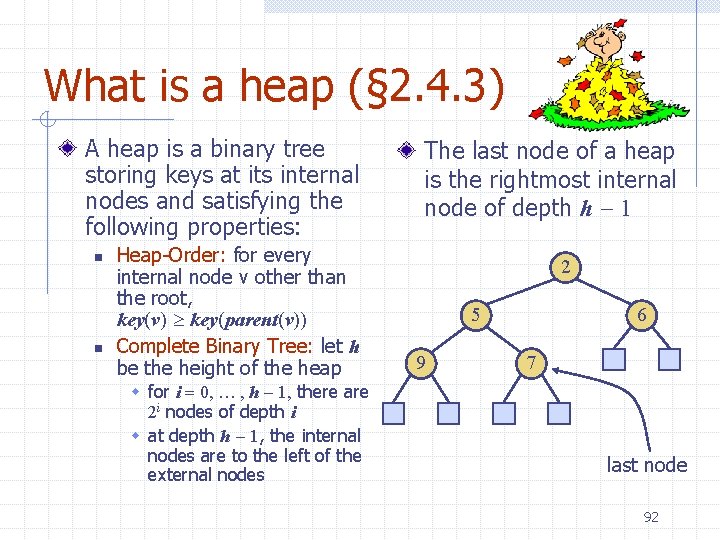
What is a heap (§ 2. 4. 3) A heap is a binary tree storing keys at its internal nodes and satisfying the following properties: n n Heap-Order: for every internal node v other than the root, key(v) key(parent(v)) Complete Binary Tree: let h be the height of the heap w for i = 0, … , h 1, there are 2 i nodes of depth i w at depth h 1, the internal nodes are to the left of the external nodes The last node of a heap is the rightmost internal node of depth h 1 2 5 9 6 7 last node 92
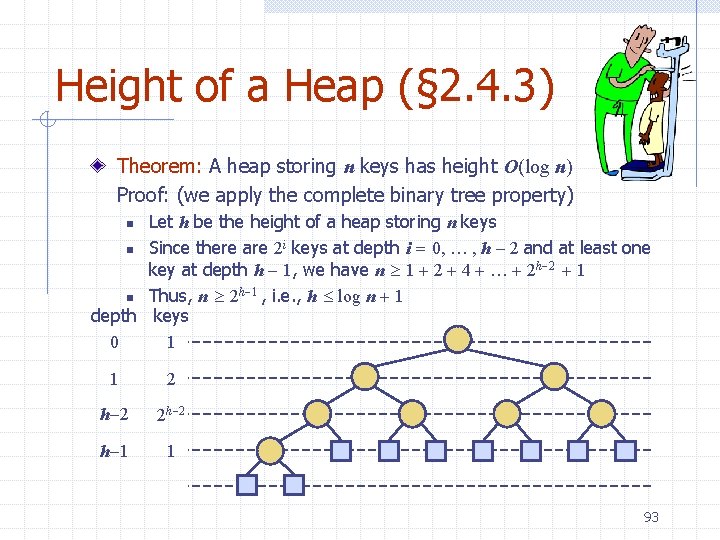
Height of a Heap (§ 2. 4. 3) Theorem: A heap storing n keys has height O(log n) Proof: (we apply the complete binary tree property) Let h be the height of a heap storing n keys n Since there are 2 i keys at depth i = 0, … , h 2 and at least one key at depth h 1, we have n 1 + 2 + 4 + … + 2 h 2 + 1 n Thus, n 2 h 1 , i. e. , h log n + 1 depth keys 0 1 n 1 2 h 2 2 h 2 h 1 1 93
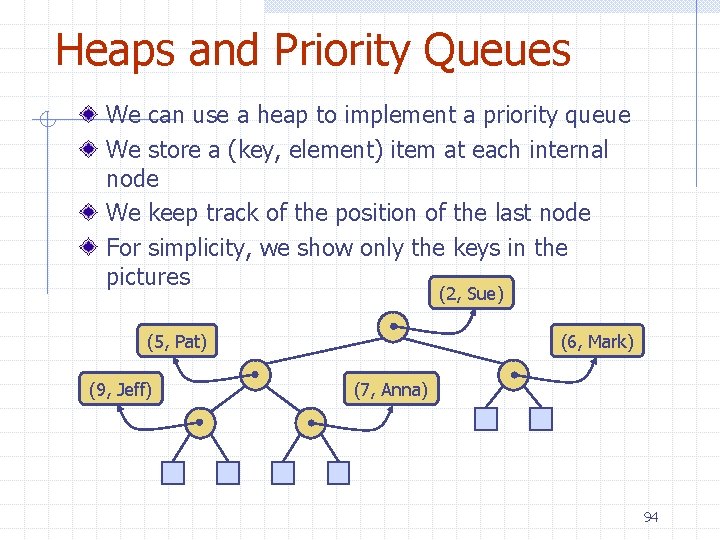
Heaps and Priority Queues We can use a heap to implement a priority queue We store a (key, element) item at each internal node We keep track of the position of the last node For simplicity, we show only the keys in the pictures (2, Sue) (5, Pat) (9, Jeff) (6, Mark) (7, Anna) 94
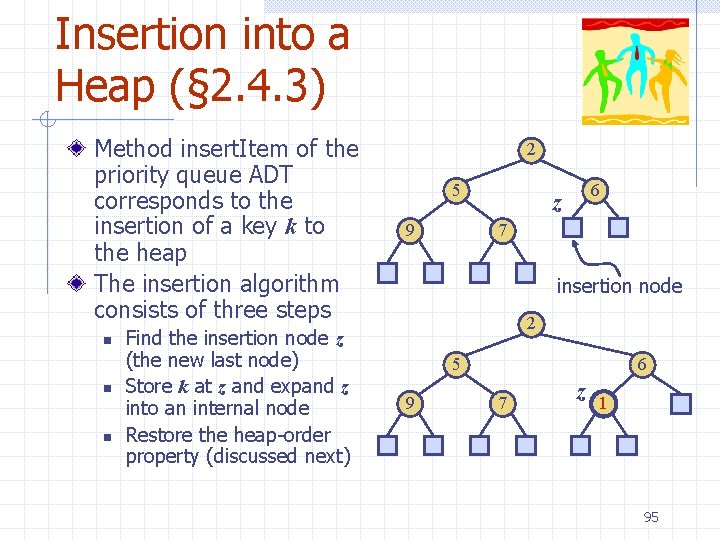
Insertion into a Heap (§ 2. 4. 3) Method insert. Item of the priority queue ADT corresponds to the insertion of a key k to the heap The insertion algorithm consists of three steps n n n Find the insertion node z (the new last node) Store k at z and expand z into an internal node Restore the heap-order property (discussed next) 2 5 9 6 z 7 insertion node 2 5 9 6 7 z 1 95
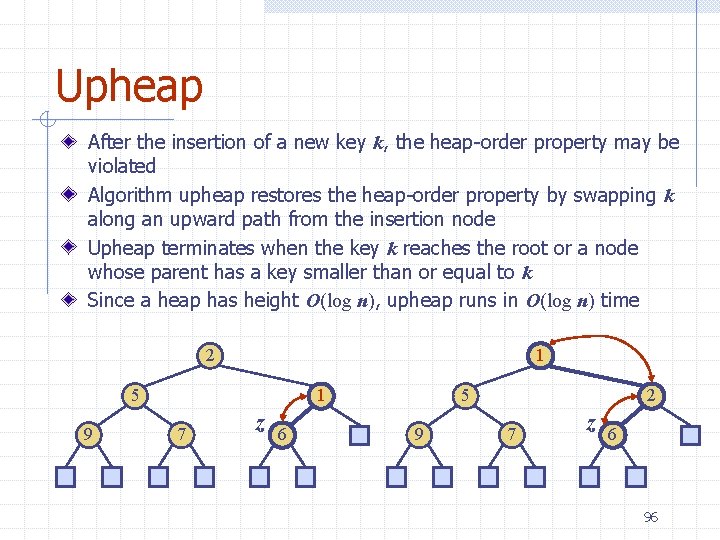
Upheap After the insertion of a new key k, the heap-order property may be violated Algorithm upheap restores the heap-order property by swapping k along an upward path from the insertion node Upheap terminates when the key k reaches the root or a node whose parent has a key smaller than or equal to k Since a heap has height O(log n), upheap runs in O(log n) time 2 1 5 9 1 7 z 6 5 9 2 7 z 6 96
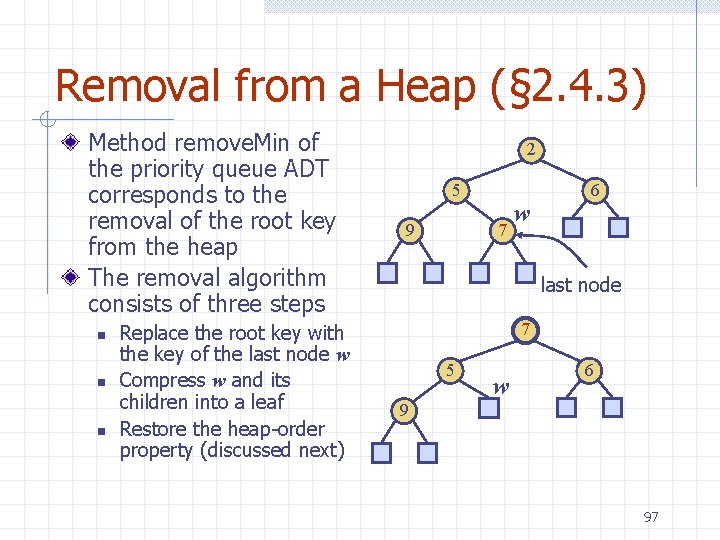
Removal from a Heap (§ 2. 4. 3) Method remove. Min of the priority queue ADT corresponds to the removal of the root key from the heap The removal algorithm consists of three steps n n n Replace the root key with the key of the last node w Compress w and its children into a leaf Restore the heap-order property (discussed next) 2 5 9 6 7 w last node 7 5 w 6 9 97
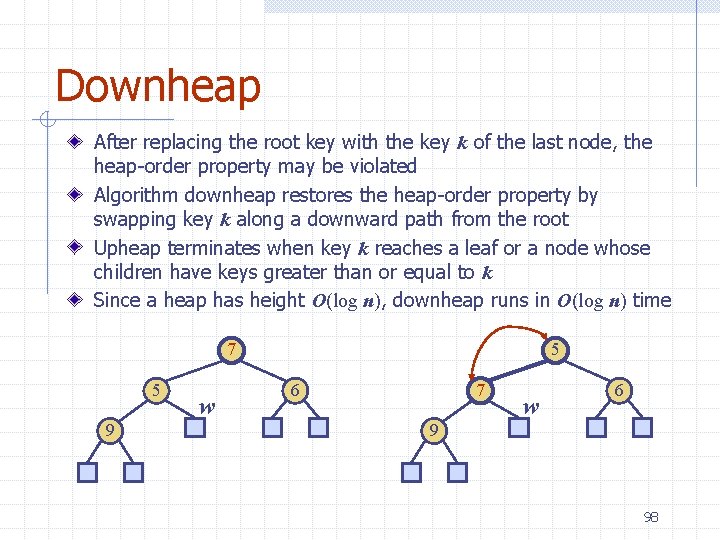
Downheap After replacing the root key with the key k of the last node, the heap-order property may be violated Algorithm downheap restores the heap-order property by swapping key k along a downward path from the root Upheap terminates when key k reaches a leaf or a node whose children have keys greater than or equal to k Since a heap has height O(log n), downheap runs in O(log n) time 7 5 9 w 5 6 7 w 6 9 98
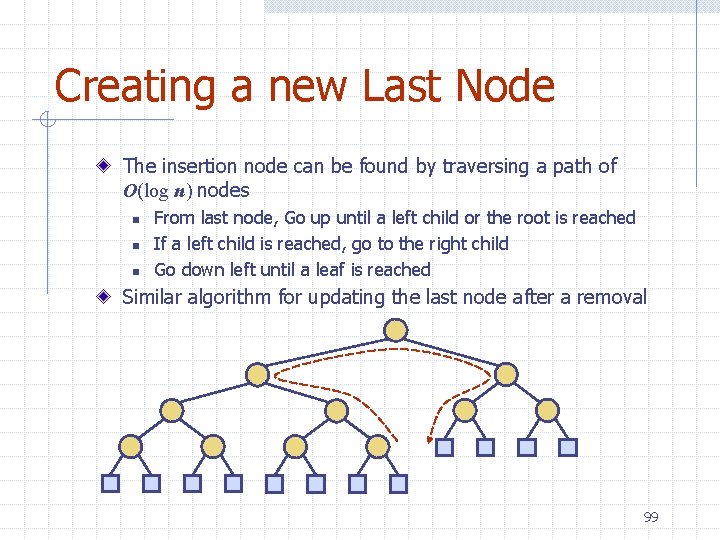
Creating a new Last Node The insertion node can be found by traversing a path of O(log n) nodes n n n From last node, Go up until a left child or the root is reached If a left child is reached, go to the right child Go down left until a leaf is reached Similar algorithm for updating the last node after a removal 99
Heap-Sort (§ 2. 4. 4) Consider a priority queue with n items implemented by means of a heap n n n the space used is O(n) methods insert. Item and remove. Min take O(log n) time methods size, is. Empty, min. Key, and min. Element take time O(1) time Using a heap-based priority queue, we can sort a sequence of n elements in O(n log n) time The resulting algorithm is called heap-sort Heap-sort is much faster than quadratic sorting algorithms, such as insertion-sort and selection-sort 100
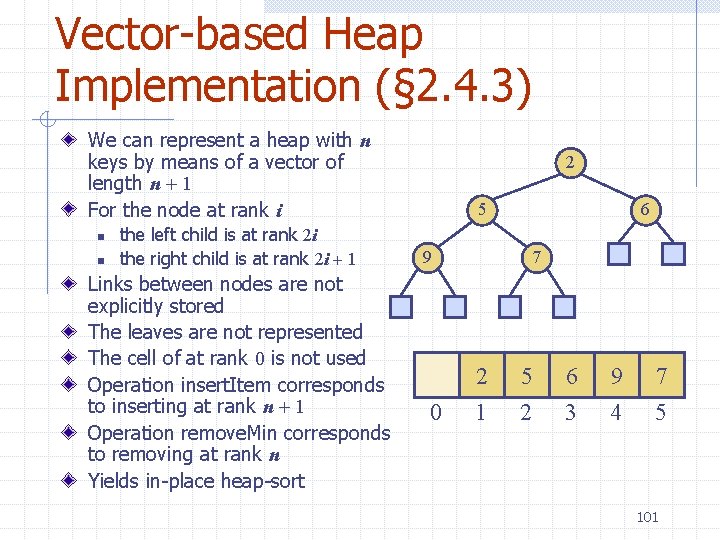
Vector-based Heap Implementation (§ 2. 4. 3) We can represent a heap with n keys by means of a vector of length n + 1 For the node at rank i n n the left child is at rank 2 i the right child is at rank 2 i + 1 Links between nodes are not explicitly stored The leaves are not represented The cell of at rank 0 is not used Operation insert. Item corresponds to inserting at rank n + 1 Operation remove. Min corresponds to removing at rank n Yields in-place heap-sort 2 5 6 9 0 7 2 5 6 9 7 1 2 3 4 5 101
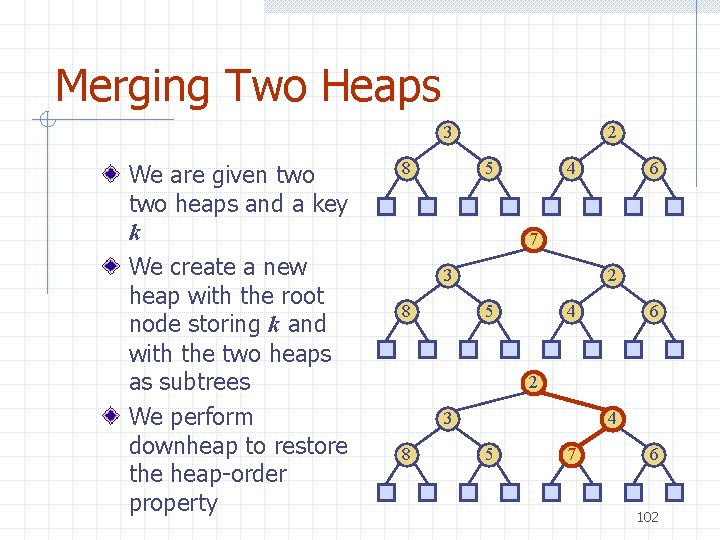
Merging Two Heaps 3 We are given two heaps and a key k We create a new heap with the root node storing k and with the two heaps as subtrees We perform downheap to restore the heap-order property 8 2 5 4 6 7 3 8 2 5 4 6 2 3 8 4 5 7 6 102
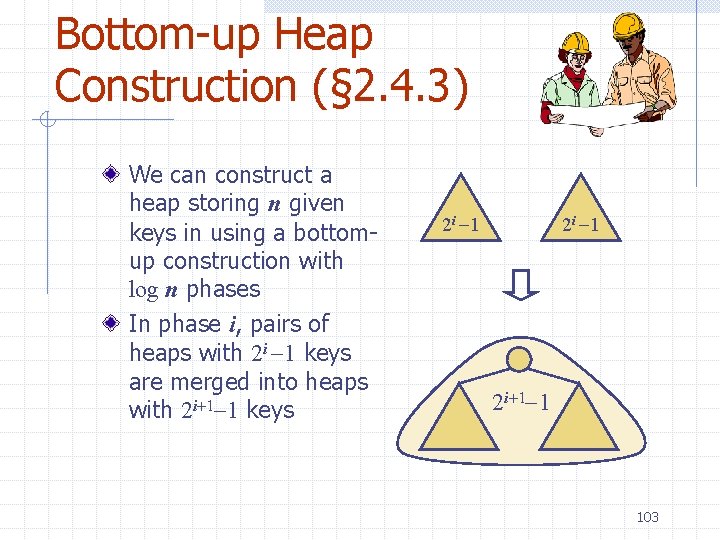
Bottom-up Heap Construction (§ 2. 4. 3) We can construct a heap storing n given keys in using a bottomup construction with log n phases In phase i, pairs of heaps with 2 i 1 keys are merged into heaps with 2 i+1 1 keys 2 i 1 2 i+1 1 103
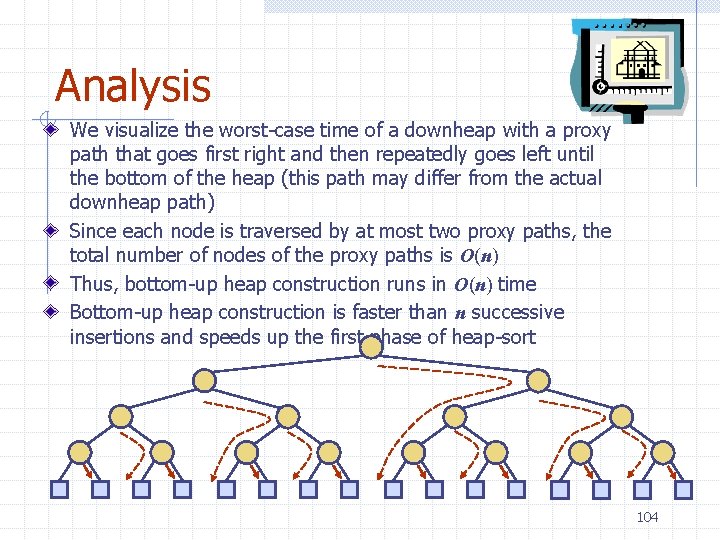
Analysis We visualize the worst-case time of a downheap with a proxy path that goes first right and then repeatedly goes left until the bottom of the heap (this path may differ from the actual downheap path) Since each node is traversed by at most two proxy paths, the total number of nodes of the proxy paths is O(n) Thus, bottom-up heap construction runs in O(n) time Bottom-up heap construction is faster than n successive insertions and speeds up the first phase of heap-sort 104
3 a Locators 1 g 4 e
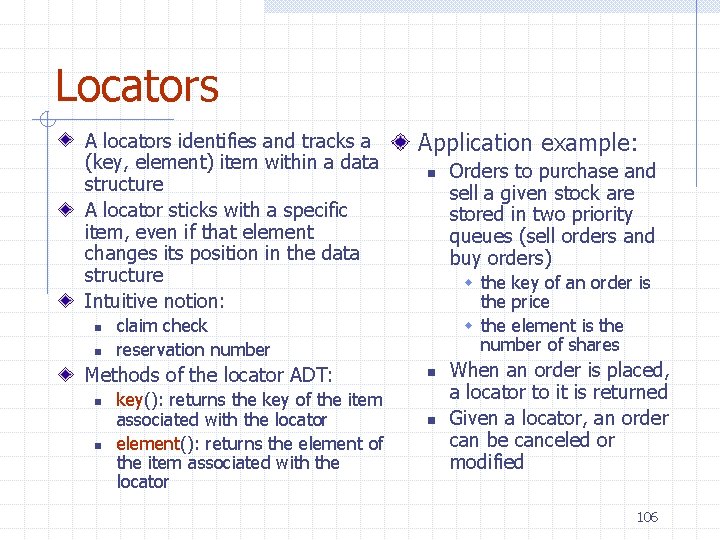
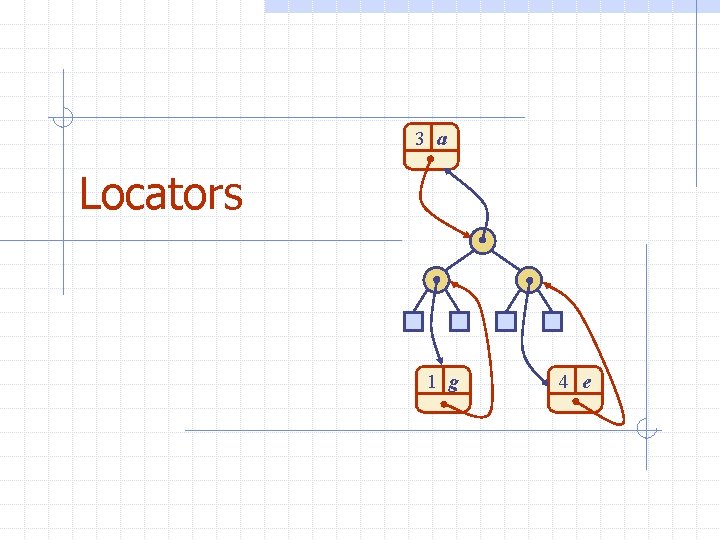
Locators A locators identifies and tracks a (key, element) item within a data structure A locator sticks with a specific item, even if that element changes its position in the data structure Intuitive notion: n n key(): returns the key of the item associated with the locator element(): returns the element of the item associated with the locator Orders to purchase and sell a given stock are stored in two priority queues (sell orders and buy orders) w the key of an order is the price w the element is the number of shares claim check reservation number Methods of the locator ADT: n Application example: n n When an order is placed, a locator to it is returned Given a locator, an order can be canceled or modified 106
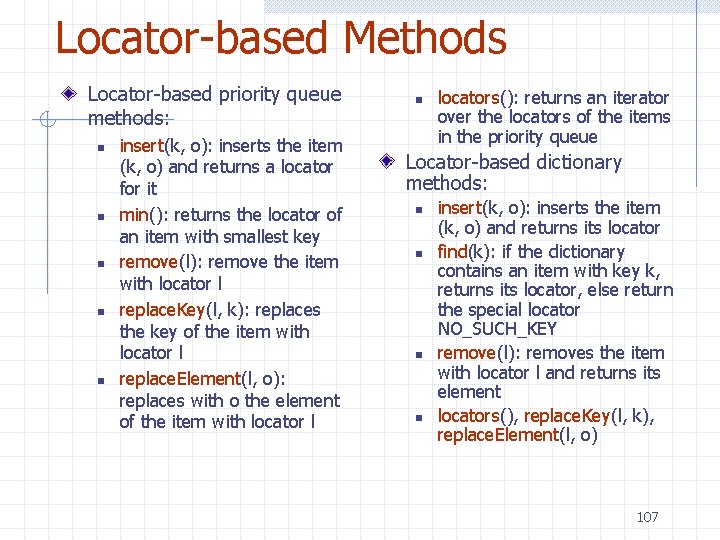
Locator-based Methods Locator-based priority queue methods: n n n insert(k, o): inserts the item (k, o) and returns a locator for it min(): returns the locator of an item with smallest key remove(l): remove the item with locator l replace. Key(l, k): replaces the key of the item with locator l replace. Element(l, o): replaces with o the element of the item with locator l n locators(): returns an iterator over the locators of the items in the priority queue Locator-based dictionary methods: n n insert(k, o): inserts the item (k, o) and returns its locator find(k): if the dictionary contains an item with key k, returns its locator, else return the special locator NO_SUCH_KEY remove(l): removes the item with locator l and returns its element locators(), replace. Key(l, k), replace. Element(l, o) 107
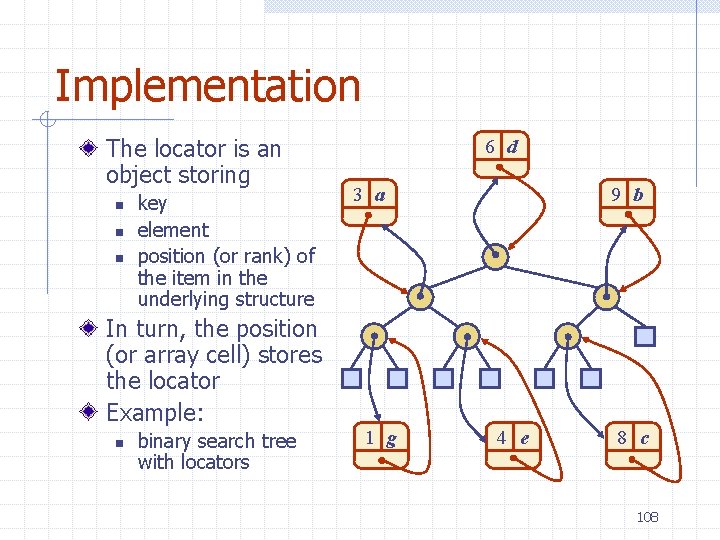
Implementation The locator is an object storing n n n key element position (or rank) of the item in the underlying structure 6 d 3 a 9 b In turn, the position (or array cell) stores the locator Example: n binary search tree with locators 1 g 4 e 8 c 108
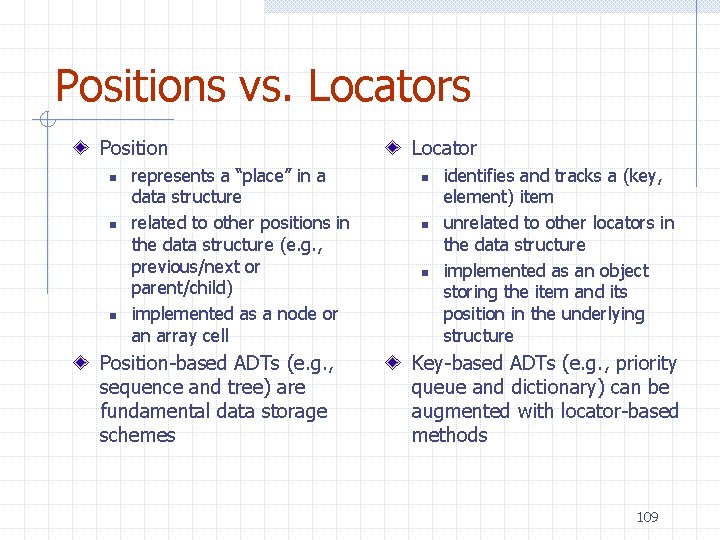
Positions vs. Locators Position n represents a “place” in a data structure related to other positions in the data structure (e. g. , previous/next or parent/child) implemented as a node or an array cell Position-based ADTs (e. g. , sequence and tree) are fundamental data storage schemes Locator n n n identifies and tracks a (key, element) item unrelated to other locators in the data structure implemented as an object storing the item and its position in the underlying structure Key-based ADTs (e. g. , priority queue and dictionary) can be augmented with locator-based methods 109
Dictionaries 2 1 6 9 > 4 = 8
Dictionary ADT The dictionary ADT models a searchable collection of keyelement items The main operations of a dictionary are searching, inserting, and deleting items Multiple items with the same key are allowed Applications: n n n address book credit card authorization mapping host names (e. g. , cs 16. net) to internet addresses (e. g. , 128. 148. 34. 101) Dictionary ADT methods: n n n find. Element(k): if the dictionary has an item with key k, returns its element, else, returns the special element NO_SUCH_KEY insert. Item(k, o): inserts item (k, o) into the dictionary remove. Element(k): if the dictionary has an item with key k, removes it from the dictionary and returns its element, else returns the special element NO_SUCH_KEY size(), is. Empty() keys(), Elements() 111
Log File A log file is a dictionary implemented by means of an unsorted sequence n We store the items of the dictionary in a sequence (based on a doubly-linked lists or a circular array), in arbitrary order Performance: n n insert. Item takes O(1) time since we can insert the new item at the beginning or at the end of the sequence find. Element and remove. Element take O(n) time since in the worst case (the item is not found) we traverse the entire sequence to look for an item with the given key The log file is effective only for dictionaries of small size or for dictionaries on which insertions are the most common operations, while searches and removals are rarely performed (e. g. , historical record of logins to a workstation) 112
Lookup Table A lookup table is a dictionary implemented by means of a sorted sequence n n We store the items of the dictionary in an array-based sequence, sorted by key We use an external comparator for the keys Performance: n n n find. Element takes O(log n) time, using binary search insert. Item takes O(n) time since in the worst case we have to shift n/2 items to make room for the new item remove. Element take O(n) time since in the worst case we have to shift n/2 items to compact the items after the removal The lookup table is effective only for dictionaries of small size or for dictionaries on which searches are the most common operations, while insertions and removals are rarely performed (e. g. , credit card authorizations) 113
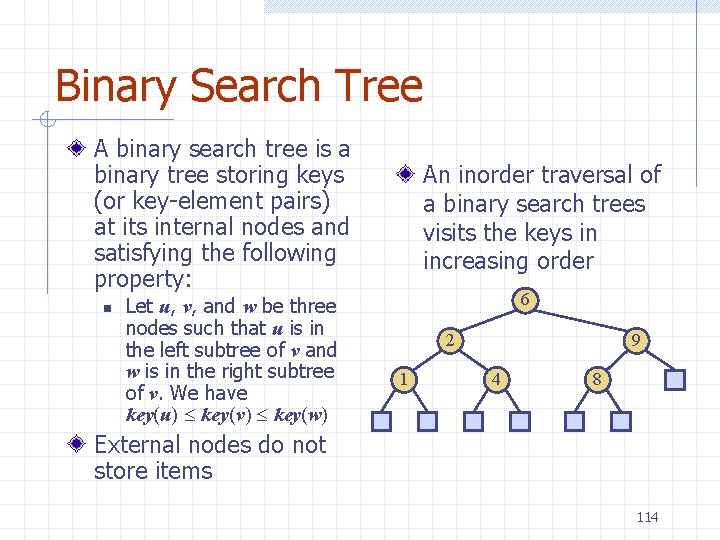
Binary Search Tree A binary search tree is a binary tree storing keys (or key-element pairs) at its internal nodes and satisfying the following property: n Let u, v, and w be three nodes such that u is in the left subtree of v and w is in the right subtree of v. We have key(u) key(v) key(w) An inorder traversal of a binary search trees visits the keys in increasing order 6 2 1 9 4 8 External nodes do not store items 114
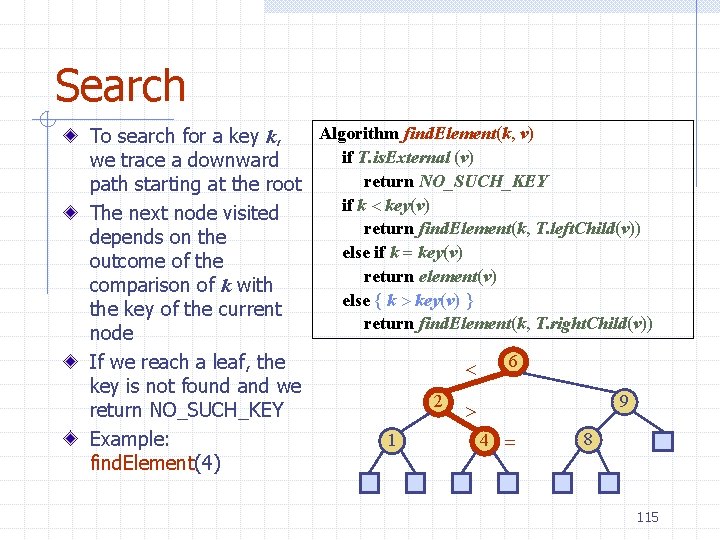
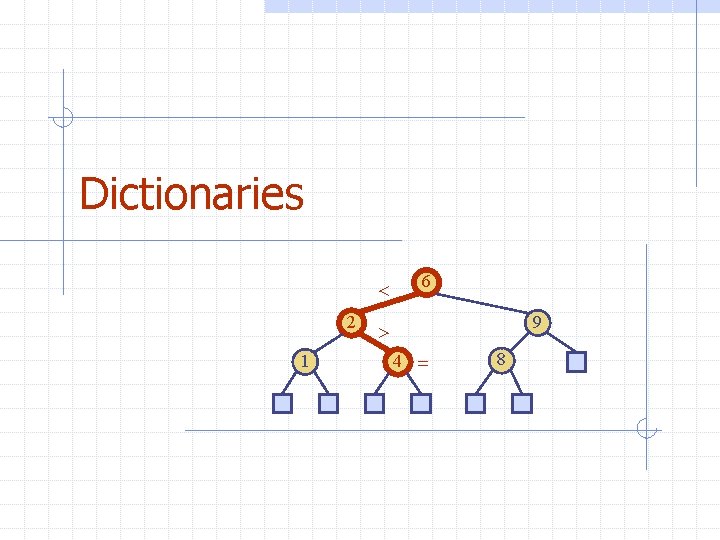
Search Algorithm find. Element(k, v) To search for a key k, if T. is. External (v) we trace a downward return NO_SUCH_KEY path starting at the root if k key(v) The next node visited return find. Element(k, T. left. Child(v)) depends on the else if k = key(v) outcome of the return element(v) comparison of k with else { k > key(v) } the key of the current return find. Element(k, T. right. Child(v)) node 6 If we reach a leaf, the key is not found and we 2 9 > return NO_SUCH_KEY 8 Example: 1 4 = find. Element(4) 115
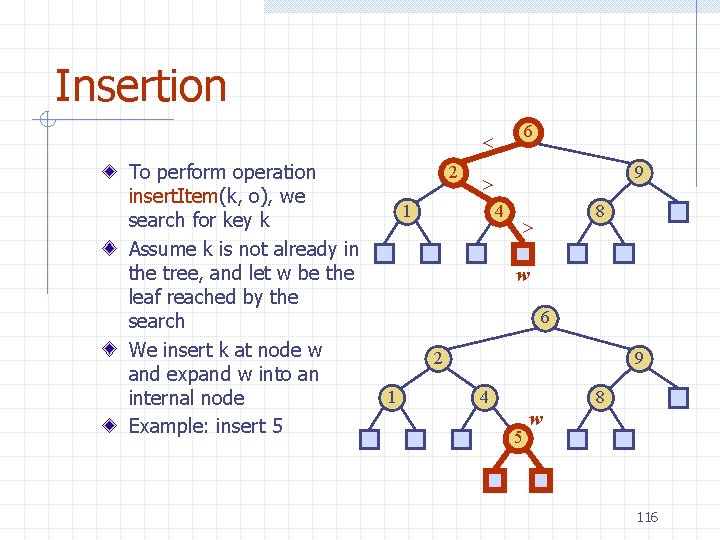
Insertion 6 To perform operation insert. Item(k, o), we search for key k Assume k is not already in the tree, and let w be the leaf reached by the search We insert k at node w and expand w into an internal node Example: insert 5 2 9 > 1 4 8 > w 6 2 1 9 4 8 5 w 116
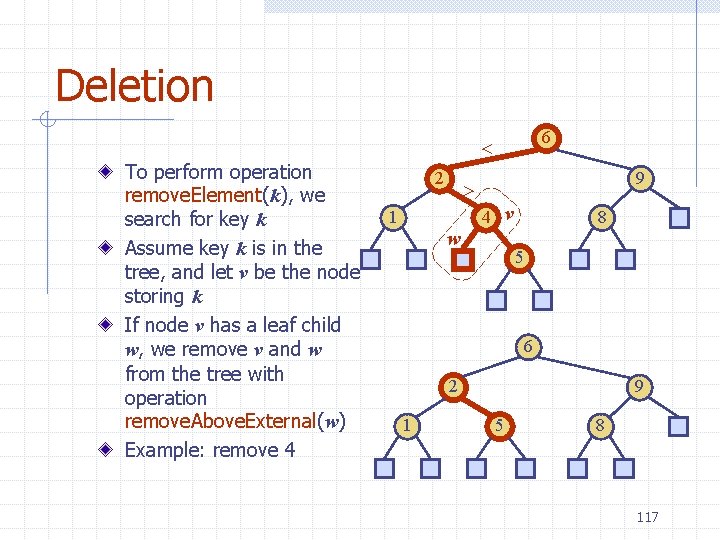
Deletion 6 To perform operation remove. Element(k), we search for key k Assume key k is in the tree, and let v be the node storing k If node v has a leaf child w, we remove v and w from the tree with operation remove. Above. External(w) Example: remove 4 2 9 > 4 v 1 w 8 5 6 2 1 9 5 8 117
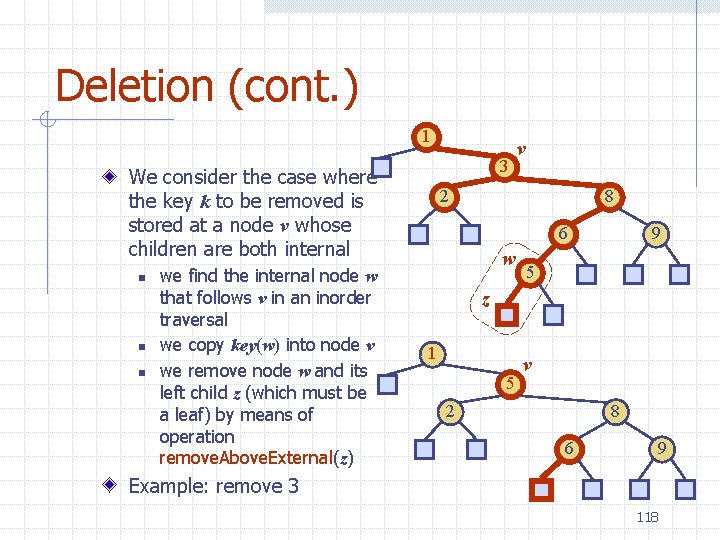
Deletion (cont. ) 1 3 We consider the case where the key k to be removed is stored at a node v whose children are both internal n n n we find the internal node w that follows v in an inorder traversal we copy key(w) into node v we remove node w and its left child z (which must be a leaf) by means of operation remove. Above. External(z) v 2 8 6 w 9 5 z 1 5 v 2 8 6 9 Example: remove 3 118
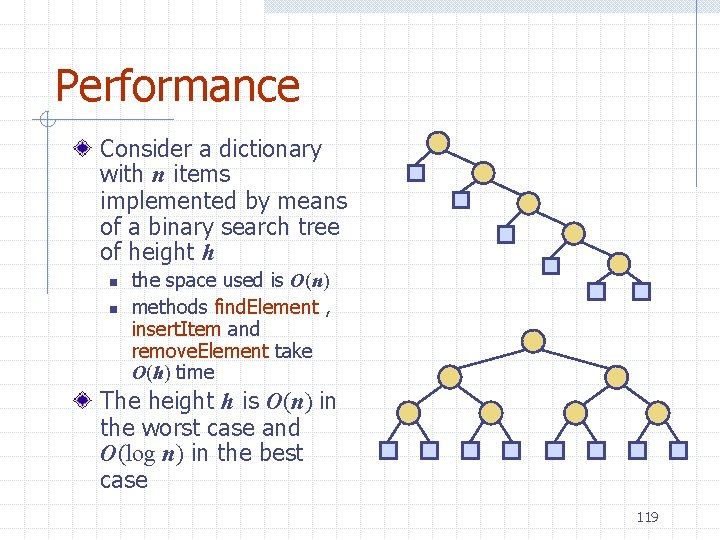
Performance Consider a dictionary with n items implemented by means of a binary search tree of height h n n the space used is O(n) methods find. Element , insert. Item and remove. Element take O(h) time The height h is O(n) in the worst case and O(log n) in the best case 119
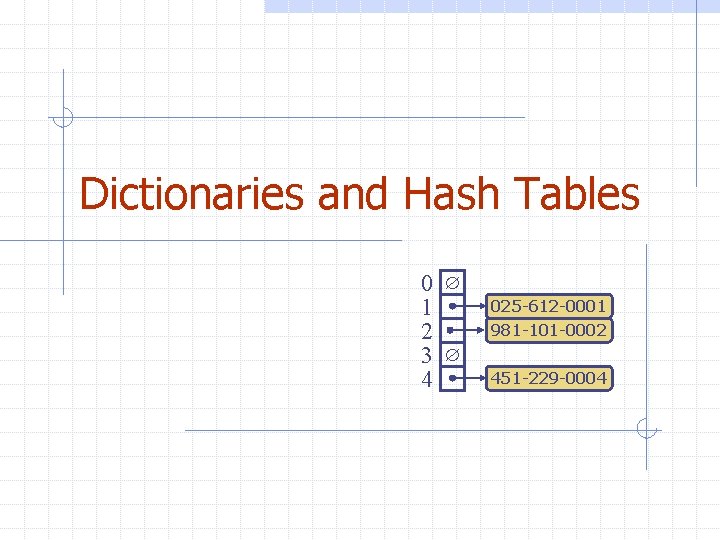
Dictionaries and Hash Tables 0 1 2 3 4 025 -612 -0001 981 -101 -0002 451 -229 -0004
Dictionary ADT (§ 2. 5. 1) The dictionary ADT models a searchable collection of keyelement items The main operations of a dictionary are searching, inserting, and deleting items Multiple items with the same key are allowed Applications: n n n address book credit card authorization mapping host names (e. g. , cs 16. net) to internet addresses (e. g. , 128. 148. 34. 101) Dictionary ADT methods: n n n find. Element(k): if the dictionary has an item with key k, returns its element, else, returns the special element NO_SUCH_KEY insert. Item(k, o): inserts item (k, o) into the dictionary remove. Element(k): if the dictionary has an item with key k, removes it from the dictionary and returns its element, else returns the special element NO_SUCH_KEY size(), is. Empty() keys(), Elements() 121
Log File (§ 2. 5. 1) A log file is a dictionary implemented by means of an unsorted sequence n We store the items of the dictionary in a sequence (based on a doubly-linked lists or a circular array), in arbitrary order Performance: n n insert. Item takes O(1) time since we can insert the new item at the beginning or at the end of the sequence find. Element and remove. Element take O(n) time since in the worst case (the item is not found) we traverse the entire sequence to look for an item with the given key The log file is effective only for dictionaries of small size or for dictionaries on which insertions are the most common operations, while searches and removals are rarely performed (e. g. , historical record of logins to a workstation) 122
Locator-based Methods Locator-based priority queue methods: n n n insert(k, o): inserts the item (k, o) and returns a locator for it min(): returns the locator of an item with smallest key remove(l): remove the item with locator l replace. Key(l, k): replaces the key of the item with locator l replace. Element(l, o): replaces with o the element of the item with locator l n (repeat slide) locators(): returns an iterator over the locators of the items in the priority queue Locator-based dictionary methods: n n insert(k, o): inserts the item (k, o) and returns its locator find(k): if the dictionary contains an item with key k, returns its locator, else return the special locator NO_SUCH_KEY remove(l): removes the item with locator l and returns its element locators(), replace. Key(l, k), replace. Element(l, o) 123
- Slides: 123