
Basic control Circuits Lac System Repression and Induction
Basic control Circuits Lac System
• Repression and Induction • Two genetic control mechanisms known as repression and induction regulate the transcription of m. RNA and consequently the synthesis of enzymes from them. These mechanisms control the formation and amounts of enzymes in the cell, not the activities of the enzymes.
• Repression • The regulatory mechanisms that inhibit gene expression and decrease the synthesis of enzymes are called repression. Repression is usually a response to the over abundance of an end -product of a metabolic pathway, it causes a decrease in the rate of the synthesis of enzymes leading to the formation of that product.
• Repression is mediated by regulatory proteins called repressors, which block the ability of RNA polymerase to initiate transcription from the repressed genes. The default position of a repressible gene is “on” • Repressible genes are active unless circumstances cause them to be inactivated(“turned off”)
• Induction • The process that turns on the transcription of a gene or genes is induction. • A substance that acts to induce transcription of a gene is called an inducer, and the enzymes that are synthesized in the presence of inducers are inducible enzymes. • Inducible genes are inactive unless circumstances cause them to be activated(“turned on”)
• The first system that we shall focus on concerns lactose metabolism in E. coli. The detailed genetic analysis of this system by François Jacob and Jacques Monod in the 1950 s provided the first major breakthrough in understanding transcription control.
• Regulation of the lac operon
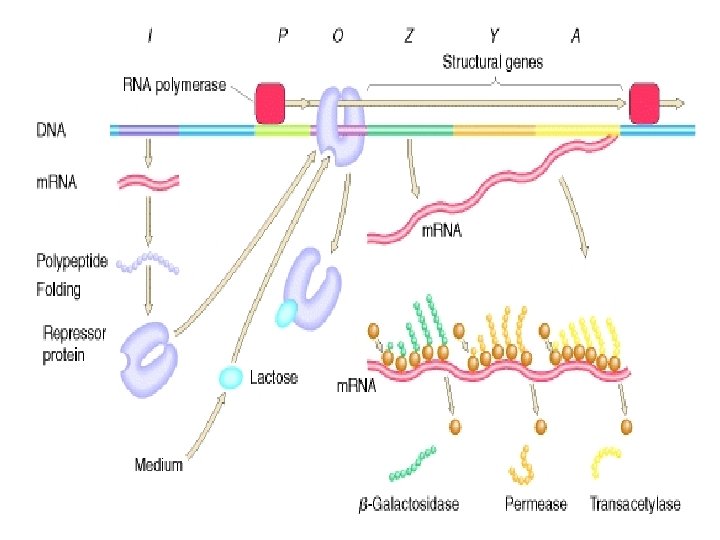
• . The I gene continually makes repressor. The repressor binds to the O (operator) region, blocking the RNA polymerase bound to P (the promoter region) from transcribing the adjacent structural genes. When lactose is present, it binds to the repressor and changes its shape so that the repressor no longer binds to O. The RNA polymerase is then able to transcribe the Z, Y, and A structural genes, and the three enzymes are produced.
• The metabolism of lactose requires three enzymes: a permease to transport lactose into the cell and β-galactosidase to cleave the lactose molecule to yield glucose and galactose. Permease and β-galactosidase are encoded by two contiguous genes, Z and Y, respectively. A third gene, the A gene, encodes an additional enzyme, termed transacetylase, but this enzyme is not required for lactose metabolism, (metabolizes certain disaccharides)and we will not concentrate on it for now.
• The genes for the 3 enzymes involved in lactose uptake and utilization are next to each other on the bacterial chromosome and regulate together. These genes , which determine the structures of proteins, are called structural genes to distinguish them from an adjoining control region on the DNA. When lactose is introduced into the culture medium, the lac structural genes are all transcribed and translated rapidly and simultaneously.
• A fourth gene, the I gene, which maps near but not directly adjacent to the Z, Y, and A genes, encodes a repressor protein, so named because it can block the expression of the Z, Y, and A genes. The repressor binds to a region of DNA near the beginning of the Z gene and near the point at which transcription of the m. RNA begins.
• The site on the DNA to which the repressor binds is termed the operator. One necessary property of the repressor is that it be able to recognize a specific short sequence of DNA—namely, a specific operator.
• This property ensures that the repressor will bind only to the site on the DNA near the genes that it is controlling and not to other random sites all over the chromosome. By binding to the operator, the repressor prevents the initiation of transcription by RNA polymerase. Normally, RNA polymerase binds to specific regions of the DNA at the beginning of genes or groups of genes, termed promoters (see Chapter 10) so that it can initiate transcription at the proper starting points. The POZYA segments constitute an operon, which is a genetic unit of coordinate expression.
• The lac repressor is a molecule with two recognition sites—one that can recognize the specific operator sequence for the lac operon and another that can recognize lactose and certain analogs of lactose. When the repressor binds to lactose derivatives, it undergoes a conformational change; this slight alteration in shape changes the operator binding site so that the repressor loses affinity for the operator.
• Thus, in response to binding lactose derivatives, the repressor falls off the DNA. This satisfies the second requirement for such a control system—the ability to recognize conditions under which it is worthwhile to activate expression of the lac genes. The relief of repression for systems such as lac is termed induction; derivatives of lactose that inactivate the repressor and lead to expression of the lac genes are termed inducers.
• Other bacterial systems operate by using protein activator molecules, which must bind to DNA as a prerequisite of transcription. Still additional mechanisms of control require proteins that allow the continuation of transcription in response to intracellular signals.
• Reference: An Introduction to Genetic Analysis. 7 th edition. Griffiths AJF, Miller JH, Suzuki DT, et al. New York: W. H. Freeman; 2000.
- Slides: 18