
Basic Conservation Laws Kinematics and Dynamics Basic Conservation

Basic Conservation Laws Kinematics and Dynamics
Basic Conservation Laws • Outline of this lecture packet… • • Introduction Eulerian and Lagrangian frameworks Momentum equations on a rotating planet Momentum equations in spherical coordinates Scale analysis of equations of motion Continuity equation (conservation of mass) Thermodynamic energy eqtn (conservation of energy) Thermodynamics Review
Basic Conservation Laws • Introduction Conservation principles • Our computer weather models are successful because they are guided by equations that represent the conservation of mass, momentum, energy, and moisture • The first three quantities are the current focus; assume a ‘dry’ (unsaturated) atmosphere [we can make life simpler by neglecting phase changes of water] https%3 A%2 F%2 Fwww. discogs. com%2 FZZ-Top-La-Grange%2 Frelease%2 F 8972626&psig=AOv. Vaw 3 KRos. J 4 UAx. BAGTUk. B 6 l 7 g 8&ust=1577542891012579
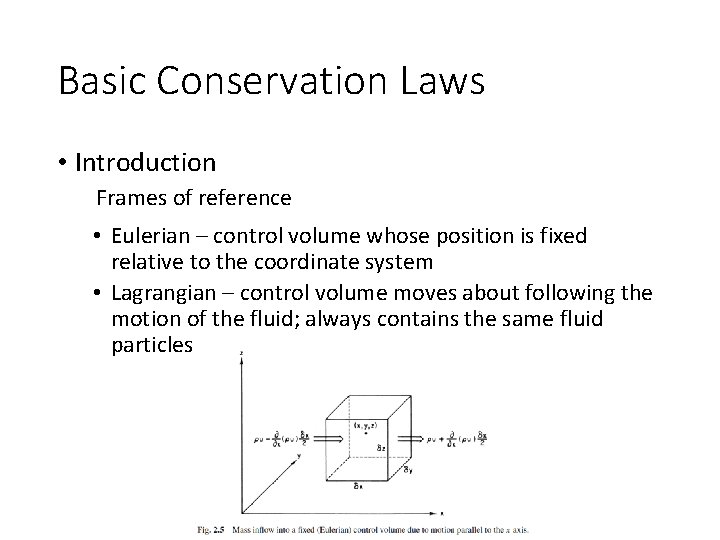
Basic Conservation Laws • Introduction Frames of reference • Eulerian – control volume whose position is fixed relative to the coordinate system • Lagrangian – control volume moves about following the motion of the fluid; always contains the same fluid particles
Basic Conservation Laws • Eulerian and Lagrangian frameworks Relationship between the two frameworks • Eulerian – local derivative; rate of change of a field variable (e. g. , u, v, w, T, , ) at a fixed point • Lagrangian – total derivative; rate of change of a field variable following fluid motion
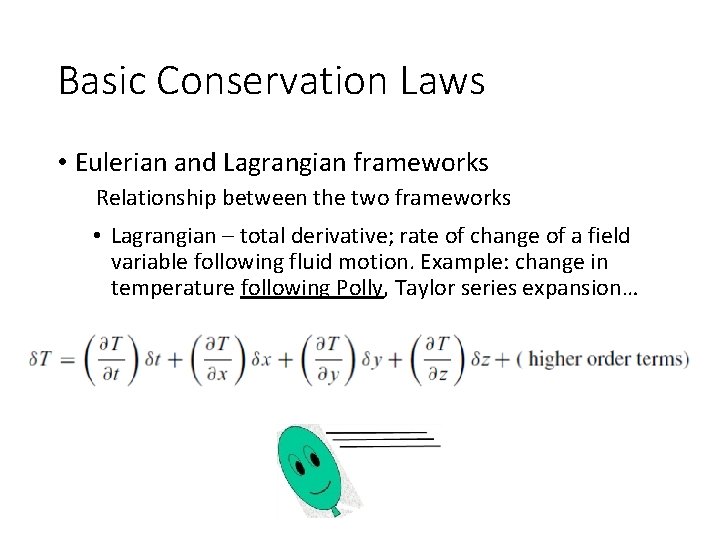
Basic Conservation Laws • Eulerian and Lagrangian frameworks Relationship between the two frameworks • Lagrangian – total derivative; rate of change of a field variable following fluid motion. Example: change in temperature following Polly, Taylor series expansion…
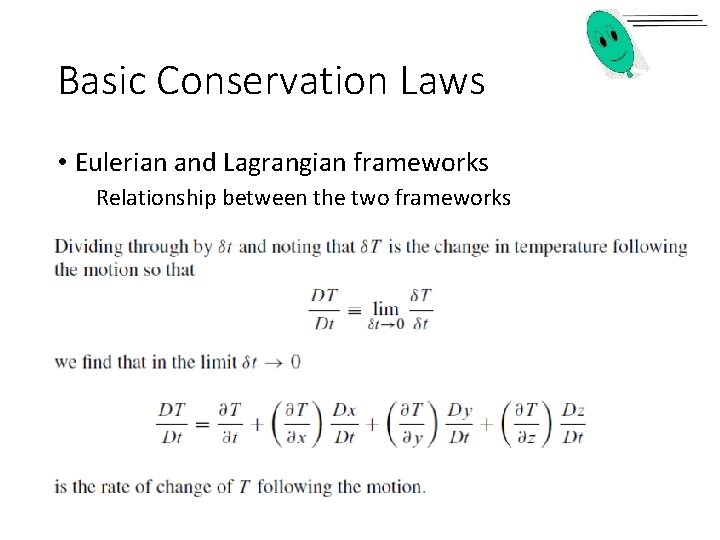
Basic Conservation Laws • Eulerian and Lagrangian frameworks Relationship between the two frameworks
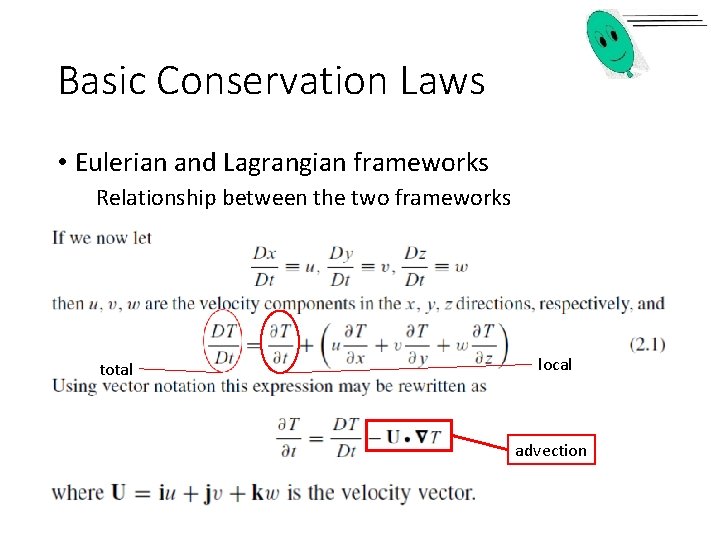
Basic Conservation Laws • Eulerian and Lagrangian frameworks Relationship between the two frameworks total local advection
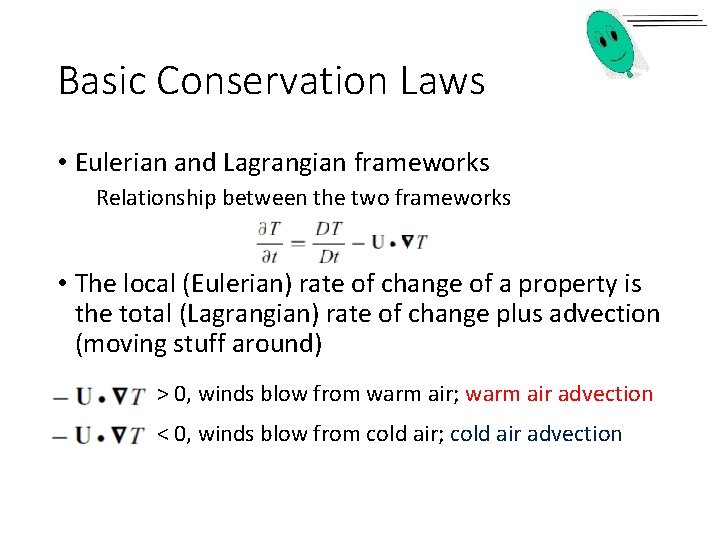
Basic Conservation Laws • Eulerian and Lagrangian frameworks Relationship between the two frameworks • The local (Eulerian) rate of change of a property is the total (Lagrangian) rate of change plus advection (moving stuff around) > 0, winds blow from warm air; warm air advection < 0, winds blow from cold air; cold air advection
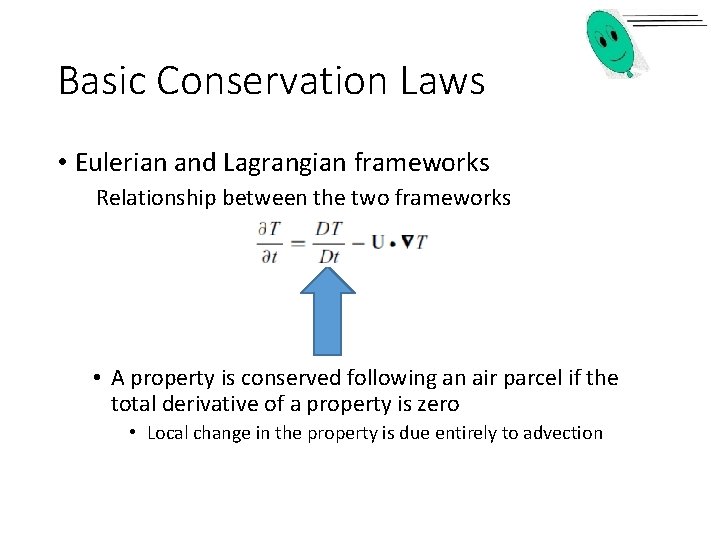
Basic Conservation Laws • Eulerian and Lagrangian frameworks Relationship between the two frameworks • A property is conserved following an air parcel if the total derivative of a property is zero • Local change in the property is due entirely to advection
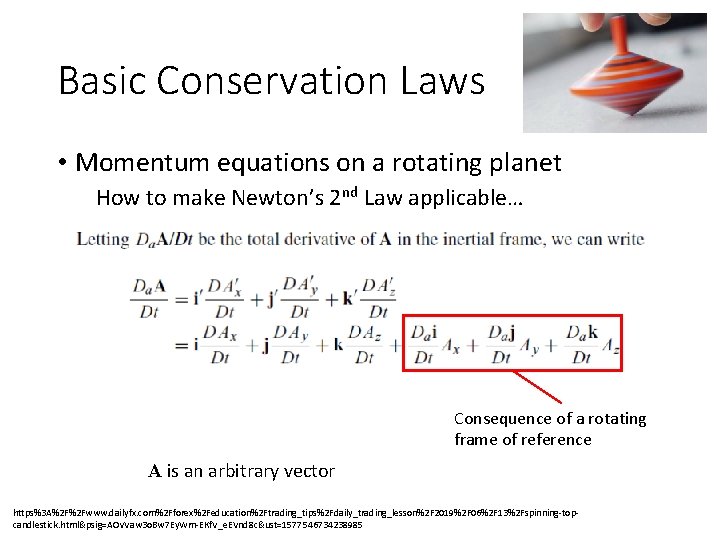
Basic Conservation Laws • Momentum equations on a rotating planet How to make Newton’s 2 nd Law applicable… Consequence of a rotating frame of reference A is an arbitrary vector https%3 A%2 F%2 Fwww. dailyfx. com%2 Fforex%2 Feducation%2 Ftrading_tips%2 Fdaily_trading_lesson%2 F 2019%2 F 06%2 F 13%2 Fspinning-topcandlestick. html&psig=AOv. Vaw 3 o. Bw 7 Ey. Wm-EKf. V_e. EVnd 8 c&ust=1577546734238985
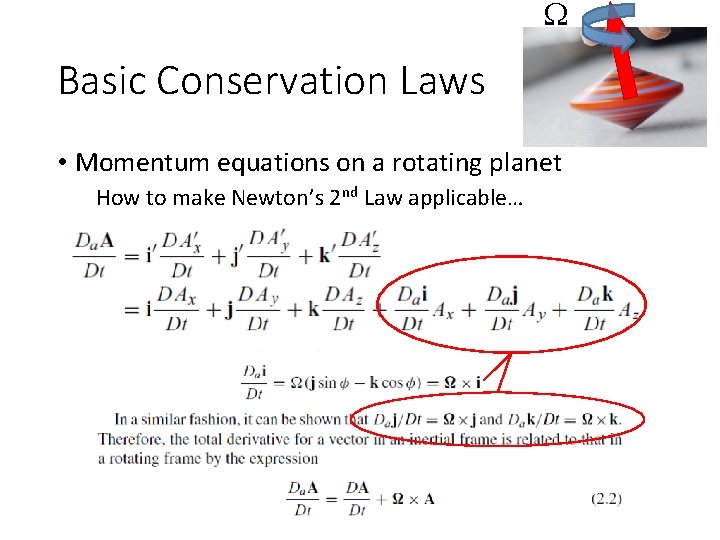
Basic Conservation Laws • Momentum equations on a rotating planet How to make Newton’s 2 nd Law applicable…
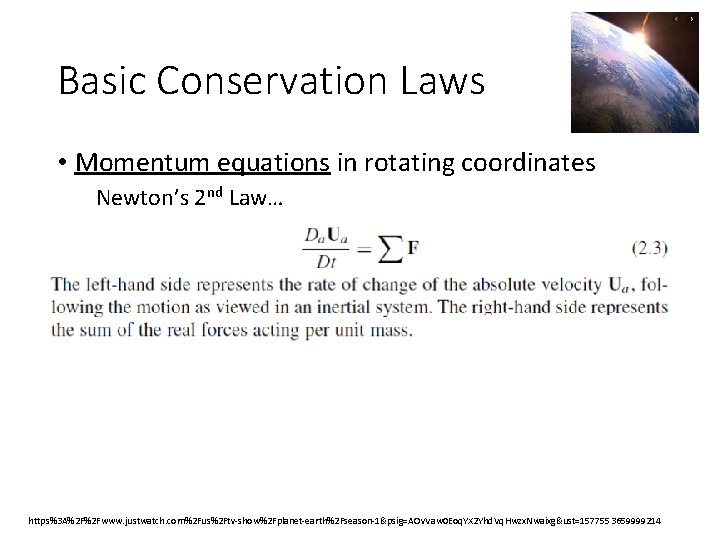
Basic Conservation Laws • Momentum equations in rotating coordinates Newton’s 2 nd Law… https%3 A%2 F%2 Fwww. justwatch. com%2 Fus%2 Ftv-show%2 Fplanet-earth%2 Fseason-1&psig=AOv. Vaw 0 Eoq. YX 2 Yhd. Vq. Hwzx. Nwaixg&ust=1577553659999214
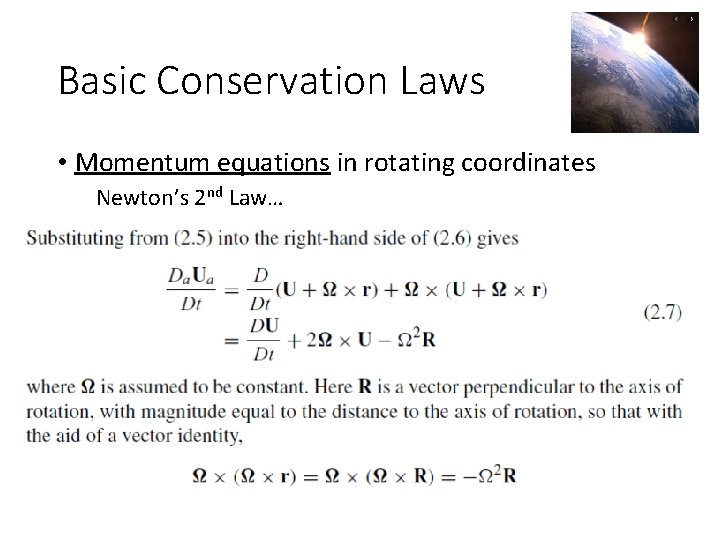
Basic Conservation Laws • Momentum equations in rotating coordinates Newton’s 2 nd Law…
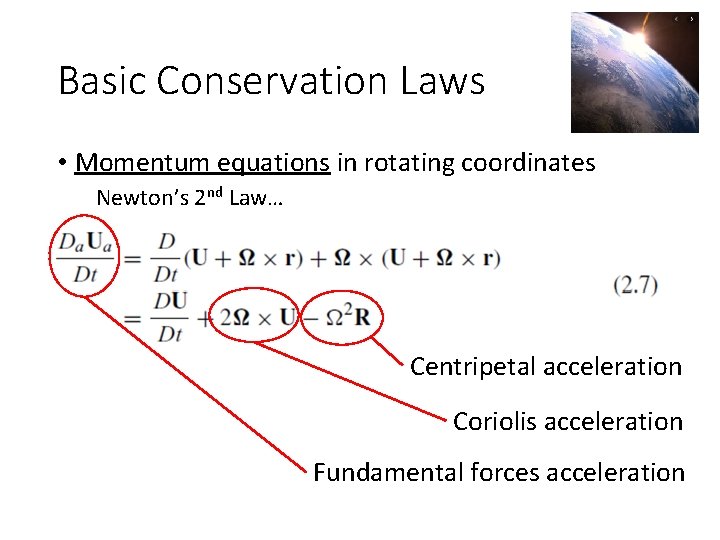
Basic Conservation Laws • Momentum equations in rotating coordinates Newton’s 2 nd Law… Centripetal acceleration Coriolis acceleration Fundamental forces acceleration
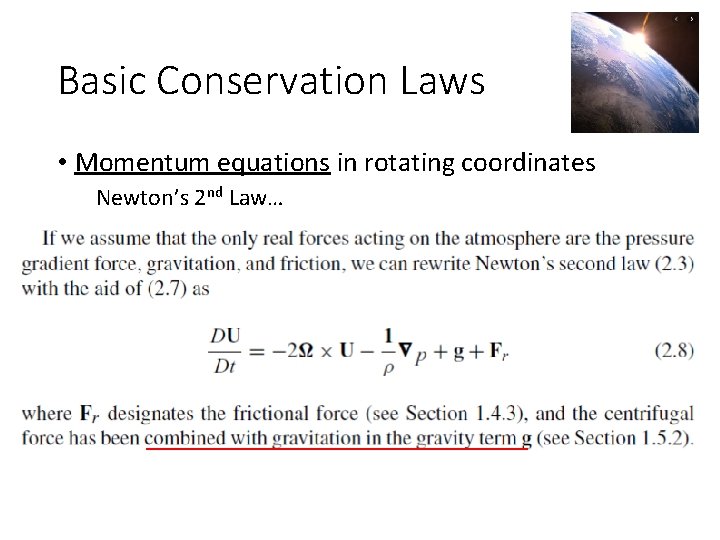
Basic Conservation Laws • Momentum equations in rotating coordinates Newton’s 2 nd Law…
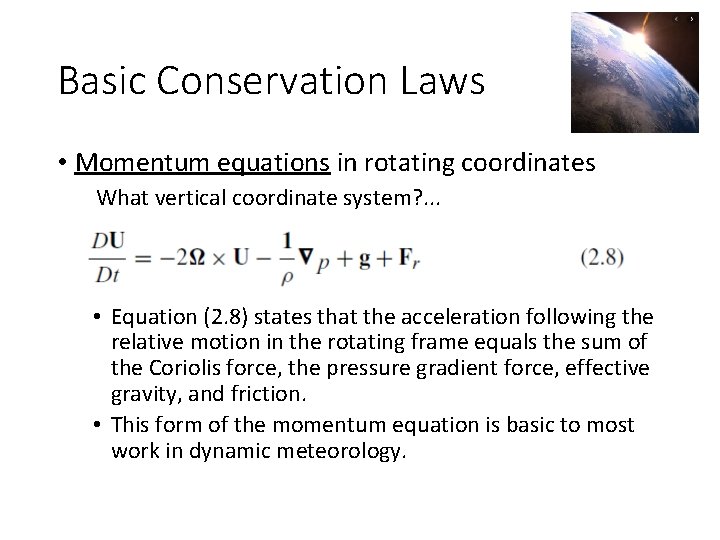
Basic Conservation Laws • Momentum equations in rotating coordinates What vertical coordinate system? . . . • Equation (2. 8) states that the acceleration following the relative motion in the rotating frame equals the sum of the Coriolis force, the pressure gradient force, effective gravity, and friction. • This form of the momentum equation is basic to most work in dynamic meteorology.
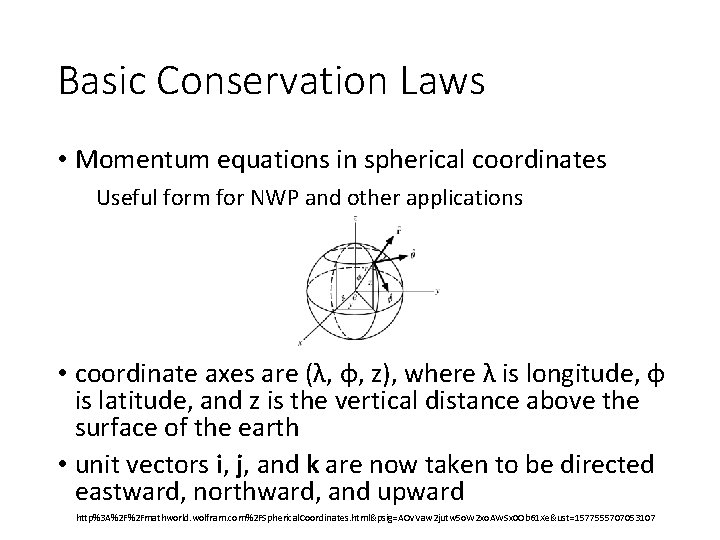
Basic Conservation Laws • Momentum equations in spherical coordinates Useful form for NWP and other applications • coordinate axes are (λ, φ, z), where λ is longitude, φ is latitude, and z is the vertical distance above the surface of the earth • unit vectors i, j, and k are now taken to be directed eastward, northward, and upward http%3 A%2 F%2 Fmathworld. wolfram. com%2 FSpherical. Coordinates. html&psig=AOv. Vaw 2 jutw 5 o. W 2 xo. AWSx 0 Ob 61 Xe&ust=1577555707053107
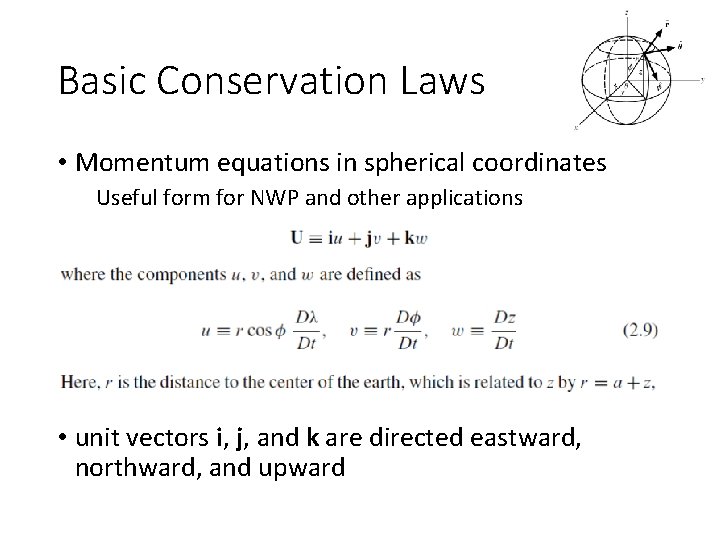
Basic Conservation Laws • Momentum equations in spherical coordinates Useful form for NWP and other applications • unit vectors i, j, and k are directed eastward, northward, and upward
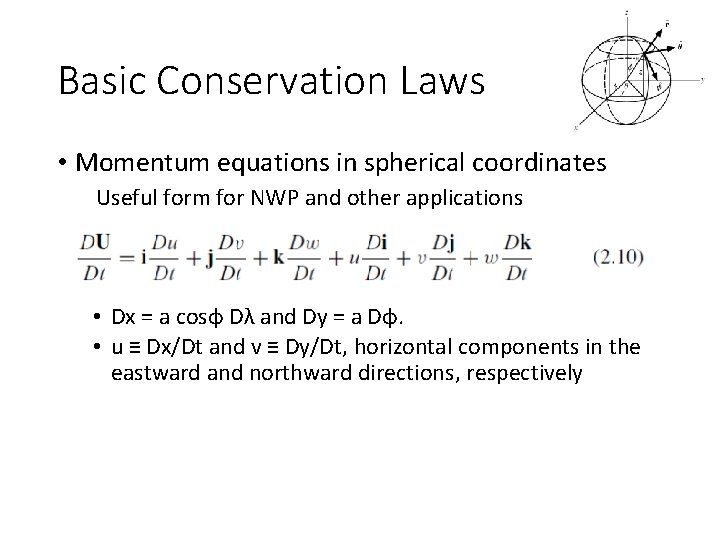
Basic Conservation Laws • Momentum equations in spherical coordinates Useful form for NWP and other applications • Dx = a cosφ Dλ and Dy = a Dφ. • u ≡ Dx/Dt and v ≡ Dy/Dt, horizontal components in the eastward and northward directions, respectively
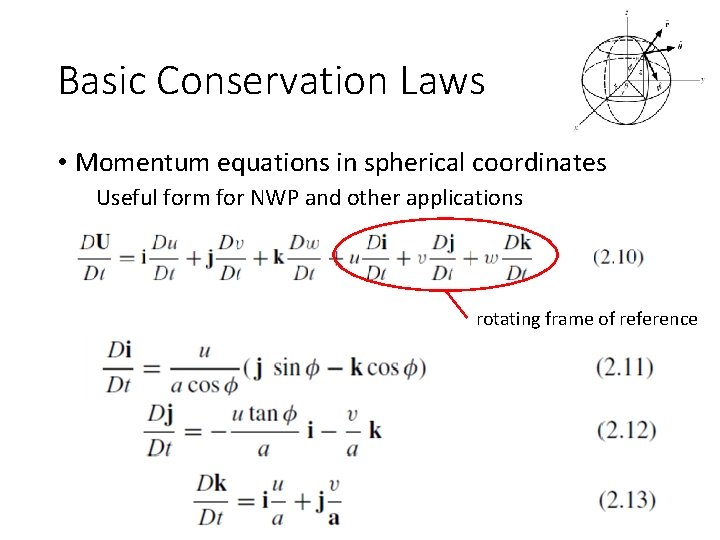
Basic Conservation Laws • Momentum equations in spherical coordinates Useful form for NWP and other applications rotating frame of reference
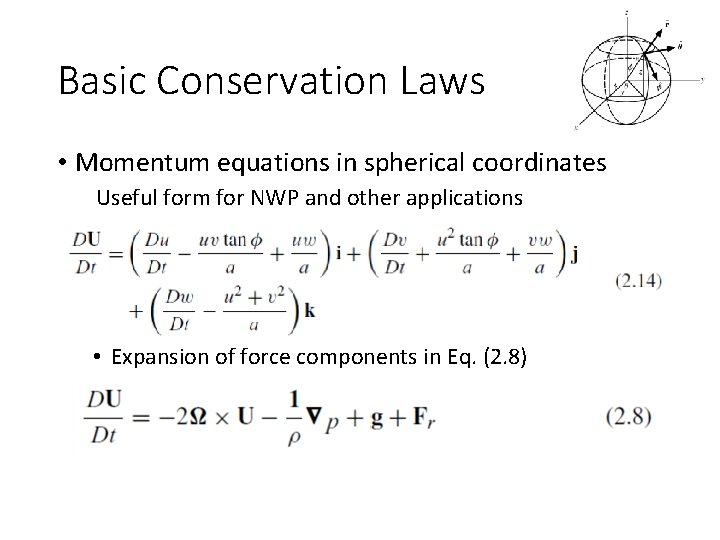
Basic Conservation Laws • Momentum equations in spherical coordinates Useful form for NWP and other applications • Expansion of force components in Eq. (2. 8)
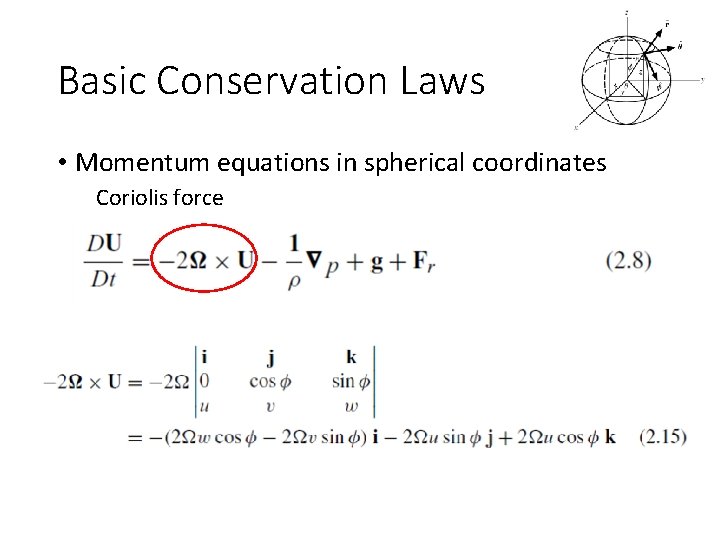
Basic Conservation Laws • Momentum equations in spherical coordinates Coriolis force
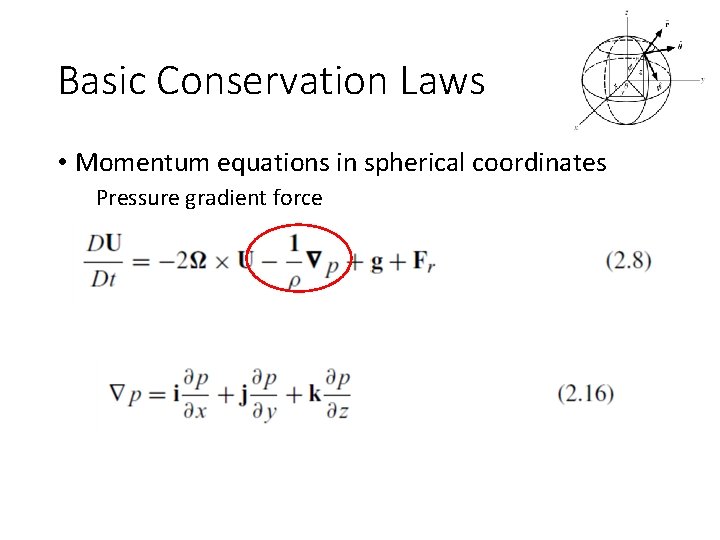
Basic Conservation Laws • Momentum equations in spherical coordinates Pressure gradient force
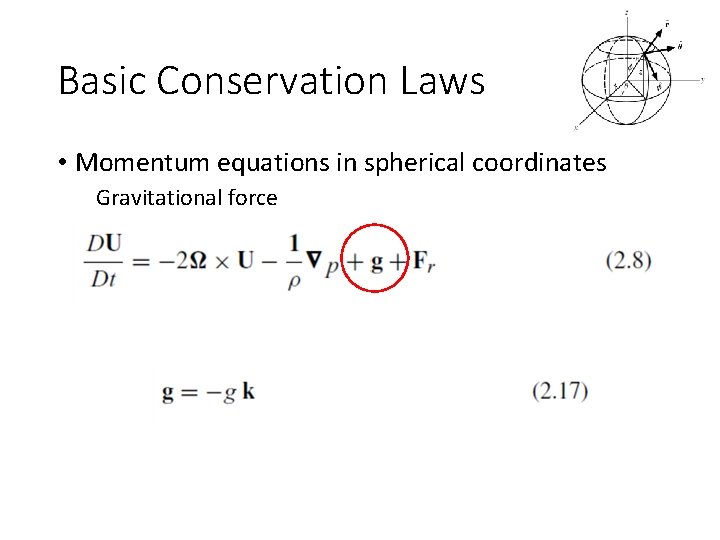
Basic Conservation Laws • Momentum equations in spherical coordinates Gravitational force
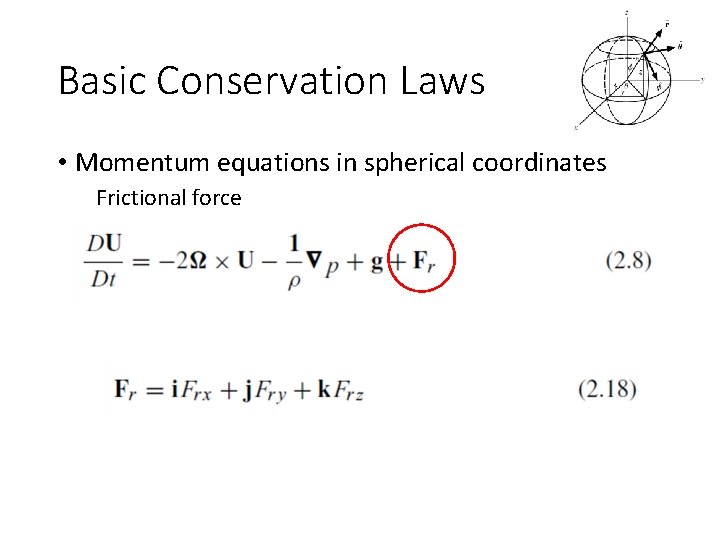
Basic Conservation Laws • Momentum equations in spherical coordinates Frictional force
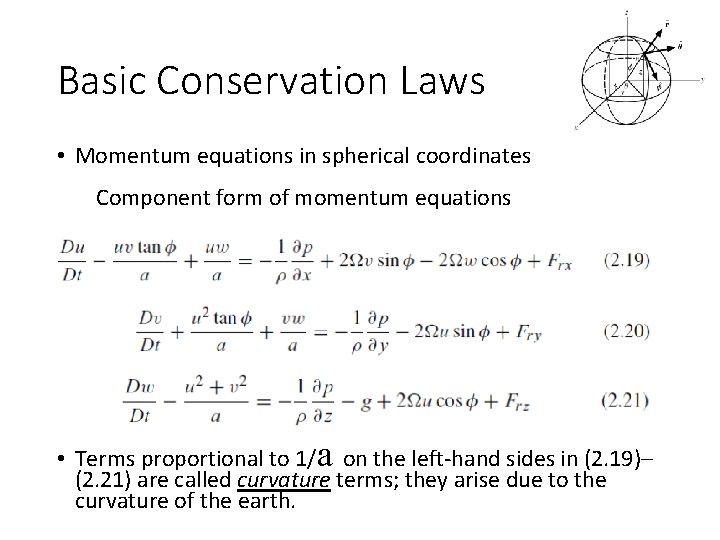
Basic Conservation Laws • Momentum equations in spherical coordinates Component form of momentum equations • Terms proportional to 1/a on the left-hand sides in (2. 19)– (2. 21) are called curvature terms; they arise due to the curvature of the earth.
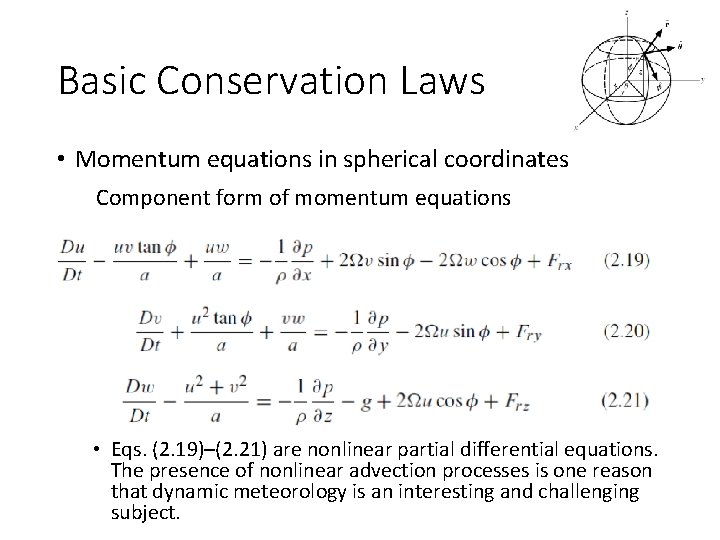
Basic Conservation Laws • Momentum equations in spherical coordinates Component form of momentum equations • Eqs. (2. 19)–(2. 21) are nonlinear partial differential equations. The presence of nonlinear advection processes is one reason that dynamic meteorology is an interesting and challenging subject.
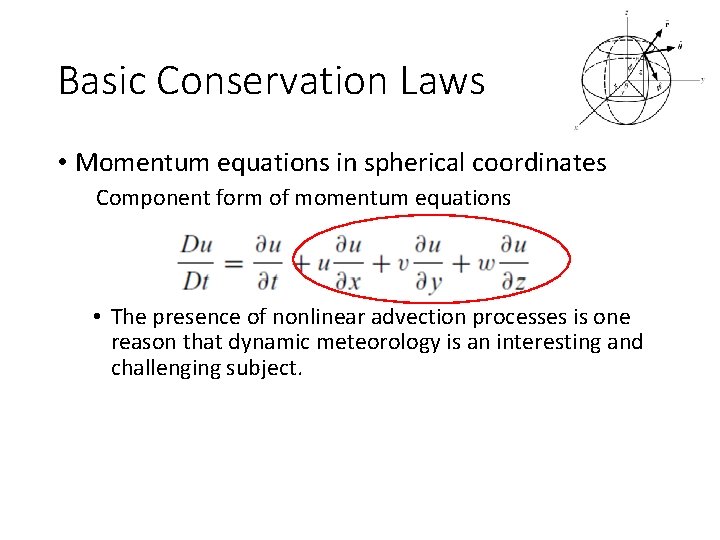
Basic Conservation Laws • Momentum equations in spherical coordinates Component form of momentum equations • The presence of nonlinear advection processes is one reason that dynamic meteorology is an interesting and challenging subject.
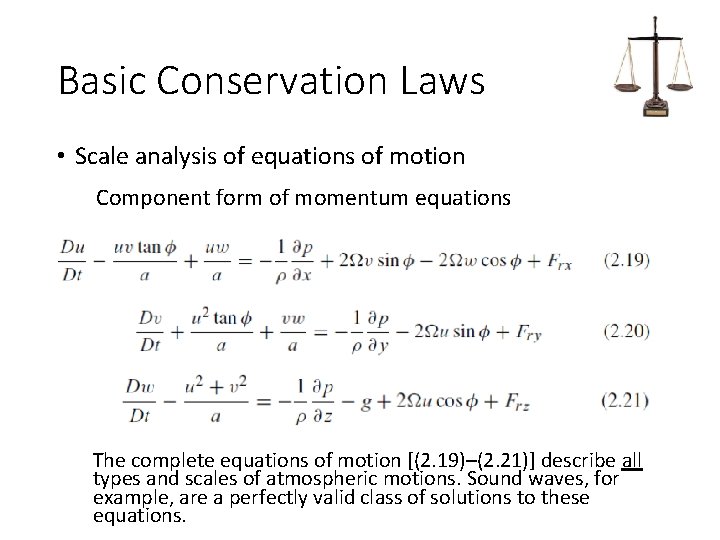
Basic Conservation Laws • Scale analysis of equations of motion Component form of momentum equations The complete equations of motion [(2. 19)–(2. 21)] describe all types and scales of atmospheric motions. Sound waves, for example, are a perfectly valid class of solutions to these equations.
Basic Conservation Laws • Scale analysis of equations of motion NWP applications • Elimination of terms on scaling considerations not only has the advantage of [1] simplifying the mathematics, [2] the elimination of small terms in some cases has the very important property of completely eliminating or filtering an unwanted type of motion (e. g. , sound waves). • Focus on weather ‘animals’ (phenomena) relevant to the synoptic scale https: //www. memorablegifts. com/gifts/pc/Scales-of-Justice-Sculpture-p 2452. htm
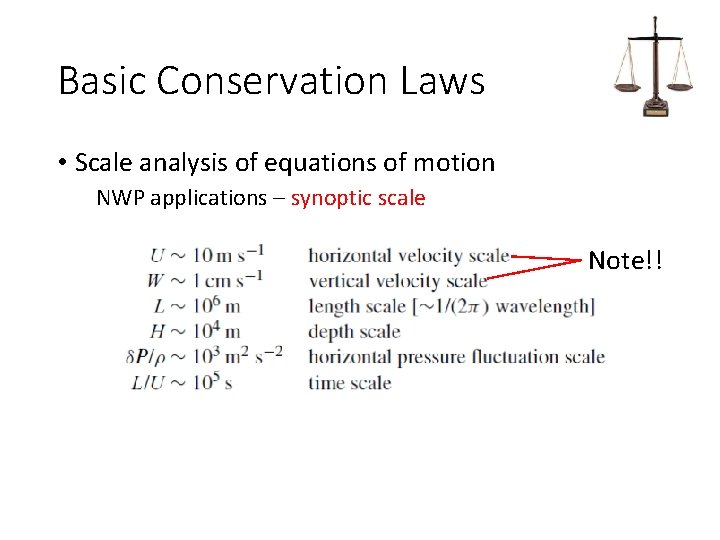
Basic Conservation Laws • Scale analysis of equations of motion NWP applications – synoptic scale Note!!
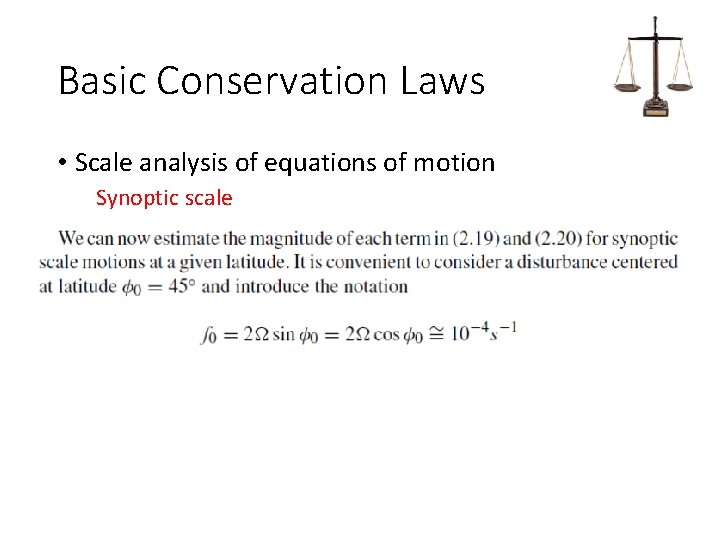
Basic Conservation Laws • Scale analysis of equations of motion Synoptic scale
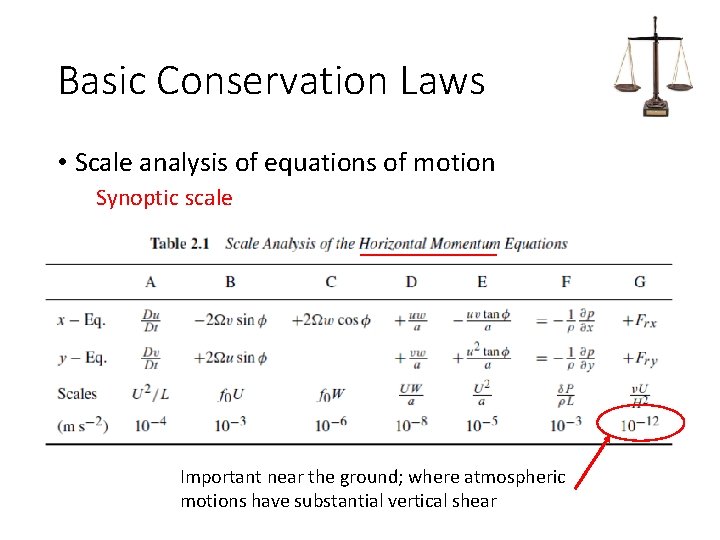
Basic Conservation Laws • Scale analysis of equations of motion Synoptic scale Important near the ground; where atmospheric motions have substantial vertical shear
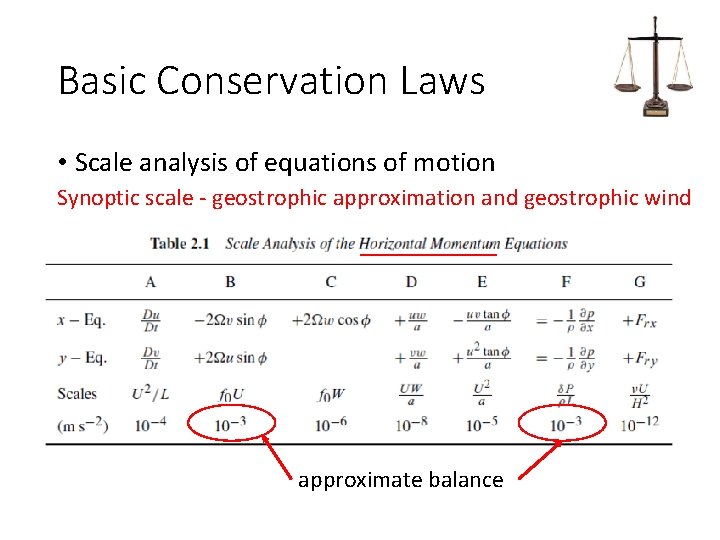
Basic Conservation Laws • Scale analysis of equations of motion Synoptic scale - geostrophic approximation and geostrophic wind approximate balance
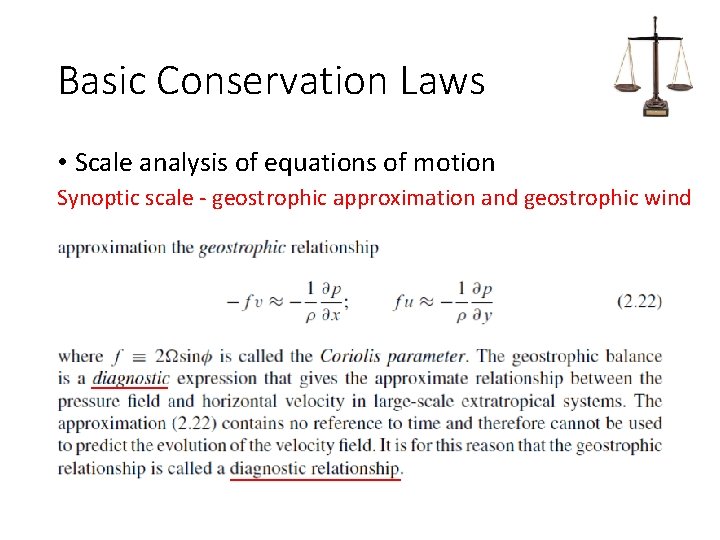
Basic Conservation Laws • Scale analysis of equations of motion Synoptic scale - geostrophic approximation and geostrophic wind
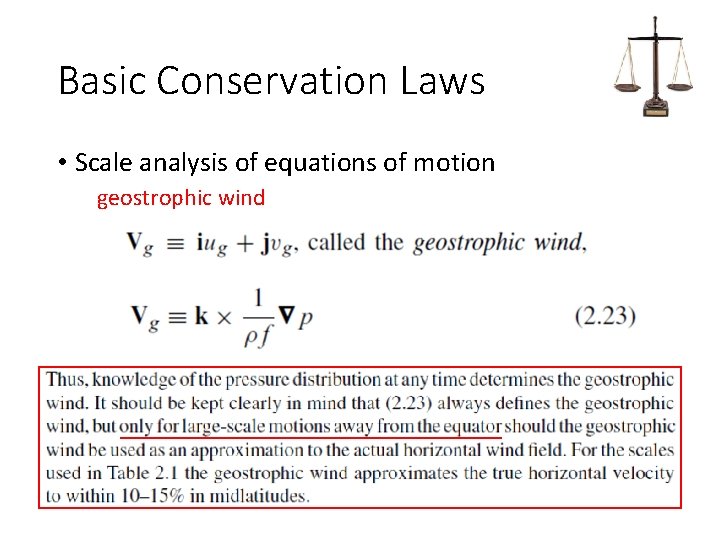
Basic Conservation Laws • Scale analysis of equations of motion geostrophic wind
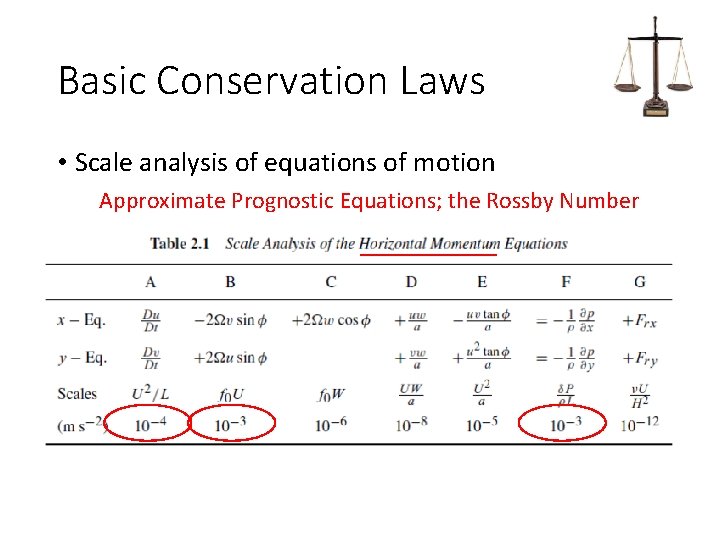
Basic Conservation Laws • Scale analysis of equations of motion Approximate Prognostic Equations; the Rossby Number
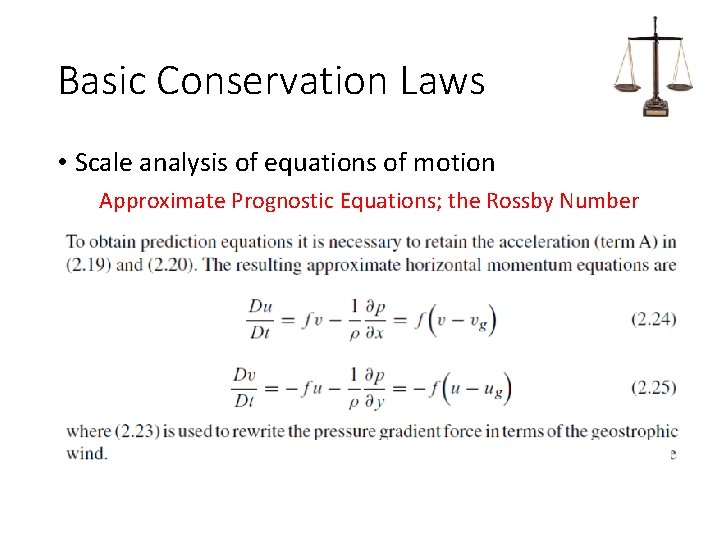
Basic Conservation Laws • Scale analysis of equations of motion Approximate Prognostic Equations; the Rossby Number
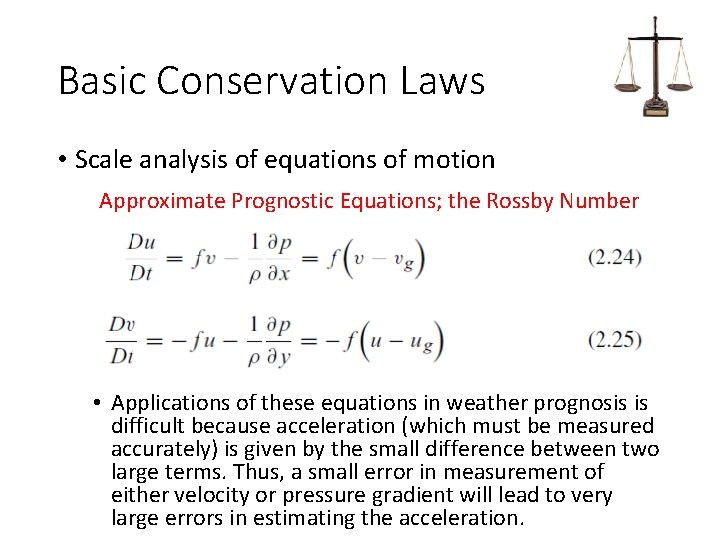
Basic Conservation Laws • Scale analysis of equations of motion Approximate Prognostic Equations; the Rossby Number • Applications of these equations in weather prognosis is difficult because acceleration (which must be measured accurately) is given by the small difference between two large terms. Thus, a small error in measurement of either velocity or pressure gradient will lead to very large errors in estimating the acceleration.
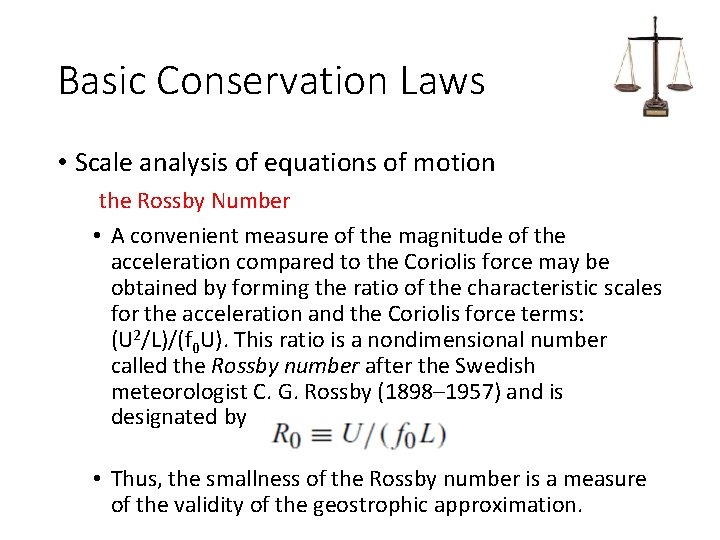
Basic Conservation Laws • Scale analysis of equations of motion the Rossby Number • A convenient measure of the magnitude of the acceleration compared to the Coriolis force may be obtained by forming the ratio of the characteristic scales for the acceleration and the Coriolis force terms: (U 2/L)/(f 0 U). This ratio is a nondimensional number called the Rossby number after the Swedish meteorologist C. G. Rossby (1898– 1957) and is designated by • Thus, the smallness of the Rossby number is a measure of the validity of the geostrophic approximation.
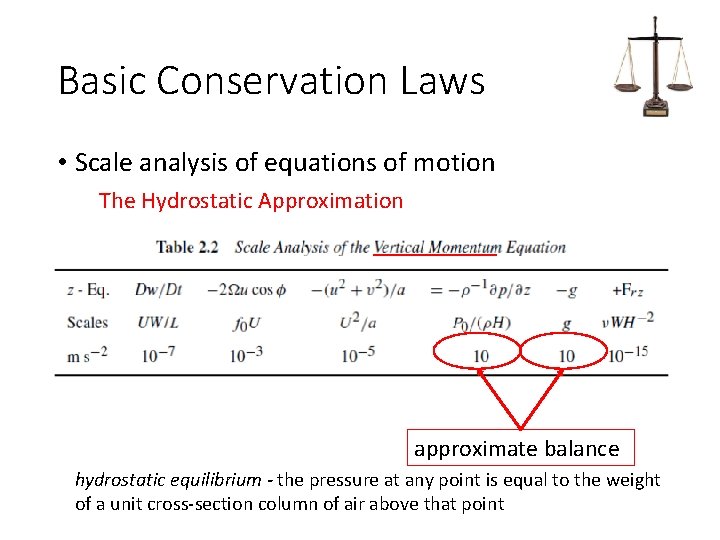
Basic Conservation Laws • Scale analysis of equations of motion The Hydrostatic Approximation approximate balance hydrostatic equilibrium - the pressure at any point is equal to the weight of a unit cross-section column of air above that point
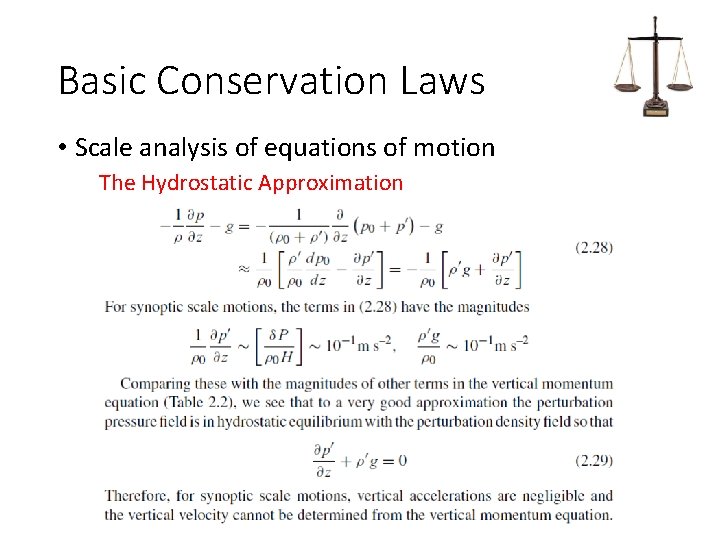
Basic Conservation Laws • Scale analysis of equations of motion The Hydrostatic Approximation
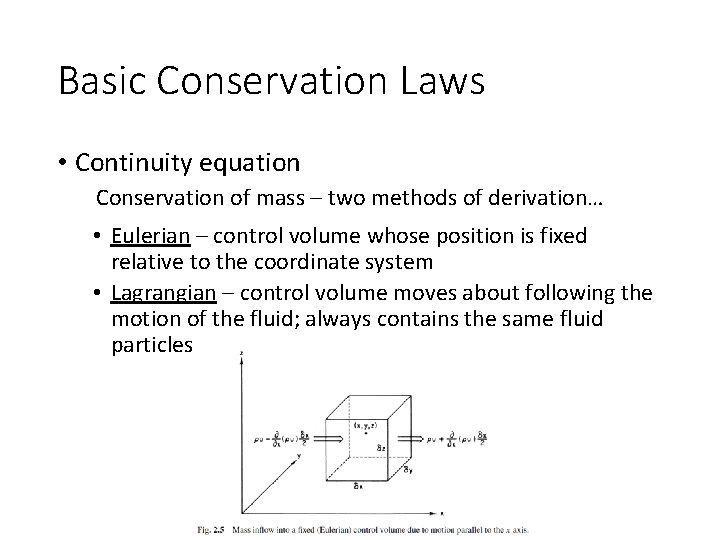
Basic Conservation Laws • Continuity equation Conservation of mass – two methods of derivation… • Eulerian – control volume whose position is fixed relative to the coordinate system • Lagrangian – control volume moves about following the motion of the fluid; always contains the same fluid particles
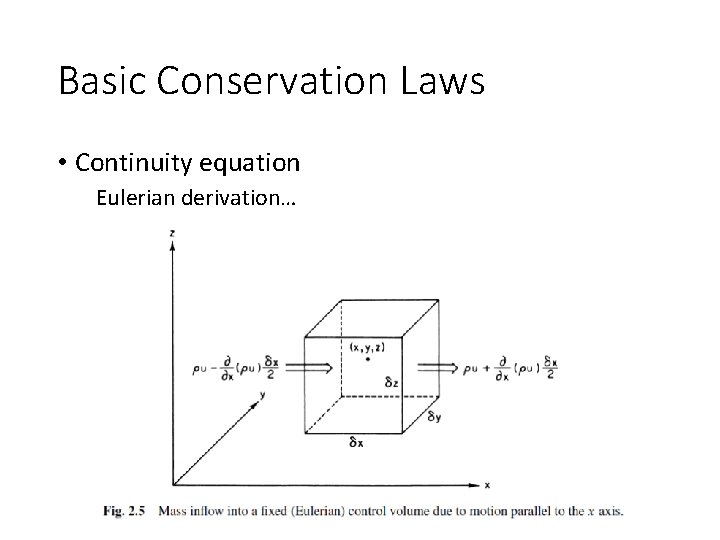
Basic Conservation Laws • Continuity equation Eulerian derivation…
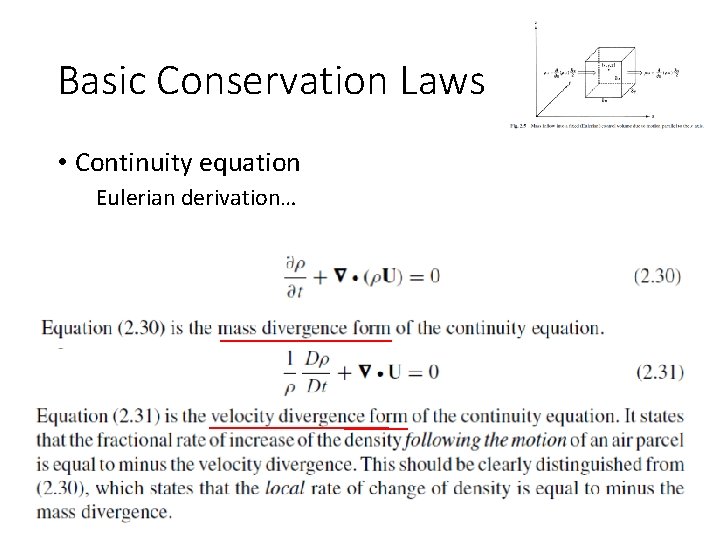
Basic Conservation Laws • Continuity equation Eulerian derivation…
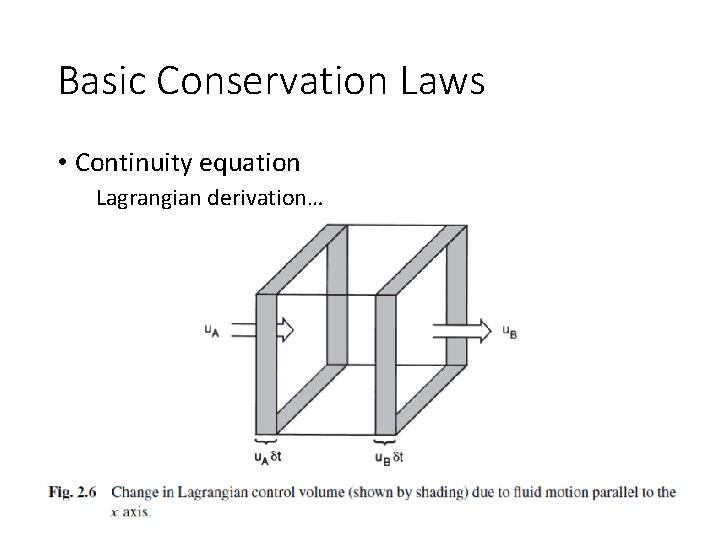
Basic Conservation Laws • Continuity equation Lagrangian derivation…
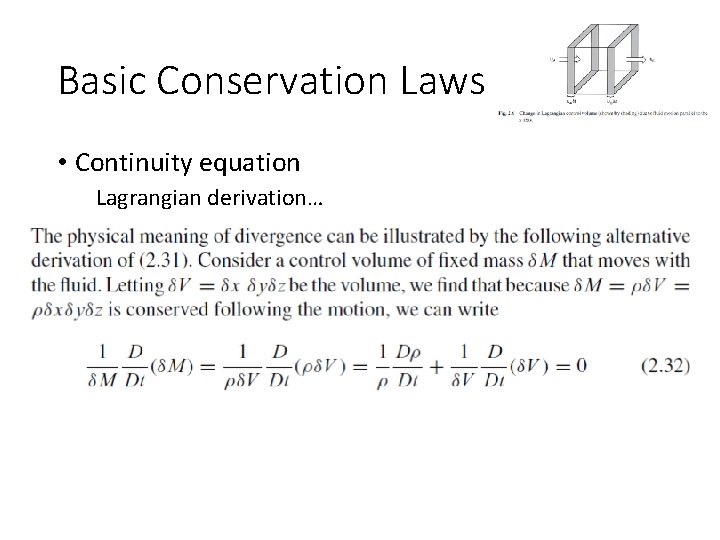
Basic Conservation Laws • Continuity equation Lagrangian derivation…
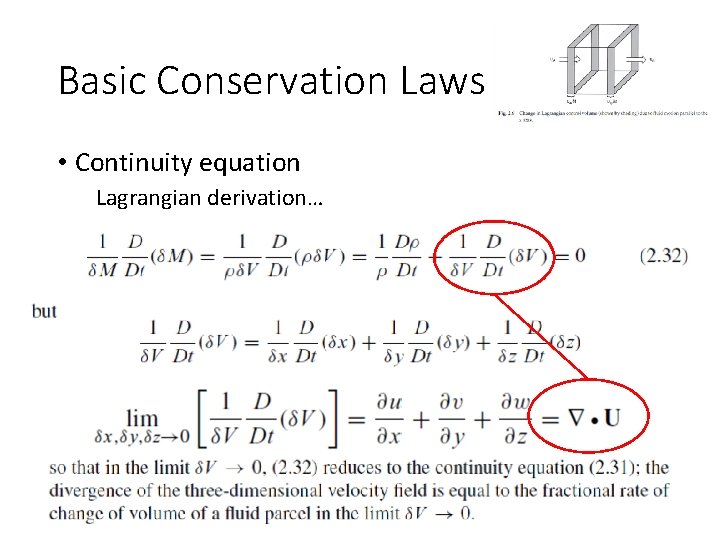
Basic Conservation Laws • Continuity equation Lagrangian derivation…
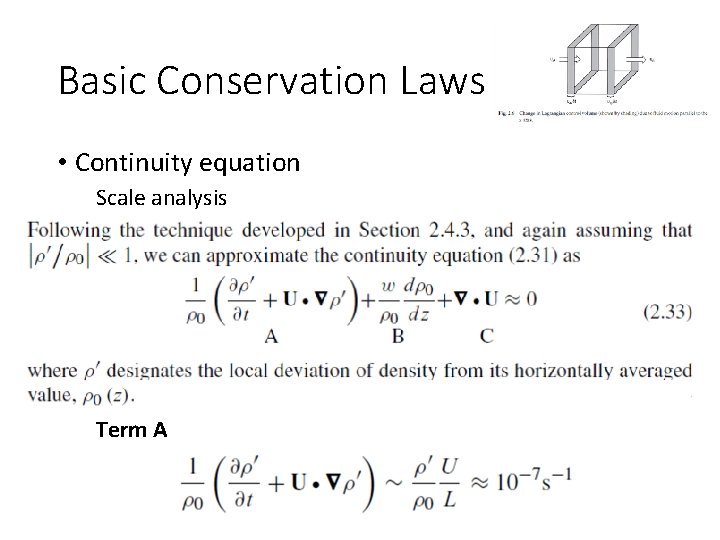
Basic Conservation Laws • Continuity equation Scale analysis Term A
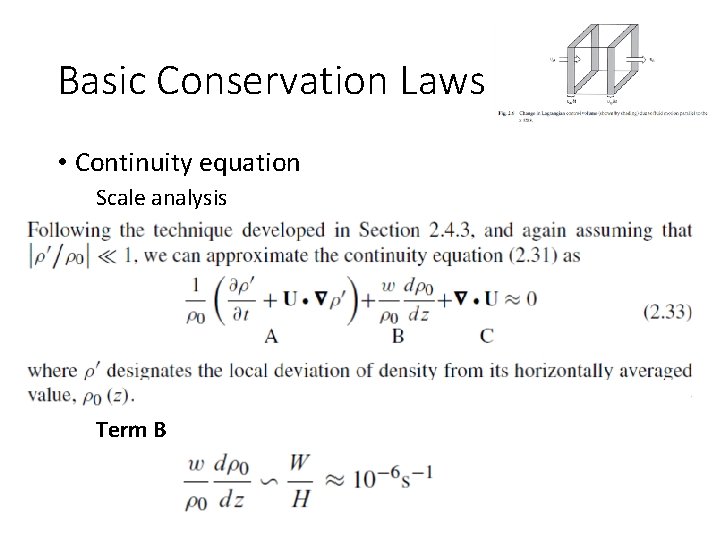
Basic Conservation Laws • Continuity equation Scale analysis Term B
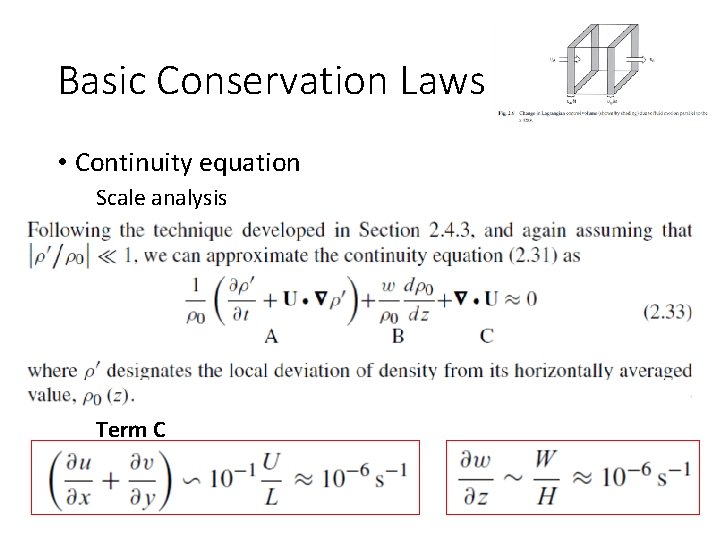
Basic Conservation Laws • Continuity equation Scale analysis Term C
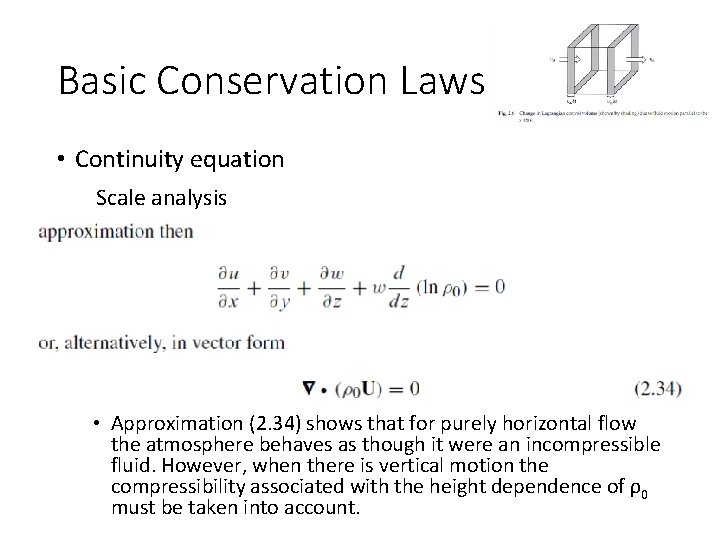
Basic Conservation Laws • Continuity equation Scale analysis • Approximation (2. 34) shows that for purely horizontal flow the atmosphere behaves as though it were an incompressible fluid. However, when there is vertical motion the compressibility associated with the height dependence of ρ0 must be taken into account.
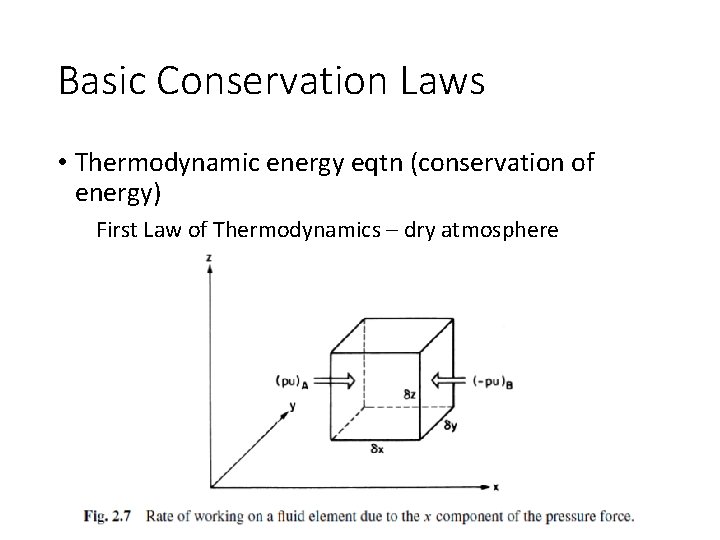
Basic Conservation Laws • Thermodynamic energy eqtn (conservation of energy) First Law of Thermodynamics – dry atmosphere
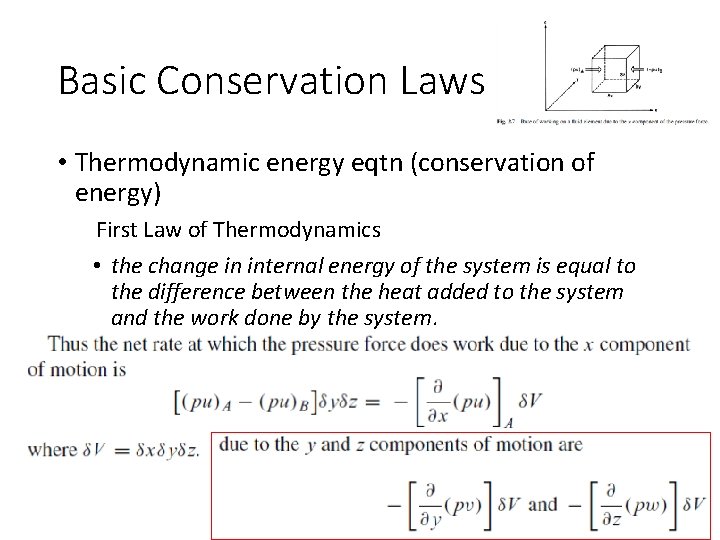
Basic Conservation Laws • Thermodynamic energy eqtn (conservation of energy) First Law of Thermodynamics • the change in internal energy of the system is equal to the difference between the heat added to the system and the work done by the system.
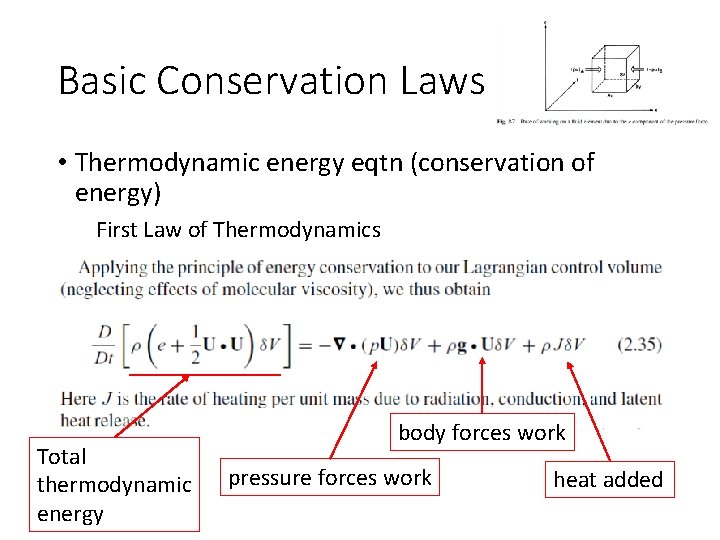
Basic Conservation Laws • Thermodynamic energy eqtn (conservation of energy) First Law of Thermodynamics Total thermodynamic energy body forces work pressure forces work heat added
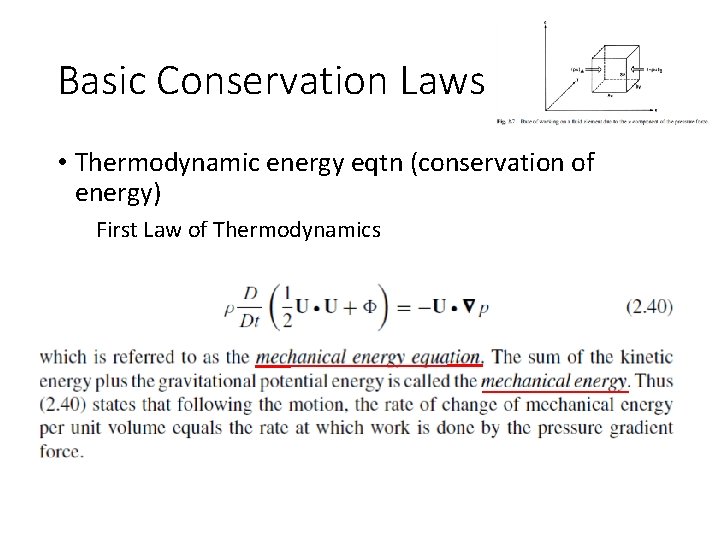
Basic Conservation Laws • Thermodynamic energy eqtn (conservation of energy) First Law of Thermodynamics
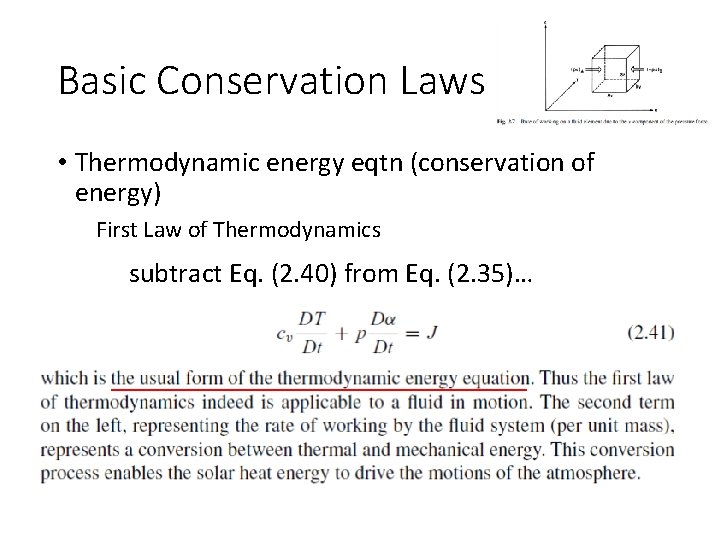
Basic Conservation Laws • Thermodynamic energy eqtn (conservation of energy) First Law of Thermodynamics subtract Eq. (2. 40) from Eq. (2. 35)…
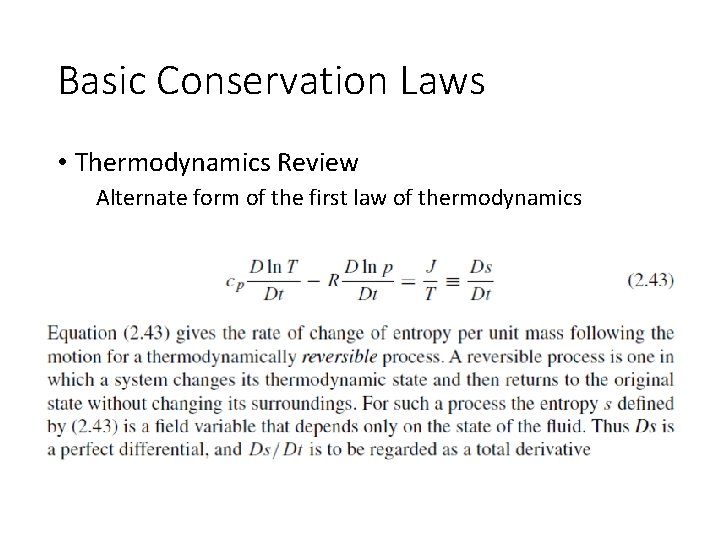
Basic Conservation Laws • Thermodynamics Review Alternate form of the first law of thermodynamics
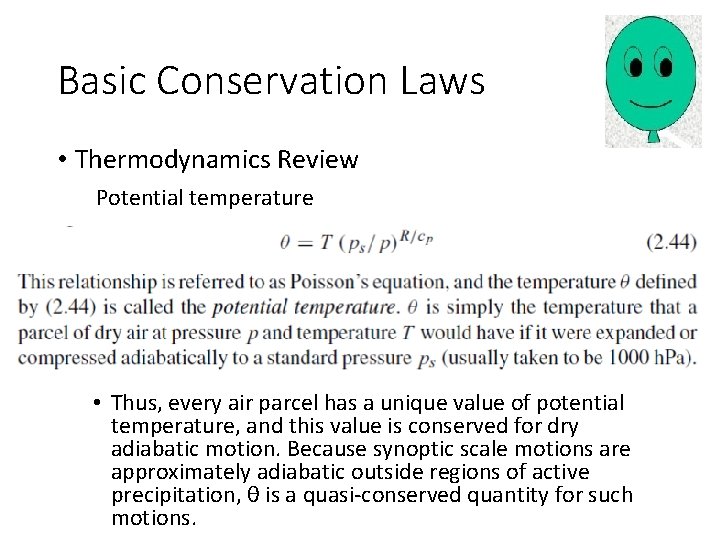
Basic Conservation Laws • Thermodynamics Review Potential temperature • Thus, every air parcel has a unique value of potential temperature, and this value is conserved for dry adiabatic motion. Because synoptic scale motions are approximately adiabatic outside regions of active precipitation, θ is a quasi-conserved quantity for such motions.
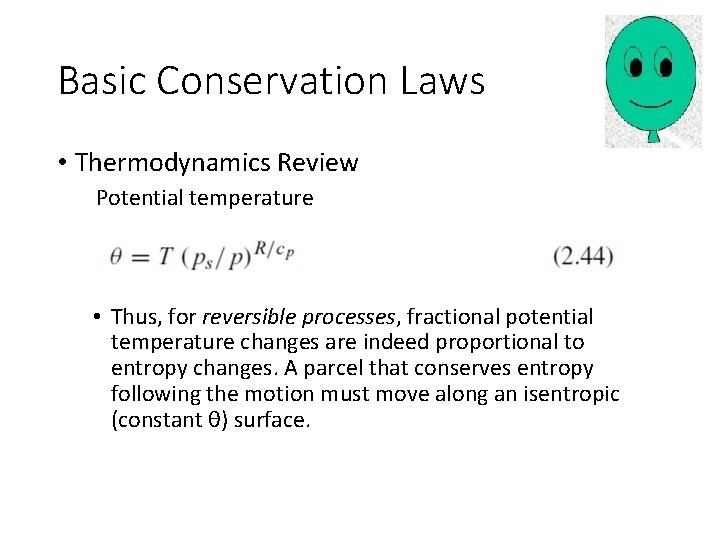
Basic Conservation Laws • Thermodynamics Review Potential temperature • Thus, for reversible processes, fractional potential temperature changes are indeed proportional to entropy changes. A parcel that conserves entropy following the motion must move along an isentropic (constant θ) surface.
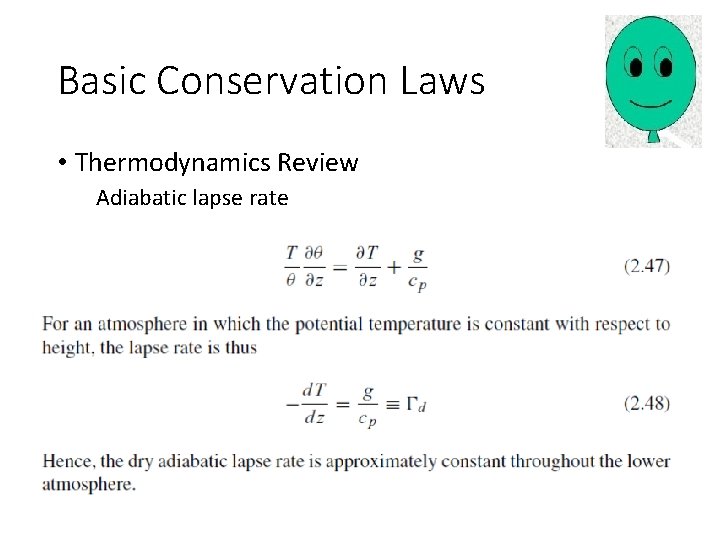
Basic Conservation Laws • Thermodynamics Review Adiabatic lapse rate
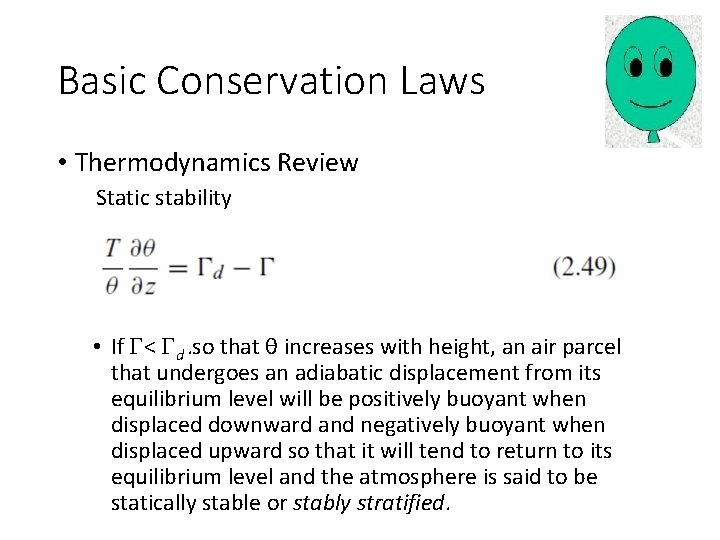
Basic Conservation Laws • Thermodynamics Review Static stability • If < d so that θ increases with height, an air parcel that undergoes an adiabatic displacement from its equilibrium level will be positively buoyant when displaced downward and negatively buoyant when displaced upward so that it will tend to return to its equilibrium level and the atmosphere is said to be statically stable or stably stratified. d
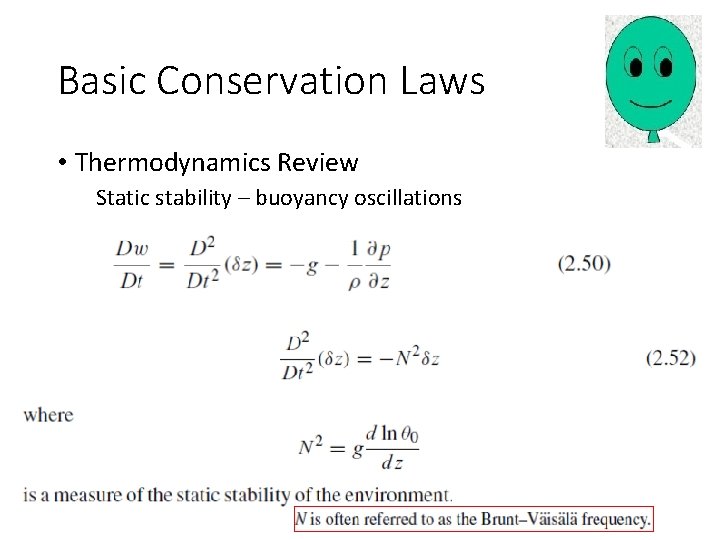
Basic Conservation Laws • Thermodynamics Review Static stability – buoyancy oscillations
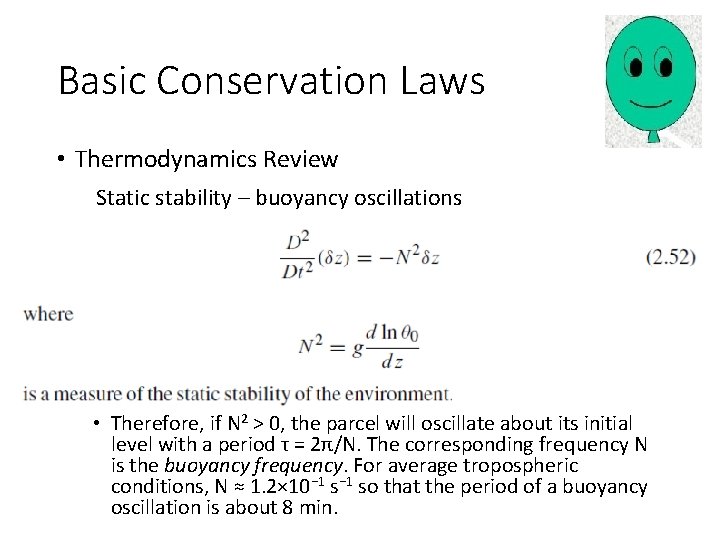
Basic Conservation Laws • Thermodynamics Review Static stability – buoyancy oscillations • Therefore, if N 2 > 0, the parcel will oscillate about its initial level with a period τ = 2π/N. The corresponding frequency N is the buoyancy frequency. For average tropospheric conditions, N ≈ 1. 2× 10− 1 so that the period of a buoyancy oscillation is about 8 min.
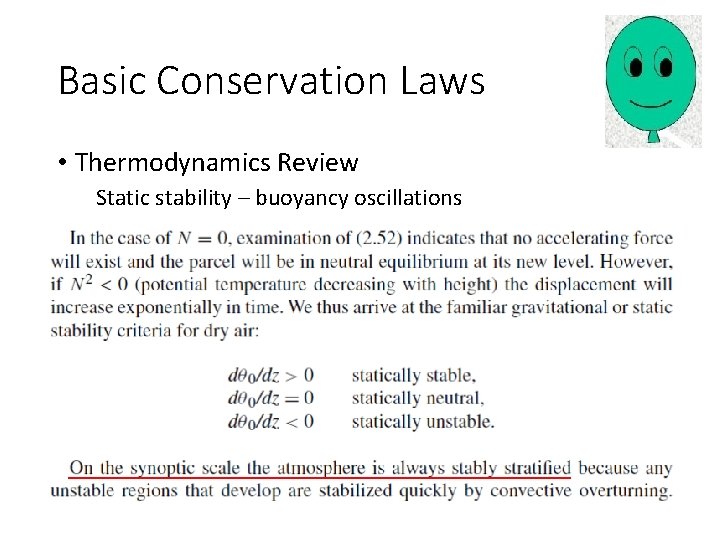
Basic Conservation Laws • Thermodynamics Review Static stability – buoyancy oscillations
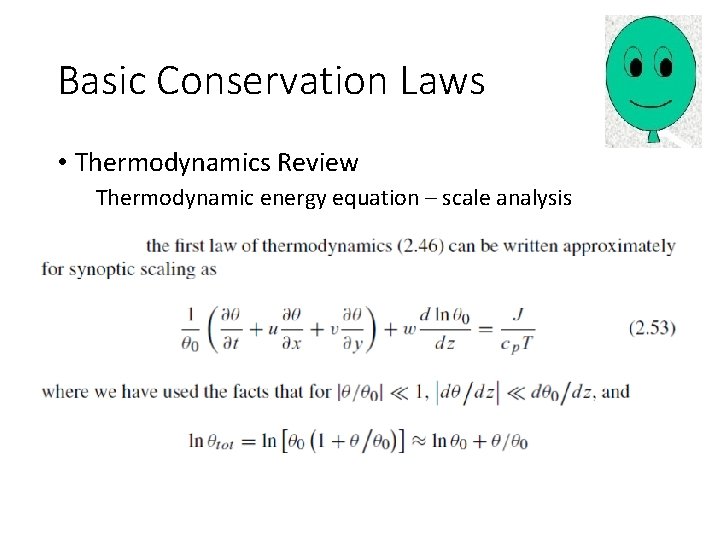
Basic Conservation Laws • Thermodynamics Review Thermodynamic energy equation – scale analysis
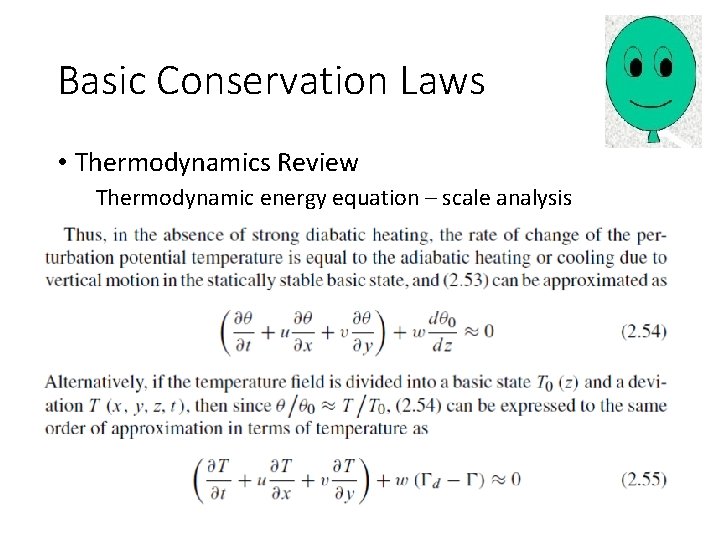
Basic Conservation Laws • Thermodynamics Review Thermodynamic energy equation – scale analysis
- Slides: 68