
Basic Concepts of Strategic Management Chapter 1 Learning
Basic Concepts of Strategic Management Chapter 1
Learning Objectives ªUnderstand the benefits of strategic management ªExplain how globalization and environmental sustainability influence strategic management ªUnderstand the basic model of strategic management and its components Copyright © 2015 Pearson Education, Inc. 1 -2
Learning Objectives ªIdentify some common triggering events that act as stimuli for strategic change ªUnderstand strategic decision-making modes ªUse the strategic audit as a method of analyzing corporate functions and activities Copyright © 2015 Pearson Education, Inc. 1 -3
The Study of Strategic Management ªStrategic Management 9 a set of managerial decisions and actions that determines the long-run performance of a corporation Copyright © 2015 Pearson Education, Inc. 1 -4
The Study of Strategic Management includes: ªInternal and external environment scanning ªStrategy formulation ªStrategy implementation ªEvaluation and control Copyright © 2015 Pearson Education, Inc. 1 -5
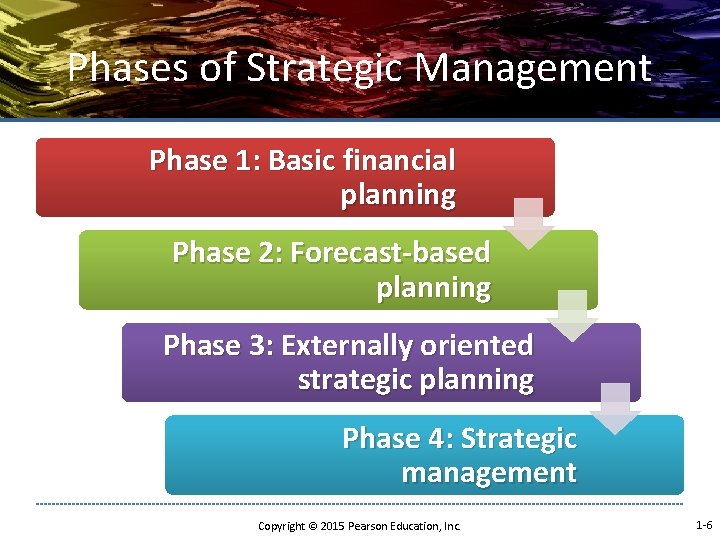
Phases of Strategic Management Phase 1: Basic financial planning Phase 2: Forecast-based planning Phase 3: Externally oriented strategic planning Phase 4: Strategic management Copyright © 2015 Pearson Education, Inc. 1 -6
Benefits of Strategic Management ª The attainment of an appropriate match, or “fit, ” between an organization’s environment and its strategy, structure and processes has positive effects on the organization’s performance. ª Strategic planning becomes increasingly important as the environment becomes more unstable. Copyright © 2015 Pearson Education, Inc. 1 -7
Benefits of Strategic Management ªClearer sense of strategic vision for the firm ªSharper focus on what is strategically important ªImproved understanding of a rapidly changing environment Copyright © 2015 Pearson Education, Inc. 1 -8
Impact of Globalization ªGlobalization 9 the integrated internationalization of markets and corporations 9 has changed the way modern corporations do business Copyright © 2015 Pearson Education, Inc. 1 -9
Impact of Innovation ªInnovation 9 describes new products, services, methods and organizational approaches that allow the business to achieve extraordinary returns ª Innovation is the implementation of potential innovations that truly drives businesses to be remarkable. Copyright © 2015 Pearson Education, Inc. 1 -10
Impact of Sustainability ªSustainability 9 refers to the use of business practices to manage the triple bottom line Copyright © 2015 Pearson Education, Inc. 1 -11
Impact of Sustainability The triple bottom line involves: 1. the management of traditional profit/loss; 2. the management of the company’s social responsibility; and 3. the management of its environmental responsibility. Copyright © 2015 Pearson Education, Inc. 1 -12
Theories of Organizational Adaptation ª Population ecology 9 once an organization is successfully established in a particular environmental niche, it is unable to adapt to changing conditions ª Institution theory 9 organizations can and do adapt to changing conditions by imitating other successful organizations Copyright © 2015 Pearson Education, Inc. 1 -13
Theories of Organizational Adaptation ªStrategic choice perspective 9 not only do organizations adapt to a changing environment, but they also have the opportunity and power to reshape their environment Copyright © 2015 Pearson Education, Inc. 1 -14
Theories of Organizational Adaptation ªOrganizational learning theory 9 an organization adjusts defensively to a changing environment and uses knowledge offensively to improve the fit between itself and its environment Copyright © 2015 Pearson Education, Inc. 1 -15
Creating a Learning Organization ªStrategic flexibility 9 the ability to shift from one dominant strategy to another and requires: • Long-term commitment to the development and nurturing of critical resources • Learning organization Copyright © 2015 Pearson Education, Inc. 1 -16
Creating a Learning Organization ªLearning organization 9 an organization skilled at creating, acquiring and transferring knowledge and at modifying its behavior to reflect new knowledge and insights ª Organizational learning is a critical component of competitiveness in a dynamic environment. Copyright © 2015 Pearson Education, Inc. 1 -17
Creating a Learning Organization Learning organizations are skilled at four main activities: ª Solving problems systematically ª Experimenting with new approaches ª Learning from their own experiences and past history as well as from the experiences of others ª Transferring knowledge quickly and efficiently throughout the organization Copyright © 2015 Pearson Education, Inc. 1 -18
Basic Model of Strategic Management Strategic management consists of four basic elements: ªEnvironmental scanning ªStrategy formulation ªStrategy implementation ªEvaluation and control Copyright © 2015 Pearson Education, Inc. 1 -19
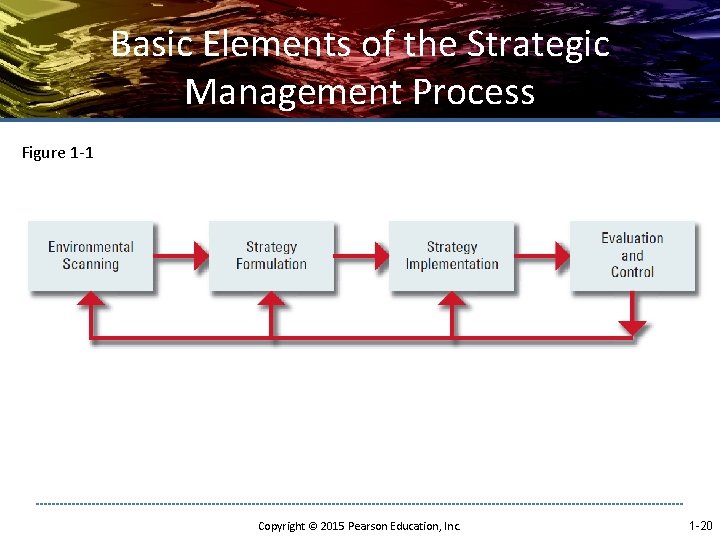
Basic Elements of the Strategic Management Process Figure 1 -1 Copyright © 2015 Pearson Education, Inc. 1 -20
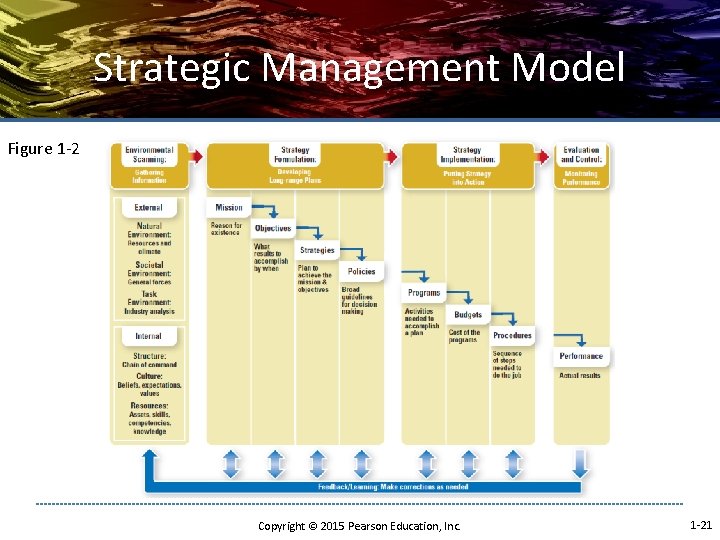
Strategic Management Model Figure 1 -2 Copyright © 2015 Pearson Education, Inc. 1 -21
Basic Model of Strategic Management ªEnvironmental scanning 9 the monitoring, evaluating and disseminating of information from the external and internal environments to key people within the organization 9 SWOT analysis Copyright © 2015 Pearson Education, Inc. 1 -22

Environmental Variables Figure 1 -3 Copyright © 2015 Pearson Education, Inc. 1 -23
Basic Model of Strategic Management ªStrategy formulation 9 process of investigation, analysis and decision making that provides the company with the criteria for attaining a competitive advantage 9 includes defining the competitive advantages of the business (Strategy), crafting the corporate mission, specifying achievable objectives and setting policy guidelines. Copyright © 2015 Pearson Education, Inc. 1 -24
Basic Model of Strategic Management ªMission 9 the purpose or reason for the organization’s existence ªVision 9 describes what the organization would like to become ªObjectives 9 the end results of planned activity Copyright © 2015 Pearson Education, Inc. 1 -25
Basic Model of Strategic Management ªStrategy 9 forms a comprehensive master approach that states how the corporation will achieve its mission and objectives 9 maximizes competitive advantage and minimizes competitive disadvantage 9 corporate, business, functional Copyright © 2015 Pearson Education, Inc. 1 -26
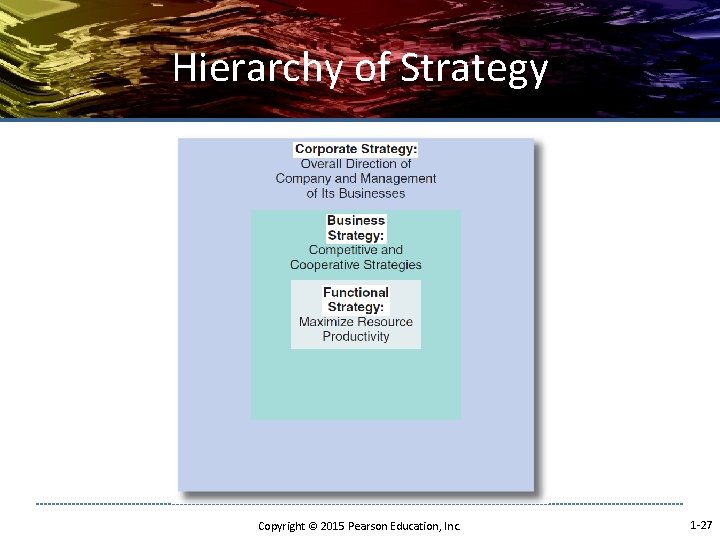
Hierarchy of Strategy Copyright © 2015 Pearson Education, Inc. 1 -27

Basic Model of Strategic Management ªPolicy 9 a broad guideline for decision making that links the formulation of a strategy with its implementation Copyright © 2015 Pearson Education, Inc. 1 -28
Basic Model of Strategic Management ªStrategy implementation 9 a process by which strategies and policies are put into action through the development of programs, budgets and procedures Copyright © 2015 Pearson Education, Inc. 1 -29
Basic Model of Strategic Management ªEvaluation and control 9 a process in which corporate activities and performance results are monitored so that actual performance can be compared with desired performance Copyright © 2015 Pearson Education, Inc. 1 -30
Basic Model of Strategic Management ªPerformance 9 the end result of organizational activities 9 includes the actual outcomes of the strategic management process ªFeedback/Learning process 9 revise or correct decisions based on performance Copyright © 2015 Pearson Education, Inc. 1 -31
Initiation of Strategy: Triggering Events ªTriggering event 9 something that acts as a stimulus for a change in strategy and can include: • New CEO • External intervention • Threat of change of ownership • Performance gap • Strategic inflection point Copyright © 2015 Pearson Education, Inc. 1 -32
Strategic Decision Making ªStrategic decisions 9 deal with the long-term future of an entire organization and have three characteristics: • Rare • Consequential • Directive Copyright © 2015 Pearson Education, Inc. 1 -33
Three Characteristics of Strategic Decisions ª Rare 9 Strategic decisions are unusual and typically have no precedent to follow. ª Consequential 9 Strategic decisions commit substantial resources and demand a great deal of commitment from people at all levels. ª Directive 9 Strategic decisions set precedents for lesser decisions and future actions throughout an organization Copyright © 2015 Pearson Education, Inc. 1 -34
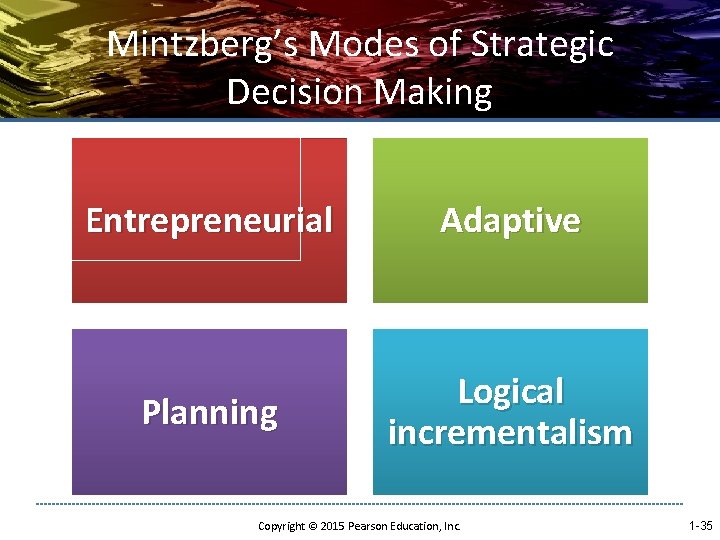
Mintzberg’s Modes of Strategic Decision Making Entrepreneurial Adaptive Planning Logical incrementalism Copyright © 2015 Pearson Education, Inc. 1 -35
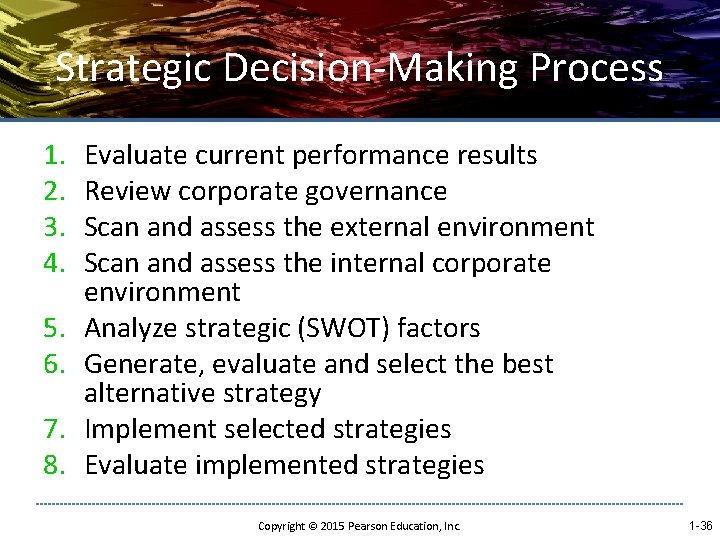
Strategic Decision-Making Process 1. 2. 3. 4. 5. 6. 7. 8. Evaluate current performance results Review corporate governance Scan and assess the external environment Scan and assess the internal corporate environment Analyze strategic (SWOT) factors Generate, evaluate and select the best alternative strategy Implement selected strategies Evaluate implemented strategies Copyright © 2015 Pearson Education, Inc. 1 -36

Strategic Decision-Making Process Figure 1 -5 Copyright © 2015 Pearson Education, Inc. 1 -37
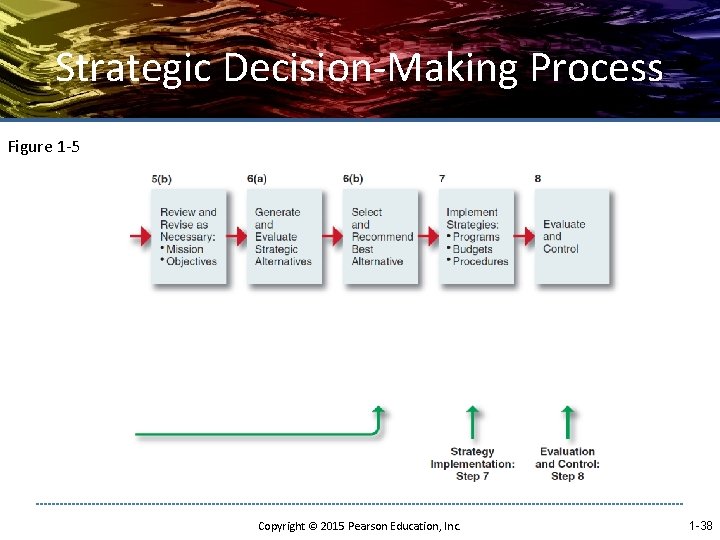
Strategic Decision-Making Process Figure 1 -5 Copyright © 2015 Pearson Education, Inc. 1 -38
The Strategic Audit: Aid to Strategic Decision Making ªStrategic audit 9 provides a checklist of questions, by area or issue, that enables a systematic analysis to be made of various corporate functions and activities Copyright © 2015 Pearson Education, Inc. 1 -39
Copyright © 2015 Pearson Education, Inc. 1 -40
- Slides: 40