
Basic concepts of research proposal and Steps of

Basic concepts of research proposal and Steps of research proposal development 1
Understand what you do? • • • You see patients You make assessment You perform follow-up procedures You read medical journals to stay current You observe anecdotal evidence 2
You are already writing but you do not realize it. • • • Write up histories Admitting notes Progress notes Discharge notes Referring letters 3
How to translate your written notes into a paper. • Write an introduction – This section is like a mini literature review. – Written in present tense • Write a method section – This section deals with how you will collect data or information. – Written in future tense 4
How to translate your written notes into a paper. • Write a results section. – This section deals with how you will analyze your result – Written in future tense. • Write a discussion section – This section tells you why think your research is important. – This section is written in present tense. 5
What is a research proposal? • A document with two major objectives: – To analyze and synthesize the existing research about particular topic. – Describe the researcher’s idea for a new study. • An art which the researcher wants to sell in the market. – Buyer needs to take it from the gallery. – Suits to buyer’s pocket. 6
Be prepared for • To make mistakes and to learn. • To write and rewrite many times. • To spend many hours looking for information. • To have your writing criticized. • To feel confuse and hopeless some times. 7
When should the research proposal be written? • Preparation with the flying mind question “Why”? • In the first few months of first year. • A substantial amount of work has to be done before a proposal can be written • Some departments assume that a research proposal will be written in first six months. • Seek advice on your draft from supervisors and peers. 8
Before start writing ……. . • • • Do I have the clear research question? Have I read broadly and deeply in that area? Have I discussed the topic with peers? Have I enough time and fund to start? Do I feel support from faculty and friends? 9
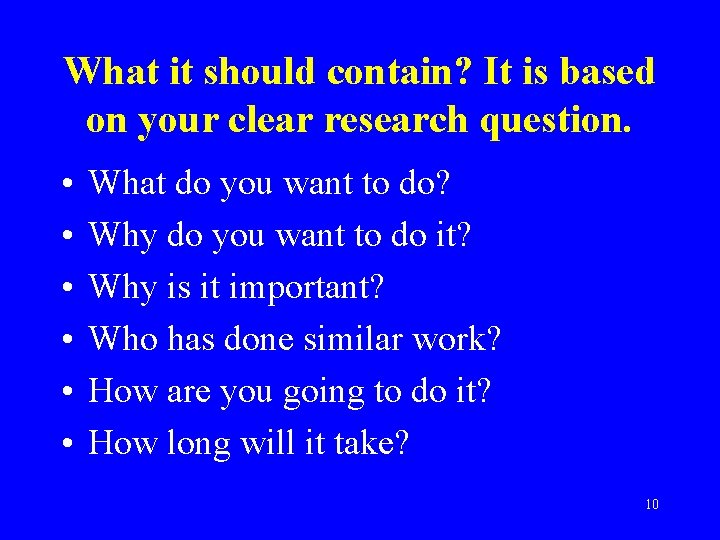
What it should contain? It is based on your clear research question. • • • What do you want to do? Why do you want to do it? Why is it important? Who has done similar work? How are you going to do it? How long will it take? 10
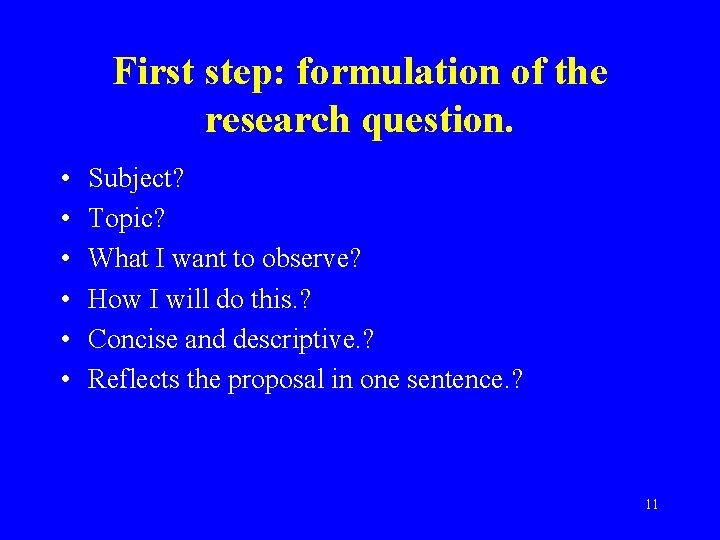
First step: formulation of the research question. • • • Subject? Topic? What I want to observe? How I will do this. ? Concise and descriptive. ? Reflects the proposal in one sentence. ? 11
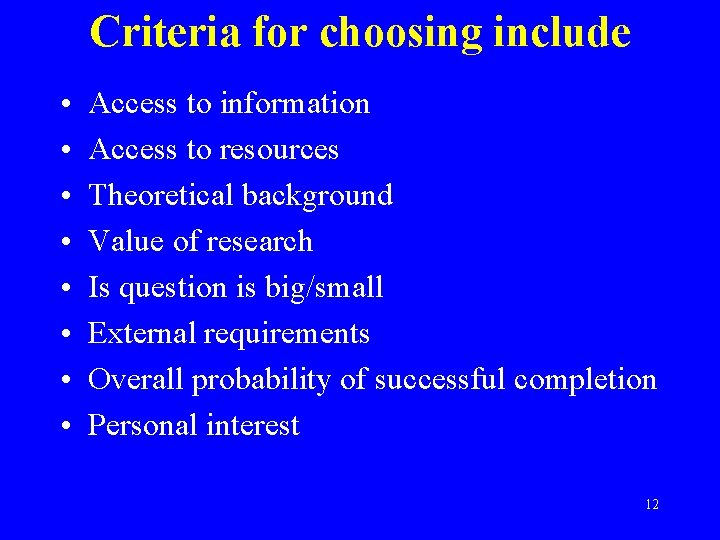
Criteria for choosing include • • Access to information Access to resources Theoretical background Value of research Is question is big/small External requirements Overall probability of successful completion Personal interest 12
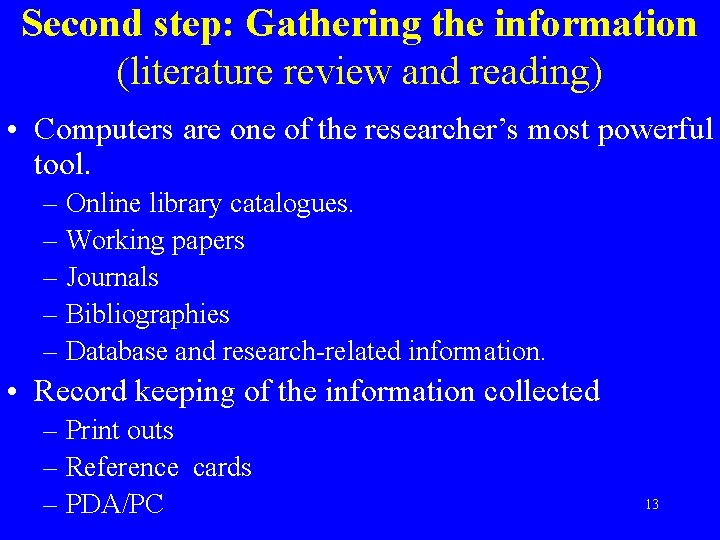
Second step: Gathering the information (literature review and reading) • Computers are one of the researcher’s most powerful tool. – Online library catalogues. – Working papers – Journals – Bibliographies – Database and research-related information. • Record keeping of the information collected – Print outs – Reference cards – PDA/PC 13

Third step: Methodology • • • Sampling techniques Inclusion and exclusion criteria Measurement instruments Data collection procedures Data analysis process – Do contact statistician. 14
What does the methodology section do? • Shows the reader how it is being set for looking answers to the research question. • It should reflect the capability of research worker to complete the research work. • The proposed methods must be appropriate to the type of research work. 15
Fourth step: Time line • Important planning tool. • Helps to establish the competency • Be realistic: compare with the existing workload; duties Fifth step: Writing the Proposal 16
Important information for writing • • Always structure your work in advance. Know that you want to say before writing. Every sentence must contain one idea only. Each sentence must follow logically from the before: chain of ideas. Write in a way that is easy to read. Use simple language. Check spelling and grammar. Do not cut and paste from articles. 17

Why research ? • Why is the development of research within universities a must ? • To maintain the quality of teaching programs. • Provide the basis for undergraduate and graduate thesis research projects. • Universities should be more than degree delivering institutions. • Universities should be the basket for new knowledge and developments. 18
Why a research proposal ? • Convince others the project you have designed is important, worth the effort. • Convince others that you have the ability to carry out the research design and report the findings. • Generate funds to sustain the research units operation. 19
Getting started • Know your subject. The reviewers will look for an up-to-date knowledge of the research area. • Know your funder. Be aware of the priorities and interests of the funder you approach, and know that funders are unlikely to support the same idea twice. 20
Getting started • Consult colleagues. Don’t be afraid to discuss your proposal with colleagues, or even with the grants officer at the funding body. Early discussions can ensure that your proposal is targeted appropriately. 21
What makes a good proposal ? • A well-prepared application should require minimal effort on the part of the reviewer. • Proposals must demonstrate high scientific quality. • The requested funds must be in proportion to the proposed project (cost-effectiveness). 22
Writing your proposal • Allow plenty of time to prepare your proposal. A good starting point is to write a one-page summary of the whole project. This may take a while to get right, but once completed it will serve as an invaluable tool for writing your full proposal. • Use your proposal to show the need and then fill the gap. 23
Writing your proposal • Present your proposal in terms of the aims and objectives of the funder and not just your own – make it clear how you will be helping them to fund their priorities. • Consider the questions the funder will be asking: Why fund you ? Why fund this ? Why now ? . . . and make sure that the proposal answers them! 24
Writing your proposal • Be aware that you will have limited to none opportunities to answer queries arising from a reading of your proposal. • Consult the funders website and read clearly the call for research proposals as well as the criteria against which your proposal will be judged. 25
Writing your proposal • Although it is the content that matters, good presentation is often crucial to making your proposal accessible to reviewers and keeping their interest. – Use diagrams and tables to add clarity; – Bullet points and sections can break up text; – Keep to page, word and font size restrictions; and – Activate the spell checker while writing. 26
How to structure your proposal ? • Check guidelines carefully – failing to meet the format and specifications is one of the most common reasons for applications being returned. • A common proposal structure normally consists of: title, abstract, background, aims and objectives, methodology, work program, resources, outcomes (outputs & dissemination), project management, reviewers. 27
How to structure your proposal ? • Title: This is the first impression the reader gets. The title should be short and clear, and the reviewer should be able to understand from the title the intentions of the research. A catchy title posing a question or including an apparant contradiction or acronym may be more easily remembered by a reviewer. 28
How to structure your proposal ? • Abstract: Should be a concise summary of the WHOLE project. Use the abstract to identify the need for this research, state what you intend to do, and how you intend to do it. Do not include unnecessary detail; make each phrase count. And remember it is the first impression a reviewer gets of an applicant’s worth! 29
How to structure your proposal ? • Background: This section should be used to put the work into context: what has been done before, and how will the proposed work add to it ? What is the innovative aspect in the research project ? Build your case by demonstrating your capability and familiarity in the area. 30
How to structure your proposal ? • Aims and objectives: The aims should describe what you intend to achieve by doing this piece of work. Your objectives are the small steps you need to reach in order to achieve your aim. Aims ad objectives should be realistic, consistent, and link them to methods, timetable, and outcomes. 31
How to structure your proposal ? • Methodology: Methods should be detailed and well thought through. Explain why you have chosen a particular method. Base your explanation on literature references. If your own experience of a methodology is limited, consider working with collaborators. 32
How to structure your proposal ? • Work program: Make use of a Pert chart to illustrate the building blocks – work packages – of the research project. Be detailed in the description of the content of each work package (why, objectives, method(s), duration, when are you going to carry out each WP, partners involved in the realization, sequence of WP, etc. ). 33
How to structure your proposal ? • Resources: The proposal should contain a detailed budget. The budget asked should be in proportion to the volume and complexity of the work activities. Be aware that funders vary as to what they are prepared to pay in terms of direct project costs, such as staff and equipment, and indirect costs, such as overheads. The funder might request to approve beforehand own inputs or inputs from other institutions 34 participating in the project.
How to structure your proposal ? • Outcomes, outputs (+ deliverables) and dissemination: In this section one should describe the contribution to knowledge and importance for future research, the benefits to users, and the broader relevance to beneficiaries. Highlight how results will be disseminated (publications, conferences, commercial exploitation, websites, . . ). 35
Quick Tips for writing a good proposal – Allow plenty of time; – Start by writing a summary of your proposed project; – Demonstrate an up-to-date knowledge of your field; – Present your proposal in terms of the aims and objectives of the funder; – Avoid jargon – say what you mean in clear, simple language; – Don’t be afraid to state the obvio– Anticipate questions that may arise, before they arise; – Ask a colleague to review your proposal; and – Be enthusiastic about your idea – if you don’t sound interested, why should anyone else be ? us; 36
- Slides: 36