
Basic Concepts of Quality Philosophy Chapter 1 Objectives
Basic Concepts of Quality Philosophy Chapter 1
Objectives l What is Quality? l History and Gurus l Global Competiveness l Customer Satisfaction, Retention, and Loyalty
Quality Management l Quality has been defined in a number of ways. When viewed from a consumer’s perspective, it means meeting or exceeding customer expectations. l Total quality is an approach to doing business that attempts to maximize an organization’s competitiveness through the continual improvement of the quality of its products, services, people, processes, and environments.

Quality Timeline 1904 -1915 1920 -30 1950 -80 1990’s Statistical analysis Management by quality Value chain Quality control Continuous improvement 1999 -Now Lean Quality Improvements 1800’s Standardization and Quality Control Zero Quality Control; quality trilogy; TQM fishbone diagram
A Change in thinking, culture and doing business. l Key characteristics l The rationale can be found in the need to: ¡ compete in the global marketplace. ¡ Higher Costs ¡ More Knowledgeable and demanding quality customers l Countries that are competing successfully in the global marketplace are seeing their quality of living improve. Those that cannot are seeing theirs decline.
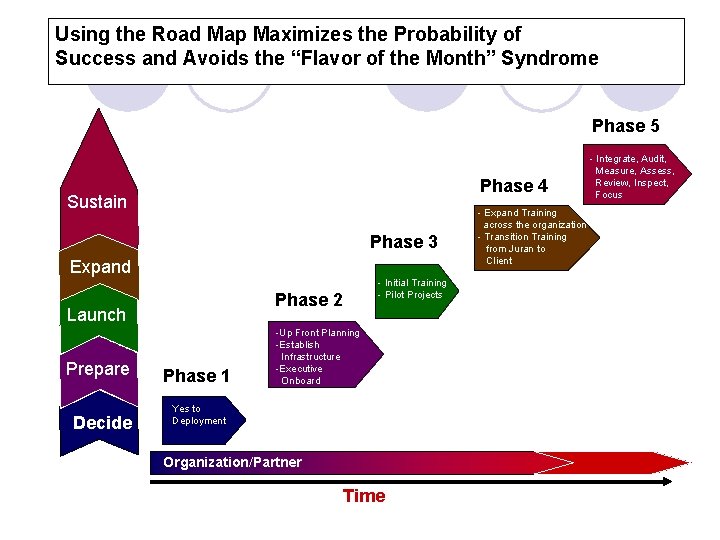
Using the Road Map Maximizes the Probability of Success and Avoids the “Flavor of the Month” Syndrome Phase 5 Phase 4 Sustain Phase 3 Expand Phase 2 Launch Prepare Decide - Initial Training - Pilot Projects Phase 1 -Up Front Planning -Establish Infrastructure -Executive Onboard Yes to Deployment Organization/Partner Time - Expand Training across the organization - Transition Training from Juran to Client - Integrate, Audit, Measure, Assess, Review, Inspect, Focus
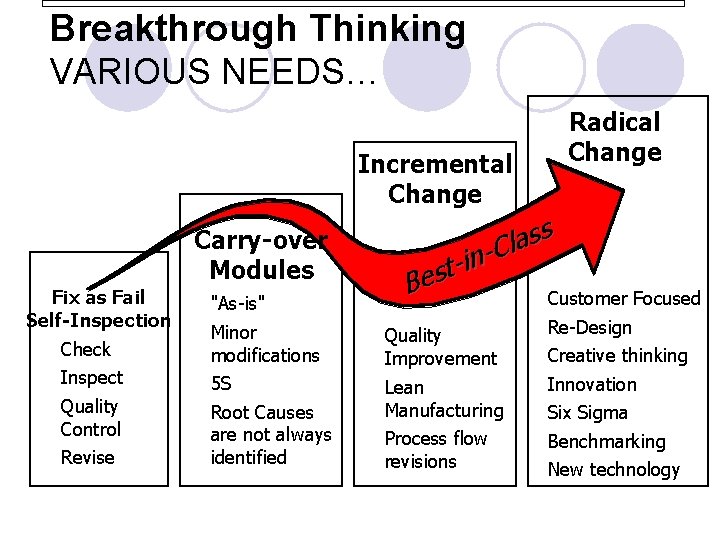
Breakthrough Thinking VARIOUS NEEDS… Radical Change Incremental Change s s a l C n i t s Be Customer Focused Carry-over Modules Fix as Fail Self-Inspection l l Check Inspect Quality Control Revise l l "As-is" Minor modifications 5 S Root Causes are not always identified l l Quality Improvement Lean Manufacturing Process flow revisions l l l Re-Design Creative thinking Innovation Six Sigma Benchmarking New technology
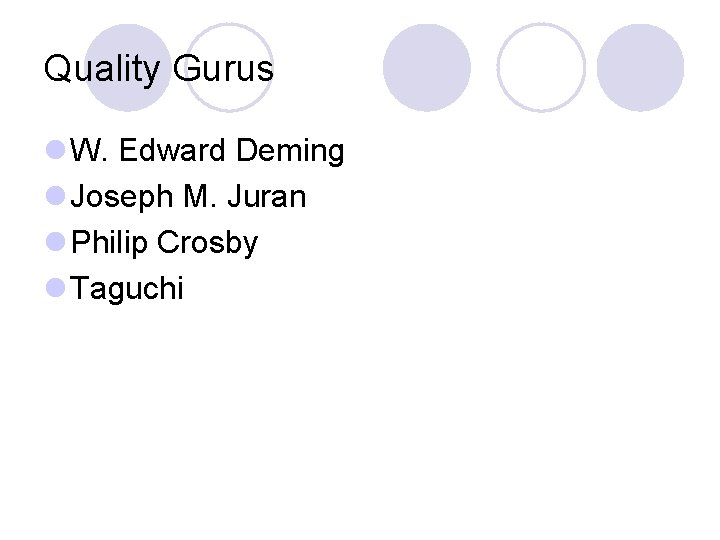
Quality Gurus l W. Edward Deming l Joseph M. Juran l Philip Crosby l Taguchi
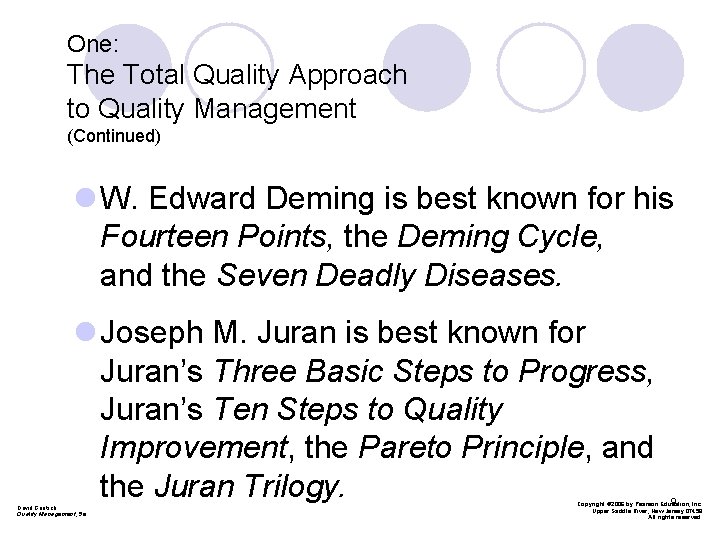
One: The Total Quality Approach to Quality Management (Continued) l W. Edward Deming is best known for his Fourteen Points, the Deming Cycle, and the Seven Deadly Diseases. l Joseph M. Juran is best known for Juran’s Three Basic Steps to Progress, Juran’s Ten Steps to Quality Improvement, the Pareto Principle, and the Juran Trilogy. David Goetsch Quality Management, 5 e 9 Copyright © 2006 by Pearson Education, Inc. Upper Saddle River, New Jersey 07458 All rights reserved.
Performance at World-class levels l competitive analysis l production and supply chain management l Customization l electronic commerce, and l compensation systems.
Customer Satisfaction, Retention, and Loyalty l Understanding Who Is a Customer ¡An external customer is the one referred to in the traditional definition. An internal customer is any employee whose work depends on that of employees l Communicating with Customers l Using Customer Feedback to Make Design Improvements David Goetsch Quality Management, 5 e 11 Copyright © 2006 by Pearson Education, Inc. Upper Saddle River, New Jersey 07458 All rights reserved.
Customer Satisfaction, Retention, and Loyalty (Continued) l Understanding Customer-Defined Quality ¡ Customer Satisfaction Process ¡ Customer-Defined Value ¡ Customer Value Analysis l Customer satisfaction is achieved by producing high-quality products that meet or exceed expectations. It must be renewed with each purchase. The key to establishing a customer focus is to put employees in touch with customers so that customer needs are known and understood. David Goetsch Quality Management, 5 e 12 Copyright © 2006 by Pearson Education, Inc. Upper Saddle River, New Jersey 07458 All rights reserved.
Customer Satisfaction, Retention, and Loyalty (Continued) l Customer Retention ¡Scholtes’ six-step strategy for identifying customer needs: speculate about results, develop an information-gathering plan, gather information, analyze the results, check the validity of conclusions, and take action. l Customer needs are not static. ¡constant contact is essential ¡this contact should be in person or by telephone. Written surveys can be used, but they will not produce the level of feedback that personal contact can generate.
Customer Satisfaction, Retention, and Loyalty (Continued) l Recognizing the Customer-Driven Organization l Value Perception and Customer Loyalty l Measurement – ¡Quality function deployment (QFD) - makes customer feedback a normal part of the product development process, thereby improving customer satisfaction. ¡Many customers who defect are satisfied. Organizations should, in addition, measure customer retention. David Goetsch Quality Management, 5 e 14 Copyright © 2006 by Pearson Education, Inc. Upper Saddle River, New Jersey 07458 All rights reserved.
Customer Satisfaction, Retention, and Loyalty (Continued) l The customer loyalty model consists of four components: 1) business performance, 2) global perceptions, 3) loyalty behaviors, and 4) financial outcomes. l Organizations should never assume a positive correlation between customer loyalty and profitability, nor should they assume that a customer who is initially profitable will always be profitable. David Goetsch Quality Management, 5 e 15 Copyright © 2006 by Pearson Education, Inc. Upper Saddle River, New Jersey 07458 All rights reserved.
Customer Satisfaction, Retention, and Loyalty (Continued) l An innovative approach to product development - turning customers into innovation partner. Customer is given a technological tool kit for designing his or her own products This approach is implemented by: § § § David Goetsch Quality Management, 5 e develop a tool kit for customers that is easy to use increase the flexibility of your own production processes carefully select the first customers to use your took kit continually improve your tool kit adapt your business practices to suit the innovation partnership approach. 16 Copyright © 2006 by Pearson Education, Inc. Upper Saddle River, New Jersey 07458 All rights reserved.
Chapter 1 ANY QUESTIONS?
- Slides: 17