
Basic Concepts of Probability Probability Experiment an action
Basic Concepts of Probability ØProbability Experiment: an action, or trial through which specific results are obtained. ØResults of a single trial is an outcome ØThe set of all possible outcomes is the sample space. ØAll probabilities should be between 0 and 1.
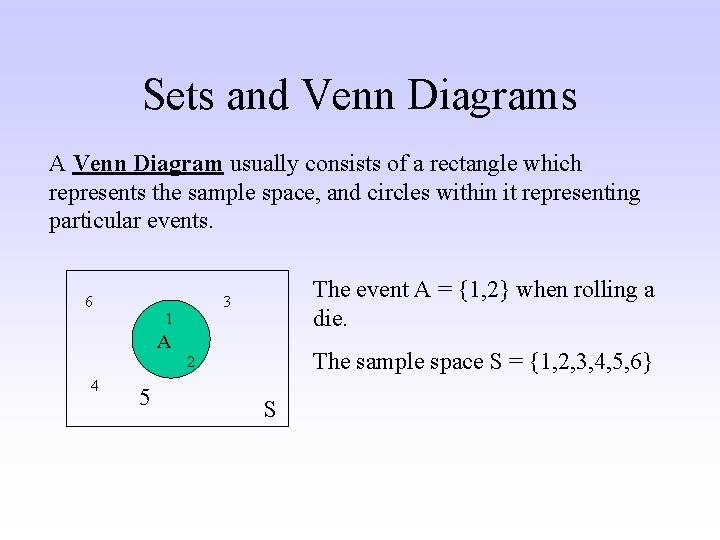
Sets and Venn Diagrams A Venn Diagram usually consists of a rectangle which represents the sample space, and circles within it representing particular events. 6 The event A = {1, 2} when rolling a die. 3 1 A The sample space S = {1, 2, 3, 4, 5, 6} 2 4 5 S

Set Notation S, the sample space is represented by a rectangle and A, an event, is represented by a circle. A S is the complement of A.

Complement of event: The set of all outcomes in samples space that are not included in event E. The complement of event E is denoted by E’ and is read as “E prime” E 5 E’ 2 6 1 3 4
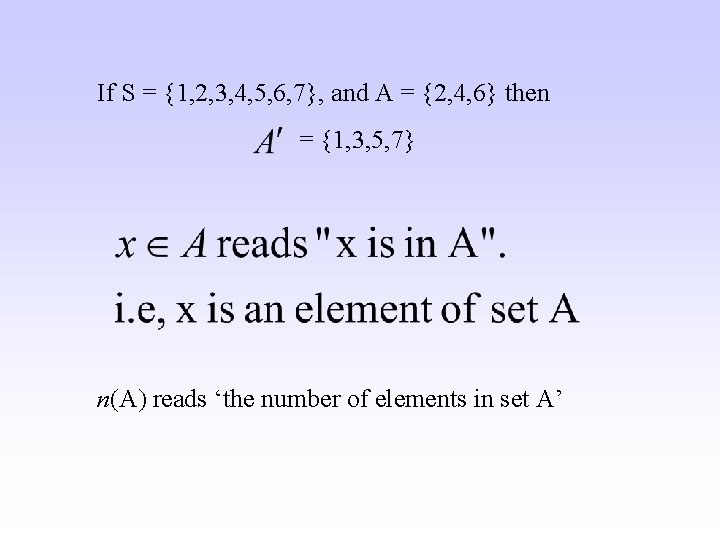
If S = {1, 2, 3, 4, 5, 6, 7}, and A = {2, 4, 6} then = {1, 3, 5, 7} n(A) reads ‘the number of elements in set A’
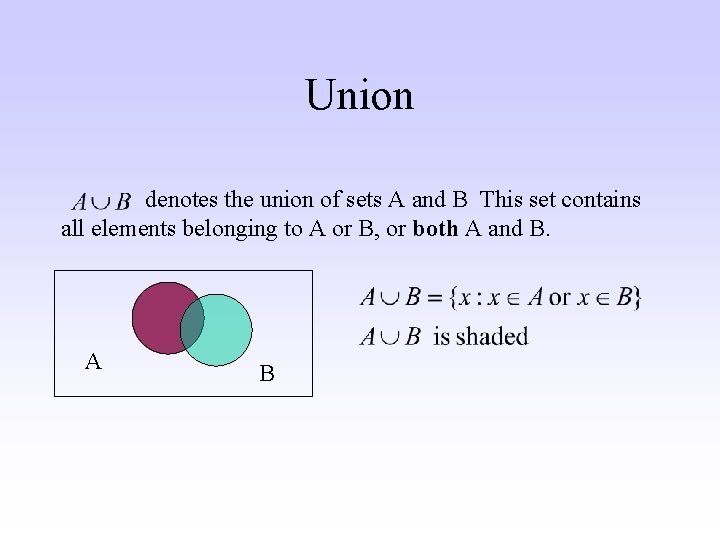
Union denotes the union of sets A and B This set contains all elements belonging to A or B, or both A and B. A B
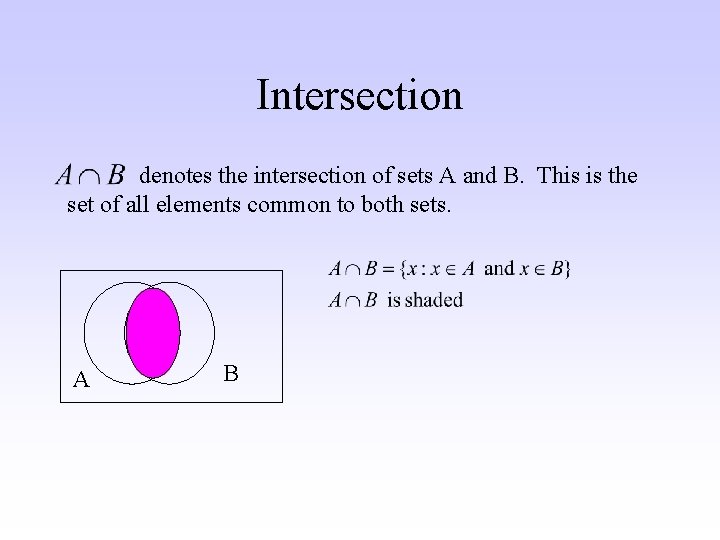
Intersection denotes the intersection of sets A and B. This is the set of all elements common to both sets. A B

Mutually Exclusive • Disjoint sets are sets which do not have elements in common These two sets are disjoint A B
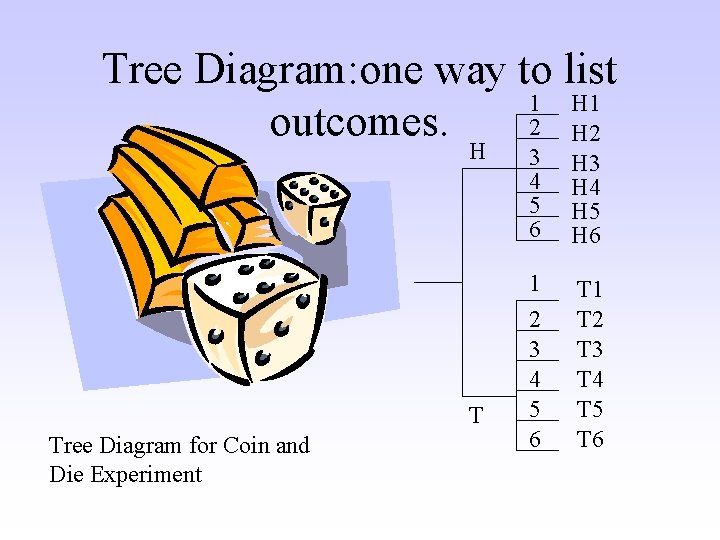
Tree Diagram: one way to list 1 H 1 2 H 2 outcomes. H T Tree Diagram for Coin and Die Experiment 3 4 5 6 H 3 H 4 H 5 H 6 1 2 3 4 5 6 T 1 T 2 T 3 T 4 T 5 T 6
Simple Events An event that consists of a single outcome • The outcome {3, 2}is different from the outcome{2, 3}for a statistician, but not for a player • The event {3, 2} is a simple event. • The event “roll a sum of 5” is not simple because it consists of the four outcomes {1, 4}, {2, 3}, {3, 2} and {4, 1}.
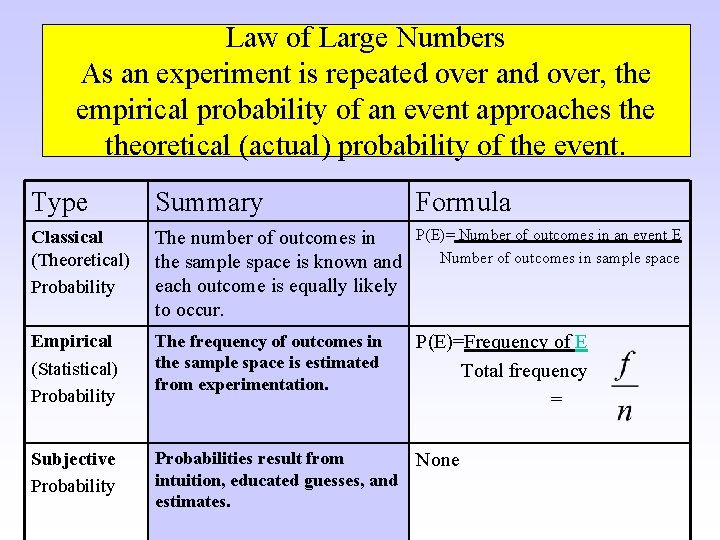
Law of Large Numbers As an experiment is repeated over and over, the empirical probability of an event approaches theoretical (actual) probability of the event. Type Summary Formula Classical (Theoretical) Probability The number of outcomes in the sample space is known and each outcome is equally likely to occur. P(E)= Number of outcomes in an event E Number of outcomes in sample space Empirical (Statistical) Probability The frequency of outcomes in the sample space is estimated from experimentation. P(E)=Frequency of E Total frequency = Subjective Probability Probabilities result from intuition, educated guesses, and estimates. None
- Slides: 11